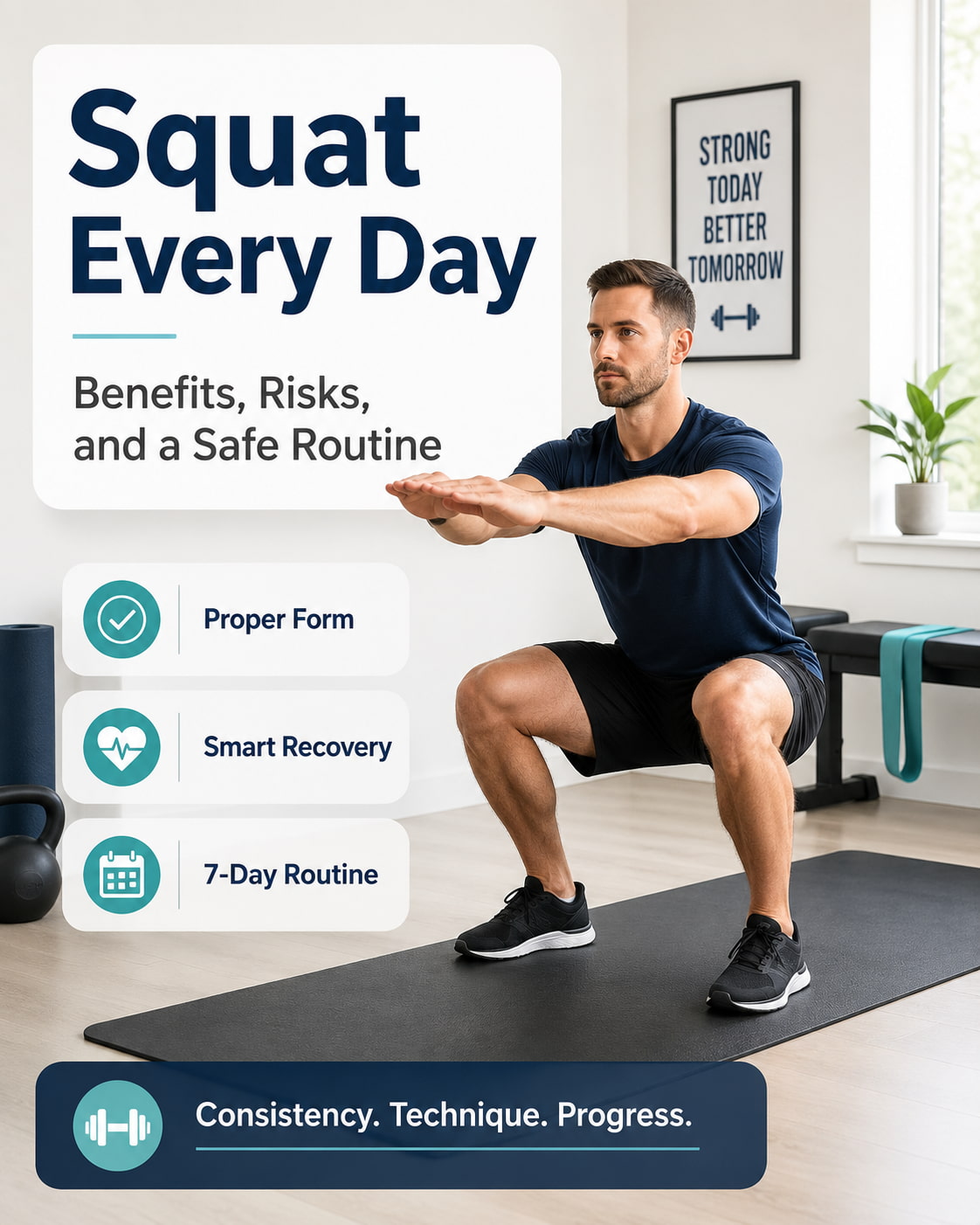
You can squat every day, but most daily sessions should be easy movement practice rather than demanding leg workouts. A safe squat-every-day plan controls total sets, load, effort, and exercise difficulty so your muscles and joints have time to recover.
Daily squatting may improve technique, consistency, lower-body strength, and muscular endurance. However, doing high-volume or heavy squats seven days per week can create unnecessary fatigue, reduce performance, and aggravate the knees, hips, or lower back.
This guide explains the benefits and risks of daily squats, proper form, muscles worked, and how to build a practical seven-day routine.
Can You Squat Every Day?
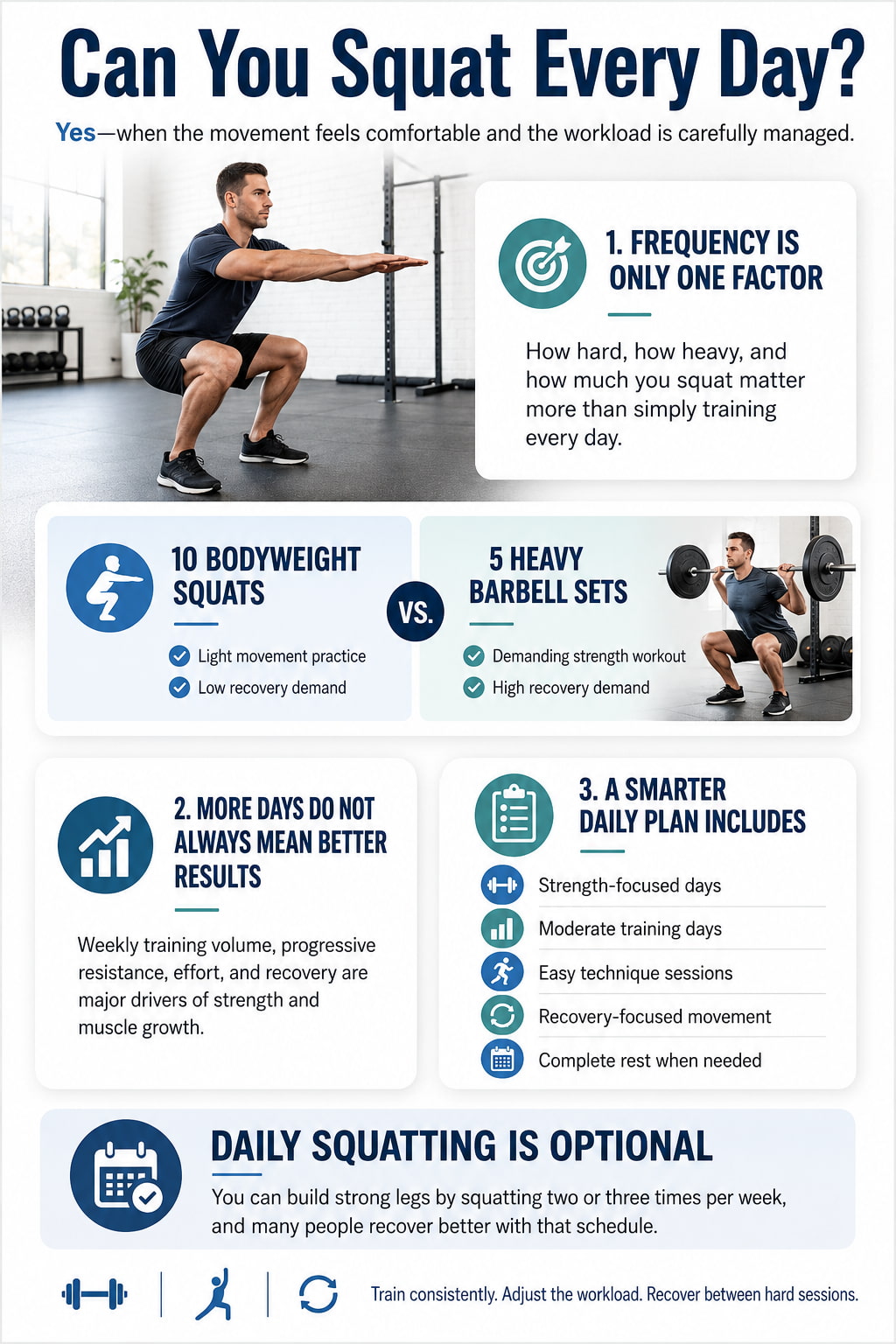
Yes, a healthy person can squat every day when the movement is comfortable and the workload is appropriately managed. The important question is not simply how often you squat. It is how hard, how heavy, and how much you squat each day.
Performing 10 controlled bodyweight squats as a movement break is very different from completing five heavy barbell sets. Both count as squatting, but they create completely different recovery demands.
The American College of Sports Medicine’s updated resistance-training guidelines emphasize consistency, progressive resistance, and individualized programming. ACSM recommends training all major muscle groups at least twice per week for general fitness, but it does not suggest that every muscle must be trained hard every day.
Research examining resistance-training frequency also suggests that weekly volume is a major driver of strength and muscle growth. Increasing frequency can help distribute that volume across shorter workouts, but adding training days does not automatically produce better results.
A sensible daily squat plan therefore includes a mixture of:
- Strength-focused days
- Moderate training days
- Easy technique sessions
- Recovery-focused movement
- Complete rest when needed
Daily practice is optional. You can build strong legs by squatting two or three times per week, and many people will recover better with that schedule.
What Does “Squat Every Day” Mean?
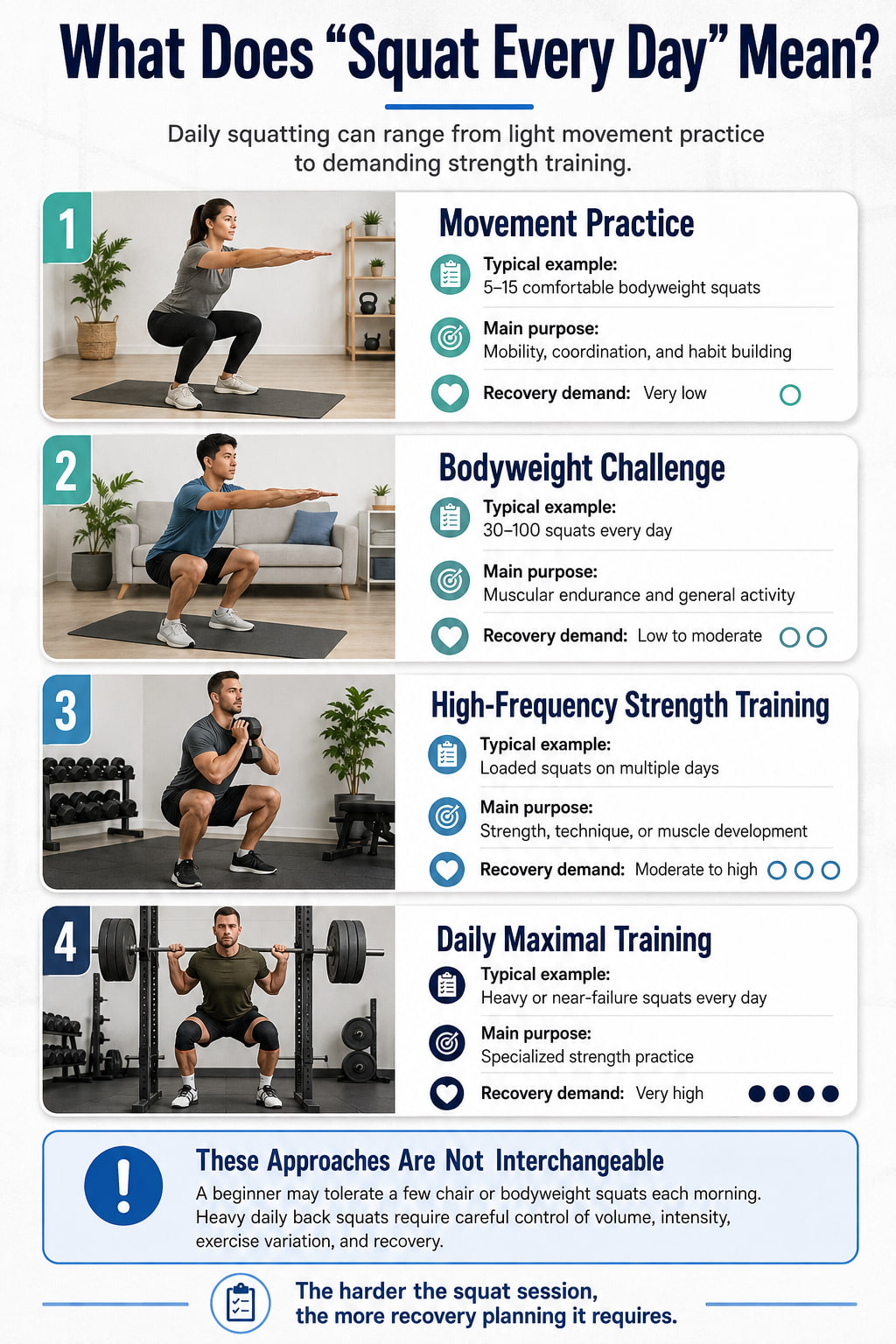
The phrase can describe several different training approaches.
| Daily squat approach | Typical example | Main purpose | Recovery demand |
|---|---|---|---|
| Movement practice | 5–15 comfortable bodyweight squats | Mobility, coordination, and habit building | Very low |
| Bodyweight challenge | 30–100 squats every day | Muscular endurance and general activity | Low to moderate |
| High-frequency strength training | Loaded squats on multiple days | Strength, technique, or muscle development | Moderate to high |
| Daily maximal training | Heavy or near-failure squats every day | Specialized strength practice | Very high |
These approaches should not be treated as interchangeable.
A beginner performing a few chair squats every morning may tolerate daily practice well. An experienced lifter performing heavy back squats requires more careful management of volume, intensity, and exercise variation.
Benefits of Squatting Every Day
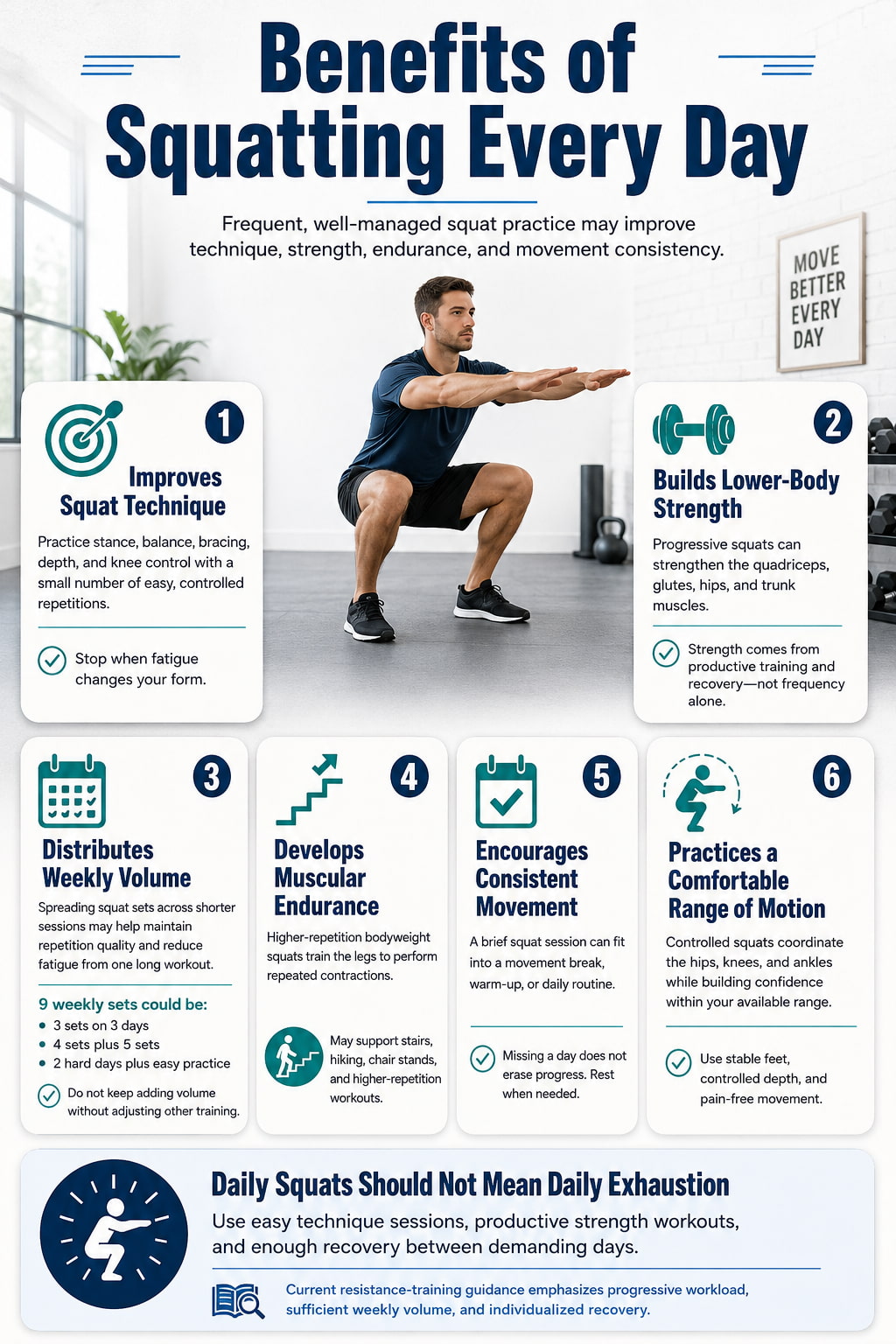
1. Improves Squat Technique
Frequent, low-fatigue practice can improve stance, balance, bracing, depth, and knee control. Keep repetitions easy and stop when fatigue changes your form.
2. Builds Lower-Body Strength
Squats train the quadriceps, glutes, hips, and core. Strength improves when resistance and weekly workload increase gradually while harder sessions are followed by enough recovery.
3. Distributes Weekly Training Volume
Dividing squat sets across several shorter sessions may help maintain repetition quality and reduce fatigue. However, daily squatting should redistribute your weekly workload—not continually add more.
4. Develops Muscular Endurance
Higher-repetition bodyweight squats can improve the legs’ ability to work repeatedly. This may support activities such as climbing stairs, hiking, and standing from a chair.
5. Encourages Consistent Movement
A short squat session can fit into a warm-up, walking routine, or movement break. Keep the habit flexible and take a recovery day when soreness or fatigue affects your technique.
6. Practices a Comfortable Range of Motion
Controlled squats move the hips, knees, and ankles together. Use the deepest range you can control with stable feet and without forcing painful positions.
Risks of Squatting Every Day
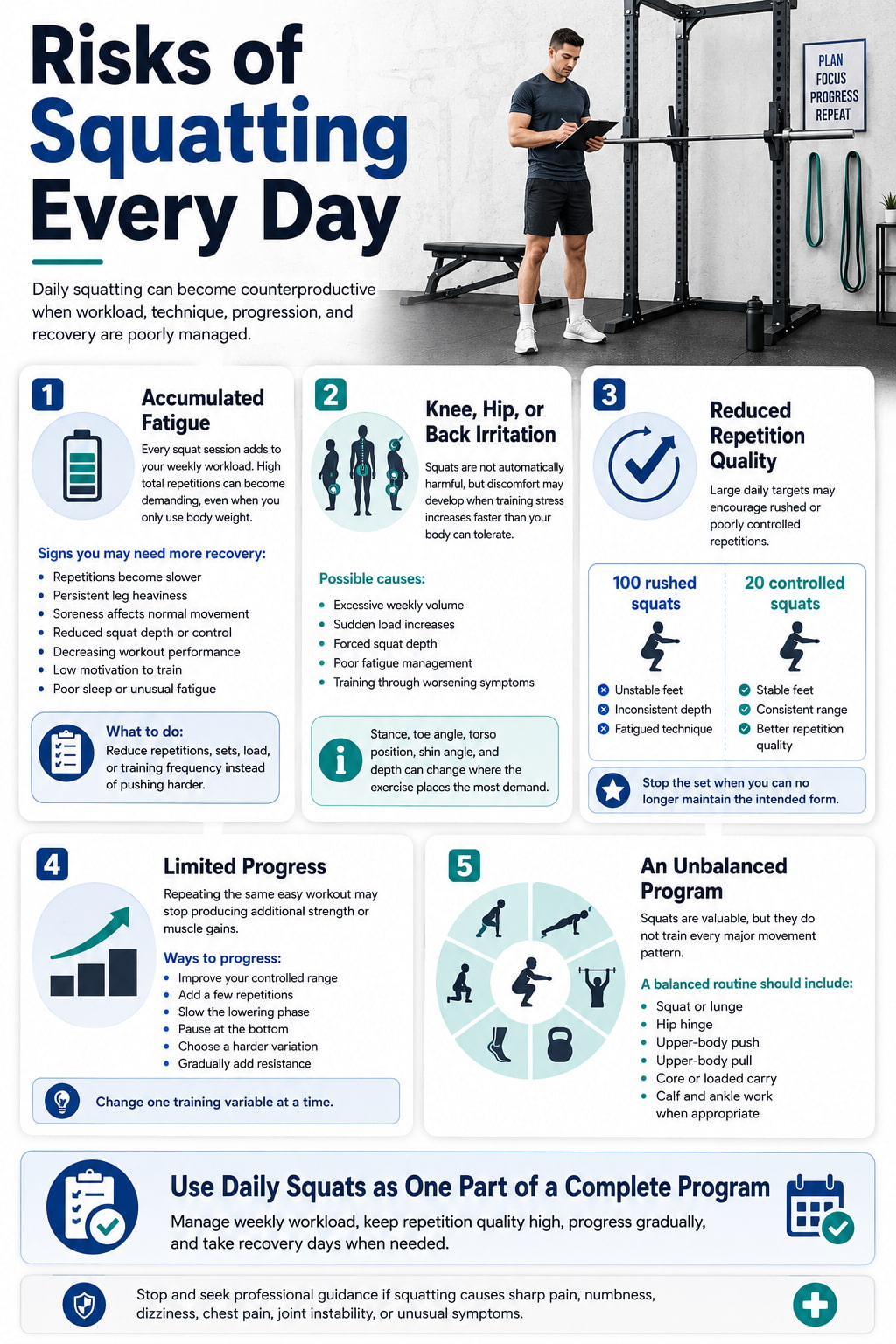
1. Accumulated Fatigue
Daily squats can become tiring when total repetitions, sets, or load are too high. Reduce the workload if your legs feel persistently heavy, performance drops, or soreness affects normal movement.
2. Knee, Hip, or Back Irritation
Squats are not inherently harmful, but excessive volume, sudden load increases, forced depth, or poor recovery may cause irritation. Adjust your stance, depth, or squat variation if discomfort develops.
3. Reduced Repetition Quality
High daily targets can encourage rushed repetitions and poor form. Stop the set when your heels lift, balance worsens, or you can no longer control the movement.
4. Limited Progress
Repeating the same easy squat routine may eventually stop producing results. Progress gradually by adding resistance, repetitions, range of motion, pauses, or a harder variation.
5. An Unbalanced Program
Squats do not replace hip hinges, upper-body pushing and pulling, core work, or other lower-body exercises. Use daily squats as one part of a balanced training plan.
Muscles Worked When You Squat Every Day
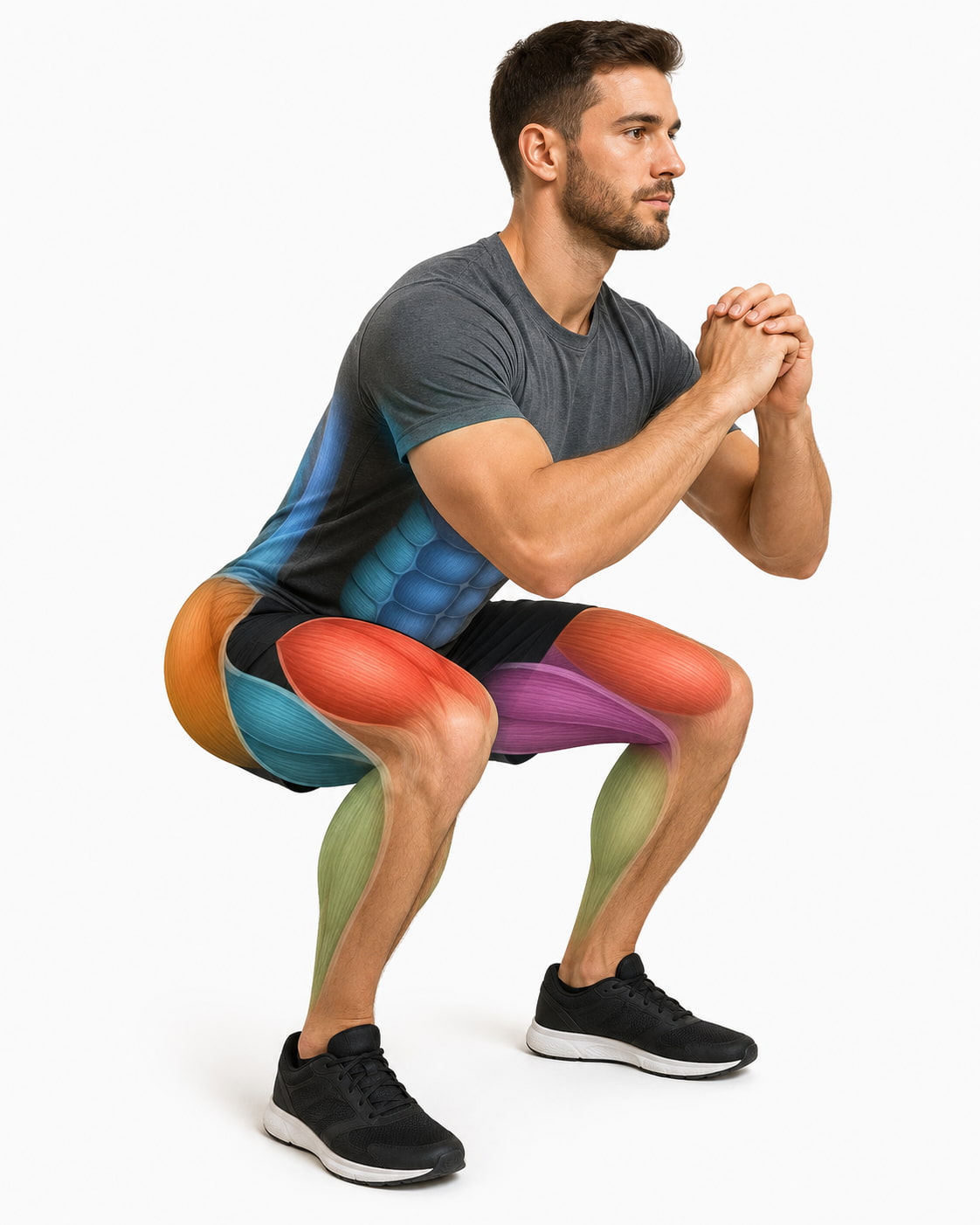
Squats mainly train the lower body while the core stabilizes the torso.
Quadriceps: Straighten the knees as you stand.
Gluteus maximus: Extends the hips and drives you upward.
Adductors: Stabilize the hips and assist during deeper squats.
Hamstrings: Help control the hips and stabilize the knees.
Core and spinal stabilizers: Keep the torso braced and controlled.
Calves and foot muscles: Support balance and keep the feet stable.
Muscle emphasis changes slightly with stance, depth, knee travel, and torso position.
How to Squat Every Day With Proper Form
Bodyweight Squat
Best for: Learning proper squat mechanics, daily movement practice, warming up, and building beginner lower-body strength.
Suggested sets and reps: Use one or two easy sets on practice days and two to four working sets during planned workouts.
Beginners: Perform 2 sets of 8–10 chair or bodyweight squats. Stop with at least four comfortable repetitions remaining.
Intermediate: Perform 2–3 sets of 10–15 controlled repetitions, finishing with approximately three repetitions in reserve.
Advanced: Use a loaded, paused, or tempo variation on training days. Avoid turning every daily session into a difficult workout.
Rest: Rest 45–90 seconds between light bodyweight sets. Rest two to three minutes between demanding loaded sets.
How to do it:
- Stand with your feet approximately hip- to shoulder-width apart.
- Turn your toes slightly outward if that feels more natural for your hips.
- Keep your whole foot in contact with the floor.
- Brace your trunk as though preparing for a gentle push against your stomach.
- Bend your knees and hips together to lower your body.
- Allow your knees to move in the same general direction as your toes.
- Descend only as far as you can maintain balance and control.
- Push through the floor and extend your knees and hips to stand.
- Finish tall without forcefully leaning backward or locking the knees.
- Reset your breath and balance before starting the next repetition.
Common mistakes: Common errors include lifting the heels, collapsing onto the inside edges of the feet, forcing the knees outward, rushing the descent, bouncing out of the bottom, losing trunk control, or continuing after fatigue changes the movement.
Expert tip: Think about keeping three points of each foot connected to the floor: the heel, the base of the big toe, and the base of the little toe. This creates a stable platform without forcing one rigid foot position.
Exercise variations: Chair squat, box squat, goblet squat, front squat, back squat, paused squat, tempo squat, heel-elevated squat, and split squat.
Easier variation: Hold a sturdy support or sit back to a raised chair. Use a comfortable depth and stand with control.
Harder variation: Hold a dumbbell in the goblet position, add a pause, slow the lowering phase, or progress to a barbell variation after developing consistent technique.
A Safe Squat-Every-Day Routine
This seven-day plan is designed for healthy beginners and intermediate trainees who want a daily squat habit.
It includes two strength days, one moderate-volume day, three easy practice days, and one optional movement day. Only the strength and moderate days should feel like actual workouts.
“Repetitions in reserve” refers to how many more good repetitions you believe you could have completed at the end of a set. Three repetitions in reserve means stopping when you could still perform approximately three controlled repetitions.
Research on proximity to failure indicates that strength can improve without taking every set to failure. Training closer to failure may contribute to muscle growth, but routinely reaching failure is unnecessary and can make daily recovery harder.
Seven-Day Daily Squat Plan
| Day | Focus | Exercise | Sets and reps | Effort | Rest |
|---|---|---|---|---|---|
| Day 1 | Strength | Goblet squat or back squat | 3 sets of 5–8 | 2–3 reps in reserve | 2–3 minutes |
| Day 2 | Easy technique | Bodyweight or chair squat | 2 sets of 8 | At least 5 reps in reserve | 45–60 seconds |
| Day 3 | Moderate volume | Goblet or bodyweight squat | 3 sets of 8–12 | 3–4 reps in reserve | 60–90 seconds |
| Day 4 | Recovery practice | Supported squat or sit-to-stand | 1–2 sets of 6–8 | Very easy | 45–60 seconds |
| Day 5 | Strength | Paused goblet or front squat | 3 sets of 6–10 | 2–3 reps in reserve | 2 minutes |
| Day 6 | Technique | Three-second lowering bodyweight squat | 2 sets of 6–8 | At least 4 reps in reserve | 60 seconds |
| Day 7 | Optional movement | Comfortable bodyweight squat | 1 set of 8–10, or rest | Very easy | As needed |
Beginner Option
Use a chair squat for every session during the first week. Perform only one set on Days 2, 4, 6, and 7.
The chair should be high enough that you can sit down without dropping or rocking backward. Gradually reduce assistance or use a slightly lower surface as your control improves.
No-Equipment Option
Use bodyweight squats on strength days, but make them harder without adding excessive repetitions.
You can slow the lowering phase to three seconds, pause briefly near the bottom, or use a controlled 1.5-repetition squat. Stop before your technique deteriorates.
Gym Option
Use a goblet, front, or barbell back squat on Days 1 and 5. Keep the other sessions bodyweight-based.
Daily barbell squatting is not necessary for general fitness. Reserve loaded sessions for the days on which you are prepared to train with focus and stable technique.
How to Warm Up Before Your Harder Squat Days
Easy daily practice usually does not require a long warm-up. Strength and moderate-volume sessions deserve more preparation.
Begin with three to five minutes of comfortable walking, cycling, or another activity that raises your body temperature. Follow it with several controlled ankle movements, hip movements, and unloaded squats.
Then perform two or more squat warm-up sets before your work sets. Gradually increase the load while keeping the repetitions low.
A simple loaded warm-up may look like this:
| Warm-up set | Suggested load | Repetitions |
|---|---|---|
| Set 1 | Bodyweight or empty bar | 8–10 |
| Set 2 | Light load | 5 |
| Set 3 | Moderate warm-up load | 3 |
| Work sets | Planned training load | Prescribed repetitions |
Heavier lifters may need additional warm-up sets. The warm-up should prepare you without creating unnecessary fatigue.
How to Progress a Daily Squat Routine
Do not increase repetitions and weight at the same time.
Keep the routine unchanged until your planned sets feel controlled, your technique remains consistent, and you recover before the next strength day.
Then progress one variable:
- Add one repetition to each work set.
- Add a small amount of resistance.
- Increase the controlled range of motion.
- Add a one- or two-second pause.
- Use a slightly more challenging variation.
- Add one set to one training day, not every day.
For loaded squats, a small increase of approximately 2.5% to 5% is usually more manageable than a large jump. Return to the lower end of your repetition range after increasing the load.
Do not progress when your repetitions are becoming less stable, your soreness is increasing, or pain is appearing.
When to Reduce the Daily Workload
Change the next planned session to easy practice or complete rest when:
- Your normal warm-up feels unusually heavy.
- Soreness changes how you walk or squat.
- Your squat depth or balance is worse than normal.
- Your knees, hips, or back become progressively more uncomfortable.
- Your performance has decreased for several sessions.
- You cannot maintain the planned repetitions in reserve.
- You are also completing demanding running, jumping, or lower-body sports training.
A recovery day is part of the program. It is not a failed workout.
Should Your Knees Go Past Your Toes?
Your knees can move past your toes during a squat when that position is comfortable and controlled.
Trying to keep the shins perfectly vertical can force more movement into the hips and torso. This may be useful in some situations, but it is not a universal form rule.
A person’s limb length, ankle mobility, stance, load position, and chosen squat depth all affect how far the knees travel. The goal is not to freeze the knees behind the toes. The goal is to keep the feet stable and control the knees through the available range.
Hospital for Special Surgery includes natural knee movement over the toes in its squat instructions and prioritizes good form, gradual loading, and avoiding sharp pain.
Are Deep Squats Bad for Your Knees?
Deep squats are not automatically bad for healthy knees.
A 2024 scoping review examined 15 studies related to deep squatting and knee health. Fourteen did not report a negative impact on knee joint health. The authors concluded that deep squats appear safe for people without previous knee pathology when proper technique and appropriate loading are used. Most interventions were relatively short, so the finding should not be treated as proof that every depth is appropriate for every person.
Use the deepest position you can control without:
- Sharp or increasing pain
- Heels lifting excessively
- Losing balance
- Forcing your pelvis or lower back into an uncomfortable position
- Allowing fatigue to change your technique
Someone with an existing knee, hip, or back condition may need a different stance, depth, load, or exercise variation.
Common Squat-Every-Day Mistakes
Making Every Session Difficult
The most common mistake is treating seven squat days as seven leg workouts.
Most daily sessions should be easy enough that they do not interfere with your next planned strength session.
Starting With 100 Squats Per Day
One hundred repetitions is an arbitrary target. It may be far too much for a beginner and far too easy for an experienced trainee.
Start with the smallest dose that supports your goal. For a beginner, that may be 10–20 total repetitions on easy days and two or three sets during workouts.
Training to Failure Every Day
Regularly taking squats to failure increases fatigue and makes technique harder to maintain.
Finish most sets with two or more good repetitions available. Easy practice sets should stop even further from failure.
Adding Daily Squats Without Adjusting Other Training
Running, jumping, lunges, deadlifts, leg presses, and sports all contribute to lower-body fatigue.
Count your entire training schedule instead of viewing squats in isolation.
Forcing One “Perfect” Stance
There is no single foot width or toe angle that works for every body.
Begin near shoulder width, make small adjustments, and choose the stance that allows stable feet, controlled knees, and a comfortable hip position.
Forcing Maximum Depth
A deeper squat is not automatically better when you lose control to reach it.
Build depth gradually. A box or chair can provide a consistent target while you improve strength and mobility.
Ignoring Pain
Muscle effort and mild post-workout soreness are different from sharp, sudden, or progressively worsening pain.
Stop the exercise if it causes sharp pain, numbness, dizziness, chest pain, joint instability, or unusual symptoms.
Can You Barbell Squat Every Day?
Experienced lifters can use high-frequency barbell programs, but these routines require careful control of load, volume, exercise selection, and proximity to failure.
Daily barbell training does not mean attempting a maximum lift every day. A structured high-frequency program might rotate between heavy, moderate, light, paused, and technique-focused sessions.
For most recreational lifters, two or three loaded squat sessions per week provide enough practice and training stimulus. Easy bodyweight squats can be used on other days when desired.
Beginners should first develop consistent form and learn how their body responds to normal training before considering a specialized daily barbell program.
Will Squatting Every Day Build Muscle?
Daily squats can contribute to muscle growth when the exercise provides enough resistance and the weekly workload progresses.
However, frequency alone does not build muscle. Performing the same easy bodyweight repetitions every day will eventually stop being challenging.
Muscle growth is more likely when you:
- Use an appropriately challenging variation.
- Complete enough weekly sets.
- Finish working sets reasonably close to failure.
- Gradually increase the training demand.
- Eat enough total food and protein.
- Sleep and recover adequately.
Daily squatting is one way to organize training, not a special muscle-building shortcut.
Will Squatting Every Day Help You Lose Weight?
Squats use large muscles and contribute to physical activity, but a daily squat challenge does not guarantee weight loss.
Changes in body weight depend on overall energy balance over time. Squats can be part of a program that also includes walking, cardiovascular exercise, balanced nutrition, and full-body strength training.
Choose daily squats because they support your strength, movement, or fitness goals—not because a fixed number of repetitions promises targeted fat loss.
Who Should Avoid a Daily Squat Challenge?
Do not begin an unsupervised daily squat program when you have:
- A recent knee, hip, ankle, or back injury
- Recent surgery
- Significant joint swelling
- A knee that locks, gives way, or feels unstable
- Pain that affects walking or daily activities
- Medical restrictions affecting exercise
- Symptoms that worsen each time you squat
Hospital for Special Surgery recommends professional assessment when pain follows an injury, lasts more than a few weeks, interferes with daily activities, or occurs with significant swelling, locking, giving way, or instability.
A physical therapist, sports medicine physician, or qualified exercise professional can help select an appropriate stance, depth, variation, and workload.
Frequently Asked Questions
How many squats should I do every day?
There is no universal daily target. Beginners can start with 10–20 comfortable total repetitions on easy practice days and two or three sets during planned workouts.
The right amount leaves you able to maintain good form and recover for your next meaningful training session.
Is it okay to do bodyweight squats every day?
Yes, easy bodyweight squats can be performed daily when they are comfortable and do not create accumulating fatigue.
Reduce the volume or take a rest day when soreness, pain, or reduced technique appears.
Are 100 squats a day good?
One hundred squats may improve muscular endurance when that number is appropriately challenging. It is not automatically better than a lower, more controlled training dose.
After your body adapts, increasing the repetition total further may be less useful than choosing a harder variation or adding resistance.
Will squatting every day make my legs bigger?
It can contribute to muscle growth when the squats are challenging, weekly volume is sufficient, and the program includes progressive overload.
A few easy repetitions performed as movement practice are unlikely to create major muscle growth by themselves.
Can I squat when my legs are sore?
Easy practice may be acceptable when soreness is mild, does not affect your movement, and improves as you warm up.
Choose rest or a different workout when soreness changes your technique, limits normal movement, or becomes worse during the session.
Should I squat every day as a beginner?
Beginners do not need seven hard squat sessions. Two strength-focused days, one moderate day, and several easy practice or rest days are more appropriate.
The goal is to learn the movement and build tolerance gradually.
How long should I follow a daily squat routine?
Start with two to four weeks and monitor technique, performance, soreness, and joint comfort.
Continue only when the routine remains productive and recoverable. You can later switch to two or three weekly squat sessions without losing the benefits of your earlier practice.
Conclusion
Squatting every day can be safe and useful, but daily frequency should not mean daily exhaustion. Use two or three productive training sessions, keep the remaining days easy, and take complete rest whenever your recovery or technique declines.
Focus on controlled repetitions, stable feet, a comfortable range of motion, and gradual progression. A flexible routine that you can recover from will produce better long-term results than forcing a high repetition target every day.
This content is for informational purposes only and is not a substitute for professional medical advice.
References
- American College of Sports Medicine: 2026 Resistance Training Guidelines
- The Resistance Training Dose-Response: Weekly Volume and Frequency
- International Journal of Sports Physical Therapy: A Biomechanical Review of the Squat Exercise
- Frontiers in Sports and Active Living: Impact of the Deep Squat on Knee Joint Structures
- PubMed: Proximity to Failure, Strength Gain, and Muscle Hypertrophy
- Hospital for Special Surgery: Knee Strengthening Exercises and Safety Guidance