Dumbbell shrugs train the upper trapezius by lifting the shoulder blades straight upward against resistance. Hold the dumbbells beside your thighs, keep your arms long and neck neutral, elevate your shoulders under control, pause briefly, and lower them without rolling or bouncing.
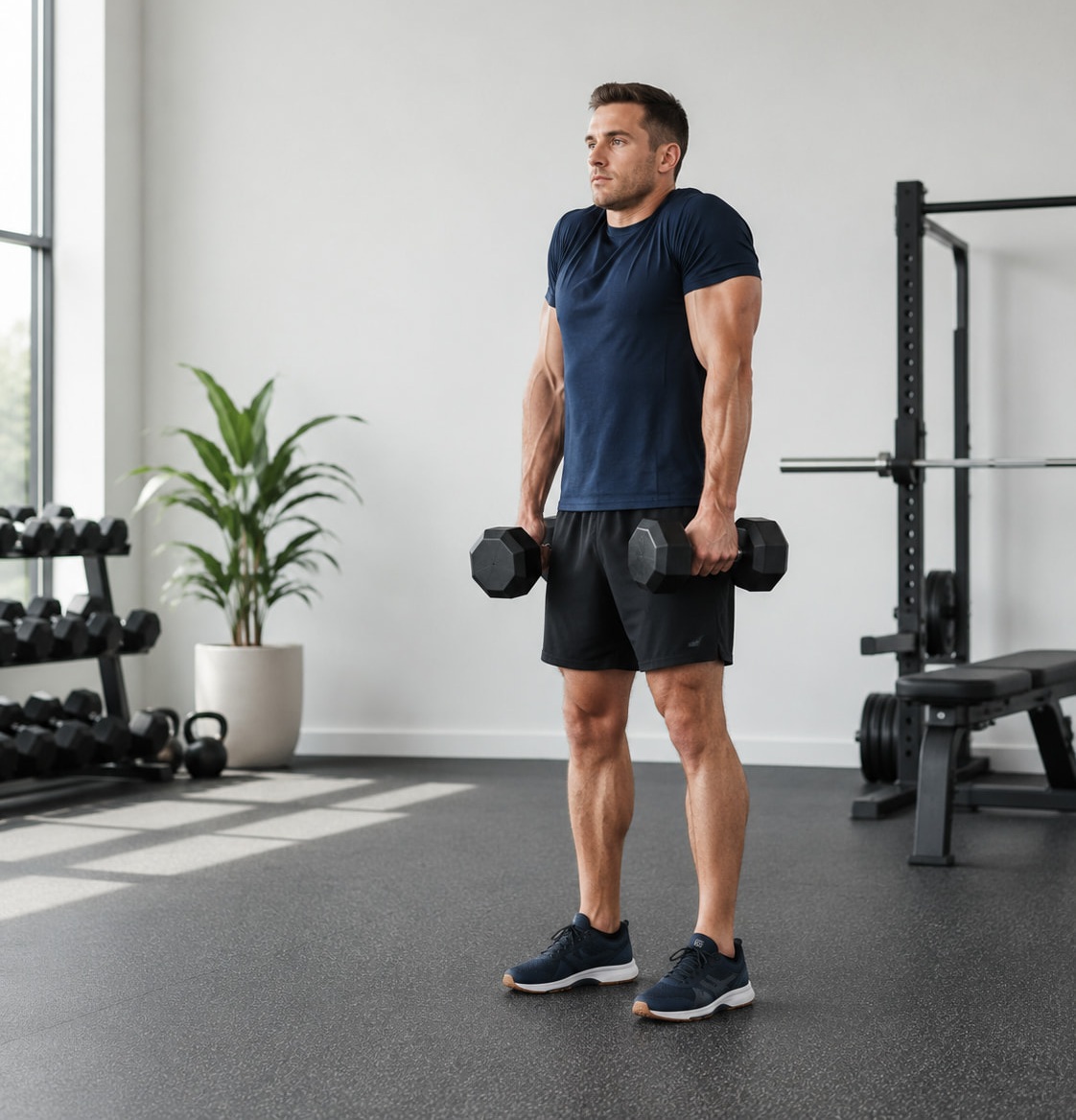
Although the movement is simple, using excessive weight can quickly turn it into a short, uncontrolled bounce. This guide explains proper dumbbell shrug form, the muscles worked, common mistakes, useful variations, and how to program the exercise effectively.
Dumbbell Shrugs at a Glance
| Category | Recommendation |
|---|---|
| Exercise type | Upper-back accessory exercise |
| Main movement | Scapular elevation |
| Primary muscle | Upper trapezius |
| Assisting muscle | Levator scapulae |
| Other muscles involved | Forearms, hands, core, and postural stabilizers |
| Equipment | Two dumbbells |
| Beginner starting range | 2–3 sets of 10–15 reps |
| General muscle-building range | 3–4 sets of 8–15 reps |
| Rest | 60–120 seconds |
| Effort | Finish with 1–3 controlled reps remaining |
| Best workout placement | After major rows, pulls, or deadlifts |
What Are Dumbbell Shrugs?
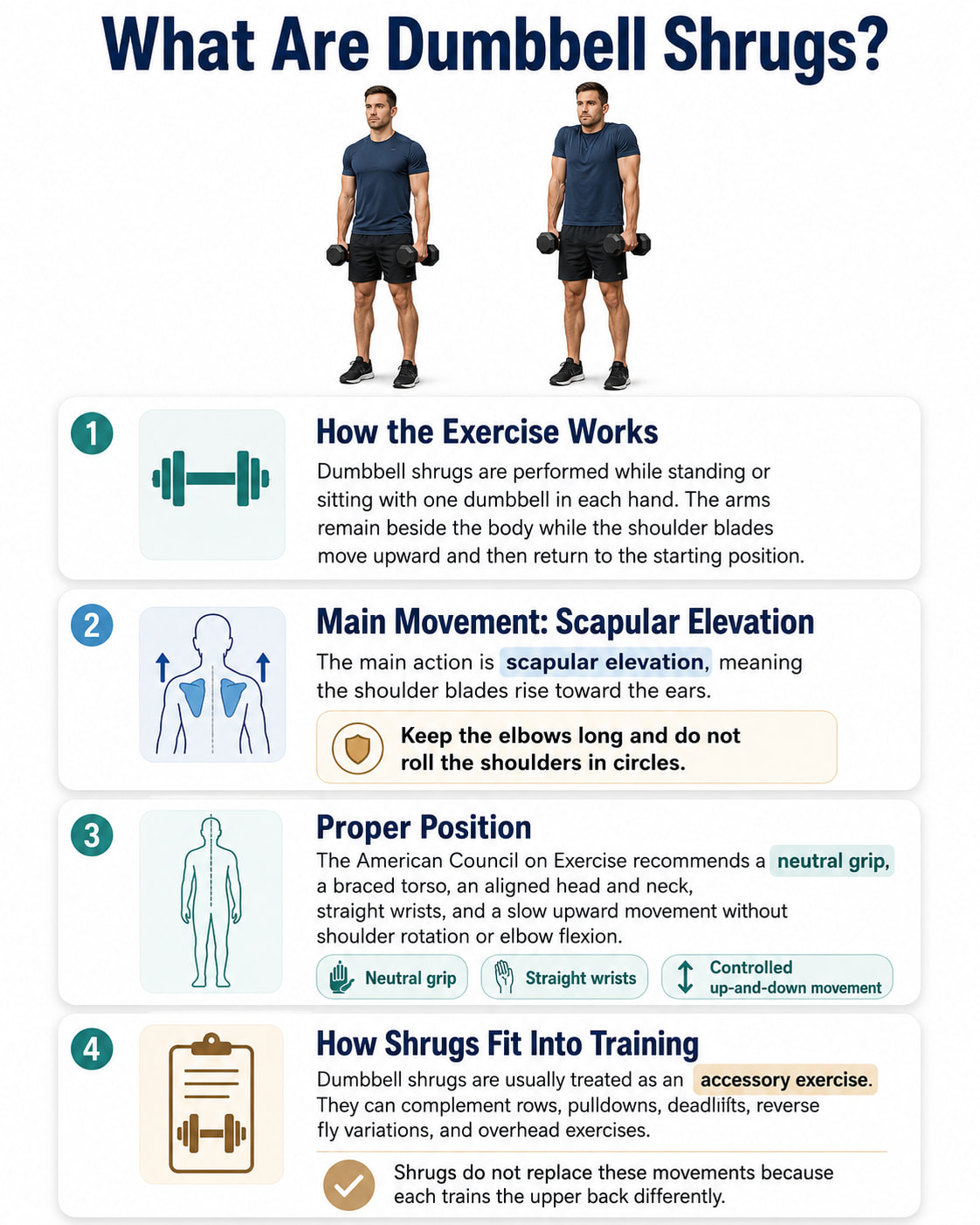
Dumbbell shrugs are performed while standing or sitting with one dumbbell in each hand. The arms remain beside the body while the shoulder blades move upward and then return to the starting position.
The main action is scapular elevation, meaning the shoulder blades rise toward the ears. The elbows should not actively bend, and the shoulders should not move in circles.
The American Council on Exercise recommends a neutral grip, a braced torso, an aligned head and neck, straight wrists, and a slow upward movement without shoulder rotation or elbow flexion.
Dumbbell shrugs are usually treated as an accessory exercise. They can complement rows, pulldowns, deadlifts, reverse fly variations, and overhead exercises, but they do not replace those movements because each trains the upper back differently.
Dumbbell Shrugs Muscles Worked
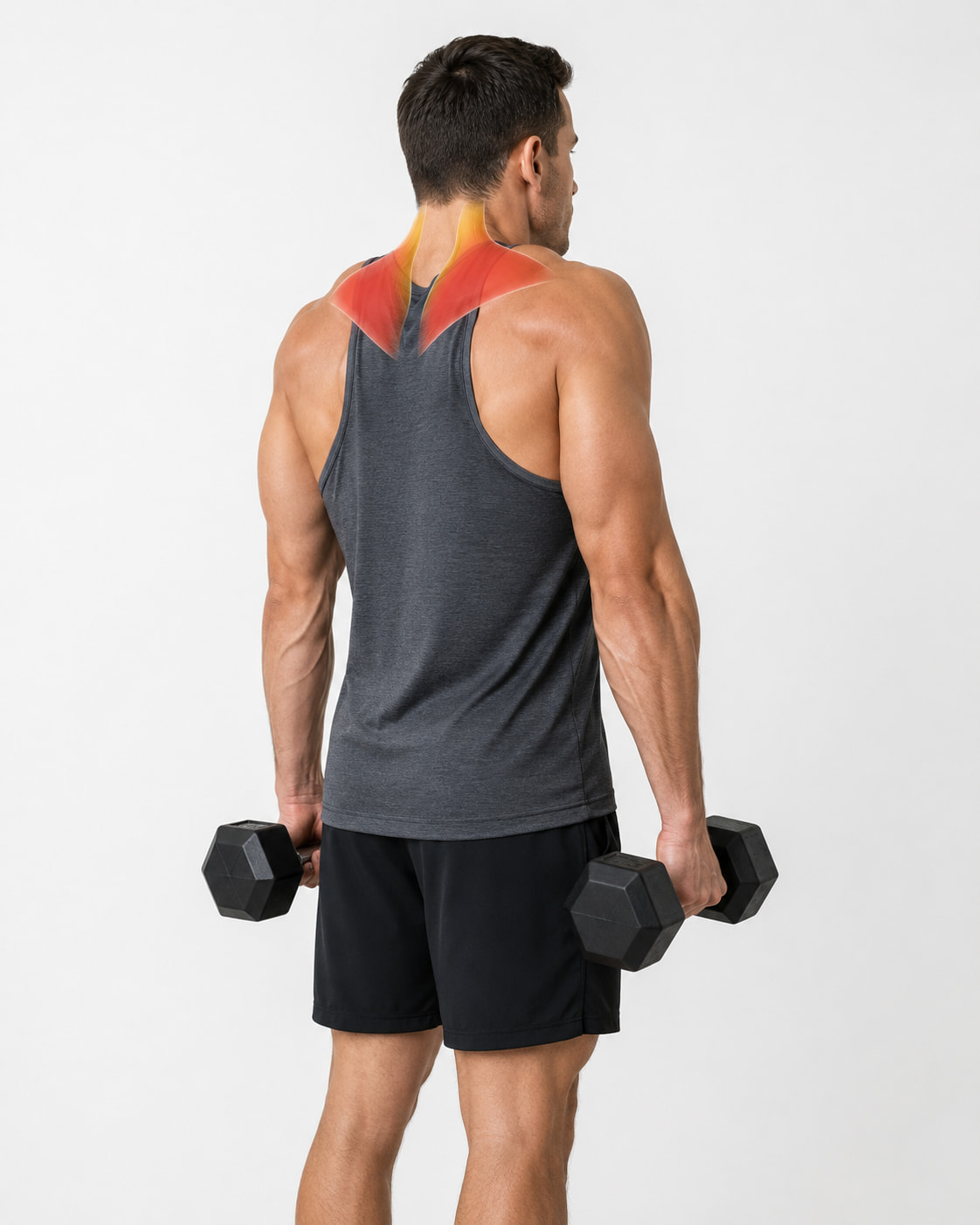
Upper Trapezius
The upper trapezius is the primary muscle emphasized during a standard dumbbell shrug.
The trapezius is a large muscle extending across the upper back, shoulders, and neck. It contains upper, middle, and lower regions with different functions:
- Upper trapezius: Elevates and assists with upward rotation of the shoulder blades
- Middle trapezius: Primarily retracts the shoulder blades
- Lower trapezius: Depresses the shoulder blades and assists with upward rotation
The NCBI Bookshelf describes these different regional actions. Because a standard shrug mainly involves elevation, it emphasizes the upper fibers more than the middle and lower fibers.
An electromyography study indexed by PubMed found that the unilateral shoulder shrug produced the greatest upper-trapezius activity among the exercises tested. This supports using shrugs as a direct upper-trapezius exercise, although short-term muscle activation does not prove that one exercise will produce the most long-term muscle growth.
Levator Scapulae
The levator scapulae runs from the upper cervical spine to the upper inner border of the shoulder blade.
Its primary action is scapular elevation, so it assists the upper trapezius during shrugs. The NCBI Bookshelf identifies elevation of the scapula as its primary function.
The levator scapulae should be described as an assisting muscle rather than the sole target of the exercise.
Hands and Forearms
The hands and forearms hold the dumbbells throughout the set. Their work is mainly isometric, meaning they produce force without repeatedly opening and closing the hands.
Your grip may become a limiting factor when the dumbbells get heavier. Beginners should first develop adequate grip strength rather than immediately relying on lifting straps.
Core and Postural Stabilizers
The abdominal muscles, spinal erectors, hips, and legs help hold the body still during standing shrugs.
These muscles should stabilize the exercise rather than create the movement. Knee drive, hip extension, or torso swinging indicates that the weight is probably too heavy.
Do Shrugs Work the Entire Trapezius?
Dumbbell shrugs involve the trapezius, but they do not train all three regions equally.
The standard arms-at-the-sides version primarily trains scapular elevation and therefore emphasizes the upper trapezius. Rows and reverse fly variations provide more scapular retraction, while carefully selected overhead or upward-rotation exercises involve different combinations of trapezius and serratus anterior activity.
A complete upper-back program should include more than shrugs alone.
Benefits of Dumbbell Shrugs
- Direct upper-trapezius training: Targets scapular elevation and helps build upper-trap strength and size.
- Minimal equipment: Requires only two dumbbells and a small training space.
- Independent loading: Each arm holds its own dumbbell, making side-to-side control easier to notice.
- Grip training: Challenges the hands and forearms while holding the dumbbells.
- Easy progression: Progress with more reps, heavier dumbbells, pauses, slower lowering, or extra sets.
- Easy workout placement: Fits well near the end of back, shoulder, upper-body, or full-body workouts.
How to Do Dumbbell Shrugs With Proper Form
Sets, reps, and rest: Start with 2–3 sets of 10–15 reps, resting 60–90 seconds. Use a weight that leaves approximately 2–3 controlled repetitions in reserve.
How to Do It
- Stand with your feet approximately hip- to shoulder-width apart. A small staggered stance is also acceptable when it improves balance.
- Hold one dumbbell beside each thigh with your palms facing inward.
- Keep your wrists straight, arms long, and elbows relaxed without actively bending them.
- Stand tall with your ribs controlled, core lightly braced, and head aligned with your spine.
- Lift both shoulders straight upward toward your ears while keeping your head still.
- Pause for approximately one second at the highest comfortable position.
- Lower the shoulders slowly until they return to a comfortable starting position.
- Reset your posture before beginning the next repetition.
Coaching cue: Lift your shoulders up, keep your head still, and lower slowly.
Breathing
Exhale as you elevate the shoulders and inhale as you lower the dumbbells. Do not hold your breath for the entire set.
Range of Motion
Use the largest comfortable range you can control without:
- Pushing your head forward
- Tilting your neck
- Bending your elbows
- Arching your lower back
- Using your legs
- Forcing the shoulders into an uncomfortable position
The range will differ slightly between people. Focus on controlled elevation rather than trying to make the dumbbells travel a particular distance.
Common Dumbbell Shrug Mistakes
1. Rolling the Shoulders
Do not rotate the shoulders forward or backward in circles.
The dumbbells create downward resistance, so the main useful action is lifting the shoulders upward against that resistance. Circular movement adds unnecessary motion without making the standard shrug more effective.
Think up and down, not around.
2. Using Too Much Weight
Shrugs allow relatively heavy loads, which can encourage lifters to prioritize the dumbbell number over movement quality.
The weight is too heavy when you must:
- Bounce the dumbbells
- Bend your knees repeatedly
- Thrust your hips
- Shorten the range
- Jut your head forward
- Drop the dumbbells rapidly
Reduce the load until every repetition looks similar.
3. Bending the Elbows
The elbows should remain mostly straight during the shrug.
Actively bending them turns the movement into a partial upright row or curl. Keep the arms long and allow the shoulder blades to create the motion.
4. Pushing the Head Forward
Some lifters move their head toward the dumbbells instead of lifting the shoulders.
Keep your chin comfortably level and your head stacked over your torso. Your shoulders should move toward your ears while your head remains still.
5. Leaning Back
Excessive backward lean changes the direction of the movement and can place unnecessary stress on the lower back.
Keep your torso upright, ribs controlled, and pelvis stable. A slight natural adjustment is acceptable, but the body should not rock through every repetition.
6. Using Leg Drive
Bending and straightening the knees turns the shrug into a momentum-assisted movement.
Unless you are intentionally performing an explosive exercise such as a jump shrug, keep your knees and hips stable.
7. Dropping the Dumbbells
The lowering phase is part of the repetition. Letting the dumbbells pull the shoulders down rapidly reduces control.
Lower the weights smoothly for approximately two seconds and begin the next repetition only after you have regained a stable position.
8. Holding the Shoulders at the Top Too Long
A brief pause can improve control, but an extended hold is not necessary for most sets.
A one-second pause is usually enough. Longer holds can cause the grip to fail before the upper trapezius receives the intended number of repetitions.
How Heavy Should Dumbbell Shrugs Be?
Choose a weight you can lift through a comfortable range without bouncing, bending your elbows, or moving your head.
A useful starting test is to perform 10 repetitions and ask:
- Could I complete at least two more clean repetitions?
- Did the last repetition use the same range as the first?
- Could I lower every repetition under control?
- Did my neck and head remain still?
- Did my knees and hips remain stable?
When the answer is yes, the weight is probably appropriate.
A load that permits 10–15 controlled repetitions is often more useful for learning the exercise than a very heavy weight that only permits short, momentum-assisted shrugs.
Sets, Reps, Rest, and Frequency
The following are practical starting ranges rather than rules that apply to everyone.
| Goal | Sets | Repetitions | Rest | Suggested effort |
|---|---|---|---|---|
| Beginner technique | 2–3 | 10–15 | 60–90 seconds | 2–3 reps remaining |
| General muscle building | 3–4 | 8–15 | 60–120 seconds | 1–3 reps remaining |
| Heavier strength-focused work | 3–4 | 6–10 | 90–180 seconds | 2–3 reps remaining |
| Controlled finisher | 2–3 | 12–20 | 45–90 seconds | 1–3 reps remaining |
The American College of Sports Medicine emphasizes consistent training, individualization, and adjusting load and volume to match the training goal in its 2026 resistance-training guidance. It also indicates that complicated methods are not required for most healthy adults to make progress.
How Often Should You Perform Shrugs?
Train dumbbell shrugs one or two times per week in most routines.
The amount you need depends on your other exercises. Deadlifts, rows, overhead movements, loaded carries, and some Olympic-lifting variations can already place substantial demands on the trapezius and grip.
Start with fewer direct shrug sets when your program already contains several heavy pulling exercises.
Where Should Shrugs Go in a Workout?
Dumbbell shrugs usually work best:
- After rows and pulldowns
- After deadlifts
- Near the end of a back or upper-body workout
- Before optional arm or abdominal work
Performing heavy shrugs before rows or deadlifts may fatigue your grip and upper back, reducing performance on the more complex exercises.
You can move shrugs earlier when upper-trapezius training is your main priority, but use enough rest that the exercise does not compromise the rest of the workout.
How to Progress Dumbbell Shrugs
A simple double-progression method works well:
- Select a range such as 10–15 repetitions.
- Begin with a weight you can control for approximately 10–12 repetitions.
- Keep the same weight until you can complete every set at the top of the range.
- Increase to the next manageable pair of dumbbells.
- Return toward the lower end of the repetition range.
- Build the repetitions again.
For example:
- Week 1: 3 sets of 10
- Week 2: 3 sets of 12
- Week 3: 3 sets of 14
- Week 4: 3 sets of 15
- Week 5: Increase the weight and return to 3 sets of 10
Only increase the load when you can maintain your range, posture, pause, and lowering speed.
Dumbbell Shrug Variations, Regressions, and Progressions
Seated Dumbbell Shrug
Best for: Beginners who use too much leg drive during standing shrugs
Sit upright on a stable bench with the dumbbells beside your hips. Elevate and lower the shoulders using the same controlled technique as the standing version.
Sitting reduces the opportunity to create momentum with the legs, although you must still avoid leaning or arching your back.
Supported Single-Arm Dumbbell Shrug
Best for: Learning one-sided control
Hold a stable rack or bench with one hand and hold a dumbbell in the opposite hand. Keep both shoulders level while elevating the loaded side.
Support can make it easier to prevent torso swaying. Avoid leaning heavily away from the dumbbell to shorten the movement.
Paused Dumbbell Shrug
Best for: Improving control at the top
Elevate the shoulders and hold the top position for one to two seconds before lowering.
Use less weight than you would for normal repetitions. The pause should not cause neck movement, elbow bending, or breath-holding.
Tempo Dumbbell Shrug
Best for: Making a lighter weight more challenging
Use the following tempo:
- One second upward
- One-second pause
- Two to three seconds downward
Tempo shrugs can be useful when the available dumbbells are too light to provide a challenge with normal repetitions.
Standing Single-Arm Dumbbell Shrug
Best for: Unilateral training and trunk control
Hold one dumbbell at your side without using the other hand for support. Elevate the loaded shoulder while resisting the tendency to lean sideways.
Use a lighter weight than you would for bilateral shrugs. Keep your torso centered rather than shortening the movement by tilting toward or away from the dumbbell.
Upward-Rotation Shrug
An upward-rotation shrug is a separate variation performed with the arms slightly away from the body rather than directly beside the thighs.
A study indexed by PubMed compared a standard shrug performed with the arms at the sides with an upward-rotation shrug performed at approximately 30 degrees of shoulder abduction. The modified variation produced greater activity in several scapular muscles during the testing conditions. However, the study measured immediate muscle activity and had a rehabilitation focus; it does not prove that this variation produces greater long-term muscle growth.
Most general fitness readers should first master the standard dumbbell shrug. People using a modified shrug for a shoulder condition should follow guidance from a qualified healthcare or rehabilitation professional.
Sample Back and Trap Workout
Perform this routine once or twice per week, leaving at least one recovery day between similar upper-body sessions.
| Exercise | Sets | Repetitions | Rest |
|---|---|---|---|
| One-arm dumbbell row | 3 | 8–12 per side | 90 seconds |
| Dumbbell reverse fly | 2–3 | 12–15 | 60–90 seconds |
| Dumbbell shrug | 3 | 10–15 | 75–120 seconds |
How to Use the Routine
Complete the rows first because they require more coordination and train several upper-back muscles. Use reverse flyes for controlled rear-shoulder and scapular work, then finish with direct upper-trapezius training.
End each shrug set with approximately two controlled repetitions remaining. When you can perform 3 sets of 15 without losing range or control, increase the dumbbell weight slightly and return to approximately 10 repetitions.
Safety Considerations
Warm up before challenging sets. A brief general warm-up followed by one or two lighter shrug sets is usually sufficient for a normal strength workout.
The American Academy of Orthopaedic Surgeons recommends warming up, moving through a controlled range, breathing regularly, and increasing exercise demands gradually.
Stop the exercise if you experience:
- Sharp neck, shoulder, or upper-back pain
- Numbness or tingling
- Pain that travels into the arm
- Dizziness
- Chest pain
- Sudden weakness
- Other unusual symptoms
Normal muscular effort in the upper trapezius is different from sharp pain or neurological symptoms. People with an existing neck, shoulder, nerve, or upper-back condition should obtain individualized professional guidance rather than using shrugs as self-directed treatment.
Frequently Asked Questions
Should You Roll Your Shoulders During Dumbbell Shrugs?
No. Lift the shoulders straight upward and lower them under control.
Rolling the shoulders adds movement that is not required for the standard exercise. It can also make it harder to maintain a stable neck, neutral wrists, and consistent range.
Are Dumbbell Shrugs a Back or Shoulder Exercise?
They are commonly classified as an upper-back exercise because the trapezius covers a large portion of the upper back.
However, the movement occurs at the shoulder blades, so shrugs also fit naturally into shoulder or upper-body workouts.
Do Dumbbell Shrugs Build Bigger Traps?
They can help build the upper trapezius when performed consistently with enough training volume, appropriate effort, gradual progression, and adequate recovery.
Shrugs are not the only useful trapezius exercise. Rows, deadlifts, loaded carries, overhead movements, and other upper-back exercises can contribute to a balanced program.
How Many Repetitions Should You Do?
Most people can start with 10–15 controlled repetitions.
Lower repetitions can be used with heavier weights, while higher repetitions can work with lighter dumbbells. The best range is one that allows a clear shoulder lift, stable posture, and controlled lowering.
Should the Shoulder Blades Be Squeezed Together?
No forceful squeeze is necessary during a standard dumbbell shrug.
The main goal is elevation, not maximal retraction. Lift the shoulders upward rather than pulling them aggressively backward.
Should You Use Lifting Straps?
Straps may be useful for experienced lifters whose grip consistently fails before their upper trapezius becomes challenged.
Beginners should usually start without straps and use a manageable weight. Straps should not be used to justify loads that cause bouncing, shortened range, or poor posture.
Can Dumbbell Shrugs Fix Posture?
Dumbbell shrugs strengthen muscles involved in controlling the shoulder blades, but they do not automatically correct posture.
Posture is influenced by movement habits, mobility, strength across several muscle groups, training balance, work setup, fatigue, and individual anatomy. A balanced program is more useful than relying on one exercise.
Conclusion
Dumbbell shrugs are most effective when treated as a controlled upper-trapezius exercise rather than a test of how much weight you can hold.
Keep the dumbbells beside your thighs, leave your arms long, elevate your shoulders without rolling, pause briefly, and lower the weight under control. Start with 2–3 sets of 10–15 repetitions, leave a few good repetitions in reserve, and increase the weight only when your range and posture remain consistent.
This content is for informational purposes only and is not a substitute for medical advice.
References
- American Council on Exercise — Standing Shrug
Standing Shrug Exercise Guide - NCBI Bookshelf — Anatomy, Back, Trapezius
Trapezius Anatomy and Function - NCBI Bookshelf — Anatomy, Head and Neck, Levator Scapulae Muscles
Levator Scapulae Anatomy and Function - Ekstrom RA, Donatelli RA, Soderberg GL. — Surface Electromyographic Analysis of Exercises for the Trapezius and Serratus Anterior Muscles
View Study on PubMed - Pizzari T, Wickham J, Balster S, Ganderton C, Watson L. — Modifying a Shrug Exercise Can Facilitate the Upward Rotator Muscles of the Scapula
View Study on PubMed - American College of Sports Medicine — 2026 Resistance Training Guidelines
ACSM Resistance Training Guidelines - American Academy of Orthopaedic Surgeons — Safe Exercise
AAOS Safe Exercise Guidelines