Knee extension exercises strengthen the quadriceps and improve your ability to straighten the knee under control. They range from gentle mobility drills and basic quad contractions to resistance-band exercises, machine leg extensions, squats, and step-ups.
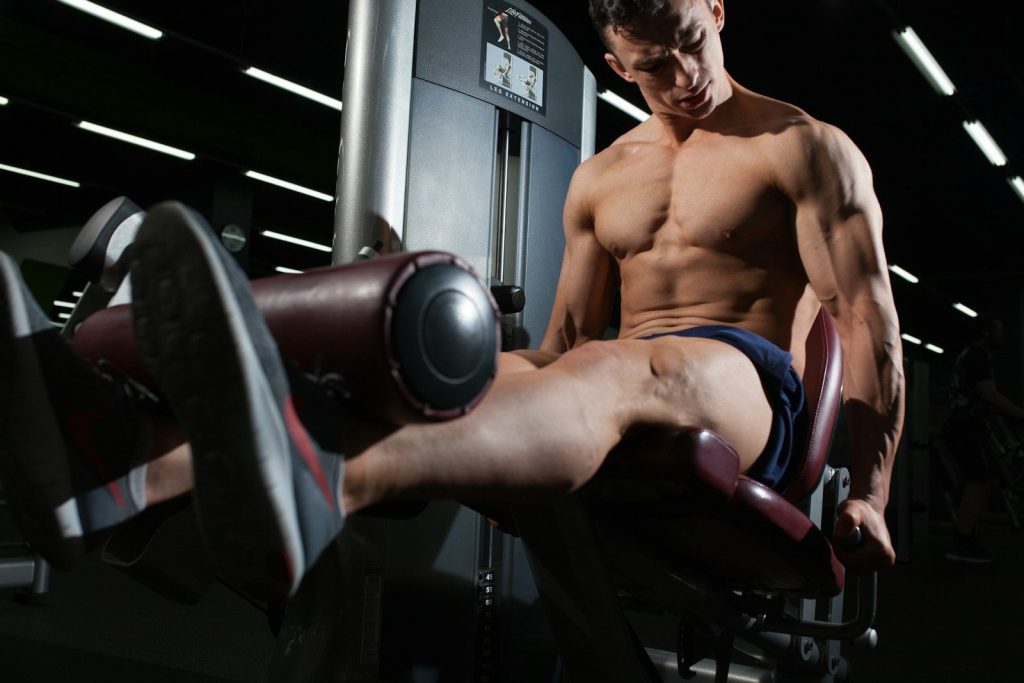
The right starting point depends on your goal. A stiff knee may benefit from gentle extension mobility, while a healthy exerciser looking for stronger thighs will need progressively challenging resistance exercises.
This guide covers 10 knee extension exercises, how to perform them correctly, common mistakes, easier options, and practical ways to include them in your training.
What Are Knee Extension Exercises?
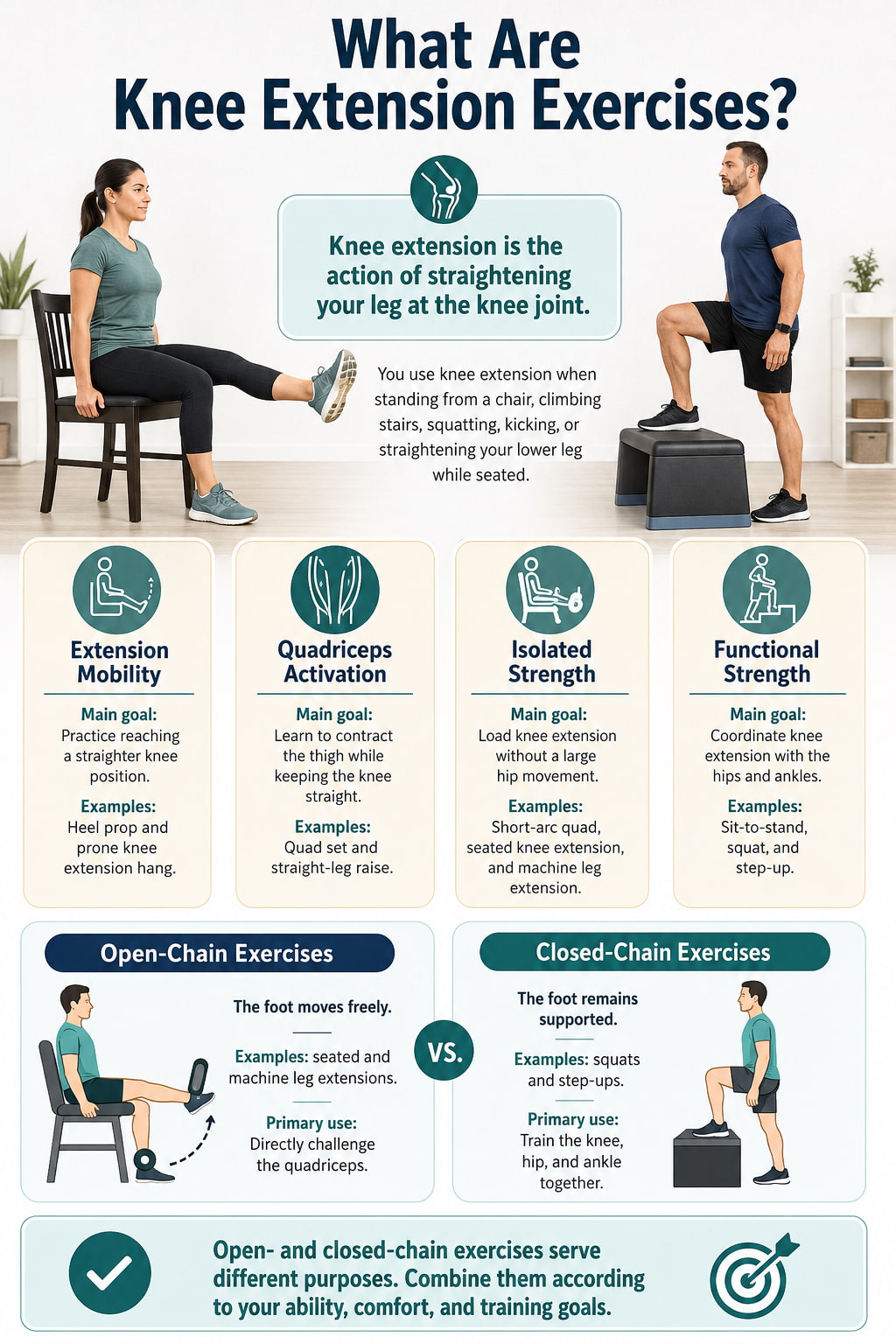
Knee extension is the action of straightening your leg at the knee joint. It happens when you stand up from a chair, climb stairs, squat, kick a ball, or straighten your lower leg while seated.
Knee extension exercises can be divided into four categories:
| Category | Main Goal | Examples |
|---|---|---|
| Extension mobility | Practice reaching a straighter knee position | Heel prop, prone knee extension hang |
| Quadriceps activation | Learn to contract the thigh while keeping the knee straight | Quad set, straight-leg raise |
| Isolated strength | Load knee extension without a large hip movement | Short-arc quad, seated extension, machine extension |
| Functional strength | Coordinate knee extension with the hips and ankles | Sit-to-stand, squat, step-up |
Open-chain exercises, such as seated leg extensions, allow the foot to move freely and directly challenge the quadriceps. Closed-chain exercises, such as squats and step-ups, keep the foot supported while the knee, hip, and ankle work together.
Neither category is automatically better. They serve different purposes and can be combined according to your ability, symptoms, and training goals. Research comparing open- and closed-chain knee exercises supports using both rather than treating one category as universally harmful.
Muscles Worked During Knee Extension
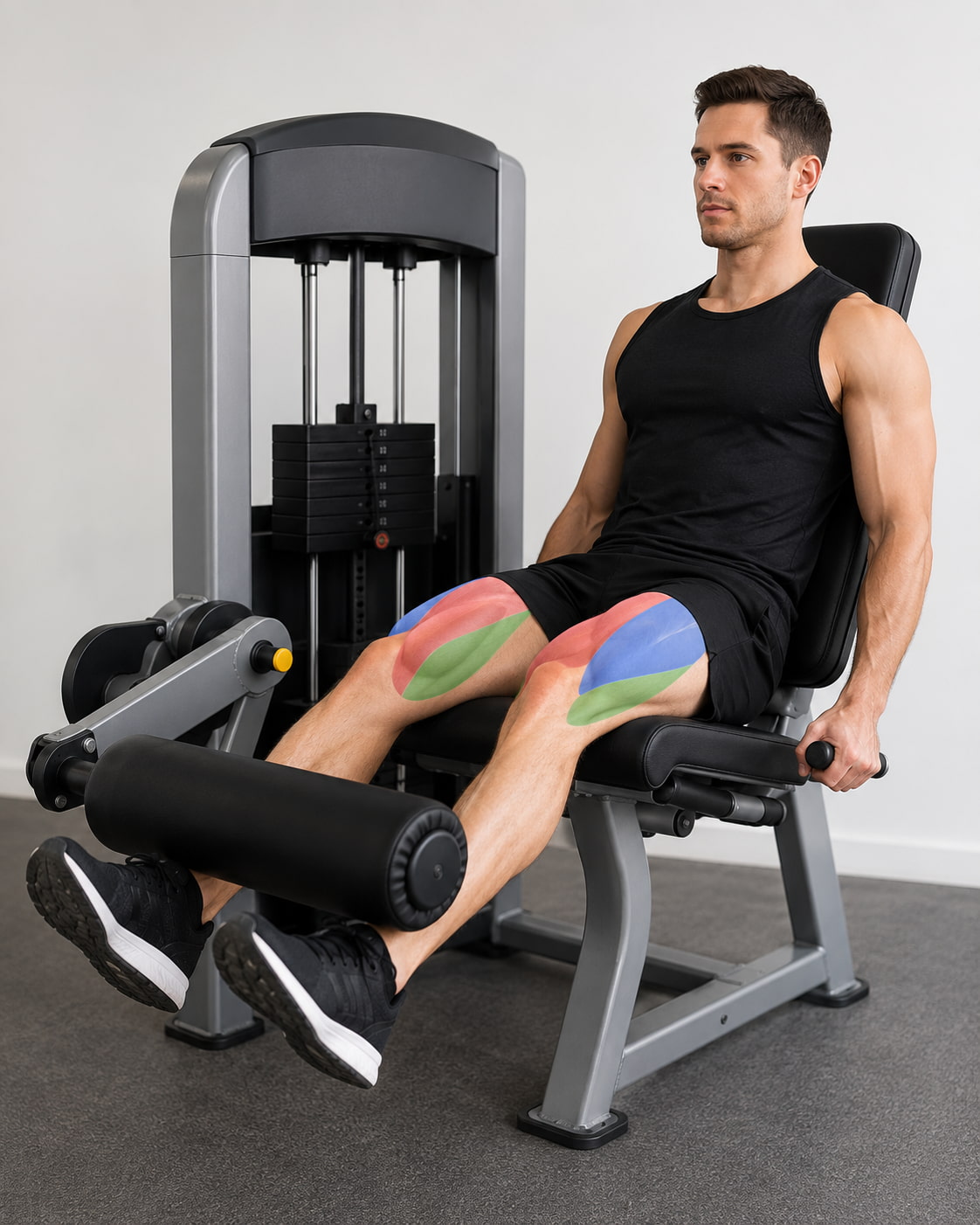
The quadriceps are the primary muscles responsible for knee extension. This group includes:
| Muscle | Main Role |
|---|---|
| Rectus femoris | Extends the knee and assists hip flexion |
| Vastus lateralis | Extends and helps stabilize the knee |
| Vastus medialis | Extends the knee and contributes to kneecap control |
| Vastus intermedius | Produces knee extension beneath the rectus femoris |
The vastus muscles cross only the knee. The rectus femoris crosses both the knee and hip, which means hip position can affect how it contributes during different exercises.
Squats, sit-to-stands, and step-ups also train the gluteus maximus, hamstrings, calves, and hip stabilizers. According to the NCBI overview of anterior thigh anatomy, the quadriceps are the primary knee extensors and connect to the patella through the quadriceps tendon.
10 Best Knee Extension Exercises
The following exercises progress from gentle mobility and muscle activation to heavier isolated and functional strength work. You do not need to perform all ten in one session.
1. Heel-Prop Knee Extension Stretch
Best for: Gently practicing a straighter knee position when the joint feels mildly stiff.
Muscles worked: This is primarily a mobility drill. The quadriceps may contract lightly if you actively tighten the thigh.
Equipment needed: A rolled towel, cushion, low stool, or firm support for the heel.
Suggested sets and reps: Perform 2–4 comfortable holds of 15–30 seconds. Use shorter holds initially if the position feels unfamiliar.
How to do it:
- Sit or lie with your leg extended in front of you.
- Place the heel on a rolled towel, cushion, or low stool.
- Leave the knee unsupported.
- Relax the leg and allow the knee to move gently toward straight.
- Stop before the stretch becomes sharp or forceful.
Common mistakes: Pressing aggressively on the knee, using a support that is too high, holding your breath, or continuing despite increasing pain.
Expert tip: Think about making the back of your knee long rather than forcing it downward.
2. Prone Knee Extension Hang
Best for: People who tolerate heel-supported extension and want another gravity-assisted mobility option.
Muscles worked: Primarily a passive mobility drill, with optional light quadriceps activation.
Equipment needed: A firm bed or padded bench.
Suggested sets and reps: Begin with 2–3 holds of 10–20 seconds. Increase gradually only when the position remains comfortable.
How to do it:
- Lie face down on a firm bed or padded bench.
- Position your knee close to the edge.
- Allow your lower leg and foot to extend beyond the surface.
- Relax the thigh and let gravity gently straighten the knee.
- Slide back onto the surface before getting up.
Common mistakes: Hanging too much of the leg off the edge, forcing the position, tightening the hips, or staying in the stretch after discomfort begins to increase.
Expert tip: Start with very little overhang. More intensity is not automatically more effective.
Prone extension appears in the Royal National Orthopaedic Hospital knee exercise pack, but anyone recovering from an operation should use only the duration and position prescribed by their clinician.
3. Quadriceps Set
Best for: Beginners learning to activate the quadriceps while keeping the knee straight.
Muscles worked: Quadriceps, particularly the vastus muscles.
Equipment needed: A floor, exercise mat, or firm bed. A small towel is optional.
Suggested sets and reps: Perform 2–3 sets of 8–15 contractions, holding each contraction for 3–5 seconds.
How to do it:
- Sit or lie with one leg straight and the other leg comfortably bent.
- Pull the toes of the straight leg toward you.
- Tighten the front of the thigh.
- Gently press the back of the knee toward the floor or bed.
- Hold briefly, relax fully, and repeat.
Common mistakes: Squeezing the glutes instead of the thigh, holding the breath, pushing through pain, or lifting the heel away from the surface.
Expert tip: Watch the kneecap. It should move slightly upward as the quadriceps tighten.
The Cambridge University Hospitals knee exercise program includes static quadriceps contractions as an early-stage exercise before progressing to more demanding movements.
4. Short-Arc Quad Extension
Best for: Building controlled quadriceps strength through the final portion of knee extension.
Muscles worked: Quadriceps.
Equipment needed: A rolled towel, foam roller, or small bolster.
Suggested sets and reps: Perform 2–3 sets of 8–15 repetitions with a 2-second squeeze at the top.
Rest: Rest for 30–60 seconds between sets.
How to do it:
- Lie on your back with a rolled towel beneath one knee.
- Keep the back of the knee resting on the towel.
- Tighten the front of the thigh.
- Lift the heel until the lower leg is nearly straight.
- Pause, then lower the heel slowly.
Common mistakes: Lifting the entire thigh, losing contact with the towel, swinging the foot, or dropping quickly from the top.
Expert tip: Imagine the knee staying heavy on the towel while the heel rises.
5. Straight-Leg Raise
Best for: Improving the ability to maintain knee extension while the leg moves at the hip.
Muscles worked: Quadriceps and hip flexors, with the abdominal muscles helping stabilize the trunk.
Equipment needed: An exercise mat or firm bed.
Suggested sets and reps: Perform 2–3 sets of 8–12 controlled repetitions.
How to do it:
- Lie on your back with one knee bent and that foot flat.
- Keep the working leg straight.
- Tighten the quadriceps before lifting.
- Raise the straight leg until it is approximately level with the opposite thigh.
- Pause and lower without allowing the knee to bend.
Common mistakes: Starting the lift before tightening the thigh, bending the knee, lifting too high, arching the lower back, or using momentum.
Expert tip: Set the knee first, then move the hip. If the knee bends during the lift, reduce the height.
Straight-leg raises and short-range quadriceps exercises are included in the staged knee program from Cambridge University Hospitals.
6. Seated Knee Extension
Best for: Directly training the quadriceps at home without a weight machine.
Muscles worked: Quadriceps.
Equipment needed: A stable chair. A resistance band or ankle weight is optional.
Suggested sets and reps: Perform 2–3 sets of 10–15 repetitions per leg.
How to do it:
- Sit tall with your hips supported and both feet on the floor.
- Tighten the front of one thigh.
- Straighten that knee smoothly until you reach a comfortable end position.
- Pause for 1–2 seconds.
- Lower the foot slowly without swinging.
Common mistakes: Leaning backward, kicking the leg upward, allowing the thigh to lift from the chair, using excessive resistance, or forcefully snapping the knee straight.
Expert tip: Move only the lower leg. Keep your thigh heavy against the chair throughout the repetition.
The AAOS knee-conditioning guidance recommends tightening the thigh, straightening the leg slowly, and avoiding forceful momentum during seated extensions.
7. Banded Terminal Knee Extension
Best for: Strengthening the final portion of standing knee extension and improving control near lockout.
Muscles worked: Quadriceps, with the glutes, calves, and trunk muscles assisting with standing stability.
Equipment needed: A looped resistance band and a secure anchor.
Suggested sets and reps: Perform 2–3 sets of 10–15 repetitions per leg with a 1–2-second pause.
How to do it:
- Anchor a resistance band at approximately knee height.
- Loop the band behind the working knee and step back to create tension.
- Begin with the knee slightly bent and the heel flat.
- Tighten the quadriceps and straighten the knee against the band.
- Pause tall, then return slowly to the small knee bend.
Common mistakes: Snapping the knee backward, leaning the torso, lifting the heel, rotating the leg, or shifting most of your weight onto the opposite side.
Expert tip: Imagine pushing the back of your knee into the band while keeping your whole body tall.
Standing banded knee extension is included in both the Royal National Orthopaedic Hospital exercise pack and the UCSF knee-strengthening protocol.
8. Machine Leg Extension
Best for: Gym users who want measurable, progressive quadriceps resistance.
Muscles worked: Quadriceps.
Equipment needed: A seated leg extension machine.
Suggested sets and reps: Perform 2–4 sets of 8–15 controlled repetitions. Begin with a light load while learning the setup.
How to do it:
- Adjust the seat so the machine’s pivot is approximately aligned with your knee joint.
- Position the lower pad above the front of the ankle.
- Keep your hips, thighs, and back supported.
- Straighten your knees smoothly without throwing the weight.
- Pause briefly and lower the weight under control.
Common mistakes: Using excessive weight, swinging the stack, lifting the hips, setting the pad across the foot, or forcing a painful range.
Expert tip: Start lighter than you think you need. A controlled lowering phase usually improves the exercise without requiring a large increase in weight.
Machine leg extensions are not automatically harmful. Their suitability depends on the person, resistance, range, control, symptoms, and any injury or surgical restrictions. Open-chain knee-extension research does not support treating the entire exercise category as universally unsafe.
9. Sit-to-Stand or Squat
Best for: Building knee extension strength that transfers to standing, sitting, lifting, and everyday movement.
Muscles worked: Quadriceps, gluteus maximus, adductors, hamstrings, calves, and trunk stabilizers.
Equipment needed: A stable chair for the sit-to-stand version. A dumbbell is optional for progression.
Why it stands out: It trains the quadriceps while coordinating the knees with the hips, ankles, feet, and torso.
Suggested sets and reps: Perform 2–3 sets of 8–15 repetitions.
How to do it:
- Stand in front of a stable chair with your feet approximately hip-width apart.
- Reach your hips back and bend your knees.
- Lower under control until you lightly contact the chair.
- Push through your feet and straighten your knees and hips.
- Finish tall without forcefully driving the knees backward.
Common mistakes: Dropping onto the chair, pushing mostly through the hands, allowing the knees to collapse inward, lifting the heels, or shifting strongly toward one side.
Expert tip: Use the chair as a depth guide, not as a place to collapse and rest between repetitions.
Cambridge University Hospitals recommends keeping the knees and toes facing the same general direction during sit-to-stands. The Hospital for Special Surgery also recommends progressive squat training, good form, and gradual loading.
10. Step-Up
Best for: Developing single-leg knee extension strength for stairs, walking, hiking, and sports.
Muscles worked: Quadriceps, gluteus maximus, gluteus medius, hamstrings, calves, and trunk stabilizers.
Equipment needed: A low, stable step or exercise box. A railing or wall may be used for balance.
Suggested sets and reps: Perform 2–3 sets of 6–12 repetitions per leg.
How to do it:
- Place your entire working foot on a stable step.
- Keep the knee, toes, and hip facing the same general direction.
- Lean forward slightly from the ankles while keeping the chest controlled.
- Push through the working foot to stand on the step.
- Lower slowly without dropping onto the trailing foot.
Common mistakes: Pushing excessively from the floor leg, using a step that is too high, allowing the knee to collapse inward, placing only the toes on the step, or falling quickly during the descent.
Expert tip: Keep the trailing foot quiet. The leg on the step should perform most of the work.
How to Choose the Right Knee Extension Exercise
Choose exercises according to what you can currently do with good control.
| Goal | Best Starting Options |
|---|---|
| Improve a mildly stiff straight-knee position | Heel prop, prone extension hang |
| Learn to activate the quadriceps | Quad set |
| Build early controlled strength | Short-arc quad, straight-leg raise |
| Strengthen at home | Seated extension, banded terminal knee extension |
| Build quadriceps size and strength in a gym | Machine leg extension, squat |
| Improve stairs and single-leg function | Step-up |
| Return after surgery or significant injury | Exercises specifically approved by your surgeon or physical therapist |
Do not assume that needing more mobility means you should force the knee farther. A knee that is acutely locked, badly swollen, unstable, or unable to bear weight needs assessment rather than aggressive stretching.
Benefits of Knee Extension Exercises
Stronger Quadriceps
Knee extension exercises progressively load the muscles at the front of the thigh. Strong quadriceps contribute to standing, walking, climbing, jumping, and controlling the body as you lower into a chair or squat.
Better Straight-Knee Control
Quad sets, short-arc extensions, straight-leg raises, and terminal knee extensions teach you to create and maintain a controlled straight-knee position.
More Useful Lower-Body Strength
Squats and step-ups integrate knee extension with hip extension, ankle control, balance, and trunk stability. This makes them useful for everyday activities and athletic training.
Flexible Equipment Options
Knee extension exercises can be performed with body weight, a towel, chair, resistance band, ankle weight, step, dumbbell, or weight machine.
The 2026 American College of Sports Medicine resistance-training update emphasizes that bodyweight, resistance-band, home-based, and traditional gym programs can all improve strength when training is consistent and progressive.
Common Knee Extension Exercise Mistakes
Treating Every Exercise as a Rehabilitation Drill
Some movements in this guide are commonly used in rehabilitation, but the correct range, frequency, and resistance depend on the specific injury or operation. A general article cannot replace an individual rehabilitation plan.
Forcing the Knee Straight
Knee extension should be controlled. Do not push aggressively on the joint or snap it backward at the end of a repetition.
Using Too Much Resistance
Heavy resistance is not useful when it causes swinging, shortened range, hip movement, or loss of knee control. Begin with a load you can move smoothly.
Progressing Several Variables at Once
Do not simultaneously increase weight, repetitions, range, step height, and training frequency. Change one variable and observe how your knee responds.
Ignoring the Lowering Phase
Dropping the leg extension weight, collapsing into a chair, or falling from a step removes valuable muscular work and may make the exercise harder to control.
Assuming All Discomfort Is Normal
Muscle fatigue and mild effort are expected. Sharp pain, increasing joint pain, instability, numbness, or significant swelling are reasons to stop.
How to Program Knee Extension Exercises
For general strength, choose two or three movements rather than performing all ten.
A balanced session could include one activation or isolated exercise and one functional exercise. For example, pair seated knee extensions with sit-to-stands, or machine leg extensions with step-ups.
Most beginners can start with two weekly sessions on nonconsecutive days. As your tolerance improves, progress toward two or three sessions per week.
Use a resistance that leaves approximately 2–4 repetitions in reserve. Increase the challenge once you can complete the top of the repetition range with consistent form and no meaningful increase in symptoms afterward.
Progress in this order:
| Progression Method | Example |
|---|---|
| Improve control | Remove swinging or assistance |
| Increase repetitions | Progress from 8 to 12 repetitions |
| Add range | Move through a larger comfortable arc |
| Add resistance | Use a stronger band or heavier weight |
| Increase difficulty | Move from sit-to-stand to goblet squat |
| Add unilateral demand | Progress from bilateral to single-leg work |
The AAOS recommends starting slowly and gradually increasing repetitions or resistance as strength improves. It also advises stopping an exercise that causes pain rather than trying to push through it.
Sample Knee Extension Workouts
Beginner Home Routine
Perform this routine twice weekly:
| Exercise | Sets and Reps | Rest |
|---|---|---|
| Quad set | 2 × 10 with 5-second holds | 30 seconds |
| Seated knee extension | 2 × 10–15 per leg | 45 seconds |
| Sit-to-stand | 2 × 8–12 | 60–90 seconds |
| Low step-up | 2 × 6–10 per leg | 60 seconds |
Keep approximately three controlled repetitions in reserve. Add repetitions before adding resistance.
Gym Quadriceps Routine
Perform this routine once or twice per week as part of a complete lower-body program:
| Exercise | Sets and Reps | Rest |
|---|---|---|
| Squat or leg press | 3 × 6–10 | 90–150 seconds |
| Step-up | 3 × 8–12 per leg | 60–120 seconds |
| Machine leg extension | 2–3 × 10–15 | 60–90 seconds |
Choose loads that allow controlled repetitions without grinding or forceful lockout.
Mobility and Activation Routine
This short sequence may be useful when gentle extension practice has already been considered appropriate:
| Exercise | Sets and Reps | Rest |
|---|---|---|
| Heel-prop stretch | 2–3 × 15–30 seconds | 20 seconds |
| Quad set | 2 × 10 with 3–5-second holds | 30 seconds |
| Short-arc quad | 2 × 10–12 | 45 seconds |
| Banded terminal knee extension | 2 × 10–15 | 45 seconds |
This is not a post-operative protocol. Follow your clinician’s instructions after surgery or a significant knee injury.
Knee Extension Exercise Safety
Warm up with 5–10 minutes of easy walking or stationary cycling before demanding strength work. Begin with a manageable range and resistance.
Stop the exercise if you experience sharp pain, numbness, dizziness, chest pain, sudden instability, rapidly increasing swelling, or other unusual symptoms.
Seek timely medical assessment when the knee is badly swollen or deformed, cannot bear weight, locks and cannot straighten, repeatedly gives way, or becomes hot and red while you feel feverish or unwell. These symptoms should not be managed by forcing mobility exercises.
People with a recent knee operation, fracture, ligament injury, tendon injury, joint replacement, or significant arthritis symptoms should ask their surgeon or physical therapist which exercises, ranges, and resistance levels are appropriate.
Frequently Asked Questions
What muscles do knee extension exercises work?
Knee extension primarily works the quadriceps: the rectus femoris, vastus lateralis, vastus medialis, and vastus intermedius. Functional exercises such as squats and step-ups also involve the glutes, hamstrings, calves, and trunk muscles.
Are machine leg extensions bad for your knees?
Machine leg extensions are not automatically bad for healthy knees. Problems are more likely when the load is excessive, the setup is poor, the weight is swung, or the exercise is performed through a painful range.
People with current knee injuries or post-surgical restrictions may need an adjusted range or a different exercise based on professional guidance.
Can I perform knee extension exercises at home?
Yes. Quad sets, short-arc extensions, straight-leg raises, seated extensions, banded terminal knee extensions, sit-to-stands, and step-ups can all be performed at home with simple equipment.
How often should I perform knee extension exercises?
General strength exercises can usually be performed two or three times per week with recovery between sessions. Gentle mobility or activation work may sometimes be performed more often, but frequency should be individualized when pain, injury, or surgery is involved.
Should I completely lock my knee during leg extensions?
Straighten the knee smoothly to a comfortable end position, but do not snap or force it backward. A controlled straight-knee position is different from aggressively pushing into hyperextension.
What is the difference between a quad set and a knee extension?
A quad set is an isometric exercise: the quadriceps tighten without visible joint movement. A seated or machine knee extension is dynamic because the lower leg moves while the quadriceps shorten and lengthen.
Can I do knee extension exercises when my knee hurts?
That depends on the cause and severity of the pain. Mild muscular effort may be acceptable, but sharp pain, worsening joint pain, swelling, locking, or instability should not be ignored.
Reduce the resistance or range if an exercise is uncomfortable. Stop and seek professional advice when symptoms are significant, unexplained, or worsening.
Conclusion
The best knee extension exercises depend on whether you need mobility, quadriceps activation, isolated resistance, or functional lower-body strength.
Begin with the simplest exercise you can control. Build repetitions and range before adding substantial resistance, and combine direct quadriceps work with movements such as sit-to-stands, squats, and step-ups.
Consistent, controlled progression will usually provide more value than forcing the knee or trying to perform every exercise at once.
This content is for informational purposes only and is not a substitute for professional medical advice.
References
- American Academy of Orthopaedic Surgeons: Knee Conditioning Program
- American College of Sports Medicine: Updated Resistance Training Guidelines
- Cambridge University Hospitals: Knee Exercises
- Royal National Orthopaedic Hospital: Total Knee Replacement Exercise Pack
- Hospital for Special Surgery: Exercises to Strengthen the Knees
- UCSF Sports Medicine: Knee Strengthening Protocol
- NCBI Bookshelf: Anterior Thigh Muscle Anatomy