These 10 warm-up exercises gradually raise your effort level, move the major joints, and prepare common movement patterns without tiring you before your workout begins. Most people can complete an effective warm-up in 5–10 minutes, although harder strength, speed, or interval sessions may require additional workout-specific preparation.
A good warm-up is not supposed to feel like a second workout. You should finish feeling warmer, more mobile, and more coordinated—not exhausted or out of breath.
What Makes a Good Pre-Workout Warm-Up?
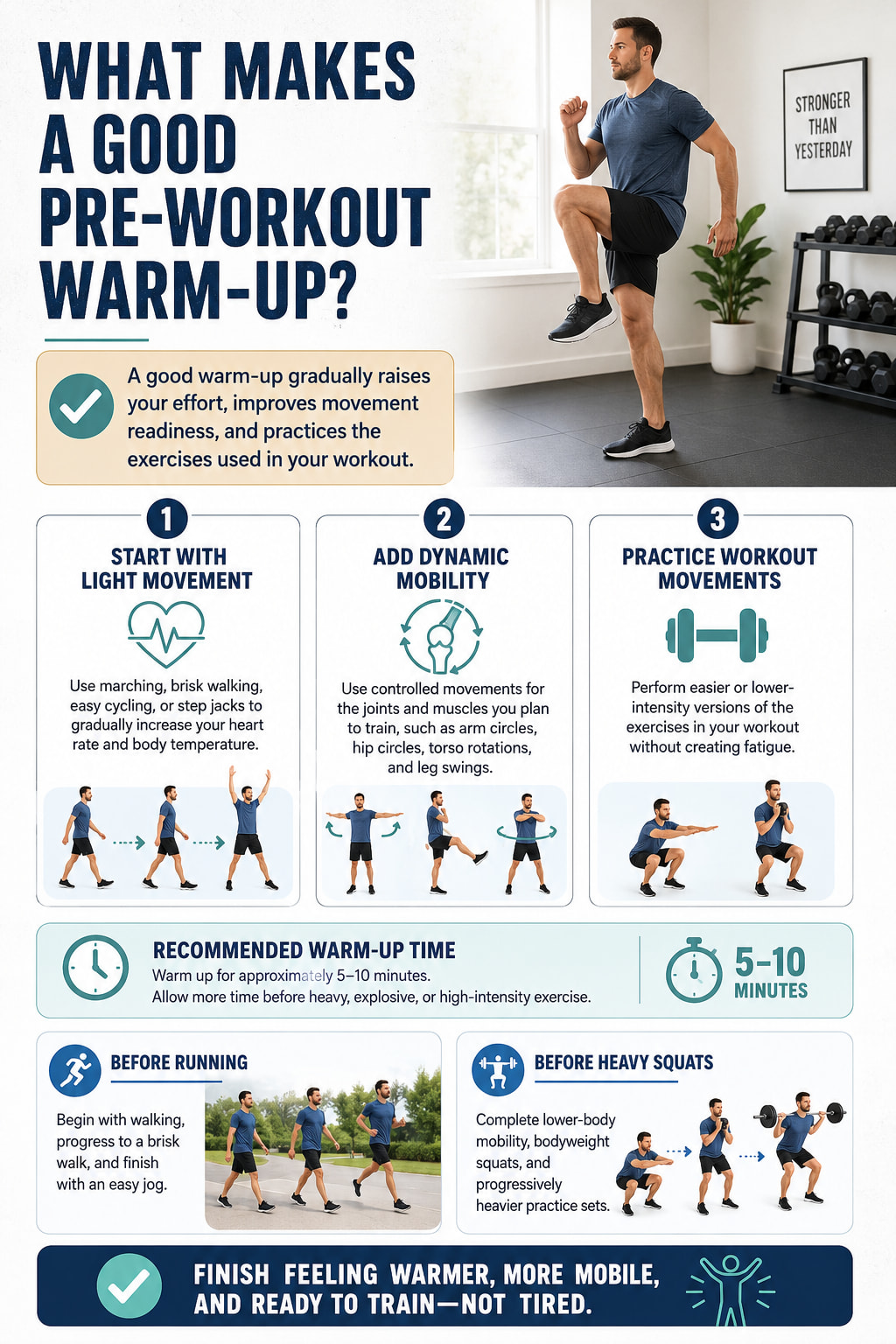
A useful warm-up normally includes three stages:
- Light movement to gradually increase heart rate and body temperature
- Dynamic mobility for the joints and muscles you plan to use
- Lower-intensity practice of the movements in your workout
The American Heart Association recommends warming up for approximately 5–10 minutes and allowing more time before higher-intensity activity. The warm-up should resemble the planned activity but use a slower pace or lighter effort.
For example, warm up for running by walking and gradually progressing to an easy jog. Before heavy squats, complete general lower-body movements and then perform progressively heavier practice sets of the squat.
Benefits of Warm-Up Exercises
A structured warm-up can help you:
- Transition gradually from rest to exercise
- Increase muscle temperature and blood flow
- Move through the ranges of motion required by the workout
- Rehearse exercise technique with little or no resistance
- Improve coordination and movement readiness
- Mentally prepare for the training session
A systematic review and meta-analysis found that warming up improved many of the physical-performance outcomes examined. The exact response depends on the warm-up method, duration, intensity, and activity that follows.
A warm-up may also support safer movement, but it cannot guarantee injury prevention. Exercise selection, technique, fatigue, training load, recovery, and progression still matter.
Dynamic Versus Static Stretching Before Exercise
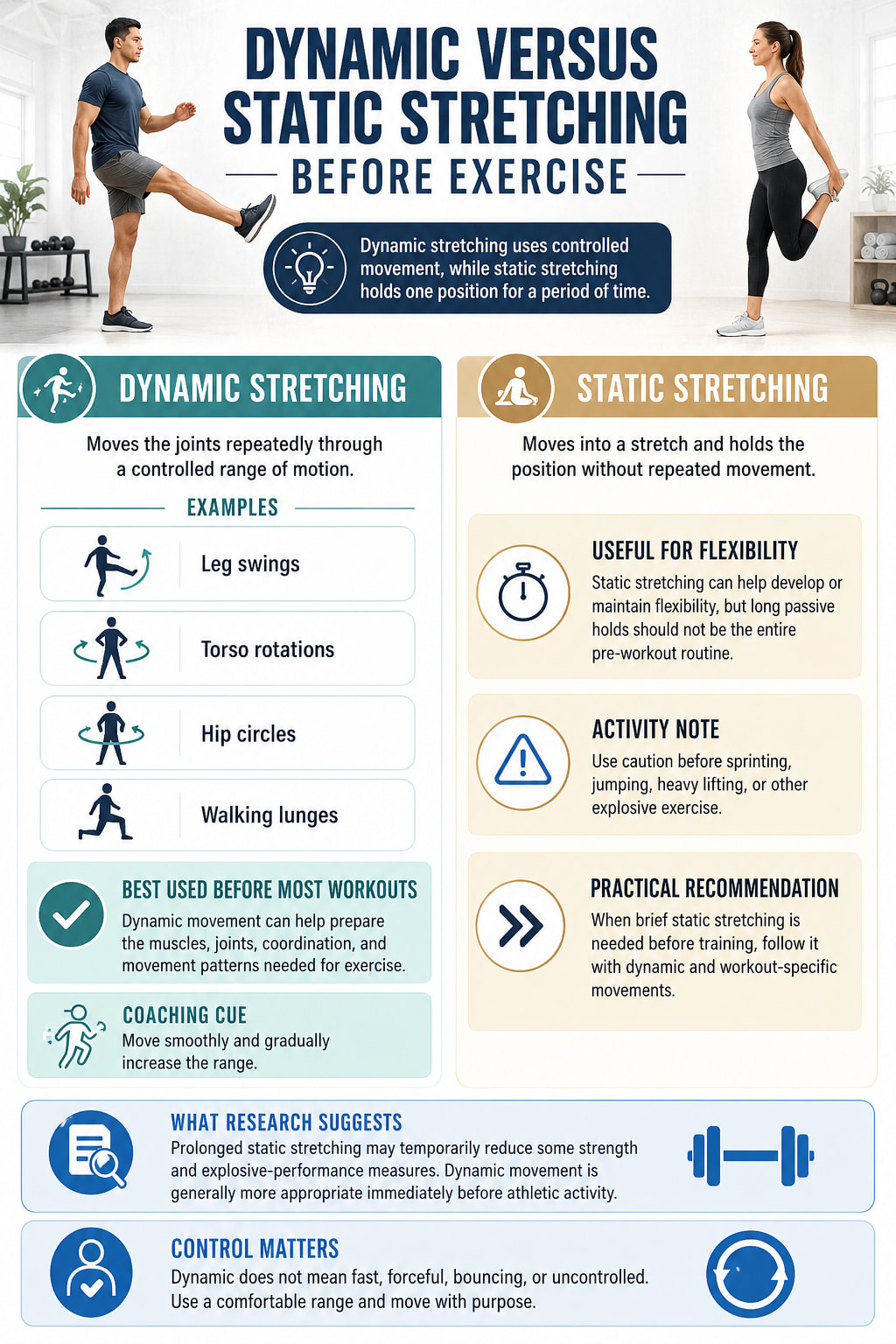
Dynamic stretching moves your joints repeatedly through a controlled range. Leg swings, torso rotations, hip circles, and walking lunges are common examples.
Static stretching involves moving into a stretch and holding the position. Static stretching can be useful for flexibility, but long passive holds should not be the entire pre-workout routine, particularly before sprinting, jumping, heavy lifting, or other explosive activities.
Research reviews suggest that prolonged static stretching can temporarily reduce some strength and explosive-performance measures, while dynamic movement is generally more suitable immediately before athletic activity. Brief static stretching may still be used when a specific range of motion is necessary, but it should usually be followed by dynamic and activity-specific movements.
Move smoothly during every exercise. Dynamic does not mean fast, forceful, or uncontrolled.
10 Good Warm-Up Exercises Before Any Workout
These movements form a full-body warm-up toolbox. You do not have to perform all ten before every session. Select the exercises that best match your workout, available time, mobility, and experience level.
1. March in Place or Brisk Walk
Best for: Beginning any warm-up, low-impact preparation, beginners, home workouts, and gradually raising your effort level.
Muscles worked: Hip flexors, quadriceps, glutes, calves, core, and shoulders work lightly as you coordinate the arms and legs.
Why it stands out: Marching is an accessible way to move from rest into exercise. It increases movement gradually without requiring jumping, floor work, or equipment.
Suggested time and rest: March for 45–90 seconds. Begin slowly and gradually increase your pace. No planned rest is necessary before the next movement.
How to do it:
- Stand tall with your feet approximately hip-width apart.
- Lift one knee to a comfortable height while swinging the opposite arm forward.
- Lower the foot under control and repeat on the other side.
- Keep your chest upright and your shoulders relaxed.
- Gradually increase the pace without stomping or leaning backward.
Common mistakes: Starting too quickly, leaning backward to lift the knees, holding the breath, and landing heavily.
Expert tip: Think about lifting your feet quietly rather than trying to drive your knees as high as possible.
Marching is also included in the beginner warm-up recommended by the NHS.
2. Step Jacks
Best for: Full-body cardio preparation, low-impact workouts, circuit training, and people who do not want to perform jumping jacks.
Muscles worked: Calves, quadriceps, glutes, inner and outer thighs, shoulders, and upper back.
Why it stands out: Step jacks provide the coordinated arm-and-leg action of jumping jacks without requiring both feet to leave the floor.
Suggested time and rest: Perform 20–40 seconds at an easy-to-moderate pace. Rest only long enough to reposition for the next movement.
How to do it:
- Stand with your feet together and your arms by your sides.
- Step your right foot out while raising both arms overhead.
- Bring the foot back in as you lower your arms.
- Repeat with the left foot.
- Continue alternating sides at a smooth, comfortable pace.
Common mistakes: Rushing the steps, shrugging the shoulders, landing on a locked knee, and allowing the feet to turn excessively outward.
Expert tip: Keep the movement rhythmic and light. Your goal is to become warmer, not to complete as many repetitions as possible.
3. Arm Circles and Shoulder Rolls
Best for: Upper-body workouts, pressing, rowing, swimming, resistance-band sessions, and desk workers preparing to exercise.
Muscles worked: Deltoids, upper back, trapezius, rotator-cuff muscles, chest, and muscles around the shoulder blades.
Why it stands out: This combination gradually introduces movement around the shoulders before push-ups, presses, rows, pulls, or overhead exercises.
Suggested time and rest: Perform 5–10 shoulder rolls in each direction, followed by 5–10 small and large arm circles in each direction.
How to do it:
- Stand tall with your arms relaxed by your sides.
- Roll your shoulders forward through a comfortable circle.
- Reverse the direction after completing the planned repetitions.
- Extend your arms out to the sides and begin making small circles.
- Gradually increase the circle size while keeping the movement controlled.
Common mistakes: Moving too aggressively, arching the lower back, forcing the hands behind the body, and shrugging toward the ears.
Expert tip: Allow the shoulder blades to move naturally instead of keeping them rigidly pulled back.
The NHS uses shoulder rolls as part of its general pre-exercise sequence, beginning with controlled repetitions rather than rapid circles.
4. Controlled Torso Rotations
Best for: Full-body workouts, rotational sports, upper-body training, and preparing the upper back and trunk to move.
Muscles worked: Obliques, spinal muscles, upper back, abdominals, shoulders, and deep core stabilizers.
Why it stands out: Torso rotations add a movement direction often missing from basic warm-ups. They can help prepare the trunk for reaching, pulling, running, and controlled rotational movements.
Suggested time and rest: Perform 8–12 controlled rotations per side.
How to do it:
- Stand with your feet slightly wider than hip-width apart.
- Soften your knees and brace your abdomen lightly.
- Hold your arms in front of your chest.
- Rotate your rib cage to one side without forcing the movement.
- Return to the center and rotate to the other side.
Common mistakes: Twisting forcefully through the lower back, locking the knees, moving too quickly, and trying to achieve maximum range immediately.
Expert tip: Rotate through your rib cage and upper back while keeping your pelvis relatively controlled.
5. Standing Hip Circles
Best for: Lower-body workouts, walking, running, cycling, squats, lunges, and improving awareness of hip movement.
Muscles worked: Hip flexors, glutes, adductors, abductors, deep hip rotators, and core stabilizers.
Why it stands out: Hip circles move the hip joint in several directions and can reveal whether one side needs a slower or smaller range before training.
Suggested time and rest: Perform 5–8 circles in each direction per leg.
How to do it:
- Stand beside a wall or stable support.
- Shift your weight onto one leg without locking the knee.
- Lift the opposite knee to a comfortable height.
- Guide the knee outward and around in a smooth circle.
- Complete the repetitions before reversing the movement and changing legs.
Common mistakes: Making circles so large that the pelvis twists, leaning heavily to one side, moving rapidly, and holding the breath.
Expert tip: Make the circle only as large as you can control without shifting your entire torso.
6. Front-to-Back and Side-to-Side Leg Swings
Best for: Running, lower-body strength training, sports, squats, lunges, deadlifts, and workouts requiring larger hip ranges.
Muscles worked: Hip flexors, hamstrings, glutes, inner thighs, outer hips, and core.
Why it stands out: Leg swings dynamically prepare the muscles surrounding the hips without holding a prolonged stretch.
Suggested time and rest: Perform 8–12 front-to-back swings and 8–12 side-to-side swings per leg.
How to do it:
- Stand beside a wall and hold it lightly for balance.
- Shift your weight onto the leg farthest from the wall.
- Swing the other leg forward and backward using a small range.
- Gradually increase the range without forcing it.
- Turn toward the wall and repeat with controlled side-to-side swings.
Common mistakes: Using momentum, arching the lower back, rotating the entire body, forcing a high swing, and bending the supporting knee excessively.
Expert tip: Let the leg move like a controlled pendulum while keeping your trunk quiet.
The Hospital for Special Surgery recommends slow, controlled leg swings as a dynamic way to prepare the hip flexors and hamstrings.
7. Bodyweight Squats
Best for: Leg workouts, full-body strength sessions, functional training, cycling, running, and practicing squat mechanics.
Muscles worked: Quadriceps, glutes, adductors, hamstrings, calves, spinal erectors, and core.
Why it stands out: The bodyweight squat prepares several major lower-body joints and rehearses a movement pattern used in many gym and daily activities.
Suggested sets and reps: Perform 1–2 sets of 8–12 controlled repetitions. Rest for approximately 15–30 seconds when completing a second set.
How to do it:
- Stand with your feet approximately shoulder-width apart.
- Brace your abdomen gently and keep your whole foot on the floor.
- Bend your knees and hips as you sit down and slightly back.
- Descend only as far as you can maintain control.
- Push through your feet and stand tall without leaning backward.
Common mistakes: Allowing the knees to collapse inward, lifting the heels, dropping quickly, rounding excessively, and forcing a depth you cannot control.
Expert tip: Keep pressure across the heel, base of the big toe, and base of the little toe.
8. Alternating Reverse Lunges With Reach
Best for: Lower-body workouts, running, split squats, sports, full-body training, and preparing single-leg balance.
Muscles worked: Quadriceps, glutes, hamstrings, calves, hip flexors, core, shoulders, and upper back.
Why it stands out: The reverse step is often easier to control than a forward lunge. Adding a reach introduces coordinated movement through the hips, trunk, and shoulders.
Suggested sets and reps: Perform 5–8 repetitions per side. Move continuously or pause briefly between repetitions when balance is challenging.
How to do it:
- Stand tall with your feet approximately hip-width apart.
- Step one foot backward and place the ball of that foot on the floor.
- Bend both knees slightly while keeping your front foot planted.
- Reach both arms upward without overextending your lower back.
- Push through the front foot to return to standing and switch sides.
Common mistakes: Using an excessively long step, losing front-foot contact, allowing the front knee to collapse inward, and arching the back during the reach.
Expert tip: Begin with a shallow lunge. Range of motion should increase only after your balance and control improve.
9. Lateral Lunges
Best for: Leg training, court sports, side-to-side movement, hip preparation, and workouts that include squats or lunges.
Muscles worked: Inner thighs, glutes, quadriceps, hamstrings, outer hips, calves, and core.
Why it stands out: Many daily activities and exercises happen primarily in a forward-and-backward direction. Lateral lunges introduce controlled side-to-side loading.
Suggested sets and reps: Perform 5–8 repetitions per side, alternating sides or completing one side at a time.
How to do it:
- Stand with your feet together and your torso upright.
- Step one foot out to the side.
- Bend the stepping knee while pushing your hips back.
- Keep the opposite leg comfortably straight and both feet planted.
- Push through the bent leg to return to the starting position.
Common mistakes: Turning the stepping foot excessively outward, allowing the knee to collapse inward, rounding the back, and attempting a deep position before the hips are ready.
Expert tip: Imagine sitting one hip back toward a chair positioned behind that side of your body.
10. Inchworm to High Plank
Best for: Full-body workouts, push-up preparation, upper-body strength training, core work, and sessions requiring shoulder stability.
Muscles worked: Shoulders, chest, triceps, abdominals, hip flexors, hamstrings, calves, and upper back.
Why it stands out: The inchworm combines upper-body support, core control, shoulder preparation, and dynamic movement through the backs of the legs.
Suggested sets and reps: Perform 3–5 controlled repetitions. Rest for 15–30 seconds if your shoulders or core begin to fatigue.
How to do it:
- Stand with your feet approximately hip-width apart.
- Soften your knees and hinge forward to place your hands on the floor.
- Walk your hands forward until you reach a strong high-plank position.
- Pause briefly without allowing your hips to sag.
- Walk your hands back and return to standing under control.
Common mistakes: Rushing, allowing the lower back to sag, shrugging the shoulders, forcing straight knees, and completing enough repetitions to fatigue the arms.
Expert tip: Bend your knees as much as necessary. This is a warm-up movement, not a hamstring-flexibility test.
Sample 7-Minute Full-Body Warm-Up Routine
Complete one round at approximately 3–4 out of 10 effort. Move steadily between exercises, resting only when necessary for balance or positioning.
| Exercise | Time or repetitions |
|---|---|
| March in place | 45–60 seconds |
| Step jacks | 30 seconds |
| Shoulder rolls and arm circles | 5–8 each direction |
| Torso rotations | 8 per side |
| Hip circles | 5 per direction on each leg |
| Leg swings | 8 in each direction per leg |
| Bodyweight squats | 8–10 reps |
| Reverse lunges with reach | 5 per side |
| Lateral lunges | 5 per side |
| Inchworms or wall walkouts | 3–4 reps |
After this general routine, spend another 1–5 minutes practicing movements specific to your workout.
Do not increase warm-up difficulty simply to make it feel more challenging. Progress by improving control, gradually expanding your range of motion, and selecting movements that better match your main session.
How to Adjust Your Warm-Up for Different Workouts
Before Strength Training
Complete 3–5 minutes of general movement, followed by mobility exercises for the joints you will train. Then perform progressively heavier practice sets of your first major lift.
For example, before a squat workout:
- March or cycle easily
- Perform leg swings and hip circles
- Complete bodyweight squats and reverse lunges
- Perform several squat warm-up sets, gradually adding weight
Reduce the repetitions as the practice weight increases. None of the warm-up sets should feel like a difficult working set.
The Mayo Clinic recommends 5–10 minutes of brisk walking or another light aerobic activity before lifting weights.
Before Running or Cardio
Begin with walking or easy movement rather than immediately starting at your planned training pace.
A simple progression is:
- Easy walk
- Brisk walk
- Controlled leg swings
- Bodyweight squats or shallow lunges
- Easy jog or slower version of the planned cardio activity
The first few minutes of the run, ride, or machine workout can remain part of the warm-up. Mayo Clinic recommends performing the planned aerobic activity at a slower pace and lower intensity before increasing the effort.
Before an Upper-Body Workout
Prioritize:
- Marching or step jacks
- Shoulder rolls
- Arm circles
- Torso rotations
- Wall walkouts or inchworms
- Light rows, presses, push-ups, or band exercises
Finish with lighter practice sets of the first pressing or pulling exercise.
Before a Lower-Body Workout
Prioritize:
- Marching
- Hip circles
- Leg swings
- Bodyweight squats
- Reverse lunges
- Lateral lunges
Before lifting, add practice sets of the first squat, hinge, lunge, or machine exercise.
Before HIIT or Sports
A high-intensity session generally needs a longer and more specific warm-up than an easy workout.
Begin with the general exercises, then practice the exact movements you plan to perform at a reduced speed. Gradually introduce changes of direction, faster running, jumping, or explosive movements. Avoid moving directly from slow mobility drills into maximal effort.
The National Strength and Conditioning Association emphasizes preparing for the specific demands of training while avoiding unnecessary fatigue.
Beginner Warm-Up Modifications
Beginners do not need to complete the hardest version of every exercise. Start with five or six movements that you can perform comfortably.
A simple beginner combination is:
- March in place
- Step jacks
- Shoulder rolls
- Hip circles with support
- Chair squats
- Side-to-side weight shifts
- Wall walkouts
Perform one round with slow transitions. Use a stable wall, counter, or chair when balance is uncertain.
As your control improves, gradually increase your movement range or add another exercise. Avoid progressing the speed, impact, range, and total volume at the same time.
Common Warm-Up Mistakes
Turning the Warm-Up Into a Workout
High repetitions, hard circuits, long planks, and demanding jumps can create fatigue before the main session. Keep most warm-up movements at an easy-to-moderate effort.
Starting Too Fast
The first exercise should be one of the easiest. Increase your pace and range gradually rather than beginning with deep lunges, fast jumps, or maximal leg swings.
Performing Only Static Stretches
Holding several stretches may improve temporary range of motion, but it does not raise your heart rate or rehearse the complete movements used in your workout. Combine any necessary stretching with general and dynamic activity.
Forcing Range of Motion
A warm-up should help your range develop gradually. Do not bounce, wrench a joint, or copy someone with greater flexibility.
Using the Same Routine for Every Workout
A general warm-up is a starting point, not the whole plan. The final movements should reflect the muscles, joints, speed, and skills required by the session.
Skipping Practice Sets Before Heavy Lifting
Bodyweight movements do not fully prepare you for a heavy barbell or machine exercise. Use lighter sets to practice setup, bracing, technique, and load progression.
Ignoring Pain or Unusual Symptoms
A warm-up should not cause sharp pain, numbness, dizziness, chest pain, or unusual shortness of breath. Stop exercising and seek appropriate professional help if these symptoms occur.
How Long Should a Warm-Up Last?
Approximately 5–10 minutes is suitable for many general workouts. More preparation may be useful before:
- Heavy strength training
- Sprinting or jumping
- High-intensity intervals
- Competitive sports
- Exercise in a cold environment
- Technically demanding movements
- Training after a long period of sitting
Your warm-up is probably sufficient when you feel warmer, your movements feel smoother, and your breathing has increased slightly without significant fatigue.
The American Heart Association notes that more intense activity generally requires a longer warm-up.
How Often Should You Warm Up?
Warm up before each structured workout. The exact routine does not have to be identical every time.
A short, easy workout may require only a few minutes of gradual movement. A heavy or explosive session may require a longer general warm-up followed by several minutes of specific preparation.
On days when you feel stiff or cold, extend the gradual movement phase rather than immediately forcing deeper stretches.
Frequently Asked Questions
What are the best warm-up exercises before a workout?
Useful full-body options include marching, step jacks, arm circles, torso rotations, hip circles, leg swings, squats, reverse lunges, lateral lunges, and inchworms. The best selection depends on the workout that follows.
Is five minutes enough for a warm-up?
Five minutes may be enough before an easy or moderate session when the movements are well chosen. Heavy lifting, intense running, sports, and explosive workouts often require a longer general and activity-specific warm-up.
Should I complete all ten exercises every time?
No. Choose approximately five to eight movements that match your workout. A leg workout needs more hip, knee, and ankle preparation, while an upper-body workout should include more shoulder, upper-back, and pressing or pulling practice.
Should I stretch before or after working out?
Use controlled dynamic movements before most workouts. Longer static stretches are often better placed after training or in a separate flexibility session. When a brief static stretch is needed before exercise, follow it with dynamic and workout-specific movements.
Do I need to warm up before strength training?
Yes. Begin with general movement and then perform lighter practice sets of the exercise you plan to load. This allows you to rehearse technique and gradually adjust to heavier resistance.
Can warming up prevent injuries?
A warm-up may help prepare your body and may contribute to a sensible risk-reduction strategy, but it cannot prevent every injury. Appropriate exercise selection, technique, progressive loading, recovery, and avoiding excessive fatigue remain important. Reviews of warm-up programs suggest potentially protective effects, but results depend on the program and activity.
How hard should a warm-up feel?
Most of the general warm-up should feel easy to moderate, around 3–4 out of 10 effort. You may breathe slightly faster and begin to feel warm, but you should still feel ready to complete your main workout.
Conclusion
Good warm-up exercises should create a gradual bridge between rest and training. Start with easy full-body movement, add controlled dynamic mobility, and finish by practicing the movements used in your workout.
You do not need a complicated routine. Select the exercises that match the session, maintain controlled form, and stop the warm-up before fatigue affects your main training.
References
- American Heart Association: Warm Up, Cool Down
- Mayo Clinic: Aerobic Exercise—How to Warm Up and Cool Down
- National Strength and Conditioning Association: Introduction to Dynamic Warm-Up
- Hospital for Special Surgery: Static and Dynamic Stretching
- Effects of Warming Up on Physical Performance: Systematic Review and Meta-Analysis
- Acute Effects of Muscle Stretching on Performance and Range of Motion