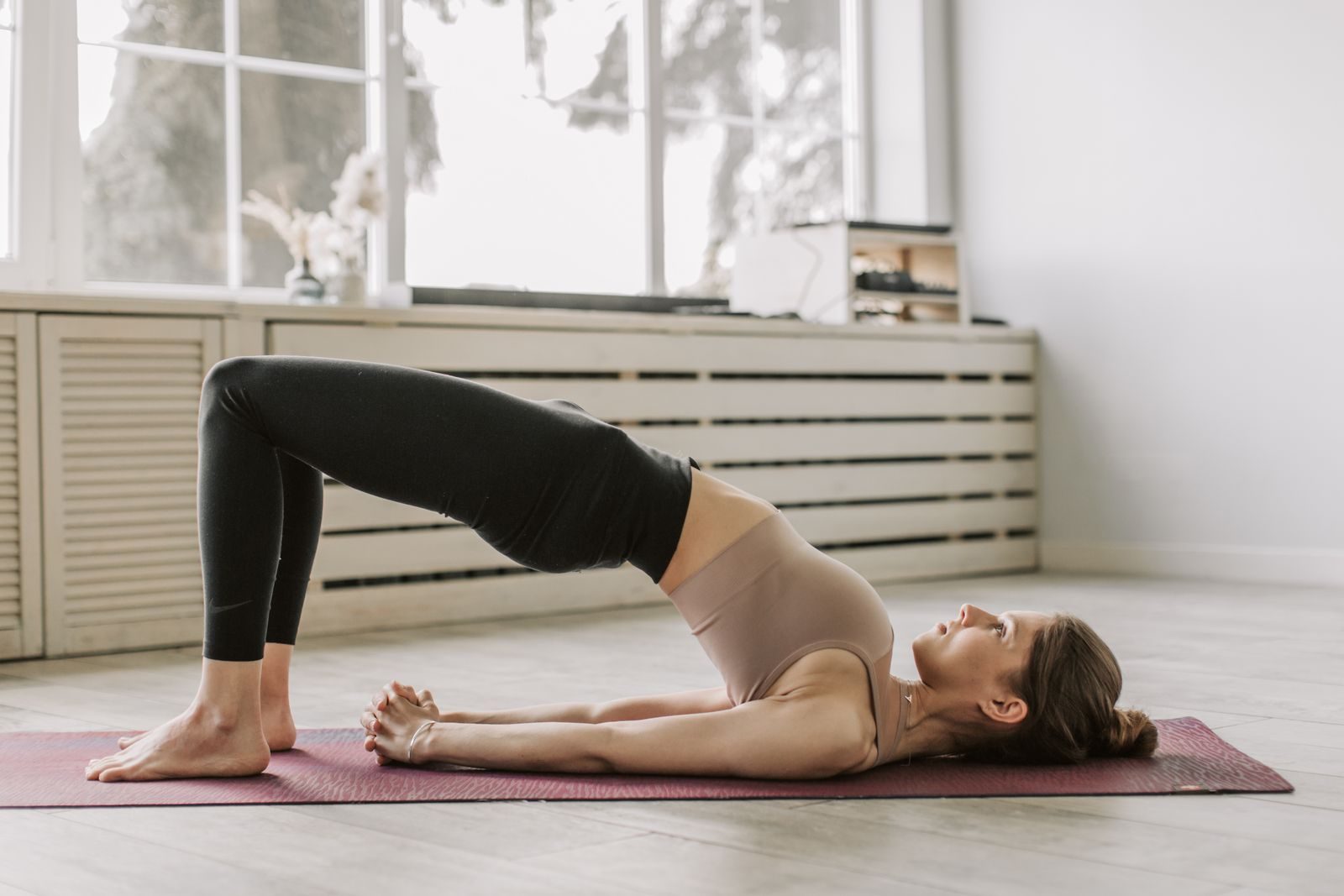
You can build a balanced, full-body Pilates routine at home without a reformer, ring, ball, weights, or other specialized equipment. These 11 Pilates exercises at home train your core, glutes, hips, back, shoulders, and arms while also improving movement control and coordination.
Mat Pilates uses body weight and gravity for resistance, according to the Victorian Government’s Better Health Channel. A mat is helpful for comfort, but a clear floor space with a stable, lightly padded surface is enough to begin.
Pilates Exercises at Home at a Glance
| Exercise | Main Training Focus | Starting Target | Easier Option |
|---|---|---|---|
| Pelvic Curl | Glutes and spinal control | 8–10 reps | Small-range bridge |
| The Hundred | Abdominal endurance and breathing | 5 breath cycles | Head down and feet planted |
| Roll-Up | Abdominal control and spinal movement | 5–8 reps | Half roll-back |
| Single-Leg Circle | Hip mobility and pelvic stability | 5 circles each direction | Bend the moving knee |
| Single-Leg Stretch | Core stability with leg movement | 6–10 reps per side | Keep the head down |
| Criss-Cross | Oblique strength and rotation | 5–8 reps per side | Keep one foot down |
| Spine Stretch Forward | Spinal control and posterior mobility | 5–8 reps | Bend the knees |
| Swan Prep | Upper-back extension | 6–8 reps | Use a smaller lift |
| Swimming | Back endurance and coordination | 15–30 seconds | Lift one limb at a time |
| Side Kick Front and Back | Hip strength and pelvic stability | 6–10 reps per side | Use a smaller range |
| Pilates Push-Up | Upper-body and core strength | 3–5 reps | Wall or knee push-up |
Before You Start
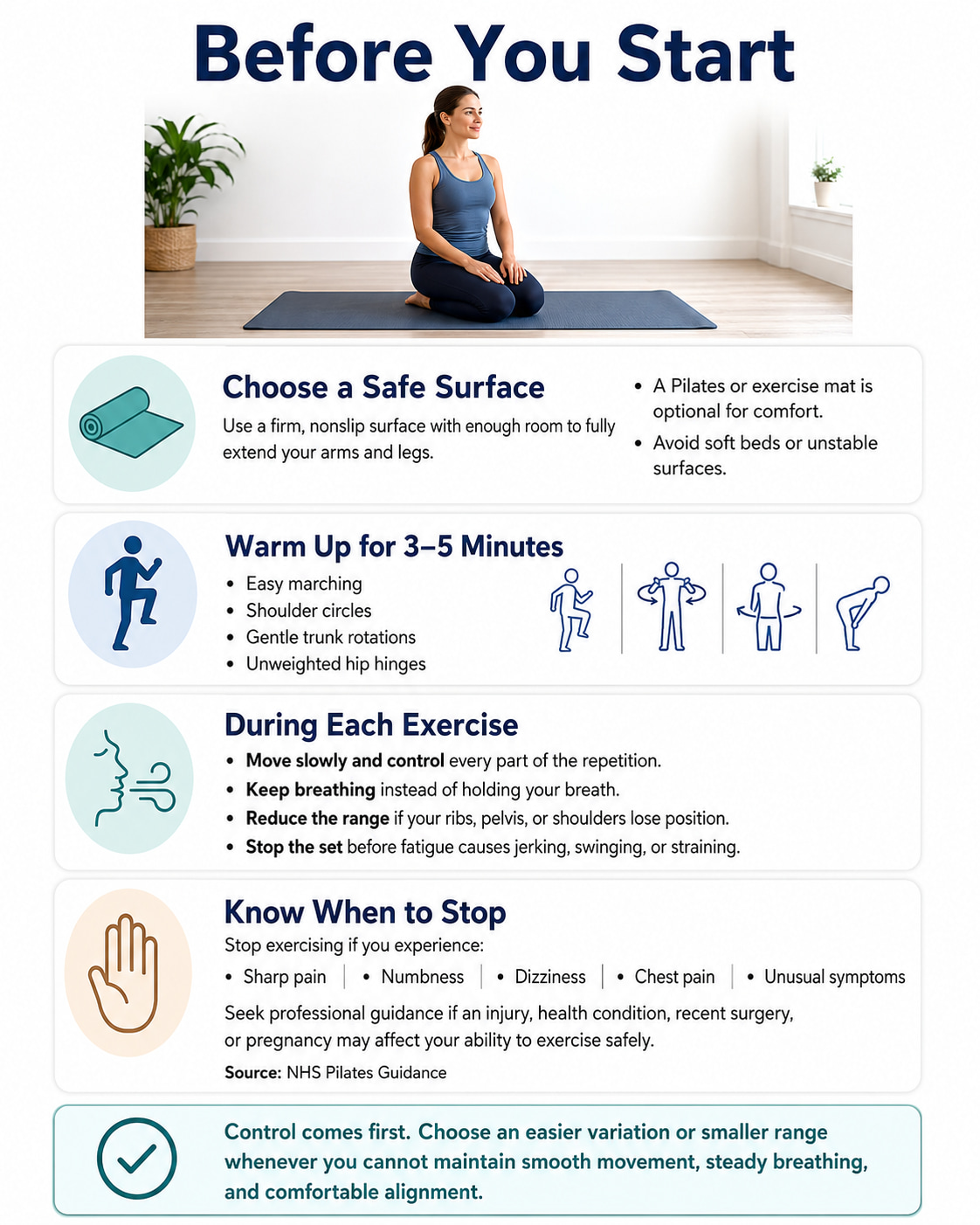
Choose a firm, nonslip surface with enough room to extend your arms and legs. A Pilates or exercise mat is optional but can make kneeling and lying positions more comfortable. Avoid practicing on a soft bed or unstable surface.
Warm up for three to five minutes with easy marching, shoulder circles, gentle trunk rotations, and unweighted hip hinges.
During each exercise:
- Move slowly enough to control every part of the repetition.
- Keep breathing rather than holding your breath.
- Use a smaller range when your ribs, pelvis, or shoulders begin to lose position.
- Stop the set before fatigue causes jerking, swinging, or straining.
Stop exercising if you experience sharp pain, numbness, dizziness, chest pain, or unusual symptoms. The NHS Pilates guidance recommends getting professional advice when an injury, health condition, recent surgery, or pregnancy may affect exercise suitability.
11 Best Pilates Exercises at Home
These exercises cover spinal flexion and extension, trunk stability, rotation, hip control, glute strength, and upper-body support. Use the listed regressions whenever you cannot maintain steady breathing and controlled alignment.
1. Pelvic Curl
Best for: Activating the glutes, learning controlled spinal movement, and preparing the body for the rest of the session.
Muscles worked: Gluteus maximus, hamstrings, abdominals, and spinal stabilizers.
Sets, reps, and rest: Perform 1–2 sets of 8–10 repetitions. Rest for 20–30 seconds.
How to Do It
- Lie on your back with your knees bent and feet flat, approximately hip-width apart.
- Rest your arms beside your body with your palms facing down.
- Exhale and gently tighten your abdominal muscles as you tilt your pelvis toward you.
- Slowly lift your hips, peeling your spine away from the floor one section at a time.
- Stop when your shoulders, hips, and knees form a comfortable line.
- Inhale at the top, then exhale as you slowly roll your spine back to the floor.
Common mistakes: Do not force your hips so high that your lower back arches. Keep your knees tracking forward rather than allowing them to fall inward or outward.
Regression or progression: Use a smaller lift or raise the hips as one unit if spinal articulation feels difficult. Progress to a marching pelvic curl by briefly lifting one foot without allowing the pelvis to drop or rotate.
2. The Hundred
Best for: Building abdominal endurance while coordinating movement with breathing.
Muscles worked: Rectus abdominis, obliques, deeper trunk stabilizers, and hip flexors.
Sets, reps, and rest: Begin with one set of 5 breath cycles, or 50 arm pumps. Progress toward 10 cycles, or 100 pumps. Rest for 30–45 seconds.
How to Do It
- Lie on your back with your knees bent and feet flat.
- Raise your legs to a tabletop position if you can keep your pelvis steady.
- Lift your head and shoulder blades while keeping a small, comfortable space beneath your chin.
- Extend your arms beside your body, a few inches above the floor.
- Pump your arms through a small, controlled range.
- Inhale for five pumps and exhale for five pumps.
You can extend your legs only as far as you can without losing control of your trunk or allowing your lower back to arch excessively.
Common mistakes: Avoid pulling the head forward, pumping only from the wrists, shrugging the shoulders, or lowering the legs beyond your controllable range.
Regression or progression: Keep your head down and feet on the floor for an easier version. Make the exercise harder by extending the legs farther away while maintaining steady trunk position.
3. Roll-Up
Best for: Developing abdominal control through a slow transition between lying and sitting.
Muscles worked: Rectus abdominis, obliques, hip flexors, and spinal stabilizers.
Sets, reps, and rest: Perform 1–2 sets of 5–8 repetitions. Rest for 30 seconds.
How to Do It
- Lie on your back with your legs extended. Bend your knees slightly if your hamstrings feel restrictive.
- Extend your arms overhead only as far as your ribs can remain controlled.
- Bring your arms toward the ceiling and gently nod your head forward.
- Exhale as you slowly roll your upper body away from the floor.
- Reach forward over your legs without collapsing your shoulders.
- Reverse the movement and lower one section of your spine at a time.
Common mistakes: Avoid throwing your arms forward, using momentum, holding your breath, or dropping quickly during the lowering phase.
Regression or progression: Sit with your knees bent and perform a half roll-back, stopping before your lower back reaches the floor. Progress by straightening your legs and using a three- to five-second lowering phase.
4. Single-Leg Circle
Best for: Improving hip mobility while teaching the core to prevent unwanted pelvic movement.
Muscles worked: Hip flexors, adductors, gluteal muscles, obliques, and other trunk stabilizers.
Sets, reps, and rest: Perform 5 circles in each direction with each leg. Rest briefly when changing legs.
How to Do It
- Lie on your back with both legs extended.
- Raise one leg toward the ceiling while keeping the opposite leg long on the floor.
- Keep your arms beside your body and your pelvis level.
- Move the raised leg slightly across your body, then down, outward, and back to the starting position.
- Complete all repetitions before reversing the direction.
- Lower the leg and repeat on the other side.
The circle should be only as large as you can control without your hips rocking.
Common mistakes: Do not create a large circle by twisting your pelvis or lifting the opposite hip. Avoid locking the knee or moving too quickly.
Regression or progression: Bend the moving knee and make smaller circles. Progress by increasing the circle slightly while keeping both sides of your pelvis steady.
5. Single-Leg Stretch
Best for: Training abdominal stability while the legs move independently.
Muscles worked: Rectus abdominis, obliques, hip flexors, and deeper trunk stabilizers.
Sets, reps, and rest: Perform 1–2 sets of 6–10 repetitions per side. Rest for 20–30 seconds.
How to Do It
- Lie on your back and bring both knees toward a tabletop position.
- Lift your head and shoulder blades if you can do so without neck strain.
- Bring one knee toward your torso while extending the opposite leg away.
- Rest your hands lightly on the bent leg without pulling it forcefully inward.
- Switch legs smoothly while keeping your pelvis and rib cage steady.
- Continue alternating at a controlled pace.
Common mistakes: Avoid yanking the knee, lifting through the neck, allowing the lower back to arch, or extending the leg too close to the floor.
Regression or progression: Keep your head down and lightly tap one foot to the floor instead of fully extending the leg. Progress by lengthening the extended leg lower, provided your trunk remains stable.
6. Criss-Cross
Best for: Strengthening the obliques and practicing controlled trunk rotation.
Muscles worked: Internal and external obliques, rectus abdominis, hip flexors, and deep trunk stabilizers.
Sets, reps, and rest: Perform 1–2 sets of 5–8 repetitions per side. Rest for 30–45 seconds.
How to Do It
- Lie on your back with your knees in a tabletop position.
- Place your hands behind your head and keep your elbows comfortably open.
- Lift your head and shoulder blades without pulling on your neck.
- Rotate your rib cage toward one bent knee as you extend the opposite leg.
- Return through the center and switch sides.
- Move slowly enough to complete the rotation with your torso rather than simply moving your elbow.
Common mistakes: Do not pull your head forward or force your elbow toward your knee. Keep your hips level and avoid quickly swinging from side to side.
Regression or progression: Keep one foot on the floor as you rotate toward the opposite knee. Progress by slowing each rotation and extending the straight leg farther away.
7. Spine Stretch Forward
Best for: Practicing controlled spinal flexion while gently lengthening the back of the body.
Muscles worked: Abdominals and spinal stabilizers. The spinal extensors, glutes, and hamstrings are lengthened during the forward movement.
Sets, reps, and rest: Perform 1–2 sets of 5–8 repetitions. Rest as needed.
How to Do It
- Sit upright with your legs slightly wider than hip-width.
- Bend your knees if you cannot sit tall comfortably.
- Extend your arms forward at shoulder height.
- Inhale and lengthen through the top of your head.
- Exhale as you gently nod your head and round forward one section at a time.
- Keep your hips grounded and reach forward rather than dropping downward.
- Inhale, then slowly restack your spine to return upright.
Common mistakes: Avoid forcing the stretch, shrugging your shoulders, collapsing suddenly, or turning the exercise into a fast reach toward your toes.
Regression or progression: Bend your knees and reduce the forward range. Progress by moving more slowly and reaching farther only when you can keep your hips grounded.
8. Swan Prep
Best for: Strengthening the upper-back extensors and balancing routines that contain several forward-flexion exercises.
Muscles worked: Thoracic spinal extensors, lower trapezius, glutes, and abdominal stabilizers.
Sets, reps, and rest: Perform 1–2 sets of 6–8 repetitions. Rest for 30–45 seconds.
How to Do It
- Lie face-down with your legs approximately hip-width apart.
- Place your hands beneath or slightly ahead of your shoulders with your elbows bent.
- Keep your pelvis and legs grounded as you lengthen through the top of your head.
- Draw your shoulders away from your ears.
- Use your upper-back muscles and light hand pressure to lift your chest.
- Stop before you feel compression in your lower back.
- Lower slowly to the starting position.
Common mistakes: Avoid pushing entirely with your arms, throwing your head backward, lifting too high, or allowing your shoulders to rise toward your ears.
Regression or progression: Lift only your head and upper chest through a small range. Progress by increasing the lift gradually or briefly reducing hand pressure while maintaining the position.
9. Swimming
Best for: Building back-extensor endurance and coordinating opposite-side arm and leg movement.
Muscles worked: Erector spinae, multifidus, glutes, hamstrings, posterior shoulders, and upper-back muscles.
Sets, reps, and rest: Perform 2 sets of 15–30 seconds. Rest for 30–45 seconds.
How to Do It
- Lie face-down with your arms extended overhead and legs long behind you.
- Keep your neck in line with your spine and look toward the floor.
- Gently brace your abdomen and lengthen your arms and legs away from your torso.
- Lift one arm and the opposite leg a small distance.
- Lower them and switch sides.
- Continue alternating without allowing your torso to rock.
The goal is to create length and control, not to lift your limbs as high as possible.
Common mistakes: Avoid looking forward, holding your breath, rapidly kicking, or creating the movement by excessively arching your lower back.
Regression or progression: Lift one arm or one leg at a time. Progress to continuous alternating reaches while keeping the movement small and controlled.
10. Side Kick Front and Back
Best for: Strengthening the hips while challenging the side of the core to stabilize the pelvis.
Muscles worked: Gluteus medius, gluteus maximus, hip flexors, hamstrings, and obliques.
Sets, reps, and rest: Perform 1–2 sets of 6–10 repetitions per side. Rest briefly before changing sides.
How to Do It
- Lie on your side with your hips and shoulders stacked.
- Support your head with your lower arm and place your top hand on the floor.
- Position your legs slightly in front of your torso for balance.
- Raise your top leg to approximately hip height.
- Move the leg forward without rolling your pelvis backward.
- Reach the leg behind you without arching your lower back.
- Continue moving between the two positions with control.
Common mistakes: Avoid swinging the leg, collapsing into the supporting shoulder, rolling the hips, or increasing the range by arching your back.
Regression or progression: Bend the bottom knee and use a smaller kick. Progress by pausing at the front and back of each repetition or using less pressure through the supporting hand.
11. Pilates Push-Up
Best for: Combining spinal control, core stability, and upper-body pushing strength.
Muscles worked: Pectoralis major, triceps, anterior deltoids, serratus anterior, abdominals, and shoulder stabilizers.
Sets, reps, and rest: Perform 1–2 sets of 3–5 complete repetitions. Rest for 45–60 seconds.
How to Do It
- Stand tall with your feet approximately hip-width apart.
- Gently nod your head and roll your torso toward the floor.
- Bend your knees as much as needed to place your hands down.
- Walk your hands forward until your body reaches a stable plank position.
- Perform one controlled push-up from your toes or knees.
- Walk your hands back toward your feet.
- Slowly restack your spine to return to standing.
Common mistakes: Avoid allowing your hips to sag in the plank, shrugging your shoulders, rushing the roll-down, or forcing your knees to remain straight.
Regression or progression: Practice the push-up against a wall or perform it from your knees. Progress by completing two or three push-ups before walking your hands back.
Can Pilates at Home Be Effective?
Home Pilates can be effective when the exercises are challenging enough, performed consistently, and progressed over time.
A systematic review and meta-analysis found that Pilates improved abdominal muscular endurance in healthy participants compared with no exercise. Results for flexibility, balance, and other outcomes varied between studies.
A small randomized trial of remotely supervised mat Pilates also found improvements in core endurance and trunk position awareness after six weeks. Because the study involved a small group of young adults, its results should not be treated as proof that every person will respond identically.
Regular home Pilates may help you develop:
- Better abdominal and back-muscle endurance
- Greater control of your ribs, spine, and pelvis
- Stronger glutes and hip stabilizers
- Improved balance and coordination
- More comfortable, controlled joint movement
- Better awareness of posture and exercise technique
Pilates is not automatically easy because it is low impact. Small changes in leg position, range, tempo, and stability can make bodyweight exercises significantly more challenging.
20–25-Minute No-Equipment Pilates Routine
Complete the following exercises as one controlled circuit.
| Exercise | Repetitions or Time |
|---|---|
| Pelvic Curl | 8–10 reps |
| The Hundred | 5 breath cycles |
| Roll-Up | 5–8 reps |
| Single-Leg Circle | 5 circles each direction per leg |
| Single-Leg Stretch | 6–10 reps per side |
| Criss-Cross | 5–8 reps per side |
| Spine Stretch Forward | 5–8 reps |
| Swan Prep | 6–8 reps |
| Swimming | 15–30 seconds |
| Side Kick Front and Back | 6–10 reps per side |
| Pilates Push-Up | 3–5 reps |
How to Use the Routine
Frequency: Complete the routine two or three times per week. Shorter mobility-focused sessions can be performed more frequently when you are recovering comfortably.
Rest: Take approximately 15–30 seconds to change positions. Rest for 45–60 seconds after more demanding exercises or 60–90 seconds after the complete circuit.
Effort: Aim for an effort of approximately 6–8 out of 10. Stop each exercise while you could still perform two or three controlled repetitions.
Rounds: Begin with one circuit. Add a second circuit only when you can complete the first without losing your breathing pattern or exercise form.
Progression: Add one or two repetitions, extend a timed exercise by five seconds, or move to a harder variation. Change one variable at a time.
How to Progress Pilates Without Equipment
You do not need to perform exercises faster to make Pilates more difficult. Speed often reduces the control that gives the movement its value.
Use this progression order:
- Improve your starting position. Learn to control your ribs, pelvis, shoulders, and breathing.
- Increase the range gradually. Extend an arm or leg farther only when your trunk remains steady.
- Add repetitions. Increase by one or two controlled repetitions at a time.
- Slow the lowering phase. Take three to five seconds to return to the starting position.
- Add a pause. Hold the most difficult position for one to three seconds.
- Use a longer lever. Straightening a bent leg or reaching the arms overhead increases the challenge.
- Reduce hand support. Use less pressure from the hands during side-lying or spinal-extension movements.
- Add another round. Increase total training volume only after the first round remains controlled.
Current American College of Sports Medicine resistance-training guidance emphasizes consistency and individualized progression. Bodyweight and home-based training can be useful when exercises remain sufficiently challenging; training to complete muscular failure is not required for most recreational exercisers.
Common Home Pilates Mistakes
Moving Too Quickly
Rushing allows momentum to replace muscular control. Slow down enough to notice whether your pelvis shifts, ribs flare, or shoulders rise.
Using a Variation That Is Too Difficult
A harder exercise is not more effective when you cannot control it. Bend your knees, keep your head down, reduce the range, or use the listed regression.
Pulling on the Neck
During abdominal exercises, support the head lightly without pulling it forward. Keep space beneath your chin and lower your head whenever your neck begins doing more work than your abdominals.
Forcing the Lower Back Flat or Allowing It to Arch
There is no single spinal position required for every Pilates exercise. Your goal is to maintain a controlled position appropriate for the movement. Raise your legs or place your feet down when the lower back begins to lift or arch uncontrollably.
Holding Your Breath
The precise breathing pattern can vary between Pilates methods. The important point is to breathe continuously. A slow exhale during the hardest part of an exercise often makes it easier to control your trunk.
Chasing Repetitions Instead of Quality
End the set when you can no longer maintain alignment and steady breathing. Ten rushed repetitions are not better than six well-controlled repetitions.
What Muscles Do At-Home Pilates Exercises Work?
Pilates is often associated with the abdominal muscles, but a balanced routine works much more than the front of the core.
The main muscle groups trained by these exercises include:
- Abdominals: Rectus abdominis, internal and external obliques, and deeper trunk stabilizers
- Back: Erector spinae, multifidus, and upper-back stabilizers
- Glutes and hips: Gluteus maximus, gluteus medius, hip flexors, adductors, and smaller hip stabilizers
- Legs: Hamstrings and other muscles that control the knees and hips
- Upper body: Chest, triceps, shoulders, serratus anterior, and shoulder-blade stabilizers
Different exercises emphasize different areas. The Hundred and Single-Leg Stretch primarily challenge abdominal endurance, while Pelvic Curls, Side Kicks, Swan Prep, and Swimming provide more work for the hips and posterior chain. The Pilates Push-Up adds an upper-body strength component.
Frequently Asked Questions
Can Pilates exercises at home be effective without equipment?
Yes. Mat Pilates uses your body weight and gravity as resistance. Exercises can become harder by changing your limb position, increasing the range, slowing the movement, adding pauses, or reducing external support.
Specialized equipment can provide additional resistance and exercise options, but it is not required for a useful home routine.
How often should I do Pilates at home?
Two or three full sessions per week is a practical starting point. Leave enough recovery time for any muscular soreness to settle before repeating a demanding session.
Short, gentle sessions focused on breathing, mobility, and technique may be performed more frequently when you feel recovered.
Is 20 minutes of Pilates enough?
A focused 20-minute session can be enough to train several major muscle groups and practice core control. Consistency matters more than making every session long.
As your endurance improves, you can add repetitions, harder variations, or a second circuit rather than adding unnecessary exercises.
Do I need a Pilates mat?
No. A mat is optional rather than required. It can provide cushioning for your spine, hips, knees, and elbows.
Use a firm, nonslip surface. A thick mattress or very soft carpet may make balance and alignment more difficult.
Why does my neck feel tired during abdominal exercises?
The neck muscles help hold the head up, so mild fatigue can occur when you are not accustomed to the position. However, excessive strain often means the exercise variation is too difficult or the head is being pulled forward.
Place your head down, keep your feet on the floor, shorten the set, or support the head lightly without tugging. Stop if the sensation is sharp, persistent, or unusual.
Can at-home Pilates build strength and muscle?
Pilates can improve muscular strength and endurance, particularly for people who are new to structured exercise. Exercises such as Pelvic Curls, Swan Prep, Side Kicks, and Pilates Push-Ups can provide meaningful bodyweight resistance.
As you become stronger, bodyweight alone may no longer provide enough resistance for continued muscle growth in every area. Pilates can then be combined with progressively loaded resistance training.
Can Pilates reduce belly fat?
Pilates cannot selectively remove fat from the stomach or any other body area. It can strengthen the abdominal muscles and contribute to overall physical activity, but visible fat loss depends on broader factors such as total activity, nutrition, sleep, and individual physiology.
A systematic review of Pilates and body composition found inconsistent results, so Pilates should not be presented as a guaranteed or targeted belly-fat solution.
Conclusion
Pilates exercises at home can provide a balanced workout without specialized equipment. Start with variations that let you control your breathing, ribs, pelvis, and shoulders, then progress by adding range, repetitions, pauses, or longer lever positions.
Use the 11 exercises as a complete routine two or three times per week, and prioritize smooth technique over speed or high repetition counts.
References
- NHS: Pilates for Beginners
- Better Health Channel: Pilates—Health Benefits
- Hospital for Special Surgery: The Benefits of Pilates
- Systematic Review and Meta-Analysis of Pilates in Healthy Participants
- Effects of Remotely Supervised Mat Pilates on Core Endurance and Trunk Proprioception
- American College of Sports Medicine: 2026 Resistance Training Guidelines Update
- Systematic Review of Pilates and Body Composition
This content is for informational purposes only and is not a substitute for medical advice.