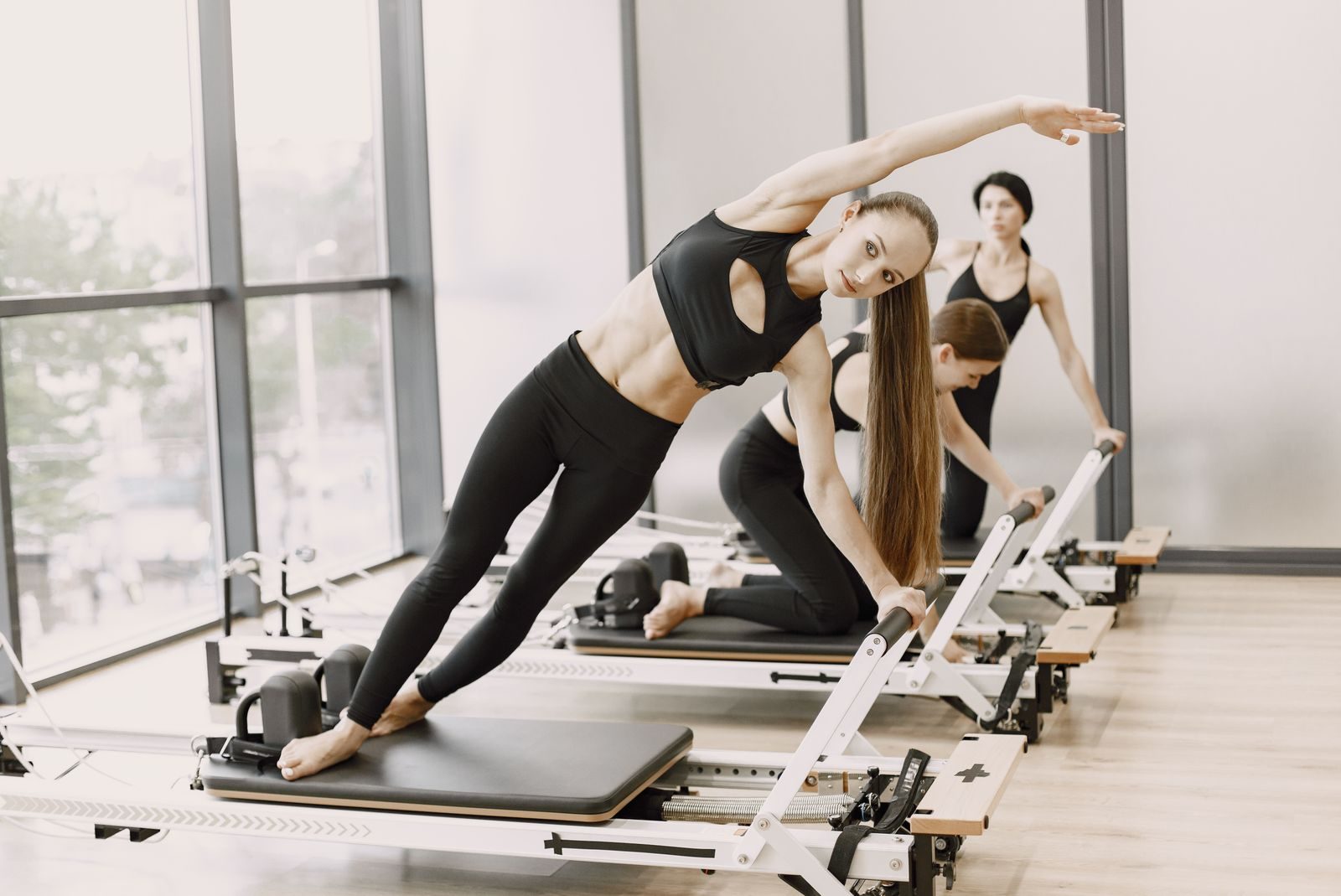
Pilates is a low-impact exercise method that combines controlled movements, coordinated breathing, and attention to body position to train strength, muscular endurance, flexibility, and balance. You can practice it on a mat or with specialized equipment, with exercises adapted to your experience and abilities, as explained in the NHS beginner Pilates guidance.
The most useful Pilates benefits come from learning movements well and practicing consistently—not choosing the hardest class. This guide explains what Pilates involves, its potential benefits, and how to begin with four accessible exercises and a simple routine.
What Is Pilates?
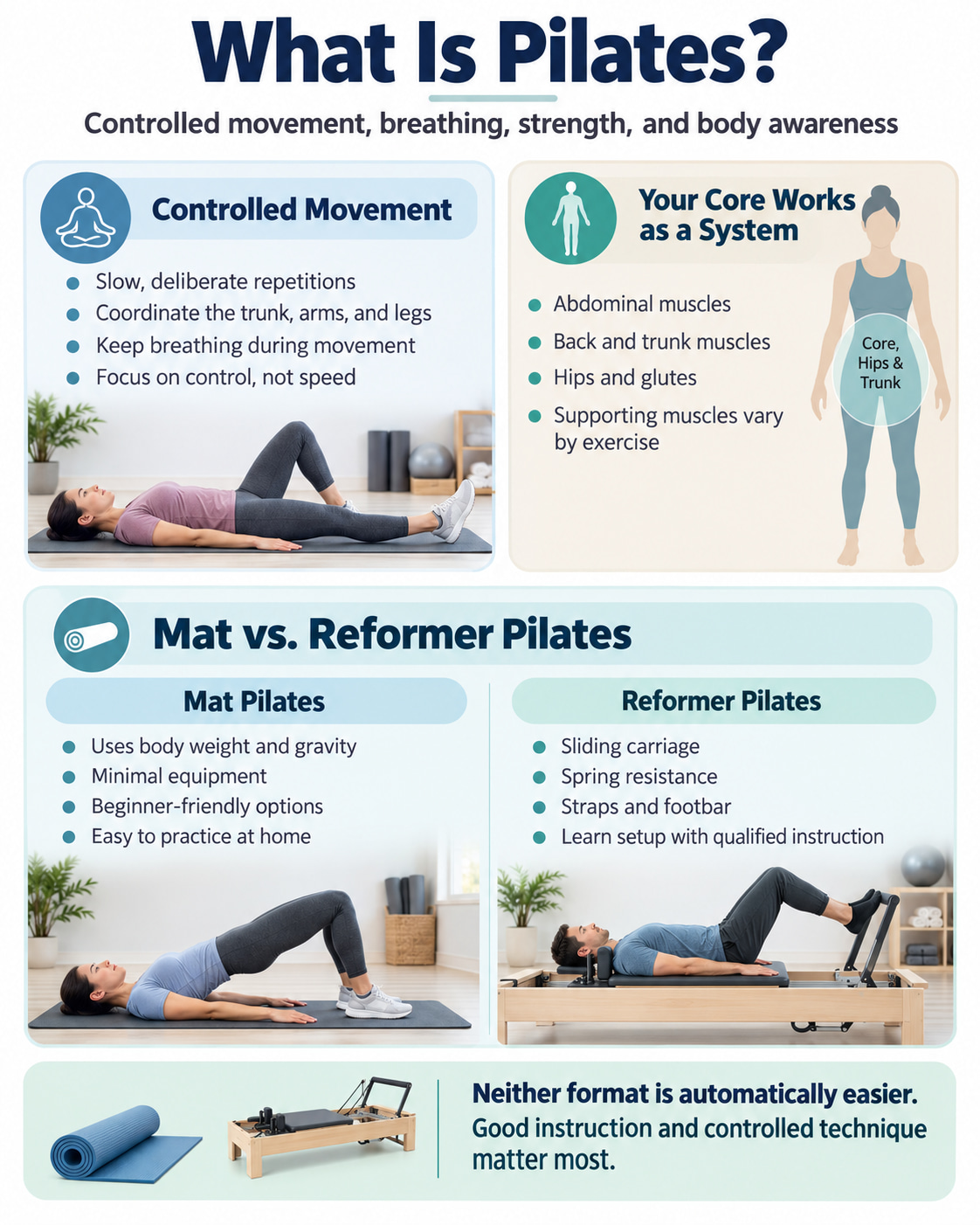
Pilates emphasizes precise, deliberate movement. Rather than rushing through repetitions, you pay attention to how your trunk, arms, and legs work together while continuing to breathe.
Although Pilates is associated with core training, your core includes more than your abdominal muscles. As Cleveland Clinic explains, the trunk, back, hips, and surrounding muscles contribute to this broader system of support. The muscles challenged in a session depend on the exercises selected.
Mat Pilates vs. Reformer Pilates
Mat Pilates primarily uses body weight and gravity for resistance. Some classes add small props, but basic sessions require little more than comfortable floor space and a mat.
Reformer Pilates uses a machine with a sliding carriage, springs, straps, and a footbar. The springs can provide resistance or assistance, depending on the exercise. Balanced Body recommends an introductory class or individual instruction to learn the equipment.
Neither format is automatically easier. A suitable beginner class and clear instruction matter more than whether you choose a mat or machine.
10 Pilates Benefits and What They Mean for You
These benefits include measured fitness outcomes, movement skills, and practical advantages. Research findings vary by population, exercise selection, and training program, so they should not be treated as guaranteed results.
1. Better Core Muscular Endurance
Pilates can improve your ability to sustain abdominal effort. A randomized trial published in the Journal of Strength and Conditioning Research found improved abdominal endurance after 12 weeks of twice-weekly mat classes.
Muscular endurance means maintaining or repeating an effort over time. It is different from maximum strength.
2. Muscular Endurance Beyond Your Abs
Pilates is not limited to abdominal work. The same trial also found improvements in upper-body muscular endurance.
However, the benefit depends on the program. A session must challenge a muscle group to train it; a few gentle abdominal exercises should not be mistaken for a comprehensive upper-body workout.
3. Greater Flexibility
The trial also found improved hamstring flexibility, supporting Pilates as one way to develop range of motion.
For practice, prioritize a comfortable range you can control. Reaching farther is not useful when it requires bouncing, forcing a stretch, or changing the intended movement.
4. Improved Balance
A National Library of Medicine indexed systematic review of randomized trials in older adults found that Pilates improved postural balance compared with control conditions.
This is encouraging, but it does not establish that every Pilates routine prevents falls. Improvements in balance tests and reductions in actual falls are different outcomes.
5. Support for Everyday Mobility
Functional mobility is the ability to move through practical tasks, such as getting up, walking, and changing direction.
A review published in Frontiers in Medicine found improvements in functional mobility among healthy older adults compared with inactive control groups, but Pilates was not clearly better than other exercise for this outcome.
The takeaway is that Pilates can be one useful option—not the only effective approach.
6. Greater Awareness of Posture and Alignment
Pilates provides opportunities to notice where your ribs, pelvis, shoulders, and head are during movement. Cleveland Clinic Canada identifies body awareness and movement control as features of its Pilates approach.
That does not mean Pilates permanently “corrects” posture. The 12-week trial mentioned earlier did not find a significant posture improvement compared with the control group.
7. Practice Coordinating Different Parts of Your Body
Pilates asks you to coordinate limb movement while managing the position of your trunk. This makes coordination a practical training focus, rather than simply moving each body part independently.
For example, an arm-and-leg reach requires you to manage several movements without rushing or losing balance. Start with simpler versions before combining them.
8. Better Breathing Coordination During Exercise
Pilates teaches you to keep breathing while your trunk muscles work. The Cambridgeshire Children’s Physiotherapy Service emphasizes this coordination in its Pilates guidance.
The practical goal is steady breathing during movement—not taking the largest possible breath or holding your breath to maintain a position.
9. Possible Improvements in Well-Being
A 2026 systematic review indexed by PubMed found more encouraging evidence for quality of life and self-esteem than for depression or anxiety.
However, results varied substantially, and the review’s unadjusted overall result was statistically inconclusive. Pilates may be an enjoyable part of a routine, but it should not be presented as a treatment for mental-health conditions.
10. An Adaptable, Low-Impact Exercise Option
Many Pilates exercises avoid jumping and can be adjusted through support, resistance, or a smaller range of movement. Low impact does not mean effortless, and not every variation suits every person.
Floor exercises are not the only option. NHS chair-based Pilates includes supported alternatives for people who have difficulty getting down to the floor.
How to Get Started With Pilates
Choose Beginner Instruction
Look for a beginner or introductory class led by an instructor trained in the format you plan to use. Tell the instructor that you are new, and ask for simpler variations when needed.
For reformer Pilates, learn the equipment setup and how to get on and off the machine under supervision before attempting independent sessions.
Prepare Your Space
For the floor routine below, use a comfortable exercise mat on a firm, nonslip surface. Leave enough room to extend your arms and legs, and wear clothing that allows easy movement.
Begin with a few minutes of easy walking or marching. During the exercises, use a controlled pace, keep breathing, and reduce the range when you cannot maintain the intended position.
Know When to Get Guidance
The NHS recommends professional advice when an injury, health condition, recent operation, pregnancy, or other concern may affect exercise suitability.
Stop and seek appropriate professional help if exercise causes sharp pain, numbness, dizziness, chest pain, or unusual symptoms. Do not continue through pain or feeling unwell.
4 Beginner Pilates-Style Exercises to Try
These four exercises introduce trunk control, hip movement, and coordination. They are also used in general conditioning; they are not exclusive to Pilates or a complete classical Pilates sequence.
Use the sets, repetitions, and rest periods in the routine that follows.
1. Supine Heel Slide
Best for: Learning to move a leg without losing pelvic control.
Muscles worked: Abdominal and back muscles stabilize the trunk while the hip and thigh muscles move the leg.
How to do it:
- Lie on your back with your knees bent, feet supported, and arms beside you.
- Gently engage your abdominal muscles while keeping your breathing relaxed.
- Exhale and slide one heel away along the floor. Stop before your pelvis shifts or your lower back arches noticeably.
- Inhale as you slide the heel back. Alternate sides.
Common mistakes: Reaching too far, holding your breath, or allowing the opposite knee to drift.
Make it easier or harder: Start with a short slide. Gradually extend the leg farther while keeping the heel supported and the pelvis steady.
2. Glute Bridge
Best for: Practicing controlled hip extension and strengthening the glutes.
Muscles worked: Primarily the glutes, with assistance from the hamstrings and abdominal stabilizers.
How to do it:
- Lie on your back with knees bent and feet flat, approximately hip-width apart.
- Gently engage your abdomen, then exhale as you press through your feet and lift your hips.
- Stop at a comfortable height without pushing your ribs upward or excessively arching your back.
- Inhale and lower your hips slowly to the mat.
Common mistakes: Chasing maximum height, letting the knees spread or collapse inward, and using momentum.
Make it easier or harder: Use a smaller lift initially. Once comfortable, add a brief pause at the top rather than lifting higher.
The American Council on Exercise emphasizes avoiding excessive lower-back arching during the bridge.
3. Side-Lying Leg Lift
Best for: Training the outer hips while controlling pelvic position.
Muscles worked: The hip abductors, including the gluteus medius and minimus.
How to do it:
- Lie on your side with your head supported and your shoulders and hips stacked.
- Keep the upper leg straight. You may bend the lower knee for support.
- Exhale and lift the upper leg a short distance, keeping the kneecap facing forward rather than toward the ceiling.
- Inhale and lower slowly. Complete the repetitions, then change sides.
Common mistakes: Rolling backward, hiking the upper hip, or lifting higher than you can control.
Make it easier or harder: Reduce the lift to make it easier. Add a brief pause to increase the challenge without increasing the range.
Keep the pelvis steady throughout the movement.
4. Quadruped Arm-and-Leg Reach
Also called a bird dog, this movement can be introduced one limb at a time.
Best for: Coordinating arm and leg movement while maintaining trunk control.
Muscles worked: Abdominal and back stabilizers, glutes, and supporting shoulder muscles.
How to do it:
- Begin on hands and knees, with hands under shoulders and knees under hips.
- Gently engage your trunk and look toward the mat, keeping your neck aligned with your back.
- Reach one arm forward and the opposite leg backward, only as far as you can without twisting or arching.
- Return slowly, reset your position, and switch sides.
Common mistakes: Lifting the leg too high, rotating the pelvis, or rushing the return.
Make it easier or harder: Begin by reaching only one arm or one leg. Progress to opposite limbs together, then add a short pause.
Make trunk control—not reaching height—the priority.
A Simple Beginner Pilates Routine
Use this as an introductory practice, not a complete weekly fitness program or a substitute for individualized instruction.
Start with two sessions on nonconsecutive days. Allow roughly 15 minutes, including a short warm-up, rest, and position changes. These are adjustable starting suggestions, not a research-established minimum dose.
| Exercise | Starting sets | Repetitions | Rest afterward |
|---|---|---|---|
| Supine heel slide | 1 | 6–8 per side | 30–60 seconds |
| Glute bridge | 1 | 8 | 30–60 seconds |
| Side-lying leg lift | 1 | 6–8 per side | 30–60 seconds |
| Quadruped arm-and-leg reach | 1 | 4–6 per side | 30–60 seconds |
Use the easier variation whenever necessary. Rest longer when needed, and finish a set before your breathing or movement becomes strained.
How Hard Should It Feel?
Aim for an easy-to-moderate effort while learning. You should feel the working muscles, but you should still be able to move smoothly and breathe normally.
A useful check is whether your final repetition looks much like your first. When it does not, stop the set rather than forcing the planned number.
When to Progress
After a couple of comfortable sessions with consistent technique, make one small change: add one or two repetitions, increase the controlled range slightly, or add a second set to one exercise.
Do not increase repetitions, sets, and difficulty together. There is no requirement to progress every week. Staying with a manageable version is appropriate while you learn it.
How Pilates Fits Into a Balanced Exercise Week
Pilates can contribute to muscle-strengthening activity, but a gentle, core-focused sequence does not automatically train every major muscle group or provide sufficient aerobic exercise.
For adults, the Centers for Disease Control and Prevention recommends at least 150 minutes of moderate-intensity aerobic activity weekly, or an equivalent vigorous combination, plus muscle-strengthening activity on at least two days. These are adult guidelines, not a prescription for every reader.
Use Pilates alongside activities you enjoy, such as walking or cycling, and broader strength training suited to your experience. Build gradually rather than trying to add everything at once.
Frequently Asked Questions
Do You Need to Be Flexible Before Starting Pilates?
No. Beginner Pilates does not require advanced flexibility. Choose exercises and ranges that suit your current ability instead of trying to match someone else’s positions.
The NHS beginner session is intended for people without previous Pilates experience.
Can You Learn Pilates at Home?
Yes, particularly basic mat exercises. Choose instruction that clearly explains setup, movement, and easier options. A live instructor can provide feedback that a prerecorded video cannot.
For reformer work, receive equipment instruction before practicing independently.
Do You Need to Do Pilates Every Day?
No. For the starter routine above, two sessions per week provide opportunities to practice without making daily training a requirement.
Adjust the schedule around your other activities and recovery. Feeling tired, uncomfortable, or unable to maintain technique is a reason to reduce the session—not add more work.
How Long Does It Take to Notice Pilates Benefits?
There is no guaranteed timetable. Research programs differ in duration, frequency, exercises, and participants, so a fixed “results in a few sessions” promise is not reliable.
Track practical changes: smoother repetitions, fewer balance corrections, more comfortable movement, and easier breathing during familiar exercises.
What Can You Do When Floor Exercises Are Difficult?
A standing or chair-supported Pilates class may be a better starting point. The NHS provides a Pilates-inspired option for people who have difficulty getting down to the floor.
Use a stable chair and select instruction appropriate to your abilities rather than forcing floor transfers.
Conclusion
Pilates offers a way to practice strength, endurance, mobility, and movement control. Start with a suitable beginner format, learn a small number of exercises, and keep the effort manageable.
Try one set of the four movements above. Prioritize comfortable breathing and repeatable technique before adding difficulty.
References
- Kloubec J. (2010) — Pilates for Improvement of Muscle Endurance, Flexibility, Balance, and Posture
- Casonatto J, Yamacita CM. (2020) — Pilates Exercise and Postural Balance in Older Adults: Systematic Review and Meta-Analysis
- da Silva LD, Shiel A, McIntosh C. (2021) — Pilates Reducing Falls Risk Factors in Healthy Older Adults
- Tsartsapakis I, Zafeiroudi A, Kouthouris C. (2026) — Pilates-Based Exercise, Psychological Well-Being, and Quality of Life
- NHS — Pilates for Beginners
- Cleveland Clinic — Pilates: What It Is and Health Benefits
- CDC — Adult Physical Activity Guidelines
This content is for informational purposes only and is not a substitute for medical advice.