
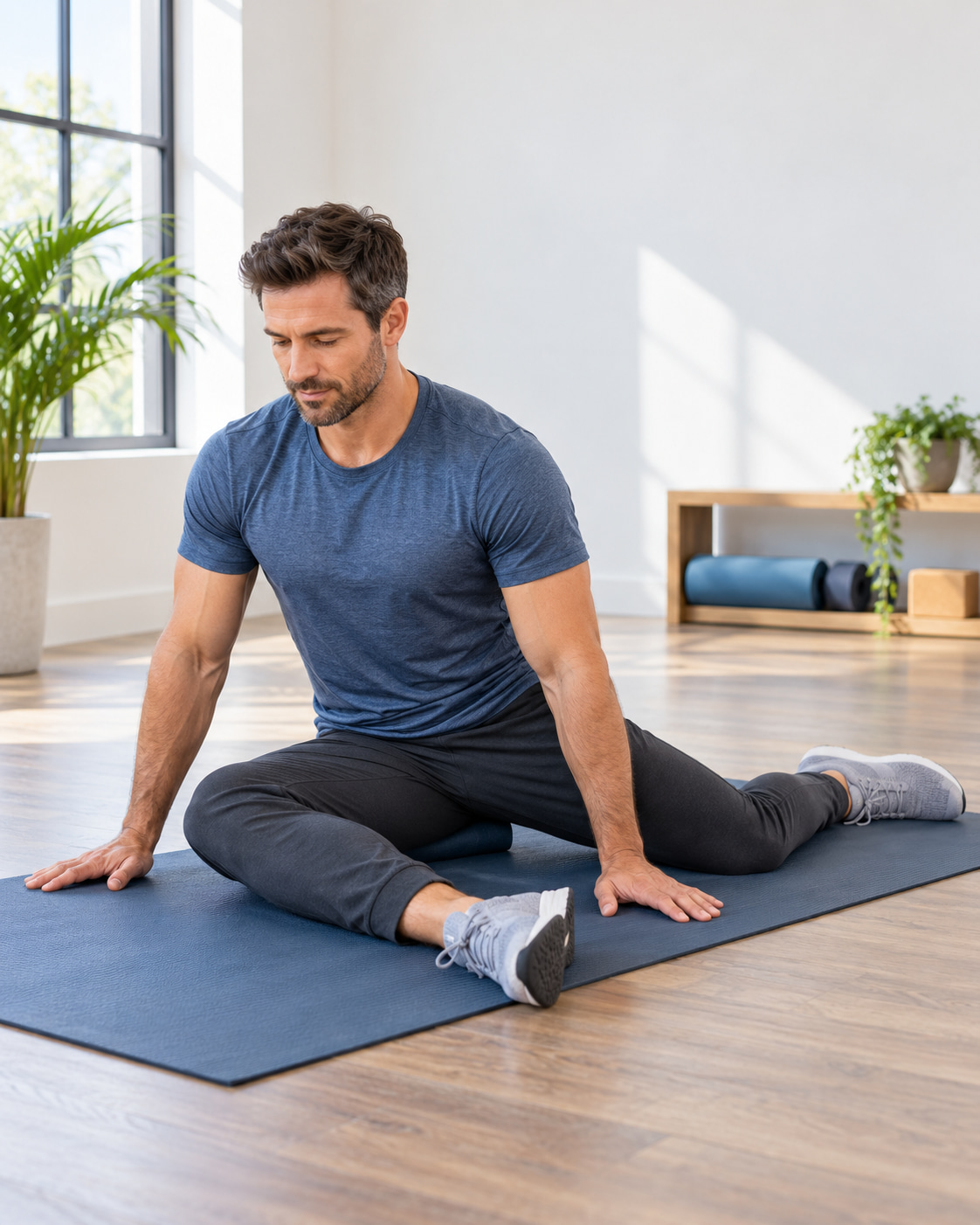
Glute stretch exercises can help improve hip flexibility, reduce feelings of muscle tightness, and support a more comfortable range of motion. They target the muscles around your buttocks and hips, including the glutes and deep hip rotators.
Whether you sit for long hours, lift weights, run, or simply want better hip movement, these eight stretches offer practical options for different flexibility levels. You’ll learn how to perform each one correctly, avoid common mistakes, and follow a simple stretching routine.
8 Best Glute Stretch Exercises
These eight glute stretches include lying, seated, and standing variations. Beginners can start with the gentler exercises and gradually try the more demanding positions as their mobility improves.
Before starting, warm up with 5–10 minutes of easy walking or other light activity. Stretch slowly, breathe normally, and stop at a comfortable level of tension.
1. Supine Figure-Four Stretch
The supine figure-four stretch is one of the most accessible ways to stretch your glutes and deep hip rotators. Because your back stays supported on the floor, you can focus on the hip position without worrying about balance.
Best for: Beginners, general glute flexibility, and post-workout stretching.
Muscles stretched: Gluteus maximus, piriformis, and other deep hip rotators.
Equipment: Exercise mat.
Hold and repeat: 20–30 seconds per side, 1–2 times.
How to Do It
- Lie on your back with both knees bent and your feet flat on the floor.
- Lift your right foot and place your right ankle across your left thigh, just above the knee.
- Reach both hands behind your left thigh.
- Gently bring your left thigh toward your chest until you feel a stretch in your right glute.
- Hold the position while keeping your shoulders and head relaxed.
- Slowly release and repeat on the opposite side.
Common mistakes: Pulling too aggressively, pressing hard against the crossed knee, or lifting the head and shoulders off the floor. Keep the movement gentle and controlled.
Beginner modification: Keep your supporting foot on the floor instead of lifting it. You may already feel enough of a stretch in this position.
2. Seated Figure-Four Stretch
The seated figure-four stretch provides a convenient way to stretch your glutes without getting onto the floor. It works especially well during breaks from prolonged sitting.
Best for: Desk workers, beginners, and people who prefer chair-based stretching.
Muscles stretched: Gluteus maximus, piriformis, and deep hip rotators.
Equipment: Sturdy, nonrolling chair.
Hold and repeat: 20–30 seconds per side, 1–2 times.
How to Do It
- Sit upright near the front of a sturdy chair with both feet flat on the floor.
- Place your right ankle across your left thigh, just above the knee.
- Allow your right knee to move outward naturally without pushing it down.
- Keep your back comfortably straight and slowly lean forward from your hips.
- Stop when you feel a gentle stretch through your right buttock or outer hip.
- Hold, return upright, and repeat with the left leg.
Common mistakes: Rounding your back excessively, forcing the crossed knee downward, or leaning forward too quickly. A small hip hinge is often enough.
Beginner modification: Remain upright instead of leaning forward. If placing your ankle on your thigh causes knee or hip discomfort, choose a different stretch.
3. Single Knee-to-Chest Stretch
The single knee-to-chest stretch is a gentle option for people who find deep hip rotation uncomfortable. It brings the hip into flexion and can stretch the gluteal muscles while allowing the body to remain supported.
The American Academy of Orthopaedic Surgeons’ hip conditioning program identifies the gluteus maximus and gluteus medius among the muscles targeted by knee-to-chest stretching.
Best for: Beginners, gentle hip stretching, and post-exercise cooldowns.
Muscles stretched: Gluteus maximus and portions of the gluteus medius.
Equipment: Exercise mat.
Hold and repeat: 20–30 seconds per side, 1–2 times.
How to Do It
- Lie on your back with both knees bent and your feet flat on the floor.
- Lift your right leg and place your hands behind your right thigh.
- Slowly bring your right knee toward your chest.
- Stop when you feel a comfortable stretch through your right buttock or hip.
- Keep your head and shoulders relaxed while holding the position.
- Lower your right foot and repeat with your left leg.
Common mistakes: Pulling the knee forcefully into the chest, straining the neck, or holding your breath. Let your hips move naturally without forcing the stretch.
Beginner modification: Bring the knee only partway toward your chest. You do not need to touch your thigh to your abdomen.
4. Cross-Body Knee-to-Opposite-Shoulder Stretch
This stretch changes the direction of the knee-to-chest movement to emphasize the posterior and outer hip. It can be especially useful when you want to stretch the deeper muscles around the buttock.
Best for: Deep glute stretching and posterior hip flexibility.
Muscles stretched: Piriformis, deep hip rotators, and surrounding gluteal muscles.
Equipment: Exercise mat.
Hold and repeat: 20–30 seconds per side, 1–2 times.
How to Do It
- Lie on your back with both legs extended.
- Bend your right knee and bring it toward your chest.
- Hold your right knee or upper shin comfortably with your hands.
- Slowly guide your right knee diagonally toward your left shoulder.
- Stop when you feel a gentle stretch along the back or outer side of your right hip.
- Hold without forcing your pelvis to twist, then repeat on the other side.
Common mistakes: Pulling the knee sharply across the body, twisting the pelvis excessively, or creating pinching in the front of the hip. Keep the movement small enough to remain comfortable.
Beginner modification: Reduce the diagonal movement and bring your knee closer to the center of your chest.
5. Seated Crossover Glute Stretch
The seated crossover glute stretch combines a crossed-leg position with gentle torso rotation. Unlike the seated figure-four, this exercise keeps one leg extended and brings the opposite foot across it.
It can stretch the posterior hip while also encouraging controlled trunk rotation.
Best for: Glute flexibility, seated hip positioning, and gentle rotational movement.
Muscles stretched: Piriformis and surrounding posterior hip muscles. The torso rotation also involves muscles around the trunk.
Equipment: Exercise mat.
Hold and repeat: 20–30 seconds per side, 1–2 times.
How to Do It
- Sit on the floor with both legs extended in front of you.
- Bend your right knee and place your right foot on the floor outside your left knee.
- Keep your left leg extended and sit as upright as comfortably possible.
- Place your right hand on the floor behind you for support.
- Bring your left arm around the outside of your right knee and gently rotate your chest toward the right.
- Keep both sitting bones on the floor, hold the stretch, and slowly return to center before switching sides.
Common mistakes: Forcing the twist with your elbow, rounding your lower back excessively, or lifting one side of your pelvis off the floor.
Beginner modification: Hug the bent knee gently toward your chest without twisting your torso. This reduces the rotational demand.
6. 90/90 Hip Stretch
The 90/90 hip stretch challenges two important hip movements: external rotation in the front leg and internal rotation in the back leg.
It is especially useful for people who want to work on hip rotation for everyday movement, squatting, or other lower-body exercises.
Best for: Intermediate-level hip mobility and improving tolerance of hip rotation positions.
Muscles stretched: Gluteal muscles and deep hip rotators, with different tissues emphasized in the front and back hips.
Equipment: Exercise mat; optional folded towel or cushion.
Hold and repeat: 20–30 seconds per side, 1–2 times.
How to Do It
- Sit on the floor and place your right leg in front of your body.
- Bend your right hip and knee to approximately 90 degrees, with your shin resting in front of you.
- Position your left leg behind and to the side, bending that knee to approximately 90 degrees.
- Sit upright with your hands resting on the floor for balance.
- Slowly lean your chest forward over your front shin until you feel a comfortable stretch around the front hip and glute.
- Hold, return upright, and switch leg positions.
Common mistakes: Forcing both knees flat against the floor, rounding the back excessively, or leaning so far forward that the pelvis loses control.
Beginner modification: Place a folded towel or cushion beneath your hips and use your hands behind or beside you for support. Keep the forward lean small.
The Cleveland Clinic’s 90/90 stretch guide explains how this position combines internal and external hip rotation.
7. Supported Pigeon Pose
Supported pigeon pose provides a deeper hip stretching position, but it requires more mobility than the lying figure-four.
Using a yoga block or folded blanket beneath the front-side hip can make the position more comfortable and reduce the need to force your body toward the floor.
Best for: People who are already comfortable with basic glute stretches and want a more demanding floor-based variation.
Muscles stretched: Gluteal muscles and deep hip rotators of the front leg. The rear-leg position may also stretch the hip flexors.
Equipment: Exercise mat and yoga block or firm cushion.
Hold and repeat: 20–30 seconds per side, 1 time initially.
Video demonstration: Pigeon Pose Using Yoga Blocks — Body By Yoga
How to Do It
- Begin on your hands and knees on an exercise mat.
- Bring your right knee forward toward your right wrist.
- Position your right shin diagonally across the mat, keeping the right heel closer to your pelvis if that feels more comfortable.
- Extend your left leg behind you with the top of your left foot resting on the floor.
- Place a yoga block or folded cushion beneath your right hip if you need support.
- Keep your torso lifted or gently lean forward until you feel a comfortable stretch around your right glute.
- Hold, carefully return to your hands and knees, and repeat with the opposite leg.
Common mistakes: Forcing the front shin parallel to the mat, allowing excessive pressure through the front knee, or pushing the hips downward despite discomfort.
Beginner modification: Use a higher cushion or block beneath the front hip. If the position causes knee pain, return to the supine figure-four instead.
The Hospital for Special Surgery’s hip stretching instructions also recommend using a pillow or block to support the hip during pigeon pose.
8. Standing Figure-Four Stretch
The standing figure-four stretch uses the same crossed-leg hip position as the lying version but adds a shallow single-leg squat.
It can help you practice glute flexibility in a standing position while gently challenging balance and lower-body control.
Best for: Standing mobility breaks, people comfortable with single-leg balance, and controlled hip stretching.
Muscles stretched: Gluteal muscles, piriformis, and other deep hip rotators of the crossed leg.
Equipment: Stable wall or countertop for support.
Hold and repeat: 20–30 seconds per side, 1–2 times.
How to Do It
- Stand beside a stable wall or countertop and hold it for balance.
- Shift your body weight onto your left foot.
- Lift your right leg and place your right ankle across your left thigh, just above the knee.
- Slowly bend your left knee and move your hips backward, as if sitting into a chair.
- Keep your chest comfortably lifted and your supporting knee aligned with your foot.
- Stop when you feel a stretch in your right glute, hold, and then return to standing.
- Repeat with the opposite leg.
Common mistakes: Allowing the supporting knee to collapse inward, rounding the back excessively, or lowering farther than your balance allows.
Beginner modification: Hold a countertop with both hands and perform only a shallow movement. If balance remains difficult, use the seated figure-four instead.
What Muscles Do Glute Stretches Target?
Your glutes contain three main muscles, which work together to move and stabilize your hips and pelvis.
| Muscle | Main function | Relevant stretches |
|---|---|---|
| Gluteus maximus | Extends the hip and helps control lower-body movement | Knee-to-chest, figure-four, pigeon |
| Gluteus medius | Stabilizes the pelvis and helps move and rotate the thigh | Figure-four, cross-body knee-to-shoulder, 90/90 |
| Gluteus minimus | Assists hip stabilization, abduction, and rotation | 90/90 and other hip rotation stretches |
| Deep hip rotators, including piriformis | Help rotate and stabilize the hip | Figure-four, seated crossover, pigeon |
These stretches do not isolate individual muscles completely. The tissues emphasized depend on your hip angle, pelvic position, and individual anatomy.
For more about these muscles, see Cleveland Clinic’s gluteal muscle anatomy guide.
Benefits of Glute Stretch Exercises
1. Improve Hip Flexibility
Regular stretching may help increase the range of motion available around your hips. This can make certain positions, such as bending, sitting cross-legged, or bringing your knees toward your torso, feel easier over time.
A 2025 systematic review published in Sports Medicine found that static stretching improved flexibility in adults, both after individual sessions and with repeated practice.
2. Reduce Feelings of Muscle Tightness
Gentle stretching may temporarily reduce sensations of tightness around your buttocks and posterior hips.
This can be useful after prolonged sitting or physical activity, although tightness does not always mean a muscle is physically shortened.
3. Support Hip Rotation
Exercises such as the 90/90 stretch and figure-four variations encourage movement into hip rotation positions that are not always practiced during everyday activity.
Over time, improving tolerance of these positions may support more comfortable hip movement.
4. Complement Strength Training
Hip flexibility can be useful for exercises such as squats, lunges, and certain deadlift variations.
However, flexibility is only one part of mobility. Strength, balance, coordination, and joint control also determine how effectively you can use your available range of motion.
Stretching should complement, not replace, resistance training.
Simple 5-Minute Glute Stretch Routine
You do not need to perform all eight exercises every day. A short routine with three or four comfortable stretches is a practical starting point.
Try this beginner-friendly sequence after a short warm-up or at the end of a workout.
| Exercise | Duration |
|---|---|
| Single Knee-to-Chest Stretch | 30 seconds per side |
| Supine Figure-Four Stretch | 30 seconds per side |
| Cross-Body Knee-to-Opposite-Shoulder Stretch | 30 seconds per side |
| Supported 90/90 Hip Stretch | 30 seconds per side |
Total: Approximately 5 minutes, including changing positions.
Frequency: Start with 3–4 days per week. You can practice more frequently if the stretches remain comfortable.
Effort: Gentle to moderate tension, without pain.
Progression: Begin with shorter holds if needed. As the positions become comfortable, work toward consistent 30-second holds and gradually use a slightly greater range of motion without forcing it.
If the 90/90 position is too demanding, replace it with the seated figure-four stretch.
How Often Should You Stretch Your Glutes?
For most healthy adults, stretching the glutes at least 2–3 days per week is a reasonable starting point. More frequent gentle stretching can also be appropriate.
The Mayo Clinic’s stretching recommendations suggest holding static stretches for about 30 seconds, avoiding bouncing, and making flexibility work a regular part of your routine.
Use these practical guidelines:
- Hold time: Start with 20–30 seconds per stretch.
- Repetitions: Perform 1–2 holds on each side, increasing gradually if useful.
- Frequency: Aim for at least 2–3 days weekly; daily gentle practice is optional.
- Intensity: Feel mild or moderate tension, never sharp pain.
- Timing: Perform longer static holds after exercise or after warming up.
Before running, lifting, or sports that require power, prioritize a dynamic warm-up with movements such as controlled hip circles, leg swings, or bodyweight squats. Save longer static holds for after training or a separate flexibility session.
Common Glute Stretching Mistakes to Avoid
Even simple stretches can become uncomfortable when performed aggressively.
1. Stretching too hard. A stronger pulling sensation does not automatically produce better results. Gradually enter each position and stop before pain.
2. Forcing knee rotation. Figure-four and pigeon stretches should create movement primarily at the hip. Do not push aggressively against the knee to make the position deeper.
3. Using excessive lower-back movement. Lean or rotate only as much as the exercise requires. Avoid using a large spinal twist to compensate for limited hip mobility.
4. Holding your breath. Keep your breathing relaxed during each hold. If you cannot breathe comfortably, reduce the intensity.
5. Stretching without warming up. Take a short walk or perform gentle movements before longer static stretches, particularly when your body feels stiff.
6. Assuming every hip needs the same range. Hip structure and flexibility vary between people. Focus on comfortable movement rather than matching someone else’s stretch depth.
If a stretch causes sharp pain, numbness, tingling, dizziness, chest pain, or other unusual symptoms, stop and seek appropriate professional help.
People with recent hip surgery, joint replacements, or significant hip or knee problems should follow their healthcare professional’s specific exercise and movement restrictions.
Frequently Asked Questions
1. What is the best stretch for tight glutes?
The supine figure-four stretch is a practical first choice for many beginners. It stretches the posterior hip while keeping your back supported. If crossing your ankle over the opposite thigh is uncomfortable, try the single knee-to-chest stretch.
2. How long should you hold a glute stretch?
Start with approximately 20–30 seconds per side. Repeat once or twice if comfortable. Longer holds are not automatically better, especially if you need to force the position.
3. Can you stretch your glutes every day?
Yes, gentle glute stretching can be performed daily if it feels comfortable and does not aggravate symptoms. However, daily stretching is not necessary for everyone. Consistent practice several times per week can still improve flexibility.
4. Do glute stretches improve hip mobility?
They can improve flexibility and available hip range of motion. However, effective hip mobility also requires strength and control. Combining stretching with movements such as squats, bridges, and controlled hip rotations can provide more complete hip training.
5. Should you stretch your glutes before or after a workout?
Longer static stretches usually fit better after a workout, when your muscles are warm. Before exercise, use controlled dynamic movements to prepare your hips for the activity you plan to perform.
6. What if a glute stretch hurts my knee?
Stop that stretch rather than pushing through the discomfort. Try a gentler position that places less rotational demand on your knee, such as the single knee-to-chest stretch. If knee pain persists, seek guidance from a qualified healthcare professional.
7. Are glute stretches enough to improve overall hip flexibility?
Not necessarily. Your hips also depend on flexibility and movement control in the hip flexors, adductors, hamstrings, and other surrounding muscles. A balanced mobility routine should address your individual movement needs rather than focusing on the glutes alone.
The Bottom Line
The best glute stretch exercises are the ones you can perform consistently with good control and without pain. Start with the supine figure-four, seated figure-four, or knee-to-chest stretch before progressing to more demanding positions such as 90/90 and supported pigeon.
Choose three or four comfortable stretches, practice for approximately five minutes several times per week, and gradually improve your range of motion. Pair stretching with regular strength training to support strong, mobile hips.
References
- Mayo Clinic — Stretching: Focus on Flexibility
- American Academy of Orthopaedic Surgeons — Hip Conditioning Program
- Cleveland Clinic — Gluteal Muscles: Anatomy and Function
- Cleveland Clinic — The 90/90 Stretch and Hip Mobility
- Hospital for Special Surgery — Hip and Glute Stretching Instructions
- Hospital for Special Surgery — Hip Flexor and 90/90 Stretches
- Sports Medicine — Optimising the Dose of Static Stretching to Improve Flexibility (2025)
This content is for informational purposes only and is not a substitute for medical advice.