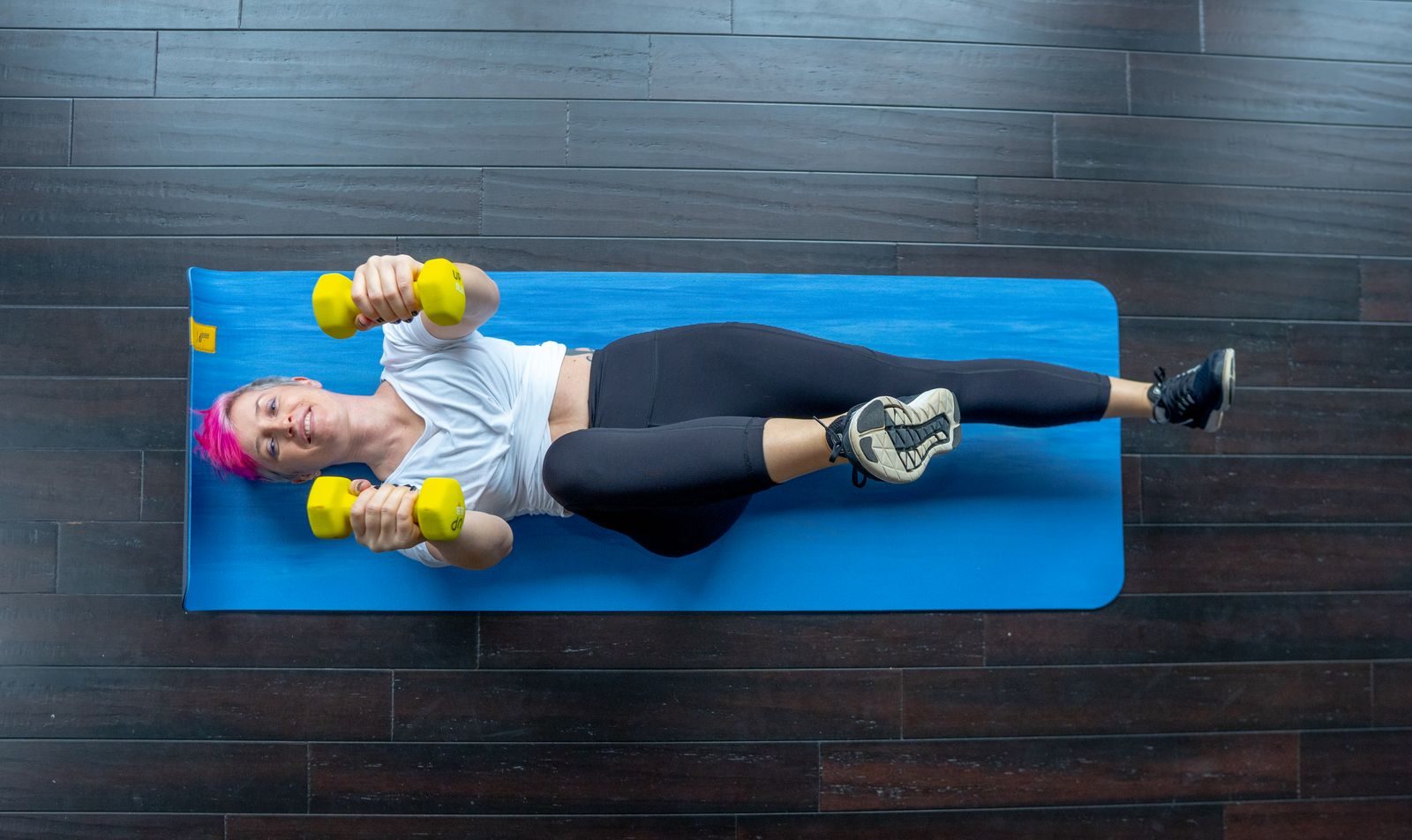
The dumbbell dead bug is a loaded core-stability exercise that trains your abdominal muscles to prevent excessive lower-back arching while your opposite arm and leg move. It can help you build trunk control, cross-body coordination, and a stronger connection between your upper and lower body.
This guide covers the version performed with one light dumbbell in each hand. You lower one weighted arm overhead while extending the opposite leg, then return to the starting position and switch sides.
The movement may look simple, but adding weight before mastering the basic dead bug can quickly cause your ribs to flare, your pelvis to rotate, or your lower back to lift. Start light, use a controlled range of motion, and make every repetition look the same.
Dumbbell Dead Bug at a Glance
| Category | Details |
|---|---|
| Best for | Core control, anti-extension strength, and opposite-arm-and-leg coordination |
| Primary muscles | Rectus abdominis, internal obliques, external obliques, and transversus abdominis |
| Assisting muscles | Hip flexors and shoulder stabilizers |
| Equipment | Two light dumbbells and an exercise mat |
| Difficulty | Beginner-to-intermediate progression |
| Suggested sets | 2–3 |
| Suggested repetitions | 5–8 per side |
| Rest | 45–75 seconds |
| Key technique goal | Move your limbs without allowing your ribs, pelvis, or lower back to shift |
What Is a Dumbbell Dead Bug?
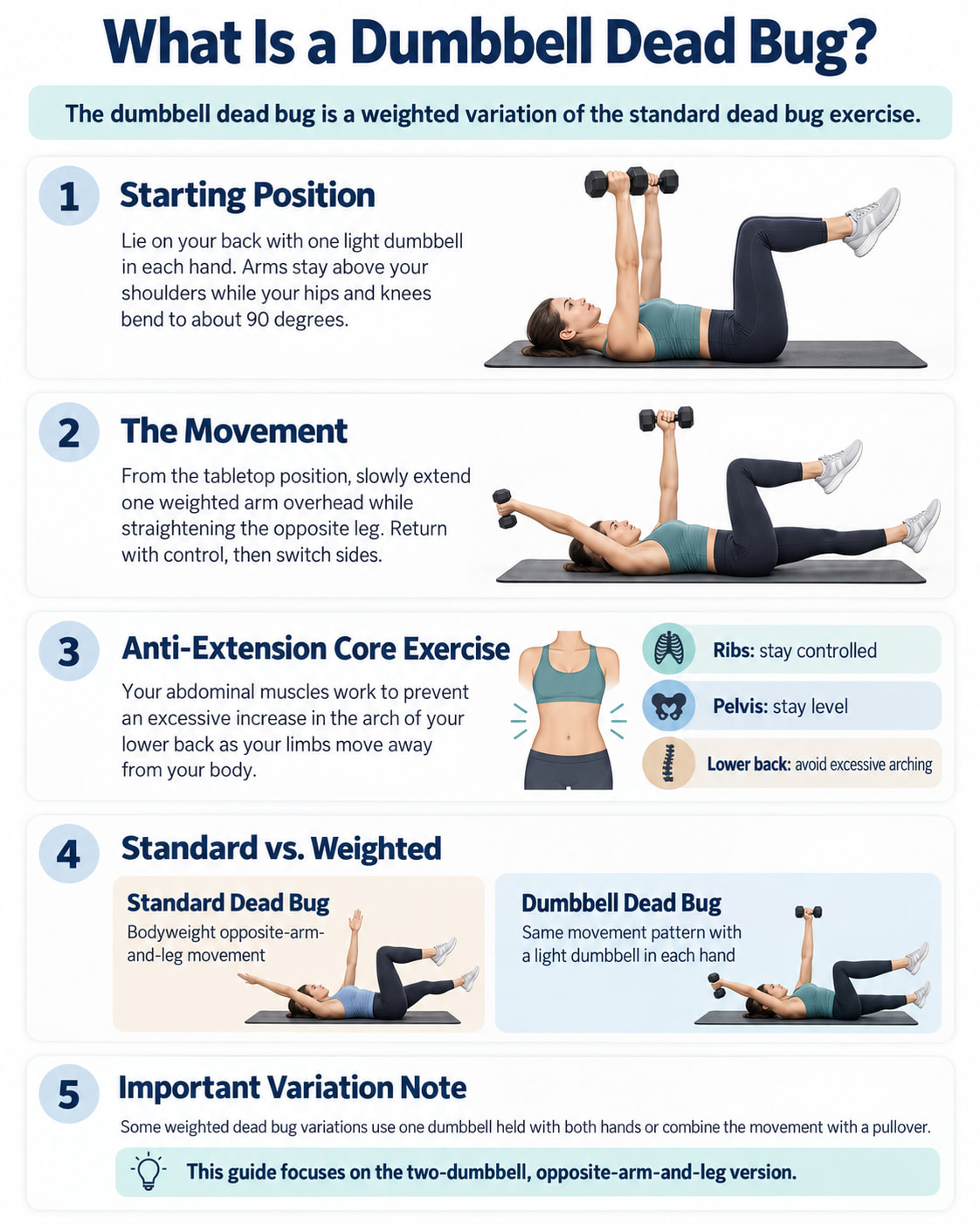
The dumbbell dead bug is a weighted variation of the standard dead bug exercise.
You begin on your back with your arms above your shoulders and your hips and knees bent to approximately 90 degrees. From this tabletop position, you slowly extend one weighted arm overhead while straightening the opposite leg.
The movement is commonly classified as an anti-extension core exercise. Anti-extension does not mean your spine cannot move at all. It means your abdominal muscles work to prevent an excessive increase in the arch of your lower back as your limbs travel away from your body.
The standard dead bug uses the same opposite-arm-and-leg pattern described in the National Academy of Sports Medicine dead bug guide. The weighted variation demonstrated by Physitrack adds a dumbbell to each hand while keeping the same contralateral movement.
Some exercises called “weighted dead bugs” use one dumbbell held in both hands or combine a dead bug with a pullover. Those are useful variations, but they are different from the two-dumbbell version explained here.
How to Do the Dumbbell Dead Bug With Proper Form
Sets, reps, and rest: Begin with 2–3 sets of 5–8 repetitions per side. Rest for 45–75 seconds between sets.
Step-by-Step Instructions
- Sit on an exercise mat with a light dumbbell beside each hip.
- Lie on your back and bring the dumbbells above your shoulders. Keep your arms straight without aggressively locking your elbows. Your palms can face each other.
- Lift your feet and position your knees over your hips. Bend your hips and knees to approximately 90 degrees so your shins are roughly parallel to the floor.
- Gently brace your abdominal muscles. Bring your ribs toward a stacked position over your pelvis and prevent the arch beneath your lower back from increasing.
- Slowly lower your right arm toward the floor behind your head while extending your left leg away from your body.
- Stop before your ribs flare, your lower back lifts, your pelvis rotates, or your heel and dumbbell reach the floor.
- Bring the arm and leg back to the starting position under control.
- Repeat with your left arm and right leg. Continue alternating sides.
The Physitrack weighted dead bug demonstration similarly begins with the hips and knees at 90 degrees and uses an opposite-arm-and-leg lowering pattern while the trunk remains stable.
How Far Should You Lower Your Arm and Leg?
Your dumbbell and heel do not need to touch the floor.
Lower them only as far as you can while maintaining the same rib, pelvis, and lower-back position. One person may be able to move close to the floor, while another may need to stop halfway.
A smaller controlled range is more productive than a larger range that causes your back to arch.
How to Breathe
Try this breathing pattern:
- Inhale in the starting position.
- Exhale slowly as you extend the opposite arm and leg.
- Inhale as you return to the center.
- Reset your abdominal tension before switching sides.
This is a useful pattern rather than an absolute rule. The main goal is to continue breathing without losing trunk position. ACE guidance on spinal-stability exercises recommends regressing the dead bug when necessary so spinal alignment and normal breathing can be maintained.
Coaching Cue
Reach long with the arm and heel without letting your ribs or pelvis follow them.
Dumbbell Dead Bug Muscles Worked
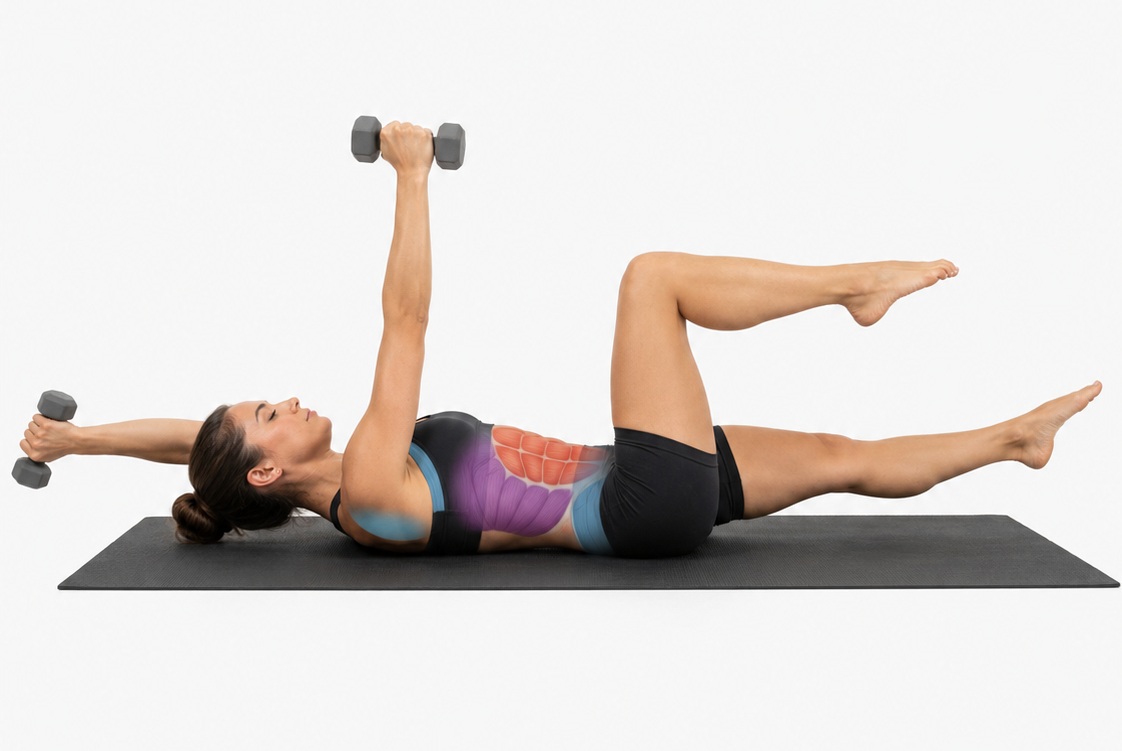
The dumbbell dead bug primarily challenges the abdominal wall. Other muscles help move and stabilize the arms and legs, but they are not necessarily the main training target.
The NCBI Bookshelf overview of abdominal-wall anatomy identifies the rectus abdominis, external obliques, internal obliques, and transversus abdominis as major muscles of the abdominal wall. These muscles contribute to trunk movement, abdominal pressure, and stabilization.
Rectus Abdominis
The rectus abdominis runs vertically along the front of your abdomen and is often called the “six-pack” muscle.
During a dumbbell dead bug, it works mainly to control the position of your rib cage and pelvis. As your arm and opposite leg move away from your body, the leverage encourages your lower back to arch. The rectus abdominis helps resist that change.
This is different from a crunch, where the rectus abdominis shortens to bend the trunk. During the dead bug, the torso should remain relatively still.
Internal and External Obliques
The internal and external obliques run along the sides of your abdomen.
They help prevent your torso and pelvis from rotating as one arm and the opposite leg move. Their stabilizing role becomes especially noticeable if one hip begins to drop or twist away from the mat.
The alternating cross-body pattern makes the obliques important even though the exercise does not involve an obvious twisting motion.
Transversus Abdominis
The transversus abdominis is the deepest of the flat abdominal-wall muscles.
It contributes to abdominal-wall tension and trunk stability throughout the repetition. However, the dumbbell dead bug does not isolate the transversus abdominis. The abdominal muscles work together to maintain position.
Hip Flexors
The hip flexors help hold your legs in the tabletop position, control the lowering leg, and bring it back over your hip.
Feeling some effort near the front of your hips does not automatically mean your technique is wrong. The problem occurs when hip-flexor effort pulls your pelvis forward and causes your lower back to arch.
When that happens, keep the moving knee more bent, shorten the leg range, or return to heel taps.
Shoulder and Upper-Back Stabilizers
The muscles around your shoulders and upper back keep the dumbbells aligned as your arms move.
They work harder as the dumbbells travel farther overhead. However, the dumbbell dead bug is not intended to replace shoulder presses, pullovers, rows, or other exercises used specifically to build the upper body.
Does the Dumbbell Dead Bug Work the Lower Abs?
The exercise can create strong effort below the navel, particularly as the leg straightens and approaches the floor.
However, the “lower abs” are not a separate muscle. The upper and lower portions of the rectus abdominis belong to the same paired muscle. You may feel more tension in one area, but the abdominal wall works together to control your trunk.
Benefits of the Dumbbell Dead Bug
1. Builds Anti-Extension Core Control
The primary challenge is preventing your lower back from arching as your arm and leg create longer levers.
This type of control can be useful during exercises in which your trunk must remain stable while your limbs produce force.
2. Trains the Core Without Repeated Trunk Flexion
Your torso remains mostly still rather than repeatedly curling forward as it does during sit-ups or crunches.
This makes the dumbbell dead bug a practical option when you want to train abdominal control with a different movement pattern.
3. Develops Cross-Body Coordination
The exercise pairs one arm with the opposite leg.
This contralateral pattern requires you to coordinate both sides of your body while keeping your pelvis and rib cage controlled.
4. Provides a Loadable Dead Bug Progression
The bodyweight dead bug can eventually become easy when performed through a controlled range.
Adding light dumbbells creates a new challenge without completely changing the exercise. The load increases the demand placed on your trunk as the weighted arm moves overhead.
Direct research on the exact two-dumbbell version is limited. An older EMG study of an unloaded dying-bug exercise found that the abdominal muscles were the predominant muscles recruited, although overall activation was modest in the healthy participants studied. This supports treating the dumbbell version as a practical progression rather than claiming that it is superior to every other core exercise.
5. Is Easy to Adjust
You can make the exercise easier or harder by changing:
- Dumbbell weight
- Leg position
- Arm range
- Leg range
- Repetition speed
- Pause length
- Number of repetitions
This allows you to progress the exercise without immediately reaching for much heavier weights.
6. Fits Warm-Ups and Core Workouts
A light set can be used before compound exercises to practice rib and pelvis control.
The dumbbell dead bug can also be performed after your main strength work as a dedicated core exercise. Its low equipment requirement makes it suitable for both home and gym workouts.
Common Dumbbell Dead Bug Mistakes
| Mistake | Why it happens | How to correct it |
|---|---|---|
| Lower back arching | The limbs are moving farther than the core can control | Shorten the range, bend the moving knee, or remove the dumbbells |
| Ribs flaring upward | The arm travels too far overhead or the weight is too heavy | Stop the arm earlier and exhale as you reach |
| Pelvis rotating | The obliques are not controlling the cross-body movement | Slow down and imagine keeping both sides of your pelvis equally heavy |
| Using heavy dumbbells | The exercise is being treated like a strength press | Use a pair that allows every repetition to look identical |
| Moving too quickly | Momentum replaces muscular control | Take two to three seconds to extend the arm and leg |
| Forcing the limbs to the floor | Floor contact is being mistaken for a complete repetition | End the range as soon as trunk position begins to change |
| Holding your breath | The brace is too aggressive | Reduce the difficulty and use a slow, controlled exhale |
| Bending the wrists | The dumbbells are too heavy or poorly positioned | Keep the wrists stacked over the forearms and use less weight |
| Lifting the head | The neck is being used to create tension | Rest your head on the mat and look toward the ceiling |
| Forcing shoulder range | The arm is moving beyond comfortable overhead mobility | Use a shorter arm path or keep the arm vertical |
Should Your Lower Back Be Flat on the Floor?
Your lower back should remain controlled, but you do not need to forcefully crush it into the mat.
When your hips move into the tabletop position, the natural arch beneath your lower back will usually become smaller. Gently maintain that position as your limbs move.
A useful standard is:
- The space beneath your lower back should not noticeably increase.
- Your ribs should not lift toward the ceiling.
- Your pelvis should not tilt or rotate.
- You should be able to breathe.
If you have to hold your breath or aggressively tuck your pelvis to stay flat, the variation may be too difficult.
How to Choose the Right Dumbbell Weight
The dumbbell dead bug is not an exercise for demonstrating how much weight you can hold.
Start with bodyweight or the lightest matching pair of dumbbells available. The correct weight allows you to:
- Complete at least five slow repetitions per side
- Keep your arms controlled
- Maintain neutral wrists
- Prevent your ribs from flaring
- Keep your pelvis level
- Avoid increasing the lower-back arch
- Continue breathing throughout the set
The dumbbells are too heavy when your arm range becomes uneven, your elbow bends excessively, or your trunk changes position before your limbs reach their normal controlled range.
When to Increase the Weight
Increase the load only after you can complete all prescribed repetitions with:
- A controlled two- to three-second lowering phase
- No lower-back arching
- No pelvic rotation
- No rib flare
- No breath-holding
- The same range on both sides
Use the smallest available weight increase. A small change can make a noticeable difference because the dumbbell moves farther away from your torso.
Dumbbell Dead Bug Regressions
1. Supine Abdominal Brace
Best for: Learning how to control the ribs and pelvis.
Lie on your back with your knees bent and feet flat. Breathe normally while gently maintaining abdominal tension. Do not move your arms or legs yet.
2. Alternating Heel Tap
Best for: Learning leg movement without adding the full straight-leg lever.
Begin in tabletop with your arms reaching toward the ceiling. Lower one bent leg until your heel lightly taps the floor, then return it over your hip.
Keep the knee bent throughout the movement.
3. Bodyweight Dead Bug
Best for: Practicing cross-body coordination before using dumbbells.
Perform the full opposite-arm-and-leg movement without weights. Shorten the range whenever your trunk begins to shift.
The ACE supine dead bug guide also uses a supported starting position and progresses toward opposite-arm-and-leg movement.
4. Short-Range Dumbbell Dead Bug
Best for: Introducing load without using a full arm or leg range.
Hold light dumbbells above your shoulders, but move the arm and opposite leg only partway toward the floor. Increase the range gradually as your control improves.
Dumbbell Dead Bug Progressions and Variations
Longer Leg Extension
Straighten the moving leg farther while keeping the heel higher than the floor.
A longer leg creates more leverage, so this can increase the challenge without adding weight.
Slower Eccentric Dumbbell Dead Bug
Take three to four seconds to lower the arm and opposite leg.
Pause briefly before returning to the starting position. This increases time under tension and makes it easier to notice when your trunk begins to move.
Paused Dumbbell Dead Bug
Hold the extended position for one to two seconds while continuing to breathe.
Do not maintain the pause if your ribs flare or your lower back lifts.
Heavier Dumbbell Dead Bug
Increase the weight only after controlling the range, tempo, and pause.
Use a small load increase and return to a shorter range during the first few sets if necessary.
Single-Arm Dumbbell Dead Bug
Hold one dumbbell above one shoulder while the other arm remains vertical or rests on the floor.
The uneven load adds an anti-rotation challenge. Begin with a very light weight and avoid allowing one side of your rib cage or pelvis to lift.
Dumbbell Pullover Dead Bug
Hold one dumbbell with both hands and lower it behind your head while moving one leg at a time.
This is a separate variation rather than the standard two-dumbbell version. It can create a greater bilateral overhead challenge, so it should be attempted only after you can control the basic exercise.
Sets, Reps, Rest, and Frequency
There is no single research-established prescription for the exact two-dumbbell dead bug. The following ranges are practical starting points.
| Training use | Sets | Repetitions | Rest | Effort |
|---|---|---|---|---|
| Technique practice | 2 | 4–6 per side | 45 seconds | Easy, with perfect control |
| Warm-up | 1–2 | 4–6 per side | 30–45 seconds | Light and non-fatiguing |
| Core accessory | 2–3 | 5–8 per side | 45–75 seconds | Stop before form deteriorates |
| Slow-tempo progression | 2–3 | 5–6 per side | 60–75 seconds | Three-second lowering phase |
Train the exercise two or three times per week when it fits your program. More frequent practice is not automatically better if your abdominal muscles or hip flexors remain fatigued.
The updated American College of Sports Medicine resistance-training guidance emphasizes consistency, appropriate progression, and choosing a program that can be performed regularly. Apply those principles by progressing the dead bug only when your current version remains controlled.
How to Use Dumbbell Dead Bugs in a Workout
Before Strength Training
Use one or two light sets before squats, deadlifts, presses, or rows.
The goal is to practice trunk control rather than tire your abdominal muscles before the main exercises.
After Strength Training
Perform two or three sets after your compound exercises.
This placement allows you to challenge the core without abdominal fatigue affecting your heavier lifts.
In a Core Circuit
Pair the dumbbell dead bug with exercises that challenge the trunk in other directions, such as side planks and bird dogs.
Avoid rushing from exercise to exercise. Core stability work is most useful when you can maintain deliberate movement and normal breathing.
Sample Beginner-to-Intermediate Core Routine
Perform this routine two times per week after your main workout.
1. Dumbbell Dead Bug
- Sets: 3
- Repetitions: 5–8 per side
- Tempo: Two to three seconds out, controlled return
- Rest: 45–60 seconds
- Effort: Finish each set before your lower back or ribs begin to move
2. Side Plank
- Sets: 2
- Duration: 15–30 seconds per side
- Rest: 45 seconds
- Regression: Keep the knees bent and supported on the floor
3. Bird Dog
- Sets: 2
- Repetitions: 6 per side
- Pause: One to two seconds in the extended position
- Rest: 45 seconds
Progress the routine by improving control first. Add a slightly longer range, slower lowering phase, or brief pause before increasing the dumbbell weight.
Dumbbell Dead Bug FAQs
Is the dumbbell dead bug good for building abs?
The exercise trains the rectus abdominis, obliques, and deeper abdominal-wall muscles, particularly through isometric control.
It can contribute to stronger abdominal muscles when it is progressively challenged. However, it should be part of a broader strength program rather than your only core exercise.
Is a dumbbell dead bug harder than a regular dead bug?
It usually is because the dumbbell increases the load moving away from your torso.
However, difficulty also depends on leg position, range of motion, tempo, and your ability to maintain trunk control. A full-range bodyweight dead bug may be harder than a short-range version with very light dumbbells.
How heavy should dumbbells be for dead bugs?
Use a light pair that allows five to eight slow repetitions per side without arching your lower back, flaring your ribs, rotating your pelvis, or holding your breath.
There is no minimum weight you must use. Bodyweight is the correct starting point when adding dumbbells changes your form.
Why do I feel the exercise in my hip flexors?
The hip flexors help hold the legs in tabletop and return the extended leg toward the body.
Some hip-flexor effort is normal. Shorten the leg range or keep the knee bent if the effort causes your pelvis to tilt or your lower back to arch.
Should my arm and leg touch the floor?
No. Touching the floor is not required.
Stop the movement before your trunk position changes. Your controlled range may increase over time, but range should never take priority over form.
Can beginners perform dumbbell dead bugs?
Beginners can work toward the dumbbell version, but many should begin with heel taps or a bodyweight dead bug.
Add dumbbells only after you can coordinate the opposite arm and leg while keeping your ribs, pelvis, and lower back stable.
Can I perform dumbbell dead bugs every day?
You may not need to. Two or three well-controlled sessions per week are usually enough for technique practice and gradual progression.
Allow recovery when your abdominal muscles, shoulders, or hip flexors remain noticeably fatigued.
Safety Considerations
Use light, matching dumbbells and maintain a secure grip because the weights are positioned above your upper body.
Keep the dumbbells above your shoulders in the starting position rather than over your face. Lower them only through a comfortable shoulder range, and do not force them toward the floor behind your head.
Stop the set when you can no longer control your ribs, pelvis, lower back, wrists, or breathing.
Stop exercising and seek appropriate professional help if the movement causes sharp pain, numbness, dizziness, chest pain, or other unusual symptoms. Anyone using the exercise during rehabilitation or while managing persistent back, hip, or shoulder symptoms should seek individualized guidance from a qualified healthcare professional.
Conclusion
The dumbbell dead bug is most effective when you treat it as a control exercise rather than a heavy lifting exercise.
Begin with a stable tabletop position, move one weighted arm and the opposite leg slowly, and end each repetition before your ribs, pelvis, or lower back shift. Master range and tempo first, then add weight in small increments.
The best repetition is not the one that reaches closest to the floor. It is the one that challenges your abdominal muscles while the rest of your trunk remains controlled.
References
- American Council on Exercise: Supine Dead Bug
- National Academy of Sports Medicine: Dead Bug Exercise
- Physitrack: Deadbug With Weight
- NCBI Bookshelf: Abdominal-Wall Anatomy
- PubMed: Electromyographic Activity During Spine-Stabilization Exercises
- PubMed: Graded Lumbar-Stabilization Exercises
- American College of Sports Medicine: 2026 Resistance-Training Guidelines
This content is for informational purposes only and is not a substitute for medical advice.