
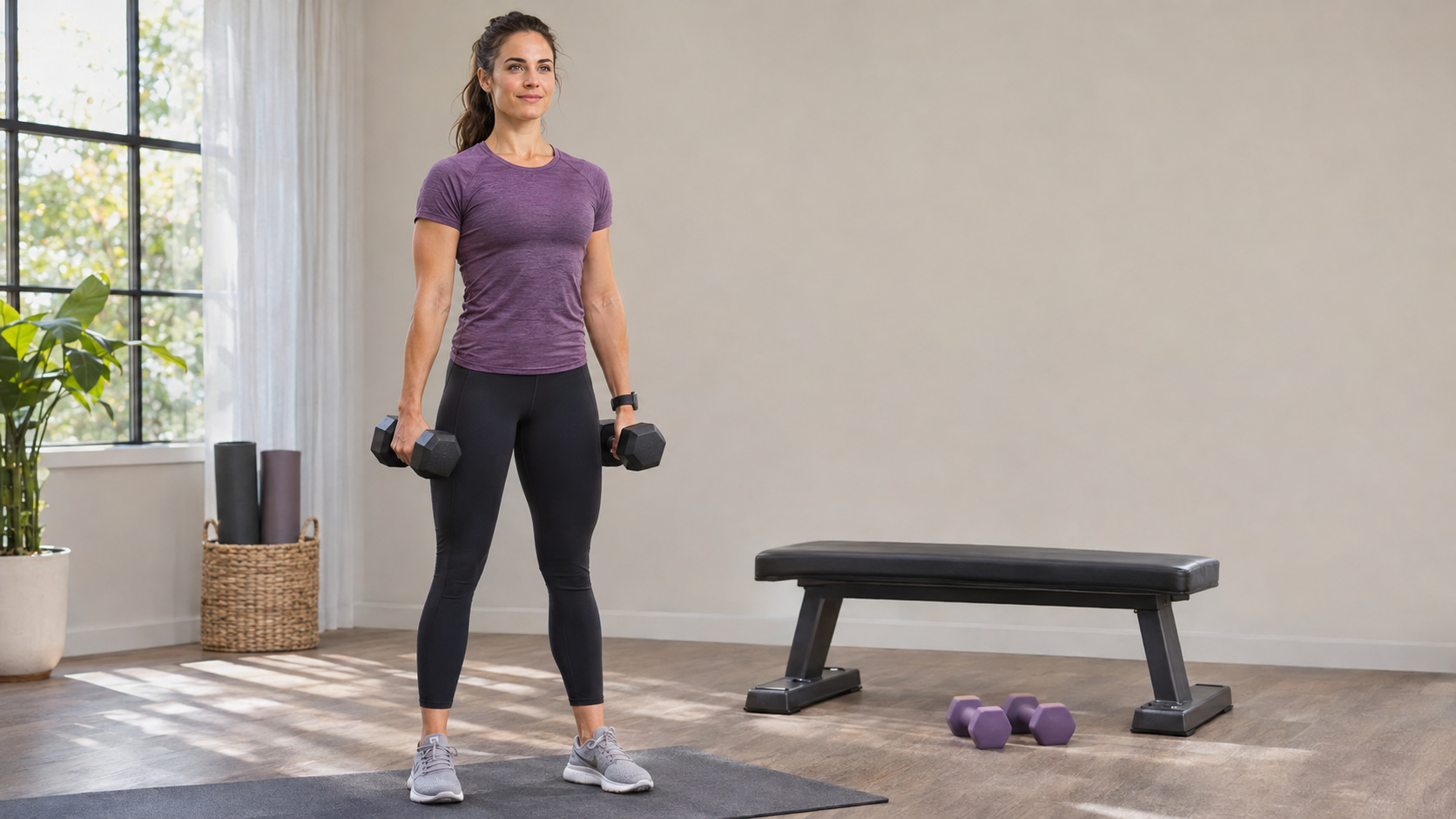
For a simple home or gym routine, three practical shoulder exercises for women are the dumbbell shoulder press, lateral raise, and seated reverse fly. Combine them in the approximately 20-minute workout below, with time included for warming up, resting, and changing weights.
These exercises offer different ways to train your shoulders without needing a long list of similar movements. You’ll learn how to perform each one, choose suitable weights, and progress without rushing your technique.
Before You Start: Muscles, Equipment, and Weight Selection
Why This Workout Uses Three Exercises
Your deltoid—the muscle covering your shoulder—has front, middle, and rear portions. This routine combines movements that emphasize different regions:
| Exercise | Main emphasis | Role in the workout |
|---|---|---|
| Dumbbell shoulder press | Front deltoids, with other shoulder muscles and triceps assisting | Overhead pressing strength |
| Dumbbell lateral raise | Middle, or side, deltoids | Raising the arms away from your sides |
| Seated reverse fly | Rear deltoids and upper-back muscles | Rear-shoulder work that complements pressing |
These are areas of emphasis, not complete muscle isolation. Pressing already provides front-shoulder work, so this short routine leaves out front raises and uses that time for the side and rear shoulders instead.
Women do not need a separate set of shoulder movements or a universally light dumbbell weight. The underlying strength-training principles are the same; your experience, current strength, goals, and recovery should determine the workload. HPRC’s guidance on training considerations for women makes this distinction clear.
What You Need
Have a pair of dumbbells and a stable, armless chair or flat bench available. Choose a seat that lets you plant both feet securely on the floor.
Ideally, prepare lighter and heavier dumbbells—or adjustable dumbbells—so you can choose the right resistance for each movement. Do not force yourself to use your pressing weight for lateral raises or reverse flies.
How Heavy Should Your Dumbbells Be?
Choose a weight that makes the last few repetitions challenging while allowing you to finish with about two or three additional good repetitions still possible. This is often called leaving two or three “repetitions in reserve.”
For example, after completing 10 presses, you should feel that you could perform roughly two or three more without leaning backward or changing the movement. You do not need to continue until you cannot lift the weight. The 2026 ACSM resistance-training position stand supports training with sufficient effort without requiring muscular failure.
During your first sessions, start conservatively and learn the movements. Reduce the weight when you cannot maintain control or reach the bottom of the suggested repetition range.
Before training: This is a general strength workout, not a rehabilitation plan. Get individualized guidance for an existing shoulder injury, recent surgery, or painful overhead movement. Stop for sharp pain, numbness, dizziness, chest pain, or other concerning symptoms and seek appropriate help. Chest pain accompanied by shortness of breath, sweating, or lightheadedness requires emergency medical attention.
3 Shoulder Exercises for Women
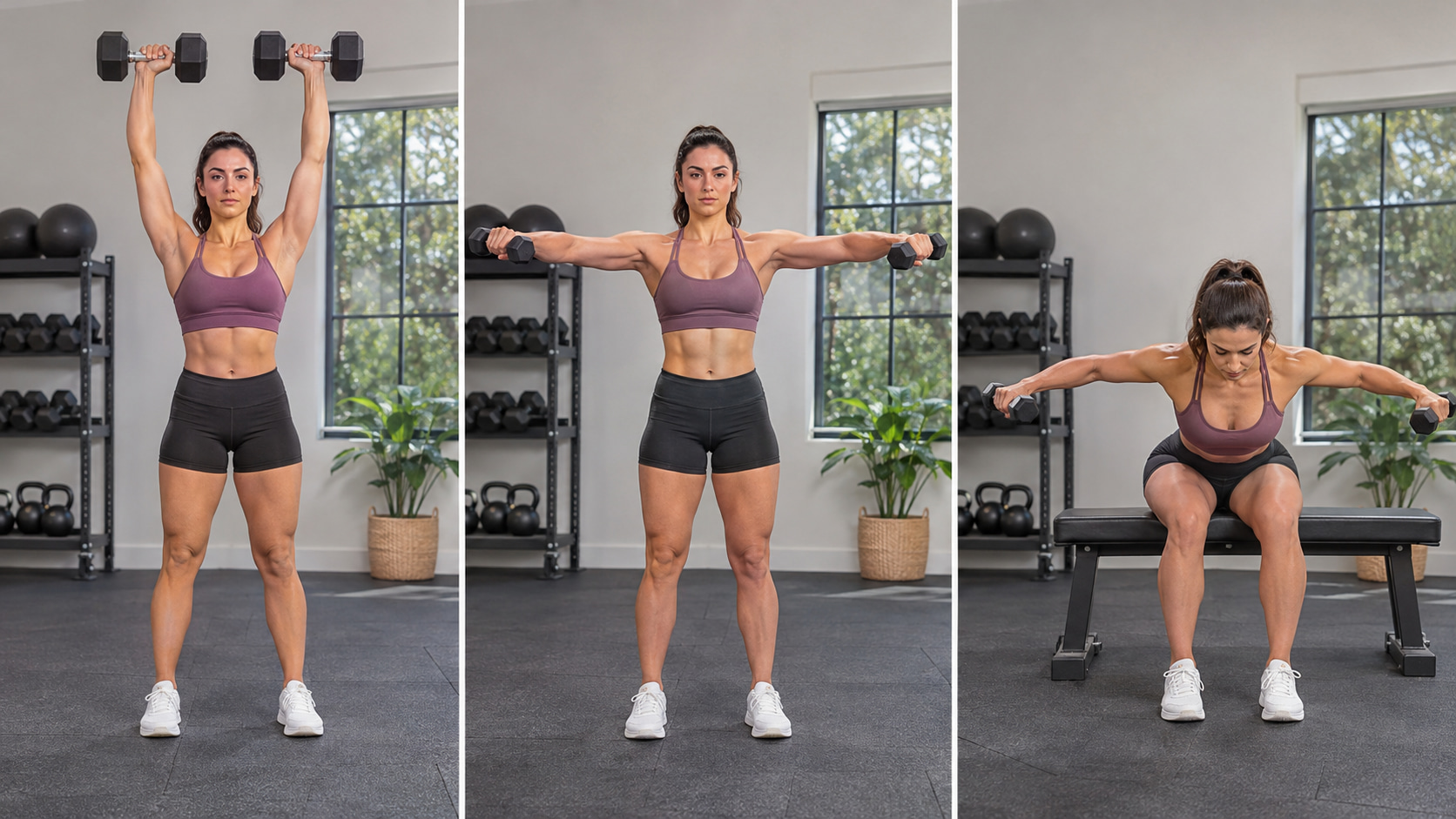
Use all three exercises for the standalone workout below. Perform both arms together, so the repetition targets are total repetitions—not repetitions per side.
1. Standing Dumbbell Shoulder Press
The shoulder press trains your front deltoids, with assistance from the other deltoid regions and triceps. Standing also requires you to keep your trunk steady while the weights move overhead.
Suggested workload: 2–3 sets of 8–12 repetitions. Rest 75–90 seconds between sets.
How to do it:
- Stand with your feet approximately shoulder-width apart. Hold a dumbbell in each hand near shoulder-to-ear height, with your palms facing forward.
- Position your elbows slightly forward of your torso rather than pulling them directly out to the sides. Keep your wrists aligned over your forearms and gently brace your abdomen.
- Press both dumbbells overhead together, extending your arms through a comfortable range. Keep your feet planted and avoid dipping your knees to help lift the weights.
- Lower the dumbbells smoothly to the starting position. Keep your torso steady rather than leaning back as the weights descend.
Common mistake and correction: Arching your lower back to finish a repetition means the set has become harder than you can control. Stop the set or reduce the weight rather than turning the press into a backward lean.
Make it easier: Use lighter dumbbells and practice a few controlled repetitions before adding a full working set.
2. Standing Dumbbell Lateral Raise
The lateral raise emphasizes the middle deltoids. It adds direct side-shoulder work without requiring another pressing movement.
Suggested workload: 2–3 sets of 10–15 repetitions. Rest about 60 seconds between sets.
How to do it:
- Stand upright with your feet about hip-width apart. Hold the dumbbells beside your thighs, palms facing inward, with a slight bend in your elbows.
- Brace your torso and raise both arms outward. Keep the elbow bend approximately the same throughout the movement.
- Stop when your upper arms are around shoulder height. Keep your wrists straight and avoid deliberately tipping your thumbs downward as though pouring from a pitcher.
- Lower the dumbbells slowly to your sides. Pause briefly enough to prevent the weights from bouncing into the next repetition.
Common mistake and correction: Swinging your torso or bouncing your knees changes the exercise into a momentum-assisted lift. Reduce the weight until you can raise and lower your arms while keeping your body still.
Make it easier: Use lighter dumbbells. Keep the same controlled movement rather than trying to match the weight you use for presses.
3. Seated Bent-Over Dumbbell Reverse Fly
Also called a seated rear lateral raise, this exercise trains the rear deltoids and muscles across the upper back. It supplies rear-shoulder work without requiring an adjustable incline bench.
Suggested workload: 2–3 sets of 10–15 repetitions. Rest about 60 seconds between sets.
How to do it:
- Sit near the front of a stable chair or flat bench with your knees bent and feet planted. Hold a dumbbell in each hand.
- Hinge forward from your hips, bringing your torso toward your thighs while keeping your back steady. Let your arms hang beside or slightly behind your calves, palms facing each other and elbows slightly bent.
- Lift both arms outward in a wide arc until your elbows are approximately level with your shoulders. Keep the elbow bend consistent rather than bending your arms further and pulling the weights toward your waist.
- Lower the dumbbells under control. Keep your torso in the same position rather than lifting your chest to help move the weights.
Common mistake and correction: Rounding your back or throwing the weights upward makes the movement harder to control. Use less weight and stop each repetition before you need to change your torso position.
Make it easier: Rehearse the movement without weights first. Add light dumbbells once you can maintain the forward-leaning position comfortably.
Your 20-Minute Shoulder Workout
This is a starting example, not a requirement to complete a fixed amount of work regardless of how you feel. Finish the sets of one exercise before moving to the next.
Warm Up for About 5 Minutes
Begin with two to three minutes of brisk walking or marching. Then rehearse six to eight easy repetitions of each planned exercise, using no weight or very light dumbbells. Take a brief pause before starting your first working set.
The rehearsal repetitions should help you check your movement and choose your weights—not tire your shoulders out. Allow more preparation time when needed; warming up and moving under control matter more than meeting an exact timer.
Complete the Working Sets
| Order | Exercise | Sets | Repetitions | Rest between sets |
|---|---|---|---|---|
| 1 | Standing dumbbell shoulder press | 3 | 8–12 | 75–90 seconds |
| 2 | Standing dumbbell lateral raise | 3 | 10–15 | About 60 seconds |
| 3 | Seated bent-over dumbbell reverse fly | 3 | 10–15 | About 60 seconds |
Keep approximately two or three good repetitions in reserve on each set. Breathe out as you lift and breathe in as you lower, rather than holding your breath throughout the repetition.
How the timing works: Budget about five minutes for the warm-up, 12–14 minutes for the working sets and their rest periods, and one to two minutes for changing weights and moving to the seat. This assumes controlled repetitions averaging roughly three seconds and equipment prepared nearby.
The session may run slightly longer at the upper end of the repetition ranges or when adjustable dumbbells take time to change. Take additional recovery when needed. With a strict 20-minute limit, omit a final set rather than rushing your repetitions or cutting necessary rest.
Beginner Option: Start With Two Sets
For your first sessions, perform two working sets of each exercise instead of three. Keep the same repetition ranges and rest periods.
That gives you six working sets rather than nine. Finishing sooner is fine; you do not need to fill the remaining minutes with extra exercises. Build toward three sets only when you can maintain your technique and recover comfortably between sessions.
How Often to Train and When to Progress
Fit the Routine Into Your Week
When this is your main shoulder training, a practical starting schedule is twice weekly on nonconsecutive days, such as Monday and Thursday. Leave recovery time between sessions instead of repeating the full workout every day.
This is a shoulder session, not a complete strength program. Continue training your other major muscle groups throughout the week. ACSM’s recommendations apply to whole-body resistance training, not simply repeating one body-part workout.
Already doing substantial pressing and shoulder work in another routine? Replace some existing shoulder work with this plan rather than automatically adding all nine sets. Alternatively, use the lateral raise and reverse fly to fill gaps in a program that already includes an overhead press.
Increase Repetitions Before Increasing Weight
Use this practical progression rule: stay with the same weight until you reach the top of the repetition range on every planned set, with steady technique and the intended effort, in two consecutive sessions.
For example, when you can complete three sets of 12 presses—and still have roughly two or three good repetitions available—try the smallest available weight increase. Begin again near the lower end of the range.
If the heavier dumbbells make you lean, swing, or fall below the minimum repetition target, return to the previous weight. Progress does not need to happen every week; gradual increases should follow improvements in your ability to perform the exercise well.
Record the weight and repetitions for each movement. That gives your next session a clear starting point and helps you distinguish real progress from simply moving the weights faster.
Start with the amount of work you can control, repeat it consistently, and increase the challenge when your performance supports it. Three well-practiced exercises are enough to make this a focused shoulder session without turning it into a rushed circuit.
References
- American College of Sports Medicine: 2026 position stand on resistance-training prescription for healthy adults.
- Human Performance Resources by CHAMP: Physical training considerations for women.
- American Council on Exercise: Lateral raise instructions and shoulder-exercise research and demonstrations.
- Mayo Clinic: Weight-training technique and precautions and reverse fly with dumbbells.
- Exercise technique guides: PureGym dumbbell shoulder press, Rogue lateral raise, and Muscle & Strength seated reverse fly.
- American Academy of Orthopaedic Surgeons: Shoulder conditioning and rehabilitation guidance.
- NHS: Shoulder symptoms requiring medical attention and chest-pain warning signs.