
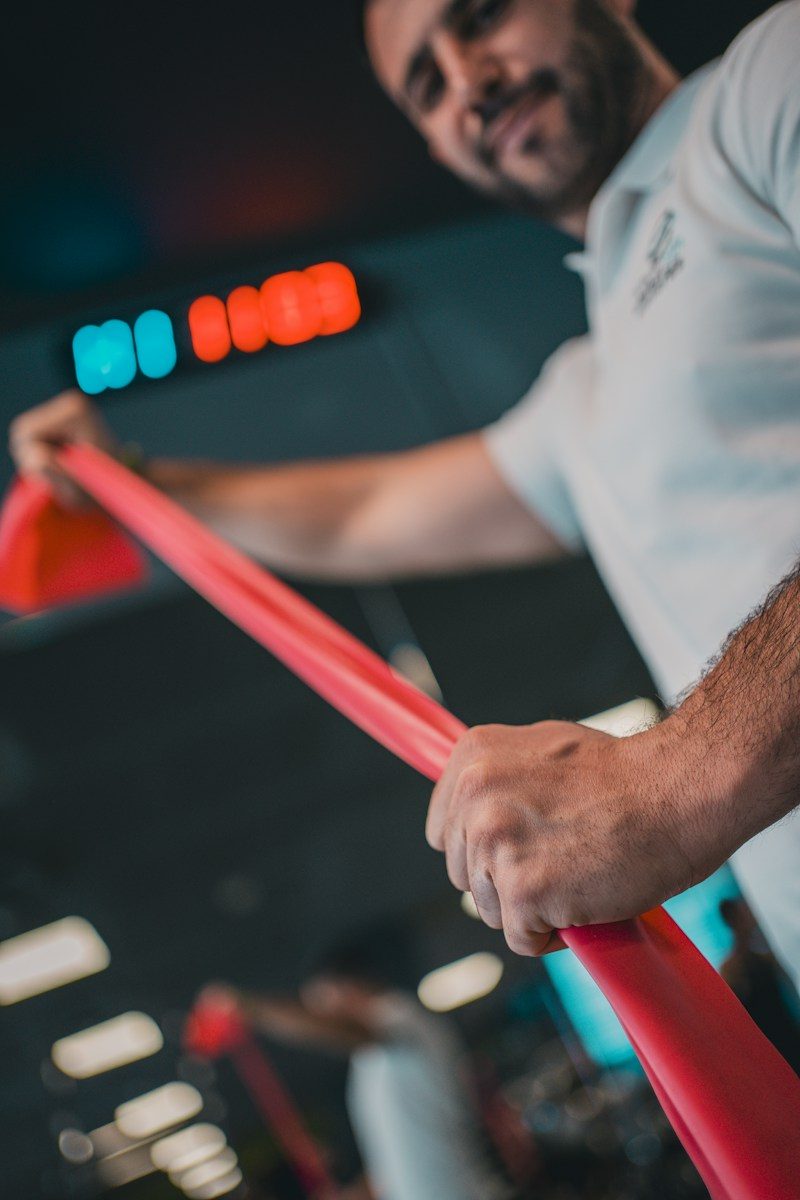
Resistance band quad exercises use squats, split squats, knee extensions, and presses to strengthen the front of your thighs. Your quadriceps straighten your knees and contribute to everyday movements such as walking and standing up, according to the Cleveland Clinic.
You do not need to perform all eight exercises in one session. Start with the three-movement workout below, then use the other options to suit your equipment, experience, and preferred training position.
Before You Start: Check Your Band and Setup
Different exercises need different bands. This guide uses handled resistance tubes, flat resistance bands, and long-loop bands. Some movements also require a stable seat, a knee pad, or a secure anchor.
Inspect the band, handles, and attachments before every workout. Follow the manufacturer’s stretching limits, discard damaged equipment, and never release a stretched band suddenly. The American Council on Exercise also warns against putting ordinary tube handles over your feet because they can slip off.
Warm up with 5–10 minutes of easy walking or cycling, as recommended by the American Academy of Orthopaedic Surgeons, then practice your first exercise with light resistance.
The sets, repetitions, and hold times below are suggested starting ranges for general strength training—not a rehabilitation prescription.
8 Resistance Band Quad Exercises
The first four options provide straightforward standing and seated ways to train your quads. The remaining exercises offer a small-range accessory, a static hold, a different squat setup, and an advanced assisted movement.
1. Resistance Tube Squat
Best for: A main two-leg strength exercise.
Muscles worked: Quadriceps, glutes, and inner-thigh muscles.
Equipment: Resistance tube with handles.
Suggested dosage: 2 sets of 8–15 repetitions; rest 90–120 seconds.
How to Do It
- Stand on the middle of the tube with your feet approximately shoulder-width apart and toes slightly outward.
- Hold one handle in each hand, keeping your arms extended beside your body.
- Bend your knees and hips to lower into a squat. Keep your heels grounded and knees moving in the direction of your toes.
- Lower toward thigh-parallel while maintaining control, pause briefly, then stand without pulling the handles upward.
This is the hands-at-sides variation, not a squat with the handles held at shoulder height. FITTR describes the underfoot setup, while ACE’s squat guidance supports limiting depth before your heels lift or your trunk position breaks down.
Common mistakes: Bending the elbows to lift the handles, letting the knees collapse inward, or forcing depth after losing balance.
Make it easier: Use a lighter tube and a shallower, controlled squat.
2. Resistance Band Split Squat
Best for: Training in a stationary split stance without stepping between repetitions.
Muscles worked: Quadriceps and glutes, with hamstrings and trunk muscles assisting.
Equipment: Resistance tube with handles.
Suggested dosage: 2 sets of 8–12 repetitions per leg; rest 90–120 seconds.
How to Do It
- Secure the tube beneath your front foot. Step the other foot behind you and establish a balanced split stance.
- Hold the handles just above your shoulders with your elbows bent.
- Bend both knees to lower your body, bringing the rear knee toward the floor without resting it down. Keep the front foot planted.
- Extend your legs to rise back into the same stance. Finish the set before changing sides.
FITTR labels this exercise “resistance band lunges,” but its written sequence establishes the backward step during setup rather than prescribing a new step on every repetition.
Common mistakes: Moving the feet between repetitions, bouncing the rear knee off the floor, or allowing the handles to drift overhead.
Make it easier: Choose a lighter tube or reduce the lowering distance. Establish balance before increasing resistance.
YouTube: Resistance Band Lunges — FITTR
3. Seated Resistance Band Knee Extension
Best for: Direct knee-extension work without a standing balance requirement.
Muscles worked: Quadriceps.
Equipment: Flat resistance band, secure low anchor behind the working ankle, and a stable, sufficiently high seat.
Suggested dosage: 1–2 sets of 10–15 repetitions per leg; rest 60–90 seconds.
How to Do It
- Secure the band around the working ankle and attach it to an appropriate anchor behind the foot.
- Sit upright with your thigh supported and enough clearance for your lower leg to move freely.
- Keep the thigh still while straightening your knee in front of you. Briefly tighten the front of your thigh near the end of the movement.
- Slowly bend the knee to return, resisting the band rather than letting it pull your leg backward.
Peak Physio describes this high-seat, rear-anchor setup with a controlled extension and return.
Common mistakes: Swinging the leg, leaning backward to finish a repetition, or lifting the thigh off the seat.
Make it easier: Reduce resistance before sacrificing control or forcing the knee into an uncomfortable position.
4. Seated Resistance Band Single-Leg Press
Best for: A seated pressing option without an external anchor.
Muscles worked: Quadriceps, with hip muscles assisting the pressing movement.
Equipment: Long flat resistance band and a firm, stable chair.
Suggested dosage: 2 sets of 10–15 repetitions per leg; rest 60–90 seconds.
How to Do It
- Sit upright on the chair. Position the band across the middle of the working foot and hold its ends securely in both hands.
- Begin with the working knee bent and the band under light tension.
- Press the foot away from your body, extending the leg as far as you can without rounding your back or losing the band’s position.
- Pause briefly, then bend the knee to return slowly.
FITTR describes the seated press-and-return movement. The British Heart Foundation also illustrates a seated single-leg press with the band beneath the middle of the foot.
Common mistakes: Letting the band migrate toward the toes, slumping, or allowing the return to become uncontrolled.
Make it easier: Use lighter resistance. Keep your grip secure rather than shortening the band aggressively.
5. Standing Terminal Knee Extension
Best for: Practicing the final portion of knee straightening.
Muscles worked: Quadriceps.
Equipment: Long-loop band secured to an immovable anchor in front of the working knee.
Suggested dosage: 1–2 sets of 15–20 repetitions per leg; rest 30–60 seconds.
How to Do It
- Place the band behind the working knee and step backward until it is taut.
- Keep most of your weight on the other leg. Begin with the working knee slightly bent, its heel raised, and the ball of that foot on the floor.
- Straighten the working knee while lowering its heel to the floor.
- Pause briefly with the foot flat, then slowly bend the knee and raise the heel again.
This is the heel-lowering version described by Barbell Logic, rather than a version that keeps the working heel down throughout.
Common mistakes: Snapping the knee backward, shifting most of your weight onto the working leg, or turning the exercise into a squat.
Workout placement: Use it as an optional warm-up or accessory—not as the only movement in your quad workout.
6. Spanish Squat Hold
Best for: Sustaining quad effort in a held squat position.
Muscles worked: Primarily quadriceps.
Equipment: Suitable heavy loop band and an immovable, load-rated anchor.
Suggested dosage: 2 holds of 15–30 seconds; rest 60–90 seconds.
How to Do It
- Stand inside the anchored band so it supports the backs of your knees. Step backward to create tension.
- Position your feet approximately hip-width apart, facing forward.
- Bend your knees and move your hips backward, allowing the band to counterbalance you. Let your trunk incline forward slightly while keeping your spine aligned.
- Stop at a comfortable depth, no deeper than approximately a 90-degree knee bend. Hold while breathing normally, then return to standing under control.
This follows Peak Physio’s Spanish squat hold guidance, which permits forward trunk inclination. Do not force your torso into a different position simply because another Spanish squat demonstration looks more upright.
Common mistakes: Using a movable anchor, descending farther than you can control, or holding your breath.
Make it easier: Use a shallower position or shorter hold.
7. Thigh-Loop Band Squat
Best for: Squat practice with additional sideways resistance around the thighs.
Muscles worked: Quadriceps and glutes, with hip stabilizers resisting the band’s inward pull.
Equipment: A flat resistance band secured in a loop above the knees.
Suggested dosage: 2 sets of 10–15 repetitions; rest 60–90 seconds.
How to Do It
- Position the loop around your thighs, just above your knees. Stand approximately shoulder-width apart with your toes slightly outward.
- Brace your trunk, then bend your hips and knees to lower into a squat.
- Maintain enough outward pressure to keep your knees aligned with your toes. Do not push them excessively outward.
- Keep your heels grounded as you return to standing.
Peak Physio describes this above-knee setup and emphasizes maintaining knee alignment during the squat.
Important distinction: The thigh band adds sideways resistance. It does not provide the same resistance against standing up as the underfoot tube in Exercise 1. Treat these as different equipment options, not interchangeable loading methods.
Common mistakes: Choosing a loop that pulls the knees inward uncontrollably or forcing the knees far outside the line of the feet.
8. Band-Assisted Reverse Nordic
Best for: Experienced exercisers who can control a kneeling backward lean.
Muscles worked: Quadriceps, with glutes and trunk muscles helping maintain body position.
Equipment: Knee pad and a resistance band anchored securely in front of you.
Suggested dosage: 1–2 sets of 5–8 controlled repetitions; rest 90–120 seconds.
How to Do It
- Kneel tall on the pad with your shins and the tops of your feet supported. Hold the anchored band in both hands.
- Brace your abdomen and keep your hips extended so your trunk and thighs form a straight line.
- Lean backward from your knees as one unit. Stop before your hips fold, your back arches, or you lose control.
- Use your quads, together with the band’s assistance, to return to tall kneeling.
The Prehab assisted reverse Nordic guidance emphasizes maintaining a straight trunk and using the band for assistance.
Common mistakes: Sitting toward the heels, bending at the waist, or bouncing out of the bottom.
Make it easier: Shorten the backward lean and use more assistance. Skip this option when kneeling is uncomfortable.
A Simple Resistance Band Quad Workout
Use this routine twice per week on nonconsecutive days. It combines a two-leg squat, a split-stance movement, and direct knee-extension work.
| Exercise | Sets | Repetitions | Rest |
|---|---|---|---|
| Resistance tube squat | 2 | 8–15 | 90–120 seconds |
| Resistance band split squat | 2 | 8–12 per leg | 90–120 seconds |
| Seated resistance band knee extension | 1–2 | 10–15 per leg | 60–90 seconds |
Effort: Choose resistance that leaves approximately two or three more controlled repetitions possible at the end of most sets. Rest between legs when needed rather than rushing the second side.
For beginners: Start with one set of each exercise. Add sets gradually when you can complete the routine with consistent technique and recover comfortably before the next session.
Useful substitutions: Replace the split squat with the seated single-leg press for a seated alternative. The Spanish squat hold can replace the final exercise for variety. Keep the reverse Nordic optional rather than adding it on top of every other movement.
The American College of Sports Medicine recognizes elastic-band and home-based resistance training as useful options and recommends training all major muscle groups at least twice weekly. This routine covers your quads; it is not a complete whole-body program.
How to Choose Resistance and Progress
For your first session, choose a band that lets you complete the lower end of the repetition range without changing your posture or rushing. Use that session to establish a repeatable setup.
Build repetitions before increasing resistance. As a practical progression rule, move to a stronger band after you reach the top of the range on every set for two sessions while still having a few controlled repetitions available. Return to the lower end of the range with the new band.
Record the band used, repetitions, and relevant setup details. Changing your stance, starting stretch, or distance from an anchor can change the exercise’s difficulty. Stay within the manufacturer’s stretching limits rather than simply moving farther away.
The assisted reverse Nordic works differently: the band helps you return upright. At a comparable setup, more assistance makes the exercise easier—not harder. Progress by controlling a slightly greater lean or gradually using less assistance.
Training to complete muscular failure is not required for the average healthy adult to benefit from resistance training. Consistency and an appropriately challenging workload matter more than making every set maximal.
Frequently Asked Questions
Can resistance bands build bigger quads?
Yes. Elastic-band training can support muscle growth when the exercises provide sufficient challenge and the program progresses over time. However, simply adding a light thigh loop does not guarantee that a squat becomes demanding enough for continued quad development.
Which exercises can I do without an external anchor?
The resistance tube squat, split squat, seated single-leg press, and thigh-loop squat do not require an external anchor. Use those options rather than improvising an attachment for the anchored movements.
Do my knees have to stay behind my toes?
Not as a universal squat rule. ACE’s squat guidance allows the knees to travel forward while tracking in line with the toes. Keep your heels grounded and use a depth you can control rather than forcing one knee position across every exercise.
Are these exercises suitable when my knees hurt?
They are not a diagnosis-specific knee program. Persistent pain, recent surgery, or an injury may require different exercises, ranges, or loading. Seek guidance from a qualified healthcare professional rather than assuming that a band makes an exercise suitable.
Stop exercising and seek professional help for sharp pain, numbness, dizziness, chest pain, or other unusual symptoms. Persistent chest pain or severe symptoms warrant urgent medical attention.
Start With Three Exercises, Not Eight
Begin with the tube squat, split squat, and seated knee extension. Keep the setups consistent, record your repetitions, and increase the challenge gradually. Use the other exercises as purposeful alternatives—not as extra work you must complete every session.
This content is for informational purposes only and is not a substitute for medical advice.