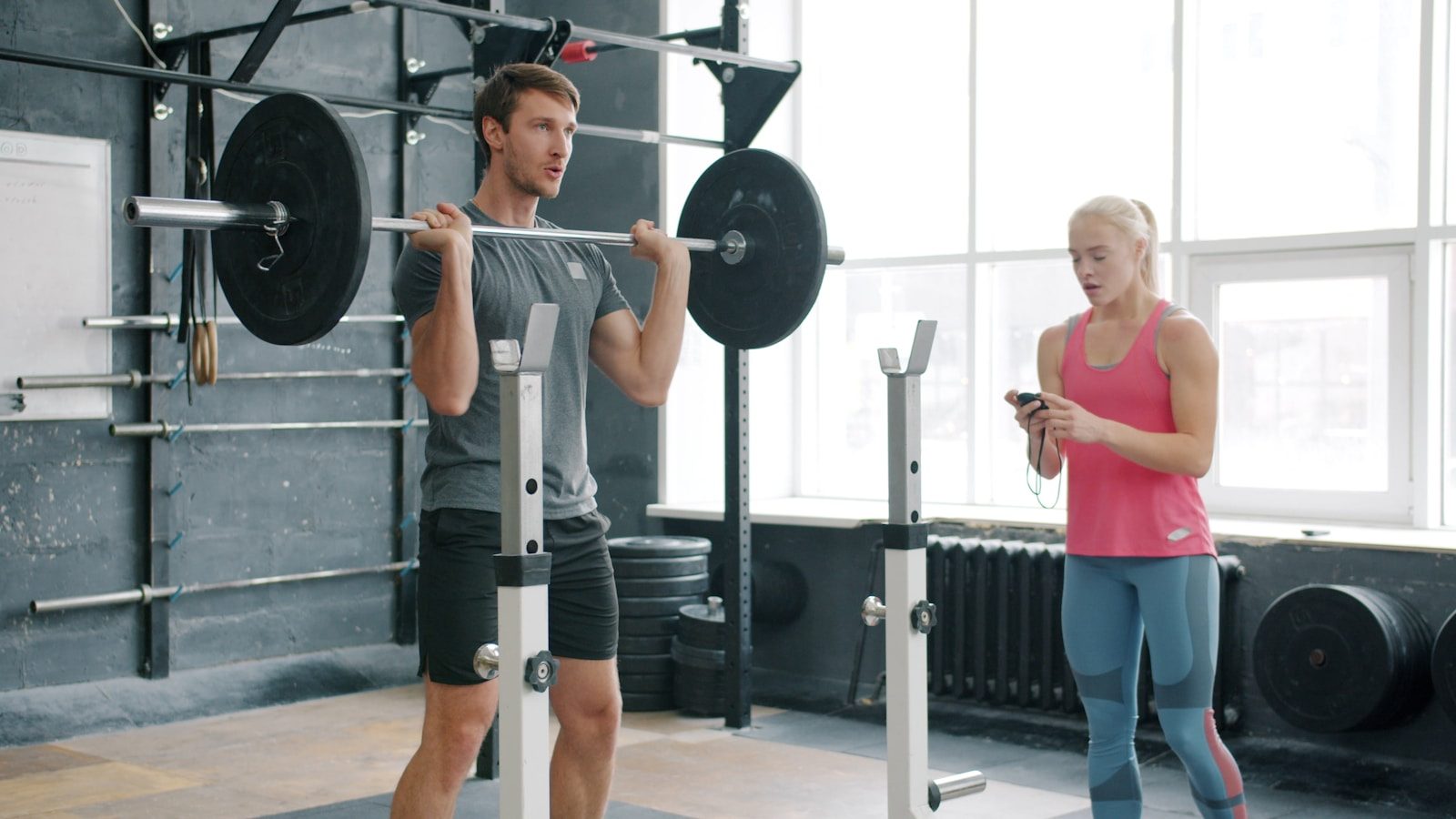
Barbell exercises for beginners should teach the main strength patterns with light loading, controlled reps, and simple progressions. A barbell can help you build strength in your legs, hips, back, chest, shoulders, arms, and core, but it works best when you learn technique before adding heavy weight.
This guide covers 12 beginner-friendly barbell exercises, how to do them, which muscles they train, common mistakes to avoid, and how to use them in a simple workout routine.
What Makes Barbell Exercises for Beginners Effective?
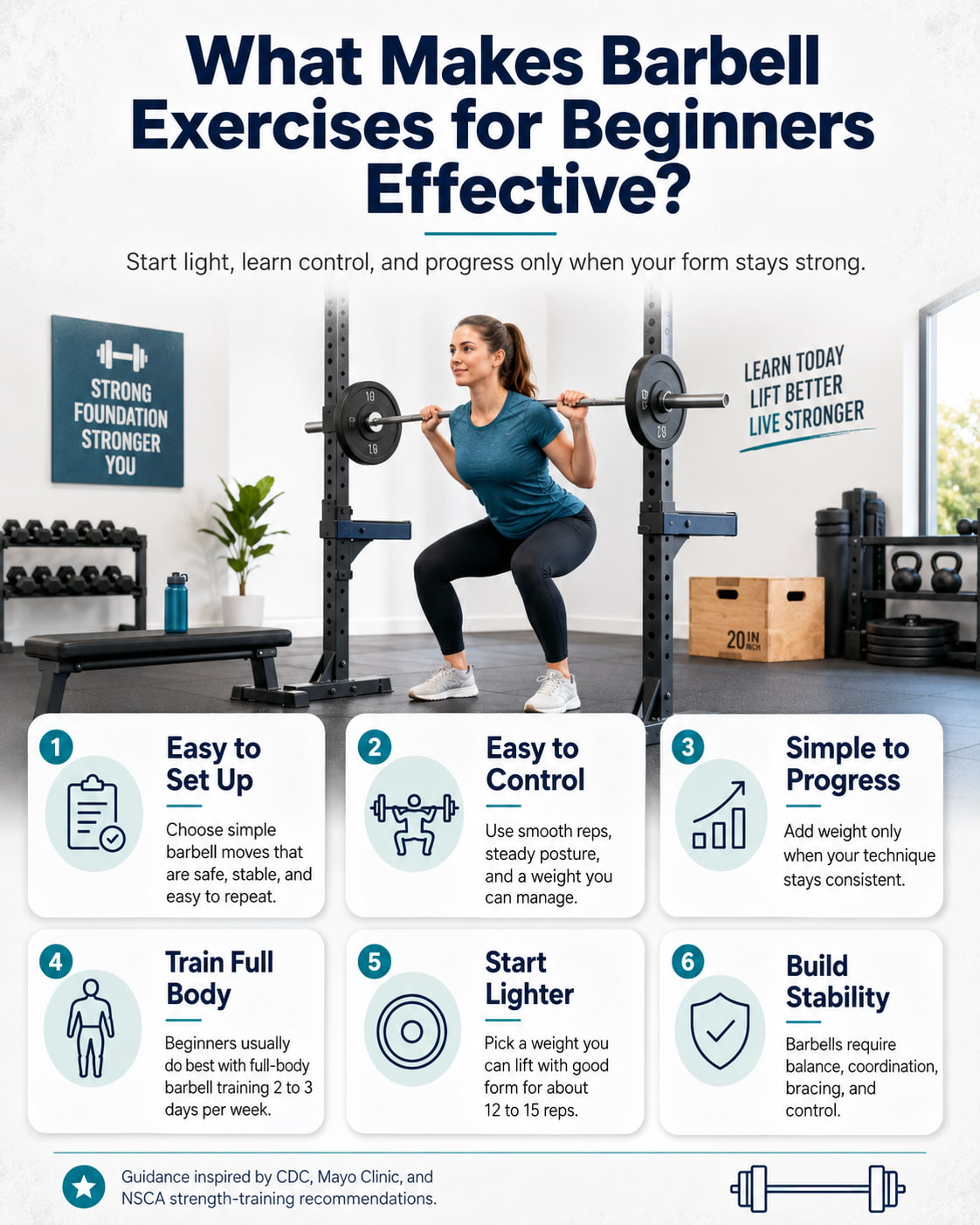
Good barbell exercises for beginners should be easy to set up, easy to control, and simple to progress. The goal is not to prove how strong you are on day one. The goal is to learn stable positions, build confidence, and add weight only when your form stays consistent.
The CDC physical activity guidelines recommend muscle-strengthening activities on two or more days per week that work all major muscle groups. For beginners, that usually means full-body barbell training two or three times per week instead of training one muscle group every day.
Start lighter than you think you need. The Mayo Clinic weight-training guide recommends choosing a weight you can lift comfortably for about 12 to 15 reps while maintaining proper technique. That is a smart starting point for beginners because lighter loads give you more room to practice.
Barbells are free weights, so they require more balance, coordination, and control than many machines. The NSCA explains that barbells allow unrestricted movement, which is useful for strength training but also means beginners need good setup, stability, and technique.
Beginner Barbell Safety Tips Before You Start
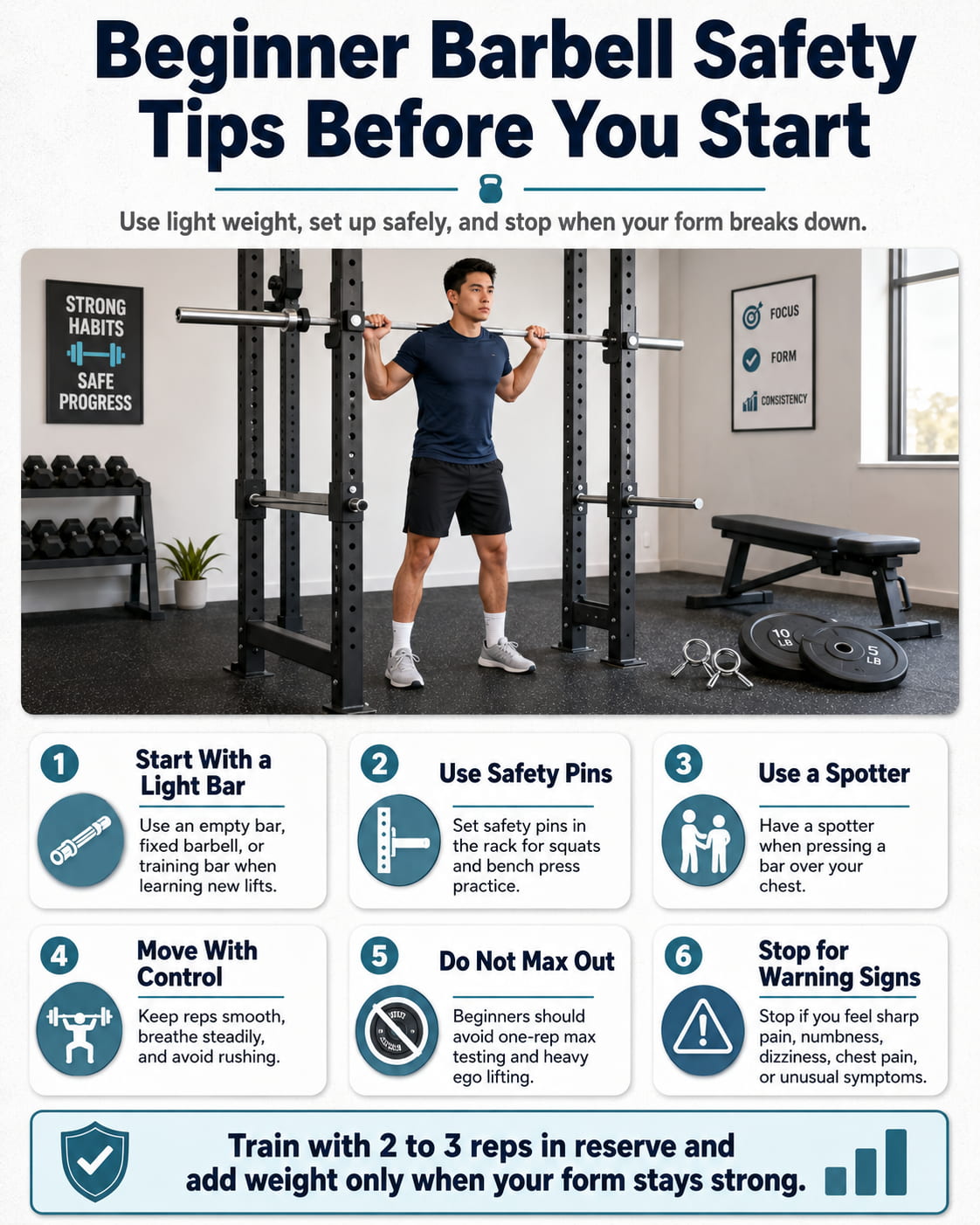
Use an empty bar, lighter fixed barbell, or training bar when learning new movements. A standard Olympic bar may be too heavy for some beginners, especially on overhead presses, rows, lunges, and curls.
Set safety pins in a squat rack for squats and bench press. Use a spotter when pressing a bar over your chest. Keep your reps smooth, breathe with control, and stop the set if your form starts to break down.
Do not test your one-rep max as a beginner. Most sets should feel like you could still complete two or three good reps if you had to. Stop and seek professional help if an exercise causes sharp pain, numbness, dizziness, chest pain, severe shortness of breath, or unusual symptoms.
12 Best Barbell Exercises for Beginners
The best barbell exercises for beginners should build strength while helping you learn safe lifting form and body control.
Start with light weight, focus on smooth technique, and progress only when each movement feels stable and repeatable.
1. Barbell Chest Press
Best for: Building beginner upper-body pushing strength.
Muscles worked: Chest, front shoulders, triceps, upper back stabilizers, and core.
Equipment needed: Barbell, flat bench, rack, weight plates, collars, and a spotter or safety arms.
Why it stands out: The barbell chest press is one of the most beginner-friendly barbell lifts because the bench supports your body while you learn to press with control. The ACE chest press guide describes the movement with the feet pressing into the floor, the bar lowering under control, and the weight pressing back up from the chest.
Suggested sets and reps: Do 2 to 3 sets of 8 to 12 reps.
Rest: Rest 90 to 120 seconds between sets.
Beginners: Start with an empty bar, fixed barbell, or dumbbells if the bar feels too heavy.
How to do it:
- Lie on a flat bench with your eyes under the bar.
- Plant your feet flat and keep your hips on the bench.
- Grip the bar slightly wider than shoulder-width.
- Unrack the bar with control and hold it over your chest.
- Lower the bar toward the mid-chest while keeping your wrists stacked.
- Press the bar back up until your arms are straight but not relaxed.
- Re-rack the bar only when it is fully under control.
Common mistakes: Bouncing the bar off the chest, lifting the hips off the bench, flaring the elbows too wide, bending the wrists back, and using too much weight too soon.
Expert tip: Think “feet down, shoulders back, bar smooth.” A stable body helps you press with better control.
2. Barbell Romanian Deadlift
Best for: Learning the hip hinge and strengthening the posterior chain.
Muscles worked: Hamstrings, glutes, spinal erectors, lats, forearms, and core.
Equipment needed: Barbell, weight plates, and collars.
Why it stands out: The Romanian deadlift teaches beginners how to hinge at the hips without turning the movement into a squat. It is useful for building hamstring and glute strength while practicing a neutral spine and controlled bar path.
Suggested sets and reps: Do 2 to 3 sets of 8 to 12 reps.
Rest: Rest 90 to 120 seconds between sets.
Beginners: Use an empty bar or light fixed barbell and lower only as far as you can control.
How to do it:
- Stand tall with the bar in front of your thighs.
- Set your feet about hip-width apart.
- Brace your core and pull your shoulders down and back.
- Soften your knees slightly.
- Push your hips back as the bar slides down your thighs.
- Stop when you feel a strong hamstring stretch without rounding your back.
- Drive your hips forward to stand tall.
Common mistakes: Squatting the weight down, rounding the back, letting the bar drift away from the legs, locking the knees hard, and going lower than your mobility allows.
Expert tip: Keep the bar close enough to almost brush your legs. A close bar path makes the lift easier to control.
3. Barbell Hip Bridge
Best for: Building glute strength with a stable beginner setup.
Muscles worked: Glutes, hamstrings, adductors, lower back stabilizers, and core.
Equipment needed: Barbell, mat, hip pad, weight plates, and collars.
Why it stands out: The barbell hip bridge is easier to control than many standing barbell lifts because your back stays on the floor. The ACE hip bridge guide describes placing the bar over the hips, keeping the feet flat, pressing into the floor, and lifting the hips upward with control.
Suggested sets and reps: Do 2 to 4 sets of 10 to 15 reps.
Rest: Rest 60 to 90 seconds between sets.
Beginners: Start with a bodyweight glute bridge before adding the bar.
How to do it:
- Sit on the floor and position the bar over your hips.
- Lie back with your knees bent and feet flat.
- Hold the bar steady with both hands.
- Brace your core and press your feet into the floor.
- Lift your hips until your torso and thighs form a straight line.
- Squeeze your glutes at the top without arching your lower back.
- Lower your hips with control.
Common mistakes: Overarching the lower back, pushing through the toes, placing the feet too far away, letting the knees cave inward, and rushing the reps.
Expert tip: Keep your ribs down as your hips rise. This helps you use your glutes instead of your lower back.
4. Barbell Back Squat to Box
Best for: Learning squat depth, balance, and lower-body control.
Muscles worked: Quadriceps, glutes, hamstrings, adductors, calves, upper back, and core.
Equipment needed: Barbell, squat rack, box or bench, safety pins, weight plates, and collars.
Why it stands out: A box gives beginners a clear depth target and helps reduce guessing. This makes the squat easier to learn before progressing to a free back squat. The goal is to touch the box lightly, not collapse onto it.
Suggested sets and reps: Do 2 to 3 sets of 6 to 10 reps.
Rest: Rest 90 to 150 seconds between sets.
Beginners: Start with bodyweight box squats, then use an empty bar if your form stays steady.
How to do it:
- Set a box or bench behind you at a comfortable height.
- Place the bar across your upper back, not your neck.
- Grip the bar firmly and step back from the rack.
- Set your feet about shoulder-width apart.
- Brace your core and sit your hips back slightly.
- Bend your knees and lower until you lightly touch the box.
- Drive through your feet to stand tall.
Common mistakes: Sitting down hard, relaxing on the box, knees collapsing inward, heels lifting, leaning too far forward, and using a box that is too low.
Expert tip: Think “touch and go.” The box is a depth guide, not a chair.
5. Landmine Goblet Squat
Best for: Learning the squat pattern with a more beginner-friendly bar path.
Muscles worked: Quadriceps, glutes, adductors, hamstrings, calves, core, and upper back.
Equipment needed: Barbell, landmine attachment or secure corner setup, and weight plates.
Why it stands out: A landmine setup anchors one end of the bar, which can make squatting feel more stable than holding a free bar on your back. The ACE landmine training resource includes landmine squat and press options that can be useful for building beginner-friendly barbell workouts.
Suggested sets and reps: Do 2 to 3 sets of 8 to 12 reps.
Rest: Rest 60 to 120 seconds between sets.
Beginners: Use the empty bar end and focus on smooth depth.
How to do it:
- Place one end of the bar in a landmine attachment.
- Hold the other end of the bar at chest height.
- Stand with your feet about shoulder-width apart.
- Brace your core and keep your chest tall.
- Bend your knees and hips to squat down.
- Keep your heels grounded and knees tracking with your toes.
- Press through your feet to stand back up.
Common mistakes: Letting the heels lift, leaning into the bar, rounding the back, dropping too low without control, and letting the knees cave inward.
Expert tip: Keep the bar close to your chest so your core can stay braced.
6. Standing Two-Arm Landmine Press
Best for: Beginner shoulder pressing with a more natural pressing angle.
Muscles worked: Shoulders, upper chest, triceps, serratus anterior, core, and glutes.
Equipment needed: Barbell, landmine attachment or secure corner setup, and weight plates.
Why it stands out: Many beginners struggle with strict overhead pressing because of shoulder mobility or core control. The landmine press uses a diagonal pressing path, which often feels easier to control than pressing a straight bar overhead.
Suggested sets and reps: Do 2 to 3 sets of 8 to 12 reps.
Rest: Rest 60 to 90 seconds between sets.
Beginners: Press with both hands and use a split stance for balance.
How to do it:
- Set one end of the bar in a landmine attachment.
- Hold the other end of the bar with both hands at chest height.
- Stand tall with your feet staggered or shoulder-width apart.
- Brace your core and squeeze your glutes lightly.
- Press the bar up and forward until your arms are nearly straight.
- Lower the bar back to your chest with control.
- Repeat without leaning back.
Common mistakes: Arching the lower back, shrugging the shoulders, pressing too fast, letting the ribs flare, and standing too close to the bar.
Expert tip: Keep your ribs stacked over your hips. If your back arches, the weight is too heavy or your stance is too narrow.
7. Barbell Bent-Over Row
Best for: Building back strength and learning a strong hip-hinge position.
Muscles worked: Lats, rhomboids, traps, rear delts, biceps, forearms, spinal erectors, glutes, and core.
Equipment needed: Barbell, weight plates, and collars.
Why it stands out: The row trains the pulling muscles that help balance pressing exercises. The ACE bent-over row guide describes hinging forward with a straight back, lowering the bar until the elbows are straight, and pulling the bar toward the belly button.
Suggested sets and reps: Do 2 to 3 sets of 8 to 12 reps.
Rest: Rest 90 to 120 seconds between sets.
Beginners: Start very light and hold a shallow hinge position.
How to do it:
- Stand with the bar in your hands and feet about hip-width apart.
- Hinge forward by pushing your hips back.
- Keep a slight bend in your knees.
- Brace your core and keep your back flat.
- Let the bar hang under your shoulders.
- Pull the bar toward your lower ribs or belly button.
- Lower the bar until your arms are straight again.
Common mistakes: Rounding the back, jerking the bar, turning the row into a shrug, standing too upright, and using body momentum.
Expert tip: Pull your elbows back instead of pulling with your hands. This helps your back do more of the work.
8. Deadlift From Blocks
Best for: Learning the deadlift pattern before pulling from the floor.
Muscles worked: Glutes, hamstrings, quads, spinal erectors, lats, traps, forearms, and core.
Equipment needed: Barbell, blocks or rack pins, weight plates, and collars.
Why it stands out: A full floor deadlift can be hard for beginners with limited hip mobility or setup control. Starting from blocks raises the bar, shortens the range of motion, and helps you learn how to brace, hinge, and keep the bar close.
Suggested sets and reps: Do 2 to 3 sets of 5 to 8 reps.
Rest: Rest 120 to 180 seconds between sets.
Beginners: Set the bar just below knee height or mid-shin height and use light weight.
How to do it:
- Set the bar on blocks or rack pins.
- Stand with your feet about hip-width apart.
- Keep the bar close to your legs.
- Hinge at your hips and grip the bar.
- Brace your core and pull your chest slightly up.
- Push the floor away and stand tall with the bar.
- Lower the bar back to the blocks with control.
Common mistakes: Starting too low, rounding the back, yanking the bar off the blocks, letting the bar drift forward, and leaning back at the top.
Expert tip: Before lifting, create tension through your arms, lats, and core. The bar should not feel loose in your hands.
9. Barbell Reverse Lunge
Best for: Building single-leg strength and balance.
Muscles worked: Glutes, quads, hamstrings, adductors, calves, and core.
Equipment needed: Barbell, rack, weight plates, and collars.
Why it stands out: The reverse lunge is often easier on balance than a forward lunge because you step backward and keep the front foot planted. The ACE reverse lunge guide describes stepping back, lowering under control, keeping the chest raised, and pressing through the front foot to return to standing.
Suggested sets and reps: Do 2 to 3 sets of 6 to 10 reps per side.
Rest: Rest 60 to 120 seconds between sets.
Beginners: Start with bodyweight reverse lunges or hold the bar only if balance is steady.
How to do it:
- Place the bar across your upper back.
- Stand tall with your feet about hip-width apart.
- Brace your core and keep your chest lifted.
- Step one foot backward.
- Lower your back knee toward the floor with control.
- Press through your front foot to return to standing.
- Repeat on the other side.
Common mistakes: Taking too short of a step, leaning forward, pushing off the back foot too much, wobbling through the rep, and letting the front knee collapse inward.
Expert tip: Keep most of your pressure through the front midfoot and heel. The back leg helps balance, but the front leg should do most of the work.
10. Barbell Overhead Press
Best for: Building shoulder and triceps strength.
Muscles worked: Shoulders, triceps, upper chest, upper back, core, and glutes.
Equipment needed: Barbell, rack, weight plates, and collars.
Why it stands out: The overhead press is a classic strength exercise, but many beginners should treat it as a skill lift. The ACE standing shoulder press guide describes setting the bar at shoulder height, keeping the back tall, pressing overhead, and lowering the bar under control.
Suggested sets and reps: Do 2 to 3 sets of 6 to 10 reps.
Rest: Rest 90 to 150 seconds between sets.
Beginners: Use a light fixed barbell or landmine press first if the empty Olympic bar is too heavy.
How to do it:
- Set the bar at upper-chest height in a rack.
- Grip the bar about shoulder-width apart.
- Bring the bar to the front of your shoulders.
- Stand tall and brace your core.
- Squeeze your glutes lightly.
- Press the bar overhead without leaning back.
- Lower the bar to your shoulders with control.
Common mistakes: Arching the lower back, pressing the bar forward, shrugging early, using a grip that is too wide, and turning every rep into a push press.
Expert tip: Move your head slightly back as the bar passes your face, then bring your head through once the bar is overhead.
11. Barbell Biceps Curl
Best for: Building arm strength with a simple accessory lift.
Muscles worked: Biceps, brachialis, brachioradialis, forearms, and core.
Equipment needed: Straight barbell or EZ-bar.
Why it stands out: The barbell curl is simple, but it still teaches control, posture, and tension. The ACE biceps curl guide describes keeping the elbows close to the body, lifting the bar toward the shoulders, lowering slowly, and keeping the chest still.
Suggested sets and reps: Do 2 to 3 sets of 10 to 15 reps.
Rest: Rest 45 to 90 seconds between sets.
Beginners: Use an EZ-bar or light fixed bar if a straight bar bothers the wrists.
How to do it:
- Stand tall and hold the bar with palms facing up.
- Keep your hands about shoulder-width apart.
- Brace your core and keep your chest still.
- Keep your elbows close to your sides.
- Curl the bar toward your shoulders.
- Squeeze briefly at the top.
- Lower the bar slowly until your arms are straight.
Common mistakes: Swinging the body, leaning back, letting the elbows drift forward too much, bending the wrists, and using weight that is too heavy.
Expert tip: Make the lowering phase smooth. Controlling the bar down is just as important as lifting it up.
12. Barbell Calf Raise
Best for: Strengthening the lower legs and improving ankle control.
Muscles worked: Gastrocnemius, soleus, foot muscles, and core.
Equipment needed: Barbell, rack, weight plates, collars, and a stable floor.
Why it stands out: Calf raises are simple, but they train an area many beginners ignore. Strong calves can support squats, lunges, running, jumping, and general lower-body training.
Suggested sets and reps: Do 2 to 4 sets of 10 to 15 reps.
Rest: Rest 45 to 90 seconds between sets.
Beginners: Start with bodyweight calf raises while holding a rack for balance.
How to do it:
- Set the bar across your upper back.
- Stand tall with your feet about hip-width apart.
- Brace your core and keep your knees mostly straight.
- Press through the balls of your feet.
- Raise your heels as high as you can control.
- Pause briefly at the top.
- Lower your heels slowly to the floor.
Common mistakes: Bouncing quickly, rolling the ankles outward, bending the knees too much, cutting the range short, and using a heavy bar before balance is steady.
Expert tip: Treat each rep like a controlled strength exercise, not a quick bounce.
Beginner Barbell Workout Routine
Use this routine two days per week for the first four to six weeks. Add a third day only if your recovery, sleep, and technique are good.
Workout A
| Exercise | Sets | Reps | Rest |
|---|---|---|---|
| Barbell Back Squat to Box | 2–3 | 6–10 | 90–150 sec |
| Barbell Chest Press | 2–3 | 8–12 | 90–120 sec |
| Barbell Romanian Deadlift | 2–3 | 8–12 | 90–120 sec |
| Barbell Bent-Over Row | 2–3 | 8–12 | 90–120 sec |
| Barbell Hip Bridge | 2–3 | 10–15 | 60–90 sec |
Workout B
| Exercise | Sets | Reps | Rest |
|---|---|---|---|
| Landmine Goblet Squat | 2–3 | 8–12 | 60–120 sec |
| Standing Two-Arm Landmine Press | 2–3 | 8–12 | 60–90 sec |
| Deadlift From Blocks | 2–3 | 5–8 | 120–180 sec |
| Barbell Reverse Lunge | 2–3 | 6–10 each side | 60–120 sec |
| Barbell Biceps Curl or Calf Raise | 2–3 | 10–15 | 45–90 sec |
Keep most sets at an effort level of about 6 to 7 out of 10. You should finish each set feeling like you could still do two or three clean reps.
How to Progress Barbell Exercises Safely
Progress slowly. When you can complete every set and rep with strong form, add a small amount of weight the next time you repeat that exercise. For upper-body lifts, adding 2.5 to 5 pounds can be enough. For lower-body lifts, adding 5 to 10 pounds may work, but only if the movement still feels controlled.
Do not increase weight on every lift every session. Some exercises, such as overhead presses and curls, progress more slowly than squats, hip bridges, and deadlift variations.
A simple beginner progression is:
Week 1: Learn the movement with light weight.
Week 2: Add reps while keeping the same weight.
Week 3: Add a small amount of weight if all reps look clean.
Week 4: Stay at the same weight and improve control.
The Mayo Clinic strength-training guide also emphasizes resting a full day before training the same muscle group again and stopping an exercise if it causes pain.
Common Beginner Barbell Mistakes to Avoid
The biggest mistake is starting too heavy. A barbell can feel exciting because it looks like serious strength training, but your first goal is skill. Learn the setup, tempo, range of motion, breathing, and safe rack position before adding plates.
Another mistake is training only the lifts you enjoy. A strong beginner routine should include a squat pattern, hinge pattern, push, pull, glute-focused exercise, and at least one single-leg or accessory movement.
Do not ignore warm-ups. Spend 5 to 10 minutes raising your body temperature, then do lighter practice sets before your working sets. For example, before chest pressing 75 pounds, do a set with the empty bar first.
Do not rush the lowering phase. Beginners often drop into squats, bounce bench press reps, or let the bar swing during curls. Controlled lowering helps you build strength and stay in better positions.
Finally, do not train through sharp pain. Muscle effort is normal. Joint pain, numbness, dizziness, chest pain, or unusual symptoms are not something to push through.
FAQ
Are barbell exercises good for beginners?
Yes, barbell exercises can be good for beginners when the movements are scaled correctly. Start with light weight, simple variations, controlled reps, and safety equipment. Some beginners may need dumbbells, machines, or bodyweight exercises first before using a standard barbell.
How much weight should a beginner use on barbell exercises?
Use a weight you can control for every rep. Many beginners should start with an empty bar, a lighter training bar, or a fixed barbell. For some exercises, even an empty Olympic bar may be too heavy, especially for overhead presses, curls, and lunges.
How many barbell exercises should a beginner do per workout?
Most beginners do well with 4 to 6 exercises per workout. Choose one squat or lunge, one hip hinge, one push, one pull, and one accessory exercise. More exercises are not always better if your form breaks down.
How often should beginners train with a barbell?
Two full-body barbell sessions per week is a strong starting point. After several weeks, you can move to three sessions per week if your technique stays solid and you recover well.
Should beginners do squats and deadlifts?
Beginners can learn squat and deadlift patterns, but they may need scaled versions first. Box squats, landmine squats, Romanian deadlifts, and block pulls are often easier starting points than heavy back squats or floor deadlifts.
Do I need a spotter for barbell training?
A spotter is strongly recommended for the bench press and useful for other heavy lifts. You should also use safety pins or safety arms in a rack when squatting or pressing. Never rely on confidence alone when a loaded bar is over your body.
Conclusion
Barbell exercises for beginners are most effective when they are simple, controlled, and easy to progress. Start with lighter loads, learn the major movement patterns, and build strength through consistent practice instead of rushing into heavy lifts.
Use the 12 exercises in this guide to train your whole body, improve technique, and create a strong foundation for long-term strength training.
This content is for informational purposes only and is not a substitute for professional medical advice.