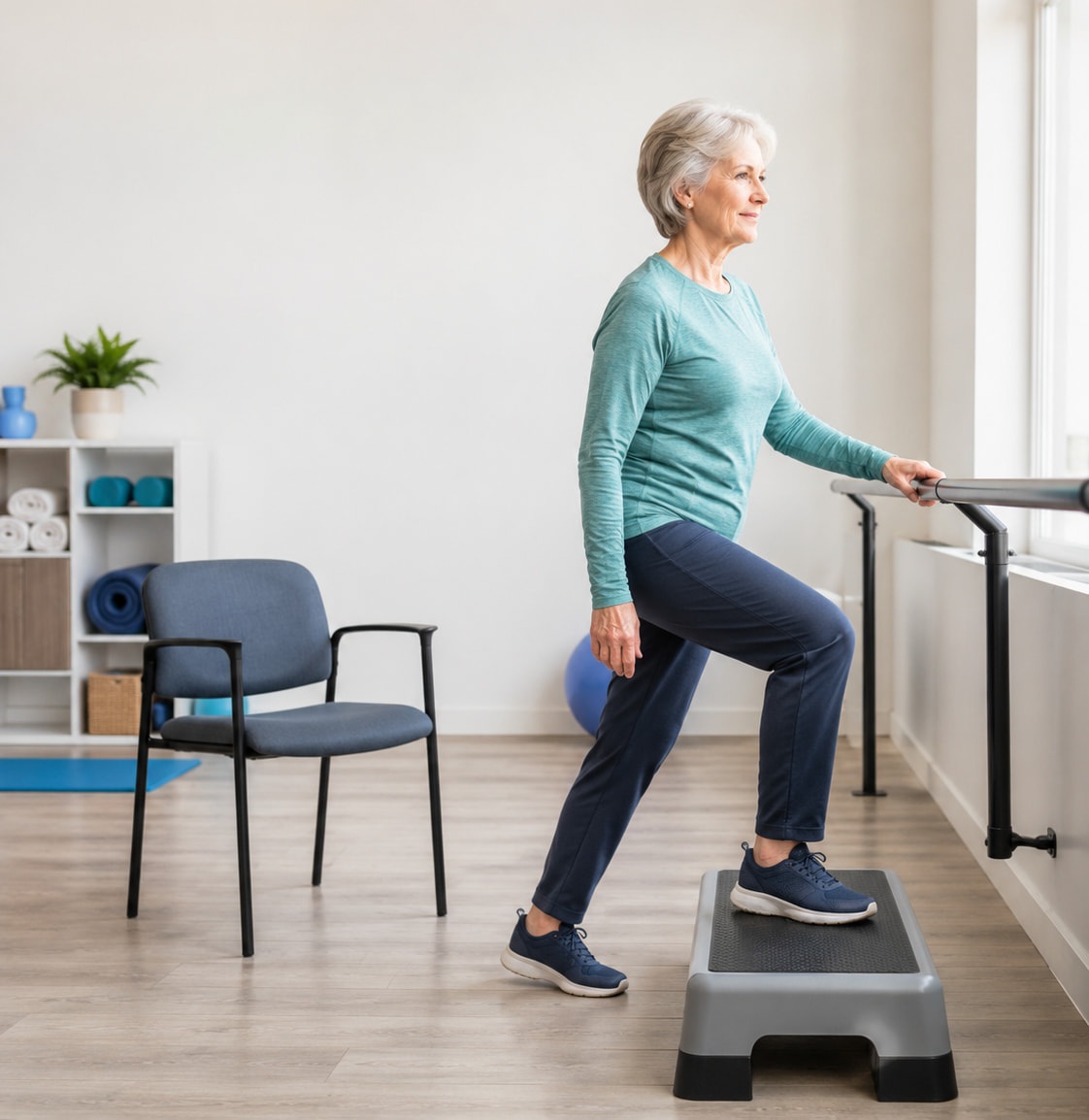
Quad exercises for seniors can strengthen the front of the thighs and make everyday movements such as standing up, walking, and climbing stairs easier to manage. The safest starting options use a chair, wall, or countertop for support and allow the movement range to match the person’s current strength and mobility.
This guide covers 10 senior-friendly quadriceps exercises, proper form, useful modifications, common mistakes, and a simple routine for getting started.
Why Quadriceps Strength Matters for Seniors
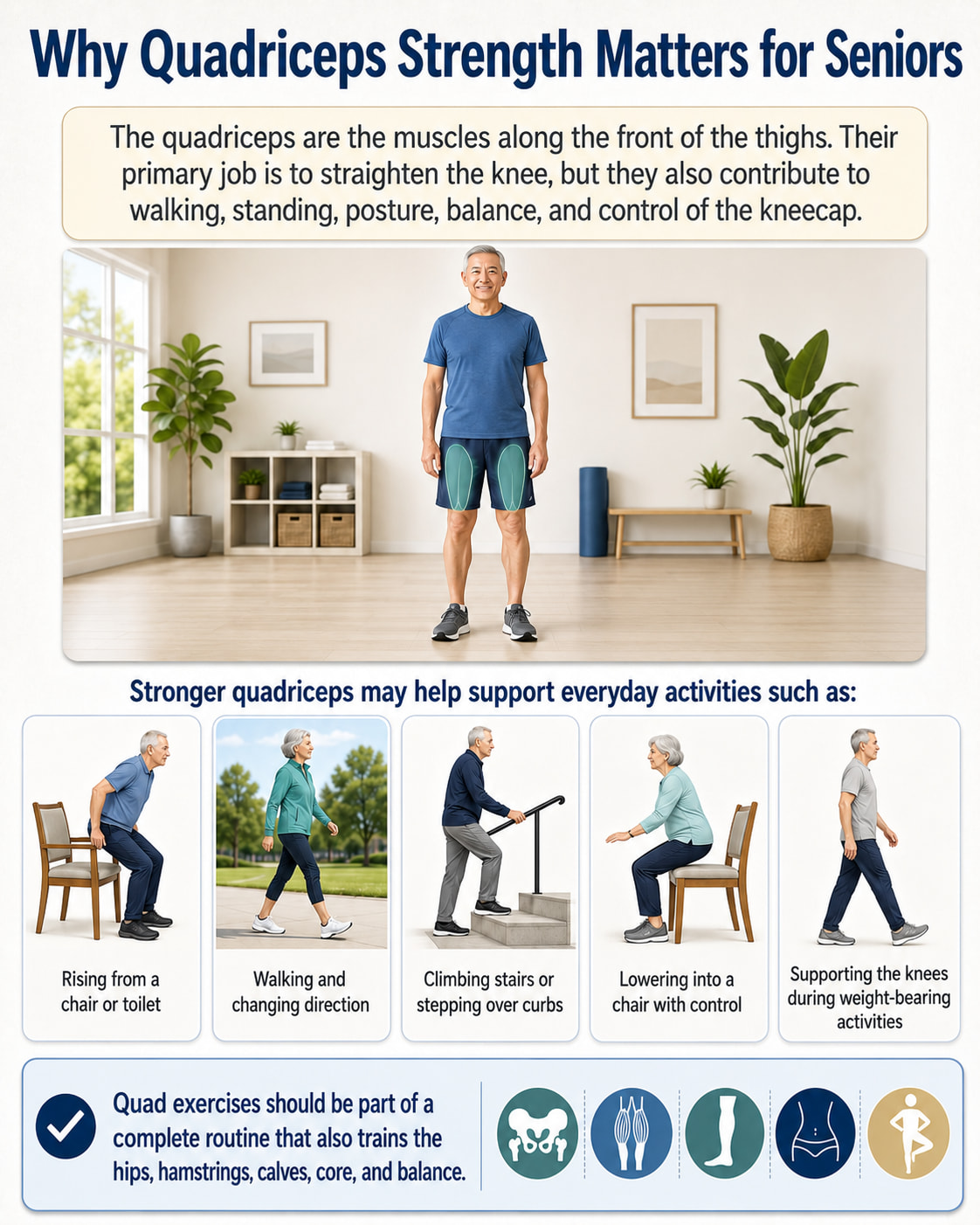
The quadriceps are the muscles along the front of the thighs. Their primary job is to straighten the knee, but they also contribute to walking, standing, posture, balance, and control of the kneecap.
Stronger quadriceps may help support everyday activities such as:
- Rising from a chair or toilet
- Walking and changing direction
- Climbing stairs or stepping over curbs
- Lowering into a chair with control
- Supporting the knees during weight-bearing activities
Quad exercises should be part of a complete routine that also trains the hips, hamstrings, calves, core, and balance.
How to Perform Quad Exercises for Seniors Safely
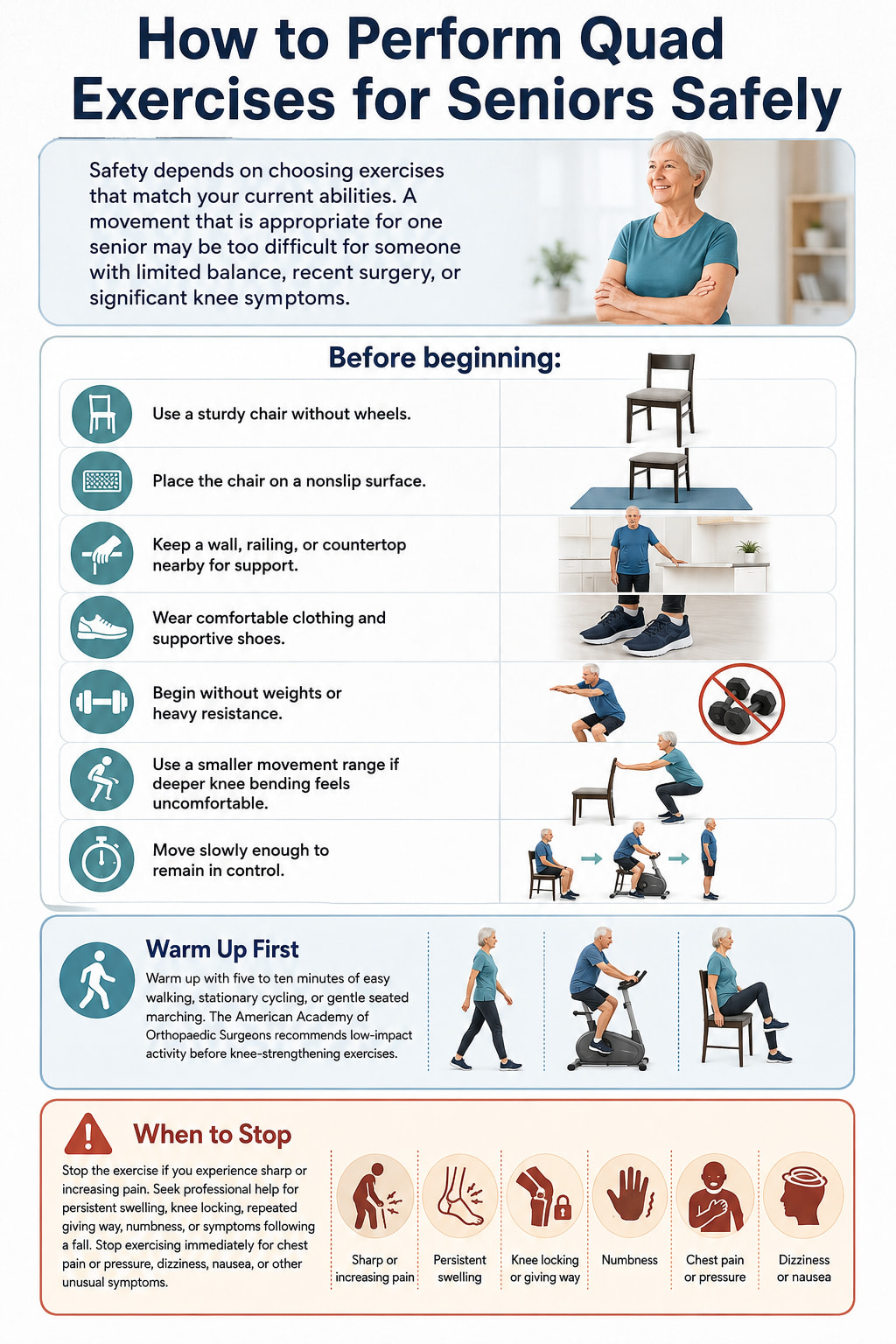
Safety depends on choosing exercises that match your current abilities. A movement that is appropriate for one senior may be too difficult for someone with limited balance, recent surgery, or significant knee symptoms.
Before beginning:
- Use a sturdy chair without wheels.
- Place the chair on a nonslip surface.
- Keep a wall, railing, or countertop nearby for support.
- Wear comfortable clothing and supportive shoes.
- Begin without weights or heavy resistance.
- Use a smaller movement range if deeper knee bending feels uncomfortable.
- Move slowly enough to remain in control.
Warm up with five to ten minutes of easy walking, stationary cycling, or gentle seated marching. The American Academy of Orthopaedic Surgeons recommends low-impact activity before knee-strengthening exercises.
Stop the exercise if you experience sharp or increasing pain. Seek professional help for persistent swelling, knee locking, repeated giving way, numbness, or symptoms following a fall. Stop exercising immediately for chest pain or pressure, dizziness, nausea, or other unusual symptoms.
Quad Exercises for Seniors at a Glance
Use this table to compare the equipment and main purpose of each exercise.
| Exercise | Position or equipment | Best for | |
|---|---|---|---|
| 1 | Seated quadriceps set | Chair and towel | Learning to contract the quads |
| 2 | Short-arc quad | Bed or floor and towel | Gentle knee extension |
| 3 | Seated knee extension | Chair | Direct quad strengthening |
| 4 | Straight-leg raise | Bed or floor | Quad control with a straight knee |
| 5 | Band terminal knee extension | Band and stable support | Standing knee control |
| 6 | Sit-to-stand | Chair | Everyday standing strength |
| 7 | Supported mini squat | Chair or counter | Squatting strength |
| 8 | Low step-up | Low step and railing | Stairs and curbs |
| 9 | Supported split squat | Chair or counter | Single-leg strength |
| 10 | Low step-down | Low step and railing | Controlled stair descent |
You do not need to perform all 10 exercises. Most beginners can choose four to six movements that match their strength, mobility, and balance.
10 Safe Quad Exercises for Seniors
These 10 safe quad exercises for seniors use seated, supported, and low-impact movements to strengthen the front of the thighs. Choose the exercises that match your balance and mobility, then progress gradually as control improves.
1. Seated Quadriceps Set
Best for: Beginners who need to practice activating the quadriceps with very little knee movement.
Muscles worked: Quadriceps.
Equipment needed: A sturdy chair and a rolled towel.
Sets, reps, and rest: Perform 1–2 sets of 8–10 contractions per leg. Hold each contraction for 3–5 seconds and rest for about 30 seconds between sets.
How to do it:
- Sit upright near the front of a sturdy chair.
- Extend one leg and place the heel on the floor.
- Put a small rolled towel beneath the knee if needed.
- Tighten the front of the thigh and gently press the knee downward.
- Hold without holding your breath, then relax slowly.
Common mistakes: Pressing through the foot instead of tightening the thigh, lifting the shoulders, holding the breath, or contracting so forcefully that the knee becomes painful.
Progression or regression: Begin with shorter holds. Progress by holding each contraction for up to 10 seconds.
2. Short-Arc Quad
Best for: Strengthening knee extension through a small, controlled range.
Muscles worked: Quadriceps, with the hip flexors assisting slightly.
Equipment needed: A firm bed or exercise mat and a rolled towel.
Sets, reps, and rest: Perform 1–2 sets of 8–12 repetitions per leg. Rest for 30–45 seconds.
How to do it:
- Lie on your back with one leg straight.
- Place a rolled towel beneath the knee so it remains slightly bent.
- Tighten the thigh and lift the heel until the lower leg straightens.
- Pause briefly without forcing the knee backward.
- Lower the heel slowly.
Common mistakes: Lifting the entire thigh off the towel, moving too quickly, forcing the knee into a locked position, or arching the lower back.
Progression or regression: Use a smaller towel for less movement. Add a very light ankle weight only after the unweighted version feels controlled.
3. Seated Knee Extension
Best for: Directly training the quadriceps without requiring standing balance.
Muscles worked: Quadriceps.
Equipment needed: A sturdy chair without wheels.
Sets, reps, and rest: Perform 1–2 sets of 8–12 repetitions per leg. Rest for 30–60 seconds.
How to do it:
- Sit tall with both feet resting on the floor.
- Keep the back supported if needed.
- Slowly straighten one knee until the leg is almost parallel to the floor.
- Pause for one or two seconds while tightening the thigh.
- Lower the foot under control and repeat.
Common mistakes: Swinging the lower leg, leaning backward, lifting the thigh from the chair, or snapping the knee into a locked position.
Progression or regression: Begin with a partial range. Progress by adding a light ankle weight or resistance band when 12 repetitions feel comfortable.
Coaching cue: Lift with the thigh rather than kicking with the foot.
4. Straight-Leg Raise
Best for: Strengthening the quadriceps while keeping the working knee straight.
Muscles worked: Quadriceps and hip flexors, with the abdominal muscles assisting with trunk control.
Equipment needed: An exercise mat or firm bed.
Sets, reps, and rest: Perform 1–2 sets of 6–10 repetitions per leg. Rest for 45–60 seconds.
How to do it:
- Lie on your back with one knee bent and the other leg straight.
- Tighten the thigh of the straight leg.
- Keep the knee straight as you lift the leg to approximately the height of the opposite thigh.
- Pause briefly.
- Lower slowly until the heel returns to the surface.
Common mistakes: Bending the working knee, lifting the leg too high, arching the lower back, or letting the leg drop quickly.
Progression or regression: Lift only a few inches if the full movement is difficult. Progress by adding a very light ankle weight.
Safety note: Skip this movement if getting onto and off the floor or bed is not safe without assistance.
5. Resistance-Band Terminal Knee Extension
Best for: Practicing controlled knee straightening while standing.
Muscles worked: Quadriceps, with the glutes, calves, and core assisting with balance.
Equipment needed: A loop resistance band, a secure anchor, and a sturdy support.
Sets, reps, and rest: Perform 1–2 sets of 8–12 repetitions per leg. Rest for 45–60 seconds.
How to do it:
- Secure the resistance band to a stable anchor at knee height.
- Place the band behind one knee and step backward until it has light tension.
- Hold a chair or countertop for balance.
- Allow the knee to bend slightly.
- Tighten the thigh and straighten the knee against the band, then return slowly.
Common mistakes: Using an insecure anchor, allowing the band to roll behind the knee, leaning the body backward, or snapping the knee straight.
Progression or regression: Begin with the lightest band and a very small bend. Increase resistance only when balance and knee control remain steady.
Safety note: Inspect the band before use and keep your face away from its path in case it slips or breaks.
6. Sit-to-Stand
Best for: Building strength for rising from chairs, couches, beds, and toilets.
Muscles worked: Quadriceps and glutes, with the hamstrings, calves, and core assisting.
Equipment needed: A sturdy chair without wheels.
Sets, reps, and rest: Perform 1–2 sets of 6–10 repetitions. Rest for 60–90 seconds.
How to do it:
- Sit near the front of the chair with your feet about hip-width apart.
- Place the feet slightly behind the knees if comfortable.
- Lean forward slightly from the hips while keeping the chest lifted.
- Press through both feet and stand tall.
- Push the hips backward and lower to the chair slowly.
Common mistakes: Rocking aggressively to create momentum, letting the knees collapse inward, pushing mostly through one leg, or dropping onto the seat.
Progression or regression: Use the armrests or place your hands on your thighs for assistance. Progress by using a slightly lower chair or holding a light weight close to the chest.
Coaching cue: Stand by pushing the floor away.
7. Supported Mini Squat
Best for: Practicing a squat through an adjustable, beginner-friendly range.
Muscles worked: Quadriceps and glutes, with the hamstrings, calves, and core assisting.
Equipment needed: A stable chair, countertop, or railing.
Sets, reps, and rest: Perform 1–2 sets of 8–12 repetitions. Rest for 60 seconds.
How to do it:
- Stand facing a countertop or the back of a sturdy chair.
- Place the feet approximately hip- to shoulder-width apart.
- Hold the support lightly.
- Move the hips slightly backward and bend the knees a comfortable amount.
- Press through the feet to return to standing.
Common mistakes: Pulling excessively with the arms, lifting the heels, rounding the back, allowing the knees to collapse inward, or squatting deeper than can be controlled.
The knees do not have to remain behind the toes throughout the movement. Allow them to move naturally while keeping the heels supported and the knees traveling in the same general direction as the toes.
Progression or regression: Begin with a very shallow bend. Progress by increasing the depth gradually or reducing hand support.
8. Low Step-Up With Support
Best for: Developing strength for climbing stairs, stepping onto curbs, and changing levels.
Muscles worked: Quadriceps and glutes, with the hamstrings and calves assisting.
Equipment needed: A low, stable step and a railing or countertop.
Sets, reps, and rest: Perform 1–2 sets of 6–10 repetitions per leg. Rest for 60–90 seconds.
How to do it:
- Stand close to a low step while holding a stable support.
- Place one entire foot on the step.
- Lean forward slightly and press through the top foot.
- Step up without pushing excessively from the trailing leg.
- Lower carefully and repeat before changing sides.
Common mistakes: Using a step that is too high, placing only the toes on the step, pushing mainly from the lower foot, or allowing the working knee to collapse inward.
Progression or regression: Begin with a platform only a few inches high. Progress by increasing repetitions before using a slightly higher step.
Coaching cue: Let the leg on the step do most of the work.
9. Supported Split Squat
Best for: Developing single-leg strength while keeping both feet on the floor.
Muscles worked: Quadriceps and glutes, with the hamstrings, calves, and core assisting.
Equipment needed: A countertop, railing, or two sturdy chair backs.
Sets, reps, and rest: Perform 1–2 sets of 5–8 repetitions per side. Rest for 60–90 seconds.
How to do it:
- Stand in a staggered position with one foot forward and the other behind.
- Keep the feet about hip-width apart rather than on one narrow line.
- Hold a stable support.
- Bend both knees slightly and lower straight down.
- Press through the front foot to return to standing.
Common mistakes: Using a stance that is too narrow, placing the feet too far apart, leaning heavily on the support, allowing the front knee to collapse inward, or lowering beyond a controllable range.
Progression or regression: Start with a shallow movement while using both hands for support. Progress by increasing the range or using only one hand.
10. Low Step-Down With Support
Best for: Improving control while descending stairs or stepping down from a curb.
Muscles worked: Quadriceps and glutes, with the calves and hip stabilizers assisting.
Equipment needed: A very low, stable step and a railing or countertop.
Sets, reps, and rest: Perform 1–2 sets of 5–8 repetitions per leg. Rest for 60–90 seconds.
How to do it:
- Stand on a low step with one foot near the edge.
- Hold a stable support.
- Keep most of your weight on the leg that remains on the step.
- Bend that knee slowly as the opposite heel reaches toward the floor.
- Lightly touch down, then straighten the working leg to return.
Common mistakes: Dropping quickly, pushing hard from the lower foot, using a step that is too high, or allowing the supporting knee to move inward.
Progression or regression: Begin by lowering only an inch or two without touching the floor. Progress by increasing the range gradually.
Safety note: This is one of the more demanding exercises in the routine. Practice step-ups first and skip step-downs if balance is uncertain.
Beginner Quad Workout for Seniors
Choose exercises that allow you to move confidently and without sharp pain. This routine combines seated and supported standing movements.
Beginner Routine
- Seated quadriceps set: 1–2 sets of 8–10 per leg
- Seated knee extension: 1–2 sets of 8–12 per leg
- Sit-to-stand: 1–2 sets of 6–10
- Supported mini squat: 1–2 sets of 8–10
- Low step-up: 1 set of 6–8 per leg, if balance permits
Rest for approximately 45–90 seconds between sets. Longer rest is appropriate when breathing is elevated or your legs still feel tired.
Perform the routine on two nonconsecutive days per week. The CDC’s physical activity guidance for older adults recommends muscle-strengthening activities on at least two days each week, along with aerobic and balance activity.
Use an effort level of approximately 5–7 out of 10. The final repetitions should feel challenging, but you should still be able to maintain proper form. You do not need to reach complete muscular failure to make progress. Current ACSM resistance-training guidance emphasizes consistent, individualized training rather than unnecessarily complicated or exhausting routines.
How to Progress Safely
Do not increase every part of the workout at once. Use the following order:
- Improve movement control.
- Reach the upper end of the recommended repetition range.
- Increase the range of motion slightly.
- Add a second set.
- Add light resistance or use a slightly higher step.
Increase only one variable at a time. Stay with the new level for several sessions before progressing again.
A practical sign that you are ready to progress is being able to complete every repetition with steady balance, controlled lowering, normal breathing, and no meaningful increase in pain or swelling afterward.
Common Quad-Training Mistakes
Performing All 10 Exercises at Once
More exercises do not automatically produce better results. Choose four to six movements that provide an appropriate challenge.
Progressing Too Quickly
Adding weight, depth, repetitions, and harder exercises at the same time can create unnecessary fatigue. Change one variable at a time.
Ignoring the Lowering Phase
Dropping into a chair or stepping down quickly removes much of the muscular work. Lower slowly and remain in control.
Allowing the Knees to Collapse Inward
Keep the knees moving in the same general direction as the toes during sit-to-stands, squats, step-ups, and split squats.
Relying Too Heavily on Hand Support
Support should improve balance, not perform the entire movement. Use the legs as much as possible while keeping the exercise safe.
Holding the Breath
Exhale during the harder part of the movement and inhale during the easier part. Avoid straining or holding your breath.
Training Through Sharp Pain
Mild muscular effort is expected, but sharp, sudden, or increasing joint pain is a reason to stop. Hospital for Special Surgery recommends prioritizing good form, using a tolerable range, and increasing resistance gradually.
Frequently Asked Questions
What is the best quad exercise for seniors?
Sit-to-stands are one of the most practical choices because they train a movement used throughout the day. Seated knee extensions are a useful alternative for directly training the quadriceps without requiring standing balance.
The best exercise is the one you can perform consistently with good control and without sharp pain.
How often should seniors perform quad exercises?
Two nonconsecutive sessions per week are a suitable starting point for most beginners. Some people may eventually train two or three times per week if they recover comfortably between sessions.
How many quad exercises should seniors do in one workout?
Most beginners need only four to six exercises. Include one or two seated movements, one chair-based movement, and one supported standing exercise. Add step exercises only when balance and knee control are reliable.
Can seated exercises strengthen the quadriceps?
Yes. Seated quadriceps sets and knee extensions can strengthen the front of the thighs, especially for beginners or people with limited balance.
However, supported standing exercises such as sit-to-stands and mini squats provide more practice for everyday weight-bearing activities.
Can seniors perform quad exercises with knee pain?
Some quad exercises may be appropriate when modified to a comfortable range, but the cause and severity of knee pain matter. Start with low resistance and supported positions.
Stop if pain becomes sharp, worsens as you continue, or is accompanied by swelling, locking, giving way, or reduced ability to bear weight. A physical therapist or other qualified healthcare professional can help select appropriate exercises.
Should the knees stay behind the toes during squats?
Not necessarily. The knees may move forward naturally during squats and sit-to-stands. Focus on keeping the heels supported, the knees aligned with the toes, and the movement comfortable and controlled rather than forcing the knees backward.
Conclusion
Quad exercises for seniors do not need to involve heavy weights or deep squats. Seated knee extensions, sit-to-stands, supported mini squats, and low step-ups can provide a practical starting point.
Choose four to six exercises, train twice per week, and progress one variable at a time. Consistent, controlled practice is more useful than attempting a routine that is too difficult to maintain safely.
Stop and seek professional help if exercise causes sharp pain, numbness, dizziness, chest pain, or other unusual symptoms.
This content is for informational purposes only and is not a substitute for professional medical advice.
References
- CDC: Physical Activity Guidelines for Older Adults
- American College of Sports Medicine: Effective Resistance Training
- American Academy of Orthopaedic Surgeons: Knee Conditioning Program
- Hospital for Special Surgery: Exercises to Strengthen the Knees
- Cleveland Clinic: Quadriceps Anatomy and Function
- National Institute on Aging: Exercise and Physical Activity