Upper body Pilates exercises use controlled bodyweight support, precise arm movements, and optional resistance to strengthen your shoulders, arms, chest, upper back, and core. You can perform most of them at home with a mat, although a resistance band is useful for adding a pulling exercise.
This guide explains how to perform 10 effective exercises, modify them for your current ability, and combine them into a practical upper-body Pilates workout.
Can Pilates Build Upper-Body Strength?
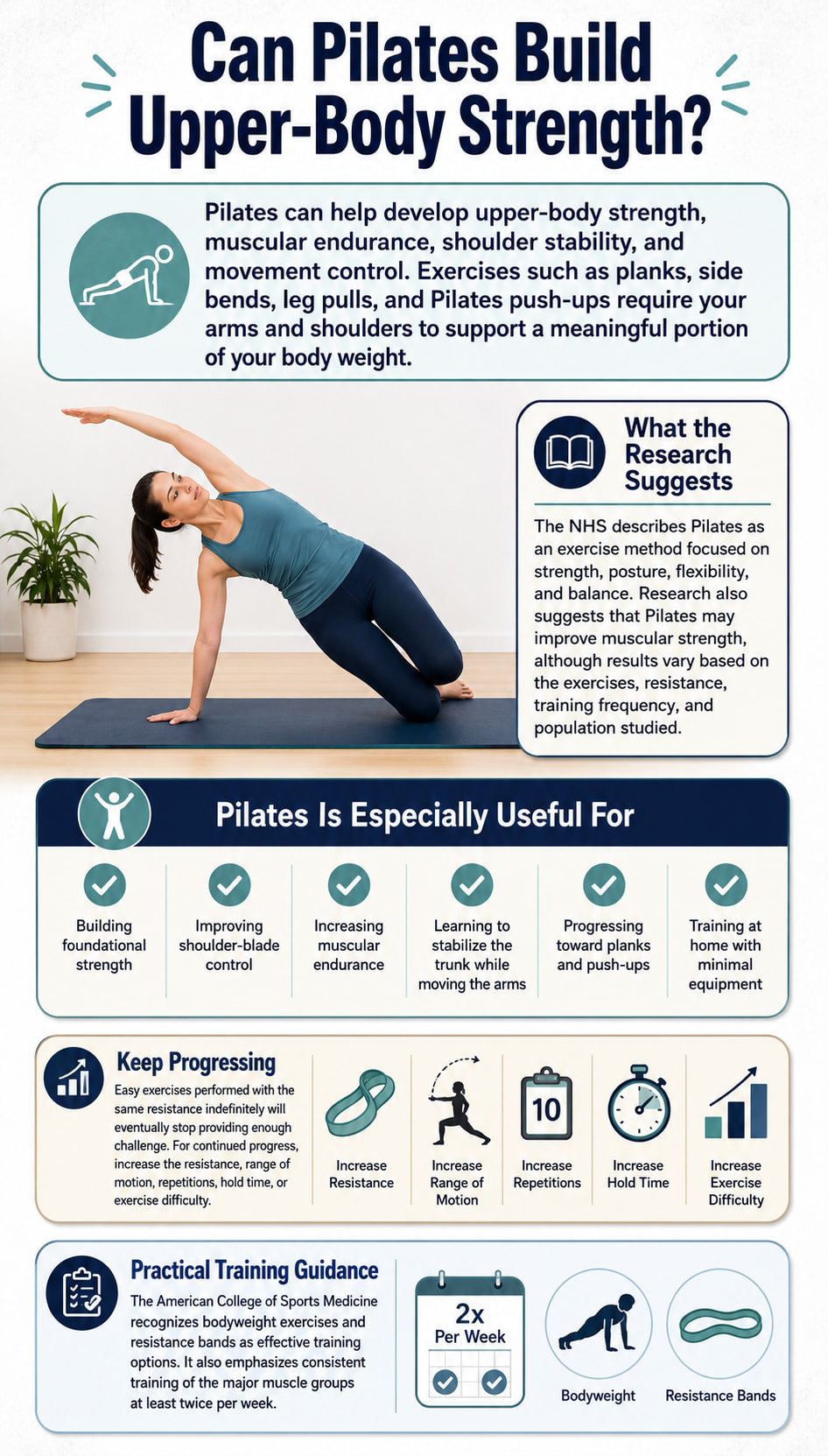
Pilates can help develop upper-body strength, muscular endurance, shoulder stability, and movement control. Exercises such as planks, side bends, leg pulls, and Pilates push-ups require your arms and shoulders to support a meaningful portion of your body weight.
The NHS describes Pilates as an exercise method focused on strength, posture, flexibility, and balance. Research also suggests that Pilates may improve muscular strength, although results vary based on the exercises, resistance, training frequency, and population studied.
Pilates is especially useful for:
- Building foundational strength
- Improving shoulder-blade control
- Increasing muscular endurance
- Learning to stabilize the trunk while moving the arms
- Progressing toward planks and push-ups
- Training at home with minimal equipment
However, easy exercises performed with the same resistance indefinitely will eventually stop providing enough challenge. For continued progress, increase the resistance, range of motion, repetitions, hold time, or exercise difficulty.
The American College of Sports Medicine’s updated resistance-training guidance recognizes bodyweight exercises and resistance bands as effective training options. It also emphasizes consistent training of the major muscle groups at least twice per week.
Muscles Worked by Upper Body Pilates Exercises
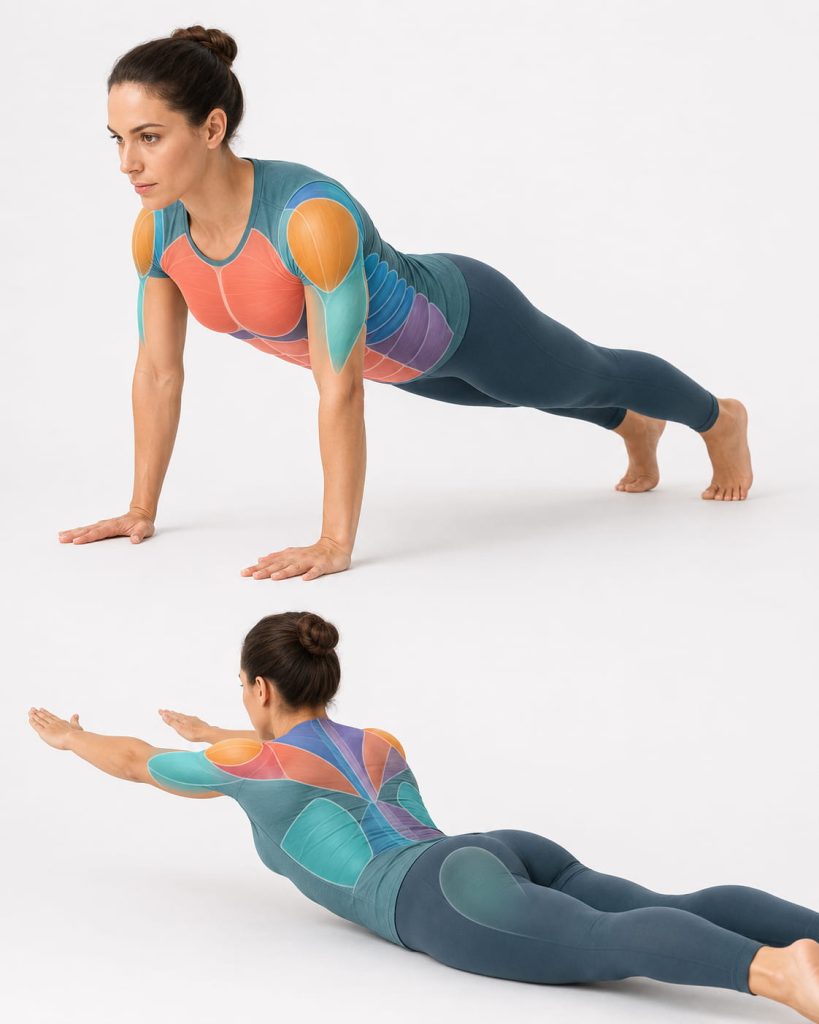
Upper-body Pilates movements commonly involve the following muscles:
- Chest: Primarily the pectoralis major during push-ups and bodyweight pressing.
- Shoulders: The deltoids help move and stabilize the arms.
- Triceps: Extend the elbows during push-ups, planks, and supporting exercises.
- Serratus anterior: Helps control the shoulder blades against the rib cage during planks and scapular push-ups.
- Upper and middle back: The trapezius and rhomboids help control shoulder-blade position.
- Latissimus dorsi: Assists with pulling and shoulder-extension movements.
- Rotator cuff: Stabilizes the shoulder joint as the arms move or support body weight.
- Core muscles: The abdominals, obliques, spinal stabilizers, and glutes prevent unwanted movement through the trunk and pelvis.
Although the article focuses on the upper body, many Pilates exercises are integrated movements. Your abdominals, hips, and legs often work to create a stable base.
What You Need
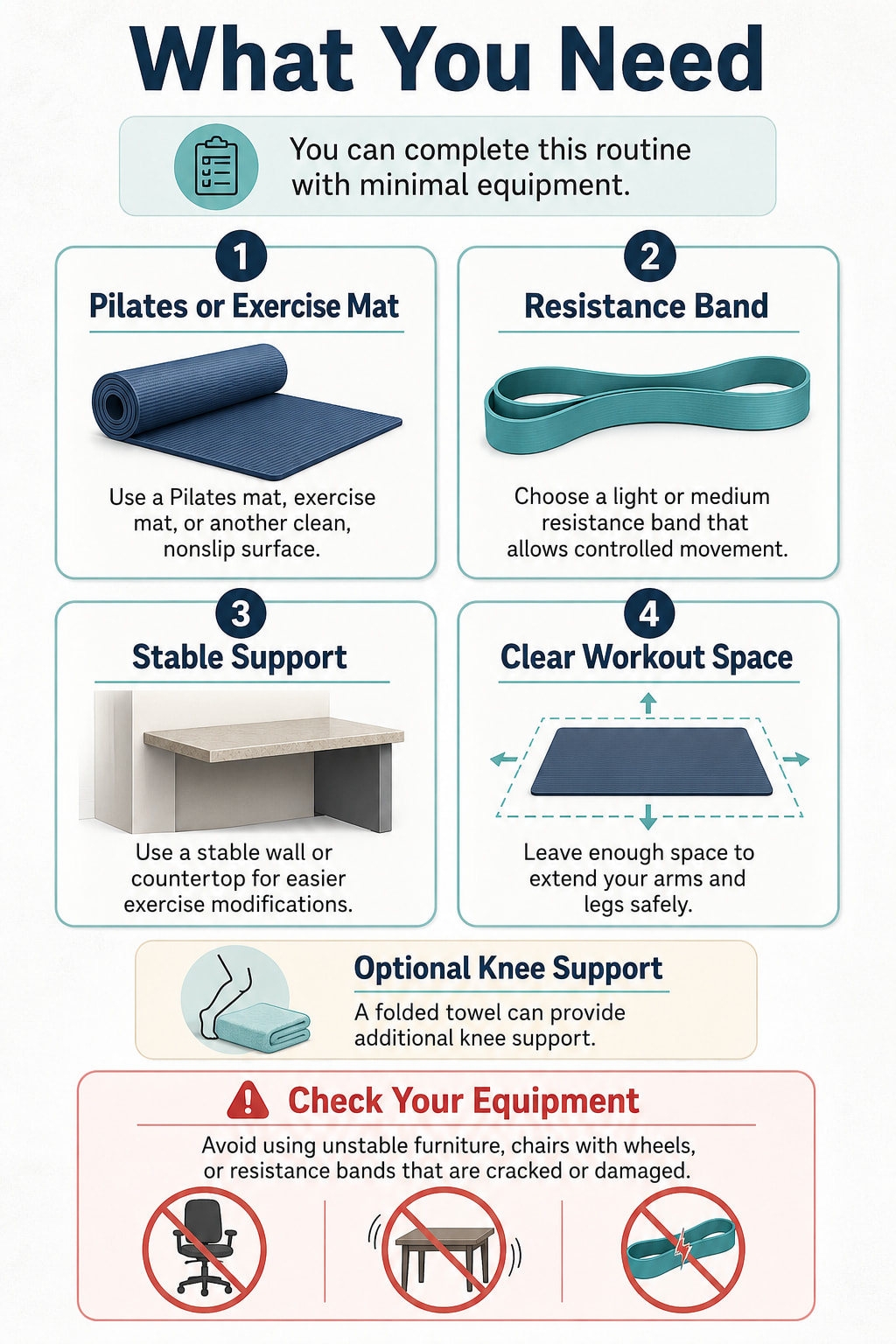
You can complete this routine with minimal equipment:
- A Pilates or exercise mat
- A light or medium resistance band
- A stable wall or countertop for modifications
- Enough space to extend your arms and legs
A folded towel can provide additional knee support. Avoid using unstable furniture, chairs with wheels, or resistance bands that are cracked or damaged.
10 Best Upper Body Pilates Exercises for Strength
The exercises are arranged roughly from foundational to advanced. Master the easier positions before progressing to full planks, reverse planks, and floor push-ups.
1. Quadruped Scapular Push-Up
Best for: Learning shoulder-blade control and preparing for planks and push-ups.
Muscles worked: Serratus anterior, trapezius, rhomboids, rotator cuff, chest, triceps, and core.
Sets, reps, and rest: Perform 2 sets of 6–10 controlled repetitions. Rest for 30–45 seconds.
How to do it:
- Start on your hands and knees with your hands beneath your shoulders and knees beneath your hips.
- Keep your elbows straight without forcing them into a locked position.
- Allow your chest to lower slightly as your shoulder blades move gently toward each other.
- Press the floor away and spread your shoulder blades across your upper back.
- Keep your spine and pelvis still throughout the movement.
Common mistakes: Bending the elbows, shrugging the shoulders, rounding the entire spine, dropping the head, or forcing the chest too close to the floor.
Regression: Perform the movement standing with your hands against a wall.
Progression: Perform the scapular movement from a high-plank position.
Coaching cue: Move through your shoulder blades rather than your elbows.
2. Bird Dog
Best for: Shoulder stability, cross-body coordination, and maintaining trunk control while an arm moves.
Muscles worked: Deltoids, trapezius, rotator cuff, spinal stabilizers, abdominals, glutes, and hamstrings.
Sets, reps, and rest: Perform 2 sets of 5–8 repetitions per side. Rest for 30–45 seconds.
How to do it:
- Begin on your hands and knees with a neutral spine.
- Brace your midsection gently without holding your breath.
- Reach one arm forward while extending the opposite leg behind you.
- Stop before your lower back arches or your pelvis begins to rotate.
- Pause briefly, return with control, and repeat on the opposite side.
Common mistakes: Lifting the arm or leg too high, rotating the hips, shifting heavily onto the supporting hand, arching the lower back, or looking forward instead of keeping the neck neutral.
The ACE bird dog guidance also emphasizes opposite-arm and leg movement while controlling the trunk.
Regression: Move only one arm at a time while keeping both knees on the floor.
Progression: Pause for three to five seconds or draw the elbow and opposite knee toward each other before extending again.
Coaching cue: Reach long rather than lifting high.
3. Seated Resistance-Band Row
Best for: Adding a pulling movement to balance the pressing and supporting exercises commonly found in mat Pilates.
Muscles worked: Latissimus dorsi, rhomboids, middle trapezius, posterior deltoids, biceps, rotator cuff, and core.
Equipment needed: A long resistance band.
Sets, reps, and rest: Perform 2–3 sets of 10–15 repetitions. Rest for 30–60 seconds.
How to do it:
- Sit tall with your legs extended or slightly bent.
- Wrap the middle of the resistance band securely around the soles of your feet.
- Hold one end in each hand with your arms extended.
- Pull your elbows backward while keeping them close to your sides.
- Pause when your hands reach your lower ribs, then straighten your arms slowly.
Common mistakes: Leaning backward to move the band, shrugging the shoulders, pushing the head forward, flaring the ribs, or allowing the band to snap the arms forward.
Regression: Use a lighter band or sit on a folded towel with the knees bent.
Progression: Use a stronger band or pause for two seconds in the contracted position.
Coaching cue: Draw your elbows toward your back pockets.
4. Swan Prep With Arm Sweep
Best for: Upper-back extension, posterior-shoulder endurance, and postural control.
Muscles worked: Spinal extensors, posterior deltoids, trapezius, rhomboids, rotator cuff, latissimus dorsi, and glutes.
Sets, reps, and rest: Perform 2 sets of 6–10 repetitions. Rest for 30–45 seconds.
How to do it:
- Lie on your stomach with your legs extended and forehead hovering just above the mat.
- Position your arms beside your body with your palms facing inward.
- Gently brace your abdomen and lengthen through the top of your head.
- Lift your upper chest slightly while reaching your fingertips toward your feet.
- Sweep your arms outward and forward only as far as you can maintain shoulder and spinal control.
- Reverse the movement and lower slowly.
Common mistakes: Throwing the head backward, creating most of the lift through the lower back, lifting the legs unnecessarily, shrugging the shoulders, or trying to raise the chest too high.
ACE’s prone shoulder-stabilization guidance recommends keeping the head aligned with the upper spine and generating the arm lift through the shoulders rather than relying primarily on the lower back.
Regression: Keep the chest on the mat and perform only the controlled arm movement.
Progression: Hold the lifted position for three seconds or add very light hand weights.
Coaching cue: Reach forward and upward, not straight up.
5. Pilates Swimming
Best for: Upper-back, posterior-shoulder, and cross-body muscular endurance.
Muscles worked: Posterior deltoids, trapezius, spinal extensors, glutes, hamstrings, rotator cuff, and deep core muscles.
Sets, reps, and rest: Perform 2–3 rounds of 15–30 seconds. Rest for 30–45 seconds.
How to do it:
- Lie on your stomach with your arms extended overhead and legs long.
- Brace your abdomen gently and keep your gaze directed toward the mat.
- Lift one arm and the opposite leg a small distance.
- Switch sides in a slow, controlled rhythm.
- Continue alternating while keeping your shoulders away from your ears.
- Lower and rest when your spinal position begins to change.
Common mistakes: Kicking or swinging quickly, lifting the limbs too high, compressing the neck, holding the breath, or using excessive lower-back extension.
Regression: Keep the legs on the floor and alternate only the arms.
Progression: Increase the working interval gradually to 30–40 seconds without speeding up.
Coaching cue: Create length from fingertips to toes.
6. Kneeling Triceps Push-Up
Best for: Developing chest and triceps strength before progressing to a full push-up.
Muscles worked: Triceps, pectoralis major, anterior deltoids, serratus anterior, abdominals, and rotator cuff.
Sets, reps, and rest: Perform 2–3 sets of 5–10 repetitions. Rest for 45–75 seconds.
How to do it:
- Start on your hands and knees with your hands approximately shoulder-width apart.
- Move your knees backward until your body forms a straight line from your head to your knees.
- Brace your core and lightly squeeze your glutes.
- Bend your elbows, keeping them angled close to your sides.
- Lower your chest toward the mat without allowing your hips to bend or drop.
- Press the floor away and return to the starting position.
Common mistakes: Bending at the hips, allowing the lower back to sag, placing the hands too far forward, shrugging the shoulders, or moving only the head toward the floor.
The ACE bent-knee push-up instructions emphasize maintaining a rigid torso, keeping the head aligned with the spine, and preventing the hips from sagging or rising.
Regression: Perform the push-up against a wall or stable countertop.
Progression: Lower more slowly, pause near the bottom, or progress to a full push-up from the toes.
Coaching cue: Lower your chest and hips together.
7. Pilates Side Bend From Knees
Best for: Supporting-arm strength, shoulder stability, and lateral-core control.
Muscles worked: Deltoids, triceps, serratus anterior, rotator cuff, obliques, quadratus lumborum, and gluteus medius.
Sets, reps, and rest: Perform 2 sets of 5–8 repetitions per side or hold for 15–25 seconds. Rest for 30–45 seconds.
How to do it:
- Sit on one hip with both knees bent and place one hand on the mat beneath the supporting shoulder.
- Press through the supporting hand and bottom knee.
- Lift your hips while extending your top arm overhead.
- Create one long line from the supporting hand through the top fingertips.
- Lower your hips under control and complete the repetitions before changing sides.
Common mistakes: Letting the supporting shoulder collapse, placing the hand too far from the body, twisting the chest toward the floor, locking the elbow aggressively, or lifting beyond a controllable range.
A knee-supported position reduces the leverage compared with a full side plank. In side-support exercises, keeping the supporting elbow or hand aligned beneath the shoulder helps create a more stable position.
Regression: Support yourself on your forearm or lift the hips through a smaller range.
Progression: Extend the legs, stack the feet, or increase the hold time.
Coaching cue: Push the floor away from you.
8. Leg Pull Back
Best for: Strengthening the triceps and posterior shoulders while integrating the glutes and posterior chain.
Muscles worked: Triceps, posterior deltoids, trapezius, rotator cuff, glutes, hamstrings, spinal stabilizers, and core.
Sets, reps, and rest: Perform 2 sets of 5–8 repetitions or hold the support position for 15–25 seconds. Rest for 45–60 seconds.
How to do it:
- Sit with your legs extended and place your hands on the mat slightly behind your hips.
- Point your fingers forward or slightly outward, depending on wrist comfort.
- Press through your hands and heels to lift your hips.
- Create a long line through your shoulders, hips, and feet without dropping your head backward.
- Hold the position or lift one leg a few inches without rotating your pelvis.
- Lower under control.
Common mistakes: Collapsing into the shoulders, forcing the hips too high, turning the hands into an uncomfortable position, throwing the head backward, or allowing the pelvis to rotate during a leg lift.
Regression: Bend your knees, place your feet flat, and perform a reverse tabletop hold.
Progression: Alternate controlled single-leg lifts while maintaining a stable pelvis.
Coaching cue: Lift your chest while pressing the floor behind you.
9. Leg Pull Front
Best for: Advanced shoulder stability and maintaining a strong plank while the base of support changes.
Muscles worked: Deltoids, triceps, chest, serratus anterior, rotator cuff, abdominals, glutes, and hip extensors.
Sets, reps, and rest: Perform 2 sets of 4–8 leg lifts per side. Rest for 45–75 seconds.
How to do it:
- Begin in a high plank with your hands beneath your shoulders.
- Create a straight line from your head through your heels.
- Brace your midsection and press the floor away.
- Lift one leg a few inches without arching your back or rotating your hips.
- Lower the foot quietly and repeat with the opposite leg.
- End the set when you can no longer maintain your plank alignment.
Common mistakes: Lifting the leg too high, shifting the shoulders behind the hands, sagging through the lower back, rotating the pelvis, locking the elbows forcefully, or holding the breath.
Regression: Keep both knees on the mat and extend one leg at a time.
Progression: Add a small controlled forward-and-back rocking action through the ankles after lifting the leg.
Coaching cue: Keep your hip bones facing the mat.
10. Pilates Push-Up
Best for: Combining spinal control, plank stability, and upper-body pressing strength.
Muscles worked: Chest, triceps, deltoids, serratus anterior, rotator cuff, abdominals, spinal stabilizers, and hip muscles.
Sets, reps, and rest: Perform 2–3 sets of 3–6 complete repetitions. Rest for 60–90 seconds.
How to do it:
- Stand tall with your feet approximately hip-width apart.
- Nod your head and roll down through your spine until your hands reach the mat or elevated support.
- Walk your hands forward into a strong plank.
- Perform one to three controlled push-ups.
- Walk your hands back toward your feet.
- Roll up gradually and finish standing tall.
Common mistakes: Forcing the hands to the floor despite limited mobility, rushing the walkout, allowing the hips to sag in the plank, flaring the elbows excessively, or rolling upward too quickly.
Regression: Place your hands on a stable bench or countertop, skip the roll-down, or perform the push-up from your knees.
Progression: Add push-up repetitions or use a slower three- to four-second lowering phase.
Coaching cue: Maintain control during the transitions, not just the push-up.
15-Minute Upper Body Pilates Workout for Beginners
Complete the following circuit two times:
- Quadruped scapular push-up: 8 repetitions
- Bird dog: 6 repetitions per side
- Seated resistance-band row: 12 repetitions
- Swan prep with arm sweep: 8 repetitions
- Kneeling triceps push-up: 6–10 repetitions
- Side bend from knees: 15–20 seconds per side
Rest for 30–45 seconds between exercises and 60–90 seconds between rounds.
Keep your effort around 6–7 out of 10, meaning the exercises feel challenging but you could still perform approximately three controlled repetitions before losing form.
Perform the workout two nonconsecutive days per week. After several weeks, add a third round, use a stronger band, or progress one exercise at a time.
Intermediate Upper Body Pilates Workout
Complete two or three rounds:
- Seated resistance-band row: 12–15 repetitions
- Pilates swimming: 20–30 seconds
- Kneeling or full triceps push-up: 8–12 repetitions
- Leg pull back: 6 repetitions or a 20-second hold
- Leg pull front: 6 leg lifts per side
- Pilates push-up: 3–5 complete repetitions
Rest for 45–75 seconds between exercises and approximately 90 seconds between rounds.
Aim for an effort of 7–8 out of 10 while maintaining controlled movement and normal breathing.
How to Progress Upper Body Pilates Exercises
Progress when you can complete every repetition without shoulder shrugging, rib flaring, hip rotation, breath-holding, or loss of spinal control.
Use one progression at a time:
- Add one or two repetitions.
- Add five seconds to an isometric hold.
- Add another set.
- Slow the lowering phase.
- Increase the range of motion.
- Move from wall to countertop, knees, and then toes.
- Use a stronger resistance band.
- Reduce the number of support points.
- Progress from a bent-knee to a straight-leg position.
- Add a brief pause at the most challenging point.
Do not progress every exercise simultaneously. Improving one or two movements at a time makes it easier to maintain proper form.
Common Upper Body Pilates Mistakes
Treating Every Exercise as an Abdominal Exercise
The core should provide stability, but the arms, chest, shoulders, and back still need to produce force. Focus on pressing, pulling, and controlling the shoulder blades rather than simply tightening your abdomen harder.
Shrugging the Shoulders
Repeatedly pulling the shoulders toward the ears can create unnecessary neck tension. Keep the neck long while allowing the shoulder blades to move naturally.
Moving Too Quickly
Speed can hide weak positions and reduce muscular tension. Slow down enough to control the lifting and lowering phases.
Allowing the Chest to Collapse
During planks, side bends, and push-ups, actively press through the supporting hand or forearm. Do not hang passively between the shoulders.
Using Excessive Range of Motion
A larger movement is not automatically better. Use the greatest range you can control without joint discomfort, spinal compensation, or breath-holding.
Performing Only Pressing Exercises
Mat Pilates contains many planks, push-ups, and support positions but fewer pulling movements. Include a resistance-band row or another controlled pulling exercise to train the upper back.
Wrist and Shoulder Safety Tips
Supporting exercises can place substantial pressure on the wrists and shoulders. Use these adjustments when needed:
- Perform planks and push-ups against a wall or countertop.
- Use your forearms for side-support exercises.
- Place your hands on push-up handles or stable dumbbell handles to keep the wrists more neutral.
- Reduce the range of motion.
- Shorten the working interval.
- Spread your fingers and distribute pressure through the entire hand.
- Keep the supporting hand, elbow, or forearm close to being aligned beneath the shoulder.
- Stop the set when the shoulder begins to collapse or shrug.
The National Pilates Certification Program advises instructors to recognize when someone cannot participate safely and to seek medical guidance when appropriate. It also states that Pilates should not be presented as a treatment or cure for an injury or disease.
Stop exercising and seek professional help if you experience sharp or increasing pain, numbness, faintness, prolonged dizziness, chest pain, unusual shortness of breath, or a sudden loss of coordination.
Frequently Asked Questions
Can Pilates make your arms stronger?
Yes. Push-ups, planks, side bends, leg pulls, and resistance-band exercises can strengthen the shoulders, chest, triceps, upper back, and supporting muscles. The exercises must be challenging enough and progressed over time.
Can you do upper body Pilates without weights?
Yes. Your body weight provides resistance during planks, push-ups, side bends, and reverse-support exercises. A resistance band is useful but not essential.
How often should you perform upper body Pilates?
Two or three nonconsecutive sessions per week is a practical starting point. Allow recovery between harder sessions, particularly when they include several plank and push-up variations.
Is Pilates enough to build significant upper-body muscle?
Pilates can build foundational strength and muscular endurance, especially for beginners. However, traditional resistance training with progressively heavier loads is generally easier to scale when maximum strength or substantial muscle growth is the main goal.
Why do my wrists hurt during Pilates planks?
Possible reasons include limited wrist tolerance, placing too much pressure through the heel of the hand, progressing too quickly, or using a position that is currently too demanding. Move to a wall, countertop, forearms, or push-up handles. Stop if discomfort is sharp, persistent, or worsening.
Should beginners attempt the full Pilates push-up?
Beginners should first develop control in wall push-ups, incline push-ups, kneeling push-ups, and high planks. The full Pilates push-up can be added after these positions are comfortable and stable.
How long does it take to become stronger?
The timeline varies with your starting level, training consistency, recovery, exercise difficulty, and progression. Focus on measurable improvements such as additional controlled repetitions, longer holds, stronger bands, or more advanced positions.
Conclusion
Upper body Pilates exercises can build practical strength when you choose movements that challenge the chest, shoulders, arms, upper back, and core—not just the abdominals.
Begin with shoulder-blade control, bird dogs, rows, and kneeling push-ups. Progress gradually toward side bends, leg pulls, full planks, and Pilates push-ups while keeping every repetition controlled.
References
- American College of Sports Medicine: Updated Resistance Training Guidelines
- NHS: Pilates for Beginners
- ACE: Bent-Knee Push-Up Exercise Instructions
- ACE: Modified Side Plank Exercise Instructions
- ACE: Prone Scapular Stabilization Exercises
- National Pilates Certification Program: Scope of Practice
- Pilates and Muscular Strength Review
This content is for informational purposes only and is not a substitute for professional medical advice.
2 thoughts on “10 Best Upper Body Pilates Exercises for Strength”