Warm-up and cool-down exercises help your body transition gradually into and out of physical activity. Before training, use controlled dynamic movements that gradually increase your heart rate and rehearse the patterns in your workout. After training, lower your pace before using gentle static stretches.
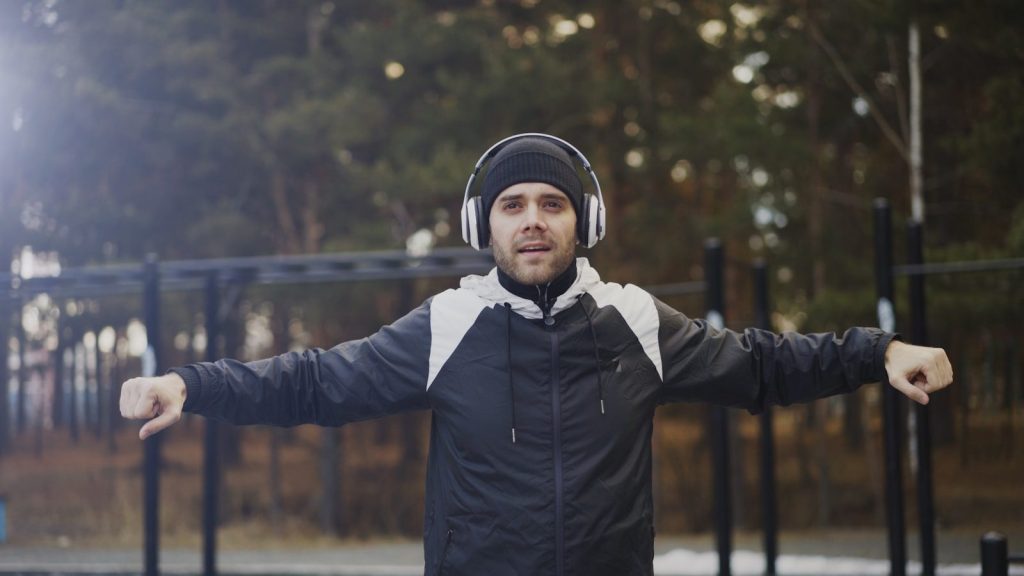
The 10-exercise routine below includes five warm-up exercises and five cool-down exercises suitable for strength training, cardio, home workouts and general fitness. No special equipment is required, although a wall or sturdy chair can provide support.
Warm-Up and Cool-Down Exercises at a Glance
| Phase | Exercise | Recommended amount | Main purpose |
|---|---|---|---|
| Warm-up | March in Place | 60–90 seconds | Gradually raises heart rate |
| Warm-up | Arm Circles | 10–15 each direction | Prepares the shoulders |
| Warm-up | Torso Rotations | 8–10 per side | Mobilizes the upper back and trunk |
| Warm-up | Front-to-Back Leg Swings | 8–12 per leg | Prepares the hips and legs |
| Warm-up | Bodyweight Squats | 10–15 reps | Rehearses lower-body movement |
| Cool-down | Slow Walk or March | 2–5 minutes | Gradually lowers exercise intensity |
| Cool-down | Wall Calf Stretch | 20–30 seconds per side | Stretches the calves |
| Cool-down | Standing Quadriceps Stretch | 20–30 seconds per side | Stretches the front of the thigh |
| Cool-down | Supine Hamstring Stretch | 20–30 seconds per side | Stretches the back of the thigh |
| Cool-down | Cross-Body Shoulder Stretch | 20–30 seconds per side | Stretches the back of the shoulder |
What Are Warm-Up and Cool-Down Exercises?
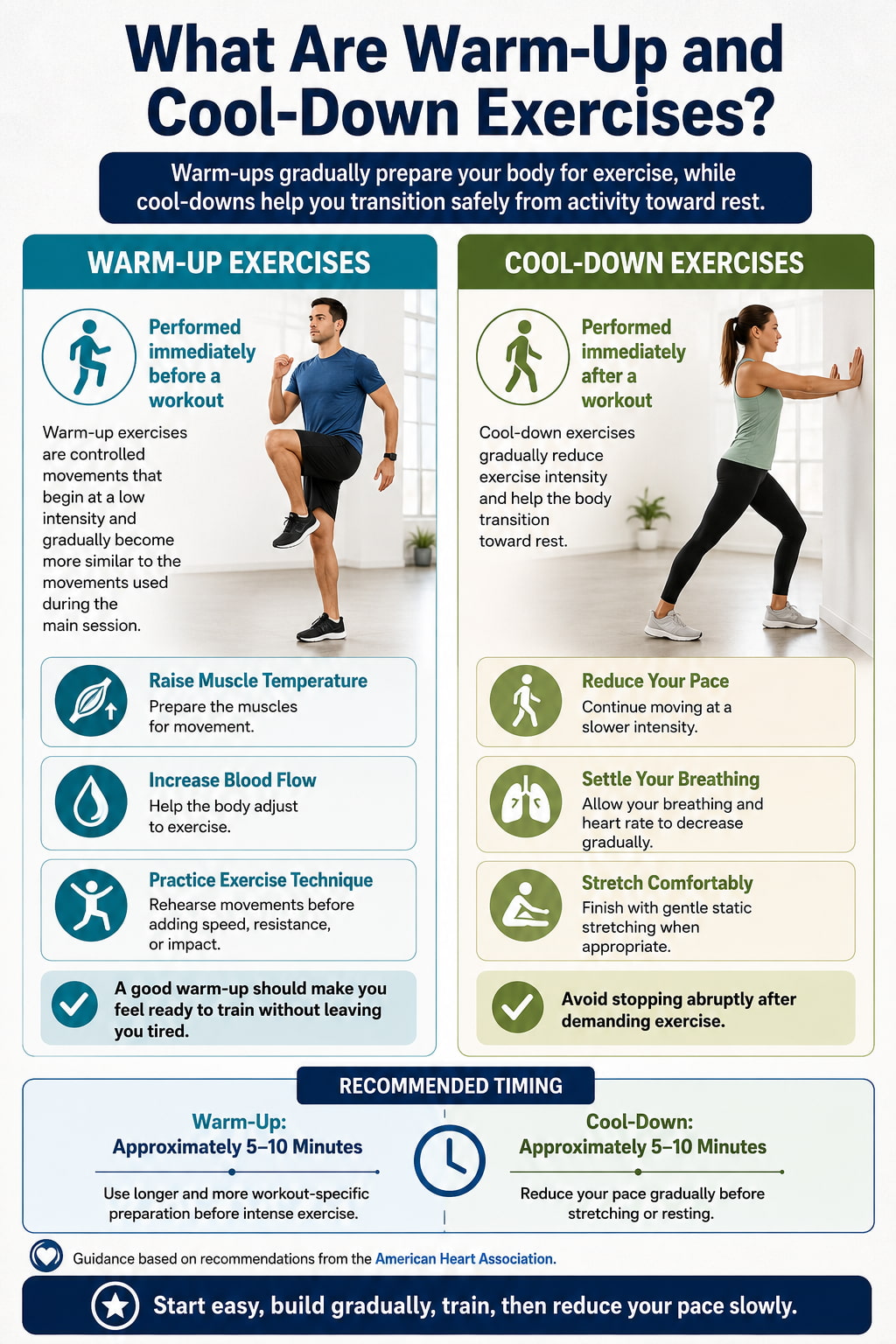
Warm-up exercises are controlled movements performed before training. They gradually prepare your muscles, joints, breathing, and movement patterns without making you tired.
Cool-down exercises are performed after the workout. Start by reducing your pace gradually, then use comfortable stretches for the muscles you trained. The American Heart Association recommends slowing down rather than stopping abruptly.
Dynamic Versus Static Stretching
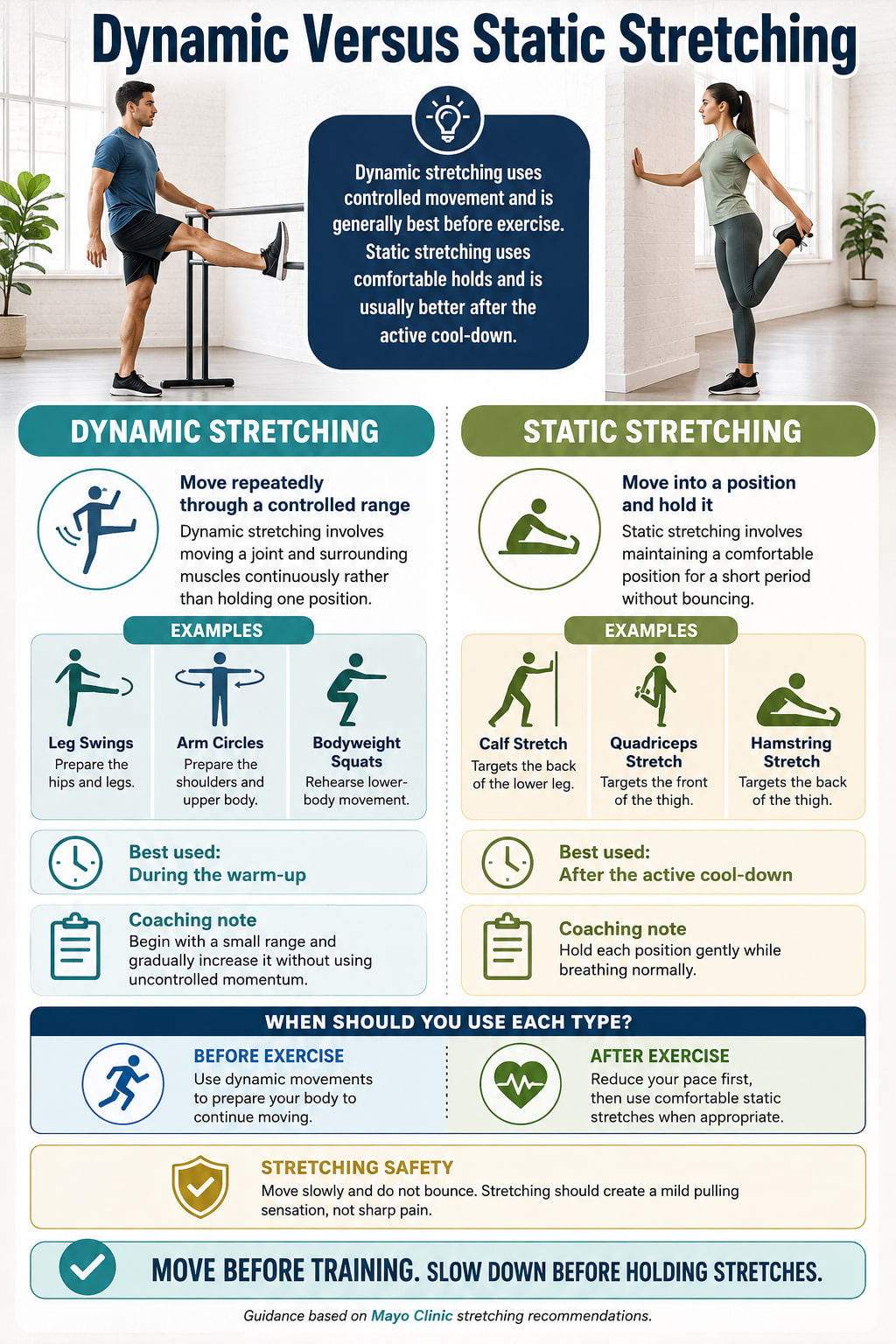
Dynamic stretching uses controlled movement through a comfortable range. Arm circles, leg swings and bodyweight squats are examples. These movements are generally better before exercise because they prepare your body to keep moving.
Static stretching involves moving into a position and holding it. Calf, quadriceps and hamstring stretches are common examples. These stretches are usually more appropriate after you have lowered your exercise intensity and your muscles are warm.
Use both styles without forcing the range:
- Before training: Choose smooth dynamic movements.
- After training: Slow down first, then use gentle static stretches when useful.
According to Mayo Clinic stretching guidance, stretches should be slow and comfortable. Avoid bouncing, and stop before mild tension becomes pain.
How Long Should You Warm Up and Cool Down?
For most general workouts, spend approximately 5–10 minutes warming up. A light home workout may need only five minutes, while heavy lifting, sprinting, demanding intervals or competitive sport may require 10–15 minutes of more specific preparation.
You are probably ready to begin when:
- Your body feels warmer.
- Your breathing has increased slightly.
- Your joints move comfortably.
- The first workout movement no longer feels abrupt.
- You feel prepared rather than tired.
A cool-down can also last approximately 5–10 minutes. Begin with two to five minutes of progressively slower movement, then stretch the main muscles used during the workout when appropriate.
For example, walk before running, gradually build toward your training pace, then return to easy jogging and walking after the run. The same principle applies to cycling, rowing and other cardio activities.
How to Use These Warm-Up and Cool-Down Exercises
This guide includes five warm-up exercises and five cool-down exercises.
Perform exercises 1–5 before your main workout to gradually prepare your body for training. After the warm-up, complete your planned strength, cardio, or fitness session.
Perform exercises 6–10 only after your main workout is finished. Begin the cool-down with slow walking or marching, then complete the gentle stretches that match the muscles you trained.
Follow this order:
1. Warm-up exercises → 2. Main workout → 3. Cool-down exercises
5 Best Warm-Up Exercises for Any Workout
Complete the following exercises in order. Start slowly and gradually increase your movement range or pace. The entire sequence should take approximately five to seven minutes.
1. March in Place
Best for: Gradually increasing heart rate, body temperature and coordination at the beginning of a workout.
Muscles worked: Hip flexors, quadriceps, hamstrings, calves, glutes, shoulders and core.
Suggested sets and reps: March for 60–90 seconds.
How to do it:
- Stand tall with your feet about hip-width apart.
- Shift your weight onto one foot and lift the opposite knee.
- Lower that foot softly and lift the other knee.
- Swing your arms naturally in rhythm with your legs.
- Begin at an easy pace and gradually move faster.
- Keep your breathing controlled and your posture upright.
Common mistakes: Leaning backward, stomping the feet, holding the breath or beginning at maximum speed.
Expert tip: Think about becoming gradually warmer rather than trying to raise your knees as high as possible.
2. Arm Circles
Best for: Preparing the shoulders for pressing, pulling, swimming, throwing and upper-body workouts.
Muscles worked: Deltoids, rotator cuff muscles, upper trapezius, lower trapezius, rhomboids and upper-back muscles.
Suggested sets and reps: Perform 10–15 forward circles and 10–15 backward circles.
How to do it:
- Stand tall with a soft bend in your knees.
- Extend your arms out to the sides.
- Begin making small forward circles.
- Gradually increase the circle size without forcing the shoulders.
- Reverse direction and repeat.
- Keep your ribs controlled instead of arching your lower back.
Common mistakes: Shrugging the shoulders, moving too quickly, forcing a painful range or arching the back to create larger circles.
Expert tip: Let the shoulder blades move naturally instead of locking them tightly together.
3. Controlled Torso Rotations
Best for: Preparing the upper back and trunk for lifting, running, recreational sports and full-body exercise.
Muscles worked: Obliques, deep core muscles, spinal erectors and muscles surrounding the upper back and shoulders.
Suggested sets and reps: Perform 8–10 rotations per side.
How to do it:
- Stand with your feet slightly wider than hip-width apart.
- Bend your knees slightly and brace your abdomen gently.
- Hold your hands in front of your chest.
- Rotate your chest slowly toward one side.
- Return to the center and rotate toward the other side.
- Keep the movement smooth and controlled.
Common mistakes: Twisting forcefully, locking the knees, moving only the arms or pushing into lower-back discomfort.
Expert tip: Imagine your rib cage rotating over a stable pelvis instead of trying to turn as far as possible.
4. Front-to-Back Leg Swings
Best for: Preparing the hips and legs before squats, lunges, running, cycling and lower-body workouts.
Muscles worked: Hip flexors, glutes, hamstrings, quadriceps and core stabilizers.
Equipment needed: A wall, rack, counter or sturdy chair for support.
Suggested sets and reps: Perform 8–12 swings per leg.
How to do it:
- Stand beside a wall or sturdy support.
- Shift your weight onto the leg closest to the support.
- Brace your core and keep your torso upright.
- Swing the outside leg forward through a comfortable range.
- Reverse the movement and swing it gently behind you.
- Complete all repetitions before changing sides.
Common mistakes: Using uncontrolled momentum, arching the lower back, turning the hips sideways or swinging into pain.
Expert tip: Start with a short swing and allow the range to increase naturally as the hip becomes warmer.
5. Bodyweight Squats
Best for: Preparing the lower body before strength training, circuits, hiking, running and athletic activity.
Muscles worked: Quadriceps, glutes, hamstrings, calves, adductors and core.
Suggested sets and reps: Perform 10–15 controlled repetitions.
How to do it:
- Stand with your feet approximately shoulder-width apart.
- Point your toes slightly outward if that feels natural.
- Brace your abdomen and keep your chest comfortably lifted.
- Bend your hips and knees together.
- Lower only as far as you can maintain stable feet and controlled posture.
- Press through your feet to stand.
- Finish tall without aggressively locking your knees.
Common mistakes: Allowing the heels to lift, collapsing the knees inward, dropping too quickly or forcing a depth you cannot control.
Expert tip: Use the squat to assess readiness. The final repetitions should feel smoother and more comfortable than the first few.
Add Workout-Specific Preparation
These five warm-up exercises create a useful general foundation, but the final stage should reflect the upcoming workout.
Before strength training, complete lighter sets of the main lifts. For example, perform bodyweight squats and progressively loaded practice sets before heavy barbell squats.
Before running, continue with brisk walking, easy jogging and a few short pace increases.
Before HIIT or sport, rehearse the direction changes, jumps or faster movements used in the session at a lower intensity.
Before upper-body training, add light versions of your first pressing or pulling exercise.
Your last warm-up movement should resemble the first demanding activity in your workout. The goal is to reduce the difference between resting and working intensity.
5 Best Cool-Down Exercises for Any Workout
Begin your cool-down by reducing movement intensity. Complete the stretches only after your breathing has started to settle.
6. Slow Walk or March
Best for: Beginning the cool-down after cardio, circuits, strength training or high-intensity exercise.
Muscles worked: Calves, quadriceps, hamstrings, glutes, hip flexors and postural muscles.
Suggested sets and reps: Walk or march for 2–5 minutes.
How to do it:
- Continue moving when the workout ends.
- Walk or march at an easy but steady pace.
- Let your arms move naturally.
- Gradually shorten your stride and reduce your speed.
- Breathe slowly and avoid holding your breath.
- Continue until your breathing and heart rate begin settling.
Common mistakes: Stopping suddenly, sitting down immediately after intense cardio or walking too quickly to allow recovery.
Expert tip: Reduce the pace in stages rather than changing instantly from hard exercise to very slow movement.
7. Wall Calf Stretch
Best for: Post-workout flexibility after walking, running, jumping, cycling or lower-body training.
Muscles worked: Gastrocnemius and soleus muscles of the calf.
Equipment needed: A stable wall or sturdy upright support.
Suggested sets and reps: Hold for 20–30 seconds per side. Complete one or two rounds.
How to do it:
- Face a wall and place both hands against it.
- Step one foot behind you.
- Point both feet mostly forward.
- Keep the rear heel in contact with the floor.
- Bend the front knee and shift your body forward.
- Stop when you feel mild tension in the rear calf.
- Hold without bouncing, then change sides.
Common mistakes: Turning the back foot outward, lifting the heel, bouncing or shifting so far forward that the stretch becomes painful.
Expert tip: Move the rear foot farther back to adjust the stretch instead of forcing the heel downward.
8. Standing Quadriceps Stretch
Best for: Stretching the front of the thigh after squats, lunges, running, cycling and leg workouts.
Muscles worked: Quadriceps, with possible involvement of the hip flexors depending on leg position.
Equipment needed: A wall, counter or sturdy chair for balance.
Suggested sets and reps: Hold for 20–30 seconds per side. Complete one or two rounds.
How to do it:
- Stand beside a stable support.
- Shift your weight onto one leg.
- Bend the opposite knee and bring the heel toward your glutes.
- Hold your ankle, shoe or a strap around the foot.
- Keep your knees close together.
- Gently tuck your pelvis and stand tall.
- Hold at mild tension before changing sides.
Common mistakes: Pulling the heel forcefully, allowing the knee to move far to the side, arching the lower back or losing balance.
Expert tip: A slight pelvic tuck often improves the stretch without requiring you to pull the foot harder.
9. Supine Hamstring Stretch
Best for: Stretching the back of the thigh after running, deadlifts, lower-body workouts and general exercise.
Muscles worked: Hamstrings, with possible mild involvement of the calf.
Equipment needed: An exercise mat is optional. A towel or stretching strap can help.
Suggested sets and reps: Hold for 20–30 seconds per leg. Complete one or two rounds.
How to do it:
- Lie on your back with both knees bent.
- Lift one leg toward the ceiling.
- Hold behind the thigh or loop a strap around the foot.
- Keep your head and shoulders relaxed.
- Gradually straighten the raised knee.
- Stop when you feel a comfortable stretch behind the thigh.
- Hold without bouncing before changing sides.
Common mistakes: Pulling directly behind the knee joint, forcing the leg straight, lifting the hips or holding the breath.
Expert tip: A slightly bent knee is acceptable. Prioritize tension in the hamstring rather than trying to create a perfectly straight leg.
10. Cross-Body Shoulder Stretch
Best for: Cooling down after pressing, pulling, swimming, rowing and upper-body workouts.
Muscles worked: Posterior deltoid and muscles around the back of the shoulder.
Suggested sets and reps: Hold for 20–30 seconds per side. Complete one or two rounds.
How to do it:
- Stand or sit with your spine upright.
- Bring one arm across your chest.
- Place the opposite hand above the elbow.
- Draw the arm gently toward your body.
- Keep the stretching shoulder down and relaxed.
- Hold at a comfortable point before changing sides.
Common mistakes: Pulling on the elbow joint, shrugging the shoulder, twisting the entire torso or forcing the arm into pain.
Expert tip: Keep your chest facing forward so the movement comes from the shoulder rather than from rotating your trunk.
Sample Warm-Up and Cool-Down Routine
This structure can be used around most general workouts.
| Stage | Exercise plan | Effort |
|---|---|---|
| Warm-up | March for 60–90 seconds | RPE 2–3 out of 10 |
| Warm-up | Arm circles and torso rotations | Easy and controlled |
| Warm-up | Leg swings and bodyweight squats | RPE 3–4 out of 10 |
| Specific preparation | Practice the first workout movement with less speed, impact or resistance | Build gradually |
| Main workout | Complete your planned training | Based on program |
| Active cool-down | Walk or march for 2–5 minutes | Reduce from RPE 3 to 1–2 |
| Stretching | Choose the calf, quadriceps, hamstring and shoulder stretches that match the workout | Mild tension only |
Use the routine before and after each planned workout. Increase the warm-up duration before harder sessions rather than making every movement faster.
For progression, first improve control and range of motion. Next, make the later warm-up exercises more specific to the workout. Avoid adding fatigue simply to make the warm-up feel more challenging.
How to Adapt the Routine to Your Workout
Before Strength Training
Use the five general warm-up exercises, then perform lighter practice sets of your first major exercise. Gradually add resistance while keeping the repetitions well below fatigue.
For example, before a squat workout, complete bodyweight squats followed by several progressively heavier squat sets. Before bench pressing, add light presses with an empty bar or manageable dumbbells.
Before Running or Cardio
Spend more time walking or marching before progressing to easy jogging. Leg swings and bodyweight squats can then prepare the hips, knees and ankles.
Increase your speed gradually during the first portion of the workout rather than starting at your planned training pace.
Before HIIT or Athletic Training
Extend the warm-up to approximately 10–15 minutes. Add low-intensity versions of the jumps, direction changes, accelerations or sport skills used during the session.
High-intensity training requires more specific preparation than a light walk or basic mobility routine.
Before a Beginner or Low-Impact Workout
Keep the warm-up low impact and use a chair whenever needed. Smaller movements are acceptable. Gradually increase your range only when you feel stable and comfortable.
The warm-up should increase confidence and readiness, not create fatigue or discomfort.
Common Warm-Up and Cool-Down Mistakes
Starting the Warm-Up Too Fast
Beginning with high knees, jumping or rapid burpees can create an abrupt increase in exercise intensity. Start with marching or easy movement and build progressively.
Turning the Warm-Up Into a Workout
A warm-up can create mild sweating, but it should not exhaust the muscles needed for training. Reduce the repetitions, speed or resistance when the routine lowers your workout performance.
Using Only Static Stretching Before Training
Holding several long stretches does not fully prepare you for running, lifting or changing direction. Use dynamic movement and practice the specific activity at a lower intensity.
Moving Without Control
Dynamic does not mean uncontrolled. Rapid leg swings, forceful torso twists and bouncing movements can place unnecessary stress on the joints.
Skipping Workout-Specific Practice
A general warm-up is not enough before heavy, fast or technically demanding exercise. Perform lighter practice sets or slower versions of the main movement.
Stopping Immediately After Intense Cardio
After a demanding session, continue walking or moving gently while your breathing and heart rate begin settling.
Forcing Static Stretches
A stronger stretch is not always a better stretch. Hold a position that creates mild tension without sharp, stabbing or joint pain.
Expecting Stretching to Prevent Soreness
Stretching may support flexibility, but it should not be presented as a reliable way to prevent delayed-onset muscle soreness. A Cochrane review found that stretching before or after exercise had little or no meaningful effect on soreness during the following week.
Warm-Up and Cool-Down Safety Tips
Use a wall, counter or sturdy chair when an exercise challenges your balance. Keep the surrounding floor dry and free from loose objects.
Move through a range you can control. Do not force a stretch, bounce at the end of the range or continue through sharp pain.
The American Heart Association’s stretching guidance recommends slow, smooth stretching for approximately 10–30 seconds without pain.
Stop exercising and seek appropriate medical help if you experience chest pain, fainting, severe dizziness, unusual shortness of breath, numbness, sudden weakness or other concerning symptoms.
People with an injury, recent surgery, medical condition, pregnancy-related concern or significant balance limitation may need personalized exercise guidance.
Frequently Asked Questions
How long should a warm-up last?
Most people can begin with 5–10 minutes. Light exercise may need less preparation, while heavy lifting, sprinting, intense intervals and competitive sport often require a longer and more specific warm-up.
Should you stretch before or after a workout?
Use dynamic movements before most workouts. Static stretching is generally better after the active cool-down or during a separate flexibility session when the muscles are warm.
Can warming up prevent injuries?
A progressive warm-up may help prepare the body and support safer movement, but it cannot guarantee injury prevention. Appropriate technique, workload, recovery, equipment and gradual progression also matter.
Does cooling down prevent muscle soreness?
Cooling down helps create a gradual transition toward rest, but research does not show that post-workout stretching reliably prevents next-day soreness. Use stretching primarily for flexibility and comfortable movement rather than as a soreness cure.
Do you need a cool-down after strength training?
A brief cool-down can be useful, especially after demanding compound exercises, circuits or sessions that significantly increase heart rate. Walk slowly for a few minutes, then stretch the main muscles trained when flexibility work is appropriate.
Can you use the same warm-up for every workout?
The five exercises in this guide provide a general starting point. The final part of the warm-up should match the workout. Use lighter lifts before strength training, easy jogging before running and low-intensity skill drills before sport.
How do you know when you are warmed up?
You should feel warmer, move more comfortably and breathe slightly faster without feeling tired. The first working movement should feel familiar rather than abrupt.
Conclusion
Effective warm-up and cool-down exercises do not need to be complicated. Begin with easy movement, gradually increase the range and intensity, and finish by practicing movements related to the workout.
After training, reduce your pace before stretching the muscles you used. Keep every stretch smooth and comfortable, and focus on consistency rather than forcing a larger range.
References
- American Heart Association: Warm Up, Cool Down
- American Heart Association: Flexibility Exercise and Stretching
- Mayo Clinic: How to Warm Up and Cool Down
- Mayo Clinic: A Guide to Basic Stretches
- NHS: How to Warm Up Before Exercising
- NHS: How to Stretch After Exercising
- Cochrane: Stretching to Prevent or Reduce Muscle Soreness
This content is for informational purposes only and is not a substitute for professional medical advice.