Inner thigh exercises for women strengthen the hip adductors—the muscles that bring the legs toward the body’s midline and help control the hips during lower-body movement. A good routine combines direct adductor exercises with squats, hinges, lateral lunges, and stability work.
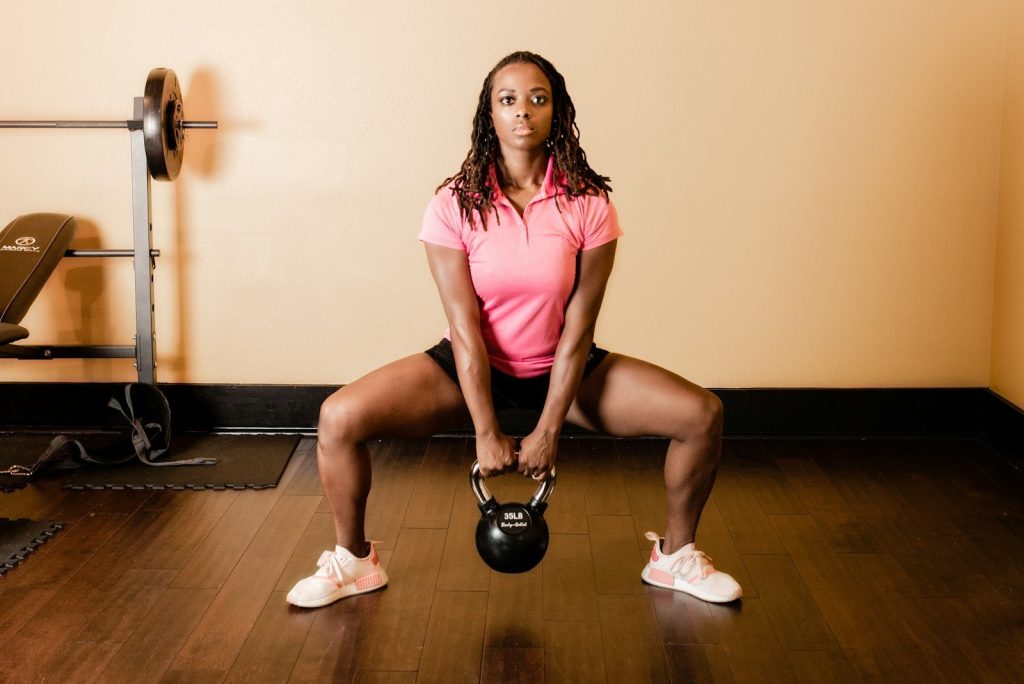
You do not need to perform all 12 exercises in one workout. Select two to four movements that match your experience, equipment, and training goals. This guide explains proper form, common mistakes, beginner modifications, progressions, and practical workout programming.
Benefits of Inner Thigh Exercises for Women
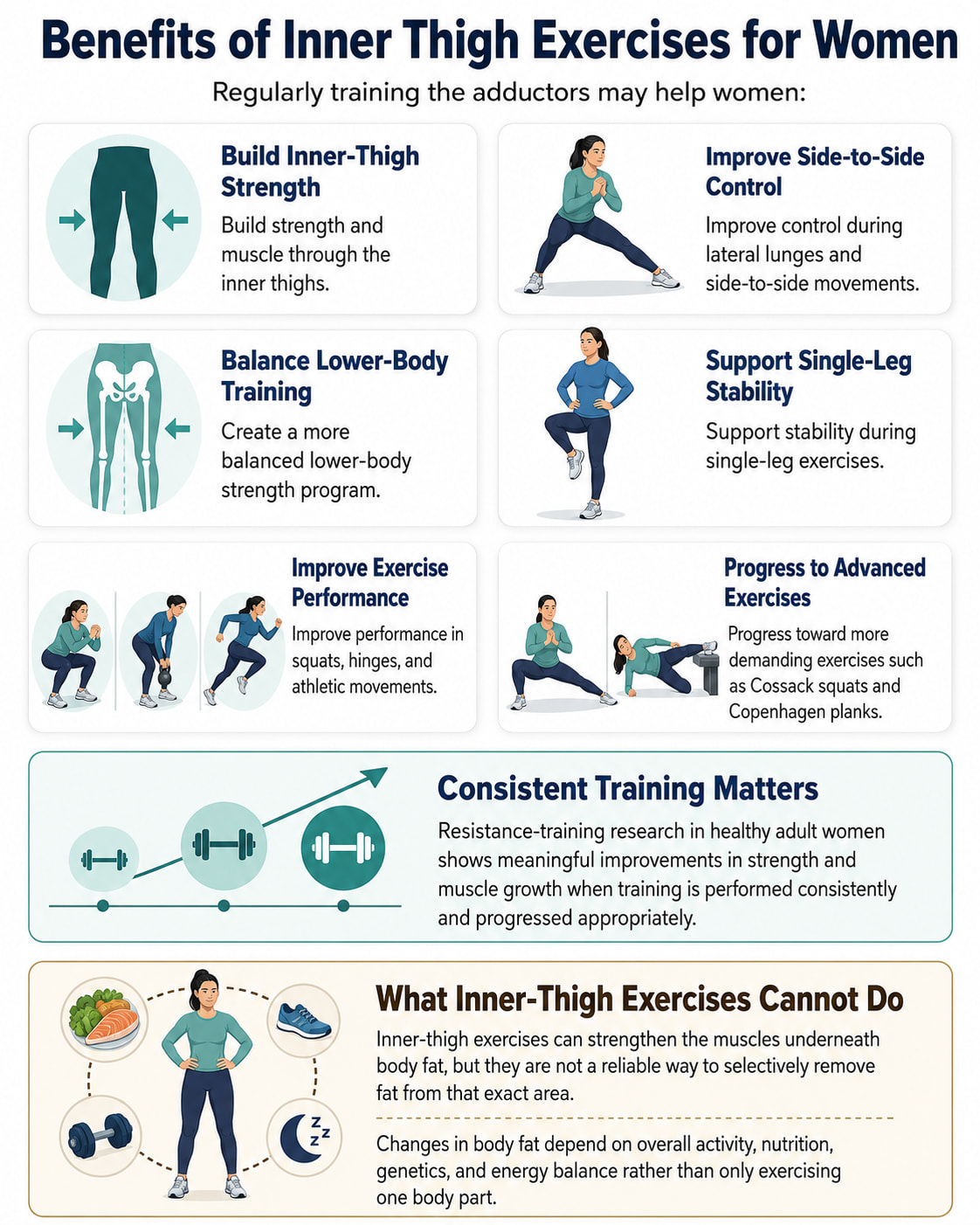
Regularly training the adductors may help women:
- Build strength and muscle through the inner thighs.
- Improve control during lateral lunges and side-to-side movements.
- Create a more balanced lower-body strength program.
- Support stability during single-leg exercises.
- Improve performance in squats, hinges, and athletic movements.
- Progress toward more demanding exercises such as Cossack squats and Copenhagen planks.
Resistance-training research in healthy adult women shows meaningful improvements in strength and muscle growth when training is performed consistently and progressed appropriately.
Inner-thigh exercises can strengthen the muscles underneath body fat, but they are not a reliable way to selectively remove fat from that exact area. Changes in body fat depend on overall activity, nutrition, genetics, and energy balance rather than only exercising one body part.
What Muscles Do Inner Thigh Exercises Work?
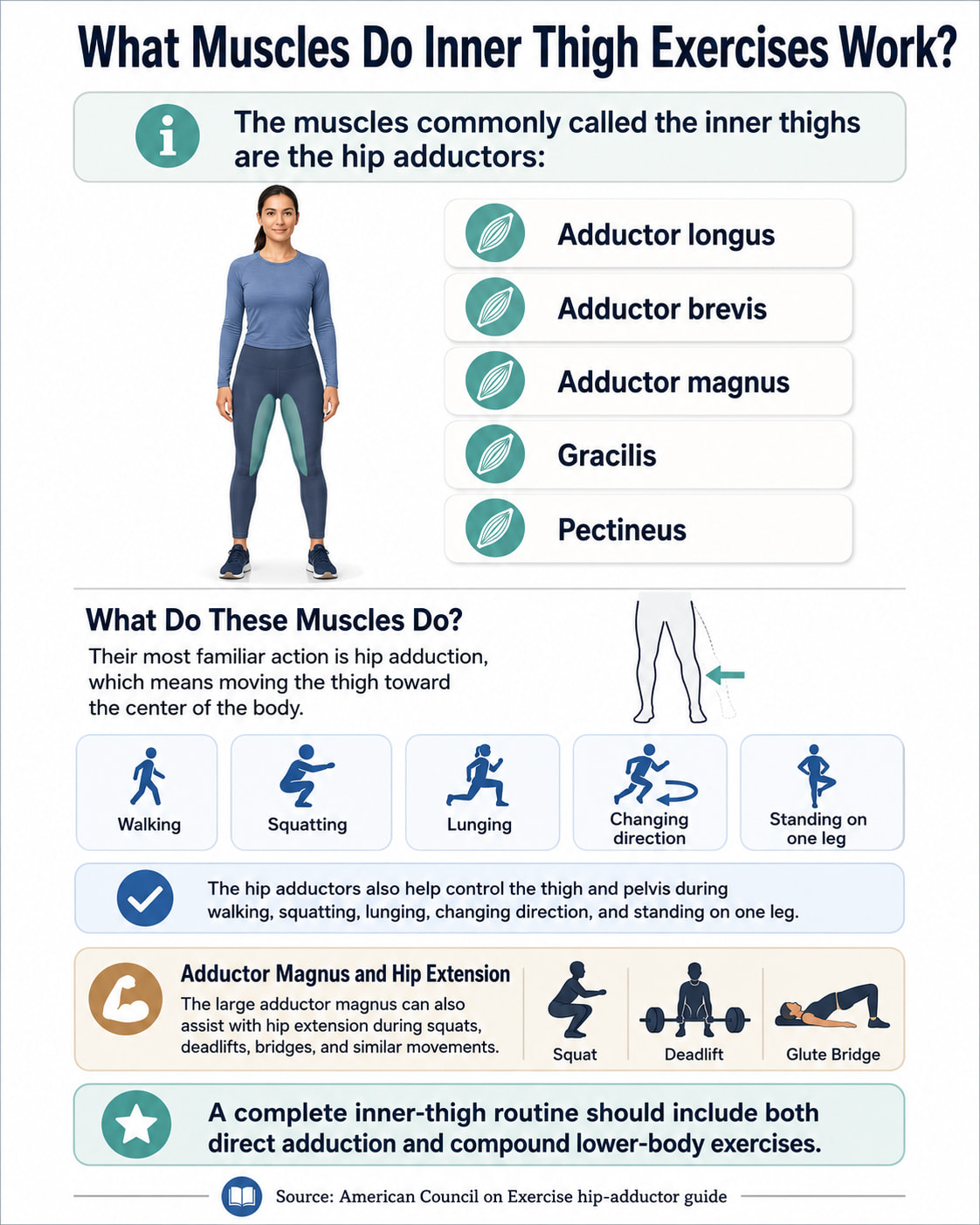
The muscles commonly called the inner thighs are the hip adductors:
- Adductor longus
- Adductor brevis
- Adductor magnus
- Gracilis
- Pectineus
Their most familiar action is hip adduction, which means moving the thigh toward the center of the body. However, they also help control the thigh and pelvis during walking, squatting, lunging, changing direction, and standing on one leg.
The large adductor magnus can also assist with hip extension during squats, deadlifts, bridges, and similar movements. This is why a complete inner-thigh routine should include both direct adduction and compound lower-body exercises. The American Council on Exercise’s hip-adductor guide explains how these muscles contribute to both isolated and integrated movement.
Before Starting These Inner Thigh Exercises
Warm up for five to ten minutes with brisk walking, easy cycling, bodyweight squats, hip circles, or controlled lateral steps. The AAOS Hip Conditioning Program similarly recommends low-impact activity before hip-strengthening exercises.
Start with a comfortable range of motion. A mild muscular effort is expected, but sharp groin, hip, knee, or lower-back pain is not.
Stop exercising and seek appropriate professional guidance if you experience sharp pain, numbness, dizziness, chest pain, unusual shortness of breath, or symptoms that continue to worsen.
12 Best Inner Thigh Exercises for Women
These 12 inner thigh exercises for women target the hip adductors while also supporting hip stability, leg strength, and better lower-body control. Choose two to four exercises that match your fitness level and perform them with slow, controlled form.
1. Supine Pillow or Ball Adductor Squeeze
Best for: Beginners, home workouts, and learning how to contract the inner thighs.
Muscles worked: Hip adductors, with light assistance from the core and pelvic stabilizers.
Equipment needed: A small pillow, folded towel, soft exercise ball, or yoga block.
Sets, reps, and rest: Perform 2–3 sets of 8–12 squeezes. Hold each squeeze for 3–5 seconds and rest for 30–45 seconds.
How to do it:
- Lie on your back with your knees bent and feet flat.
- Place the pillow or ball between your knees.
- Keep your feet and pelvis still.
- Gently squeeze your knees toward the object.
- Hold without holding your breath, then slowly release.
Common mistakes: Squeezing as hard as possible immediately, lifting the feet, tilting the pelvis, or holding the breath. Use firm but controlled pressure rather than creating pain or cramping.
Progression: Hold each contraction longer or perform the exercise during a glute bridge.
Coaching cue: Imagine gently pressing both knees into the object equally.
2. Side-Lying Hip Adduction
Best for: Directly training each inner thigh without equipment.
Muscles worked: Adductor longus, adductor brevis, adductor magnus, gracilis, and pectineus.
Sets, reps, and rest: Perform 2–3 sets of 10–15 repetitions per side. Rest for 30–60 seconds.
How to do it:
- Lie on one side with your shoulders and hips stacked.
- Keep the lower leg straight.
- Bend the upper leg and place its foot on the floor in front of the lower leg.
- Brace your midsection and lift the lower leg a few inches.
- Pause briefly before lowering it slowly.
The leg only needs to rise a short distance. ACE recommends keeping the knee extended, the foot neutral, and the hips stacked throughout the movement.
Common mistakes: Rolling backward, turning the toes toward the ceiling, swinging the leg, or trying to lift too high.
Progression: Add a light ankle weight.
Regression: Perform fewer repetitions or bend the lower knee slightly.
3. Glute Bridge With Adductor Squeeze
Best for: Training the inner thighs, glutes, and hip extension together.
Muscles worked: Hip adductors, gluteus maximus, hamstrings, and trunk stabilizers.
Equipment needed: A pillow, folded towel, or soft ball.
Sets, reps, and rest: Perform 2–3 sets of 10–15 repetitions. Rest for 45–75 seconds.
How to do it:
- Lie on your back with your knees bent and feet flat.
- Place a soft object between your knees.
- Apply light inward pressure with both knees.
- Push through your feet and lift your hips.
- Pause without overextending your back, then lower under control.
Common mistakes: Flaring the ribs, arching the lower back, pushing mainly through the toes, or allowing the object to slip.
Progression: Hold a dumbbell across your hips or use a longer pause at the top.
Regression: Practice a regular glute bridge or the lying adductor squeeze separately.
4. Standing Resistance-Band Hip Adduction
Best for: Home workouts and progressing from floor-based exercises.
Muscles worked: Hip adductors of the moving leg, with the glutes, core, and foot muscles stabilizing the supporting side.
Equipment needed: Long resistance band and a secure low anchor.
Sets, reps, and rest: Perform 2–3 sets of 10–15 repetitions per side. Rest for 45–60 seconds.
How to do it:
- Attach the band to a secure anchor near floor level.
- Loop the other end around the ankle closest to the anchor.
- Stand tall while holding a stable support.
- Begin with the working leg slightly out to the side.
- Pull it inward across or toward the front of the supporting foot.
- Return slowly against the band’s pull.
Common mistakes: Leaning away from the anchor, rotating the hips, swinging the leg, locking the supporting knee, or using a band that is too heavy.
Progression: Use a stronger band or reduce hand support.
Coaching cue: Keep your belt line facing forward.
5. Standing Cable Hip Adduction
Best for: Gym training and applying resistance through a controlled range.
Muscles worked: Hip adductors, with the glutes and core stabilizing the pelvis.
Equipment needed: Cable machine and ankle cuff.
Sets, reps, and rest: Perform 2–3 sets of 10–15 repetitions per side. Rest for 45–75 seconds.
How to do it:
- Set the cable at its lowest position and attach the cuff above your ankle.
- Stand side-on with the cuffed leg closest to the machine.
- Step far enough away to create light tension.
- Keep the supporting knee slightly bent.
- Pull the cuffed leg inward toward the center of your body.
- Pause briefly, then return slowly.
ACE’s standing hip-adduction instructions emphasize a stable torso, a softly bent supporting knee, and a controlled return.
Common mistakes: Using momentum, bending sideways, turning the toes outward, or allowing the weight stack to slam down.
Progression: Increase the weight once you can complete every repetition without leaning or swinging.
6. Seated Hip Adduction Machine
Best for: Stable, measurable inner-thigh resistance at the gym.
Muscles worked: Hip adductors.
Equipment needed: Seated hip-adduction machine.
Sets, reps, and rest: Perform 2–4 sets of 8–15 repetitions. Rest for 60–90 seconds.
How to do it:
- Adjust the seat and starting position to a comfortable range.
- Sit with your back supported and feet on the machine platforms.
- Keep your knees aligned with the pads.
- Bring your thighs inward without bouncing.
- Pause briefly before allowing the pads to open slowly.
Common mistakes: Starting with an excessively wide position, using a load that shortens the range, bouncing out of the stretch, or letting the weight stack drop.
Progression: Add the smallest available weight increase after reaching the top of your repetition range with controlled form.
Safety note: A deeper starting position is not automatically better. Use a range that does not create pinching or sharp groin discomfort.
7. Goblet Sumo Squat
Best for: Building the inner thighs, quadriceps, and glutes with one compound exercise.
Muscles worked: Adductors, quadriceps, gluteus maximus, hamstrings, calves, and core.
Equipment needed: Dumbbell or kettlebell; body weight also works.
Sets, reps, and rest: Perform 3 sets of 8–12 repetitions. Rest for 60–90 seconds.
How to do it:
- Stand slightly wider than shoulder-width.
- Turn your toes outward only as far as your knees can comfortably follow.
- Hold the weight close to your chest.
- Brace your core and sit down between your hips.
- Keep your knees tracking in the direction of your toes.
- Push through your whole foot to stand.
Common mistakes: Forcing an extremely wide stance, allowing the knees to collapse inward, lifting the heels, rounding the back, or dropping lower than you can control.
Progression: Increase the dumbbell weight or use a slower lowering phase.
Regression: Perform a bodyweight squat to a box or chair.
8. Dumbbell Sumo Deadlift
Best for: Training the adductors as part of a hip-dominant strength movement.
Muscles worked: Adductor magnus, gluteus maximus, hamstrings, quadriceps, back extensors, and grip muscles.
Equipment needed: One or two dumbbells or a kettlebell.
Sets, reps, and rest: Perform 3 sets of 6–12 repetitions. Rest for 75–120 seconds.
How to do it:
- Stand in a comfortably wide stance with the weight between your feet.
- Turn the toes slightly outward and keep the knees aligned with them.
- Push your hips back and bend your knees enough to reach the weight.
- Keep your spine neutral and chest comfortably lifted.
- Drive through your feet and extend your hips to stand.
- Lower the weight by sending the hips back first.
Common mistakes: Treating the movement like a very wide squat, rounding the back, letting the knees collapse inward, or leaning backward at the top.
Progression: Gradually increase the load while maintaining the same controlled range.
Coaching cue: Stand tall by pushing the floor away, not by pulling with your back.
9. Lateral Lunge
Best for: Developing side-to-side strength, hip control, and adductor strength through a larger range.
Muscles worked: Adductors, glutes, quadriceps, hamstrings, calves, and core.
Sets, reps, and rest: Perform 2–3 sets of 6–10 repetitions per side. Rest for 60–90 seconds.
How to do it:
- Stand tall with your feet together or hip-width apart.
- Step to one side while keeping both feet mostly forward.
- Push the hips back over the stepping leg.
- Bend that knee while keeping the opposite leg straighter.
- Keep the stepping foot fully planted.
- Push through that foot to return to standing.
ACE advises keeping the heel down and aligning the bent knee over the foot. A shorter step can help if the knee begins falling inward.
Common mistakes: Stepping too far, collapsing the knee inward, lifting the heel, rounding the back, or pushing off mainly with the straight leg.
Progression: Hold a dumbbell in the goblet position.
Regression: Use a shorter step, reduce the depth, or hold a stable support.
10. Slider Lateral Lunge
Best for: Increasing control as the working leg moves away from and back toward the body.
Muscles worked: Adductors, glutes, quadriceps, hamstrings, and core.
Equipment needed: Exercise slider or folded towel on a smooth floor.
Sets, reps, and rest: Perform 2–3 sets of 6–10 repetitions per side. Rest for 60–90 seconds.
How to do it:
- Stand with one foot on the slider.
- Keep most of your weight over the planted leg.
- Slide the other foot sideways as you push your hips back.
- Bend the planted knee while keeping its foot fully supported.
- Stop before losing balance or pelvic control.
- Pull the sliding leg inward as you return to standing.
Common mistakes: Placing too much weight on the slider, allowing the planted knee to collapse inward, sliding farther than you can control, or jerking the leg back.
Progression: Hold a dumbbell or increase the sliding distance gradually.
Regression: Hold a chair or countertop and use a shorter range.
11. Supported Cossack Squat
Best for: Advanced lateral strength and controlled mobility through the hips, knees, and ankles.
Muscles worked: Adductors, quadriceps, glutes, hamstrings, calves, and core.
Equipment needed: Sturdy support such as a squat rack, railing, or suspension trainer.
Sets, reps, and rest: Perform 2–3 sets of 5–8 repetitions per side. Rest for 60–90 seconds.
How to do it:
- Take a wide stance and hold your support.
- Shift your hips toward one side.
- Bend that knee while keeping the opposite leg long.
- Keep the working foot planted and knee aligned with the toes.
- Descend only as far as you can control.
- Push through the bent leg to return to the center.
The toes of the straight leg may turn upward if that position feels natural and controlled.
Common mistakes: Dropping too quickly, forcing excessive depth, allowing the bent knee to collapse inward, or rounding the lower back to reach lower.
Progression: Use less hand support, hold a light weight, or increase depth gradually.
Regression: Practice supported lateral lunges first.
12. Bent-Knee Copenhagen Plank
Best for: Advanced adductor strength and lateral core stability.
Muscles worked: Hip adductors, obliques, transverse abdominis, shoulders, and glutes.
Equipment needed: Padded bench or sturdy chair that cannot move.
Sets, reps, and rest: Perform 2–3 sets of 10–20 seconds per side. Rest for 45–75 seconds.
How to do it:
- Lie on your side with your upper knee supported on a padded bench.
- Place your lower elbow directly beneath your shoulder.
- Bend both knees for the beginner version.
- Brace your core and lift your hips from the floor.
- Press the upper knee downward into the bench.
- Maintain a straight line from your shoulder through your hips.
Research comparing hip-adduction exercises identified Copenhagen adduction and band adduction as demanding options, so the Copenhagen plank should be introduced gradually.
Common mistakes: Placing the elbow too far from the shoulder, letting the hips rotate, holding the breath, or progressing to the straight-leg version too early.
Progression: Support the upper ankle instead of the knee.
Regression: Keep the lower hip lightly supported on the floor or return to side-lying adduction.
How to Choose the Right Inner Thigh Exercises
Choose exercises based on your current ability rather than trying to include every movement.
For Beginners
Start with:
- Adductor squeeze
- Side-lying hip adduction
- Bridge with adductor squeeze
- Supported lateral lunge
These exercises provide stability and make it easier to learn how the inner thighs should work.
For Home Workouts
Good options include:
- Pillow squeeze
- Side-lying hip adduction
- Resistance-band adduction
- Goblet sumo squat
- Slider lateral lunge
For Gym Workouts
Use exercises that are easy to load progressively:
- Cable hip adduction
- Hip-adduction machine
- Goblet sumo squat
- Sumo deadlift
- Lateral lunge
For Advanced Training
Progress toward:
- Loaded lateral lunges
- Slider lateral lunges
- Cossack squats
- Copenhagen planks
Advanced exercises are not automatically better. The best exercise is one you can perform through an appropriate range while controlling your pelvis, knees, and trunk.
Sample Beginner Inner Thigh Workout at Home
Perform this workout twice per week with at least one recovery day between sessions.
- Bodyweight or goblet sumo squat: 2 sets of 10–12 repetitions
- Side-lying hip adduction: 2 sets of 10–15 repetitions per side
- Bridge with adductor squeeze: 2 sets of 10–15 repetitions
- Supported lateral lunge: 2 sets of 6–8 repetitions per side
Rest for 45–75 seconds between sets. Finish each set while you could still complete approximately two or three controlled repetitions.
When you can reach the top of every repetition range without losing form, add a small amount of resistance, perform an additional set, or progress to a more difficult variation.
Sample Gym Inner Thigh Workout
Add this structure to a balanced lower-body workout once or twice per week.
- Dumbbell sumo deadlift: 3 sets of 6–10 repetitions
- Lateral lunge: 3 sets of 8 repetitions per side
- Seated hip-adduction machine: 2–3 sets of 10–15 repetitions
- Bent-knee Copenhagen plank: 2 sets of 10–20 seconds per side
Rest for 75–120 seconds after the sumo deadlift and 45–90 seconds after the remaining exercises.
You do not need to train to complete muscular failure. The 2026 American College of Sports Medicine resistance-training guidance emphasizes consistent resistance training and appropriate progression rather than unnecessarily complicated programming.
Common Inner Thigh Exercise Mistakes
Performing Too Many Isolation Exercises
More exercises do not always produce better results. One direct adduction movement combined with one or two compound exercises is enough for many workouts.
Using Momentum
Swinging through band, cable, or side-lying exercises reduces control. Use a weight that allows a smooth return phase.
Forcing an Extremely Wide Stance
A wider stance is not automatically more effective. Use a position that allows your knees to follow your toes without hip or groin discomfort.
Allowing the Knees to Collapse Inward
During squats and lunges, keep the knee generally tracking in the same direction as the foot. Reduce the range, stance width, or resistance if alignment changes.
Chasing an Intense Stretch
Do not force deep lateral lunges or Cossack squats to feel a stronger stretch. Strength should be developed gradually within a controllable range.
Training Through Groin Pain
Normal muscular effort or mild fatigue is different from sharp, catching, or worsening groin pain. Stop the exercise if pain develops and obtain appropriate professional guidance when symptoms persist.
How Often Should Women Train Their Inner Thighs?
Most women can train the inner thighs two times per week as part of their normal lower-body routine. More frequent training is not necessarily needed, especially when squats, lunges, deadlifts, and single-leg exercises are already included.
A practical weekly target is:
- Two to four inner-thigh exercises per session.
- Two to three working sets per exercise.
- At least one recovery day between demanding sessions.
- Gradual increases in repetitions, resistance, range, or exercise difficulty.
Consider all lower-body training when estimating volume. Sumo squats, deadlifts, and lateral lunges already train the adductors even when they are not labeled as isolation exercises.
Frequently Asked Questions
What is the best exercise for the inner thighs?
There is no single best exercise for everyone. Side-lying adduction and cable adduction directly train hip adduction, while sumo deadlifts, squats, and lateral lunges train the adductors as part of larger movement patterns. A balanced routine should normally contain both types.
Can inner thigh exercises make my legs slimmer?
They can strengthen and develop the muscles, but they cannot reliably determine where your body loses fat. Overall body-fat changes require a broader approach involving sustainable nutrition, regular activity, resistance training, sleep, and recovery.
Are sumo squats enough for the inner thighs?
Sumo squats are a useful compound exercise, but they do not replace every type of adductor training. Adding a direct exercise such as side-lying, band, cable, or machine adduction can provide more focused work.
How long does it take to strengthen the inner thighs?
There is no exact timeline because progress depends on your starting level, training consistency, effort, recovery, and progression. Focus on gradual improvements in repetitions, resistance, range, and control rather than expecting a specific visual change by a certain date.
Why do I feel inner thigh exercises near my groin?
The hip adductors attach near the pelvis, so muscular effort may be felt high on the inner thigh. However, sharp, pinching, catching, or worsening pain is a reason to stop rather than continue through the movement.
Are Copenhagen planks suitable for beginners?
The full straight-leg Copenhagen plank is usually too demanding for beginners. Start with adductor squeezes, side-lying adduction, band adduction, or the bent-knee Copenhagen variation.
Should I train my inner thighs on leg day?
Yes. Inner-thigh exercises fit naturally into a lower-body workout. Perform demanding compound exercises near the beginning of the session and smaller isolation exercises near the end.
Conclusion
The best inner thigh exercises for women combine direct hip adduction with compound and lateral lower-body movements. Beginners can start with squeezes, side-lying adduction, bridges, and supported lunges before progressing to loaded squats, deadlifts, cable exercises, Cossack squats, and Copenhagen planks.
Choose two to four appropriate exercises, train them consistently once or twice per week, and increase the challenge only when you can maintain controlled form.
References
- American College of Sports Medicine: Resistance Training Position Stand
- American Academy of Orthopaedic Surgeons: Hip Conditioning Program
- American Council on Exercise: Side-Lying Hip Adduction
- American Council on Exercise: Standing Hip Adduction
- American Council on Exercise: Side Lunge
- PubMed: EMG Evaluation of Hip-Adduction Exercises
- PubMed: Resistance Training in Healthy Adult Women
This content is for informational purposes only and is not a substitute for professional medical advice.