The dumbbell bent-over row is a two-arm horizontal pulling exercise used to strengthen the lats, upper back, rear shoulders, biceps, and grip. To perform it correctly, hinge at the hips, brace your trunk, keep your torso still, and row both dumbbells toward your lower ribs without shrugging or using momentum.
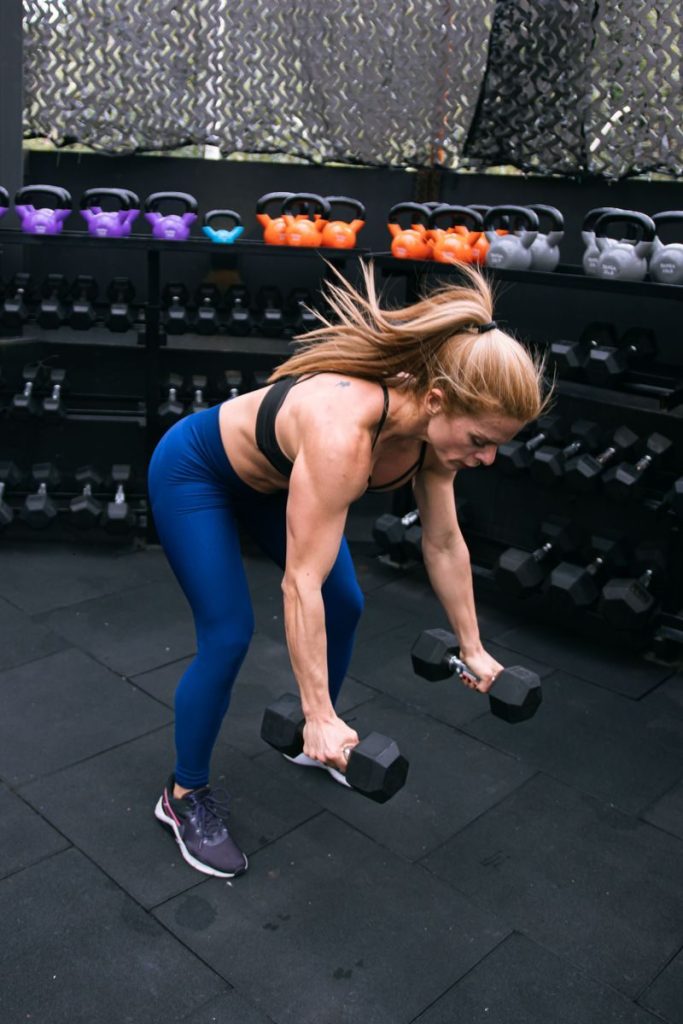
This guide explains proper dumbbell bent-over row form, the muscles worked, common mistakes, beginner modifications, programming, and safe ways to progress.
Dumbbell Bent-Over Row at a Glance
| Category | Recommendation |
|---|---|
| Exercise type | Compound horizontal pull |
| Main purpose | Build upper- and mid-back strength |
| Primary muscles | Latissimus dorsi, middle trapezius, rhomboids, and posterior deltoids |
| Assisting muscles | Teres major, biceps, brachialis, and brachioradialis |
| Stabilizing muscles | Spinal erectors, abdominal muscles, glutes, hamstrings, and forearms |
| Equipment | Two dumbbells |
| Experience level | Beginner to advanced |
| Typical working range | 2–4 sets of 8–15 repetitions |
| General rest | 90–150 seconds |
| Workout placement | Early or middle of an upper-body, pull, or back workout |
The unsupported bent-over position adds more trunk demand than a bench-supported dumbbell row. This can be useful when you can maintain a strong hip hinge, but a supported variation may be a better starting point if your lower back becomes the limiting factor.
Research available through PubMed comparing rowing variations found that the standing bent-over row created substantial back-muscle activity along with greater lumbar loading than the other rows tested. However, that small study did not examine the exact bilateral dumbbell variation described here.
What Is a Dumbbell Bent-Over Row?
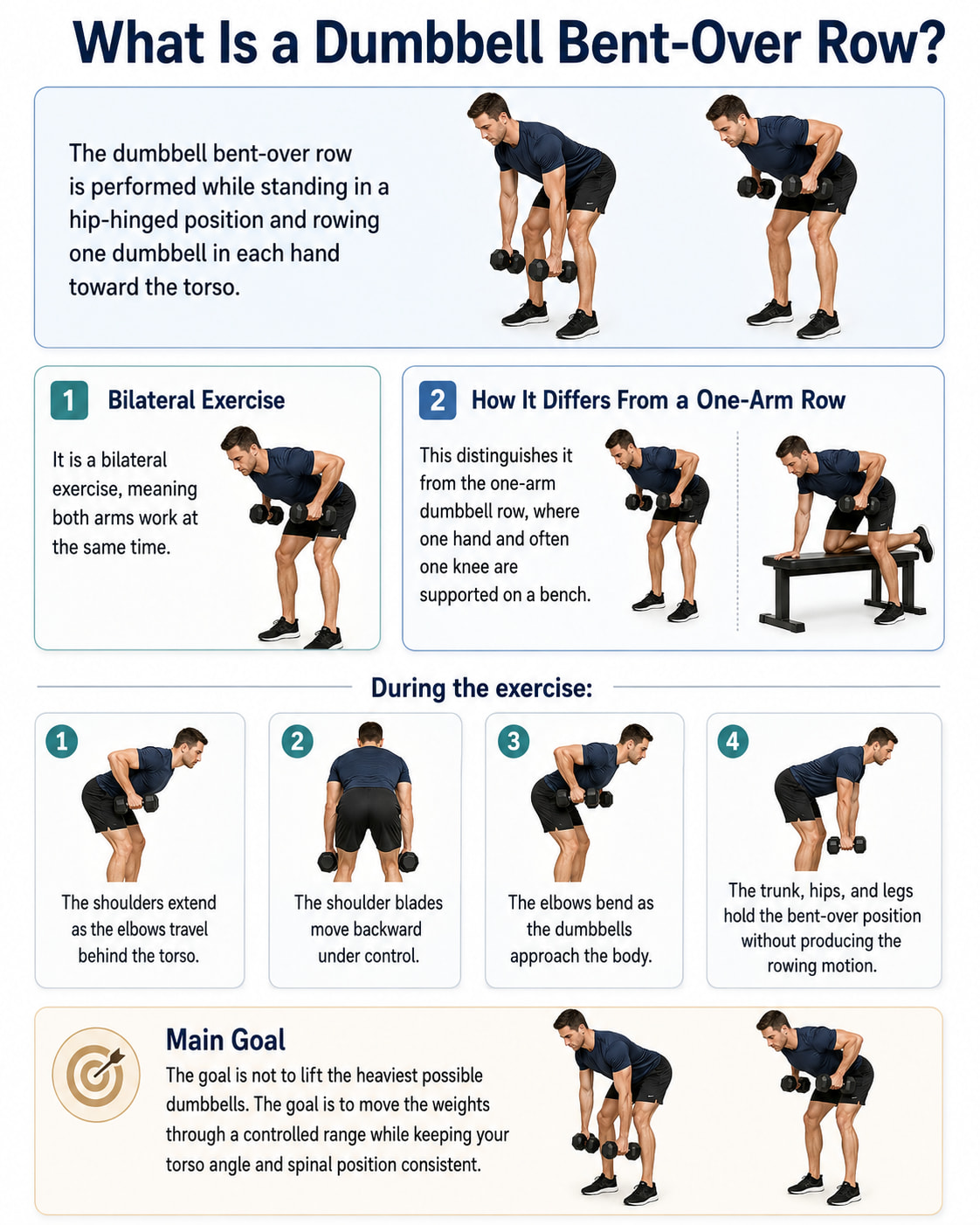
The dumbbell bent-over row is performed while standing in a hip-hinged position and rowing one dumbbell in each hand toward the torso.
It is a bilateral exercise, meaning both arms work at the same time. This distinguishes it from the one-arm dumbbell row, where one hand and often one knee are supported on a bench.
During the exercise:
- The shoulders extend as the elbows travel behind the torso.
- The shoulder blades move backward under control.
- The elbows bend as the dumbbells approach the body.
- The trunk, hips, and legs hold the bent-over position without producing the rowing motion.
The goal is not to lift the heaviest possible dumbbells. The goal is to move the weights through a controlled range while keeping your torso angle and spinal position consistent.
How to Do the Dumbbell Bent-Over Row
Sets, reps, and rest: Begin with 2–3 sets of 10–15 repetitions. Rest for 90–120 seconds and finish most sets with approximately 2–3 controlled repetitions remaining.
Step-by-Step Instructions
- Stand with your feet approximately hip- to shoulder-width apart.
- Hold one dumbbell in each hand with your palms facing your legs or slightly inward.
- Soften your knees without turning the setup into a squat.
- Push your hips backward and hinge forward while keeping your spine neutral.
- Brace your abdominal muscles and let the dumbbells hang below your shoulders.
- Keep your head aligned with your spine and look toward the floor slightly ahead of you.
- Pull your elbows backward and row the dumbbells toward the sides of your abdomen or lower ribs.
- Stop when your upper arms reach approximately torso level or slightly behind it without rotating, shrugging, or lifting your chest.
- Lower the dumbbells slowly until your arms are extended.
- Reset your brace and repeat without changing your torso angle.
The Mayo Clinic similarly emphasizes bending through the hips, maintaining a neutral spine, tightening the abdominal muscles, and using smooth, controlled movements.
Coaching cue: Keep your chest facing the floor while driving your elbows toward your back pockets.
Recommended Tempo
A controlled repetition may look like this:
- Pull for about one second.
- Pause briefly near the top.
- Lower for about two seconds.
The pause should not involve forcing the shoulders backward. It simply helps you confirm that momentum is not moving the dumbbells.
How Far Should You Bend Over?
There is no single torso angle that works perfectly for everyone.
Hinge forward far enough that:
- The dumbbells hang naturally below your shoulders.
- Your arms can move without the weights repeatedly hitting your thighs.
- Your spine remains neutral.
- Your weight stays balanced over your feet.
- You can hold the same torso angle throughout the set.
A more horizontal torso can make the position harder to stabilize. A more upright torso may reduce the rowing range and can make it easier to turn the exercise into a shrug.
Choose the deepest hinge you can hold without rounding your back, shifting onto your toes, or standing more upright during each repetition.
What Does “Keep Your Back Flat” Mean?
A flat back does not mean forcing your spine into an exaggerated arch.
It means maintaining a comfortable neutral position from your head through your pelvis. Your natural spinal curves can remain, but they should not noticeably change as you row.
Avoid lifting your head to look straight ahead. This can place your neck out of alignment with the rest of your spine. Keep your gaze on the floor a few feet in front of you instead.
Where Should You Pull the Dumbbells?
For a standard dumbbell bent-over row, pull the dumbbells toward the sides of your abdomen or lower ribs.
This path normally allows you to:
- Keep the wrists relatively straight.
- Lead with the elbows.
- Avoid excessive shoulder elevation.
- Use the lats and mid-back through a comfortable range.
Pulling toward the upper chest usually requires a wider elbow position. That variation can place more emphasis on the upper back and rear shoulders, but it should be performed intentionally rather than because the dumbbells are too heavy to control.
Do not try to pull the dumbbells as far behind your body as possible. Stop when continuing would require you to rotate your shoulders, lift your torso, or roll the fronts of your shoulders forward.
Dumbbell Bent-Over Row Muscles Worked
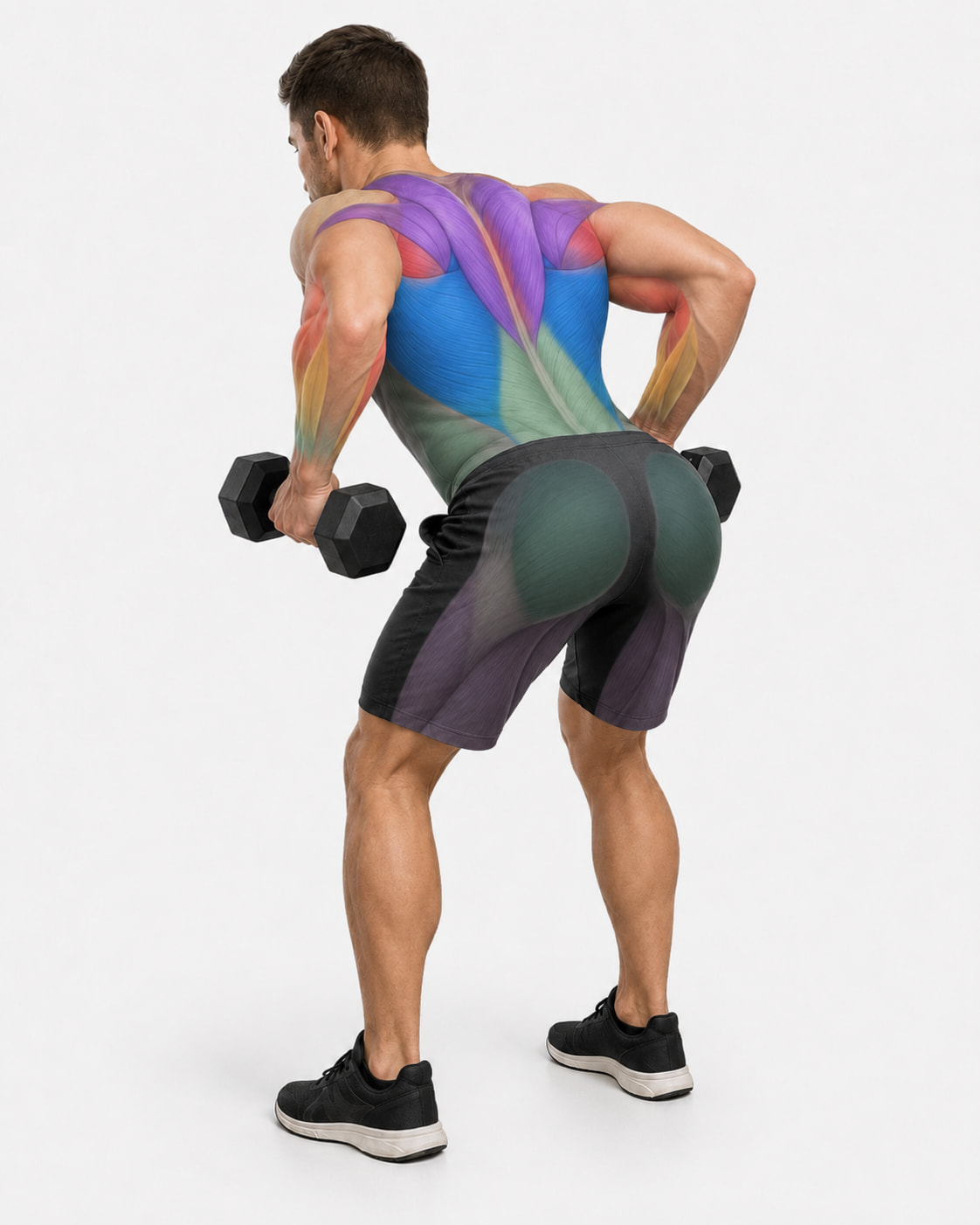
1. Latissimus Dorsi
The latissimus dorsi, commonly called the lats, are large muscles covering much of the middle and lower back.
During the row, they help extend the upper arms by pulling them backward toward the body. The NCBI Bookshelf identifies shoulder extension and adduction as important actions of the lats.
Keeping your elbows moderately close to your sides generally creates a comfortable path for using the lats, although no elbow position completely isolates them.
2. Rhomboids and Middle Trapezius
The rhomboids and middle fibers of the trapezius help control the shoulder blades as your elbows move backward.
These muscles contribute to scapular retraction, which means moving the shoulder blades toward the spine. The movement should remain smooth; you do not need to squeeze your shoulder blades together as forcefully as possible.
Scapular anatomy references also describe the trapezius and rhomboids as important contributors to shoulder-blade retraction.
3. Posterior Deltoids
The posterior deltoids are the rear portions of the shoulder muscles. They assist in moving the upper arms backward during the row.
A slightly wider elbow path may increase their contribution, but allowing the elbows to flare excessively can shorten the range or encourage shrugging.
4. Teres Major
The teres major assists the lats in moving the upper arm backward. It contributes to shoulder extension and works as part of the pulling movement rather than being isolated.
5. Biceps, Brachialis, and Brachioradialis
The biceps, brachialis, and brachioradialis bend the elbows as the dumbbells move toward your torso.
Your arms should assist the row, but they should not turn it into a curl. Think about moving your elbows backward instead of lifting your hands toward your shoulders.
6. Trunk and Hip Stabilizers
The spinal erectors, abdominal muscles, glutes, and hamstrings work to hold your body in the hip-hinged position.
These muscles mainly stabilize the exercise rather than moving the dumbbells. Your forearms and hand muscles also work to maintain your grip.
The Cleveland Clinic identifies the lats, trapezius, and rhomboids as major muscles trained during dumbbell rows.
Benefits of the Dumbbell Bent-Over Row
Builds Upper- and Mid-Back Strength
The exercise trains several back muscles together, making it a practical compound pulling movement for home and gym workouts.
Trains Both Arms Independently
Unlike a barbell, dumbbells allow each arm to hold and control its own load. This prevents one arm from directly helping the other move the weight.
The bilateral version does not automatically correct strength differences, but separate dumbbells can make uneven control easier to notice.
Requires Minimal Equipment
You only need two dumbbells and enough space to hinge forward safely. No cable machine, pull-up bar, or specialized row machine is required.
Develops Hip-Hinge Stability
Holding the bent-over position requires your trunk, hips, and legs to resist movement while your arms row.
This makes the exercise more demanding than chest-supported rows. However, it also means your lower back or hamstrings may fatigue before your upper back if your position or weight selection is unsuitable.
Complements Pressing Exercises
Rows provide a pulling pattern that can be programmed alongside push-ups, dumbbell chest presses, and overhead presses.
A balanced program should include both pushing and pulling movements rather than relying on one exercise to correct posture or prevent every shoulder problem.
Offers Flexible Loading
The dumbbell bent-over row can be performed with light weights for controlled higher-repetition sets or moderately heavy dumbbells for lower-repetition strength work.
Load should only increase when the lifter can keep the same torso position and rowing path from the first repetition to the last.
Common Dumbbell Bent-Over Row Mistakes
1. Rounding the Back
Rounding often occurs when you hinge farther than you can control, use too much weight, or continue after the trunk muscles are fatigued.
How to fix it: Reduce the weight, stand slightly more upright, brace before lifting, and end the set when you can no longer maintain a neutral spine.
2. Squatting Instead of Hinging
Bending the knees excessively lowers the body but does not create an effective hip hinge.
How to fix it: Keep a small bend in your knees, push your hips backward, and feel tension through your hamstrings without forcing a stretch.
3. Standing Up During Each Repetition
Raising the chest as you pull turns the row into a combination of a row and hip extension.
How to fix it: Choose lighter dumbbells and imagine keeping your chest pointed toward the same place on the floor throughout the set.
4. Jerking the Dumbbells
Using the hips, knees, or lower back to start the repetition reduces control and makes it difficult to judge whether the load is appropriate.
How to fix it: Pause briefly with your arms extended before beginning each pull.
5. Shrugging the Shoulders
Allowing the shoulders to rise toward the ears can make the exercise feel more like a shrug than a row.
How to fix it: Keep your neck relaxed and drive your elbows backward without deliberately lifting the shoulders.
6. Turning the Row Into a Curl
If your hands travel toward your shoulders while your elbows remain low, your elbow flexors may take over more of the movement.
How to fix it: Keep your wrists straight and focus on moving the elbows, not the dumbbells.
7. Pulling Too High
Pulling toward the neck or upper chest can encourage excessive elbow flaring and shoulder elevation.
How to fix it: For the standard variation, row toward the lower ribs or sides of the abdomen.
8. Pulling the Elbows Too Far Behind the Body
More range is not always better. Excessively pulling the elbows behind the torso may cause the shoulders to roll forward or the chest to lift.
How to fix it: Stop when your upper arms reach torso level or slightly behind it while your shoulders remain controlled.
9. Bending the Wrists
Curling the wrists to finish the repetition can increase forearm fatigue without improving the row.
How to fix it: Keep your knuckles, wrists, and forearms aligned throughout the movement.
10. Dropping the Dumbbells
Letting the weights fall quickly removes control from the lowering phase.
How to fix it: Take approximately two seconds to extend your arms and return to the starting position.
How to Choose the Right Dumbbell Weight
Start with a weight you can row for at least 10 controlled repetitions without:
- Changing your torso angle
- Rounding or overextending your back
- Swinging the weights
- Shrugging
- Bending your wrists
- Shortening the range
- Holding your breath uncontrollably
Your final repetitions should feel challenging, but they should still resemble your first repetitions.
A practical starting target is to finish each set with approximately two or three good repetitions still available. You do not need to train to complete muscular failure for the exercise to be productive.
The American College of Sports Medicine emphasizes individualizing load and volume while noting that momentary failure and complex training techniques are not consistently necessary for the average healthy adult.
A Simple Progression Method
Use a repetition range such as 8–12:
- Choose a weight you can row for 8 controlled repetitions.
- Keep the same weight until you can complete 12 repetitions on every set.
- Increase to the next manageable dumbbell size.
- Return to the lower part of the repetition range.
- Build the repetitions again while maintaining the same form.
Do not increase the weight merely because you reached the target repetitions once. First confirm that your torso remained stable and the dumbbells followed a consistent path.
Sets, Reps, Rest, and Frequency
| Training goal | Sets | Repetitions | Rest | Effort |
|---|---|---|---|---|
| Beginner technique | 2–3 | 10–15 | 90–120 seconds | Stop with 2–3 reps remaining |
| General muscle building | 3–4 | 8–15 | 90–150 seconds | Stop with 1–3 reps remaining |
| General strength | 3–4 | 6–10 | 2–3 minutes | Use only if the hinge stays stable |
| Light accessory work | 2–3 | 12–20 | 60–90 seconds | Use controlled, lighter loads |
Most people can train their back once or twice per week, depending on the rest of the program.
The same bent-over row does not need to be performed twice weekly. Your total back training can also include pulldowns, pull-ups, supported rows, machine rows, or other pulling exercises.
The ACSM recommends training all major muscle groups at least twice per week while tailoring volume and load to the person’s goals and ability.
How to Use the Dumbbell Bent-Over Row in a Workout
Place the row early in your workout when building back strength is a priority.
A typical order might be:
- General warm-up
- Main compound press or pull
- Dumbbell bent-over row
- Secondary upper-body exercises
- Smaller arm or shoulder exercises
You can also perform the row first after warming up when it is the main exercise you want to improve.
Combining Rows With Deadlifts
Deadlifts, Romanian deadlifts, and bent-over rows all require the trunk to support a hip-hinged position.
Performing several demanding hinge exercises in one session may cause your lower back or hamstrings to fatigue before your back receives enough rowing work.
Possible solutions include:
- Perform the most technically demanding lift first.
- Use moderate rather than maximal row loads.
- Reduce the number of bent-over row sets.
- Replace the bent-over row with a chest-supported variation.
- Place rows and deadlifts on different training days.
Beginner Regression: Bench-Supported One-Arm Row
The bench-supported one-arm dumbbell row is a useful alternative when you are still learning to hinge or cannot keep your torso stable during the two-arm version.
Equipment needed: One dumbbell and a stable bench.
How to Do It
- Place one hand and the same-side knee on the bench.
- Hold the dumbbell in the opposite hand.
- Brace your trunk and keep your hips and shoulders level.
- Row the dumbbell toward the side of your torso.
- Stop before your body rotates.
- Lower the weight under control.
- Complete the repetitions before changing sides.
The American Council on Exercise emphasizes bracing the torso, aligning the head with the spine, pulling the upper arm backward, and avoiding trunk rotation during the single-arm row.
Other lower-back-friendly options include:
- Chest-supported incline dumbbell row
- Chest-supported machine row
- Seated cable row
- Inverted row with an appropriate setup
Dumbbell Bent-Over Row Progressions
Use Heavier Dumbbells
Increase the load gradually after reaching the top of your repetition range with consistent form.
This is the most direct progression, but it is only effective when the added weight does not create momentum.
Add a Pause
Hold the top position for one second while keeping your torso still.
A pause makes it harder to bounce the dumbbells upward and can improve awareness of the finishing position.
Slow the Lowering Phase
Take three seconds to lower the dumbbells.
This increases the difficulty without requiring a heavier weight, although it may also reduce the number of repetitions you can complete.
Alternating Bent-Over Row
Hold the hip hinge while rowing one dumbbell at a time.
This variation adds an anti-rotation challenge because the load is uneven during each repetition. Start lighter than you would for the standard two-arm row.
Wider-Elbow Bent-Over Row
Use an overhand grip and allow your elbows to travel farther from your sides.
This changes the rowing path toward the rear shoulders and upper back. Use lighter weights and avoid shrugging.
Dumbbell Bent-Over Row vs. One-Arm Dumbbell Row
| Feature | Dumbbell bent-over row | One-arm dumbbell row |
|---|---|---|
| Arms working | Both simultaneously | One at a time |
| Support | Usually unsupported | Hand and often knee supported |
| Trunk demand | Higher | Generally lower |
| Time efficiency | Trains both sides together | Requires separate sets per side |
| Load control | Demands a stable bilateral hinge | Makes it easier to focus on one arm |
| Best for | Lifters who can maintain an unsupported hinge | Beginners or lifters wanting more torso support |
Neither variation is automatically better.
Choose the bilateral bent-over row when you want to train both arms efficiently and can hold the hinge without movement. Choose the supported one-arm version when you want more stability, greater focus on one side, or less fatigue from maintaining the bent-over position.
Sample Beginner Dumbbell Back Workout
Perform this workout once or twice per week with at least one recovery day between sessions.
| Exercise | Sets and reps | Rest |
|---|---|---|
| Dumbbell bent-over row | 3 × 8–12 | 90–120 seconds |
| Dumbbell pullover | 2 × 10–15 | 60–90 seconds |
| Chest-supported reverse fly | 2 × 12–15 | 60–90 seconds |
| Dumbbell hammer curl | 2 × 10–15 | 60–90 seconds |
| Suitcase carry | 2 × 20–40 seconds per side | 60 seconds |
Use an effort level that leaves approximately two controlled repetitions available at the end of each set.
When you reach the top of the repetition range on every set with consistent technique, add a small amount of weight or one repetition per set.
Dumbbell Bent-Over Row Safety Tips
- Use a clear exercise area where the dumbbells cannot strike surrounding equipment.
- Begin with lighter weights while learning the hip hinge.
- Keep your feet firmly planted and your weight balanced.
- Do not continue a set after your back begins rounding or your torso starts rising.
- Use a supported row when maintaining the hinge causes discomfort or excessive fatigue.
- Avoid forcing the dumbbells through a painful shoulder range.
- Do not use the exercise to diagnose or treat back, neck, or shoulder pain.
Some lower-back muscular effort can occur because the spinal erectors help hold the torso in position. However, sharp pain, pain that increases with each repetition, numbness, or symptoms traveling into an arm or leg are not normal training sensations.
Stop exercising and seek appropriate professional help if you experience sharp pain, numbness, dizziness, chest pain, or other unusual symptoms.
Frequently Asked Questions
Is the Dumbbell Bent-Over Row Good for Beginners?
Yes, provided the beginner can perform a controlled hip hinge and maintain a neutral spine.
A bench-supported one-arm row or chest-supported row may be easier when the unsupported position is difficult to hold.
How Far Should I Bend Forward?
Hinge as far as you can while keeping your spine neutral, feet balanced, and torso still.
You do not need to make your torso perfectly parallel to the floor. A slightly more upright position is acceptable when it allows better control.
Should My Elbows Stay Close to My Body?
For a standard row, keep your elbows moderately close to your sides and pull toward your lower ribs.
They do not need to touch your torso. A wider position changes the rowing path and generally requires lighter weights.
Why Do I Feel Dumbbell Rows in My Lower Back?
Your lower-back muscles help hold the bent-over position, so some muscular effort can be expected.
If the lower back consistently fails before the upper back, reduce the weight, adjust your hinge, shorten the set, or use a supported row. Stop if the exercise causes pain rather than ordinary muscular fatigue.
Why Do My Biceps Fatigue Before My Back?
The biceps assist every repetition by bending the elbows. They may dominate when the dumbbells are too heavy or when you focus on lifting with your hands.
Use a lighter load, keep your wrists neutral, and lead the movement with your elbows.
Should I Squeeze My Shoulder Blades Together?
Allow the shoulder blades to move backward naturally as you row, but do not force an extreme squeeze.
Pull until your elbows reach a controlled finishing position without shrugging, rotating, or rolling the shoulders forward.
How Many Dumbbell Bent-Over Rows Should I Do?
A practical starting point is 2–3 sets of 10–15 repetitions with 90–120 seconds of rest.
Adjust the range according to your experience, goals, available dumbbells, and the other pulling exercises in your program.
Conclusion
The dumbbell bent-over row is an effective back exercise when the torso remains stable and the dumbbells move under control. Build the exercise around a strong hip hinge, neutral spine, straight wrists, and an elbow-led pull toward the lower ribs.
Start with a manageable weight, stop the set when your position changes, and progress only after your first and final repetitions look consistent. Use a bench-supported or chest-supported row when torso stability limits your ability to train your back effectively.
This content is for informational and educational purposes only and is not intended as a substitute for professional medical advice, diagnosis, or treatment.
References
- American College of Sports Medicine: Updated Resistance Training Guidelines
- Mayo Clinic: Bent-Over Row With a Dumbbell
- American Council on Exercise: Single-Arm Row Exercise Guide
- PubMed: Comparison of Rowing Exercises, Muscle Activation, and Lumbar Loading
- NCBI Bookshelf: Anatomy of the Latissimus Dorsi
- NCBI Bookshelf: Anatomy of the Trapezius