The best dumbbell exercises for seniors are controlled, full-body movements that match the person’s current strength, balance, mobility, and training experience. A good routine should train the legs, hips, back, chest, shoulders, arms, grip, and trunk without requiring complicated equipment or exhausting workouts.
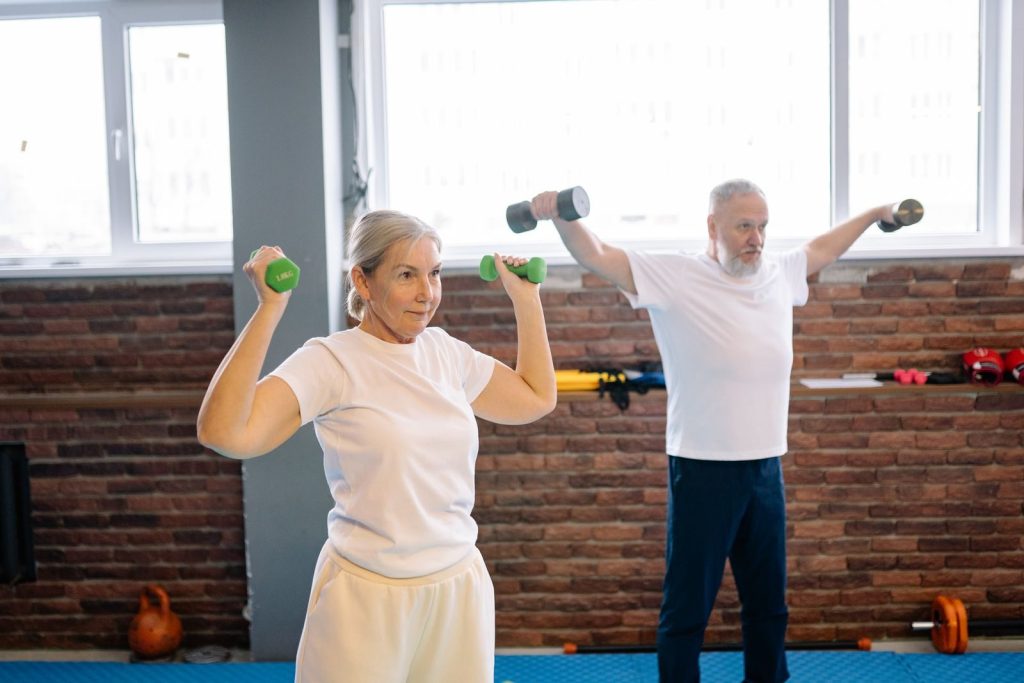
This guide explains how to perform 10 practical exercises, choose an appropriate dumbbell weight, modify each movement, and organize the exercises into a manageable full-body workout.
Adults aged 65 and older should generally include muscle-strengthening activity on at least two days each week, along with aerobic and balance activities. The CDC recommends training all major muscle groups rather than concentrating only on the arms.
Age alone does not determine which exercises or weights are appropriate. Some older adults may need a chair and very light dumbbells, while experienced lifters may be ready for heavier resistance and more challenging variations.
Dumbbell Exercises for Seniors at a Glance
| Exercise | Best for | Main muscles worked | Beginner starting option | |
|---|---|---|---|---|
| 1 | Dumbbell sit-to-stand | Standing and squat-pattern strength | Quadriceps, glutes, inner thighs | Bodyweight or one light dumbbell |
| 2 | Dumbbell Romanian deadlift | Hip-hinge and lifting strength | Glutes, hamstrings, back, grip | Shallow range with one dumbbell |
| 3 | Supported dumbbell step-up | Single-leg and stair-climbing strength | Quadriceps, glutes, calves | Low step with hand support |
| 4 | Chair-supported calf raise | Lower-leg and ankle strength | Calves | Bodyweight with two hands supported |
| 5 | One-arm supported dumbbell row | Back and pulling strength | Lats, upper back, biceps | High support and light dumbbell |
| 6 | Neutral-grip dumbbell chest press | Upper-body pushing strength | Chest, shoulders, triceps | Light weights on a stable bench |
| 7 | Seated neutral-grip overhead press | Shoulder and triceps strength | Deltoids, triceps | Back-supported chair and short range |
| 8 | Seated dumbbell hammer curl | Arm and grip-related strength | Biceps, brachialis, forearms | One arm at a time |
| 9 | Chair-supported triceps kickback | Direct triceps training | Triceps | Very light dumbbell |
| 10 | Farmer’s carry | Grip, trunk, and carrying strength | Forearms, shoulders, trunk, legs | Static farmer’s hold |
These exercises train the major muscle groups and can be adjusted for different strength, mobility, and balance levels. You do not need to perform all 10 in one workout; choose the movements that fit your current ability and training goals.
Before Starting Dumbbell Exercises for Seniors
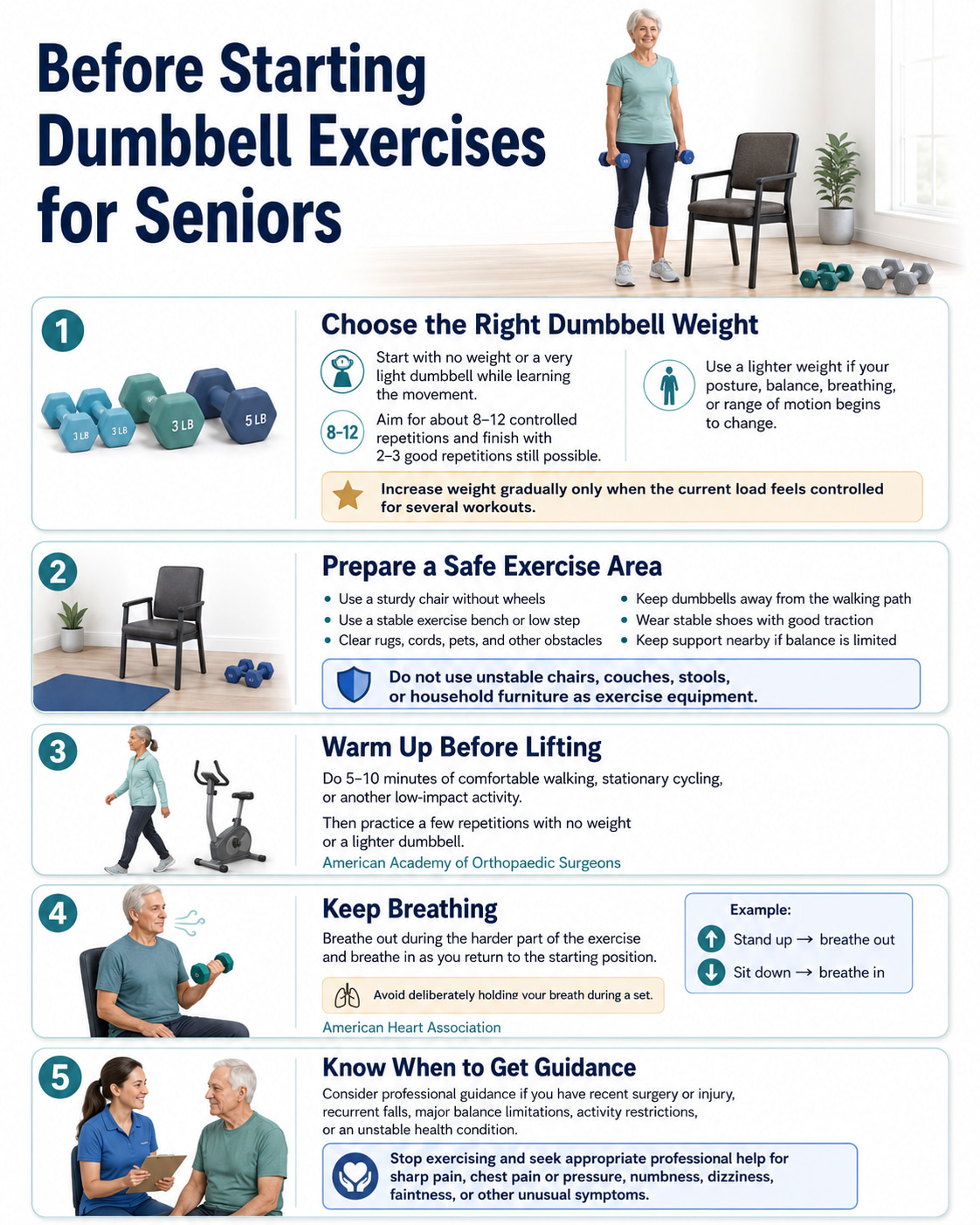
Choose the Right Dumbbell Weight
There is no single dumbbell weight that is right for every older adult. The appropriate resistance depends on the exercise, current strength, training experience, joint comfort, and ability to maintain good form.
A practical starting approach is to:
- Begin with no weight or a very light dumbbell while learning the movement.
- Choose a weight that allows about 8–12 controlled repetitions.
- Finish the set with roughly two or three good repetitions still possible.
- Reduce the weight if you need to swing, hold your breath, lose balance, or shorten the movement unintentionally.
- Increase the weight gradually once the top of the repetition range feels controlled for several workouts.
The final repetitions should feel challenging, but your technique should remain steady.
Set Up a Safe Training Area
Before exercising:
- Use a sturdy chair without wheels when support is needed.
- Use a stable exercise bench or low step for exercises that require one.
- Clear loose rugs, cords, and other obstacles from the training area.
- Keep dumbbells away from your walking path between sets.
- Wear stable footwear with good traction.
- Keep a wall, railing, countertop, or sturdy chair nearby if you need extra balance support.
Avoid using unstable furniture, folding chairs, soft couches, or lightweight stools as exercise equipment.
Warm Up Before Lifting
Start with about 5–10 minutes of comfortable walking, stationary cycling, or another low-impact activity. Then perform a few practice repetitions of the first exercises using no dumbbell or a lighter weight.
The American Academy of Orthopaedic Surgeons recommends warming up with 5–10 minutes of low-impact activity before strengthening exercise.
Keep Breathing During Each Repetition
Breathe normally throughout each set. A simple pattern is to breathe out during the harder part of the movement and breathe in as you return to the starting position.
For example, exhale while standing from a chair and inhale as you lower yourself back down.
The American Heart Association advises against holding your breath during exercise because it can raise blood pressure.
When to Get Individualized Guidance
Older adults with recent surgery or injury, recurrent falls, significant balance limitations, clinician-imposed activity restrictions, or unstable health conditions may need individualized guidance from a qualified health professional or physical therapist before starting or modifying resistance training.
Stop exercising and seek appropriate professional help if a movement causes sharp pain, chest pain or pressure, numbness, dizziness, faintness, or other unusual symptoms.
10 Best Dumbbell Exercises for Seniors
These 10 dumbbell exercises for seniors target the major muscle groups while keeping the movements simple, practical, and easy to modify. Choose the exercises that match your current strength and balance, and focus on controlled form before adding more weight.
1. Dumbbell Sit-to-Stand
Best for: Building leg strength for standing from a chair and practicing the squat movement.
Muscles worked: Quadriceps, gluteus maximus, inner-thigh muscles, calves, and trunk stabilizers.
Equipment needed: One dumbbell and a sturdy chair without wheels.
Sets, reps, and rest: Begin with 1–2 sets of 8–12 repetitions. Rest for 90–120 seconds.
How to Do It
- Sit near the front half of the chair with your feet approximately hip- to shoulder-width apart.
- Keep both feet flat and position your knees in line with your toes.
- Hold one dumbbell vertically against your chest. Start without weight when necessary.
- Lean your torso slightly forward from the hips while keeping your back comfortably neutral.
- Push through your whole foot and stand tall.
- Move your hips backward and lower yourself to the chair under control.
- Lightly touch the chair before beginning the next repetition.
Common mistakes: Avoid dropping quickly onto the chair, rocking several times to create momentum, allowing the knees to collapse inward, or standing by pushing only through the toes.
Regression: Perform the exercise without a dumbbell, use a higher chair, or use the hands lightly on the armrests.
Progression: Increase the dumbbell weight, use a slightly lower chair, or pause just above the seat before standing.
Coaching cue: Bring your chest slightly forward, then stand through the whole foot.
2. Dumbbell Romanian Deadlift
Best for: Developing the hip-hinge pattern used when lifting objects from a raised surface.
Muscles worked: Gluteus maximus, hamstrings, adductor magnus, spinal stabilizers, upper back, and grip muscles.
Equipment needed: One or two dumbbells.
Sets, reps, and rest: Perform 1–3 sets of 8–12 repetitions. Rest for 90–120 seconds.
How to Do It
- Stand with your feet approximately hip-width apart and hold the dumbbells in front of your thighs.
- Soften your knees without turning the exercise into a squat.
- Brace your trunk and push your hips backward.
- Allow the dumbbells to travel close to your thighs and shins.
- Lower only until you feel controlled tension through the backs of your thighs or before your back begins to round.
- Push through your feet and bring your hips forward to stand.
- Finish upright without leaning backward.
The dumbbells do not need to reach the floor. The correct depth is the lowest position you can control while maintaining a stable spine and balance.
Common mistakes: Avoid squatting the dumbbells downward, rounding the back, reaching the weights away from the legs, locking the knees, or lowering farther than your mobility allows.
Regression: Practice pushing the hips toward a wall, use one light dumbbell, or shorten the range.
Progression: Increase the weight gradually or take approximately three seconds to lower the dumbbells.
Coaching cue: Push your hips back as though closing a car door behind you.
3. Supported Dumbbell Step-Up
Best for: Developing single-leg strength for stairs, curbs, and changes in elevation.
Muscles worked: Quadriceps, gluteus maximus, gluteus medius, inner-thigh muscles, calves, and trunk stabilizers.
Equipment needed: One dumbbell, a low stable exercise step, and a railing or other secure support.
Sets, reps, and rest: Perform 1–3 sets of 6–10 repetitions per leg. Rest for 90–120 seconds.
How to Do It
- Stand close to a low, stable step.
- Hold a secure railing or support with one hand and a dumbbell in the free hand.
- Place the whole foot of the working leg on the step.
- Lean forward slightly and push through the foot on the step.
- Rise until you are standing securely on top.
- Step down slowly and place the trailing foot on the floor.
- Complete the repetitions on one side before changing legs, or alternate sides when balance allows.
Choose a step height that lets you maintain control. A lower step is usually better while learning.
Common mistakes: Avoid placing only the toes on the step, pushing excessively from the trailing leg, allowing the knee to fall inward, using a step that is too high, or dropping quickly to the floor.
Regression: Use no dumbbell, choose a lower step, or practice placing one foot on the step and returning it to the floor without standing fully.
Progression: Increase the dumbbell weight before significantly increasing the step height.
Safety note: Never perform this exercise on a chair, stool, or unstable household step.
4. Chair-Supported Dumbbell Calf Raise
Best for: Building lower-leg and ankle strength.
Muscles worked: Gastrocnemius, soleus, and smaller foot and ankle stabilizers.
Equipment needed: One or two dumbbells and a sturdy chair or countertop.
Sets, reps, and rest: Perform 1–3 sets of 10–15 repetitions. Rest for 60–90 seconds.
How to Do It
- Stand behind a sturdy chair with your feet approximately hip-width apart.
- Hold the chair lightly with one hand and a dumbbell in the other.
- Keep your weight evenly distributed across both feet.
- Rise onto the balls of your feet without rolling the ankles outward.
- Pause briefly at the top.
- Lower your heels slowly until they contact the floor.
Use the support for balance rather than pulling your body upward with your arm.
Common mistakes: Avoid bouncing, leaning heavily on the chair, rolling onto the outside edges of the feet, or rushing the lowering phase.
Regression: Use no dumbbell and hold the support with both hands.
Progression: Hold a dumbbell in each hand or perform alternating single-leg repetitions while remaining close to secure support.
Coaching cue: Rise straight upward rather than allowing the ankles to drift outward.
5. One-Arm Supported Dumbbell Row
Best for: Strengthening the back and practicing a controlled pulling movement.
Muscles worked: Latissimus dorsi, rhomboids, middle and lower trapezius, posterior deltoids, biceps, and forearms.
Equipment needed: One dumbbell and a stable bench, chair, or countertop for support.
Sets, reps, and rest: Perform 1–3 sets of 8–12 repetitions per arm. Rest for 60–90 seconds.
How to Do It
- Place one hand on a stable support and step the opposite foot slightly backward.
- Push your hips back and keep your spine comfortably long.
- Hold the dumbbell beneath your shoulder with your palm facing inward.
- Pull your elbow toward your hip or lower ribs.
- Pause briefly without twisting your torso.
- Lower the dumbbell under control until your arm is straight.
- Complete the set before changing sides.
Allow the shoulder blade to move naturally as the arm lowers, but do not let the shoulder collapse toward the floor.
Common mistakes: Avoid jerking the dumbbell, shrugging toward the ear, rotating the torso, pulling the elbow excessively high, or rounding the back.
Regression: Use a lighter dumbbell and a higher support so the torso remains more upright.
Progression: Increase the weight or pause for one to two seconds at the top of each repetition.
Coaching cue: Pull your elbow toward your back pocket.
6. Neutral-Grip Dumbbell Chest Press
Best for: Building chest, shoulder, and triceps strength with a shoulder-friendly hand position.
Muscles worked: Pectoralis major, anterior deltoids, triceps, and shoulder stabilizers.
Equipment needed: Two dumbbells and a stable exercise bench.
Sets, reps, and rest: Perform 1–3 sets of 8–12 repetitions. Rest for 90–120 seconds.
How to Do It
- Sit on the end of the bench with one dumbbell resting on each thigh.
- Carefully lie back and bring the dumbbells beside your chest.
- Keep your head, upper back, and hips supported, with your feet firmly planted.
- Turn your palms toward each other and keep your wrists above your forearms.
- Position your elbows approximately 30–60 degrees from your torso.
- Press the dumbbells upward until they are above your shoulders.
- Lower them slowly to a comfortable depth before repeating.
Do not lower the elbows far below the torso simply to create a larger stretch.
Common mistakes: Avoid flaring the elbows directly outward, bending the wrists backward, bouncing at the bottom, lifting the hips, or allowing the shoulders to shrug.
Regression: Use lighter dumbbells or perform a dumbbell floor press only when getting down to and up from the floor is safe and comfortable.
Progression: Increase the load gradually or pause briefly at the bottom without relaxing.
Safety note: Use a spotter or lighter load if getting the dumbbells into position is difficult. A soft bed or couch is not a suitable pressing surface.
7. Seated Neutral-Grip Dumbbell Overhead Press
Best for: Building shoulder and triceps strength from a stable seated position.
Muscles worked: Anterior and lateral deltoids, triceps, upper trapezius, serratus anterior, rotator cuff, and trunk stabilizers.
Equipment needed: Two dumbbells and a sturdy back-supported chair without wheels.
Sets, reps, and rest: Perform 1–3 sets of 8–12 repetitions. Rest for 60–120 seconds.
How to Do It
- Sit with your back supported and both feet flat on the floor.
- Hold the dumbbells at shoulder height with your palms facing each other or slightly forward.
- Keep your wrists straight and elbows slightly forward of your torso.
- Brace your trunk without forcing your lower back flat.
- Press the dumbbells upward while keeping your ribs controlled.
- Stop at a comfortable overhead position.
- Lower the dumbbells slowly to shoulder height.
A complete repetition does not require forcing the arms into a position that causes pinching or discomfort.
Common mistakes: Avoid leaning backward, flaring the ribs, pressing the weights behind the head, bending the wrists, or using leg drive.
Regression: Use lighter dumbbells, reduce the range, or perform one controlled repetition at a time with longer rest between repetitions.
Progression: Increase the weight or move to a standing press when balance and trunk control are sufficient.
Coaching cue: Press upward while keeping your ribs stacked over your hips.
8. Seated Dumbbell Hammer Curl
Best for: Strengthening the arms and forearms without requiring a palms-up grip.
Muscles worked: Biceps brachii, brachialis, brachioradialis, and forearm muscles.
Equipment needed: Two dumbbells and a sturdy chair.
Sets, reps, and rest: Perform 1–2 sets of 10–15 repetitions. Rest for 60–90 seconds.
How to Do It
- Sit tall with both feet flat on the floor.
- Hold one dumbbell in each hand with your palms facing your thighs.
- Keep your elbows close to your sides.
- Curl the dumbbells upward without moving your upper arms forward.
- Stop before the shoulders begin to roll or shrug.
- Lower the dumbbells slowly until the elbows are straight but not forcefully locked.
Common mistakes: Avoid swinging the torso, lifting the elbows forward, bending the wrists, squeezing the dumbbells excessively, or dropping the weights quickly.
Regression: Use one arm at a time or reduce the weight.
Progression: Increase the load gradually or perform the curl while standing once balance is reliable.
Coaching cue: Move only your forearms; keep your upper arms quiet.
9. Chair-Supported Dumbbell Triceps Kickback
Best for: Directly training the muscles that straighten the elbow.
Muscles worked: Triceps, posterior shoulder stabilizers, upper back, and trunk stabilizers.
Equipment needed: One light dumbbell and a sturdy chair, bench, or countertop.
Sets, reps, and rest: Perform 1–2 sets of 10–15 repetitions per arm. Rest for 60–90 seconds.
How to Do It
- Place one hand on a stable support and step the opposite foot slightly backward.
- Hinge forward while keeping your back comfortably neutral.
- Hold the dumbbell with your palm facing inward.
- Pull your upper arm close to your torso and bend the elbow to approximately 90 degrees.
- Straighten the elbow until the arm is roughly in line with the torso.
- Pause briefly, then bend the elbow under control.
- Keep the upper arm still throughout the set.
The triceps kickback has a long lever and usually requires a much lighter dumbbell than a row or chest press.
Common mistakes: Avoid swinging the entire arm, allowing the elbow to drop, lifting the hand above the torso, rounding the back, or choosing a weight that prevents full elbow control.
Regression: Use a lighter dumbbell or reduce the range.
Progression: Slow the lowering phase or increase the load by the smallest available amount.
Coaching cue: Pin your elbow beside your ribs and move only the forearm.
10. Farmer’s Carry
Best for: Building grip strength, trunk stability, and controlled carrying ability.
Muscles worked: Forearms, hands, trapezius, shoulders, trunk stabilizers, glutes, quadriceps, hamstrings, and calves.
Equipment needed: Two dumbbells and a clear, level walking area.
Sets, time, and rest: Perform 2–3 carries of 20–40 seconds. Rest for 60–90 seconds.
How to Do It
- Place the dumbbells on a secure raised surface when picking them up from the floor is uncomfortable.
- Hold one dumbbell at each side with your wrists neutral.
- Stand tall with your ribs over your pelvis and your eyes facing forward.
- Keep your shoulders controlled rather than aggressively pulling them backward.
- Walk with short, steady steps.
- Turn slowly without crossing your feet.
- Return the dumbbells to the raised surface under control.
End the set before your grip begins to fail or your posture changes noticeably.
Common mistakes: Avoid leaning to one side, shrugging continuously, rushing turns, holding your breath, walking through clutter, or carrying the weights until they must be dropped.
Regression: Stand in place and perform a farmer’s hold for 10–30 seconds.
Progression: Increase the duration first, then increase the weight by a small amount.
Coaching cue: Walk tall and quiet, as though balancing a glass of water on your head.
Beginner Dumbbell Workout for Seniors
A beginner does not need to perform all 10 exercises in one session. Start with six or seven movements that cover the major muscle groups.
Perform the following routine on two nonconsecutive days each week:
| Order | Exercise | Sets and repetitions | Rest |
|---|---|---|---|
| 1 | Dumbbell sit-to-stand | 1–2 sets of 8–12 | 90–120 seconds |
| 2 | Dumbbell Romanian deadlift | 1–2 sets of 8–12 | 90–120 seconds |
| 3 | One-arm supported dumbbell row | 1–2 sets of 8–12 per side | 60–90 seconds |
| 4 | Neutral-grip dumbbell chest press | 1–2 sets of 8–12 | 90–120 seconds |
| 5 | Seated neutral-grip overhead press | 1 set of 8–12 | 60–90 seconds |
| 6 | Chair-supported calf raise | 1–2 sets of 10–15 | 60–90 seconds |
| 7 | Farmer’s carry or hold | 2 sets of 20–30 seconds | 60–90 seconds |
The supported step-up can replace the sit-to-stand during one weekly session once balance and technique are reliable.
The hammer curl and triceps kickback are optional accessories. Add one at the end of each workout for 1–2 sets of 10–15 repetitions rather than extending every session with both.
Beginner Programming Guidelines
Frequency: Two nonconsecutive full-body sessions per week.
Starting volume: One set per exercise may be enough during the learning stage. Add a second set after recovery and technique remain consistent.
Effort: Finish most sets with approximately two or three controlled repetitions still available.
Rest: Rest until your breathing is controlled and you feel stable. Larger leg and pressing exercises generally need more rest than curls or kickbacks.
Exercise order: Perform sit-to-stands, deadlifts, step-ups, rows, and presses before smaller arm exercises.
Recovery: Avoid hard training for the same muscles on consecutive days.
How to Progress Safely
The goal is to make the exercises gradually more challenging without sacrificing form or recovery.
The American College of Sports Medicine emphasizes that consistency and individualized progression matter more than complicated training systems. Training to complete muscular failure and using advanced periodization are not necessary for most healthy adults.
Use this progression order:
1. Improve the Movement
First, develop a controlled range of motion, steady balance, regular breathing, and consistent posture.
2. Add Repetitions
Build from the lower end of the range toward the upper end. For example, progress from 8 repetitions to 12 before increasing the weight.
3. Add a Set
Once one set feels manageable and recovery is good, add a second set to the larger exercises.
4. Increase the Dumbbell Weight
When you can complete the top of the repetition range for at least two workouts with good form and two or three repetitions still available, use the smallest practical weight increase.
Return to the lower end of the repetition range after increasing the load.
5. Increase Complexity Only When Needed
A heavier dumbbell is not the only progression. You can also use a slightly larger range, add a controlled pause, slow the lowering phase, or reduce hand support.
Change only one training variable at a time.
Common Dumbbell Training Mistakes to Avoid
Using the Same Weight for Every Exercise
The legs and hips can usually handle more resistance than the shoulders or triceps. Choose the weight separately for each movement.
Beginning With All 10 Exercises
More exercises can create unnecessary soreness and fatigue. Start with a short full-body routine and add movements only when they serve a clear purpose.
Moving Too Quickly
Fast repetitions make it harder to maintain balance and control. Lift smoothly and lower each dumbbell deliberately.
Holding the Breath
Breath-holding can increase pressure and make the set feel more stressful. Exhale during the effort and inhale during the easier phase.
Using Unstable Furniture
A chair with wheels, soft bed, folding stool, or lightweight table can shift unexpectedly. Use purpose-built or firmly secured equipment.
Forcing a Larger Range of Motion
More depth is not automatically better. Use the largest range you can control without sharp pain, loss of balance, or major changes in posture.
Training Until Technique Fails
The set should finish before repetitions become unstable or uncontrolled. Muscular effort is expected; sharp pain, dizziness, numbness, or chest symptoms are not.
Never Increasing the Challenge
Very light exercise may become insufficient after strength improves. Add repetitions, sets, range, or weight gradually when the current version is consistently easy.
Frequently Asked Questions
How Heavy Should Dumbbells Be for Seniors?
There is no standard weight based only on age or gender. Choose a weight that allows approximately 8–12 controlled repetitions while leaving two or three good repetitions available.
Use a lighter dumbbell when balance changes, the weight must be swung, the breath is held, or the intended range cannot be controlled.
How Often Should Seniors Perform Dumbbell Exercises?
Two nonconsecutive full-body sessions per week are a practical starting point. This schedule allows the major muscle groups to be trained regularly while providing recovery between sessions.
More experienced older adults may train more frequently by adjusting their exercise selection and weekly volume.
Can Seniors Lift Dumbbells Every Day?
Hard training for the same muscles every day is generally unnecessary. The National Institute on Aging advises avoiding strength training for the same muscle groups on consecutive days.
Light movement, walking, balance practice, and mobility work may still be performed between lifting sessions when appropriate.
Are Seated Dumbbell Exercises Safer Than Standing Exercises?
Not automatically. Sitting can reduce balance demands, which may help with curls and overhead presses, but the chair must still be stable and the lifter must control the weights.
Standing exercises can provide useful practice for balance, weight-bearing, and daily movement. Use hand support when needed rather than avoiding every standing exercise.
How Many Dumbbell Exercises Should Seniors Do in One Workout?
Approximately five to seven well-chosen exercises are enough for many beginners. Include at least one lower-body movement, one hip-hinge movement, one pull, one press, and one grip or carrying exercise.
The remaining movements can be rotated between sessions.
Can People in Their 70s or 80s Still Build Strength?
Many people can improve strength at these ages when resistance, range of motion, training volume, and progression are matched to their abilities.
Chronological age matters less than current function, health status, training experience, and the ability to recover from the workout.
Can Seniors With Arthritis or Osteoporosis Use Dumbbells?
Resistance training may be appropriate for many people with these conditions, but exercise selection, loading, and range of motion may need to be individualized.
Anyone with a fracture history, joint replacement, significant pain, movement restrictions, or condition-specific instructions should ask a qualified health professional or physical therapist which exercises are appropriate.
Conclusion
Dumbbell exercises for seniors should train the whole body while remaining adaptable to different strength and balance levels. Begin with five to seven exercises, one controlled set per movement, and two nonconsecutive workouts each week.
Prioritize stable setup, regular breathing, and consistent form before adding more repetitions or weight. A lighter exercise performed well is more useful than a heavier exercise that causes swinging, instability, or discomfort.
References
- National Strength and Conditioning Association — Resistance Training for Older Adults: Position Statement
https://www.nsca.com/about-us/position-statements/resistance-training-for-older-adults/ - National Institute on Aging — Three Types of Exercise Can Improve Your Health and Physical Ability
https://www.nia.nih.gov/health/exercise-and-physical-activity/three-types-exercise-can-improve-your-health-and-physical - Centers for Disease Control and Prevention — Older Adult Activity: An Overview
https://www.cdc.gov/physical-activity-basics/guidelines/older-adults.html - American College of Sports Medicine — 2026 Resistance Training Guidelines
https://acsm.org/resistance-training-guidelines-update-2026/ - Radaelli R, et al. — Resistance Training Volume in Healthy Older Adults: Systematic Review and Network Meta-analysis
https://pubmed.ncbi.nlm.nih.gov/39405023/ - World Health Organization — Guidelines on Physical Activity and Sedentary Behaviour
https://www.who.int/publications/i/item/9789240015128
This content is for informational purposes only and is not a substitute for medical advice.