Dumbbell calf raises strengthen the gastrocnemius and soleus by loading the ankle movement that lifts your heels from the floor. They require little equipment, work in home and commercial gyms, and can be progressed by adding weight, range of motion, pauses, or single-leg work.
This guide explains how to perform dumbbell calf raises with proper form, which muscles they work, how many sets and reps to use, and how to avoid common mistakes.
What Are Dumbbell Calf Raises?
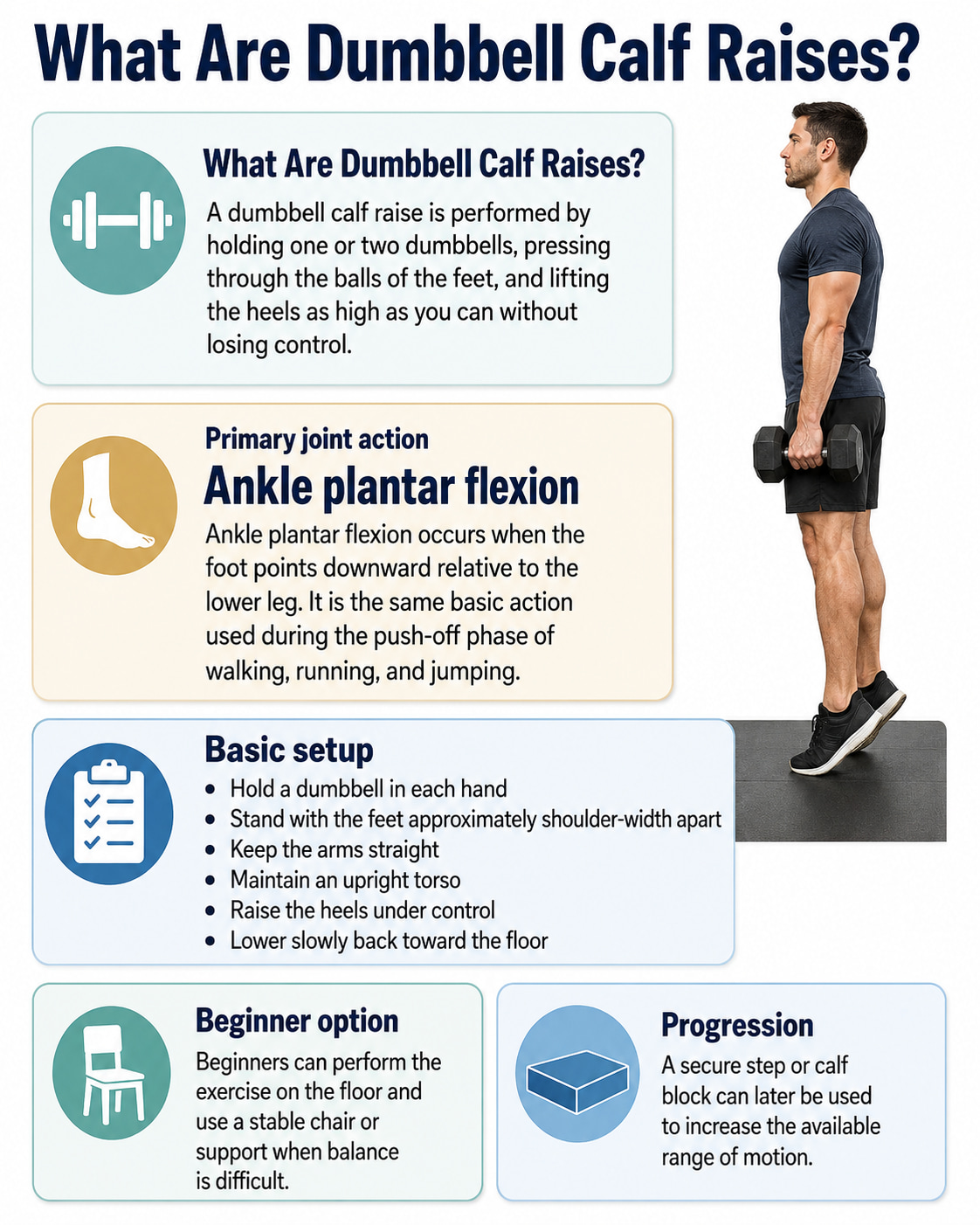
A dumbbell calf raise is performed by holding one or two dumbbells, pressing through the balls of the feet, and lifting the heels as high as you can without losing control.
The primary joint action is ankle plantar flexion, which occurs when the foot points downward relative to the lower leg. It is the same basic action used during the push-off phase of walking, running, and jumping.
The Mayo Clinic dumbbell calf-raise demonstration shows the exercise with a dumbbell in each hand, the feet approximately shoulder-width apart, straight arms, an upright torso, and a slow return to the floor. Mayo Clinic also recommends using a chair or stable support when balance is difficult.
Beginners can perform the exercise on the floor. A secure step or calf block can later be used to increase the available range of motion.
Dumbbell Calf Raises at a Glance
| Category | Recommendation |
|---|---|
| Exercise type | Weighted ankle plantar flexion |
| Best for | Calf strength and muscle development |
| Primary muscles | Gastrocnemius and soleus |
| Equipment | One or two dumbbells |
| Difficulty | Beginner to intermediate |
| Starting sets | 2–3 |
| Practical rep range | 10–15 |
| Rest between sets | 60–90 seconds |
| Suggested effort | Finish with 2–3 good repetitions available |
| Typical frequency | 2 times per week |
| Best placement | Near the end of a lower-body workout |
How to Do Dumbbell Calf Raises With Proper Form
Best for: Building calf strength and muscle with minimal equipment.
Muscles worked: Gastrocnemius, soleus, and smaller muscles that help control the foot and ankle.
Equipment needed: One or two dumbbells. A wall, rack, or sturdy chair can provide balance support.
Sets, reps, and rest: Start with 2–3 sets of 10–15 controlled repetitions. Rest for 60–90 seconds between sets.
Step-by-Step Instructions
- Stand upright with your feet approximately hip- to shoulder-width apart and your toes facing generally forward.
- Hold one dumbbell in each hand with your arms hanging naturally at your sides. Keep your wrists straight and shoulders relaxed.
- Place your weight evenly across the balls of both feet. Keep your heels on the floor at the start.
- Brace your core and keep your chest, pelvis, and head stacked over your feet. Keep your knees extended without aggressively pushing them backward.
- Press through your forefeet and raise both heels. Imagine lifting your body straight upward rather than rocking forward.
- Continue until you reach the highest position you can control. Pause briefly and contract your calves.
- Lower your heels slowly until they return to the floor. Begin the next repetition without bouncing.
Coaching cue: Rise straight up, pause, and lower without bouncing.
Breathing
Exhale as you raise your heels and inhale as you lower them. Avoid holding your breath through the entire repetition.
Dumbbell Calf Raises Muscles Worked
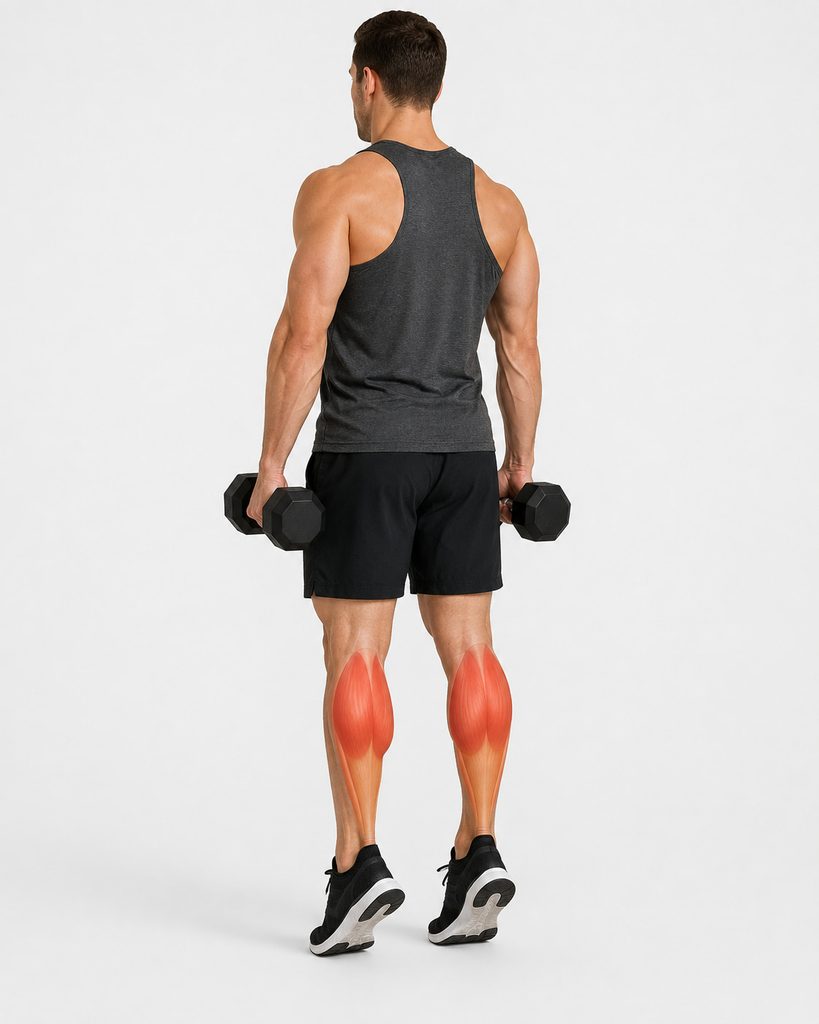
Gastrocnemius
The gastrocnemius is the large, visible muscle near the surface of the back of the lower leg. It has medial and lateral heads and crosses both the knee and ankle.
Its primary role during a calf raise is plantar flexion, although it can also assist with knee flexion. Keeping the knee extended places the gastrocnemius in a longer position than performing the movement with a deeply bent knee.
Soleus
The soleus sits underneath the gastrocnemius. It crosses the ankle but not the knee, allowing it to contribute to plantar flexion whether the knee is straight or bent.
The soleus remains active during standing dumbbell calf raises. Bending the knee, as in a seated calf raise, reduces the gastrocnemius contribution and places greater relative emphasis on the soleus.
Together, the gastrocnemius and soleus form the main calf complex and connect to the heel through the Achilles tendon. According to the NCBI Bookshelf review of gastrocnemius anatomy, these muscles produce plantar flexion and contribute to ankle control, posture, gait, and propulsion.
Supporting Muscles
The smaller muscles surrounding the foot and ankle help control the position of the heel and forefoot. Your abdominal, back, and hip muscles also work to keep your body upright, while your hands and forearms hold the dumbbells.
These muscles provide support, but the gastrocnemius and soleus should remain the main limiting muscles. When grip or balance fails before the calves become challenged, use lighter dumbbells or hold a stable support with one hand.
Benefits of Dumbbell Calf Raises
Build Calf Strength With Minimal Equipment
You only need one or two dumbbells and enough space to stand. This makes the exercise practical for home workouts and gyms without a dedicated calf-raise machine.
Allow Gradual Progressive Overload
Bodyweight calf raises may eventually become too easy. Dumbbells let you increase the resistance in small amounts as your strength improves.
Train the Gastrocnemius and Soleus Together
The standing position trains both major calf muscles. The extended-knee position is particularly useful when developing the gastrocnemius is a priority.
Strengthen an Important Push-Off Movement
The calf complex produces the ankle action used when the heel leaves the ground. Strengthening this movement can support the lower-leg capacity needed for walking, running, jumping, and many sports, although calf raises alone do not guarantee improved performance.
Offer Several Useful Progressions
You can perform the exercise with two legs, one leg, on the floor, from a step, or with balance support. These options make it easier to match the exercise to your current ability.
Common Dumbbell Calf Raise Mistakes
Bouncing Through the Repetitions
Dropping quickly and springing immediately into the next repetition allows momentum and elastic rebound to take over.
Pause briefly at the bottom, lift deliberately, and control the descent. You should feel each repetition rather than rapidly bobbing up and down.
Using Dumbbells That Are Too Heavy
Excessive weight often causes shortened repetitions, bent knees, torso rocking, or loss of balance. Reduce the load until you can reach a consistent top position and lower under control.
Cutting the Range of Motion Short
Some lifters barely lift their heels or stop lowering before reaching the starting position.
Raise the heels as high as your ankle structure allows without rolling onto the outside edges of your feet. Lower until your heels reach the floor or until you feel a comfortable calf stretch when using a step.
Repeatedly Bending the Knees
A small, natural amount of knee softness is acceptable, but repeatedly bending and straightening the knees turns the movement into a partial squat.
Keep the knees quiet so the calves produce most of the movement.
Letting the Ankles Roll Outward
Do not allow your weight to shift sharply toward the little-toe side of the foot. Keep pressure distributed across the forefoot and aim to move the heels mostly straight up and down.
Your exact heel path will depend on your anatomy, so do not force the feet into an unnatural position.
Leaning Forward or Backward
Rocking the torso creates momentum and makes balance more difficult. Keep your ribs, pelvis, and head stacked vertically.
Refusing to Use Balance Support
Balance support does not make calf raises ineffective. Lightly holding a wall, rack, or sturdy chair may help you use more resistance and better ankle movement without wobbling.
The AAOS foot and ankle conditioning program uses a wall or chair for support and progresses from two-legged to one-legged calf raises as control improves.
Should You Do Dumbbell Calf Raises on the Floor or a Step?
Both options can be effective.
Floor Dumbbell Calf Raise
The floor version is usually the best starting point because it provides a stable surface and prevents the heels from dropping too far.
Choose the floor version when:
- You are learning the exercise
- Your balance is limited
- You are returning after a training break
- A secure step is unavailable
- Lowering below the forefoot feels uncomfortable
Dumbbell Calf Raise From a Step
A step allows your heels to descend below the level of your forefeet, increasing the available range of motion.
Choose the step version when:
- You can perform floor repetitions with good control
- The step is wide, secure, and nonslip
- You have a stable support nearby
- You can lower into a comfortable stretch without pain
- You can avoid bouncing out of the bottom position
Research suggests that calf training performed with the gastrocnemius in a more lengthened position may support greater growth than training only in the shortened upper portion of the movement. However, this does not mean you should force the heels as low as possible. Use only the range you can control comfortably.
Keep enough of the forefoot on the step to remain secure. Avoid balancing only on the ends of your toes.
Are Standing or Seated Calf Raises Better?
Standing and seated calf raises change the position of the knee.
A standing calf raise keeps the knee extended, placing the gastrocnemius in a longer position. A seated calf raise bends the knee, shortening the gastrocnemius and increasing the relative contribution of the soleus.
In a 12-week study, 14 untrained adults trained one leg with standing calf raises and the other with seated calf raises. Standing training produced greater growth in both heads of the gastrocnemius and the total calf complex, while soleus growth was similar between positions.
This suggests that standing calf raises are the stronger single choice when gastrocnemius development is the main goal. However, the study was small and used calf-raise machines rather than handheld dumbbells. Seated dumbbell calf raises can still be useful for adding bent-knee calf work.
For balanced calf training, use standing raises as the main exercise and seated raises as an optional accessory.
Dumbbell Calf Raise Sets, Reps, Rest, and Frequency
The best starting volume depends on your experience and how much other lower-leg work you perform.
| Training level or goal | Sets | Reps | Rest | Suggested effort |
|---|---|---|---|---|
| Beginner | 2 | 10–15 | 60–90 seconds | Keep 3–4 reps available |
| General strength and muscle | 3–4 | 8–15 | 60–120 seconds | Keep 1–3 reps available |
| Seated accessory work | 2–3 | 15–20 | 45–90 seconds | Keep 1–3 reps available |
Frequency
Train your calves approximately two times per week to start. Leave enough recovery time between sessions for soreness and fatigue to settle.
Begin with about four to six challenging weekly sets. Add sets only when you are recovering well, maintaining your range of motion, and progressing in repetitions or weight.
The 2026 ACSM resistance-training guidance emphasizes consistent training, individualization, and approximately 10 weekly sets per muscle group when maximizing hypertrophy is the goal. It also notes that training to complete muscular failure is not required for the average healthy adult.
Calf-focused trainees may eventually use more weekly work. Current NASM calf-programming guidance suggests 8–16 weekly sets divided between straight- and bent-knee exercises for growth-focused programming. Beginners do not need to start with that much volume.
Tempo
Use a deliberate tempo rather than rushing:
- Raise in approximately 1–2 seconds
- Pause for about 1 second at the top
- Lower in approximately 2–3 seconds
- Pause briefly at the bottom before the next repetition
The exact timing is less important than maintaining control and avoiding bouncing.
How to Progress Dumbbell Calf Raises
Progress when you can complete every set at the upper end of your repetition range with:
- A consistent range of motion
- A clear pause at the top
- A controlled lowering phase
- Stable ankles and torso
- Approximately 1–3 good repetitions still available
Use the following progression order:
- Add repetitions until you reach the top of your target range.
- Increase the dumbbell weight by the smallest practical amount.
- Rebuild your repetitions with the heavier weight.
- Add a step or bottom pause when more range is appropriate.
- Progress to a supported single-leg variation when two-leg repetitions no longer provide enough challenge.
Change one variable at a time. Increasing weight, volume, frequency, and range simultaneously can create unnecessary fatigue and soreness.
Dumbbell Calf Raise Regressions and Variations
Supported Bodyweight Calf Raise
Best for: Beginners learning the movement or anyone whose balance limits performance.
Stand near a wall or chair, use both legs, and perform the exercise without dumbbells. Gradually add a dumbbell once you can complete controlled repetitions.
Supported One-Dumbbell Calf Raise
Best for: Adding resistance without allowing balance to limit the calves.
Hold one dumbbell in one hand and lightly support yourself with the other. You can train both legs together or perform the movement one leg at a time.
Support yourself only enough to stay stable. Do not pull your body upward with the supporting arm.
Dumbbell Calf Raise From a Step
Best for: Increasing the available range of motion.
Stand with the balls of your feet securely on a stable step. Lower the heels into a comfortable stretch, pause, and then raise them as high as you can without losing foot position.
Use a handrail, rack, or wall for support when needed.
Single-Leg Dumbbell Calf Raise
Best for: Increasing the challenge with a lighter dumbbell and comparing control between sides.
Stand on one leg, bend the nonworking knee, and hold a dumbbell in the opposite or same-side hand. Lightly hold a stable support with the free hand.
Complete all repetitions on one side before changing legs. Start with your weaker or less coordinated side and match the repetitions on the stronger side.
Seated Dumbbell Calf Raise
Best for: Adding bent-knee calf work with greater relative soleus emphasis.
Sit upright on a sturdy bench or chair with your knees bent to approximately 90 degrees. Place the balls of your feet on the floor or a low, stable block.
Rest the dumbbells securely across the lower thighs just behind the knees. Use a pad or folded towel for comfort if necessary. Raise your heels, pause at the top, and lower under control.
Do not place the dumbbells directly on the kneecaps.
Sample Dumbbell Calf Workout
Perform this short routine twice per week after your main lower-body exercises.
Standing Dumbbell Calf Raise
- Sets: 3
- Reps: 10–15
- Rest: 75–90 seconds
- Effort: Finish with approximately 2 good repetitions available
Seated Dumbbell Calf Raise
- Sets: 2
- Reps: 15–20
- Rest: 60–75 seconds
- Effort: Finish with approximately 2 good repetitions available
Beginners can perform two standing sets and one or two seated sets. Increase the dumbbell weight only after reaching the top of the repetition range with controlled form.
Safety Considerations
Use a flat, uncluttered floor and dumbbells you can control. When performing calf raises from a step, confirm that the surface is stable, wide enough for your forefeet, and unlikely to slide.
Use a wall, rack, handrail, or sturdy chair when balance is uncertain. Avoid forcing the heel into an extreme stretch or bouncing quickly from the bottom position.
Increase calf-training volume gradually, especially when you also run, jump, play sports, or perform other activities that heavily load the lower legs.
Muscle effort and temporary calf fatigue are expected. Stop the exercise if you experience sharp pain, sudden pulling, numbness, dizziness, chest pain, or other unusual symptoms. Persistent calf, ankle, heel, or Achilles discomfort should be assessed by an appropriate healthcare professional before you continue adding load.
Frequently Asked Questions
What muscles do dumbbell calf raises work?
They primarily work the gastrocnemius and soleus. The muscles around the foot and ankle, along with the core and grip, help stabilize the exercise.
How many dumbbell calf raises should beginners do?
A practical starting point is two sets of 10–15 repetitions, twice per week. Add a third set when you can recover comfortably and maintain good form.
Should your knees be straight during dumbbell calf raises?
Keep your knees extended and relatively still to maintain the standing calf raise’s gastrocnemius emphasis. Do not aggressively force the knees backward.
Are dumbbell calf raises better on a step?
A step provides more available range of motion, but it is not automatically better for every person. Beginners should usually learn the exercise on the floor before progressing to a secure step.
Should you hold one dumbbell or two?
Two dumbbells provide balanced loading and are appropriate when your balance is good. One dumbbell allows you to use the other hand for support and may be better for single-leg raises.
Can you do dumbbell calf raises every day?
Daily training is usually unnecessary for building strength or muscle. Start with approximately two weekly sessions and add frequency only when your recovery, training history, and total lower-leg workload support it.
Should your toes point forward, inward, or outward?
A generally forward, comfortable foot position is a reliable default. Small natural differences are acceptable, but forcing an extreme toe angle can make the exercise less stable. Consistent technique and progressive loading matter more than constantly changing foot position.
Conclusion
Dumbbell calf raises are a simple way to train the gastrocnemius and soleus without a machine. Stand tall, keep the knees relatively still, rise through a controlled range, pause at the top, and lower without bouncing.
Start with manageable dumbbells and two weekly sessions. Add repetitions before increasing the weight, and use balance support whenever it helps you produce cleaner, more consistent calf work.
References
- Mayo Clinic: Calf Raise With Dumbbell
- NCBI Bookshelf: Gastrocnemius Muscle Anatomy
- Frontiers in Physiology: Standing Versus Seated Calf-Raise Training
- PubMed: Calf Training at Longer Muscle Lengths
- American College of Sports Medicine: 2026 Resistance-Training Guidelines
- AAOS: Foot and Ankle Conditioning Program
- NASM: Calf Training and Programming Guidance
This content is for informational purposes only and is not a substitute for medical advice.