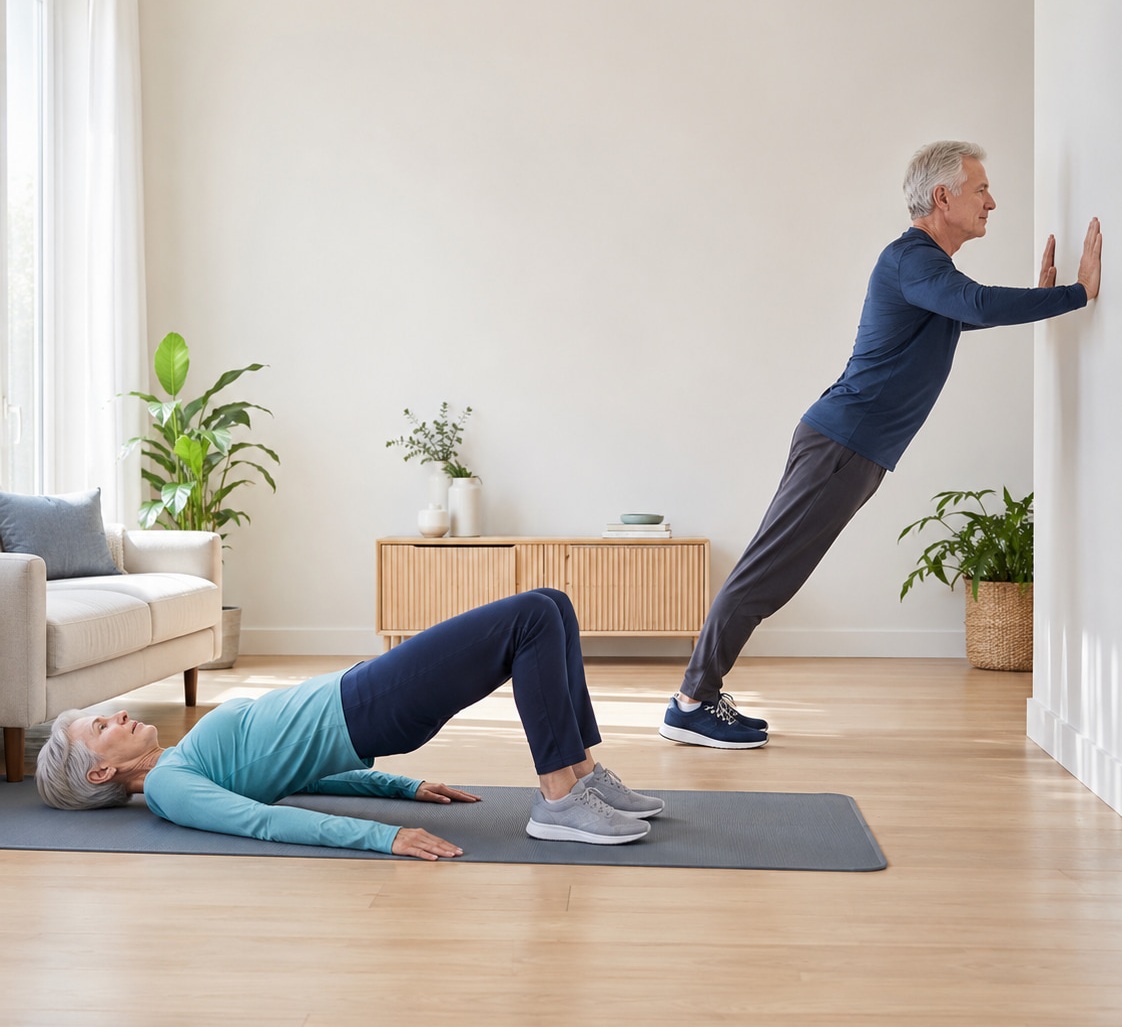
Pilates exercises for seniors can provide a gentle way to practice core control, balance, posture, hip strength, and mobility at home. The 10 exercises below include mat-based, chair-supported, and standing options, so you can choose movements that match your current ability.
You do not need to complete every exercise during your first session. Begin with the easiest versions, move slowly, and prioritize steady breathing and control over a large range of motion.
Pilates Exercises for Seniors at a Glance
| Exercise | Main training purpose | Easiest starting option |
|---|---|---|
| Seated Pilates Breathing | Practice breathing and abdominal control | Sit against the chair back |
| Pelvic Tilt | Improve pelvic and lower-trunk control | Perform a small seated pelvic rock |
| Heel Slide | Stabilize the pelvis while moving one leg | Slide one heel from a chair |
| Knee Fold | Coordinate core control with hip movement | Perform a seated march |
| Neutral-Spine Glute Bridge | Train the glutes and hip-extension pattern | Lift the hips only a few inches |
| Clamshell | Strengthen the outer hip | Perform a seated hip opening |
| Modified Bird Dog | Improve trunk stability during limb movement | Use a countertop or move one limb |
| Wall Plank | Build supported core and shoulder endurance | Stand closer to the wall |
| Supported Standing Side Leg Lift | Train the outer hips and standing control | Use both hands on a chair |
| Supported Heel Raise | Strengthen the calves and ankles | Perform seated heel raises |
What You Need Before Starting
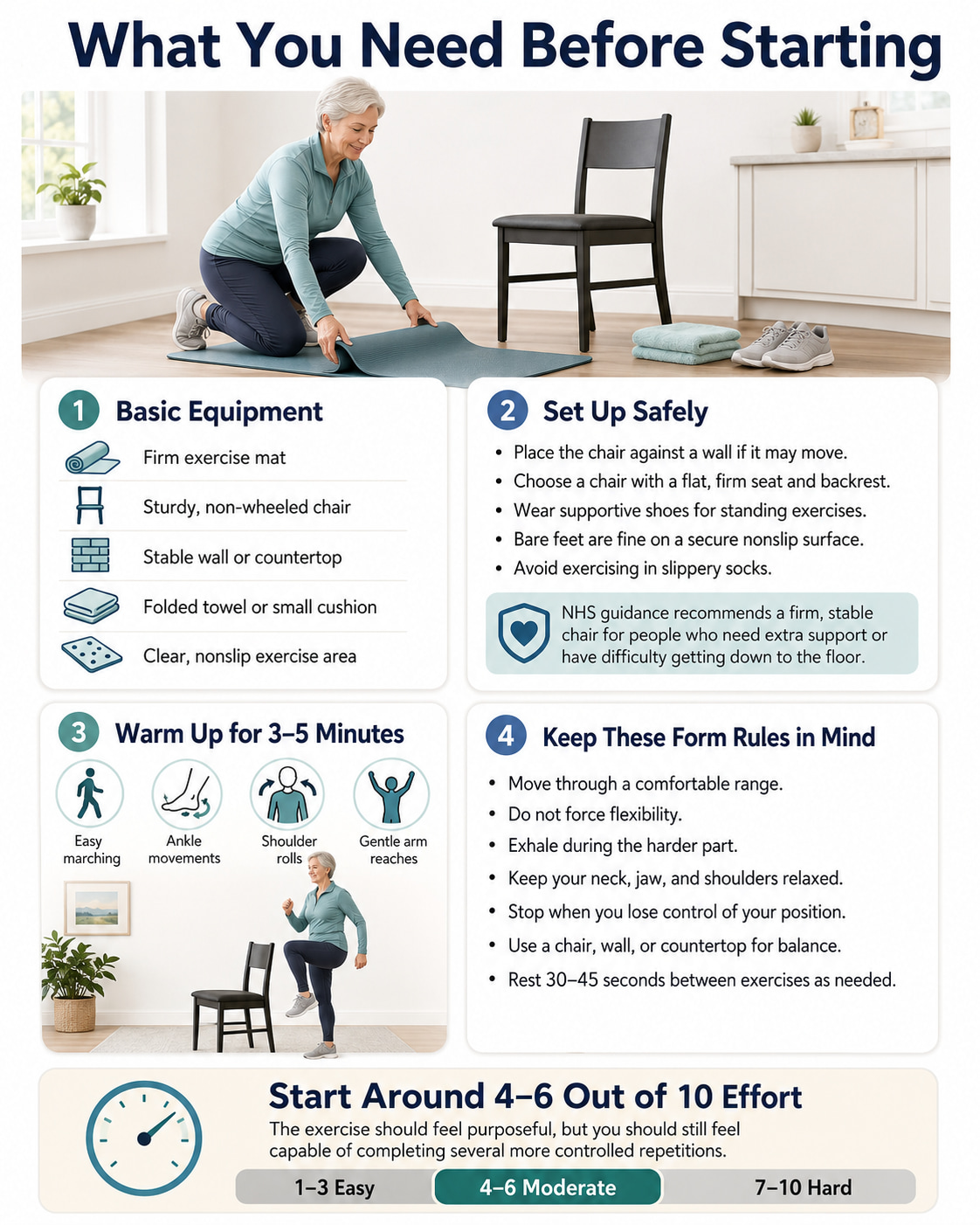
Most of these gentle Pilates exercises require only:
- A firm exercise mat
- A sturdy, non-wheeled chair
- A stable wall or countertop
- A folded towel or small cushion
- A clear, nonslip exercise area
Place the chair against a wall if there is any chance it could move. The NHS recommends a chair with a flat, firm seat and backrest for people who prefer support or have difficulty getting down to the floor.
For standing exercises, use supportive shoes or bare feet on a nonslip surface. Avoid exercising in slippery socks.
Warm up for three to five minutes with easy seated or standing marching, ankle movements, shoulder rolls, and gentle arm reaches.
Keep These Form Rules in Mind
- Move through a comfortable range rather than forcing flexibility.
- Exhale during the more difficult part of an exercise.
- Keep your neck, jaw, and shoulders relaxed.
- Stop a set when you can no longer control your position.
- Use a chair, wall, or countertop before attempting unsupported balance work.
- Rest for 30–45 seconds between exercises or longer when needed.
A reasonable starting effort is approximately 4–6 out of 10, where the exercises feel purposeful but you could still complete several more controlled repetitions.
10 Gentle Pilates Exercises for Seniors
The exercises are arranged from foundational breathing and floor-based control to supported standing movements. Use the listed regression whenever the standard version feels uncomfortable, unstable, or difficult to control.
1. Seated Pilates Breathing
Best for: Learning controlled breathing before performing the other exercises.
Muscles worked: Diaphragm, muscles around the rib cage, deep abdominals, and other trunk stabilizers.
Equipment needed: A sturdy chair.
Sets, reps, and rest: Perform 5–8 slow breathing cycles. Rest normally if you feel lightheaded.
How to Do It
- Sit near the front of the chair with both feet flat and approximately hip-width apart.
- Lengthen your spine without forcing your chest upward.
- Place your hands around the sides of your lower ribs.
- Inhale gently and feel the rib cage expand into your hands.
- Exhale slowly while allowing the ribs to narrow and gently tightening the muscles around your midsection.
- Keep your shoulders relaxed throughout the breath.
Common mistakes: Lifting the shoulders while inhaling, sucking the stomach inward forcefully, arching the lower back, or holding the breath between repetitions.
Progression or regression: Sit against the backrest for more support. To progress, sit upright without using the backrest and coordinate the exhale with a slow arm raise.
Coaching cue: Breathe into the sides and back of your ribs.
2. Pelvic Tilt
Best for: Practicing small, controlled movement of the pelvis and lower trunk.
Muscles worked: Deep abdominals, spinal stabilizers, and muscles around the pelvis.
Equipment needed: An exercise mat or sturdy chair.
Sets, reps, and rest: Perform 1–2 sets of 6–10 repetitions. Rest for 30 seconds.
How to Do It
- Lie on your back with your knees bent and feet flat.
- Allow your spine to rest in a comfortable position rather than pressing it forcefully into the mat.
- Exhale and gently tip the pelvis so the lower back moves slightly closer to the floor.
- Inhale and return to your starting position.
- Keep the movement slow and small.
Common mistakes: Pushing hard through the feet, squeezing the glutes excessively, lifting the hips, or forcing the lower back flat.
Progression or regression: Perform a small pelvic rock while seated if lying down is uncomfortable. People who have been advised to limit spinal flexion can remain in a comfortable neutral position and practice gentle abdominal bracing instead.
Coaching cue: Imagine your pelvis is a shallow bowl that tips only slightly.
3. Heel Slide
Best for: Improving abdominal control while one leg moves.
Muscles worked: Deep abdominals, hip flexors, quadriceps, and pelvic stabilizers.
Equipment needed: An exercise mat.
Sets, reps, and rest: Perform 1–2 sets of 6–10 repetitions per side. Rest for 30–45 seconds.
How to Do It
- Lie on your back with both knees bent and feet flat.
- Place your arms beside your body and gently brace your midsection.
- Slowly slide one heel away from your hips.
- Extend the leg only as far as you can without the pelvis tipping or the lower back changing position.
- Slide the heel back to the starting position.
- Repeat on the opposite side.
Common mistakes: Straightening the leg too far, holding the breath, allowing the pelvis to rotate, or rushing the return.
Progression or regression: Perform the movement while seated by sliding one heel forward along the floor. To progress, pause briefly before returning the heel.
Coaching cue: Let the leg move while the pelvis stays quiet.
4. Knee Fold
Best for: Coordinating controlled hip movement with trunk stability.
Muscles worked: Deep abdominals, hip flexors, and muscles that stabilize the pelvis.
Equipment needed: An exercise mat.
Sets, reps, and rest: Perform 1–2 sets of 6–8 repetitions per side. Rest for 30–45 seconds.
How to Do It
- Lie on your back with your knees bent and feet flat.
- Find a comfortable neutral position for your pelvis.
- Exhale and slowly lift one foot a few inches from the floor.
- Keep the knee bent as the thigh moves toward you.
- Lower the foot quietly without letting the pelvis rock.
- Alternate sides.
Common mistakes: Pulling the knee too close to the chest, lifting both feet at once, flattening or arching the lower back, or moving too quickly.
Progression or regression: Use a seated march while holding the sides of a chair. To progress, hold the lifted position for two seconds before lowering.
Coaching cue: Lift the leg without letting your belt line move.
5. Neutral-Spine Glute Bridge
Best for: Training hip extension and strengthening the muscles behind the hips.
Muscles worked: Gluteus maximus, hamstrings, deep abdominals, and spinal stabilizers.
Equipment needed: An exercise mat and optional folded towel.
Sets, reps, and rest: Perform 1–2 sets of 6–10 repetitions. Rest for 45 seconds.
How to Do It
- Lie on your back with your knees bent and feet approximately hip-width apart.
- Place your feet close enough that you can press through them comfortably.
- Gently brace your abdomen and keep your spine in a comfortable neutral position.
- Exhale and press through your feet to lift your hips.
- Stop when your shoulders, hips, and knees form a comfortable sloping line.
- Pause briefly, then lower the hips slowly.
Common mistakes: Pushing the hips too high, arching the lower back, letting the knees fall outward, lifting through the toes, or holding the breath.
Progression or regression: Begin with a lift of only a few inches. A standing hip extension while holding a chair is an alternative when floor exercise is unsuitable. Progress by adding a two-second pause at the top.
Coaching cue: Lift with your hips, not your lower back.
6. Clamshell
Best for: Strengthening the outer hips without requiring a standing balance position.
Muscles worked: Gluteus medius, gluteus maximus, gluteus minimus, and deep hip rotators.
Equipment needed: An exercise mat and optional pillow.
Sets, reps, and rest: Perform 1–2 sets of 8–12 repetitions per side. Rest for 30–45 seconds.
How to Do It
- Lie on your side with your hips and knees bent comfortably.
- Place a pillow under your head so your neck remains aligned with your spine.
- Stack your hips and keep your heels together.
- Exhale and lift the top knee without separating your feet.
- Stop before the top hip rolls backward.
- Lower the knee slowly and repeat.
Common mistakes: Rolling the pelvis backward, opening the knee as far as possible, separating the feet, or twisting through the lower back.
Progression or regression: Sit upright and gently open one knee to the side while keeping the foot planted for an easier option. Progress by pausing for two seconds at the top of the clamshell.
Coaching cue: Keep the top hip pointing toward the ceiling.
7. Modified Bird Dog
Best for: Improving trunk stability while moving the arms or legs.
Muscles worked: Deep abdominals, multifidus, spinal erectors, glutes, and shoulder stabilizers.
Equipment needed: An exercise mat or stable countertop.
Sets, reps, and rest: Perform 1–2 sets of 5–8 repetitions per side. Rest for 45 seconds.
How to Do It
- Begin on your hands and knees with your hands below your shoulders and knees below your hips.
- Gently brace your abdomen and look toward the floor.
- Slide one leg backward while keeping the toes on the floor.
- Lift the leg only if you can keep the pelvis level and lower back controlled.
- For more challenge, reach the opposite arm forward.
- Return slowly and change sides.
The American Council on Exercise emphasizes limiting the bird dog’s range to what you can perform while maintaining controlled lower-back and pelvic positioning.
Common mistakes: Lifting the leg too high, arching the lower back, turning the pelvis, raising the head, or rushing between sides.
Progression or regression: Move only one arm or one leg. For a wrist- and knee-friendly option, place both hands on a countertop and extend one leg behind you.
Coaching cue: Reach long rather than lifting high.
8. Wall Plank
Best for: Building supported core, shoulder, and upper-body endurance.
Muscles worked: Abdominals, chest, shoulders, serratus anterior, triceps, and glutes.
Equipment needed: A clear wall.
Sets, reps, and rest: Perform 2 holds of 15–30 seconds. Rest for 30–45 seconds.
How to Do It
- Stand facing a wall and place your hands slightly below shoulder height.
- Step your feet backward until your body forms a straight, comfortable line.
- Keep your hands approximately shoulder-width apart.
- Gently tighten your abdomen and glutes.
- Press the wall away without rounding your upper back excessively.
- Breathe normally while holding the position.
Common mistakes: Letting the hips sag, bending at the waist, shrugging the shoulders, locking the elbows aggressively, or holding the breath.
Progression or regression: Stand closer to the wall to make the exercise easier. Step farther away or use a stable countertop to increase the challenge.
Coaching cue: Keep your body long from your head to your heels.
9. Chair-Supported Standing Side Leg Lift
Best for: Training the outer hips and practicing controlled weight shifting.
Muscles worked: Gluteus medius, gluteus minimus, outer hip muscles, and stabilizers of the standing leg.
Equipment needed: A sturdy chair or countertop.
Sets, reps, and rest: Perform 1–2 sets of 8–12 repetitions per side. Rest for 30–45 seconds.
How to Do It
- Stand tall behind a sturdy chair and hold it with both hands.
- Position your feet approximately hip-width apart.
- Shift your weight onto one leg without leaning your torso.
- Lift the opposite leg a few inches to the side.
- Keep the toes and kneecap pointing mostly forward.
- Lower the foot slowly before repeating.
Common mistakes: Leaning away from the lifting leg, turning the toes upward, hiking one side of the pelvis, swinging the leg, or using an unnecessarily large range.
Progression or regression: Keep the toe in contact with the floor and slide it sideways for an easier option. Progress by using one hand for support only when your balance is reliable.
Coaching cue: Stay tall and make the leg lift small.
10. Chair-Supported Heel Raise
Best for: Strengthening the calves and improving ankle control.
Muscles worked: Gastrocnemius, soleus, and stabilizing muscles of the feet and ankles.
Equipment needed: A sturdy chair or countertop.
Sets, reps, and rest: Perform 1–2 sets of 8–15 repetitions. Rest for 30–45 seconds.
How to Do It
- Stand behind a chair with your feet approximately hip-width apart.
- Hold the chair lightly with both hands.
- Press evenly through the balls of both feet.
- Lift your heels without allowing the ankles to roll outward.
- Pause briefly at the top.
- Lower the heels slowly to the floor.
Common mistakes: Bouncing, leaning heavily on the chair, rushing the lowering phase, or shifting all your weight toward the outer edges of the feet.
Progression or regression: Perform seated heel raises if standing is uncomfortable. Progress by pausing for two or three seconds at the top or gradually reducing hand support.
Coaching cue: Rise straight upward rather than rolling onto your toes.
15-Minute Beginner Pilates Routine for Seniors
This routine uses eight of the exercises and can be completed at home with a chair and exercise mat.
| Order | Exercise | Starting amount |
|---|---|---|
| 1 | Seated Pilates Breathing | 5 slow breaths |
| 2 | Pelvic Tilt | 8 repetitions |
| 3 | Heel Slide | 6 per side |
| 4 | Knee Fold | 6 per side |
| 5 | Neutral-Spine Glute Bridge | 8 repetitions |
| 6 | Clamshell | 8 per side |
| 7 | Wall Plank | 15–20 seconds |
| 8 | Supported Heel Raise | 10 repetitions |
Frequency: Two nonconsecutive days per week to start
Sets: One set of each exercise
Rest: 30–45 seconds between movements
Effort: Approximately 4–6 out of 10
Tempo: Slow enough to stop and correct your position at any point
When you can complete the routine for two consecutive sessions with steady breathing and controlled form, add two repetitions to one or two exercises. After that, you can gradually add a second set.
Change only one training variable at a time. Avoid simultaneously increasing repetitions, range of motion, balance difficulty, and workout frequency.
How Often Should Seniors Do Pilates?
Most beginners can start with two Pilates sessions per week, leaving at least one recovery day between sessions. A third lighter session may be added when you are recovering comfortably and maintaining good technique.
A randomized trial available through the National Library of Medicine involved 61 older adults completing a 12-week Pilates program twice weekly with supplementary home exercises. Researchers identified improvements in selected measures of functional mobility, postural balance, gait, and general mobility, although longer trials were still needed to determine whether Pilates prevents falls.
Consistency matters more than performing long sessions. Ten to 20 minutes of controlled practice is a reasonable starting point for someone who is new to exercise or returning after a long break.
Benefits of Pilates Exercises for Seniors
May Improve Postural Balance
Pilates asks you to control the position of your trunk and pelvis while moving your arms or legs. Supported standing exercises can also provide opportunities to practice weight shifting safely.
A 2024 systematic review available through the National Library of Medicine analyzed 39 studies involving 1,770 older adults and found that Pilates performed better than inactive control conditions on several measures of static and dynamic balance. However, it did not reduce the number of falls or fear of falling, and the certainty of the evidence ranged from very low to moderate. Pilates should therefore be described as a possible way to improve postural balance—not a guaranteed method of preventing falls.
Trains Core and Hip Control
Heel slides, knee folds, bridges, clamshells, and bird dogs teach you to control the trunk while the hips and limbs move. This type of control can be useful when standing, changing direction, reaching, or completing other daily movements.
Offers Chair, Wall, and Floor Options
Pilates does not have to be performed entirely on the floor. Chair-supported breathing, seated leg movements, wall planks, and supported standing exercises can make a routine more accessible for people who find kneeling or floor transfers difficult.
Encourages Controlled Movement
Pilates exercises are generally performed slowly enough to notice unwanted leaning, twisting, breath-holding, or loss of balance. That makes it easier to reduce the range or use additional support when form begins to change.
Should Not Replace Progressive Strength Training
Pilates activates and trains many muscles, but that does not mean gentle Pilates alone will produce substantial strength or power gains.
A 2024 review available through the National Library of Medicine examined 24 randomized trials involving 1,190 participants and concluded that the evidence was not strong enough to recommend Pilates specifically for improving strength, muscular endurance, or power in older adults. For meaningful strength development, combine Pilates with progressively challenging exercises such as sit-to-stands, rows, presses, step-ups, or resistance-band movements when appropriate.
How Pilates Fits Into a Complete Weekly Exercise Plan
Pilates can contribute to balance practice, trunk control, mobility, and some muscle conditioning. However, it is only one part of a complete activity plan.
The Centers for Disease Control and Prevention recommends that adults aged 65 and older include:
- At least 150 minutes of moderate-intensity aerobic activity per week, or an equivalent alternative
- Muscle-strengthening activities on at least two days per week
- Activities that improve balance
People who cannot meet the full recommendations should be as active as their abilities and health conditions allow.
A practical week might include:
- Pilates on Monday and Thursday
- Walking, cycling, swimming, or another suitable aerobic activity on several days
- Progressive resistance exercises twice per week
- Short supported balance practice on two or more days
Some activities may overlap. A standing Pilates routine, for example, can challenge both muscle control and balance.
Pilates Safety for Older Adults
Choose Supported Options When Needed
Use a wall, chair, or countertop when standing. Do not remove hand support simply because an exercise feels easy for your muscles; balance must also remain reliable.
When using a chair, make sure it does not roll, swivel, fold, or slide.
Do Not Force Floor Exercise
Use seated and standing variations if you cannot confidently get down to the floor and return to standing. A caregiver or stable piece of furniture is not a substitute for learning a safe floor-transfer method from a qualified professional.
Keep the Range Comfortable
A smaller controlled movement is more useful than a large movement that causes twisting, straining, breath-holding, or loss of balance.
Mild muscular effort is expected. Sharp pain, pinching, numbness, or joint instability is not.
Modify Pilates for Osteoporosis
Most people with osteoporosis can remain active, but some Pilates movements may require modification. The Royal Osteoporosis Society advises caution with uncontrolled, repetitive, sudden, or loaded forward bending of the spine. It recommends smooth movement within a comfortable range and individualized advice for people with previous spinal fractures, multiple fractures, or a current fracture.
Possible modifications include:
- Using a neutral-spine bridge instead of forcefully rolling the spine
- Replacing roll-ups and rolling exercises with seated breathing or heel slides
- Avoiding deep, forced spinal rounding
- Using a chair or wall rather than rapidly moving between the floor and standing
- Working with a physical therapist or appropriately qualified Pilates instructor
Know When to Stop
Stop exercising and seek professional guidance if a movement causes:
- Sharp or worsening pain
- Numbness or tingling
- Dizziness or faintness
- Chest pain
- Unusual shortness of breath
- Sudden weakness
- Loss of balance that does not settle
- New or unusual symptoms
Speak with a healthcare professional before beginning when you are recovering from surgery or injury, have a recent fracture, experience unexplained dizziness, or are uncertain whether a movement is appropriate for a health condition.
Frequently Asked Questions
Is Pilates safe for seniors?
Pilates can be suitable for many older adults when the exercise selection, range of motion, and level of support match the individual. Seniors with limited mobility can begin with chair- or wall-supported versions rather than immediately attempting a complete mat routine.
Can seniors do Pilates without getting on the floor?
Yes. Seated breathing, seated pelvic movements, wall planks, supported leg lifts, and heel raises can all be performed without getting on the floor. Chair-based Pilates is particularly useful for people who have difficulty kneeling or completing floor transfers.
How often should seniors perform Pilates?
Two sessions per week is a manageable starting point. After several weeks, a third session can be added when recovery is comfortable. Begin with 10–20 minutes rather than assuming every workout must last an hour.
Can Pilates improve balance in older adults?
Research suggests Pilates may improve measures of static and dynamic postural balance. However, current evidence does not show that Pilates alone reduces the number of falls or fear of falling. Use stable support during balance exercises and include other appropriate strength and balance activities.
Is Pilates enough to maintain muscle strength?
Pilates can train muscle control and endurance, but gentle routines may not provide enough resistance to maintain or build all-around strength. Include progressively challenging resistance exercises that work the legs, hips, back, chest, shoulders, arms, and abdomen.
Which Pilates exercises may need modification for osteoporosis?
Deep or forceful spinal rounding, loaded forward bending, and rolling exercises may need to be modified. Neutral-spine exercises, supported standing movements, and smaller controlled ranges are often more appropriate, but individual guidance is important when spinal fractures or a high fracture risk are present.
What should I do if my wrists or knees hurt during Pilates?
Use a wall or countertop instead of placing your hands on the floor. Add padding beneath the knees, reduce the movement range, or select a seated alternative. Stop if discomfort becomes sharp, worsens with each repetition, or continues after changing the setup.
Conclusion
Pilates exercises for seniors should emphasize control, steady breathing, comfortable movement, and appropriate support. Start with five to eight exercises, complete one controlled set twice per week, and progress only when your form remains consistent.
Chair and wall variations are not lesser exercises. They are practical ways to build confidence and establish the movement control needed for more challenging Pilates work.
This content is for informational purposes only and is not a substitute for medical advice.
References
- Effects of Pilates Exercises on Postural Balance and Reduced Risk of Falls in Older Adults: A Systematic Review and Meta-Analysis (2024)
PubMed – National Library of Medicine - Effects of Pilates Exercises on Strength, Endurance and Muscle Power in Older Adults: Systematic Review and Meta-Analysis (2024)
PubMed – National Library of Medicine - Effects of Pilates on the Risk of Falls, Gait, Balance and Functional Mobility in Healthy Older Adults: A Randomised Controlled Trial (2022)
PubMed – National Library of Medicine - Benefits of Pilates in the Elderly Population: A Systematic Review and Meta-Analysis (2022)
PubMed – National Library of Medicine - Older Adult Activity: An Overview
Centers for Disease Control and Prevention - Pilates and Osteoporosis
Royal Osteoporosis Society