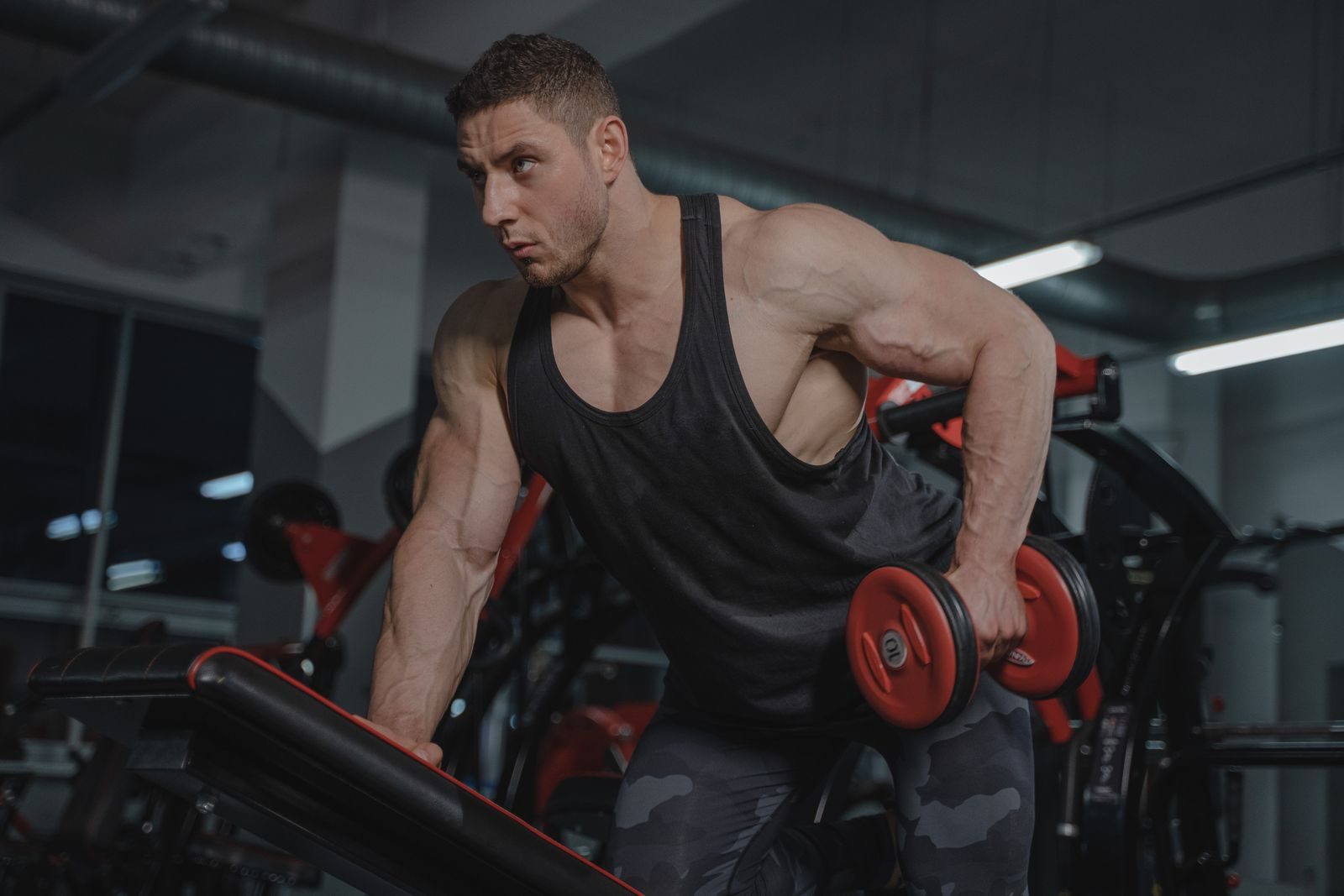
There is no exact dumbbell version of a cable lat pulldown because a machine supplies resistance from overhead, while gravity pulls a dumbbell toward the floor. However, you can still train your lats effectively without a machine by combining dumbbell pullovers with lat-focused rows.
This guide explains what people mean by a dumbbell lat pulldown, which muscles the exercises work, how to perform the best alternatives, and how to organize them into a practical workout.
Dumbbell Lat Pulldown at a Glance
| Question | Practical answer |
|---|---|
| Can dumbbells duplicate a machine lat pulldown? | No. The resistance direction is different. |
| Closest overhead dumbbell exercise | Dumbbell pullover |
| Best main strength exercise | One-arm dumbbell row |
| Best stable beginner option | Chest-supported dumbbell row |
| Optional pulldown-style accessory | Prone dumbbell lat pulldown |
| Best true vertical pull without a machine | Pull-up, chin-up, or resistance-band pulldown |
| Recommended frequency | About twice per week as part of a balanced program |
| General repetition range | 8–15 reps for rows and 10–20 reps for lighter accessories |
Can You Do a Lat Pulldown With Dumbbells?
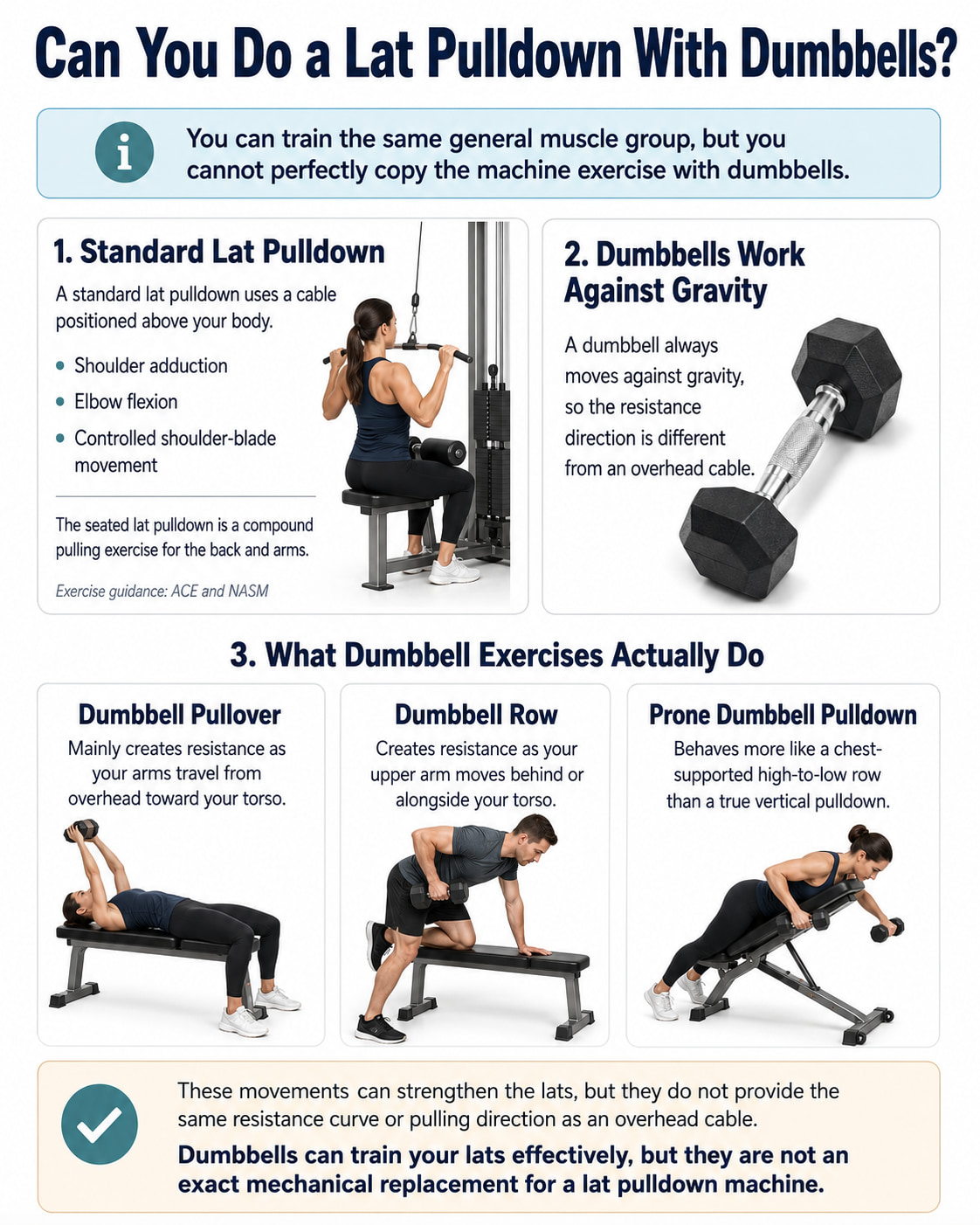
You can train the same general muscle group, but you cannot perfectly copy the machine exercise with dumbbells.
A standard lat pulldown uses a cable positioned above your body. As you pull the bar toward your upper chest, the main actions include shoulder adduction, elbow flexion, and controlled movement of the shoulder blades. The American Council on Exercise classifies the seated lat pulldown as a selectorized-machine exercise, while NASM describes it as a compound pulling movement for the back and arms.
A dumbbell always moves against gravity. This means:
- A dumbbell pullover mainly creates resistance as your arms travel from overhead toward your torso.
- A dumbbell row creates resistance as your upper arm moves behind or alongside your torso.
- A prone dumbbell pulldown behaves more like a chest-supported high-to-low row than a true vertical pulldown.
These movements can strengthen the lats, but they do not provide the same resistance curve or pulling direction as an overhead cable.
What Is a Dumbbell Lat Pulldown?
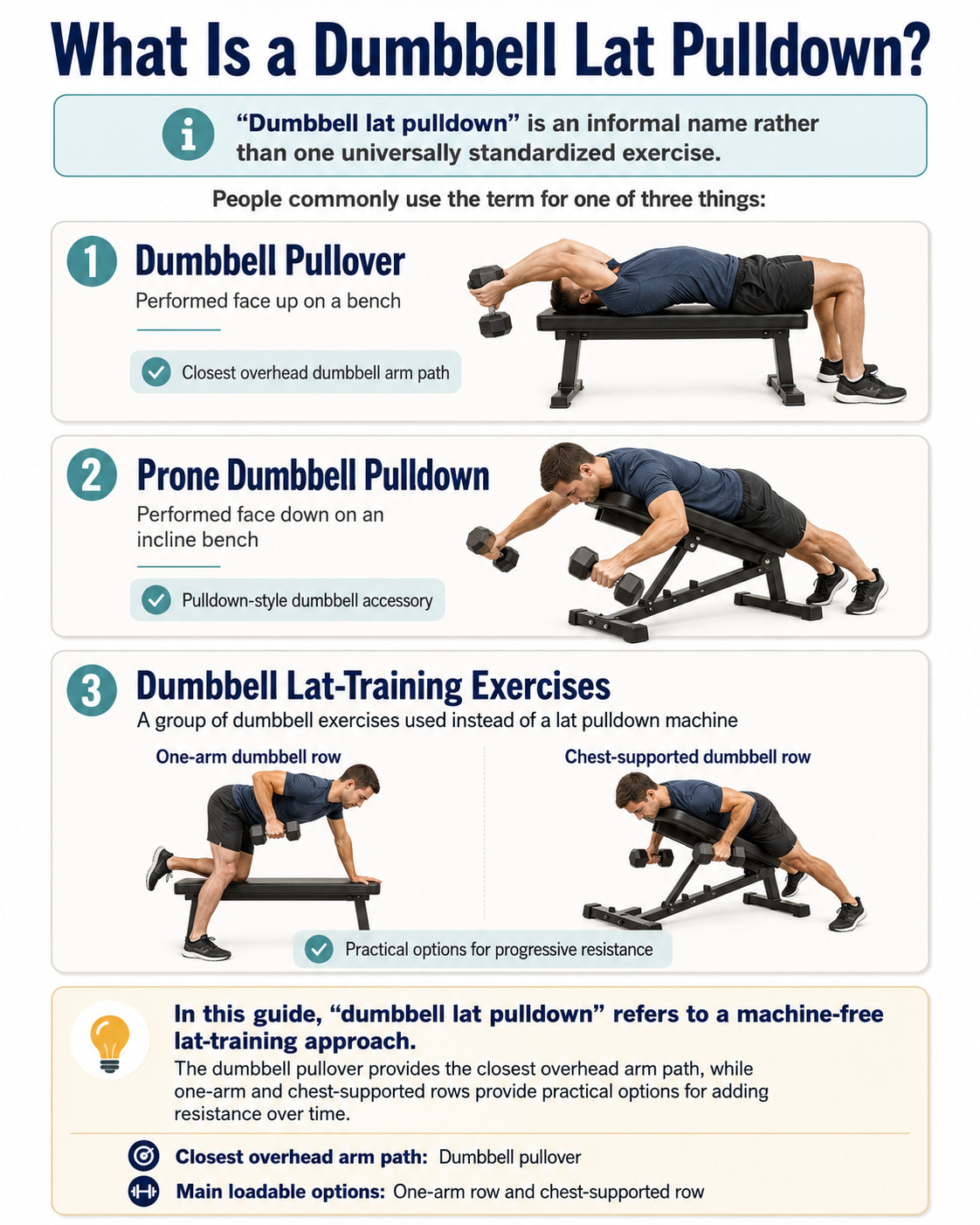
“Dumbbell lat pulldown” is an informal name rather than one universally standardized exercise.
People commonly use the term for one of three things:
- A dumbbell pullover performed face up on a bench
- A prone dumbbell pulldown performed face down on an incline bench
- A group of dumbbell exercises used instead of a lat pulldown machine
In this guide, the term refers to a machine-free lat-training approach. The dumbbell pullover provides the closest overhead arm path, while one-arm and chest-supported rows provide the most practical options for adding resistance over time.
Dumbbell Lat Pulldown Muscles Worked
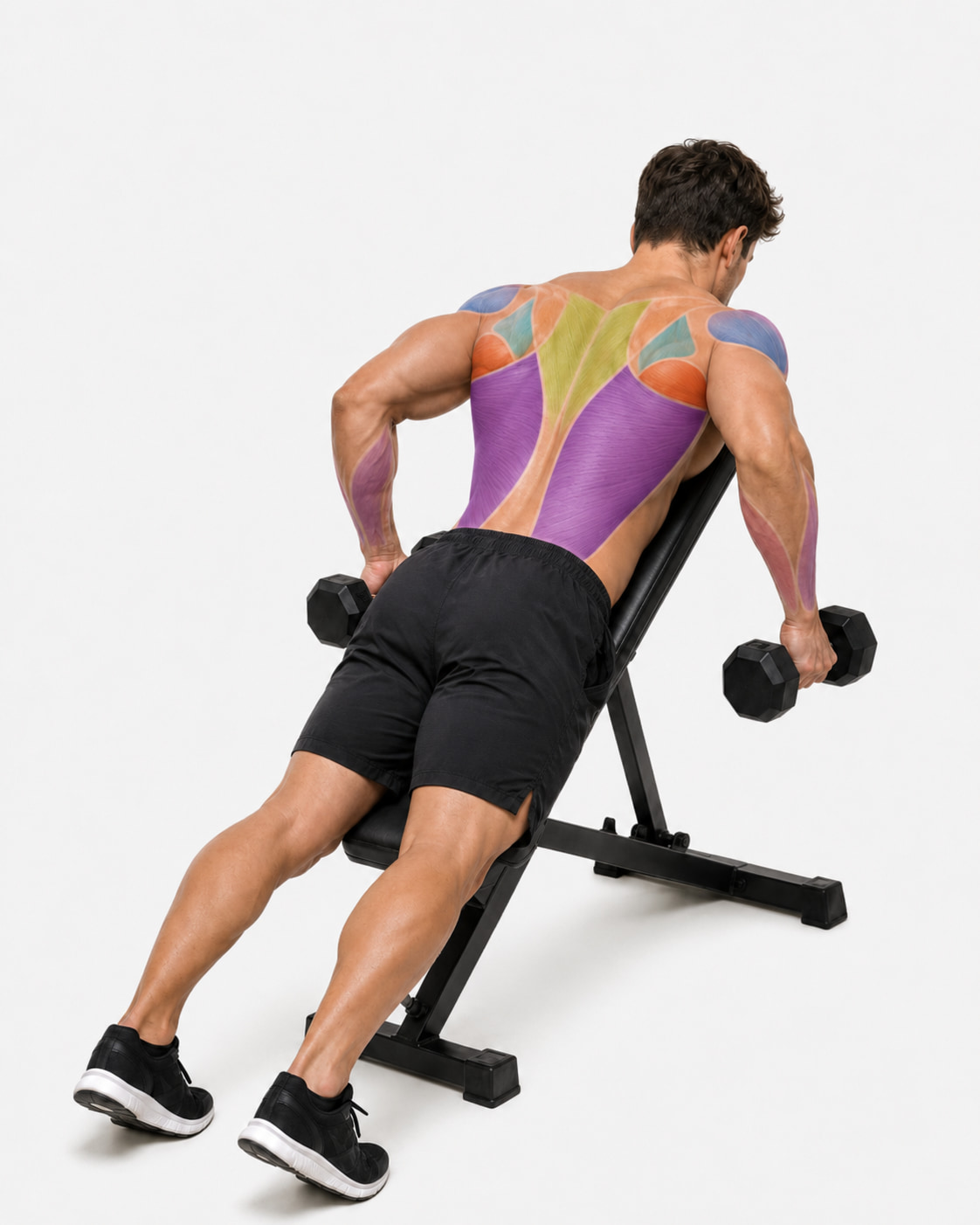
The exact muscles emphasized depend on which dumbbell exercise you perform.
Latissimus Dorsi
The latissimus dorsi, or lats, are large muscles covering much of the sides and lower portion of the back. Their actions include extending, adducting, and internally rotating the upper arm.
The lats work especially well when the upper arm moves from a forward or overhead position toward the torso. This is why pullovers, rows, pull-ups, and cable pulldowns can all involve the lats despite using different movement paths.
Teres Major
The teres major assists the lats in extending and adducting the upper arm. It is active during pulldowns, rows, and pullovers.
Biceps, Brachialis, and Brachioradialis
These muscles bend the elbow during rows and pulldown-style movements. They contribute less during a relatively straight-arm pullover because the elbow angle should remain mostly unchanged.
Rhomboids and Trapezius
The rhomboids and middle and lower portions of the trapezius help control the shoulder blades. Their involvement is generally greater during rows than during straight-arm pullovers.
Rear Deltoids
The posterior deltoids assist as the upper arms travel backward during dumbbell rows.
Rotator Cuff and Core
The rotator-cuff muscles help stabilize the shoulders. Your abdominal and spinal muscles help prevent excessive rotation, arching, or movement of the torso.
NASM identifies the lats and teres major as major contributors to a pulldown, with the biceps, brachialis, rhomboids, trapezius, rear deltoids, and rotator cuff assisting or stabilizing the movement.
Best Dumbbell Lat Pulldown Alternatives
A complete machine-free approach should include at least one loadable row. The pullover and prone pulldown can then be used as secondary exercises.
1. Dumbbell Pullover
Best for: Training shoulder extension from an overhead position and adding a machine-free accessory after rows.
Muscles worked: Latissimus dorsi, teres major, pectoralis major, long head of the triceps, serratus anterior, and core stabilizers.
Equipment needed: One fixed dumbbell and a stable flat bench.
Sets, reps, and rest: Perform 2–3 sets of 10–15 controlled reps. Rest for 60–90 seconds and finish each set with approximately 2–3 good reps remaining.
How to Do a Dumbbell Pullover
- Lie lengthwise on a flat bench with your head, upper back, and hips supported.
- Plant your feet firmly on the floor.
- Hold one fixed dumbbell securely with both hands and position it above your chest.
- Keep a small, consistent bend in your elbows and lightly brace your abdomen.
- Slowly lower the dumbbell behind your head in an arc.
- Stop when you reach a comfortable shoulder stretch without lifting your ribs or arching your lower back.
- Sweep your upper arms back toward your torso and return the dumbbell above your chest.
- Keep the movement smooth and controlled from start to finish.
The pullover resembles part of the shoulder-extension action used by the lats, but it should not be described as a pure lat-isolation exercise. ACE lists lying pullovers under chest exercises, and a small electromyography study of the barbell pullover reported greater pectoralis-major activity than latissimus-dorsi activity during the tested movement. That study used a barbell and measured short-term muscle activity rather than muscle growth, so it does not prove that dumbbell pullovers cannot train the lats. It does show that chest involvement should not be ignored.
Common mistakes: Avoid using a dumbbell that pulls you into an uncontrolled overhead position. Do not repeatedly bend and straighten your elbows, flare your ribs, lift your hips, or force the weight lower than your shoulders can comfortably control.
Regression: Perform the exercise on the floor, use a shorter range of motion, or use a lighter dumbbell.
Progression: Add repetitions, use a small load increase, pause briefly in the stretched position, or take two to three seconds to lower the dumbbell.
Coaching cue: Keep your ribs down and sweep your upper arms toward your hips.
2. One-Arm Dumbbell Row
Best for: Building machine-free back strength, training one side at a time, and using progressively heavier dumbbells.
Muscles worked: Latissimus dorsi, teres major, rhomboids, trapezius, rear deltoids, biceps, brachialis, forearms, and core.
Equipment needed: One dumbbell and a stable flat bench.
Sets, reps, and rest: Perform 3 sets of 8–12 reps on each side. Rest for 90–120 seconds between sets.
How to Do a One-Arm Dumbbell Row
- Place one hand and the same-side knee on a bench.
- Plant your opposite foot firmly beside the bench and hold the dumbbell in the free hand.
- Brace your abdomen and keep your back flat with your head aligned with your spine.
- Let the working arm extend toward the floor without allowing your torso to twist.
- Pull your elbow close to your side and guide it toward your hip or lower ribs.
- Stop before you need to rotate your torso or lift your shoulder toward your ear.
- Pause briefly, then lower the dumbbell under control.
- Complete all repetitions before changing sides.
ACE’s single-arm row guidance emphasizes a braced torso, aligned head and spine, an arm kept close to the body, and avoiding torso rotation while lifting the dumbbell.
Common mistakes: The most common errors are rotating the torso, jerking the weight upward, shrugging the shoulder, pulling the elbow excessively high, and shortening the lowering phase.
Regression: Use a lighter dumbbell or place both feet on the floor while supporting one hand on a bench or sturdy rack.
Progression: Increase the weight gradually, add a pause with the elbow beside the torso, or use a slower lowering phase.
Coaching cue: Drive your elbow toward your back pocket without turning your chest.
3. Chest-Supported Dumbbell Row
Best for: Strict back training, beginners who struggle to maintain a hip hinge, and anyone who wants to reduce torso movement.
Muscles worked: Latissimus dorsi, teres major, rhomboids, middle and lower trapezius, rear deltoids, biceps, and forearms.
Equipment needed: Two dumbbells and an adjustable bench.
Sets, reps, and rest: Perform 2–3 sets of 8–15 reps. Rest for 75–120 seconds.
How to Do a Chest-Supported Dumbbell Row
- Set an adjustable bench to a low or moderate incline.
- Lie face down with your chest supported and your feet planted firmly.
- Hold a dumbbell in each hand and let your arms hang naturally beneath your shoulders.
- Use a neutral grip with your palms facing each other.
- Brace your abdomen and keep your chest in contact with the bench.
- Pull your elbows toward your lower ribs while keeping them reasonably close to your torso.
- Pause without shrugging your shoulders.
- Lower the dumbbells slowly until your arms are extended again.
Common mistakes: Avoid lifting your chest from the bench, pulling the dumbbells toward your shoulders, flaring the elbows widely, shrugging, or dropping quickly into the bottom position.
Regression: Use one dumbbell at a time or reduce the bench angle and load.
Progression: Add weight, pause at the top, slow the lowering phase, or perform one side at a time with a controlled reach at the bottom.
Coaching cue: Keep your chest heavy on the bench and pull your elbows toward your hips.
4. Prone Dumbbell Lat Pulldown
Best for: Light accessory work and practicing an elbows-down pulling action without a cable machine.
Muscles worked: Latissimus dorsi, teres major, rear deltoids, rhomboids, trapezius, biceps, and shoulder stabilizers.
Equipment needed: Two light dumbbells and an adjustable bench.
Sets, reps, and rest: Perform 2–3 sets of 12–20 reps. Rest for 60–75 seconds.
This variation should be treated as a light accessory rather than your primary back exercise. Because gravity still pulls the dumbbells downward, it acts more like a chest-supported high-to-low row than a true vertical lat pulldown.
How to Do a Prone Dumbbell Lat Pulldown
- Set the bench to a low or moderate incline.
- Lie face down with your chest and abdomen supported.
- Hold a light dumbbell in each hand using a neutral grip.
- Reach your arms forward and overhead in line with your torso, stopping at a comfortable shoulder position.
- Brace your abdomen and keep your forehead or head in a neutral position.
- Bend your elbows and pull them down toward your sides.
- Finish with your elbows close to your lower ribs without lifting your chest.
- Slowly extend your arms back toward the starting position.
Common mistakes: Do not use heavy dumbbells, turn the exercise into a wide reverse fly, lift your chest from the bench, shrug your shoulders, or move quickly through the overhead position.
Regression: Practice the movement without dumbbells, shorten the overhead reach, or replace it with a chest-supported row.
Progression: Add a small amount of load, pause with your elbows beside your torso, or use a three-second return.
Coaching cue: Pull your elbows down toward your ribs while keeping your chest still.
Dumbbell Lat Pulldown vs. Machine Lat Pulldown
| Feature | Dumbbell alternatives | Machine lat pulldown |
|---|---|---|
| Resistance source | Gravity | Overhead cable and weight stack |
| Main movement | Rowing or shoulder extension | Vertical pulling and shoulder adduction |
| Body position | Lying, chest-supported, or bench-supported | Seated beneath thigh pads |
| Stability demand | Usually greater | Machine provides more external support |
| Unilateral training | Easy to perform | Depends on the attachment and machine |
| Load adjustments | Limited by available dumbbells | Usually adjustable in smaller increments |
| Best use | Home workouts and machine-free training | Direct vertical pulling |
| Exact replacement | No | Standard movement |
The machine is better when your main goal is to train a vertical pulling pattern with easily adjustable resistance. Dumbbells are useful when a machine is unavailable or when you want to add unilateral and chest-supported variations.
For the closest machine-free vertical pull, use a pull-up, assisted pull-up, chin-up, or securely anchored resistance-band pulldown. These are not dumbbell exercises, but they reproduce the direction of a pulldown more closely.
Benefits of Training Your Lats With Dumbbells
1. Requires Minimal Equipment
A bench and one or two dumbbells are enough for several productive back exercises. Chest-supported rows and floor pullovers can also be adapted to limited workout spaces.
2. Makes Unilateral Training Easy
One-arm rows allow each side to work independently. This makes it easier to notice when one side uses a different range of motion or requires more control.
3. Offers Several Body Positions
You can train while bench-supported, chest-supported, lying face up, or lying face down. This flexibility helps you choose a position in which you can maintain good control.
4. Allows Progressive Resistance
Rows can be progressed by adding weight or repetitions. Pullovers and prone pulldowns can be progressed with load, tempo, pauses, and improved control.
5. Complements Vertical Pulling Exercises
Dumbbell rows provide a strong horizontal-pulling component, while pullovers train the upper arm from an overhead position. They can complement pull-ups, chin-ups, or band pulldowns in a complete back routine.
How to Feel Your Lats Working
Feeling a strong burn is not required for an exercise to be productive. However, these adjustments may help you reduce unwanted momentum and maintain a more lat-focused movement:
- Reduce the weight until you can control every repetition.
- Keep your shoulders away from your ears.
- Guide your elbow toward your hip rather than straight toward the ceiling.
- Treat your hand as a hook instead of aggressively curling the dumbbell.
- Pause briefly when your upper arm reaches your torso.
- Lower the weight slowly and allow a controlled reach at the bottom.
- Use a chest-supported variation if your torso keeps rotating or rising.
- Stop the set when you can no longer maintain the same movement path.
Do not force your shoulder blades into a rigid position throughout the entire repetition. Allow controlled movement as your arm reaches and pulls, while preventing excessive shrugging or loss of torso position.
Common Dumbbell Lat Pulldown Mistakes
Treating the Pullover as an Exact Machine Replacement
The pullover is useful, but it does not reproduce the machine’s vertical resistance. Include a row as your main loadable exercise.
Using Too Much Weight
A weight that causes swinging, torso rotation, rib flare, shortened range, or uncontrolled lowering is too heavy for the current repetition target.
Shrugging the Shoulders
Allowing the shoulders to rise toward the ears often shifts attention away from the intended elbow and upper-arm movement. Keep the neck relaxed and the shoulders controlled.
Pulling Rows Too High
Pulling the elbow far behind the torso may cause the shoulder to roll forward or the body to rotate. Stop when your upper arm reaches a strong position beside your torso.
Flaring the Elbows
A very wide elbow path generally shifts more work toward the rear deltoids and upper back. Keep the elbow closer to the torso when your goal is a lat-focused row.
Arching During Pullovers
Do not gain extra range by lifting your ribs and extending your lower back. Shorten the range and use a lighter dumbbell.
Forcing the Overhead Position
Shoulder mobility differs between individuals. Lower the dumbbell only as far as you can control without sharp discomfort, numbness, or a major change in spinal position.
Dropping Through the Lowering Phase
Control the return instead of allowing gravity to pull the dumbbell quickly into the bottom position.
Beginner Dumbbell Lat Workout Without a Machine
Perform the following two sessions on nonconsecutive days. Leave at least one recovery day between them.
Before your first working set, complete a few minutes of easy general movement and one or two lighter practice sets.
Workout A
| Exercise | Sets | Reps | Rest | Effort |
|---|---|---|---|---|
| One-arm dumbbell row | 3 | 8–12 per side | 90–120 seconds | About 2 reps in reserve |
| Dumbbell pullover | 2 | 10–15 | 60–90 seconds | About 2–3 reps in reserve |
Workout B
| Exercise | Sets | Reps | Rest | Effort |
|---|---|---|---|---|
| Chest-supported dumbbell row | 3 | 10–15 | 90 seconds | About 2 reps in reserve |
| Prone dumbbell lat pulldown | 2 | 12–20 | 60–75 seconds | About 2–3 reps in reserve |
The 2026 ACSM resistance-training guidance emphasizes regular training of the major muscle groups at least twice per week, individualized programming, and consistency over unnecessarily complicated routines. It also notes that approximately 2–3 sets per exercise can support strength development and that higher weekly volume may be useful when muscle growth is the main goal.
This sample provides approximately 10 direct working sets across two sessions. Reduce the number of sets if your full workout already includes pull-ups, cable rows, pulldowns, or other demanding back exercises.
How to Progress Safely
Use a simple double-progression method:
- Choose a weight you can control at the lower end of the repetition range.
- Keep approximately two good repetitions in reserve during most sets.
- Add one repetition when you can maintain the same form from the first rep to the last.
- Continue until every set reaches the top of the range.
- Increase to the next available dumbbell weight.
- Return to the lower end of the repetition range and repeat.
Increase only one training variable at a time. Do not add weight, sets, repetitions, and slower tempo all in the same week.
When your available dumbbells are too light, progress by:
- Adding a brief pause
- Taking two to three seconds to lower the weight
- Adding repetitions within a reasonable range
- Improving the controlled stretch
- Adding one set to one exercise
- Reducing unnecessary torso movement
Do not create progression by forcing a deeper overhead range or pulling your elbow excessively behind your body.
Safety Considerations
Use a stable bench on a level, nonslip surface. Check that an adjustable bench is fully locked before lying on it.
Start pullovers and prone pulldowns with a light dumbbell. Overhead exercises require more control than most supported rows, and the correct load may be much lighter than expected.
Keep your breathing steady. Exhale as you pull or raise the dumbbell and inhale during the controlled return. Avoid prolonged breath-holding during normal moderate-load sets.
Stop the exercise if it causes sharp pain, numbness, dizziness, chest pain, sudden weakness, or unusual symptoms. Persistent shoulder, elbow, neck, or back discomfort should be evaluated by an appropriate healthcare or exercise professional before you continue loading the movement.
Frequently Asked Questions
Can dumbbells replace a lat pulldown machine?
Dumbbells can replace the machine’s general lat-training role, but they cannot reproduce its exact overhead resistance. Use rows as your main strength exercises and pullovers as secondary overhead accessories.
Is a dumbbell pullover a back or chest exercise?
It can involve both. The lats and teres major help extend the upper arm, while the chest, triceps, and other shoulder muscles may also contribute. Your technique does not completely isolate one muscle group.
What is the best dumbbell exercise for the lats?
The one-arm dumbbell row is usually the most practical choice because it is stable, loadable, and easy to progress. A chest-supported row is an excellent option when you want stricter form and less torso movement.
Do dumbbell rows train the lats?
Yes. The lats contribute as the upper arm moves toward and behind the torso. Keeping the elbow relatively close and pulling toward the lower ribs or hip creates a clear shoulder-extension movement.
How heavy should a dumbbell pullover be?
Use a weight that allows approximately 10–15 smooth repetitions without bending your elbows repeatedly, arching your back, flaring your ribs, or losing control in the overhead position. Most people should use considerably less weight for pullovers than for rows.
How often should I train my lats?
Two weekly training exposures are a practical starting point for many people. Count all demanding rows, pull-ups, pulldowns, and pullover variations when planning your weekly workload.
Do I need a vertical pulling exercise?
A vertical pull is not required to make dumbbell exercises useful, but it can make your back training more complete. Add pull-ups, chin-ups, assisted pull-ups, or resistance-band pulldowns when suitable equipment is available.
Conclusion
A dumbbell lat pulldown cannot perfectly duplicate a cable machine, but that does not prevent effective machine-free lat training.
Use the one-arm or chest-supported row as your main strength exercise. Add dumbbell pullovers for an overhead shoulder-extension movement, and use prone dumbbell pulldowns only as a light accessory. Progress gradually, control every repetition, and choose a range of motion that keeps your shoulders and spine in a stable position.
References
- American College of Sports Medicine: Updated Resistance Training Guidelines
- ACSM Position Stand on Resistance Training Prescription
- NASM: Biomechanics of the Lat Pulldown
- American Council on Exercise: Single-Arm Row
- American Council on Exercise: Lying Pullovers
- NCBI Bookshelf: Latissimus Dorsi Anatomy
- PubMed: Pectoralis Major and Latissimus Dorsi Activity During the Pullover
This content is for informational purposes only and is not a substitute for medical advice.