
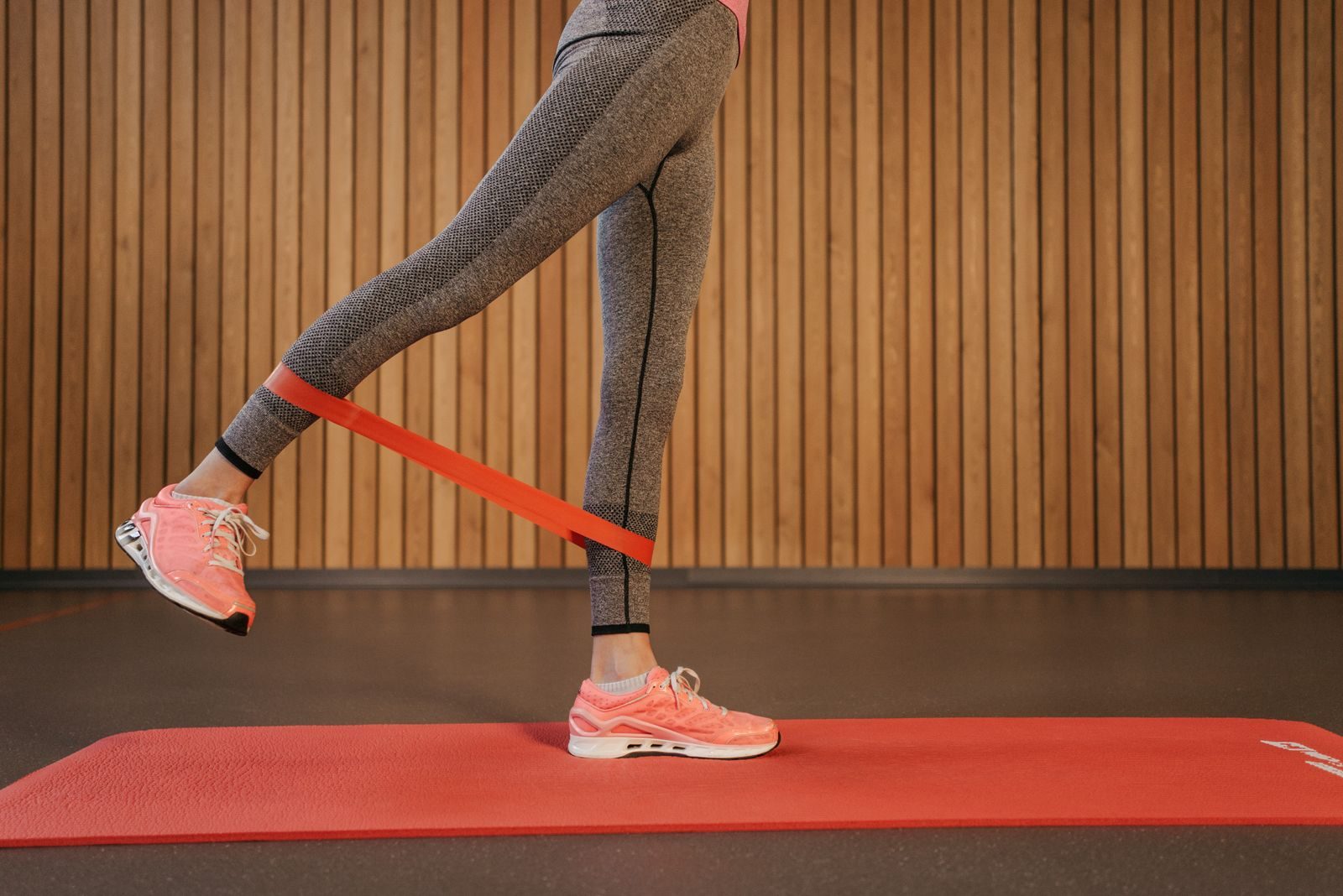
Resistance band hamstring exercises train the backs of your thighs through knee curls and hip hinges. A practical starting routine pairs one curl with one hinge, rather than trying to complete every variation in a single workout.
The hamstrings contribute to both bending your knees and extending your hips, according to Cleveland Clinic.
These seven options cover standing, seated, and floor-based exercises, plus an advanced assisted Nordic curl. Use the instructions below to choose your equipment, learn the movements, and build a manageable routine.
Before You Start
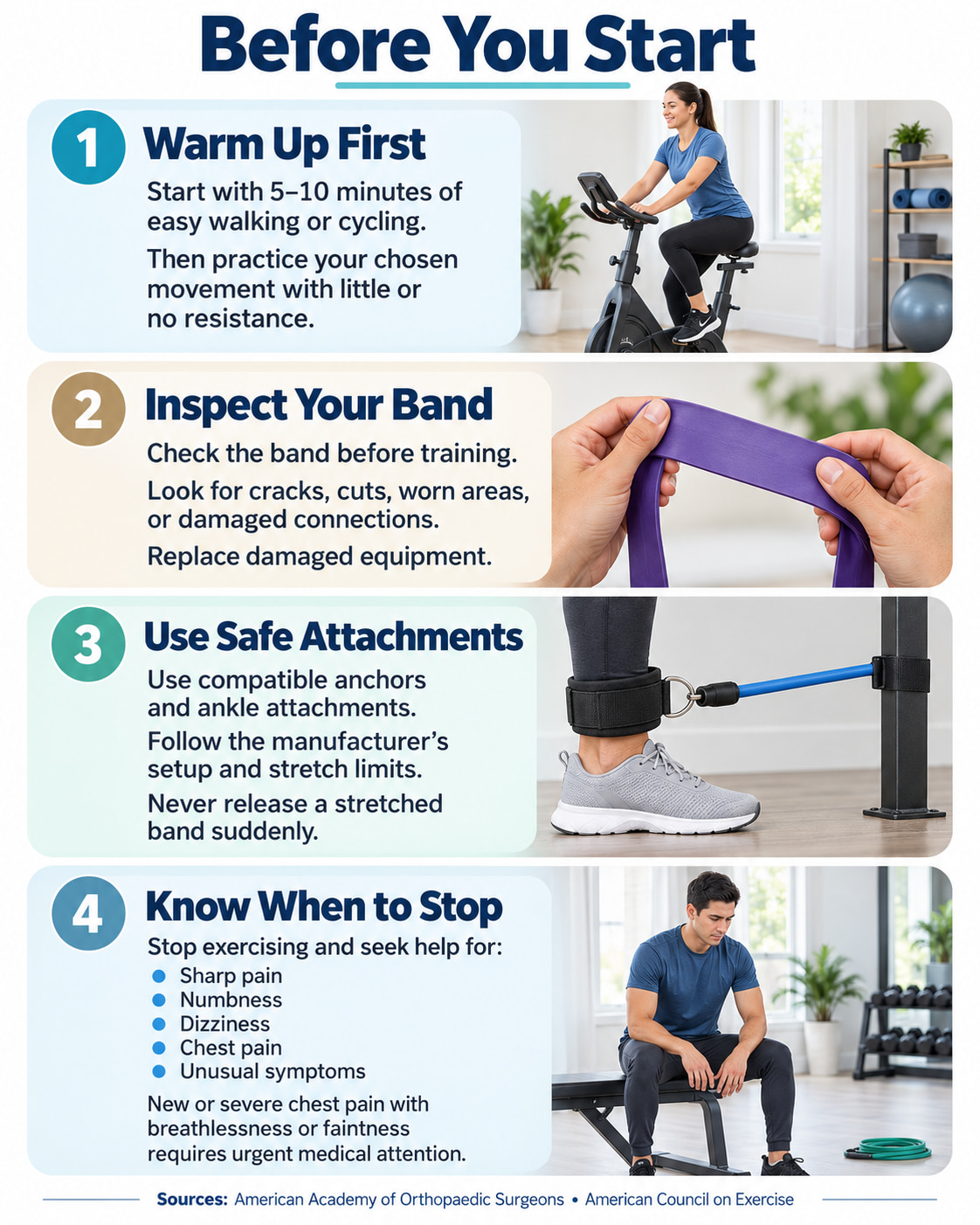
Warm up with 5–10 minutes of easy walking or cycling, as recommended in conditioning guidance from the American Academy of Orthopaedic Surgeons. Then rehearse your chosen movements with little or no resistance.
Check bands for cracks, cuts, and damaged connections. Use compatible anchors and ankle attachments, follow the manufacturer’s installation and stretching limits, and never release a stretched band suddenly. American Council on Exercise guidance also emphasizes checking resistance bands and attachments before training. A regular tube handle should not be slipped over your foot as an ankle attachment.
These exercises are for general strength training, not a hamstring-injury rehabilitation plan. Stop and seek professional help for sharp pain, numbness, dizziness, chest pain, or other unusual symptoms. New or severe chest pain, particularly with breathlessness or faintness, requires urgent medical attention.
7 Best Resistance Band Hamstring Exercises
Choose exercises that match your equipment and current ability. The sets and repetitions below are suggested starting points—not a requirement to perform all seven exercises.
1. Standing Resistance Band Hamstring Curl
Best for: Learning a knee curl without an external anchor.
Muscles worked: Primarily the hamstrings, with the glutes and trunk helping maintain your standing position.
Equipment: A suitable loop resistance band and a stable chair or wall for support.
Sets, reps, and rest: Start with 2 sets of 10–15 repetitions per leg. Rest 60–90 seconds between sets.
How to do it:
- Position the band beneath the middle of your left shoe and around your right ankle. Hold a stable support.
- Stand upright with your left knee slightly bent and your right thigh beside your left.
- Bend your right knee to bring your heel toward your buttock through a comfortable range. Keep your torso and thigh relatively still.
- Slowly lower your foot. Complete your repetitions, then switch sides.
Common mistakes: Swinging the working leg backward, leaning forward, or locking the supporting knee. The movement should come mainly from bending your knee—not kicking from your hip.
Make it easier: Use a lighter band while keeping hand support. Mayo Clinic emphasizes a stable back, a slightly bent supporting knee, and smooth movement in its foot-anchored tubing curl guidance.
2. Seated Resistance Band Hamstring Curl
Best for: Training both legs together without getting down on the floor.
Muscles worked: Primarily the hamstrings.
Equipment: A long-loop band suitable for ankle use, a stable bench, and a compatible low anchor in front.
Sets, reps, and rest: Start with 2 sets of 10–15 repetitions. Rest 60–90 seconds.
How to do it:
- Secure the band to a low anchor in front of the bench. Position the free loop behind both ankles, just above your heels, so it cannot slip off.
- Sit upright with your thighs supported and your knees clear of the bench’s front edge. Hold the bench and extend your lower legs forward without locking your knees.
- Bend both knees to draw your heels back toward the bench. Keep your hips on the seat and avoid rocking backward.
- Slowly extend your knees to return, controlling the band throughout.
Common mistakes: Using a bench that slides toward the anchor, letting the band slip down, or leaning backward to move more resistance.
Make it easier: Reduce the band resistance before shortening the movement. Use the largest comfortable range you can control without moving your torso. The seated, two-leg setup is described in Iron Bull Strength resistance-band exercise guidance.
3. Prone Resistance Band Hamstring Curl
Best for: A lying curl with the torso supported on the floor.
Muscles worked: Primarily the hamstrings, with the calves assisting knee flexion.
Equipment: A mat, a resistance-band system with compatible ankle cuffs, and a low anchor beyond your feet.
Sets, reps, and rest: Start with 2 sets of 10–15 repetitions. Rest 60–90 seconds.
How to do it:
- Secure the band system to a low anchor and attach both ankle cuffs. For a door anchor, follow the manufacturer’s instructions and prevent the door from being opened.
- Lie face down with your legs extended and the anchor beyond your feet. Keep your hips and thighs on the mat, with your hands beside your shoulders.
- Bend both knees to bring your heels toward your buttocks. Stop before you need to lift your hips or arch your back.
- Slowly straighten your knees, resisting the band rather than letting it pull your legs down.
Common mistakes: Lifting the pelvis, pressing the chest upward, or allowing the knees to snap straight during the return.
Alternative: Choose the seated curl when getting onto the floor is inconvenient. The prone, two-leg anchored setup follows published instructions from FITTR.
4. Resistance Band Romanian Deadlift
Best for: A main hip-hinge exercise that trains the hamstrings and glutes without an external anchor.
Muscles worked: Hamstrings and glutes, with the back and abdominal muscles stabilizing the torso.
Equipment: A long-loop resistance band.
Sets, reps, and rest: Start with 2 sets of 8–12 repetitions. Rest 90–120 seconds.
How to do it:
- Stand on the band with both feet approximately hip-width apart. Take an even grip in both hands and stand tall.
- Soften your knees, brace your abdomen, and push your hips backward as your torso inclines forward.
- Keep your hands close to your legs. Lower until you feel a comfortable hamstring stretch or before your back begins to round.
- Press through your feet and bring your hips forward to stand upright. Finish tall without leaning backward.
Common mistakes: Squatting downward instead of moving the hips back, reaching for the floor, or looking straight ahead while your torso tips forward.
Make it easier: Practice the movement without a band first. American Council on Exercise guidance recommends learning an unloaded hip hinge before adding resistance. Your depth should follow your control and mobility—not a fixed floor target.
5. Resistance Band Good Morning
Best for: An alternative hip hinge for exercisers comfortable positioning a band across the upper back.
Muscles worked: Hamstrings and glutes, with the back muscles helping maintain torso position.
Equipment: A long-loop resistance band.
Sets, reps, and rest: Start with 2 sets of 10–15 repetitions. Rest 60–90 seconds.
How to do it:
- Stand on the band with both feet about hip-width apart. Position its upper portion across your upper back and hold it near your shoulders. Keep it off your neck.
- Maintain a small bend in your knees and gently brace your abdomen.
- Push your hips backward while your torso inclines forward. Keep your head aligned with your back and maintain your natural spinal position.
- Bring your hips forward to return upright without leaning backward.
Common mistakes: Turning the movement into a squat, rounding the back, or allowing the band to migrate onto the neck.
Alternative: Use the Romanian deadlift instead when the upper-back band position feels awkward or will not stay secure. GOWOD exercise guidance describes this underfoot, upper-back band setup and hip-hinge movement.
6. Resistance Band Pull-Through
Best for: Training hip extension with resistance pulling from behind rather than from beneath your feet.
Muscles worked: Glutes and hamstrings, with the trunk muscles stabilizing your back.
Equipment: A long resistance band and a compatible low anchor behind you.
Sets, reps, and rest: Start with 2 sets of 10–15 repetitions. Rest 60–90 seconds.
How to do it:
- Secure the band to a low anchor. Face away from it and hold the free end with both hands between your legs.
- Step forward until there is light tension. Set your feet wide enough for your hands to pass comfortably between your thighs.
- Keep your knees softly bent and push your hips backward, allowing your hands to travel behind you while your back stays neutral.
- Press through your feet and extend your hips to stand tall. Let your hips move the band rather than lifting it with your arms.
Common mistakes: Bending the knees into a deep squat, pulling upward with the arms, or leaning backward at the finish. These corrections are consistent with Fysio Fitaal pull-through guidance.
Finishing the set: Step back toward the anchor to reduce tension before releasing the band.
7. Band-Assisted Nordic Hamstring Curl
Best for: Experienced exercisers who want an advanced knee-flexion challenge.
Muscles worked: Primarily the hamstrings, with the glutes and abdominal muscles helping maintain body alignment.
Equipment: A suitable lat-pulldown station, a secure high band attachment, padded kneeling support, and secure ankle restraint.
Sets, reps, and rest: Begin with 1 set of 3–5 controlled repetitions. Build to 2 sets as tolerated, resting about 2 minutes between sets.
Unlike the other exercises, the band assists this movement rather than adding resistance. An assisted Nordic hamstring curl technique described in research from the University of Salford uses elastic assistance to make the exercise more manageable.
How to do it:
- Have a qualified trainer check the station, high band anchor, knee support, and ankle restraint. Face away from the high anchor with your ankles secured beneath the station’s thigh pad.
- Begin tall kneeling. Hold the band with both hands behind your head without letting it press against your neck.
- Brace your abdomen and keep your shoulders, hips, and knees aligned as you slowly lean forward from your knees. Lower only as far as you can control.
- Use your hamstrings and the band’s assistance to return upright without folding at your hips.
Common mistakes: Sitting the hips backward, dropping uncontrollably, or using insufficient assistance. Choose a seated or prone curl instead when the setup cannot be secured.
Progression: Increase your controlled range first. Later, reduce assistance slightly while keeping the same setup. The band-assisted Nordic setup is also demonstrated in exercise guidance from Muscle & Strength.
A Simple Resistance Band Hamstring Workout
Pair one knee curl with one hip hinge. This covers the two hamstring actions most relevant to these exercises: bending the knee and helping extend the hip.
Start with this adjustable routine twice a week on nonconsecutive days:
| Exercise | Working sets | Repetitions | Rest |
|---|---|---|---|
| Resistance band Romanian deadlift | 2 | 8–12 | 90–120 seconds |
| Standing resistance band hamstring curl | 2 | 10–15 per leg | 60–90 seconds |
Finish each set with approximately two or three good repetitions still possible. New exercisers can begin with one set of each movement and add the second set once the routine feels manageable.
The American College of Sports Medicine recommends progressive resistance training for healthy adults and supports training major muscle groups at least twice weekly. Its guidance does not require every set to reach muscular failure.
How to Use the Other Exercises
The seated or prone curl can replace the standing curl. The good morning or pull-through can replace the Romanian deadlift.
Experienced exercisers can introduce the assisted Nordic in place of a regular curl, beginning with its lowest suggested dose. It is an optional progression—not a requirement for an effective routine.
Keep this hamstring work within a broader strength program. When you already perform challenging deadlifts or leg curls elsewhere in the week, adjust this routine rather than automatically adding all its sets.
How to Choose Resistance and Progress
Choose a band that lets you complete the full movement you can comfortably control. The last few repetitions should require effort without swinging, shortening every repetition, or changing your body position.
Record the band, repetitions, anchor position, and starting distance. Band tension changes as the band stretches, so a different setup can change the challenge even when the band stays the same.
A practical progression rule is to reach the top of your repetition range on every set, with consistent form and roughly two repetitions remaining, for two sessions. Then make a small resistance increase and build up from the lower end again.
Change one variable at a time. For assisted Nordics, remember that reducing band assistance—not increasing it—makes the exercise harder.
Frequently Asked Questions
Can resistance bands build hamstring strength and muscle?
Yes. Resistance bands can provide an effective strength-training stimulus when the exercises are sufficiently challenging and progress over time. ACSM’s resistance-training guidance recognizes elastic bands and home-based resistance training as useful options for improving strength and muscle size.
That does not mean every light-band workout provides enough challenge. The resistance and training volume still need to progress as your body adapts.
Can I train my hamstrings without a door anchor?
Yes. The standing curl uses your supporting foot as the anchor, while the Romanian deadlift and good morning use a band secured beneath both feet.
Choose a band suitable for the exercise and keep it firmly positioned beneath your shoes.
Should I do all three hamstring curl variations?
No. Start with the standing, seated, or prone version that best suits your equipment and preferred position. Treat the others as alternatives rather than extra exercises you must add.
Keeping one variation consistent also makes it easier to track your repetitions, resistance, and technique.
Do I need to progress to Nordic curls?
No. Nordic curls are optional. Regular band curls and hip hinges can remain part of your program as long as you can continue increasing their challenge appropriately.
General resistance-training guidance emphasizes progressive effort and consistency rather than requiring a particular advanced exercise.
The Bottom Line
Start with one hamstring curl and one hip hinge, using resistance you can control from the first repetition to the last. Keep the setup consistent, leave a little effort in reserve, and increase the challenge gradually.
For your next session, try the two-exercise routine above. Use the other variations as substitutions—not as a reason to turn a manageable workout into seven exercises.
This content is for informational purposes only and is not a substitute for medical advice.
References
- American College of Sports Medicine. (2026). Resistance Training Prescription for Muscle Function, Hypertrophy, and Physical Performance in Healthy Adults: An Overview of Reviews.
https://pubmed.ncbi.nlm.nih.gov/41843416/ - Lopes, J. S. S., et al. (2019). Effects of training with elastic resistance versus conventional resistance on muscular strength: A systematic review and meta-analysis.
https://pubmed.ncbi.nlm.nih.gov/30815258/ - McAllister, M. J., et al. (2014). Muscle activation during various hamstring exercises.
https://pubmed.ncbi.nlm.nih.gov/24149748/ - Yanagisawa, O., & Fukutani, A. (2020). Muscle Recruitment Pattern of the Hamstring Muscles in Hip Extension and Knee Flexion Exercises.
https://pubmed.ncbi.nlm.nih.gov/32269647/ - Maeo, S., et al. (2024). Hamstrings Hypertrophy Is Specific to the Training Exercise: Nordic Hamstring versus Lengthened State Eccentric Training.
https://pubmed.ncbi.nlm.nih.gov/38857522/ - Matthews, M. J., Jones, P. A., Cohen, D., & Matthews, H. P. (2015). The Assisted Nordic Hamstring Curl.
https://salford-repository.worktribe.com/output/1414890/the-assisted-nordic-hamstring-curl