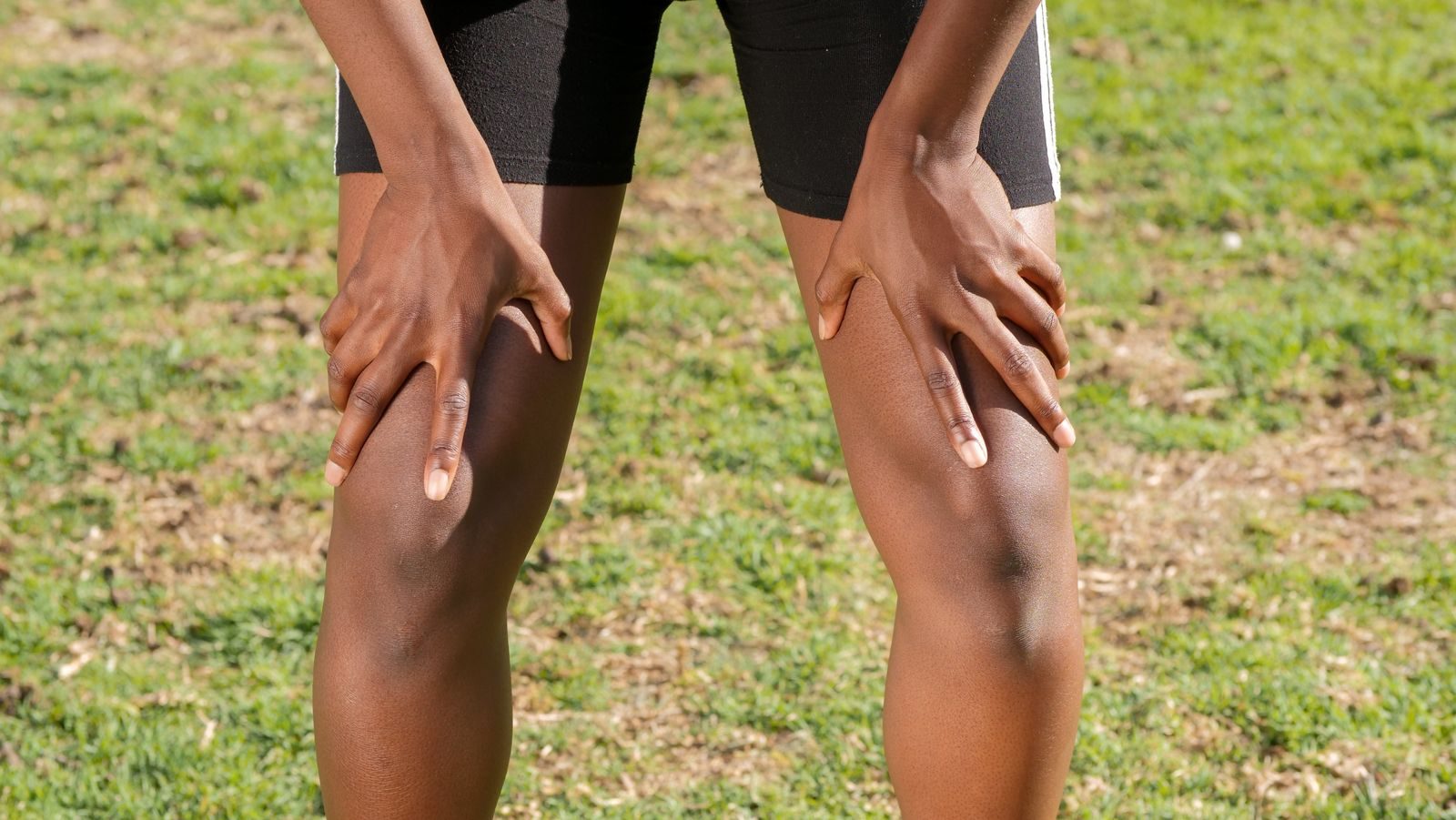
Knee hyperextension exercises help strengthen the muscles that control knee position so your knee can straighten without snapping backward into lockout. The goal is not to force more range of motion. The goal is better stability, stronger hips and legs, and cleaner control during standing, walking, squats, step-ups, and training.
A hyperextended knee happens when the knee bends backward beyond its normal range. If you recently injured your knee, have swelling, sharp pain, giving way, locking, or trouble walking, get checked before using this as a workout plan. Cleveland Clinic warns against trying to “play through” a hyperextended knee because ignoring symptoms can make an injury worse.
This guide covers the best knee hyperextension exercises for stability, the muscles they train, safe form cues, progressions, regressions, and a simple routine you can use once exercise feels comfortable and appropriate.
What Are Knee Hyperextension Exercises?
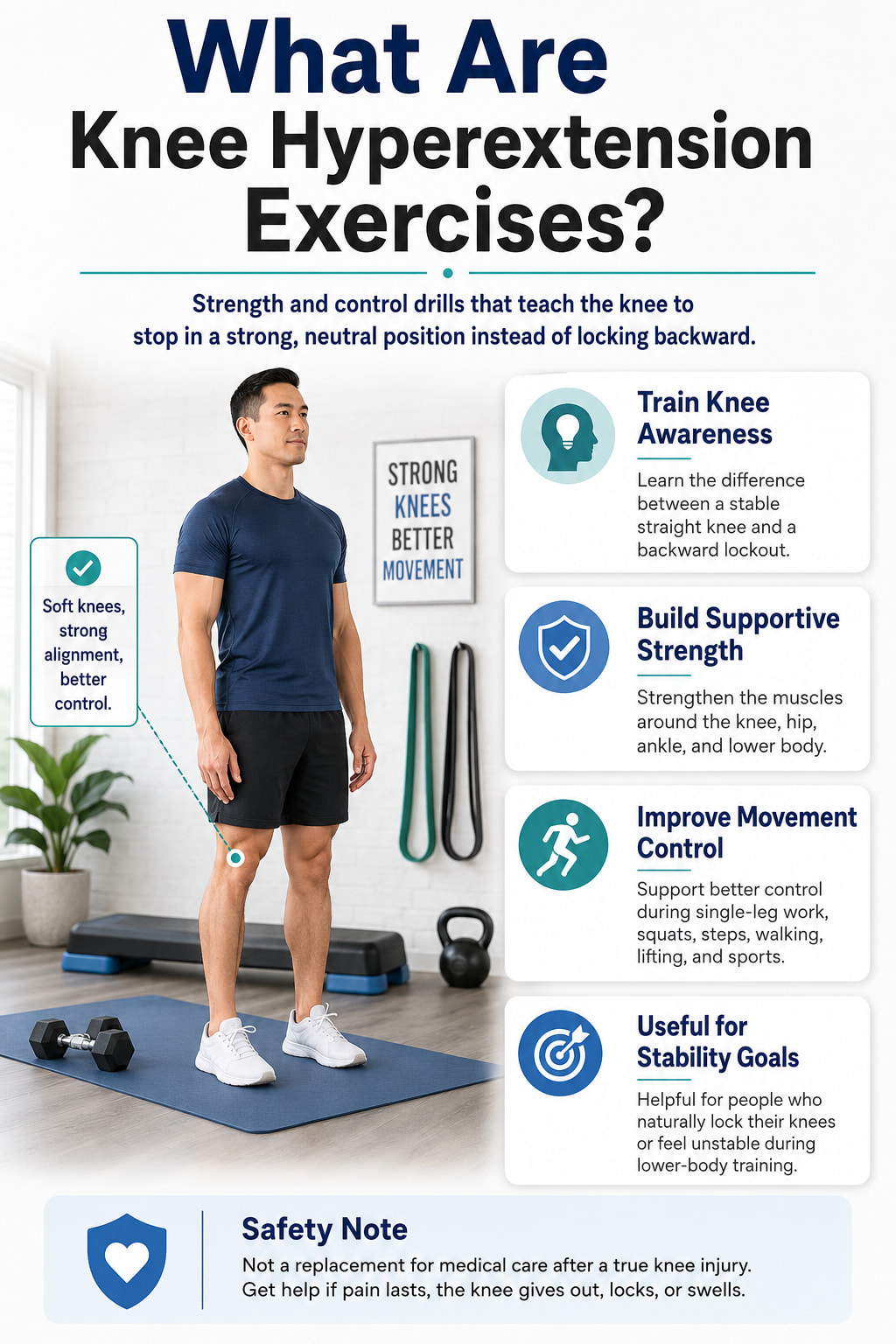
Knee hyperextension exercises are strength and control drills that teach the knee to stop at a strong, neutral position instead of locking backward.
They usually train three things:
- Better awareness of knee position
- Stronger muscles around the knee, hip, and ankle
- More control during single-leg and weight-bearing movements
These exercises are useful for people who naturally stand with locked knees, feel unstable during lower-body training, or want to improve knee control for sports, lifting, walking, or daily movement.
They are not a replacement for medical care after a true knee injury. Hospital for Special Surgery recommends seeking help if knee pain comes from an injury, lasts more than a few weeks, interferes with daily activities, or if the knee feels unstable, gives out, locks, or swells significantly.
Muscles Worked During Knee Hyperextension Exercises
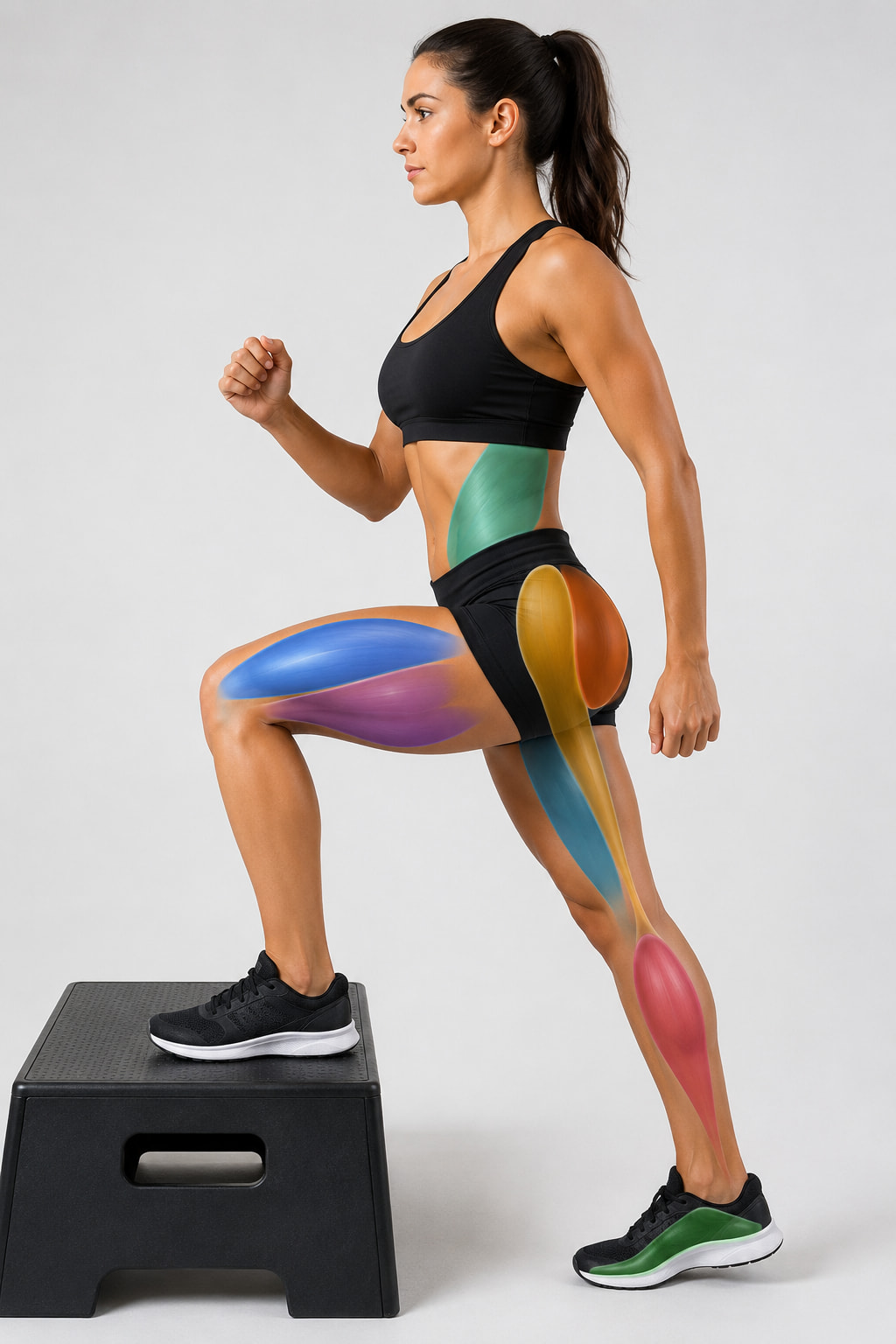
Knee hyperextension control depends on more than the knee joint itself.
The main muscles involved are the quadriceps, hamstrings, glutes, hip abductors, adductors, calves, and deep core muscles.
The quadriceps help straighten and control the knee. The hamstrings help resist the knee from snapping too far backward. The glutes and hip stabilizers help keep the thigh, knee, and foot aligned during squats, steps, and single-leg work. The calves and foot muscles help control pressure through the ground, which can affect how the knee tracks.
A good knee stability plan should include both front-of-thigh and back-of-thigh work. Training only the quads without strengthening the hamstrings and hips can leave gaps in control.
How to Train Safely With Knee Hyperextension
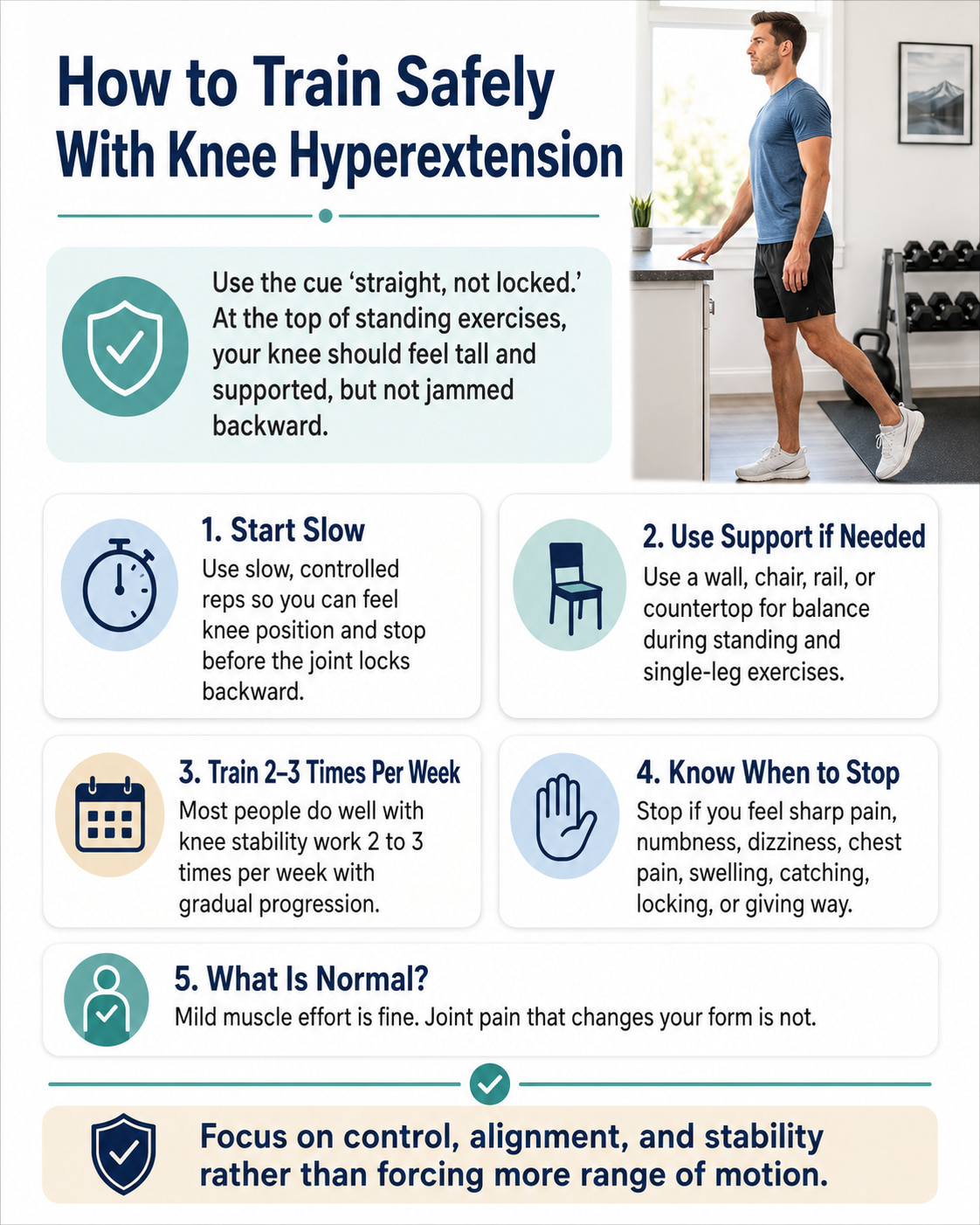
Use the cue “straight, not locked.” At the top of standing exercises, your knee should feel tall and supported, but not jammed backward.
Start with slow reps. Use a wall, chair, rail, or countertop for balance when needed. Most people do well with knee stability work 2 to 3 times per week, which matches HSS guidance for knee strengthening frequency and gradual progression.
Stop the exercise if you feel sharp pain, numbness, dizziness, chest pain, unusual symptoms, swelling, catching, locking, or a giving-way feeling. Mild muscle effort is fine. Joint pain that changes your form is not.
10 Best Knee Hyperextension Exercises for Stability
These knee hyperextension exercises focus on building control, strength, and stability around the knees, hips, and lower body.
The goal is to help you straighten your knees safely without snapping into lockout or losing alignment during movement.
1. Soft-Knee Alignment Drill
Best for: Learning how to stand tall without locking the knees backward.
Muscles worked: Quadriceps, hamstrings, glutes, calves, foot stabilizers, and core.
Equipment needed: Mirror, wall, or sturdy chair for feedback.
Why it stands out: This is the foundation exercise. Many people with knee hyperextension do not realize when the knee is locked. This drill teaches you to feel the difference between a strong straight leg and an overextended knee.
Suggested sets and reps: Do 2 to 3 sets of 5 to 8 slow position changes per side.
Rest: Rest 30 to 45 seconds between sets.
How to do it:
- Stand tall with your feet hip-width apart.
- Gently straighten your knees without pushing them backward.
- Slightly soften the knees until you feel the quads and hamstrings share control.
- Stack your ribs over your pelvis and keep your weight through the middle of each foot.
- Shift your weight slightly from side to side without letting either knee snap backward.
- Hold the controlled position for 3 to 5 seconds, then reset.
Common mistakes: Pushing the knees backward, gripping the toes, leaning the hips forward, or holding the breath.
Expert tip: Think of your knees as “quiet and tall,” not locked. You should feel supported through the whole leg, not jammed into the back of the knee.
2. Straight-Leg Raise
Best for: Building basic quadriceps control without standing load.
Muscles worked: Quadriceps, hip flexors, core, and lower-leg stabilizers.
Equipment needed: Exercise mat.
Why it stands out: The straight-leg raise is a low-load way to train the quadriceps while keeping the knee controlled. MSD Manual describes the exercise by contracting the quadriceps, raising the straight leg to thigh level, and lowering slowly with control.
Suggested sets and reps: Do 2 to 3 sets of 8 to 12 reps per side.
Rest: Rest 45 to 60 seconds between sets.
How to do it:
- Lie on your back with one knee bent and the working leg straight.
- Gently brace your core and tighten the front of the working thigh.
- Lift the straight leg until it reaches about the height of the opposite thigh.
- Pause briefly while keeping the kneecap facing upward.
- Lower slowly without dropping the leg.
- Reset and repeat.
Common mistakes: Lifting too high, arching the lower back, letting the knee bend, or forcing the knee into hard lockout.
Expert tip: Before you lift, gently tighten the thigh as if you are pulling the kneecap upward. Keep the movement slow enough to control the lowering phase.
3. Banded Terminal Knee Extension to Neutral
Best for: Training the knee to finish extension without snapping backward.
Muscles worked: Quadriceps, hamstrings, calves, glutes, and foot stabilizers.
Equipment needed: Light resistance band and a stable anchor point.
Why it stands out: This drill trains the final part of knee extension, which is where many people lose control and fall into hyperextension. The key is to stop at neutral, not push past it.
Suggested sets and reps: Do 2 to 3 sets of 10 to 15 controlled reps per side.
Rest: Rest 45 to 60 seconds between sets.
How to do it:
- Anchor a light band behind knee height.
- Loop the band behind one knee and step forward to create gentle tension.
- Start with the working knee slightly bent.
- Slowly straighten the knee until the leg is tall and neutral.
- Pause without locking backward.
- Bend the knee slightly and repeat.
Common mistakes: Snapping the knee back, using too much band tension, leaning the torso, or lifting the heel.
Expert tip: Imagine the back of your knee moving toward the band, then stopping before it jams. The finish should feel muscular, not passive.
4. Glute Bridge
Best for: Strengthening the glutes and hamstrings to support knee control.
Muscles worked: Gluteus maximus, hamstrings, core, adductors, and lower back stabilizers.
Equipment needed: Exercise mat.
Why it stands out: Strong glutes help control hip position, which affects knee alignment. A bridge also teaches posterior-chain engagement without placing heavy load through the knee.
Suggested sets and reps: Do 2 to 4 sets of 10 to 15 reps.
Rest: Rest 45 to 75 seconds between sets.
How to do it:
- Lie on your back with knees bent and feet flat.
- Place your feet about hip-width apart.
- Brace your core gently and press through your heels.
- Lift your hips until your body forms a straight line from shoulders to knees.
- Pause and squeeze your glutes.
- Lower slowly and repeat.
Common mistakes: Arching the lower back, pushing through the toes, letting the knees collapse inward, or lifting too high.
Expert tip: Keep your ribs down as you lift. You should feel glutes and hamstrings, not pressure in the lower back.
5. Stability Ball Hamstring Curl
Best for: Building hamstring strength to help control knee extension.
Muscles worked: Hamstrings, glutes, calves, and core.
Equipment needed: Stability ball.
Why it stands out: The hamstrings help control the back side of the knee. ACE lists the stability ball hamstring curl as a butt, hip, and thigh exercise and cues keeping the torso stable while the hamstrings pull the heels toward the hips.
Suggested sets and reps: Do 2 to 3 sets of 8 to 12 reps.
Rest: Rest 60 to 90 seconds between sets.
How to do it:
- Lie on your back with your heels on a stability ball.
- Brace your core and lift your hips into a bridge.
- Keep your hips level as you bend your knees.
- Pull the ball toward your hips using your hamstrings.
- Slowly roll the ball away without dropping your hips.
- Repeat with controlled tempo.
Common mistakes: Letting the hips sag, rushing the roll-out, cramping the calves, or arching the lower back.
Expert tip: Keep the movement smooth. The hardest part is often the slow extension back out, so do not let the ball pull you into a sloppy finish.
6. Hip Hinge
Best for: Teaching the hips and hamstrings to share load instead of dumping stress into the knees.
Muscles worked: Hamstrings, glutes, erector spinae, adductors, core, and calves.
Equipment needed: Dowel, broomstick, dumbbells, or kettlebell when progressed.
Why it stands out: A good hinge strengthens the posterior chain and teaches you to move from the hips while keeping the knees softly bent. ACE describes the hip hinge as a beginner exercise that uses a slight knee bend while the hips move backward.
Suggested sets and reps: Do 2 to 4 sets of 8 to 12 reps.
Rest: Rest 60 to 90 seconds between sets.
How to do it:
- Stand with feet hip-width apart.
- Soften your knees without letting them move backward.
- Push your hips back as your torso leans forward.
- Keep your spine neutral and weight through midfoot to heel.
- Stop when you feel tension in the hamstrings.
- Drive the hips forward to stand tall without locking the knees.
Common mistakes: Squatting too much, rounding the back, locking the knees, or leaning onto the toes.
Expert tip: Think “hips back, knees soft.” The knees bend slightly, but the hips do most of the movement.
7. Lateral Band Walk
Best for: Improving hip stability and knee tracking.
Muscles worked: Gluteus medius, gluteus minimus, gluteus maximus, quadriceps, hamstrings, calves, and core.
Equipment needed: Mini resistance band.
Why it stands out: The glute medius helps control the thigh so the knee does not collapse inward or drift into unstable positions. HSS includes monster walks and side steps in knee-strengthening guidance and cues keeping the knees aligned over the feet.
Suggested sets and reps: Do 2 to 3 sets of 8 to 15 steps each direction.
Rest: Rest 45 to 75 seconds between sets.
How to do it:
- Place a mini band above your knees or around your ankles.
- Stand with feet about hip-width apart.
- Soften your knees and push your hips back slightly.
- Step sideways under control.
- Bring the other foot in without losing band tension.
- Continue for the planned steps, then switch directions.
Common mistakes: Letting the knees cave in, dragging the feet, standing too upright, or using a band that is too heavy.
Expert tip: Keep your kneecaps pointing in the same direction as your toes. Small clean steps are better than big sloppy steps.
8. Box Squat
Best for: Building controlled squat strength with a clear depth target.
Muscles worked: Quadriceps, glutes, hamstrings, adductors, calves, and core.
Equipment needed: Box, bench, or sturdy chair.
Why it stands out: The box squat helps beginners control depth, foot pressure, and knee position. It is also useful for people who tend to lock their knees aggressively at the top of regular squats.
Suggested sets and reps: Do 2 to 4 sets of 6 to 12 reps.
Rest: Rest 60 to 90 seconds between sets.
How to do it:
- Stand in front of a box or chair with feet about shoulder-width apart.
- Brace your core and soften your knees.
- Sit your hips back and lower under control.
- Keep your knees tracking over your toes.
- Lightly touch the box or sit with control.
- Stand by pressing through your feet and stop tall without locking backward.
Common mistakes: Dropping onto the box, knees collapsing inward, lifting the heels, or snapping the knees at the top.
Expert tip: Finish each rep by squeezing the glutes and standing tall, but keep a tiny softness in the knees.
9. Step-Up
Best for: Building single-leg strength, balance, and knee alignment.
Muscles worked: Quadriceps, glutes, hamstrings, calves, adductors, and core.
Equipment needed: Low step, sturdy box, or staircase.
Why it stands out: Step-ups train the knee to stay aligned while one leg supports most of the work. This is useful for stairs, hiking, running, field sports, and everyday movement.
Suggested sets and reps: Do 2 to 3 sets of 6 to 10 reps per side.
Rest: Rest 60 to 90 seconds between sets.
How to do it:
- Stand facing a low step.
- Place one foot fully on the step.
- Keep your knee tracking over the middle toes.
- Press through the whole foot to stand up.
- Pause at the top without locking the knee backward.
- Step down slowly and repeat.
Common mistakes: Pushing off too much from the back foot, knee collapsing inward, using a step that is too high, or snapping into lockout at the top.
Expert tip: The working leg should do most of the job. If you need to jump off the back foot, lower the step height.
10. Single-Leg Balance With Reach
Best for: Improving balance, proprioception, and knee control.
Muscles worked: Glutes, quadriceps, hamstrings, calves, foot stabilizers, and core.
Equipment needed: Wall, chair, or cone for support and target.
Why it stands out: Knee stability is not only about strength. You also need control when your weight shifts. This drill teaches the foot, ankle, knee, and hip to work together while the knee stays softly unlocked.
Suggested sets and reps: Do 2 to 3 sets of 5 to 8 reaches per side.
Beginners: Keep one hand on a wall or chair.
How to do it:
- Stand tall near a wall or chair.
- Shift your weight onto one foot.
- Keep the standing knee softly bent.
- Reach the free foot forward and lightly tap the floor.
- Return to center without locking the standing knee.
- Repeat in different directions if control stays strong.
Common mistakes: Locking the standing knee, letting the hip drop, rushing the reach, or gripping the floor with the toes.
Expert tip: Keep the standing knee pointing over the second and third toes. The goal is quiet control, not a large reach.
Beginner Knee Hyperextension Stability Workout
Use this routine 2 to 3 times per week on nonconsecutive days. The CDC recommends adults perform muscle-strengthening activities at least 2 days per week, and this routine can fit into that broader strength-training goal.
| Exercise | Sets | Reps |
|---|---|---|
| Soft-Knee Alignment Drill | 2 | 5 to 8 per side |
| Straight-Leg Raise | 2 | 8 to 12 per side |
| Glute Bridge | 3 | 10 to 15 |
| Lateral Band Walk | 2 | 8 to 12 steps each way |
| Box Squat | 2 to 3 | 8 to 10 |
| Single-Leg Balance With Reach | 2 | 5 reaches per side |
Rest 45 to 90 seconds between exercises. Keep the effort around 5 to 7 out of 10. You should finish each set feeling like you could do 2 to 4 more clean reps.
How to Progress Safely
Progress one variable at a time. Do not add load, range, reps, and balance challenge all at once.
A simple progression plan looks like this:
Week 1 to 2: Learn the soft-knee position and use easy ranges.
Week 3 to 4: Add reps, pauses, and slower lowering phases.
Week 5 and beyond: Add light resistance, lower support, or more single-leg work.
Move forward only when the knee feels stable, your form looks consistent, and you can finish the exercise without snapping into hyperextension.
Common Mistakes to Avoid
Locking the Knees at the Top
This is the main mistake. Standing tall is good. Jamming the knee backward is not. Finish each rep with active muscle control.
Using Exercises That Are Too Advanced
Jumping into deep lunges, high step-ups, or single-leg deadlifts too soon can make control worse. Start with easier drills and earn the next level.
Ignoring the Hips
The knee often follows what the hip allows. Weak or poorly controlled glutes can make the knee drift inward, rotate, or feel unstable.
Training Through Pain
Muscle effort is expected. Sharp joint pain, swelling, catching, locking, or giving way is not. Stop and get professional guidance if symptoms appear.
Moving Too Fast
Fast reps hide poor control. Slow tempo makes it easier to feel whether your knee is stopping at neutral or snapping backward.
How Often Should You Do Knee Hyperextension Exercises?
Most people can start with 2 to 3 sessions per week. Keep at least one day between harder lower-body stability sessions.
If you are using the soft-knee alignment drill as a posture cue, you can practice it briefly every day. For strengthening moves like box squats, step-ups, hamstring curls, and hinges, give your muscles time to recover.
A good rule is simple: practice control often, train strength progressively, and avoid chasing fatigue when your form starts to break down.
Who Should Be Careful With These Exercises?
Be careful if you recently hyperextended your knee, had a ligament injury, had surgery, feel unstable while walking, or have swelling that does not improve.
You should get medical or physical therapy guidance before exercising if your knee gives way, locks, catches, looks deformed, has major swelling, or cannot bear weight normally. Cleveland Clinic lists extreme pain, worsening swelling, discoloration, and inability to move the knee as reasons to seek emergency care.
FAQs
Can exercises fix knee hyperextension?
Exercises may help improve strength, awareness, and control, but they do not “fix” every cause of knee hyperextension. If your knee hyperextension comes from injury, ligament laxity, pain, or a medical condition, get professional guidance.
What is the best exercise for knee hyperextension?
The best starting exercise is the soft-knee alignment drill because it teaches the exact position you need to control. After that, glute bridges, straight-leg raises, banded terminal knee extensions to neutral, hamstring curls, and box squats are strong options.
Should I lock my knees during these exercises?
No. The goal is to stand tall without pushing the knee backward. Think “straight but not locked” at the top of squats, step-ups, bridges, and balance drills.
Are squats bad for knee hyperextension?
Squats are not automatically bad. A controlled box squat can be useful because it teaches knee alignment, hip control, and a strong finish. The problem is standing up and snapping the knees into lockout.
Do hamstrings help with knee hyperextension?
Yes. The hamstrings help control the back of the thigh and knee. Strengthening them with bridges, hip hinges, and hamstring curls can support better knee control.
Can I do these exercises after a hyperextended knee injury?
Only if the injury is mild, symptoms are improving, and you have been cleared to exercise. If you have swelling, instability, sharp pain, or trouble walking, get evaluated first.
Conclusion
Knee hyperextension exercises should teach control, not force range. Start with soft-knee awareness, then build strength through the quads, hamstrings, glutes, hips, calves, and core. Use slow reps, clean alignment, and a “straight but not locked” finish on every exercise.
Train 2 to 3 times per week, progress gradually, and stop if your knee becomes painful, swollen, unstable, locked, or difficult to move.
This content is for informational purposes only and is not a substitute for professional medical advice.