BOSU ball ab exercises can be an excellent way to train your abs, obliques, and deeper trunk stabilizers while also challenging balance and control. The reason they work so well is simple: the unstable surface makes your core work harder to resist wobbling, which can make basic movements like planks, crunches, and V-sits feel much more demanding when done with good form. The American Council on Exercise notes that core work is the number one use for the BOSU Balance Trainer, while Mayo Clinic explains that core training involves the abdominal muscles, back muscles, and muscles around the pelvis working together to create stability.
In practice, the best BOSU ball ab exercises are not the flashiest ones. They are the ones that help you brace better, control spinal position, and progress safely from simple holds to more dynamic movements. Below, you will learn which BOSU ab exercises are worth doing, which muscles they target, how to perform them correctly, and how to turn them into a practical workout.
Why BOSU Ball Ab Exercises Work
A strong core is not just about the front of your abs. Your core includes the abdominal wall, muscles around the spine, and muscles around the pelvis and hips. According to Mayo Clinic, stronger core muscles make many physical activities easier, while the American Council on Exercise highlights that the BOSU’s unstable surface can make movements easier or harder depending on the setup. That combination makes the BOSU especially useful for building stability, body awareness, and controlled core strength.
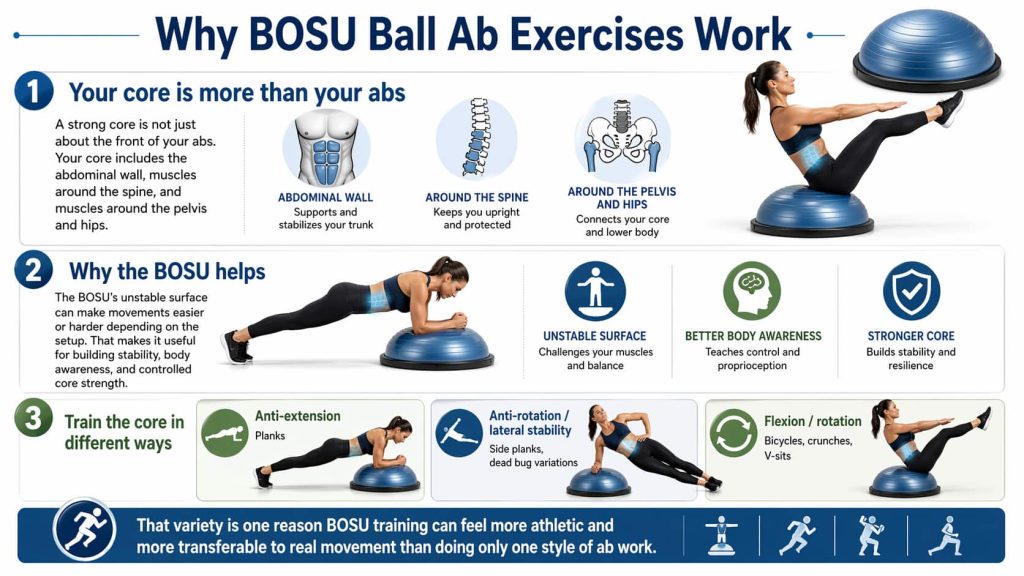
The BOSU is also useful because it lets you train the core in several ways instead of relying on endless crunches. Some exercises challenge anti-extension control, like planks. Some challenge anti-rotation or lateral stability, like side planks and dead bug variations. Others add trunk flexion or rotation, like bicycles, crunches, and V-sits. That variety is one reason BOSU training can feel more athletic and more transferable to real movement than doing only one style of ab work.
How to Choose the Best BOSU Ball Ab Exercises
The easiest way to build a useful BOSU ab routine is to include one move from each of these buckets:
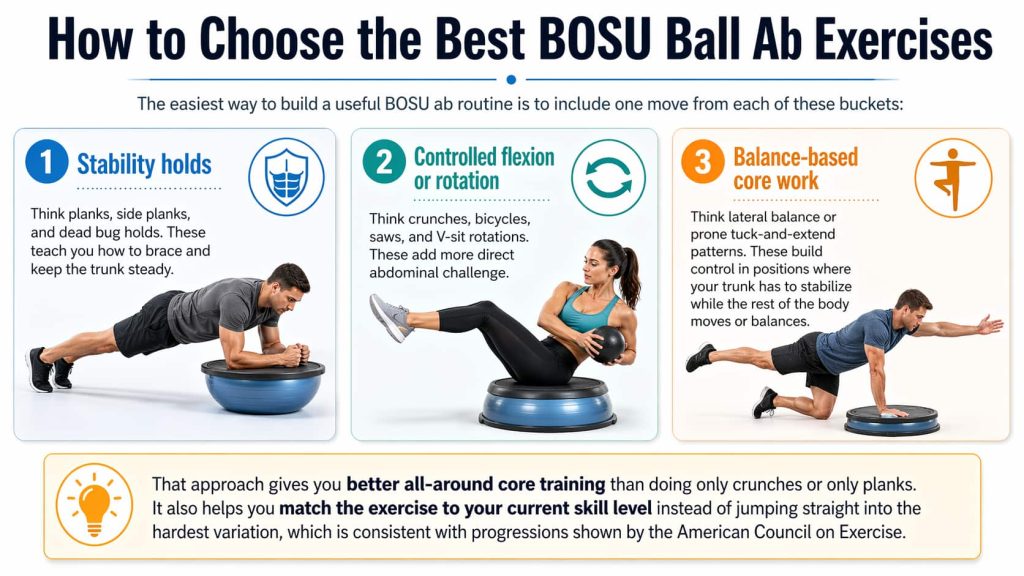
1. Stability holds
Think planks, side planks, and dead bug holds. These teach you how to brace and keep the trunk steady.
2. Controlled flexion or rotation
Think crunches, bicycles, saws, and V-sit rotations. These add more direct abdominal challenge.
3. Balance-based core work
Think lateral balance or prone tuck-and-extend patterns. These build control in positions where your trunk has to stabilize while the rest of the body moves or balances.
That approach gives you better all-around core training than doing only crunches or only planks. It also helps you match the exercise to your current skill level instead of jumping straight into the hardest variation, which is consistent with progressions shown by the American Council on Exercise.
7 Best BOSU Ball Ab Exercises
Build a stronger, more stable core with these 7 best BOSU ball ab exercises for abs, obliques, balance, and better trunk control. This list covers proper form, muscles worked, common mistakes, and practical workout tips to help you train your core more effectively.
1. BOSU Forearm Plank
Best for: Building foundational core stiffness, anti-extension strength, and better full-body bracing.
Muscles worked: Transverse abdominis, rectus abdominis, obliques, glutes, shoulders, and deep trunk stabilizers.
Equipment needed: BOSU ball.
Why it stands out: This is one of the best BOSU ball ab exercises for beginners because it teaches you how to create tension through the trunk without a lot of movement. Once you can hold a stable plank on the BOSU, other BOSU ab variations become much easier to control.
Suggested sets and reps: Beginners: 2–3 sets of 15–20 seconds. Intermediate: 3 sets of 20–30 seconds. Advanced: 3–4 sets of 30–45 seconds.
How to do it:
- Place the BOSU on the floor with the flat platform down.
- Put your forearms on the dome and step your feet back into a plank.
- Keep your shoulders stacked over your elbows.
- Brace your abs and squeeze your glutes.
- Hold a straight line from head to heels without letting the lower back sag.
Common mistakes: Letting the hips drop, piking the hips too high, holding your breath, or treating the exercise like a shoulder hold instead of a full-body brace.
Coaching cue: Pull your ribs down, squeeze your glutes, and make your body feel like one solid plank.
Exercise variations:
- Easier variation: BOSU plank from the knees.
- Harder variation: BOSU forearm plank with alternating toe taps or longer holds.
How to use in a workout: Place it early in the session as your first stability drill or at the end as a core finisher. BOSU and the American Council on Exercise both use plank-style BOSU work as a practical way to challenge stability and endurance.
2. BOSU Side Plank
Best for: Training the obliques, lateral core stability, and anti-side-bend strength.
Muscles worked: Obliques, transverse abdominis, quadratus lumborum, glutes, and shoulder stabilizers.
Equipment needed: BOSU ball.
Why it stands out: Side planks fill a gap that many ab routines miss. They train the muscles along the side of the trunk, which matter for posture, trunk control, and resisting side-to-side collapse.
Suggested sets and reps: Beginners: 2 sets of 10–15 seconds per side. Intermediate: 2–3 sets of 20–30 seconds per side. Advanced: 3 sets of 30–45 seconds per side.
How to do it:
- Place one forearm on top of the BOSU dome with the elbow directly under the shoulder.
- Stack your shoulders vertically.
- Extend your legs and stack your feet.
- Tighten your abs and glutes.
- Hold your body in a straight line from head to heels.
- Repeat on the other side.
Common mistakes: Letting the hips drop, rotating the chest downward, or placing the elbow too far from the shoulder.
Coaching cue: Drive the floor away through your forearm and keep your top hip lifted.
Exercise variations:
- Easier variation: Bend the bottom knee for support.
- Harder variation: Add a controlled torso rotation or top-leg lift.
How to use in a workout: Pair it with front planks or crunch variations to cover both front and side core work in the same session. The American Council on Exercise and Mayo Clinic both emphasize straight-line alignment and abdominal bracing in side plank work.
3. BOSU Dead Bug Hold
Best for: Learning anti-rotation control, core bracing, and pelvic stability.
Muscles worked: Transverse abdominis, obliques, rectus abdominis, hip stabilizers, and deep trunk stabilizers.
Equipment needed: BOSU ball.
Why it stands out: Dead bug variations are excellent for teaching control without spinal sloppiness. BOSU uses this progression to create a bigger balance challenge, making it a strong choice for people who want smarter, not just harder, ab training.
Suggested sets and reps: Beginners: 2 sets of 5 reps per side. Intermediate: 2–3 sets of 6–8 reps per side. Advanced: 3 sets of 8–10 reps per side or add a light offset load.
How to do it:
- Sit on the front third of the BOSU with the dome side up.
- Lean back until your low back is at the top of the dome.
- Lift one knee so it is bent above the hip.
- Brace your trunk and resist rotation.
- Add one or both arms overhead for more challenge.
- Alternate slow, controlled reps side to side.
Common mistakes: Letting the ribs flare, rotating the torso, rushing the arm motion, or losing the low-back position.
Coaching cue: Stay quiet through the torso while the arms and legs move.
Exercise variations:
- Easier variation: Keep one foot on the floor.
- Harder variation: Lift both legs into dead bug and move one arm away from center or hold a light dumbbell.
How to use in a workout: Use it near the start of your core session as a control drill before more dynamic BOSU ab exercises.
4. BOSU Double Crunch
Best for: Directly training the front of the abs with a larger range of controlled trunk flexion.
Muscles worked: Rectus abdominis, transverse abdominis, and hip flexors.
Equipment needed: BOSU ball.
Why it stands out: The dome supports the low back while adding balance demand, which makes the crunch feel different from a floor crunch. Done well, it is a strong direct-ab option rather than just a momentum-based burner.
Suggested sets and reps: Beginners: 2 sets of 6–10 reps. Intermediate: 2–3 sets of 10–15 reps. Advanced: 3 sets of 12–15 reps with slower lowering.
How to do it:
- Center the small of your back on the dome.
- Bring your knees to a 90-degree bend over the hips.
- Keep your neck neutral and hands light behind your head.
- Extend the trunk slightly.
- Curl the chest toward the legs while slightly lifting the hips.
- Pause, then lower slowly.
Common mistakes: Yanking on the neck, swinging the legs, moving too fast, or collapsing into the BOSU instead of controlling the descent.
Coaching cue: Curl through the abs, not through the neck.
Exercise variations:
- Easier variation: Keep the feet on the floor.
- Harder variation: Hold the feet off the floor for the full set.
How to use in a workout: Put it after planks or dead bug work when you want more direct rectus abdominis fatigue. The American Council on Exercise includes it as a core-focused BOSU staple and recommends simple regressions like keeping the feet supported.
5. BOSU Crunch and Reach
Best for: Combining an ab crunch with trunk control and overhead reaching.
Muscles worked: Rectus abdominis, transverse abdominis, and shoulder stabilizers.
Equipment needed: BOSU ball.
Why it stands out: This variation adds a reach phase after the crunch, which increases the challenge to trunk control and helps prevent turning every rep into a tiny, rushed ab pulse.
Suggested sets and reps: Beginners: 2 sets of 6–8 reps. Intermediate: 2–3 sets of 8–12 reps. Advanced: 3 sets of 10–15 reps.
How to do it:
- Start in a balanced dead bug-style position with the low back centered on the dome.
- Ground your feet to the floor.
- Cross your arms over your chest.
- Crunch up.
- Lean back while keeping the shoulder blades off the dome.
- Reach the arms overhead.
- Bring the arms back in and repeat.
Common mistakes: Dropping fully onto the dome between reps, arching too much during the reach, or losing abdominal tension as the arms go overhead.
Coaching cue: Crunch up with control, then reach long without letting the ribs pop up.
Exercise variations:
- Easier variation: Shorten the overhead reach.
- Harder variation: Keep the feet lighter on the floor or slow the eccentric.
How to use in a workout: This works well in the middle of a circuit after a stability hold and before a rotational movement. BOSU uses it as a primary core exercise in its official core workout.
6. BOSU Supine Bicycle
Best for: Training the abs and obliques through a controlled rotating pattern.
Muscles worked: Rectus abdominis, obliques, transverse abdominis, and hip flexors.
Equipment needed: BOSU ball.
Why it stands out: The BOSU version adds instability to a familiar bicycle pattern, which makes trunk control and pacing much more important than on the floor.
Suggested sets and reps: Beginners: 2 sets of 6 rotations per side. Intermediate: 2–3 sets of 8–10 rotations per side. Advanced: 3 sets of 10–12 rotations per side.
How to do it:
- Center your low back on the dome.
- Bring the knees to 90 degrees above the hips.
- Keep your neck neutral and slightly curl the trunk.
- Start a small bicycle motion with the legs.
- Once stable, rotate the trunk toward the bent knee.
- Alternate slowly side to side.
Common mistakes: Turning it into a fast cardio drill, over-rotating from the elbows, or losing the curl position between reps.
Coaching cue: Move slowly enough that the BOSU does not wobble wildly under you.
Exercise variations:
- Easier variation: Do the bicycle with little or no rotation.
- Harder variation: Increase the range of motion only if you can keep control.
How to use in a workout: Great as your main rotational core exercise for the day. The American Council on Exercise specifically uses a small bicycling motion first, then adds trunk rotation once control is established.
7. BOSU V-Sit With Trunk Rotation
Best for: Building seated core balance, oblique control, and trunk coordination.
Muscles worked: Rectus abdominis, obliques, hip flexors, and deep stabilizers.
Equipment needed: BOSU ball.
Why it stands out: This exercise blends balance and rotation, which makes it more demanding than a standard seated twist. It is especially useful for intermediate lifters who already own basic planks and crunches.
Suggested sets and reps: Beginners: 2 sets of 6 rotations per side with one foot down. Intermediate: 2–3 sets of 8–10 rotations per side. Advanced: 3 sets of 10–12 rotations per side.
How to do it:
- Sit with your hips centered on top of the dome.
- Place your hands on the sides of the BOSU for balance.
- Bend your knees and place your toes lightly on the floor.
- Lean back slightly with a neutral spine.
- Lift the feet into a V-sit balance.
- Tilt the legs to one side and the torso to the other.
- Reverse and continue alternating.
Common mistakes: Rounding the lower back, jerking through the rotation, or lifting both feet before earning balance.
Coaching cue: Stay tall through the chest and rotate with control, not momentum.
Exercise variations:
- Easier variation: Keep one foot or both feet on the floor.
- Harder variation: Lift both feet for the full set and slow each side-to-side transition.
How to use in a workout: Use it after a plank and one flexion move for a more athletic-feeling oblique challenge. The American Council on Exercise includes this regression strategy and emphasizes maintaining a straight back while rotating side to side.
Common BOSU Ball Ab Exercise Mistakes
The biggest BOSU ab mistake is trying to make every movement harder by going faster. On an unstable surface, speed often turns into sloppiness. A better approach is to slow down, control the wobble, and only add range of motion or instability once you can keep a neutral neck and a steady trunk. The American Council on Exercise repeatedly cues neutral neck positioning and gradual progression on BOSU exercises, while Mayo Clinic stresses breathing freely and keeping good trunk alignment during core training.
Another common mistake is choosing advanced seated or rotational variations before you own simpler drills like planks, side planks, and supported dead bug positions. Start with stable holds, then layer in crunching, rotation, and balance-based challenges. That progression tends to improve form and makes the workout feel more productive, which lines up well with BOSU progressions shown by BOSU.
How to Build a BOSU Ball Ab Workout
A practical BOSU ab workout usually needs only 3 to 5 exercises. Pick one front-body stability move, one side-core move, one flexion or rotation move, and optionally one balance-based finisher.
Beginner option
- BOSU Forearm Plank: 2–3 sets of 15–20 seconds
- BOSU Dead Bug Hold: 2 sets of 5 reps per side
- BOSU Double Crunch: 2 sets of 8–10 reps
Intermediate option
- BOSU Forearm Plank: 3 sets of 20–30 seconds
- BOSU Side Plank: 2–3 sets of 20 seconds per side
- BOSU Supine Bicycle: 2–3 sets of 8–10 reps per side
- BOSU V-Sit With Trunk Rotation: 2–3 sets of 8 reps per side
Accessory finisher option
- BOSU Crunch and Reach: 10 reps
- BOSU Side Plank: 20 seconds per side
Run that as 2 to 3 rounds with controlled rest.
For most people, adding BOSU ab work 2 to 3 times per week is plenty. The CDC recommends muscle-strengthening work at least 2 days per week, and core training fits best when it supports a larger strength plan rather than replacing it.
Are BOSU Ball Ab Exercises Good for Beginners?
Yes, as long as beginners start with the right exercises. The BOSU does not automatically make a movement advanced. It can also be used to scale movements gradually. The American Council on Exercise specifically notes that the BOSU can make exercises easier or more challenging depending on setup, and many official BOSU progressions start with one foot on the floor, shorter holds, or extra hand support before advancing to full balance variations.
A good rule is to begin with planks, dead bug holds, supported crunches, and short side-plank holds. Once those feel steady, then add bicycles, V-sit rotations, and longer balance holds, which matches the progression style shown by BOSU.
Safety Tips for BOSU Ball Ab Training
Use the BOSU on a non-slip surface and give yourself enough room around it. Keep the neck neutral, breathe normally, and do not add speed just to make the set feel harder. If you are brand new to BOSU training, start with the dome side up for many supine and seated exercises, and use hand or foot contact with the floor until balance improves. The American Council on Exercise shows these kinds of gradual progressions clearly.
If an exercise causes sharp pain, numbness, dizziness, or symptoms that clearly worsen as you continue, stop and get individual guidance from a qualified clinician. Mayo Clinic also advises people with back problems, osteoporosis, or other health concerns to check with a health professional before starting core-strength work.
FAQ
Are BOSU ball ab exercises effective?
Yes. They can be very effective for improving core stability, balance, and controlled abdominal strength when you use well-chosen exercises and good form. The unstable surface is the main reason they feel different from standard floor ab work, as shown in BOSU-based core training from the American Council on Exercise.
How often should I do BOSU ball ab exercises?
For most people, 2 to 3 times per week is a solid target. That is enough to build skill and strength without turning core training into daily junk volume. It also fits well within the CDC recommendation for regular muscle-strengthening work.
Should the BOSU dome face up or down for ab exercises?
Both can work. Dome-up is common for supported supine, seated, and side-balance exercises. Platform-down or platform-up setups can also be used for plank variations. The best setup depends on the movement and your skill level, which is clear in BOSU exercise examples from the American Council on Exercise.
Do BOSU ball ab exercises improve balance too?
They can. BOSU training often combines core work with balance demands, and the CDC notes that balance activities help reduce fall risk while stronger back, abdomen, and leg muscles also improve balance.
Can I use BOSU ab work as my only core training?
You can, but it usually works better as part of a broader strength routine. BOSU ab exercises are excellent tools, but they do not replace the need for full-body strength training and regular weekly activity, which aligns with CDC guidance.
What should I do if BOSU ab exercises hurt my lower back?
First, stop the exercise and check your setup. Many BOSU core drills work best when you keep the ribs down, brace the abs, and move slowly. If the pain is sharp, persistent, or comes with numbness or dizziness, stop and seek professional help, as advised by Mayo Clinic.
Conclusion
The best BOSU ball ab exercises are the ones that help you build real core control, not just chase fatigue. Start with stable positions like planks, side planks, and dead bug holds. Then add crunches, bicycles, V-sits, and balance-based variations as your control improves. If you want a simple place to start, choose 3 to 5 exercises from this list and run them 2 to 3 times per week with slow, clean reps, using progression ideas shown by the American Council on Exercise.
References
- American Council on Exercise – Complete Core BOSU Workout
- American Council on Exercise – 6 BOSU Exercises for the Core
- BOSU – Strength Training with the BOSU Balance Trainer
- Mayo Clinic – Core Exercises: Why You Should Strengthen Your Core Muscles
- CDC – Adult Activity: An Overview
- American Council on Exercise – Side Plank Exercise Library