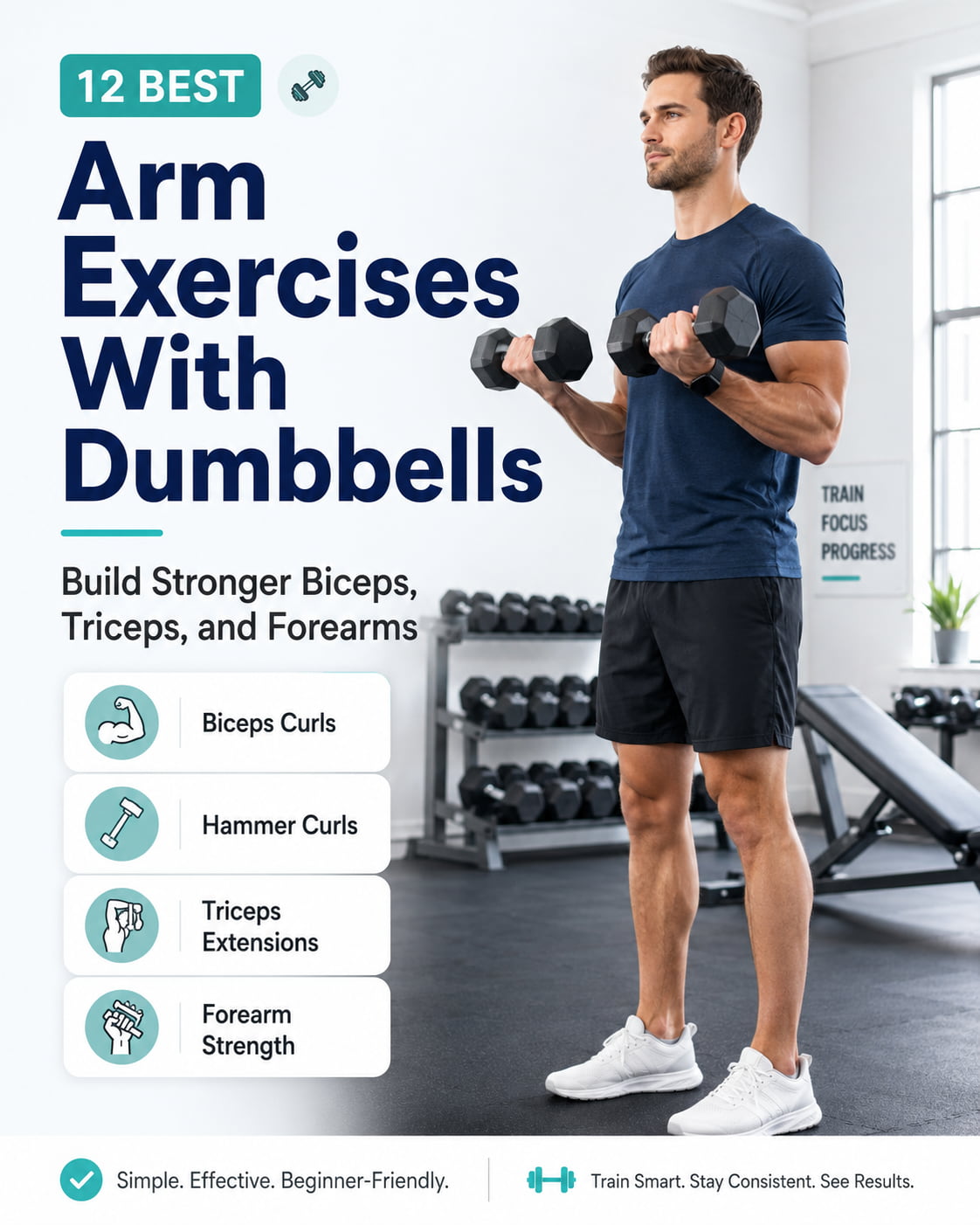
Arm exercises with dumbbells can help you build stronger biceps, triceps, and forearms with simple equipment, controlled form, and steady progression. The best approach is not doing endless curls. It is choosing movements that train elbow flexion, elbow extension, grip, wrist control, and different arm angles.
In this guide, you will learn the best arm exercises with dumbbells, which muscles they target, how to perform each one correctly, common mistakes to avoid, and how to build a complete dumbbell arm workout.
What Makes Arm Exercises With Dumbbells Effective?
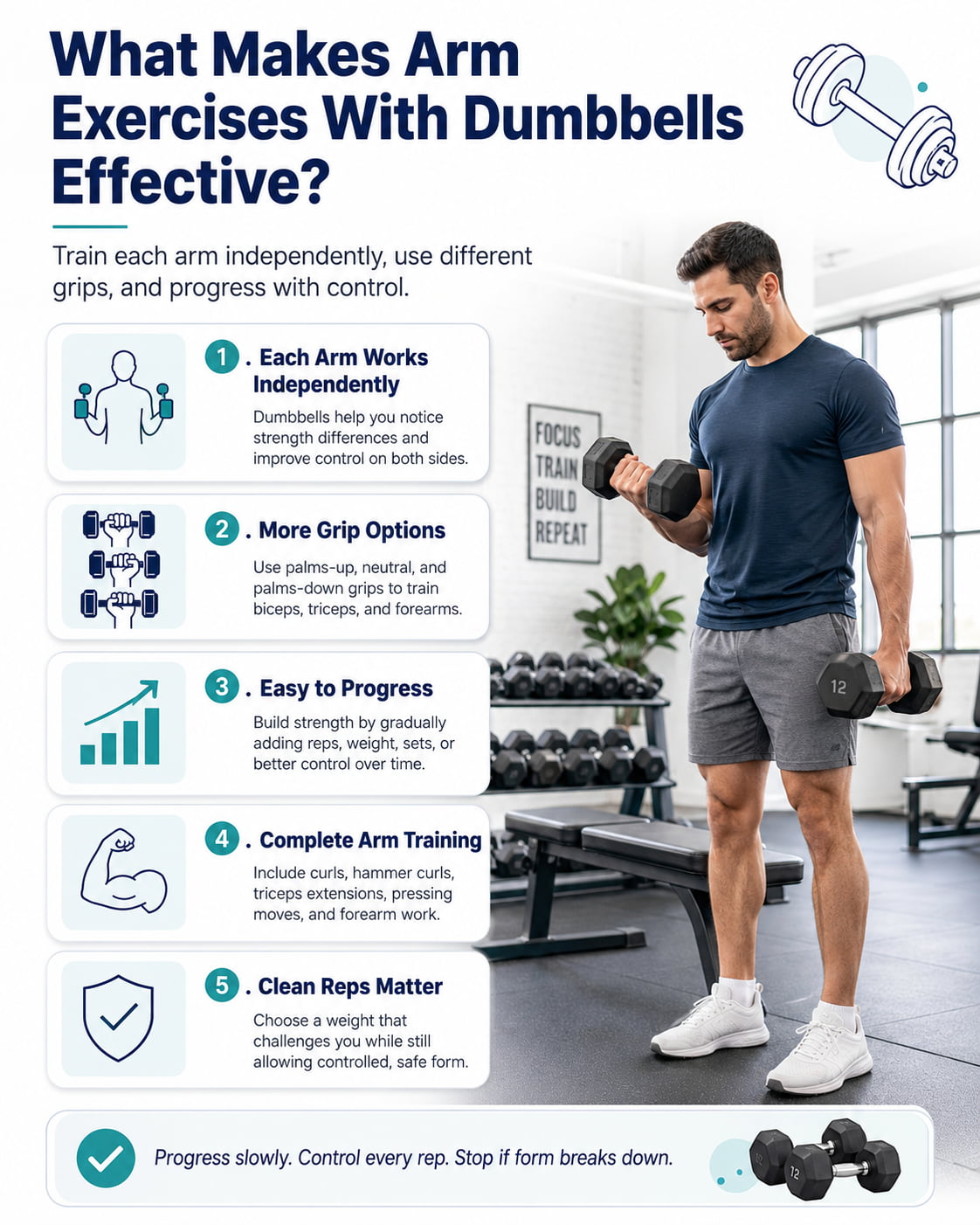
Dumbbells are useful because they let each arm work independently. That can help you notice strength differences, control your range of motion, and train with different grips such as palms-up, neutral, and palms-down.
For stronger arms, the main goal is progressive resistance training. That means you gradually increase reps, weight, sets, or control over time. The American College of Sports Medicine recommends matching resistance training variables to the goal, with higher weekly volume often used for muscle growth and heavier loading used for strength. ACSM’s progression model also supports adjusting load, reps, rest, and exercise difficulty based on training level.
For most people, a good dumbbell arm workout should include biceps curls, hammer-curl variations, triceps extensions, pressing variations, and forearm-focused work. Use a weight that challenges you while still allowing clean reps.
Muscles Worked During Dumbbell Arm Exercises
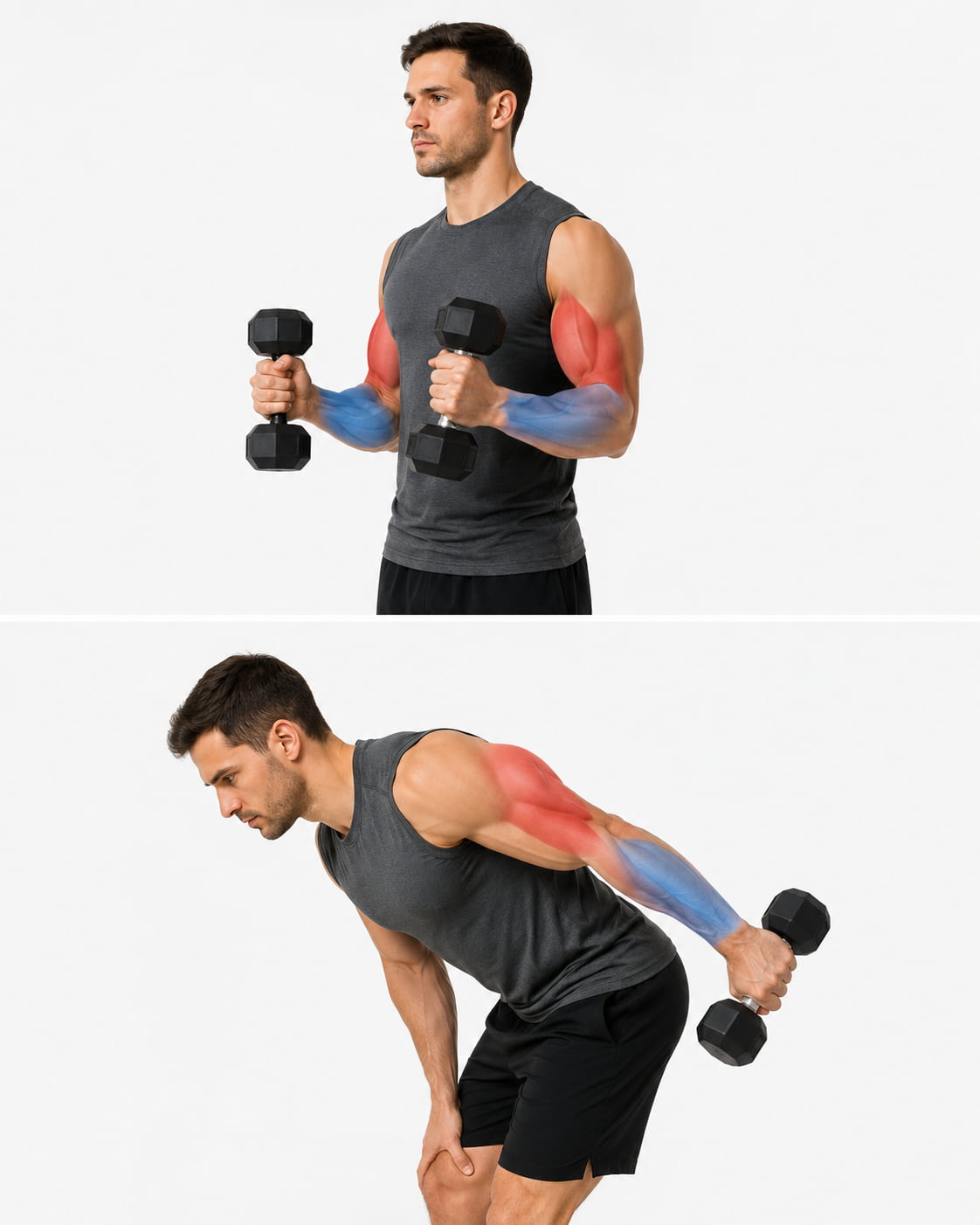
Dumbbell arm exercises mainly train the biceps, brachialis, brachioradialis, triceps, and forearm muscles.
The biceps brachii helps bend the elbow and is strongly involved in turning the palm upward, also called supination. The brachialis is an important elbow flexor underneath the biceps, while the brachioradialis helps flex and stabilize the elbow, especially with neutral-grip curling patterns. The triceps brachii has three heads and is the main muscle responsible for straightening the elbow.
That is why this list includes more than standard curls. A complete dumbbell arm plan should train curls, neutral-grip curls, reverse-grip curls, overhead triceps work, lying triceps work, kickbacks, and close-grip pressing.
Dumbbell Arm Workout for Stronger Arms
Use this routine 1 to 2 times per week. It can be done on its own or after an upper-body workout. Choose weights that leave about 1 to 3 good reps in reserve on most sets.
| Exercise | Sets | Reps | Rest |
|---|---|---|---|
| Close-Grip Dumbbell Floor Press | 3 | 8 to 12 | 90 seconds |
| Standing Dumbbell Biceps Curl | 3 | 8 to 12 | 60 to 90 seconds |
| Overhead Dumbbell Triceps Extension | 3 | 10 to 15 | 60 to 90 seconds |
| Dumbbell Hammer Curl | 3 | 10 to 12 | 60 to 90 seconds |
| Dumbbell Triceps Kickback | 2 | 12 to 20 | 45 to 75 seconds |
| Dumbbell Reverse Curl | 2 | 10 to 15 | 45 to 75 seconds |
Start with the lower end of the set range if you are new to direct arm training. Add reps first. When you can complete the top of the rep range with clean form on every set, increase the dumbbell weight slightly.
12 Best Arm Exercises With Dumbbells
Use these exercises to build stronger arms at home or in the gym. Beginners should start with lighter weights and controlled reps. Intermediate and advanced lifters can use heavier loading, slower eccentrics, higher volume, or more challenging exercise angles.
1. Standing Dumbbell Biceps Curl
Best for: Building basic biceps strength and learning strict curling form.
Muscles worked: Biceps brachii, brachialis, brachioradialis, forearms, and core stabilizers.
Why it stands out: The standing dumbbell biceps curl is one of the simplest and most effective dumbbell arm exercises because it trains elbow flexion directly. It is easy to set up, easy to progress, and useful for almost every training level.
Suggested sets and reps: Do 3 to 4 sets of 8 to 12 reps.
Beginners: Use light dumbbells and focus on keeping your elbows still.
Intermediate: Use a moderate load and control the lowering phase for 2 to 3 seconds.
Advanced: Use heavier dumbbells while keeping strict form, or add a pause at the top.
Rest: Rest 60 to 90 seconds between sets.
How to do it:
- Stand tall with a dumbbell in each hand and your palms facing forward.
- Keep your elbows close to your sides.
- Brace your core and keep your shoulders down.
- Curl the dumbbells toward your shoulders without swinging your torso.
- Squeeze your biceps at the top.
- Lower the dumbbells slowly until your elbows are fully extended.
Common mistakes: Swinging the dumbbells, leaning back, letting the elbows drift forward, shrugging the shoulders, and cutting the range of motion short.
Expert tip: Think about pulling your pinky slightly higher than your thumb at the top to improve biceps contraction.
2. Alternating Supinating Dumbbell Curl
Best for: Training the biceps through elbow flexion and forearm supination.
Muscles worked: Biceps brachii, brachialis, brachioradialis, and forearm supinators.
Why it stands out: This variation starts with the palms facing inward and finishes with the palms facing up. That twisting motion matches one of the biceps’ key jobs and makes the exercise useful for building stronger, more complete arms.
Suggested sets and reps: Do 3 sets of 8 to 12 reps per arm.
Beginners: Curl one arm at a time and pause between reps to stay controlled.
Intermediate: Keep constant tension by avoiding long pauses at the bottom.
Advanced: Use a slower lowering phase and avoid any body movement.
Rest: Rest 60 to 90 seconds between sets.
How to do it:
- Stand with dumbbells at your sides and palms facing your body.
- Brace your core and keep your upper arms close to your ribs.
- Curl one dumbbell upward.
- Rotate your palm up as the dumbbell rises.
- Squeeze at the top with your palm facing your shoulder.
- Lower slowly and rotate back to the starting position.
- Repeat on the other side.
Common mistakes: Rotating too late, rushing the lowering phase, leaning to one side, and turning the curl into a shoulder movement.
Expert tip: Start rotating your wrist early in the curl so the palm is mostly up by the time your forearm reaches parallel to the floor.
3. Dumbbell Hammer Curl
Best for: Building thicker-looking arms and strengthening the brachialis and brachioradialis.
Muscles worked: Brachialis, brachioradialis, biceps brachii, and forearms.
Why it stands out: The hammer curl uses a neutral grip, which shifts more emphasis toward the brachialis and brachioradialis. ACE’s hammer curl guidance emphasizes a neutral grip, braced torso, stable shoulders, and controlled arm position, which makes it a strong choice for clean arm training.
Suggested sets and reps: Do 3 to 4 sets of 8 to 12 reps.
Beginners: Start with a lighter pair of dumbbells and keep your wrists straight.
Intermediate: Use moderate weight and pause briefly at the top.
Advanced: Use heavier dumbbells for 6 to 10 controlled reps.
Rest: Rest 60 to 90 seconds between sets.
How to do it:
- Stand tall with dumbbells at your sides.
- Face your palms toward each other.
- Keep your elbows tucked near your body.
- Curl the dumbbells up without rotating your wrists.
- Stop when your forearms are near vertical.
- Lower slowly with control.
Common mistakes: Letting the wrists bend, swinging the hips, lifting the elbows forward, and using weights that are too heavy.
Expert tip: Keep your thumbs pointing upward throughout the rep.
4. Cross-Body Hammer Curl
Best for: Targeting the brachialis, brachioradialis, and outer-arm look.
Muscles worked: Brachialis, brachioradialis, biceps brachii, and forearms.
Why it stands out: Instead of curling straight up, you curl the dumbbell across your body toward the opposite shoulder. This angle can feel more natural for some lifters and gives the forearm and elbow flexors a slightly different challenge.
Suggested sets and reps: Do 2 to 4 sets of 10 to 15 reps per arm.
Beginners: Use light dumbbells and learn the path before adding weight.
Intermediate: Add a short squeeze at the top of each rep.
Advanced: Use a controlled tempo and heavier dumbbells without torso rotation.
Rest: Rest 45 to 90 seconds between sets.
How to do it:
- Stand with dumbbells at your sides and palms facing inward.
- Brace your core and keep your shoulders level.
- Curl one dumbbell across your body toward the opposite shoulder.
- Keep your wrist neutral and elbow close to your side.
- Pause briefly near the top.
- Lower the dumbbell slowly and repeat on the other side.
Common mistakes: Twisting the torso, shrugging the working shoulder, bending the wrist, and rushing the lowering phase.
Expert tip: Think about bringing the thumb side of the dumbbell toward the opposite upper chest.
5. Incline Dumbbell Curl
Best for: Training the biceps through a longer range of motion.
Muscles worked: Biceps brachii, brachialis, brachioradialis, and forearms.
Equipment needed: Dumbbells and an incline bench.
Why it stands out: The incline position places the upper arm slightly behind the torso, which increases the stretch at the bottom. This can make light to moderate dumbbells feel much harder than standing curls.
Suggested sets and reps: Do 2 to 4 sets of 8 to 12 reps.
Beginners: Use a low incline and very light dumbbells.
Intermediate: Use moderate weight and keep the upper arm still.
Advanced: Add a pause in the stretched position without relaxing the shoulder.
Rest: Rest 60 to 90 seconds between sets.
How to do it:
- Set a bench to a low or moderate incline.
- Sit back with a dumbbell in each hand.
- Let your arms hang down with palms facing forward or slightly inward.
- Keep your shoulders down and chest steady.
- Curl the dumbbells up without moving your upper arms.
- Squeeze at the top.
- Lower slowly until your arms are extended again.
Common mistakes: Using too much incline, swinging from the shoulder, lifting the head off the bench, and bouncing out of the bottom position.
Expert tip: Use less weight than your standing curl. The stretched position makes this exercise more demanding.
6. Concentration Curl
Best for: Improving biceps control and reducing body momentum.
Muscles worked: Biceps brachii, brachialis, brachioradialis, and forearm flexors.
Equipment needed: One dumbbell and a bench or sturdy seat.
Why it stands out: The concentration curl helps you focus on one arm at a time. Because the upper arm is supported against the inner thigh, it is harder to cheat with your hips or back.
Suggested sets and reps: Do 2 to 3 sets of 10 to 15 reps per arm.
Beginners: Use a light dumbbell and practice a full range of motion.
Intermediate: Pause at the top for 1 second.
Advanced: Use a slow eccentric and stop just short of resting at the bottom.
Rest: Rest 45 to 75 seconds between arms or sets.
How to do it:
- Sit on a bench with your feet wider than hip-width.
- Hold one dumbbell in your working hand.
- Place the back of your upper arm against your inner thigh.
- Let the arm straighten toward the floor.
- Curl the dumbbell toward your shoulder.
- Squeeze your biceps at the top.
- Lower slowly until your elbow is extended.
Common mistakes: Leaning back, twisting the shoulder, shortening the bottom range, and letting the wrist collapse.
Expert tip: Keep your working upper arm pinned in the same position for the entire set.
7. Dumbbell Reverse Curl
Best for: Strengthening the forearms, brachioradialis, and grip.
Muscles worked: Brachioradialis, brachialis, biceps brachii, wrist extensors, and forearms.
Why it stands out: Reverse curls use a palms-down grip, which makes the forearms work harder and reduces how much the biceps can dominate the movement. This is useful if you want stronger elbows, wrists, and grip for pulling exercises.
Suggested sets and reps: Do 2 to 3 sets of 10 to 15 reps.
Beginners: Use very light dumbbells and keep the wrists straight.
Intermediate: Add reverse curls after your main biceps work.
Advanced: Use a slow tempo and avoid relaxing at the bottom.
Rest: Rest 45 to 75 seconds between sets.
How to do it:
- Stand tall with dumbbells in front of your thighs.
- Turn your palms toward the floor.
- Keep your wrists straight and elbows near your sides.
- Curl the dumbbells upward without bending the wrists.
- Stop when your forearms are near parallel or slightly higher.
- Lower with control.
Common mistakes: Letting the wrists bend backward, using too much weight, flaring the elbows, and turning the movement into a regular curl.
Expert tip: Choose a lighter weight than you use for standard curls. Reverse curls punish sloppy wrist position quickly.
8. Zottman Curl
Best for: Training the biceps on the way up and the forearms on the way down.
Muscles worked: Biceps brachii, brachialis, brachioradialis, wrist extensors, and forearm flexors.
Why it stands out: The Zottman curl combines a palms-up curl with a palms-down lowering phase. This gives you biceps work during the lift and extra forearm demand during the eccentric.
Suggested sets and reps: Do 2 to 3 sets of 8 to 12 reps.
Beginners: Learn standard curls and reverse curls first.
Intermediate: Use Zottman curls as a second or third biceps movement.
Advanced: Lower the dumbbells for 3 to 4 seconds on every rep.
Rest: Rest 60 to 90 seconds between sets.
How to do it:
- Stand with dumbbells at your sides and palms facing forward.
- Curl both dumbbells toward your shoulders.
- At the top, rotate your palms so they face down.
- Lower the dumbbells slowly with the palms-down grip.
- Rotate back to palms-up at the bottom.
- Repeat with smooth control.
Common mistakes: Rotating too fast, dropping the dumbbells during the lowering phase, bending the wrists, and using more weight than you can control.
Expert tip: Treat the lowering phase like the main part of the exercise.
9. Overhead Dumbbell Triceps Extension
Best for: Training the triceps, especially the long head, through a stretched overhead position.
Muscles worked: Triceps brachii, especially the long head, plus core and shoulder stabilizers.
Why it stands out: The overhead position places the long head of the triceps under more stretch than many neutral-arm triceps exercises. Research comparing overhead and neutral-position elbow extension found greater triceps hypertrophy from the overhead position, which supports including this movement in a balanced arm program.
Suggested sets and reps: Do 3 to 4 sets of 10 to 15 reps.
Beginners: Use one light dumbbell held with both hands.
Intermediate: Use a moderate dumbbell and keep the ribs down.
Advanced: Use one-arm overhead extensions or slow eccentrics.
Rest: Rest 60 to 90 seconds between sets.
How to do it:
- Stand or sit tall while holding one dumbbell with both hands.
- Press the dumbbell overhead.
- Keep your elbows pointing mostly forward.
- Brace your core and avoid arching your lower back.
- Bend your elbows and lower the dumbbell behind your head.
- Extend your elbows to lift the dumbbell back overhead.
- Stop just short of locking out aggressively.
Common mistakes: Flaring the elbows too wide, arching the lower back, lowering too fast, letting the head push forward, and using a weight that pulls the shoulders out of position.
Expert tip: Keep your ribs stacked over your hips so the movement comes from your elbows, not your spine.
10. Lying Dumbbell Triceps Extension
Best for: Direct triceps training with more stability than standing extensions.
Muscles worked: Triceps brachii, forearms, and shoulder stabilizers.
Equipment needed: Dumbbells and a flat bench or floor.
Why it stands out: Also called a dumbbell skull crusher, this exercise trains elbow extension while your torso is supported. It is a strong option for people who want direct triceps work without needing a cable machine.
Suggested sets and reps: Do 3 to 4 sets of 8 to 12 reps.
Beginners: Start on the floor to limit range of motion and improve control.
Intermediate: Use a bench and moderate dumbbells.
Advanced: Lower the dumbbells slightly behind the head to increase the triceps stretch if your elbows and shoulders tolerate it well.
Rest: Rest 60 to 90 seconds between sets.
How to do it:
- Lie on a bench or on the floor with a dumbbell in each hand.
- Hold the dumbbells above your chest with palms facing each other.
- Keep your upper arms angled slightly back or vertical.
- Bend your elbows to lower the dumbbells toward the sides of your head.
- Keep your wrists straight.
- Extend your elbows to return the dumbbells to the starting position.
Common mistakes: Turning it into a press, letting the elbows flare too wide, dropping the dumbbells too fast, and losing wrist alignment.
Expert tip: Keep the upper arms mostly still. The elbows should bend and straighten while the shoulders stay controlled.
11. Dumbbell Triceps Kickback
Best for: Finishing the triceps with strict form and lighter weight.
Muscles worked: Triceps brachii, rear shoulders, upper-back stabilizers, and core.
Equipment needed: Dumbbells and a bench if needed.
Why it stands out: The kickback is not the heaviest triceps exercise, but it can be useful when performed strictly. ACE’s triceps kickback instructions emphasize bracing, keeping the upper arm close to the torso, extending the elbow with the triceps, and avoiding low-back arching or torso rotation.
Suggested sets and reps: Do 2 to 3 sets of 12 to 20 reps.
Beginners: Use one arm at a time with your free hand supported on a bench.
Intermediate: Use both arms if you can keep your torso stable.
Advanced: Pause for 1 second at full elbow extension.
Rest: Rest 45 to 75 seconds between sets.
How to do it:
- Hold a dumbbell in one hand.
- Hinge forward and support your other hand on a bench or thigh.
- Keep your back flat and core braced.
- Bring your upper arm close to your torso.
- Start with your elbow bent about 90 degrees.
- Extend your elbow until your arm is straight.
- Squeeze your triceps briefly.
- Lower the dumbbell under control.
Common mistakes: Swinging the dumbbell, moving the upper arm, rounding the back, rotating the torso, and choosing a weight that is too heavy.
Expert tip: Use lighter weight than you think. The kickback works best when the lockout is controlled.
12. Close-Grip Dumbbell Floor Press
Best for: Training the triceps with a heavier compound-style dumbbell movement.
Muscles worked: Triceps brachii, chest, front delts, and upper-back stabilizers.
Equipment needed: Dumbbells and floor space.
Why it stands out: This is one of the best dumbbell arm exercises for using more load safely. The floor limits shoulder range of motion, and the close grip increases triceps involvement compared with a wider press. ACE’s dumbbell chest press guidance highlights stable positioning, foot support, and controlled pressing mechanics, which also apply to this floor-press variation.
Suggested sets and reps: Do 3 to 4 sets of 6 to 12 reps.
Beginners: Use light dumbbells and learn how to control the bottom position.
Intermediate: Use moderate to heavy dumbbells and keep the elbows close.
Advanced: Add a pause when the upper arms touch the floor.
Rest: Rest 90 to 120 seconds between sets.
How to do it:
- Lie on your back with knees bent and feet flat.
- Hold a dumbbell in each hand above your chest.
- Turn your palms toward each other.
- Keep the dumbbells close together but not crashing into each other.
- Lower your elbows toward the floor at about a 30- to 45-degree angle from your body.
- Pause lightly when your upper arms touch the floor.
- Press the dumbbells back up by extending your elbows.
Common mistakes: Flaring the elbows too wide, bouncing off the floor, letting the dumbbells drift apart, and shrugging the shoulders.
Expert tip: Think about pushing the floor away with your upper arms while keeping your ribs down.
How Often Should You Do Arm Exercises With Dumbbells?
Most people can train arms 1 to 3 times per week, depending on the rest of their workout plan. If you already do rows, pulldowns, presses, and push-ups, your arms are getting extra work from those exercises.
A simple plan is to train biceps and triceps directly twice per week. Keep most sets controlled and avoid taking every set to failure. Your elbows, wrists, and shoulders should feel better as you warm up, not worse.
Common Dumbbell Arm Training Mistakes
Using Too Much Momentum
Swinging the dumbbells may help you lift more weight, but it reduces the work your arms actually do. Keep your torso steady and control both the lifting and lowering phases.
Training Only Biceps
Many people focus on curls and forget triceps. The triceps make up a large part of the upper arm and are important for pressing strength, elbow extension, and balanced arm development.
Ignoring Grip and Wrist Position
Bent wrists can make curls, reverse curls, and triceps extensions feel uncomfortable. Keep your wrists neutral and let your elbows do the main work.
Doing Too Much Too Soon
More exercises are not always better. Start with a few quality movements, recover well, and gradually add volume only when your form and joints tolerate it.
Skipping Full Range of Motion
Partial reps can have a place, but most lifters should first learn a smooth full range of motion. Lower the dumbbells with control and avoid bouncing out of the bottom position.
How to Progress Arm Exercises With Dumbbells
Progression does not always mean adding weight every workout. You can also add reps, add a set, slow the lowering phase, improve your range of motion, or reduce unnecessary swinging.
A good rule is to keep the same dumbbells until you can complete every set at the top of the rep range with clean form. For example, if your goal is 3 sets of 8 to 12 reps, increase the weight once you can perform 12, 12, and 12 with control.
For muscle growth, weekly volume matters. A practical target is 6 to 12 direct sets per week for biceps and 6 to 12 direct sets per week for triceps, then adjust based on recovery, soreness, and performance.
Safety Tips Before Training Arms With Dumbbells
Warm up before lifting. Start with light curls, light presses, arm circles, and easy elbow extensions. Your first working set should not be your first movement of the day.
Use controlled reps and avoid sudden jerking. Stop the exercise if you feel sharp pain, numbness, dizziness, chest pain, or unusual symptoms. If elbow, wrist, or shoulder discomfort keeps returning, get guidance from a qualified professional.
FAQs About Arm Exercises With Dumbbells
Can I build strong arms with dumbbells only?
Yes. Dumbbells can train the biceps, triceps, brachialis, brachioradialis, forearms, and grip effectively. You need good exercise selection, enough weekly sets, clean form, and progressive overload.
What dumbbell arm exercise is best for biceps?
The standing dumbbell curl is the best basic biceps exercise for most people. Incline curls and supinating curls are also excellent because they challenge the biceps through different arm positions and ranges of motion.
What dumbbell arm exercise is best for triceps?
The overhead dumbbell triceps extension is one of the best dumbbell options for the triceps because it trains the long head in a stretched position. The lying dumbbell triceps extension and close-grip dumbbell floor press are also strong choices.
How heavy should dumbbells be for arm exercises?
Use a weight that lets you complete the target reps with control while keeping 1 to 3 good reps in reserve. If you have to swing, lean back, flare your elbows, or shorten the range of motion, the dumbbells are too heavy.
Should I train biceps and triceps on the same day?
Yes. Training biceps and triceps together works well because they perform opposite actions at the elbow. You can alternate biceps and triceps exercises to save time and keep the workout balanced.
Are dumbbell arm exercises good for beginners?
Yes. Dumbbell arm exercises are beginner-friendly when you start light and learn proper form. Beginners should focus on standing curls, hammer curls, overhead triceps extensions, floor presses, and supported triceps kickbacks.
Conclusion
The best arm exercises with dumbbells train more than one curl pattern. For stronger arms, include biceps curls, hammer curls, reverse curls, overhead triceps extensions, lying triceps extensions, kickbacks, and close-grip pressing.
Start with clean form, use a weight you can control, and progress slowly over time. A simple dumbbell-only arm workout done consistently can build stronger biceps, triceps, forearms, and grip without complicated equipment.
This content is for informational purposes only and is not a substitute for professional medical advice.
References
- American College of Sports Medicine: Updated Resistance Training Guidelines
- ACSM Position Stand: Progression Models in Resistance Training for Healthy Adults
- ACE Fitness: Arm Strengthening Exercises
- ACE Fitness: Hammer Curl
- ACE Fitness: Triceps Kickback
- PubMed: Overhead Versus Neutral-Arm Triceps Extension Training
1 thought on “12 Best Arm Exercises With Dumbbells for Stronger Arms”