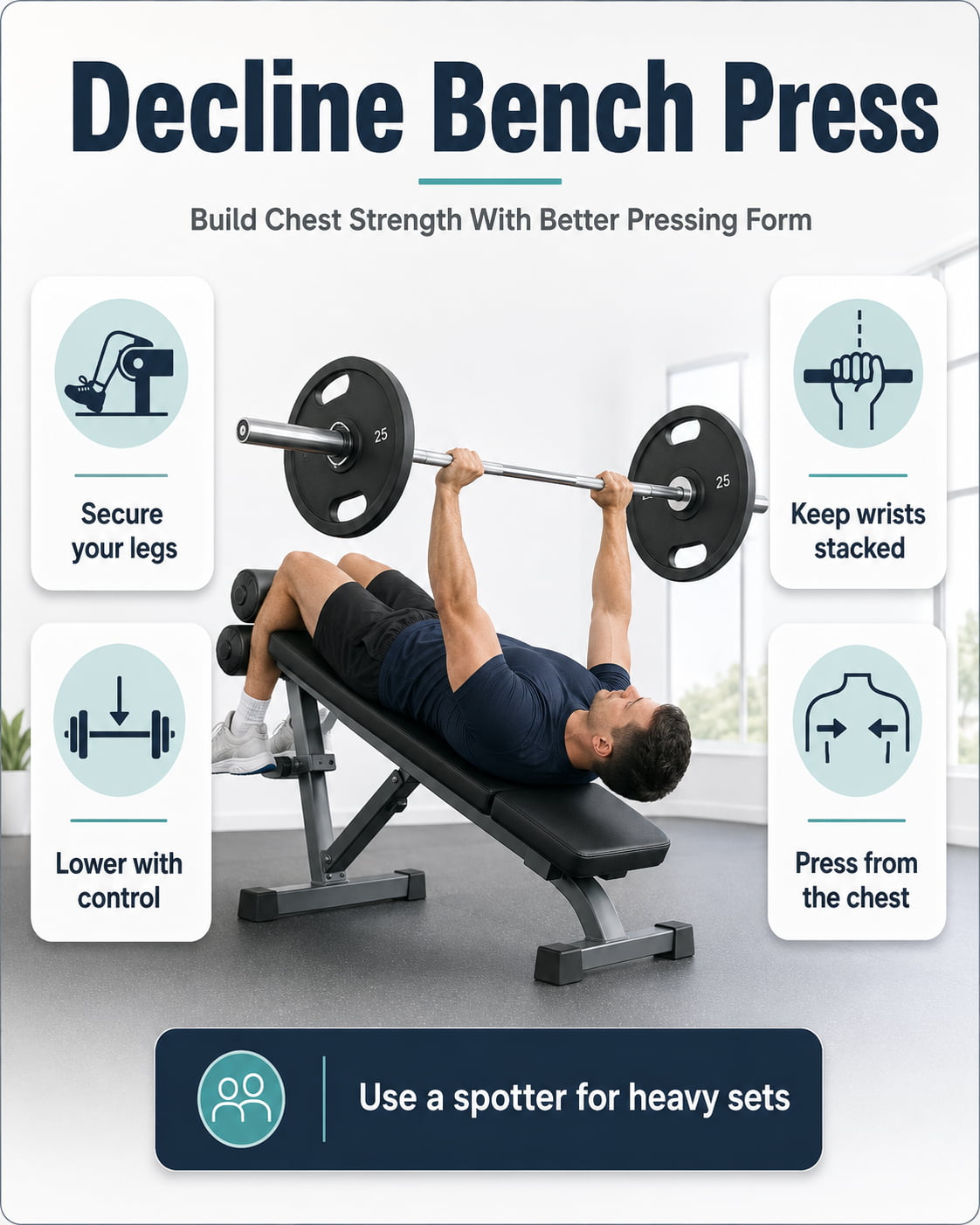
The decline bench press is a chest press variation that trains the pectorals, triceps, and front shoulders while placing more emphasis on the lower or sternal fibers of the chest. It is performed on a decline bench with your torso angled downward and your legs secured.
This guide explains how to do the decline bench press correctly, which muscles it works, its benefits, common mistakes, best variations, and how to use it in a real chest workout.
What Is the Decline Bench Press?
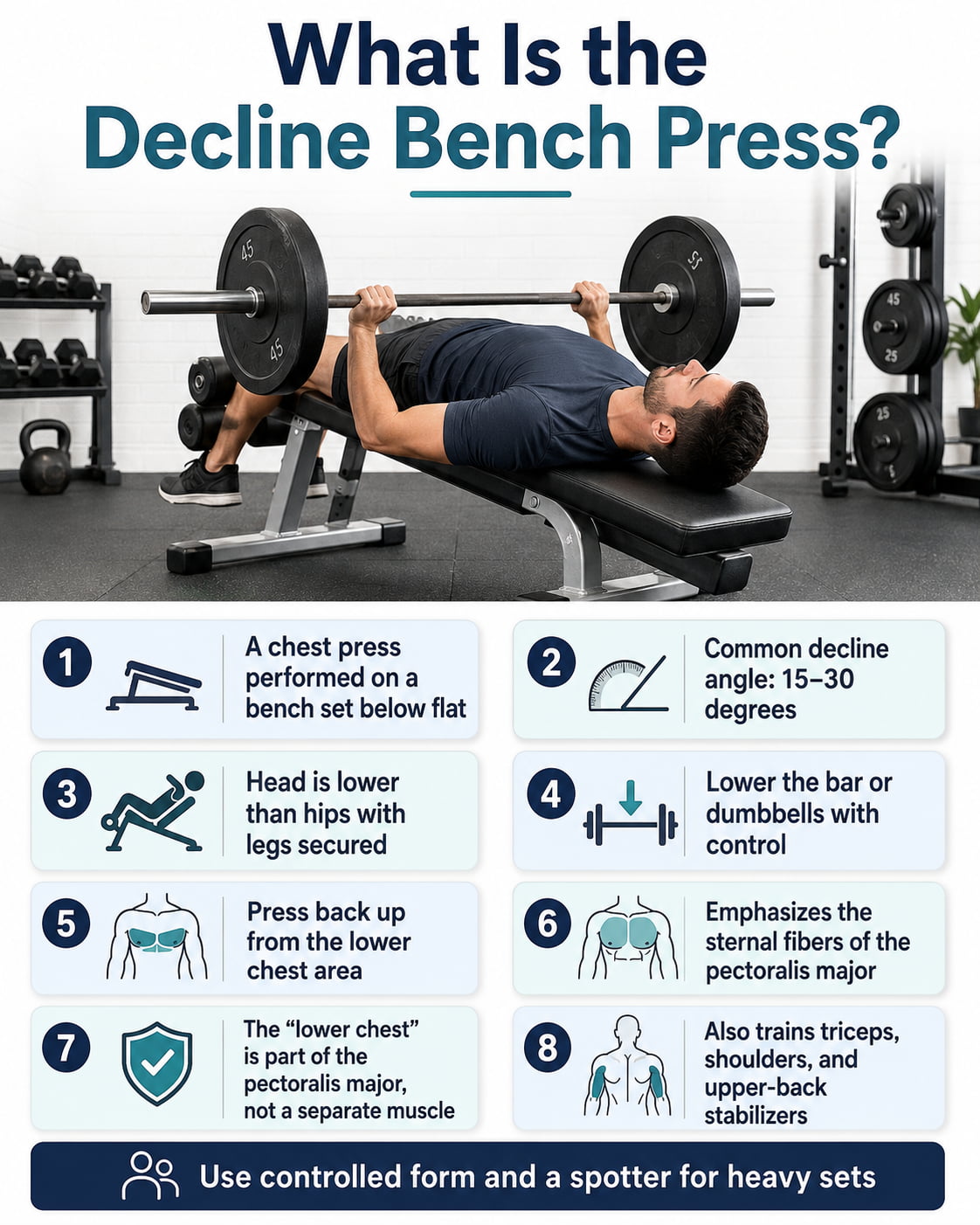
The decline bench press is a pressing exercise performed on a bench set below flat, usually around a 15- to 30-degree decline. Instead of lying flat, your head is lower than your hips, and your feet or legs are secured under pads.
The movement is similar to a regular bench press: lower the bar or dumbbells under control, pause briefly near the lower chest, and press the weight back up. The difference is the bench angle. That angle changes the line of press and shifts more work toward the sternal fibers of the pectoralis major.
The decline bench press is often called a “lower chest” exercise. That is mostly correct in a practical gym sense, but it needs a little context. The lower chest is not a separate muscle. It is part of the pectoralis major. A 2023 systematic review in Applied Sciences found that decline pressing tends to increase activation of the sternal portion of the pectoralis major compared with flat bench pressing, while reducing upper-chest or clavicular emphasis.
So, the decline bench press can be useful for chest training, but it should not be treated as a magic isolation exercise. It is still a compound press that also uses the triceps, shoulders, and upper-back stabilizers.
Decline Bench Press Muscles Worked
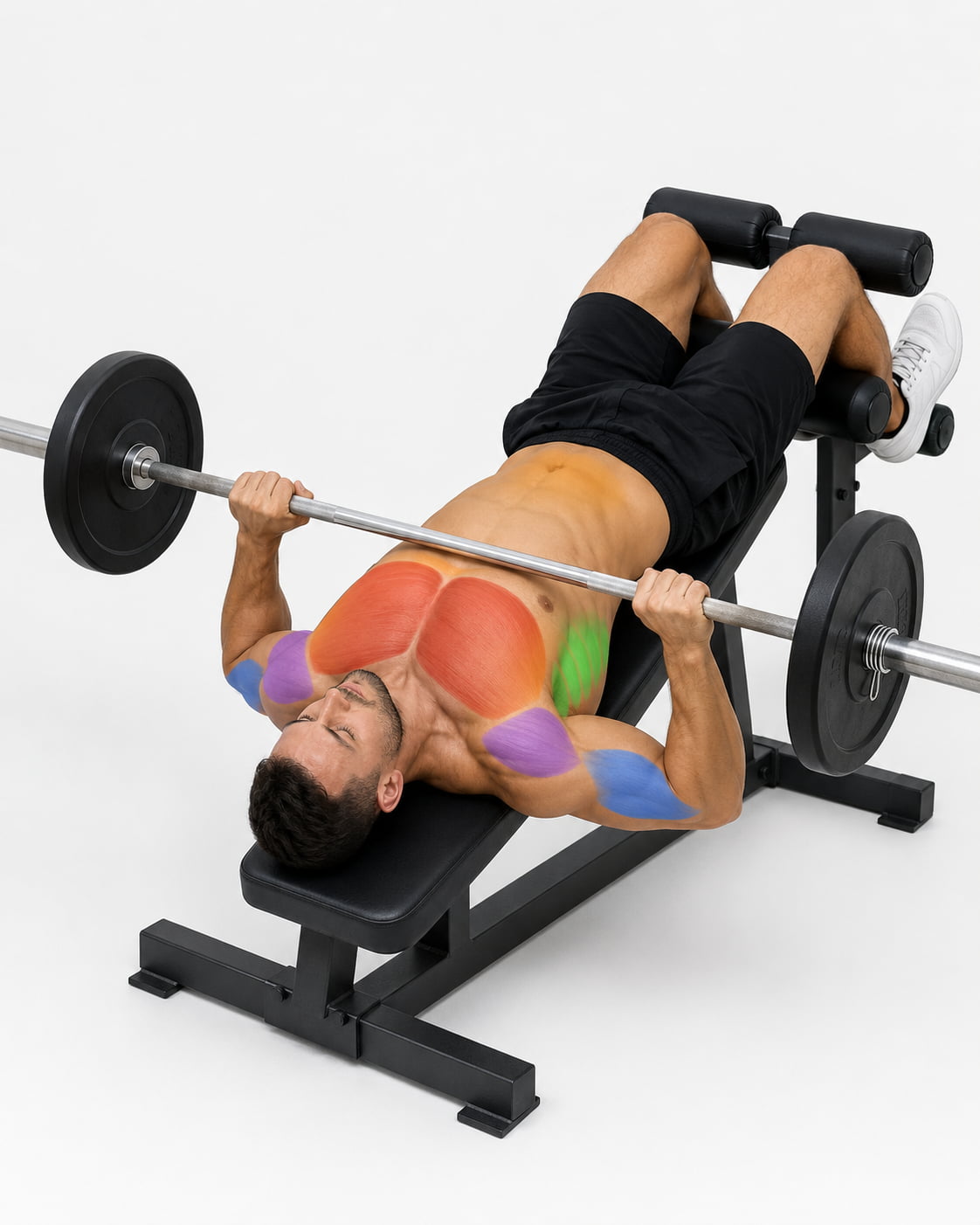
The decline bench press mainly works the chest, triceps, and front shoulders. It also requires upper-back and core stability to keep your pressing position strong.
Pectoralis Major
The pectoralis major is the main target muscle. This large chest muscle helps bring your upper arm across your body and press the weight away from you.
During the decline bench press, the sternal fibers of the chest usually receive more emphasis than they do in an incline press. This is why many lifters use the exercise when they want more lower-chest-focused pressing work.
Triceps Brachii
The triceps are located on the back of your upper arms. They help straighten your elbows as you press the bar or dumbbells upward.
If you use a narrower grip, lock out hard, or let your elbows stay tucked too close to your sides, the triceps may take over more of the movement.
Anterior Deltoids
The anterior deltoids are the front part of your shoulders. They assist during the press, especially near the bottom and middle of the lift.
Decline pressing usually places less emphasis on the front delts than incline pressing, but they still contribute to the movement.
Serratus Anterior and Shoulder Stabilizers
The serratus anterior and smaller shoulder stabilizers help control your shoulder blades and upper arms during the press. Good shoulder control matters because pressing without stability can make the movement feel loose and uncomfortable.
Upper Back
Your upper back does not press the weight, but it helps create a stable base. When you pull your shoulder blades down and back, your upper back gives your shoulders a stronger platform against the bench.
NASM explains that scapular retraction during the bench press helps create a stable base for the shoulders and may improve pressing safety and performance.
How to Do the Decline Bench Press With Proper Form
Equipment needed: Decline bench, barbell, weight plates, rack, collars, and ideally a spotter or safety setup.
Suggested sets and reps: For muscle growth, use 2 to 4 sets of 8 to 12 reps. For strength, use 3 to 5 sets of 3 to 6 reps with longer rest and a spotter. For a lighter accessory movement, use 2 to 3 sets of 10 to 15 reps.
Beginners: Start with dumbbells, a machine decline press, or a light barbell. Use a controlled tempo and stop each set with 2 to 3 reps left in reserve.
Intermediate: Use the barbell decline bench press as your second or third chest movement after flat bench, incline press, or dips. Progress slowly by adding reps before adding weight.
Advanced: Use heavier sets when you have a reliable spotter, strong setup, and consistent bar path. You can also use tempo reps, paused reps, or lower-rep strength blocks.
Rest: Rest 2 to 3 minutes for heavy strength sets. Rest 60 to 90 seconds for moderate hypertrophy sets. Rest 45 to 75 seconds for lighter accessory work.
How to do it:
- Set the decline bench to a moderate angle and secure your legs under the pads.
- Lie back with your eyes slightly under the bar.
- Grip the bar slightly wider than shoulder-width with a closed grip.
- Pull your shoulder blades down and back into the bench.
- Keep your chest lifted, wrists stacked over your elbows, and core braced.
- Unrack the bar with control and hold it above your lower chest.
- Lower the bar slowly toward the lower chest or lower sternum area.
- Keep your elbows at a controlled angle instead of flaring them straight out.
- Lightly touch or come close to the chest without bouncing.
- Press the bar up and slightly back toward the starting position.
- Finish with your elbows extended but not aggressively locked.
- Re-rack the bar only after it is fully under control.
Common mistakes: Using too much weight, setting the decline too steep, bouncing the bar off the chest, letting the shoulders roll forward, bending the wrists backward, flaring the elbows too wide, and unracking without control.
Expert tip: Think “shoulders down, chest tall, bar controlled.” Your goal is not to drop the bar fast. Lower it with control, keep your shoulder blades set, and press smoothly.
Exercise variations: Dumbbell decline bench press, Smith machine decline press, decline machine chest press, decline push-up, and low-to-high cable press.
Easier variation: Use a decline machine chest press or dumbbell decline press with light weights. These options are easier to control than a heavy barbell.
Harder variation: Use a paused decline bench press. Lower the bar, pause briefly near the lower chest without relaxing, then press up with control.
Decline Bench Press Benefits
Builds Chest Pressing Strength
The decline bench press is a compound upper-body exercise. It trains the chest, triceps, and shoulders together, which makes it useful for building pressing strength.
Because the decline angle may feel stronger for some lifters, it can allow solid loading while still keeping the focus on the chest. However, heavier is not always better. The movement only works well when you can control the descent, keep your shoulders stable, and press without bouncing.
Adds Lower-Chest Emphasis
The biggest reason lifters use the decline bench press is to bias the sternal fibers of the chest. This can help round out a chest routine that already includes flat and incline pressing.
The key is to use the exercise as part of a complete plan. A good chest program can include flat presses, incline presses, dips, push-ups, machine presses, cable work, and fly variations. Decline pressing is one useful option, not the only answer.
May Feel Shoulder-Friendly for Some Lifters
Some lifters find the decline bench press more comfortable than flat or incline pressing because the angle may reduce front-shoulder involvement. That does not mean it is automatically safer for everyone.
Shoulder comfort depends on your grip width, elbow position, shoulder-blade control, load, range of motion, and injury history. A 2024 bench press technique paper available through PMC notes that grip width, scapular position, and bar forces can influence shoulder loading during bench press variations.
If the decline bench press causes sharp pain, pinching, numbness, or unusual symptoms, stop the exercise and use a different variation.
Trains the Triceps and Front Shoulders
Even though it is chest-focused, the decline bench press still builds pressing strength through the triceps and anterior deltoids. This makes it more efficient than an isolation movement if your goal is general upper-body strength.
Cleveland Clinic notes that bench press variations commonly train the chest, front shoulders, and triceps.
Adds Variety to Chest Training
Repeating the same flat bench press every session can become stale. Decline pressing gives your chest a different angle, which may help you train hard without relying on only one movement pattern.
This is especially useful for intermediate lifters who already have a base of strength and want to rotate exercises across training blocks.
Common Decline Bench Press Mistakes
Setting the Bench Too Steep
A steeper decline is not automatically better. Too much decline can make the setup awkward, shorten your pressing path, and make it harder to control the bar.
Use a moderate decline. Most lifters do best with a small to moderate angle rather than an extreme one.
Not Securing the Legs
Because your body is angled downward, you need to secure your legs before unracking the weight. If your legs are loose, you may slide on the bench or lose tension during the set.
Before every set, make sure your lower body is locked into position and your torso feels stable.
Letting the Shoulders Roll Forward
Your shoulders should not drift forward at the bottom of the rep. When the shoulders roll forward, the chest loses tension and the front of the shoulder may take more stress.
Before pressing, pull your shoulder blades down and back. Keep that position as you lower and press.
Bouncing the Bar
Bouncing the bar off your chest is a common way to lift more weight with worse control. It can reduce muscle tension and increase risk.
Lower the bar smoothly, touch lightly, and press with control. ACE Fitness emphasizes controlled pressing and proper spotting during chest press variations.
Flaring the Elbows Too Wide
If your elbows flare straight out to the sides, your shoulders may feel less stable. A slight elbow tuck is usually better.
Think of your upper arms moving at a controlled angle rather than forming a hard “T” shape with your torso.
Bending the Wrists Back
Your wrists should stay stacked and strong. If they bend backward, the bar may sit too high in your hand and stress the wrists.
Grip the bar firmly and keep it over the base of your palm, not high in your fingers.
Training Heavy Without a Spotter
The decline bench press can be harder to escape from than some other press variations. If you miss a rep, the bar position can be awkward.
Use a spotter or safety setup when lifting heavy. This is especially important for beginners and anyone training close to failure.
Decline Bench Press vs Flat Bench Press vs Incline Bench Press
All three exercises train the chest, shoulders, and triceps. The main difference is emphasis.
Decline Bench Press
The decline bench press tends to emphasize the sternal or lower fibers of the chest. It may involve slightly less front-shoulder emphasis than incline pressing.
Best for: chest pressing variety, lower-chest emphasis, and lifters who tolerate the decline angle well.
Flat Bench Press
The flat bench press is the most common bench press variation. It trains the chest, triceps, and shoulders through a balanced horizontal pressing pattern.
Best for: general upper-body strength, beginner strength development, and standard bench press progress.
Incline Bench Press
The incline bench press shifts more emphasis toward the upper chest and front shoulders. The higher the incline, the more shoulder involvement you usually get.
Best for: upper-chest emphasis, pressing variety, and lifters who want to train the chest from multiple angles.
Which One Should You Choose?
Choose the variation that fits your goal and feels good on your joints.
For general strength, start with flat bench press.
For upper-chest emphasis, use incline bench press.
For sternal or lower-chest emphasis, use decline bench press.
A complete chest program can use more than one angle across the week.
Best Decline Bench Press Variations
1. Dumbbell Decline Bench Press
Best for: Lifters who want more freedom of movement than a barbell.
Muscles worked: Pectoralis major, triceps, anterior deltoids, and shoulder stabilizers.
Equipment needed: Decline bench and dumbbells.
Why it stands out: Dumbbells let each arm move independently. This can help you notice side-to-side differences and may feel more natural for some shoulders.
Suggested sets and reps: Use 2 to 4 sets of 8 to 12 reps.
Beginners: Start light and learn how to get the dumbbells into position safely.
Intermediate: Use this as a secondary chest exercise after a main press.
Advanced: Use slower lowering, paused reps, or heavier dumbbells with a spotter nearby.
Rest: Rest 60 to 120 seconds between sets.
How to do it:
- Sit on the decline bench with dumbbells resting near your thighs.
- Secure your legs and lie back under control.
- Hold the dumbbells above your lower chest with palms facing forward.
- Pull your shoulders down and back.
- Lower the dumbbells until your upper arms are near chest level.
- Press the dumbbells up without letting them crash together.
- Finish the set by lowering the weights safely with control.
Common mistakes: Dropping too deep, letting the dumbbells drift too wide, losing shoulder position, and rushing the setup.
Expert tip: Keep your elbows under the dumbbells. If the weights drift too far behind your wrists, reduce the load.
Exercise variations: Neutral-grip decline dumbbell press, alternating decline dumbbell press, and paused decline dumbbell press.
Easier variation: Use a machine decline press.
Harder variation: Use a slow 3-second lowering phase on every rep.
2. Decline Machine Chest Press
Best for: Beginners, controlled hypertrophy work, and lifters who do not want to manage a barbell on a decline bench.
Muscles worked: Pectoralis major, triceps, and anterior deltoids.
Equipment needed: Decline chest press machine.
Why it stands out: The machine gives you a fixed path, making it easier to focus on chest tension and pressing control.
Suggested sets and reps: Use 2 to 4 sets of 8 to 15 reps.
Beginners: Start here if barbell decline pressing feels awkward or unsafe.
Intermediate: Use it after free-weight pressing for extra chest volume.
Advanced: Use it for higher-rep work near the end of a chest session.
Rest: Rest 60 to 90 seconds between sets.
How to do it:
- Adjust the seat so the handles line up near your lower chest.
- Sit tall with your back against the pad.
- Grip the handles firmly and brace your core.
- Press forward until your arms are extended.
- Lower the handles slowly until you feel a chest stretch.
- Repeat with smooth control.
Common mistakes: Setting the seat too low or high, shrugging the shoulders, locking out aggressively, and using momentum.
Expert tip: Do not let the weight stack slam down between reps. Keep tension on the chest.
Exercise variations: Single-arm machine press, neutral-grip machine press, and tempo machine press.
Easier variation: Use lighter weight and a shorter range of motion while learning.
Harder variation: Add a 1-second pause in the stretched position.
3. Decline Push-Up
Best for: Bodyweight chest training, home workouts, and push-up progression.
Muscles worked: Chest, triceps, front shoulders, serratus anterior, and core.
Equipment needed: Bench, step, or sturdy box.
Why it stands out: The decline push-up does not perfectly copy the decline bench press. Because your feet are elevated, it often shifts more emphasis toward the upper chest and shoulders than a traditional decline press. Still, it is a useful bodyweight pressing variation.
Suggested sets and reps: Use 2 to 4 sets of 8 to 20 reps.
Beginners: Start with regular push-ups or incline push-ups before elevating the feet.
Intermediate: Use controlled decline push-ups as a chest accessory.
Advanced: Add a slow tempo, pause, or weighted vest if appropriate.
Rest: Rest 45 to 90 seconds between sets.
How to do it:
- Place your feet on a stable bench or box.
- Set your hands slightly wider than shoulder-width.
- Brace your abs and keep your body in a straight line.
- Lower your chest toward the floor.
- Keep your elbows at a controlled angle.
- Press back up without letting your hips sag.
Common mistakes: Letting the hips drop, shrugging the shoulders, cutting reps short, and using a surface that is too high.
Expert tip: Keep your ribs down and glutes lightly squeezed so the movement stays controlled.
Exercise variations: Regular push-up, feet-elevated push-up, paused push-up, and weighted push-up.
Easier variation: Incline push-up with hands elevated.
Harder variation: Slow eccentric decline push-up.
How to Program the Decline Bench Press
The decline bench press can fit into a chest workout in several ways. The right setup depends on your goal.
For Muscle Growth
Use moderate reps and controlled form.
A good starting point is 3 sets of 8 to 12 reps with 1 to 3 reps in reserve. Keep the lowering phase controlled and add weight only when your reps stay clean.
The ACSM notes that higher weekly training volume is useful for hypertrophy, with about 10 weekly sets per muscle group as a practical target for many lifters.
For Strength
Use heavier weight, lower reps, and longer rest.
Try 3 to 5 sets of 3 to 6 reps. Rest 2 to 4 minutes between hard sets. Use a spotter or safety setup.
Do not max out on the decline bench press unless you are experienced, prepared, and properly spotted.
For Beginners
Use the decline bench press carefully. The setup can feel awkward because your head is lower than your hips and your legs are locked in.
Start with one of these options:
Dumbbell decline bench press
Machine decline chest press
Flat dumbbell press
Push-up
Once you can control the movement and understand the setup, you can try the barbell version.
For Chest Workout Variety
Use decline bench press after your main press. For example, start with flat bench press or incline dumbbell press, then use decline pressing as your second chest movement.
This keeps the exercise useful without forcing it to carry the entire workout.
How Often Should You Do Decline Bench Press?
Most lifters can train chest 1 to 2 times per week, depending on total volume and recovery. The decline bench press itself can be used once per week or rotated with other chest exercises.
The NSCA notes that recovery should be planned between sessions that stress the same muscle groups.
Sample Chest Workout With Decline Bench Press
Use this workout once per week as part of a balanced upper-body or push-day routine.
Beginner Chest Workout
Flat Dumbbell Press: 3 sets of 8 to 10 reps
Machine Decline Chest Press: 2 sets of 10 to 12 reps
Cable Chest Fly or Pec Deck: 2 sets of 12 to 15 reps
Push-Up: 2 sets of controlled reps
Rest: 60 to 120 seconds between sets.
Effort level: Stop with 2 to 3 reps in reserve.
Progression: Add 1 to 2 reps per set before increasing weight.
Intermediate Chest Workout
Flat Barbell Bench Press: 3 sets of 5 to 8 reps
Decline Bench Press: 3 sets of 8 to 10 reps
Incline Dumbbell Press: 3 sets of 8 to 12 reps
Cable Fly: 2 to 3 sets of 12 to 15 reps
Triceps Pressdown: 2 to 3 sets of 10 to 15 reps
Rest: 2 to 3 minutes on heavy presses and 60 to 90 seconds on accessory work.
Effort level: Keep 1 to 2 reps in reserve on most sets.
Progression: When you reach the top of the rep range on all sets with clean form, increase the load slightly.
Advanced Chest Workout
Decline Bench Press: 4 sets of 4 to 6 reps
Incline Dumbbell Press: 4 sets of 6 to 10 reps
Weighted Dip or Machine Chest Press: 3 sets of 8 to 10 reps
Cable Fly: 3 sets of 12 to 15 reps
Paused Push-Up: 2 sets near technical fatigue
Rest: 2 to 4 minutes for heavy decline presses and 60 to 90 seconds for isolation work.
Effort level: Heavy sets should be challenging but controlled. Avoid grinding reps without a spotter.
Progression: Use small weight jumps, add pauses, or increase total weekly chest volume gradually.
Safety Tips for the Decline Bench Press
Use a spotter when lifting heavy. The decline position can make a missed rep more difficult to manage.
Secure your legs before unracking the bar. Do not start the set if your lower body feels unstable.
Use collars when appropriate so plates do not shift.
Keep your grip closed around the bar. Avoid a thumbless grip.
Lower the weight under control. Do not bounce the bar.
Stop the set if your form breaks down.
Stop and seek professional help if you feel sharp pain, numbness, dizziness, chest pain, unusual shortness of breath, or symptoms that do not feel normal for exercise.
Who Should Use the Decline Bench Press?
The decline bench press is a good option for lifters who want a chest-focused compound press, tolerate the decline setup well, and want to add sternal-pec emphasis to their training.
It may be especially useful for:
Intermediate lifters who already know basic bench press form
Lifters who want more chest pressing variety
People who want to train the lower-chest area with a compound movement
Bodybuilding-style training programs
Push-day routines that already include flat or incline pressing
Who May Want to Skip It?
You may want to skip or modify the decline bench press if the setup feels unsafe, you do not have a spotter, your gym does not have a secure decline bench, or the exercise causes shoulder discomfort.
Better alternatives may include:
Flat dumbbell press
Machine chest press
Push-up
Cable press
Chest dip
Low-to-high cable fly
Incline or flat bench press
No single chest exercise is mandatory. Choose the movements you can perform safely, consistently, and with good control.
Decline Bench Press FAQs
Is the decline bench press good for lower chest?
Yes, the decline bench press can be useful for emphasizing the lower or sternal fibers of the chest. However, the lower chest is not a separate muscle. It is part of the pectoralis major, and the exercise should be used as one part of a complete chest program.
Is decline bench press better than flat bench press?
Not always. The flat bench press is better for general bench press strength and balanced chest training. The decline bench press is better when you specifically want a different pressing angle or more sternal-pec emphasis.
What angle should I use for decline bench press?
Most lifters do well with a moderate decline, often around 15 to 30 degrees. Avoid using an extreme decline because it can make the setup harder and may reduce control.
Where should the bar touch on decline bench press?
The bar usually touches around the lower chest or lower sternum area. Do not force an exact touch point if it makes your shoulders uncomfortable. Keep your wrists stacked, elbows controlled, and shoulder blades pulled down and back.
Should beginners do decline bench press?
Beginners can do it, but it is not always the best first chest exercise. A flat dumbbell press, machine chest press, or push-up is usually easier to learn. If beginners use the decline bench press, they should start light and use a spotter.
Can I do decline bench press with dumbbells?
Yes. The dumbbell decline bench press is a useful variation. It allows each arm to move independently and may feel more natural for some lifters. Start light because getting into position on a decline bench can be tricky.
How often should I train decline bench press?
Most lifters can use the decline bench press once per week as part of a chest or push workout. If chest training volume is low and recovery is good, some lifters may use it twice per week, but it should not crowd out other useful pressing angles.
Conclusion
The decline bench press is a useful chest exercise when you want a compound press that emphasizes the sternal or lower fibers of the pectoralis major. It works best with a moderate decline, secure leg position, tight shoulder setup, controlled lowering, and smart loading.
Use it as part of a balanced chest routine with flat presses, incline presses, push-ups, dips, machines, or cable work. Keep the movement controlled, progress gradually, and choose variations that feel strong and safe for your body.
This content is for informational purposes only and is not a substitute for professional medical advice.
References
- Cleveland Clinic: How To Do a Bench Press Correctly
- NASM: Bench Press Targeted Muscles, Grips, and Movement Patterns
- Applied Sciences: Electromyographic Activity of the Pectoralis Major Muscle During Bench Press Variations
- PMC: A Biomechanical Analysis of Wide, Medium, and Narrow Grip Bench Press
- ACSM: Resistance Training Guidelines Update
1 thought on “Decline Bench Press Guide: Form, Muscles Worked, Benefits”