The reverse grip lat pulldown is an underhand cable exercise that primarily trains the latissimus dorsi while also involving the biceps and other upper-back muscles. Using controlled form, a comfortable grip, and an appropriate weight makes it an effective option for building vertical-pulling strength.
This guide explains how to perform the reverse grip lat pulldown, which muscles it works, common mistakes to avoid, and how to include it in a back workout.
What Is a Reverse Grip Lat Pulldown?
The reverse grip lat pulldown—also called the underhand lat pulldown or supinated-grip lat pulldown—is performed on a cable pulldown machine with your palms facing you.
Most people use a shoulder-width or slightly narrower grip. From a seated position, you pull the bar toward your upper chest by driving your elbows downward while keeping your torso stable.
The exercise uses a movement pattern similar to an underhand chin-up. However, the machine lets you adjust the resistance, making the pulldown more accessible for beginners and easier to progress gradually.
Reverse Grip Lat Pulldown Muscles Worked
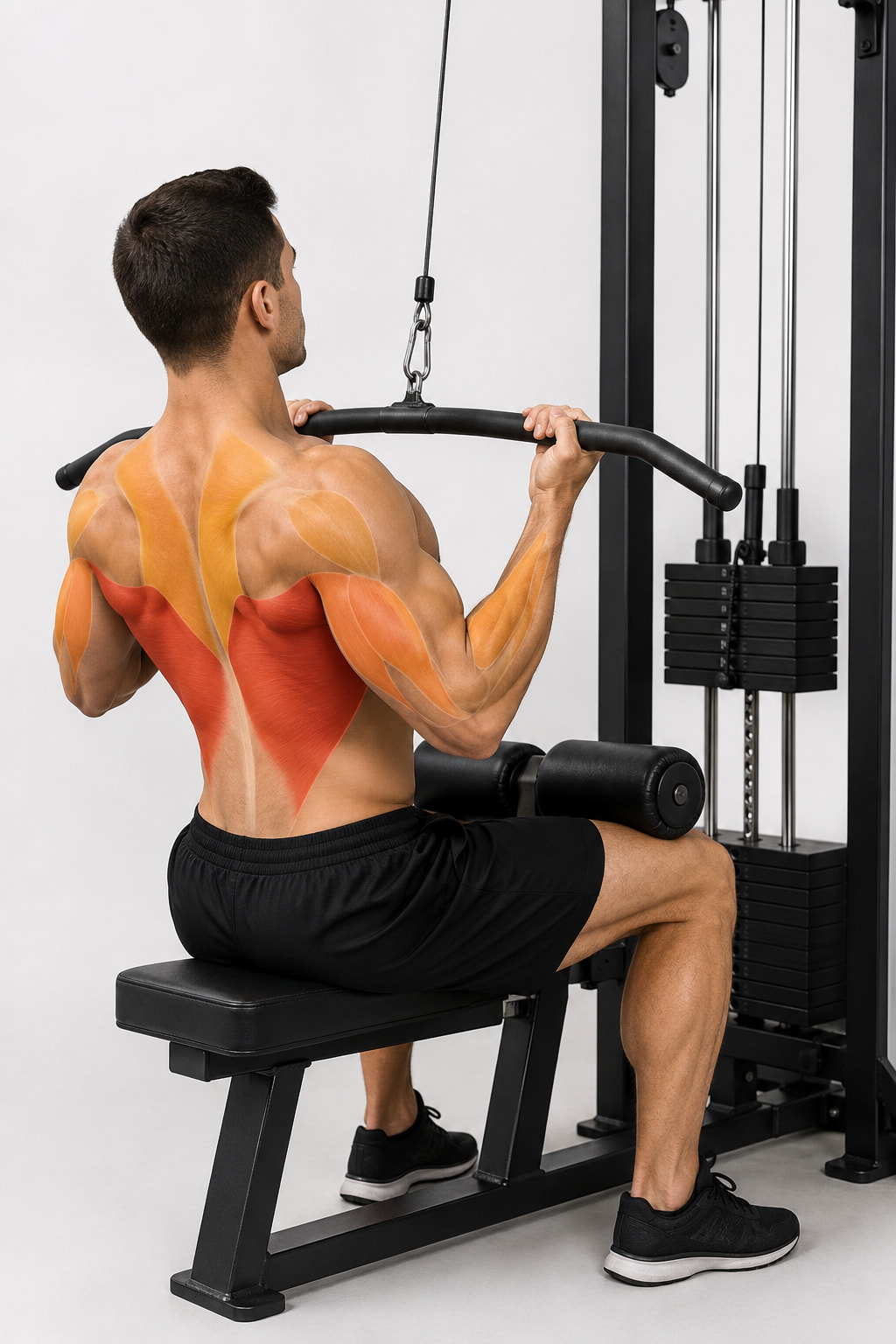
The reverse grip lat pulldown is a compound exercise, meaning several muscles and joints contribute to the movement.
Primary Muscle
The latissimus dorsi, commonly called the lats, is the main target. These large back muscles help pull the upper arms downward and toward the torso.
Assisting Muscles
Other muscles involved include:
- Teres major
- Biceps brachii
- Brachialis
- Brachioradialis
- Posterior deltoids
- Rhomboids
- Middle and lower trapezius
- Rotator-cuff muscles
- Abdominals and spinal stabilizers
The biceps contribute significantly to bending the elbows, but the movement should still be treated as a back exercise. Think about moving your elbows rather than curling the bar with your hands.
Does the Reverse Grip Target the Lower Lats?
The reverse grip is often promoted as a special lower-lat exercise, but the evidence does not show that it isolates one section of the lats.
A narrower underhand grip may allow you to keep your elbows close to your body, which can make the movement feel different from a wide overhand pulldown. However, that sensation does not prove that the lower portion of the lats is being isolated.
A study comparing pronated and supinated pulldown grips found greater overall latissimus dorsi activity with the pronated grip and no significant grip-related difference in biceps activity. A more recent study comparing seven pulldown variations found few meaningful differences in the activity of most measured back and arm muscles.
The practical takeaway is simple: the reverse grip trains the lats effectively, but it does not need to be presented as superior to every other pulldown grip.
How to Do the Reverse Grip Lat Pulldown
Best for: Building lat and upper-back strength with additional assistance from the biceps.
Muscles worked: Latissimus dorsi, teres major, biceps, brachialis, rear deltoids, trapezius, rhomboids, and trunk stabilizers.
Equipment needed: Cable lat pulldown machine and a straight or slightly curved bar.
Sets, reps, and rest: Begin with 2–4 sets of 8–15 repetitions. Rest for approximately 90–150 seconds between sets.
Step-by-Step Instructions
- Attach a straight or slightly curved bar to the high pulley.
- Adjust the thigh pad so it holds your legs securely when seated.
- Stand and grasp the bar with your palms facing you.
- Place your hands approximately shoulder-width apart or slightly narrower.
- Sit down with your thighs under the pad and both feet firmly supported.
- Brace your abdomen and lean back only slightly while keeping your spine neutral.
- Begin the repetition by driving your elbows down toward your sides.
- Pull the bar toward your upper chest without swinging or leaning far backward.
- Stop when your elbows can no longer travel downward without moving excessively behind your torso.
- Slowly extend your arms and allow the bar to return overhead under control.
Avoid relaxing completely at the top. Maintain enough tension to control the weight while allowing your shoulder blades to move naturally.
The National Academy of Sports Medicine’s lat-pulldown biomechanics guide also emphasizes a stable torso, neutral spine, controlled shoulder-blade movement, and a slow return.
Coaching cue: Drive your elbows toward your front pockets while keeping your wrists straight.
Reverse Grip Lat Pulldown Form Tips
Use a Comfortable Grip Width
A shoulder-width or slightly narrower grip works well for most people. An extremely wide underhand grip can place the wrists and elbows in an awkward position without providing a clear training benefit.
Your forearms should remain reasonably vertical through the strongest part of the pull.
Keep Your Wrists Neutral
Do not let your wrists bend backward as the bar approaches your chest. Keep your knuckles, wrists, and forearms aligned.
If maintaining a straight wrist feels difficult, reduce the weight or try independent rotating handles.
Lead With Your Elbows
The hands connect you to the bar, but the elbows should guide the movement. Think about pulling your elbows downward instead of trying to curl the bar toward you.
This helps keep the exercise focused on shoulder movement and back-muscle involvement.
Use Only a Slight Backward Lean
A small torso angle can create room for the bar to reach the upper chest. However, leaning far backward changes the exercise into more of a cable row.
Your torso should remain in nearly the same position throughout each repetition.
Control the Return
Do not allow the weight stack to pull your arms upward quickly. Take approximately two or three seconds to return the bar overhead.
The controlled return keeps tension on the working muscles and helps you maintain a stable shoulder and torso position.
Use a Comfortable Range of Motion
Lower the bar until it reaches the upper-chest area or until your elbows stop moving downward. You do not need to force the bar toward your stomach.
At the top, allow your arms to extend into a comfortable overhead position without losing control or forcing a painful stretch.
Benefits of the Reverse Grip Lat Pulldown
Builds Back Strength
The movement trains the lats, teres major, and several muscles that control the shoulder blades. These muscles contribute to vertical pulling and many other upper-body exercises.
Includes More Elbow Flexion
The underhand grip places the elbows in a position where the biceps and other elbow flexors assist the pull. This makes the exercise useful on back, pull, or back-and-biceps training days.
Research has not consistently shown substantially greater biceps activation than other pulldown grips, so the exercise should not replace direct biceps work when arm development is a priority.
Provides an Accessible Chin-Up Pattern
Because the movement resembles an underhand chin-up, it can help beginners practice pulling their elbows downward while using an adjustable resistance.
It is not an exact replacement for chin-ups because the body and machine move differently, but it can help develop relevant back and arm strength.
Allows Simple Load Progression
A selectorized pulldown machine lets you change resistance in small increments. This makes it easier to increase the training challenge without immediately moving to full-bodyweight pulling.
Adds Variety to Back Training
Changing grips can help make a routine more comfortable and varied. The best grip is not automatically the one that produces the highest reading in a single muscle-activation study. Comfort, technique, available equipment, and consistent progression also matter.
Common Reverse Grip Lat Pulldown Mistakes
Using Too Much Weight
A load that causes rocking, jerking, shortened repetitions, or excessive backward lean is too heavy for controlled pulldowns.
Reduce the weight until you can complete every repetition without changing your torso position.
Turning It Into a Row
Leaning far backward and pulling the bar toward the abdomen changes the direction of resistance and makes the movement more horizontal.
Use a seated cable row when you want to train a rowing pattern. Keep the pulldown primarily vertical.
Curling the Bar Down
Trying to perform a heavy biceps curl with the bar often causes the wrists to fold backward and the elbows to drift forward.
Keep the wrists firm and focus on pulling the elbows down.
Pulling the Elbows Too Far Behind the Body
Once the elbows stop traveling downward, continuing to pull usually adds unnecessary shoulder movement rather than useful lat range.
Finish near the upper chest and return with control.
Shrugging the Shoulders
Avoid pulling with the shoulders raised toward the ears. Keep your neck relaxed and allow the shoulder blades to move smoothly rather than forcing them into a rigid position.
Releasing the Weight Too Quickly
Letting the bar snap upward reduces control and can pull the shoulders suddenly into the overhead position.
Control both the downward and upward phases of every repetition.
Reverse Grip vs. Overhand Lat Pulldown
Both variations train the lats and surrounding back muscles. The main differences are hand position, typical grip width, and elbow path.
| Feature | Reverse Grip Pulldown | Overhand Pulldown |
|---|---|---|
| Hand position | Palms face the lifter | Palms face away |
| Typical grip | Shoulder-width or narrower | Shoulder-width to moderately wide |
| Elbow path | Close to the torso | Slightly farther outward |
| Arm involvement | Biceps assist the pull | Biceps still assist the pull |
| Common use | Underhand vertical-pulling variation | Standard vertical-pulling variation |
| Potential limitation | Wrist or elbow discomfort | Very wide grips may shorten range |
Some research has found higher lat activity with a pronated grip, while other studies have found only small or inconsistent differences between pulldown variations.
Choose the variation that allows you to use a comfortable range of motion, control the resistance, and progress without joint discomfort. You can also rotate between grips across different training phases.
Sets, Reps, Rest, and Workout Placement
The best repetition range depends on your training goal, experience, and the other exercises in your workout.
Beginner Starting Point
- 2 sets
- 10–12 repetitions
- 90 seconds of rest
- Approximately 2–3 repetitions left before technical failure
Use a weight that lets you practice the same controlled movement on every repetition.
Muscle-Building Option
- 3–4 sets
- 8–15 repetitions
- 90–150 seconds of rest
- Approximately 1–3 repetitions in reserve
A wide range of loads can support muscle development when sets are challenging and technique remains controlled. Consistency, progressive training, and sufficient weekly work matter more than finding one perfect repetition number. The current American College of Sports Medicine resistance-training position stand supports progressive, individualized resistance training rather than one rigid prescription for every person.
Strength-Focused Option
- 3–4 sets
- 6–10 repetitions
- 2–3 minutes of rest
Avoid using loads so heavy that the movement becomes a torso swing. Machine pulldowns can build strength, but technical control should remain the priority.
Where to Place It in a Workout
Place the reverse grip lat pulldown:
- Near the beginning of a back workout as the main vertical pull
- After chin-ups when additional back volume is needed
- After a heavy row as a secondary back exercise
- Before direct biceps curls on a pull day
- In a full-body routine as the primary pulling movement
If the workout includes several back exercises, one vertical pull and one horizontal row are usually more useful than repeating multiple nearly identical pulldown variations.
How to Progress the Exercise
Choose a repetition range, such as 8–12 repetitions.
When you can complete all planned sets at the top of that range with stable technique and one or two good repetitions still available, increase the weight by the smallest practical amount.
Other progression methods include:
- Adding one repetition per set
- Adding one additional set
- Pausing briefly near the upper chest
- Slowing the lowering phase
- Improving range of motion
- Reducing unnecessary torso movement
Change only one or two variables at a time. Adding weight is not progress when it causes shorter repetitions or more momentum.
Regressions, Progressions, and Alternatives
Easier Options
Use one of these modifications when learning the exercise:
- Reduce the machine resistance.
- Use a neutral-grip attachment.
- Use independent rotating handles.
- Perform fewer repetitions per set.
- Use a slightly shorter but pain-free overhead range.
More Challenging Options
Once you can control the standard exercise:
- Increase the resistance gradually.
- Add a one-second pause at the bottom.
- Use a three-second lowering phase.
- Try a single-arm underhand cable pulldown.
- Progress toward assisted or bodyweight chin-ups.
Alternatives
Useful alternatives include:
- Neutral-grip lat pulldown
- Standard overhand lat pulldown
- Single-arm cable pulldown
- Assisted chin-up
- Resistance-band pulldown
- Straight-arm cable pulldown
A neutral grip or rotating handle is often the most practical substitution when a fixed underhand bar feels uncomfortable.
Sample Back Workout
This simple workout combines vertical and horizontal pulling without unnecessary overlap.
Beginner Back Workout
- Reverse grip lat pulldown: 3 sets of 8–12 reps
- Seated cable row: 3 sets of 10–12 reps
- Cable reverse fly: 2 sets of 12–15 reps
- Dumbbell biceps curl: 2 sets of 10–15 reps
Rest for 90–150 seconds after the pulldown and row. Rest for approximately 60–90 seconds after the reverse fly and curls.
Perform the workout once or twice per week, depending on your full training schedule. Start with about two or three repetitions in reserve and add weight only after reaching the top of the target range with clean form.
Safety Considerations
Do not force your wrists into an uncomfortable underhand position. Some straight bars require more forearm rotation than a person can comfortably maintain.
Try a neutral attachment, rotating handles, or another pulldown variation if the reverse grip causes wrist, elbow, or shoulder discomfort.
Stop exercising and seek appropriate professional help if you experience sharp pain, numbness, dizziness, chest pain, or other unusual symptoms.
Frequently Asked Questions
Is the reverse grip lat pulldown a back or biceps exercise?
It is primarily a back exercise. The lats move the upper arms downward, while the biceps assist by bending the elbows. Focus on driving the elbows down rather than curling the bar.
What grip width should I use?
Start with your hands approximately shoulder-width apart or slightly narrower. Avoid an extremely wide underhand grip, especially if it causes your wrists or elbows to feel strained.
How low should I pull the bar?
Pull toward the upper chest and stop when your elbows can no longer travel downward without moving far behind your body. Pulling the bar toward the stomach is unnecessary.
Should I lean back during the exercise?
A slight backward lean is acceptable, but your torso should remain stable. Excessive leaning changes the pulldown into more of a rowing movement.
Is the reverse grip better than the overhand grip?
Neither variation is universally better. Both train the lats, upper back, and elbow flexors. Choose the grip that feels comfortable and allows controlled, progressive training.
Does the reverse grip build more biceps?
The biceps assist the movement, but research has not consistently shown significantly greater biceps activation than other pulldown grips. Use direct curls when biceps development is a major goal.
Can beginners perform reverse grip lat pulldowns?
Yes. The adjustable resistance makes the exercise beginner-friendly. Begin with a light load and learn to keep your torso, wrists, and elbows controlled.
Conclusion
The reverse grip lat pulldown is a useful vertical-pulling exercise for strengthening the lats, upper back, and assisting arm muscles. Its main value comes from controlled execution, comfortable hand positioning, and gradual progression—not from supposedly isolating the lower lats.
Use a shoulder-width underhand grip, pull your elbows toward your sides, keep your wrists straight, and avoid turning the movement into a backward-leaning row. Once you can complete your target repetitions with consistent form, increase the resistance gradually.
References
- National Academy of Sports Medicine: Biomechanics of the Lat Pulldown
- American College of Sports Medicine Position Stand on Resistance Training
- Grip Width and Forearm Orientation During the Lat Pulldown
- Effects of Grip Variations and Forearm Orientation During Lat Pulldowns
- Variations in Muscle Activation During Traditional Lat-Training Exercises
- Effects of Grip Width on Lat-Pulldown Strength and Muscle Activation
This content is for informational purposes only and is not a substitute for professional medical advice.