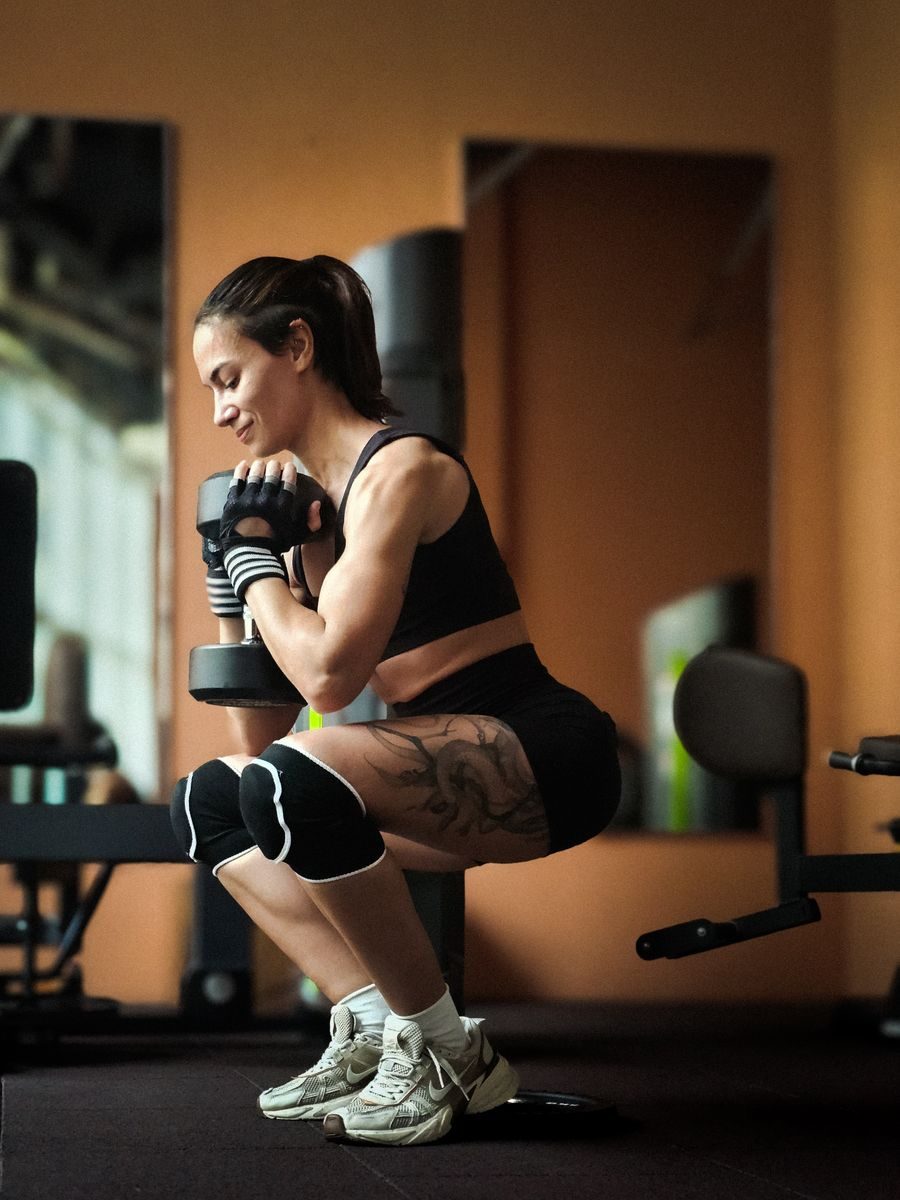
The dumbbell goblet squat is a front-loaded lower-body exercise that primarily strengthens the quadriceps, glutes, and adductors while requiring your trunk to keep the weight stable. You perform it by holding one dumbbell close to your chest and bending your hips, knees, and ankles together to lower into a squat.
Because it requires only one dumbbell and is easy to adjust, the exercise can work well for beginners learning to squat, home workouts, and experienced lifters who need a lower-body accessory exercise.
This guide explains proper dumbbell goblet squat form, muscles worked, common mistakes, modifications, progressions, and practical workout programming.
Dumbbell Goblet Squat at a Glance
| Training detail | Recommendation |
|---|---|
| Best for | Learning loaded squat mechanics and building lower-body strength |
| Primary muscles | Quadriceps, gluteus maximus, and adductor magnus |
| Supporting muscles | Hamstrings, calves, hip stabilizers, abdominals, and spinal erectors |
| Equipment | One dumbbell |
| Experience level | Beginner to intermediate |
| Suggested starting range | 2–3 sets of 8–12 repetitions |
| Rest between sets | 60–120 seconds |
| Effort level | Finish with 2–3 controlled repetitions still possible |
| Main form goal | Keep the dumbbell close, feet planted, and knees tracking with the toes |
The American Council on Exercise demonstrates the movement with a vertical dumbbell held in front of the chest, the elbows close to the ribs, and both feet pressing into the floor.
What Is a Dumbbell Goblet Squat?
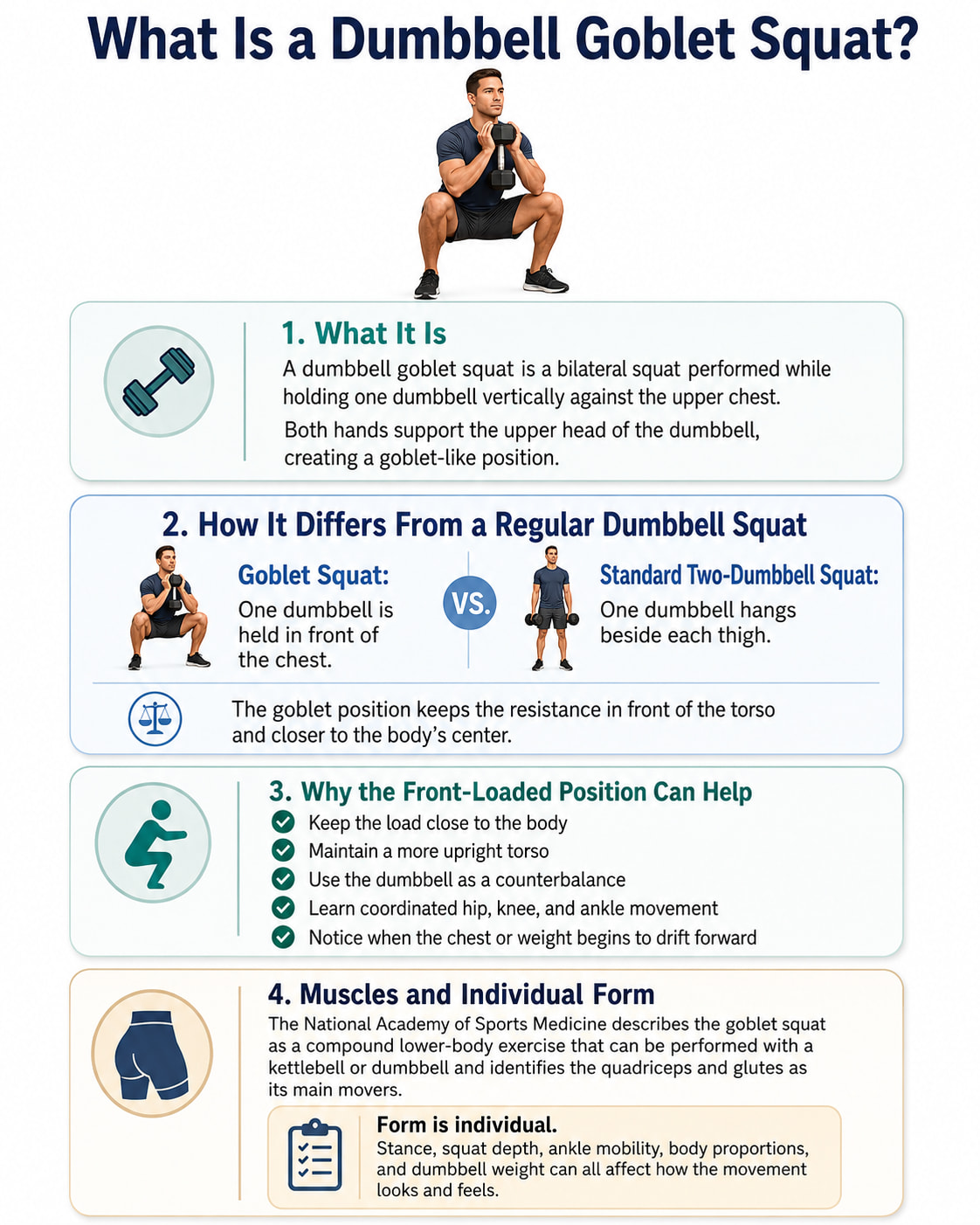
A dumbbell goblet squat is a bilateral squat performed while holding one dumbbell vertically against the upper chest. Both hands support the upper head of the dumbbell, creating a goblet-like position.
This is different from a standard two-dumbbell squat, in which one dumbbell hangs beside each thigh. The goblet position places the resistance in front of the torso and closer to the body’s center.
That front-loaded position often makes it easier to:
- Keep the load close to the body
- Maintain a more upright torso
- Use the dumbbell as a counterbalance
- Learn coordinated hip, knee, and ankle movement
- Notice when the chest or weight begins to drift forward
The National Academy of Sports Medicine describes it as a compound lower-body exercise that can be performed with a kettlebell or dumbbell and identifies the quadriceps and glutes as its main movers.
The position does not guarantee perfect form. Your stance, depth, ankle mobility, body proportions, and dumbbell weight still affect how the squat looks and feels.
Dumbbell Goblet Squat Muscles Worked
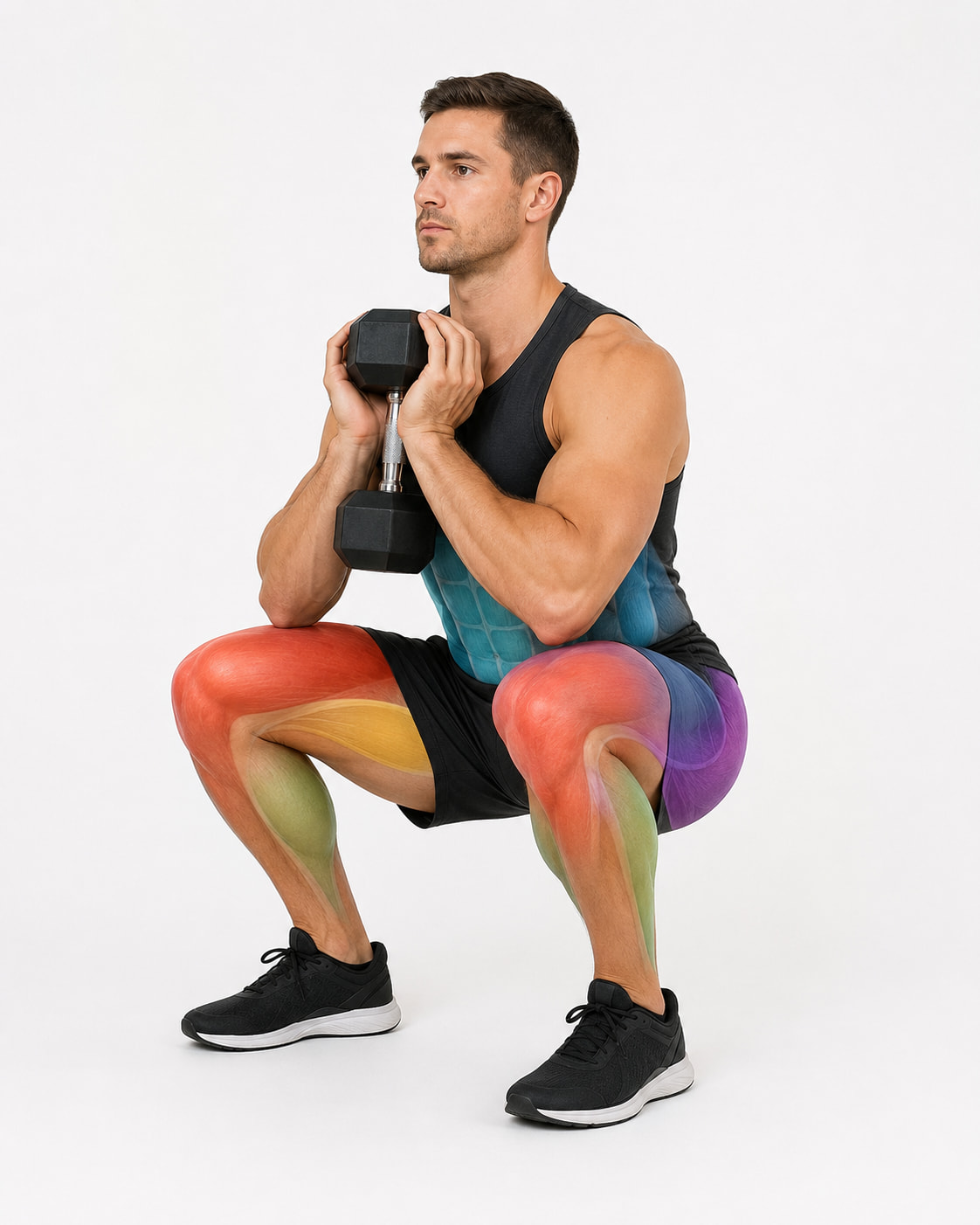
The dumbbell goblet squat trains several muscles because the hips, knees, and ankles move during every repetition while the torso stabilizes the weight.
Quadriceps
The quadriceps on the fronts of the thighs extend the knees as you stand.
They generally receive more demand when you use meaningful knee bending, allow the knees to travel forward naturally, and keep the torso relatively upright.
Gluteus Maximus
The gluteus maximus extends the hips during the upward phase.
It becomes especially important when rising from a deeper controlled position, although you should not force more depth than you can manage with stable form.
Adductor Magnus
The adductor magnus is a large inner-thigh muscle. Part of it assists hip extension as you rise from the squat.
The NCBI Bookshelf overview of the thigh muscles explains that the hamstring portion of the adductor magnus extends and adducts the thigh.
Supporting and Stabilizing Muscles
Other muscles help control the movement:
- Hamstrings: Assist hip control and help stabilize the knees.
- Gluteus medius and minimus: Help control the position of the pelvis and thighs.
- Calves: Assist ankle control and help keep the lower legs stable.
- Abdominals and obliques: Brace the trunk against the front-loaded dumbbell.
- Erector spinae: Help maintain a controlled spinal position.
- Upper back, shoulders, and forearms: Hold the dumbbell securely against the chest.
The hamstrings are involved, but the goblet squat is not usually a primary hamstring exercise. A hip-hinge movement such as a dumbbell Romanian deadlift generally provides more direct hamstring training.
How to Do a Dumbbell Goblet Squat
Sets, reps, and rest: Begin with 2–3 sets of 8–12 repetitions and rest for 60–120 seconds
Step-by-Step Instructions
- Position the dumbbell.
Hold one dumbbell vertically against your upper chest. Cup both hands securely underneath the upper head and keep your wrists as straight as possible. - Set your stance.
Stand with your feet approximately hip- to shoulder-width apart. Turn your toes slightly outward if that feels more natural for your hips and knees. - Create a stable starting position.
Keep your ribs stacked over your pelvis, gently brace your abdomen, and relax your shoulders away from your ears. - Begin the descent.
Bend your hips, knees, and ankles together. Lower your body between your legs rather than pushing your hips as far backward as possible. - Keep your feet planted.
Maintain pressure through your heels, the base of your big toes, and the outer forefeet. Let your knees travel in the same general direction as your toes. - Use a controlled depth.
Descend until you reach the deepest position you can control without your heels lifting, knees collapsing inward, or lower back noticeably rounding. - Stand up.
Push the floor away while extending your knees and hips together. Keep the dumbbell close to your chest throughout the upward phase. - Finish under control.
Stand tall without leaning backward or forcefully pushing your hips forward. Reset your breath and brace before the next repetition.
Breathing
Inhale before or during the controlled lowering phase. Brace your trunk, then exhale gradually as you pass the hardest part of the upward phase.
Avoid prolonged breath-holding, particularly when you are inexperienced with resistance training.
Coaching Cue
Keep the dumbbell close and sit between your feet.
How Deep Should You Goblet Squat?
There is no single correct squat depth for every person.
Some lifters can comfortably lower until their hips are below their knees. Others reach the limit of their ankle or hip mobility earlier. Limb lengths, stance width, foot angle, balance, and previous training experience also affect depth.
Use the deepest position in which you can maintain:
- The whole foot on the floor
- Controlled knee alignment
- A secure dumbbell position
- A comfortable, controlled spine
- Enough balance to stand without bouncing
A 2024 biomechanical review published by the International Journal of Sports Physical Therapy explains that squat mechanics and joint demands change with stance width, foot rotation, torso angle, shin angle, and depth. It also notes that squatting beyond the available hip-flexion range can cause the pelvis to rotate backward.
Squatting deeper is not automatically better when control has already been lost. A box or bench can provide a useful depth target while you develop mobility and consistency.
Can Your Knees Move Past Your Toes?
Your knees do not have to remain behind your toes during every goblet squat.
For many people, some forward knee movement is a normal part of reaching a comfortable squat depth while keeping the heels down. Restricting all forward movement may force excessive hip movement or torso inclination.
The more useful goals are to:
- Keep the knees moving with the toes
- Maintain the entire foot on the floor
- Avoid sudden inward knee collapse
- Use a pain-free, controlled range
- Adjust your stance to fit your structure
Greater forward shin inclination generally increases the demand placed on the knee extensors and quadriceps. A more inclined torso generally shifts more demand toward the hips and spinal extensors.
Benefits of Dumbbell Goblet Squats
Builds Lower-Body Strength
Goblet squats train the muscles responsible for extending the knees and hips. They can serve as a main squat exercise for beginners or as an accessory exercise for more experienced lifters.
Provides an Accessible Loaded Squat
The front-loaded dumbbell can provide a counterbalance and may help some people maintain a controlled torso position while learning to squat.
You can first learn the pattern with body weight and then add a light dumbbell when you can squat with consistent balance and alignment.
Requires Minimal Equipment
You need only one dumbbell and enough clear floor space. This makes the exercise practical for home workouts, small gyms, and full-body routines with limited equipment.
Challenges Trunk Stability
The abdominals, obliques, and spinal extensors work to prevent the dumbbell from pulling the torso forward.
The squat pattern requires lower-body force production together with trunk stabilization rather than isolating a single muscle.
Offers Several Ways to Progress
You can make the exercise more difficult by:
- Adding repetitions
- Increasing the dumbbell weight
- Slowing the lowering phase
- Pausing at the bottom
- Increasing the controlled range of motion
- Using 1½ repetitions
Can Help Prepare You for Other Squat Variations
The goblet squat can help you practice holding a front-loaded resistance before progressing to a double-dumbbell front squat or barbell front squat.
However, it has a loading limitation. Your arms, upper back, or ability to hold a large dumbbell may become fatigued before your legs. Stronger lifters may eventually need a variation that allows more resistance.
Common Dumbbell Goblet Squat Mistakes
| Mistake | How to correct it |
|---|---|
| Holding the dumbbell away from the chest | Pull it gently toward the upper chest and keep the elbows near the ribs |
| Starting with too much weight | Reduce the load until every repetition looks consistent |
| Allowing the knees to collapse inward | Track the knees in the same direction as the toes |
| Lifting the heels | Reduce the depth, adjust the stance, or work on ankle mobility |
| Shifting entirely onto the heels | Keep the heels, big-toe bases, and outer forefeet in contact with the floor |
| Turning the squat into a hip hinge | Bend the knees and hips together instead of pushing the hips far backward |
| Rounding the lower back at the bottom | Stop slightly higher or use a box as a depth target |
| Letting the hips rise before the chest | Stand by extending the knees and hips together |
| Bouncing out of the bottom | Pause briefly and reverse the movement under control |
| Rushing the repetitions | Use a steady descent and avoid relying on momentum |
NASM lists inward knee movement, excessive forward leaning, uncontrolled repetitions, chest collapse, and allowing the resistance to drift away from the body among the main goblet squat mistakes.
Beginner Modifications and Regressions
Bodyweight Squat to a Box
Place a stable box or bench behind you. Squat down until you lightly touch or sit on the surface, then stand.
This provides a clear depth target and can help beginners learn balance before holding a dumbbell.
Goblet Squat to a Box
Hold a light dumbbell against your chest and squat toward a box. Touch the box lightly without relaxing or rocking backward, then stand.
Choose a box height that allows you to maintain foot pressure and spinal control.
Reduced-Range Goblet Squat
Lower only as far as you can control. Gradually increase the range as your balance, strength, and mobility improve.
A shorter controlled squat is more useful than a deeper repetition performed with lifted heels or a rounded back.
Assisted Squat
Hold a stable post, railing, or suspension trainer with one or both hands while practicing the squat pattern.
Do not hold a dumbbell at the same time unless you can maintain a secure grip and stable setup.
Heel-Elevated Goblet Squat
A small, stable heel wedge or weightlifting shoe may help some lifters squat with a more upright torso when ankle mobility limits depth.
Heel elevation is a modification, not automatically an easier version. It permits more forward shin movement and can increase quadriceps and knee-extensor demand.
Dumbbell Goblet Squat Progressions
Progress only when you can complete your current variation with consistent depth, foot pressure, and knee alignment.
Useful progressions include:
- Increase repetitions within your current range.
- Add the smallest practical amount of dumbbell weight.
- Lower for three seconds on each repetition.
- Pause for one or two seconds at the bottom.
- Perform 1½ repetitions.
- Progress to a double-dumbbell front squat.
- Use another squat variation that permits heavier loading.
A simple progression method is to begin with three sets of eight repetitions. Add repetitions over several workouts until you can complete three sets of 12 with two or three good repetitions still possible. Then increase the weight and return to eight repetitions.
How Much Weight Should You Use?
There is no universal starting dumbbell weight.
Choose a load that allows you to:
- Hold the dumbbell securely
- Maintain a stable stance
- Reach a consistent depth
- Keep the weight against your chest
- Complete the planned repetitions without rushing
- Finish with approximately two or three repetitions still possible
The weight is too heavy when your elbows drop uncontrollably, the dumbbell moves away from your body, your heels lift, or your torso collapses.
The Mayo Clinic recommends lowering the resistance or number of repetitions when proper form cannot be maintained and increasing the weight gradually as strength improves.
Sets, Reps, Rest, and Frequency
The best range depends on your goal and current ability.
| Training goal | Sets | Repetitions | Rest | Suggested effort |
|---|---|---|---|---|
| Learning the movement | 2–3 | 8–12 | 60–90 seconds | 3–4 reps in reserve |
| General strength and muscle | 3–4 | 6–12 | 90–150 seconds | 1–3 reps in reserve |
| Higher-repetition accessory work | 2–3 | 12–20 | 45–90 seconds | 2–3 reps in reserve |
| Slow-tempo or paused squats | 2–3 | 6–10 | 90–120 seconds | Stop before form changes |
For most beginners, two sessions per week provide a practical starting point. The goblet squat can also be performed once or three times weekly when total lower-body volume, exercise selection, and recovery are adjusted appropriately.
The updated American College of Sports Medicine resistance-training guidance emphasizes consistency, individualizing load and volume, and training the major muscle groups at least twice weekly. It also reports that reaching momentary muscular failure is not necessary for the average healthy adult to make progress.
Sample Beginner Goblet Squat Workout
Perform this lower-body workout twice per week on nonconsecutive days.
Warm-Up
Complete five to ten minutes of light movement, followed by:
- Bodyweight squat: 2 sets of 8 repetitions
- Alternating reverse lunge: 1 set of 6 repetitions per side
- Hip hinge drill: 1 set of 10 repetitions
Workout
| Exercise | Sets and reps | Rest | Effort |
|---|---|---|---|
| Dumbbell goblet squat | 3 × 8–12 | 90 seconds | 2–3 reps in reserve |
| Dumbbell Romanian deadlift | 3 × 8–12 | 90 seconds | 2–3 reps in reserve |
| Reverse lunge | 2 × 8 per side | 60–90 seconds | 2–3 reps in reserve |
| Standing calf raise | 2 × 12–15 | 60 seconds | Controlled repetitions |
Begin at the lower end of each repetition range. Add repetitions before adding weight, and do not increase the goblet squat load until all three sets remain controlled.
Dumbbell Goblet Squat vs. Regular Dumbbell Squat
| Feature | Dumbbell goblet squat | Regular dumbbell squat |
|---|---|---|
| Dumbbell position | One dumbbell at the chest | One dumbbell in each hand beside the body |
| Loading | Front-loaded | Side-loaded |
| Main advantage | Useful counterbalance and squat-learning variation | May allow more total resistance |
| Common limitation | Arms or upper back may fatigue first | Grip may limit the weight |
| Equipment | One dumbbell | Two dumbbells |
| Best use | Beginners, home training, and accessory work | Progressive lower-body loading |
Neither version is universally better.
Choose the goblet squat when you want a simple front-loaded squat or are learning the movement. Choose the regular two-dumbbell squat when you can control the pattern and need more total resistance than one chest-held dumbbell allows.
Safety Tips
- Warm up before using a challenging dumbbell.
- Practice with body weight or a light dumbbell first.
- Use a stable, nonslip training surface.
- Keep the area around you clear.
- Hold the dumbbell securely with both hands.
- Pick up and set down the weight with controlled hip and knee movement.
- Avoid bouncing, jerking, or rushing the repetitions.
- Breathe throughout the set rather than holding your breath for long periods.
- Stop the set when your grip or squat technique becomes unstable.
- Allow recovery before training the same muscles hard again.
Mayo Clinic recommends warming up, using controlled movements, breathing during weight training, and stopping an exercise that causes pain.
Stop exercising and seek professional help if you experience sharp pain, numbness, dizziness, chest pain, or other unusual symptoms.
Frequently Asked Questions
Are dumbbell goblet squats good for beginners?
Yes. The front-loaded position and simple one-dumbbell setup can make the exercise useful for learning a loaded squat.
Beginners should first be able to perform a controlled bodyweight squat or box squat. Start with a light dumbbell and use a range of motion that can be maintained without losing balance.
Do goblet squats build the glutes?
Goblet squats train the gluteus maximus as the hips extend during the upward phase. They also train the quadriceps and adductors.
For more complete glute and hamstring training, combine goblet squats with a hip-hinge exercise such as a Romanian deadlift or hip thrust.
Should you squeeze your glutes at the top?
Finish each repetition by standing tall and extending the hips naturally. A gentle glute contraction is normal, but you do not need to forcefully push the hips forward or lean backward.
How low should you squat?
Squat as low as you can while keeping your feet planted, knees controlled, dumbbell secure, and spine comfortable.
Use a box or bench if you need a consistent depth target.
Why do my arms get tired before my legs?
Your arms, shoulders, upper back, and forearms must hold the dumbbell against your chest throughout the set.
If your upper body consistently limits the exercise, use slightly shorter sets, improve your holding strength, or progress to a squat variation that does not require supporting one large dumbbell at chest height.
How often can you perform goblet squats?
Most beginners can start with goblet squats twice per week on nonconsecutive days.
More experienced lifters may use them one to three times weekly depending on training volume, intensity, and the other lower-body exercises in the program.
Conclusion
The dumbbell goblet squat is a practical way to build lower-body strength with minimal equipment. Keep the dumbbell close to your chest, bend your hips and knees together, maintain full-foot contact, and use only the depth you can control.
Start with a manageable weight, progress repetitions before load, and move to a heavier squat variation when holding the dumbbell becomes more limiting than the work performed by your legs.
This content is for informational purposes only and is not a substitute for medical advice.
References
- American Council on Exercise: Goblet Squat Exercise Guide — Supports dumbbell position, stance, squat form, foot pressure, and controlled movement.
- National Academy of Sports Medicine: Goblet Squat Exercise Library — Relevant to muscles worked, proper technique, common mistakes, and programming.
- National Strength and Conditioning Association: Progressive Strategies for Teaching Fundamental Movement Patterns — Supports bodyweight, box-squat, and goblet-squat progressions.
- Straub et al.: A Biomechanical Review of the Squat Exercise — Supports squat depth, knee travel, stance width, foot angle, torso position, and heel elevation.
- Collins et al.: Goblet Squat and Landmine Squat Muscle Activity — Provides goblet-squat-specific evidence on quadriceps activity and lower-body force.
- American College of Sports Medicine: Resistance-Training Guidelines — Supports training frequency, sets, effort, progressive overload, and strength programming.
- Mayo Clinic: Weight Training Dos and Don’ts — Supports warm-ups, breathing, weight selection, controlled repetitions, and safety guidance.