Dumbbell kickbacks are a single-joint exercise that primarily trains the triceps by extending the elbow while the upper arm remains still beside the torso. They require little equipment, work well for unilateral training, and can be a useful finishing exercise after heavier upper-body movements.
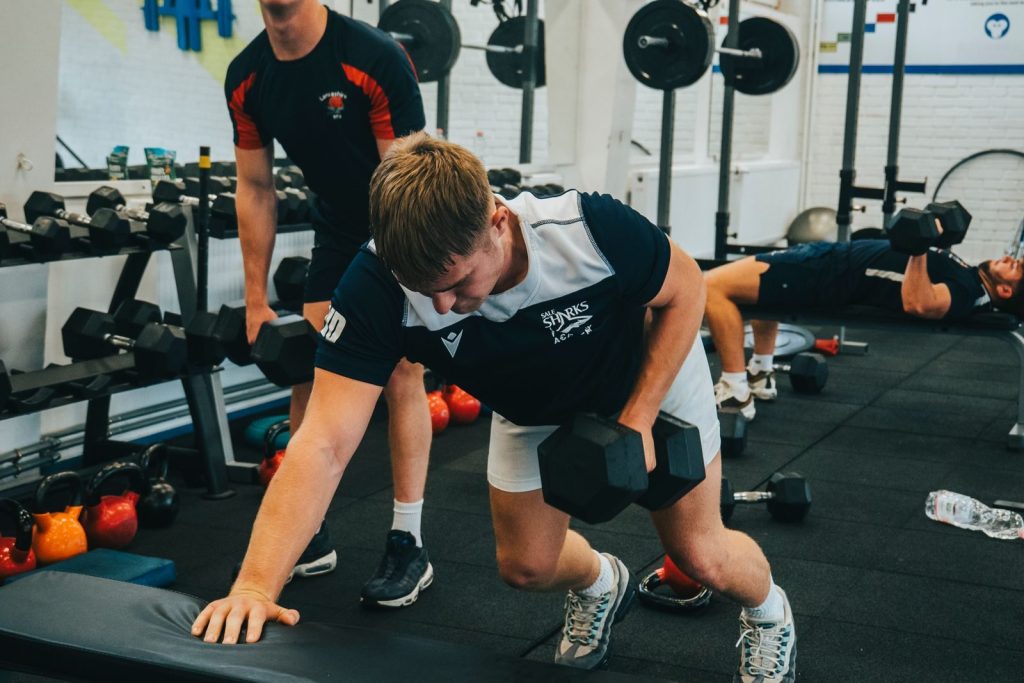
Although the exercise looks simple, using too much weight can quickly turn it into a swinging shoulder movement. This guide explains proper dumbbell kickback form, the muscles worked, common mistakes, useful variations, and practical sets and reps.
Dumbbell Kickbacks at a Glance
| Category | Details |
|---|---|
| Exercise type | Single-joint elbow extension |
| Primary muscle | Triceps brachii |
| Equipment | One or two dumbbells |
| Optional equipment | Exercise bench |
| Best for | Triceps accessory work and home workouts |
| Typical rep range | 10–20 repetitions per arm |
| Suggested sets | 2–4 |
| Rest | 60–90 seconds |
| Difficulty | Beginner-friendly with support |
| Workout placement | After presses or other main upper-body exercises |
What Are Dumbbell Kickbacks?
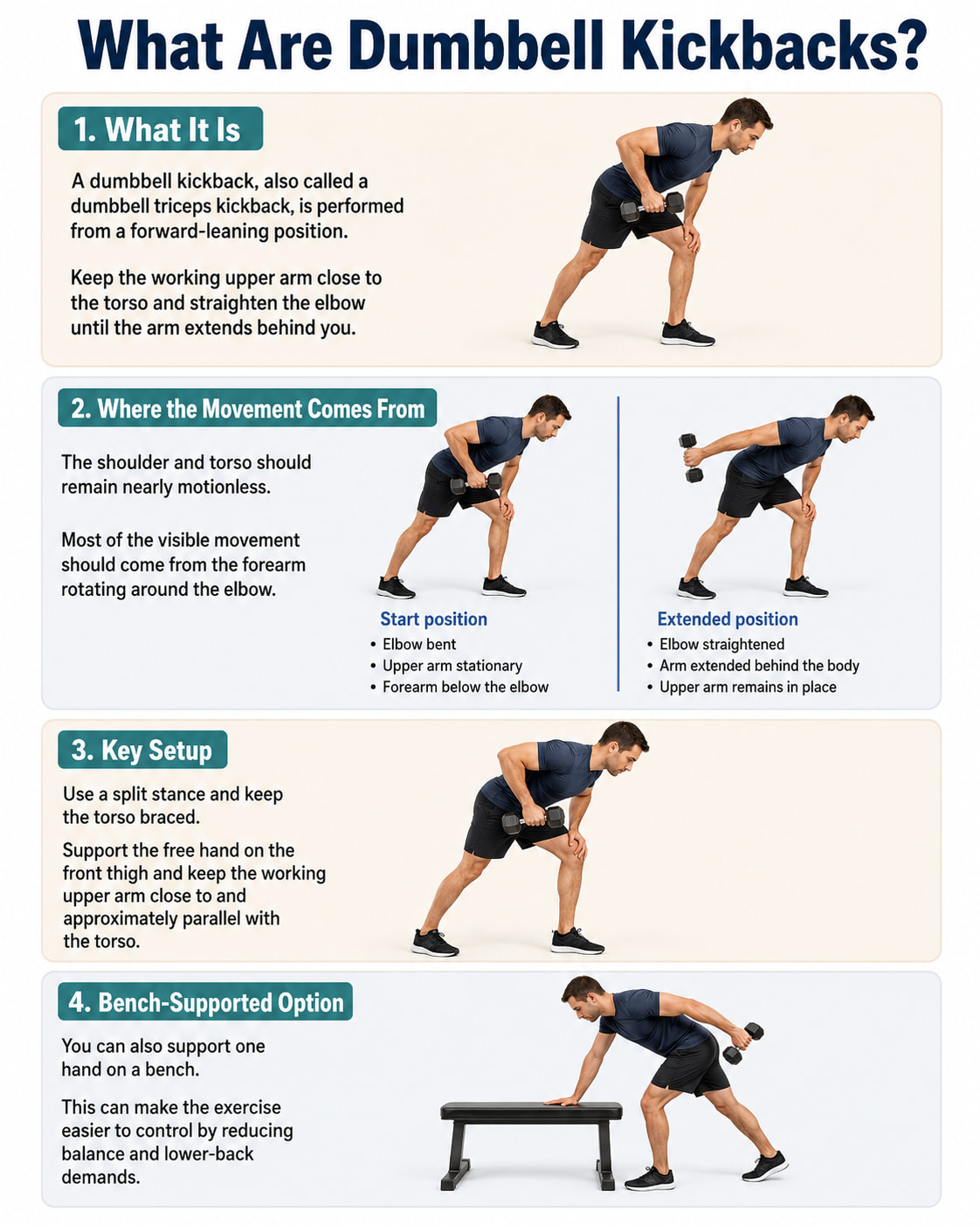
The dumbbell kickback, also called the dumbbell triceps kickback, is performed from a forward-leaning position. You hold the working upper arm close to the torso and straighten the elbow until the arm extends behind you.
The shoulder and torso should remain nearly motionless. Most of the visible movement should come from the forearm rotating around the elbow.
The American Council on Exercise teaches the exercise with a split stance, a braced torso, the free hand supported on the front thigh, and the working upper arm held close to and approximately parallel with the torso.
You can also support one hand on a bench. This usually makes the exercise easier to control because it reduces the balance and lower-back demands.
Dumbbell Kickbacks: Muscles Worked
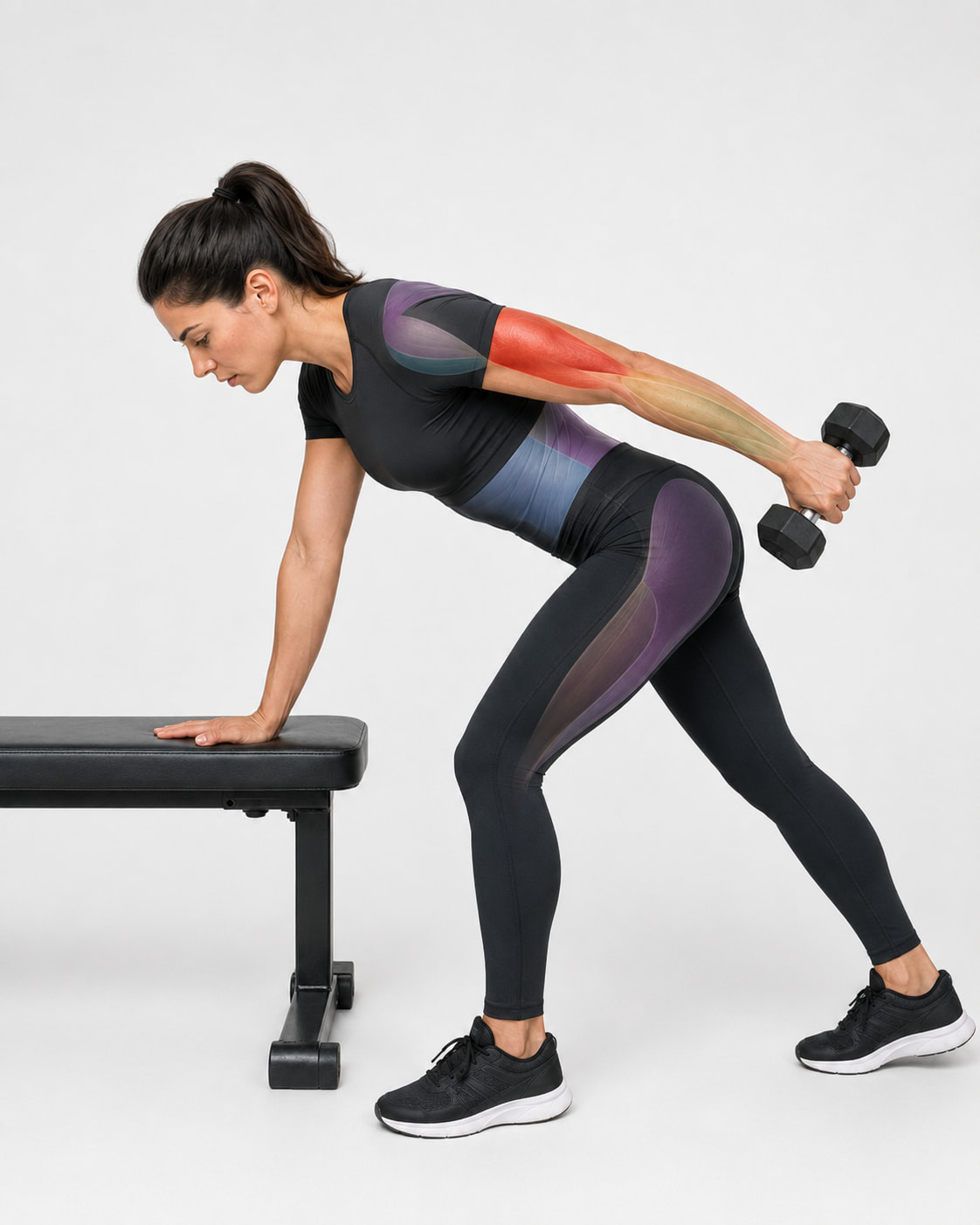
Triceps Brachii
The triceps brachii is the primary muscle worked during dumbbell kickbacks. It is located along the back of the upper arm and produces elbow extension—the action of straightening your arm.
The triceps has three heads:
- Long head
- Lateral head
- Medial head
All three heads contribute to elbow extension. The NCBI Bookshelf overview of triceps anatomy explains that the three heads begin from different locations but join into a common tendon near the elbow. The long head also crosses the shoulder joint, while the lateral and medial heads begin on the upper-arm bone.
Dumbbell kickbacks therefore train the entire triceps. They do not isolate only the long head, lateral head, or medial head.
Arm position can change the length and contribution of the individual heads, particularly the long head, but it is more accurate to describe kickbacks as a complete elbow-extension exercise than as a single-head isolation movement.
Assisting and Stabilizing Muscles
Several other muscles help maintain the kickback position:
- Posterior deltoid
- Rotator-cuff muscles
- Upper-back and shoulder-blade stabilizers
- Forearm and grip muscles
- Abdominal muscles
- Obliques
- Spinal erectors
- Glutes and hamstrings during the hip hinge
These muscles mainly stabilize your shoulder, wrist, torso, and hips. They should not become the primary drivers of the repetition.
How to Do Dumbbell Kickbacks Correctly
Best for: Adding direct triceps work after pressing exercises or training the arms with minimal equipment.
Equipment needed: One dumbbell. A stable bench is optional.
Sets, reps, and rest: Start with 2–3 sets of 10–15 repetitions per arm. Rest for 60–90 seconds between sets or arms.
Step-by-Step Instructions
- Hold a light dumbbell in one hand with your palm facing your torso.
- Stand in a split stance with the opposite foot forward. Place your free hand on the front thigh or on a stable bench.
- Push your hips backward and lean forward while keeping your back and neck neutral. Brace your abdominal muscles so your torso remains still.
- Pull the working elbow back until the upper arm is close to your ribs and approximately in line with your torso.
- Bend the elbow to about 90 degrees. Your forearm should hang almost vertically beneath the elbow.
- Keeping the upper arm still, straighten your elbow and move the dumbbell behind you.
- Finish with the arm straight but not aggressively locked. Briefly contract the triceps without forcing the elbow beyond its natural range.
- Lower the dumbbell slowly until the elbow returns to approximately 90 degrees.
- Complete all repetitions on one side before switching arms.
Exhale as you extend the elbow and inhale as you return the dumbbell.
Coaching Cue
“Pin your upper arm beside your ribs and move only your forearm.”
Recommended Tempo
Use a controlled tempo rather than swinging the weight:
- About one second to straighten the arm
- A brief pause near full extension
- Two seconds to lower the dumbbell
The tempo does not need to be exact. The goal is to control both directions and prevent momentum from taking over.
Why Dumbbell Kickbacks Feel Hardest at the Top
A dumbbell does not provide equal resistance throughout a kickback.
At the beginning of the repetition, the forearm hangs close to vertical. Because gravity pulls the dumbbell straight down, there is relatively little turning force around the elbow in this position.
As you straighten the arm and the forearm becomes more horizontal, the dumbbell creates a larger challenge for the triceps. The exercise is generally hardest near the straight-arm position.
This resistance pattern explains several important technique points:
- A controlled finish matters.
- Letting the elbow drop reduces the challenge.
- Swinging through the top removes tension from the triceps.
- Heavy dumbbells can make proper form difficult.
- The bent-elbow position may feel much easier than the final part of the repetition.
You do not need to force the dumbbell higher after the elbow is straight. Doing so moves the shoulder instead of creating additional elbow extension.
Common Dumbbell Kickback Mistakes
Using Too Much Weight
A weight that is too heavy commonly causes the elbow to drop, the shoulder to swing, or the torso to rotate.
Use a load that allows you to reach a straight-arm position without changing your posture. Kickbacks usually require less weight than curls, presses, or rows.
Moving the Entire Arm
The upper arm should remain almost stationary. If the elbow repeatedly moves forward and backward, the shoulder is contributing too much to the repetition.
Set the upper arm before starting and imagine that the elbow is resting against an invisible support.
Allowing the Elbow to Drop
When the elbow drops toward the floor, the forearm may remain mostly vertical even as the arm straightens. This reduces the dumbbell’s leverage against the triceps.
Reduce the weight and keep the upper arm close to the torso.
Swinging the Dumbbell
Momentum may help you move a heavier dumbbell, but it reduces control and makes it harder to keep tension on the triceps.
Pause briefly before each repetition and deliberately straighten the elbow.
Rotating the Torso
The shoulders and chest should remain square to the floor. Rotating the torso often means the weight is too heavy or the stance is not stable enough.
Widen your stance slightly, brace your core, or support your free hand on a bench.
Rounding or Overarching the Back
The forward lean should come from the hips, not from rounding the spine. Excessively arching the lower back is also unnecessary.
Push the hips backward, maintain a neutral spine, and use bench support when holding the position is uncomfortable.
Bending the Wrist
Keep the wrist aligned with the forearm throughout the repetition. Do not curl the dumbbell upward or allow the hand to collapse toward the floor.
Snapping the Elbow Straight
The arm can reach full extension, but the movement should remain controlled. Do not violently force the elbow into lockout.
Benefits of Dumbbell Kickbacks
Provide Direct Triceps Training
Presses and push-ups train the triceps along with the chest and shoulders. Kickbacks make elbow extension the main movement, allowing you to add targeted triceps work without chest strength being the primary limiting factor.
Require Minimal Equipment
You need only one dumbbell. A bench can improve stability, but it is not required.
This makes dumbbell kickbacks practical for home workouts, small training spaces, and gyms with limited equipment.
Allow Unilateral Training
Training one arm at a time lets you concentrate on each side independently. It can also make differences in control, range of motion, or strength easier to notice.
Start with the weaker or less coordinated arm and perform the same number of controlled repetitions on the other side.
Challenge the Straight-Arm Position
Because the exercise becomes harder as the arm extends, kickbacks provide useful resistance near the end of elbow extension.
This makes them a practical complement to exercises that feel hardest in different portions of the range.
Fit Easily Into Upper-Body Workouts
Kickbacks work well after heavier exercises such as:
- Dumbbell presses
- Push-ups
- Overhead presses
- Close-grip floor presses
- Rows
- Overhead triceps extensions
They usually work best as an accessory exercise rather than the first movement in a workout.
Are Dumbbell Kickbacks Effective?
Dumbbell kickbacks can be effective for strengthening and building the triceps when you perform them with controlled technique, sufficient effort, and gradual progression.
An ACE-sponsored triceps exercise study recorded relatively high triceps activity during kickbacks. However, the study included only 15 trained women and measured short-term muscle activity during one set of seven repetitions. It did not measure long-term muscle growth.
The findings support the idea that kickbacks can strongly involve the triceps, but they do not prove that kickbacks are the best triceps exercise for every person.
Kickbacks also have limitations:
- They are difficult to load heavily without losing form.
- Resistance is low near the bent-elbow position.
- The unsupported version requires a stable hip hinge.
- Small increases in dumbbell weight can feel significant.
- They may not provide enough variety as your only triceps exercise.
For more complete triceps training, combine kickbacks with pressing and an exercise performed with the arms overhead.
A 12-week study indexed in PubMed found greater triceps growth from cable elbow extensions performed overhead than from extensions performed with the arm beside the torso. The study did not test dumbbell kickbacks, so it does not show that kickbacks are ineffective. It suggests that including more than one arm position may provide a more complete training stimulus.
How Much Weight Should You Use?
Choose a dumbbell you can control for at least 10 repetitions without:
- Swinging the arm
- Dropping the elbow
- Rotating the torso
- Bending the wrist
- Shortening the finishing position
- Losing your neutral spine
For your first session, select a weight that feels relatively light. Aim to finish each set with approximately two or three good repetitions still possible.
The correct weight may be much lighter than you expect. That is normal because the dumbbell has substantial leverage against the elbow near the top of the movement.
There is no need to test a one-repetition maximum for kickbacks.
When to Increase the Weight
Increase the load when you can:
- Reach the top of your target rep range on every set.
- Keep the upper arm stationary.
- Straighten the elbow fully without swinging.
- Lower every repetition under control.
- Repeat that performance for at least two workouts.
Use the smallest available increase. When the next dumbbell is too heavy, add repetitions, slow the lowering phase, or add a brief pause before increasing the load.
Dumbbell Kickback Sets, Reps, and Rest
A practical starting range for most people is:
- Sets: 2–4 per arm
- Repetitions: 10–20 per set
- Rest: 60–90 seconds
- Effort: Stop with approximately 1–3 controlled repetitions remaining
- Frequency: 1–2 times per week
Higher repetitions are often practical because kickbacks use relatively light weights and become difficult to control when loaded too heavily.
For Beginners
Perform 2 sets of 12–15 repetitions per arm. Use bench or thigh support and leave approximately three repetitions in reserve.
Focus on keeping the elbow still rather than making the set feel as difficult as possible.
For Muscle Growth
Perform 3–4 sets of 10–20 repetitions. Finish most sets with approximately one to three good repetitions remaining.
The American College of Sports Medicine’s 2026 resistance-training guidance emphasizes progressive training and notes that higher weekly volume can support muscle growth. Your total triceps work can include presses, push-ups, overhead extensions, pushdowns, and kickbacks rather than relying on kickbacks alone. Training to complete muscular failure is not required for most healthy adults.
As a Workout Finisher
Perform 2 sets of 15–20 repetitions after your main pressing and triceps exercises. Rest for 45–75 seconds and stop the set when your upper arm begins to move.
Dumbbell Kickback Regressions
Bench-Supported Single-Arm Kickback
Place the nonworking hand on a stable bench. You may also place the same-side knee on the bench if that position feels secure.
Support reduces the balance and torso-stability demands, making it easier to concentrate on the elbow.
Thigh-Supported Kickback
Use a split stance and place the free hand firmly on the front thigh. This option requires no bench while still providing some upper-body support.
No-Weight Technique Practice
Practice the movement without a dumbbell. Hold the upper arm in position and repeatedly straighten the elbow without moving the shoulder.
This can help beginners understand the movement before adding resistance.
Reduced Range of Motion
Use a comfortable range if full elbow flexion or extension feels restricted. Do not force the arm through discomfort.
Gradually increase the range only when you can control it without symptoms.
Dumbbell Kickback Progressions and Variations
Unsupported Single-Arm Kickback
Remove the hand support and maintain the hip-hinged position using your core, hips, and legs.
This increases the stability demand but should not change the basic elbow movement.
Two-Arm Dumbbell Kickback
Hold one dumbbell in each hand and train both arms simultaneously.
This variation is time-efficient, but it requires more torso stability and makes it easier to swing both weights. Use lighter dumbbells than you would during the supported one-arm version.
Kickback With a Longer Pause
Hold the straight-arm position for one or two seconds before lowering.
A pause can improve control and make a lighter dumbbell more challenging, but do not force the hand upward by moving the shoulder.
Cable Kickback
A cable can provide resistance through more of the movement because the pull comes from the cable rather than straight down from gravity.
Cable kickbacks can feel smoother near the bent-elbow position, while dumbbell kickbacks usually create their greatest challenge near full extension.
Neither version is automatically better. Use dumbbells for convenience and minimal equipment, or cables when you want a different resistance profile.
Dumbbell Kickbacks vs. Overhead Triceps Extensions
Both exercises extend the elbow, but they place the upper arm in different positions.
During a kickback, the upper arm is held beside or slightly behind the torso. During an overhead extension, the arm is raised above the head, placing the long head of the triceps in a more lengthened position.
Use kickbacks when you want:
- Minimal equipment
- Unilateral training
- Strong resistance near full extension
- A controlled finishing exercise
Use overhead extensions when you want:
- Triceps training in an overhead position
- Greater challenge while the long head is lengthened
- A movement that can usually be loaded more heavily
Including both can provide more varied triceps training than relying on either exercise alone.
Sample Dumbbell Triceps Workout
Perform this routine one or two times per week, depending on your other upper-body training and recovery.
1. Close-Grip Dumbbell Floor Press
- Sets: 3
- Repetitions: 8–12
- Rest: 90 seconds
- Effort: Finish with approximately two repetitions remaining
Keep the elbows close to the torso and press the dumbbells upward without bouncing the upper arms against the floor.
2. One-Dumbbell Overhead Triceps Extension
- Sets: 2–3
- Repetitions: 10–15
- Rest: 60–90 seconds
- Effort: Finish with approximately two repetitions remaining
Keep the ribs controlled and avoid excessive lower-back arching.
3. Bench-Supported Dumbbell Kickback
- Sets: 2–3 per arm
- Repetitions: 12–20
- Rest: 45–75 seconds
- Effort: Stop when only one or two technically sound repetitions remain
Keep the upper arm still and finish every repetition under control.
How to Progress the Workout
Begin at the lower end of each rep range. Add repetitions over several workouts while maintaining proper form.
Once you reach the top of the range on every set, increase the dumbbell by the smallest available amount and return to the lower end of the range.
Safety Considerations
Use a stable bench or solid thigh support. Do not place your hand on unstable furniture or equipment that can slide.
Warm up with easy arm movements and at least one light practice set before using your working weight.
Avoid holding your breath. Exhale while straightening the arm and inhale while lowering the dumbbell.
Stop the exercise if it causes sharp pain, numbness, dizziness, chest pain, sudden weakness, or other unusual symptoms. Persistent elbow, shoulder, wrist, or back discomfort should be assessed by a qualified medical or exercise professional.
People managing an existing elbow, shoulder, wrist, or lower-back condition may need a different setup or exercise selection.
Frequently Asked Questions
What muscles do dumbbell kickbacks work?
Dumbbell kickbacks primarily work the triceps brachii. All three triceps heads contribute to straightening the elbow.
The shoulders, upper back, forearms, abdominal muscles, and spinal erectors help maintain your position.
Should your elbow stay high during kickbacks?
The upper arm should remain close to and approximately in line with the torso. You do not need to force the elbow excessively high.
The important point is keeping the upper arm stationary while the forearm moves.
Why do I feel dumbbell kickbacks in my shoulder?
Your shoulder may become more involved when the weight is too heavy or when you repeatedly swing the entire arm backward.
Reduce the load, support your free hand on a bench, and keep the working elbow still. Stop if the exercise causes shoulder pain rather than normal muscular effort.
Is one-arm or two-arm better?
The one-arm supported version is usually easier to learn because it provides more stability and lets you focus on one elbow at a time.
The two-arm version is faster but requires more core and hip-hinge control. Both can be effective when performed correctly.
Are dumbbell kickbacks better than cable kickbacks?
Dumbbells and cables provide different resistance patterns.
A dumbbell is most challenging near the straight-arm position. A cable can provide more resistance earlier in the repetition, depending on where the pulley is positioned.
Choose the version that fits your equipment, feels comfortable, and allows consistent progression.
Can beginners perform dumbbell kickbacks?
Yes. Beginners should start with the bench-supported single-arm version and a light dumbbell.
Learn to keep the torso and upper arm still before increasing the weight.
How often should you perform dumbbell kickbacks?
One or two sessions per week is a practical starting point. Consider the triceps work you already receive from presses, push-ups, and other elbow-extension exercises.
More frequent training is not automatically better if your performance or recovery begins to decline.
Conclusion
Dumbbell kickbacks are most effective when treated as a controlled triceps exercise rather than a heavy swinging movement. Keep your torso braced, hold the upper arm still, straighten the elbow completely without snapping it, and lower the dumbbell slowly.
Start with a light weight, use the supported single-arm version when learning, and progress through repetitions before adding load. For balanced triceps training, combine kickbacks with pressing and an overhead elbow-extension exercise.
References
- American Council on Exercise: Triceps Kickback Exercise Instructions
- NCBI Bookshelf: Anatomy, Shoulder and Upper Limb, Triceps Muscle
- American College of Sports Medicine: Updated Resistance Training Guidelines
- PubMed: ACSM Resistance Training Position Stand
- American Council on Exercise: ACE-Sponsored Triceps Exercise Research
- PubMed: Triceps Hypertrophy With Overhead Versus Neutral-Arm Extensions
This content is for informational purposes only and is not a substitute for medical advice.