The best dumbbell hamstring exercises combine a controlled hip hinge, such as the Romanian deadlift, with a knee-flexion movement, such as the lying dumbbell hamstring curl. This approach trains the hamstrings through their two main functions instead of relying on several nearly identical deadlift variations.
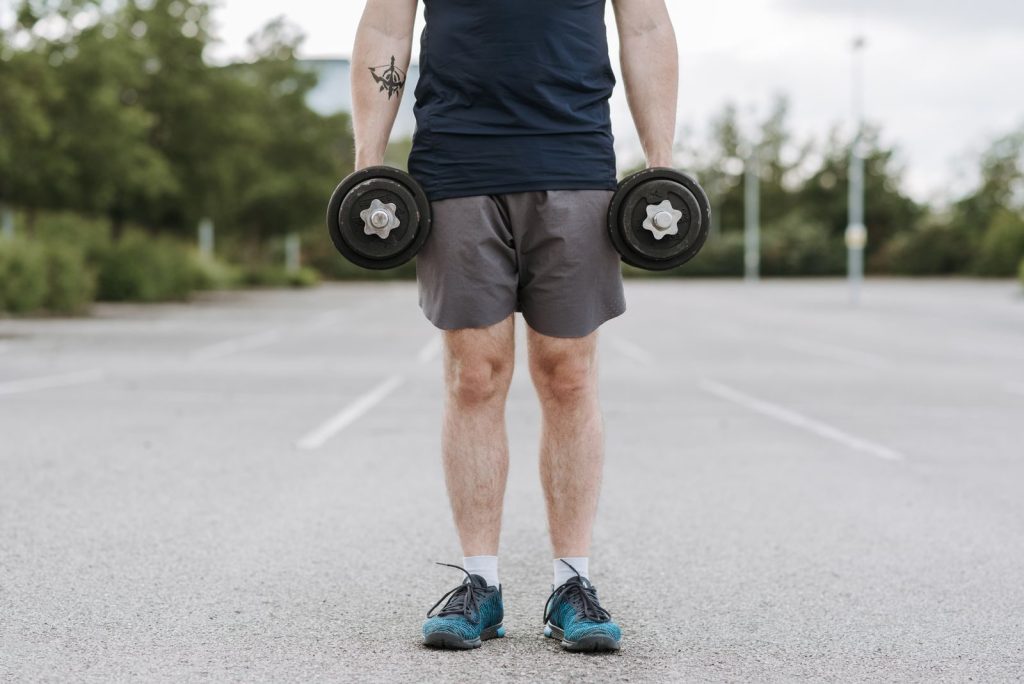
You do not need to perform all 10 exercises in one session. Most effective workouts use one main hinge, one knee-flexion exercise when a safe option is available, and one optional unilateral or compound movement.
This guide explains which exercises to choose, how to perform them correctly, and how to organize them into a practical hamstring workout.
Dumbbell Hamstring Exercises at a Glance
| Exercise | Main pattern | Best for | Level | Suggested reps | |
|---|---|---|---|---|---|
| 1 | Dumbbell Romanian deadlift | Hip extension | Overall hamstring strength | Beginner to intermediate | 6–12 |
| 2 | Lying dumbbell hamstring curl | Knee flexion | Direct hamstring isolation | Intermediate | 8–15 |
| 3 | B-stance Dumbbell Romanian deadlift | Unilateral hip extension | Emphasizing one leg with support | Intermediate | 8–12 per side |
| 4 | Single-leg Dumbbell Romanian deadlift | Unilateral hip extension | Balance and hip control | Intermediate | 8–12 per side |
| 5 | Dumbbell stiff-leg deadlift | Hip extension with less knee bend | Controlled lengthened loading | Intermediate | 8–12 |
| 6 | Dumbbell 45-degree hip extension | Hip extension | Gym-based hamstring accessory | Beginner to intermediate | 8–15 |
| 7 | Dumbbell deadlift | Hip and knee extension | Total lower-body strength | Beginner | 5–10 |
| 8 | Dumbbell hip thrust | Hip extension | Glute and posterior-chain strength | Beginner | 8–15 |
| 9 | Dumbbell reverse lunge | Unilateral compound movement | Single-leg lower-body strength | Beginner to intermediate | 8–12 per side |
| 10 | Dumbbell step-up | Unilateral compound movement | Leg strength and control | Beginner | 8–12 per side |
The first six exercises place a relatively direct training demand on the hamstrings. The final four are compound movements in which the hamstrings assist the glutes, quadriceps, and other lower-body muscles.
How Dumbbell Hamstring Exercises Work
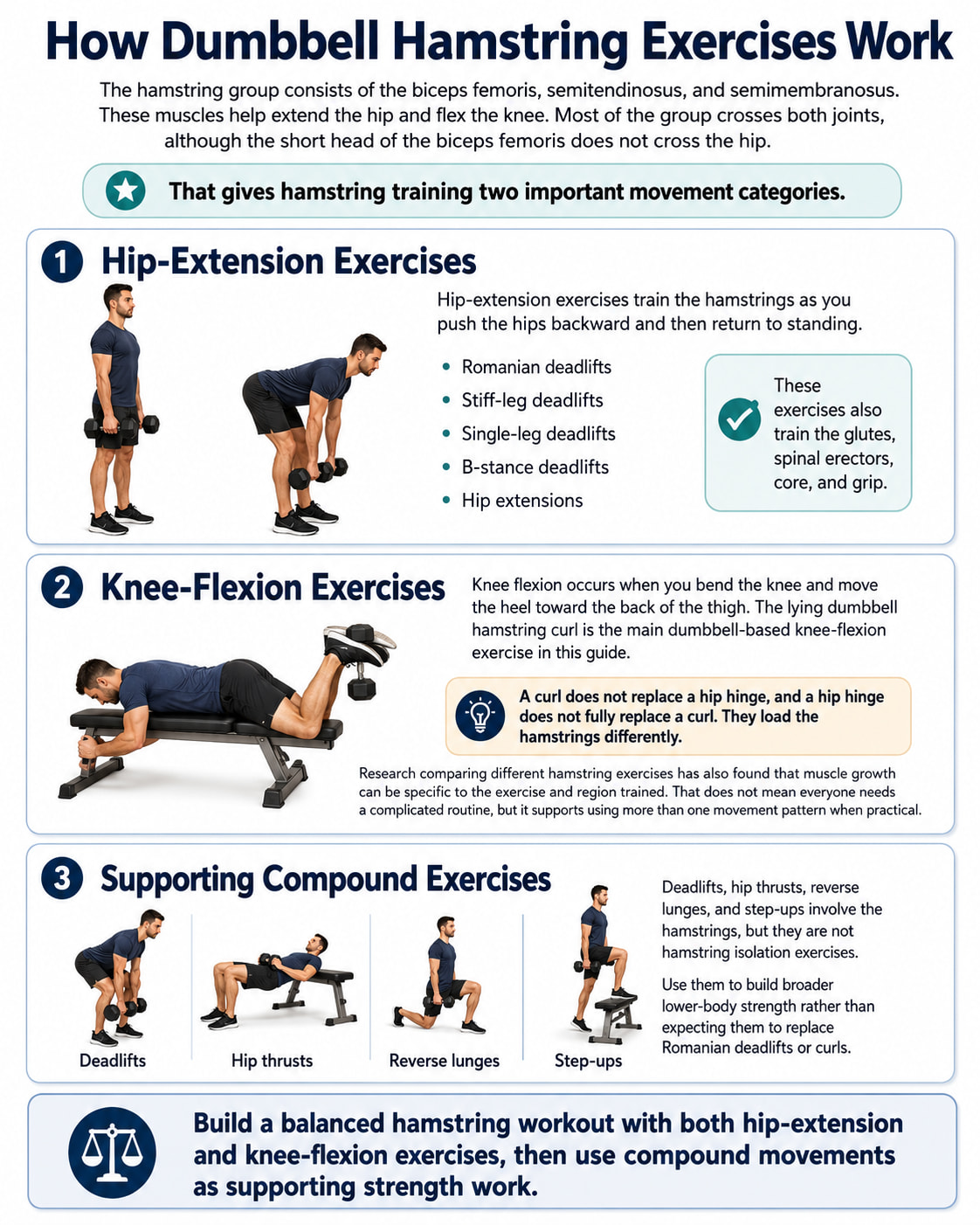
The hamstring group consists of the biceps femoris, semitendinosus, and semimembranosus. According to the NCBI Bookshelf overview of hamstring anatomy, these muscles help extend the hip and flex the knee. Most of the group crosses both joints, although the short head of the biceps femoris does not cross the hip.
That gives hamstring training two important movement categories.
Hip-Extension Exercises
Hip-extension exercises train the hamstrings as you push the hips backward and then return to standing. Examples include:
- Romanian deadlifts
- Stiff-leg deadlifts
- Single-leg deadlifts
- B-stance deadlifts
- Hip extensions
These exercises also train the glutes, spinal erectors, core, and grip.
Knee-Flexion Exercises
Knee flexion occurs when you bend the knee and move the heel toward the back of the thigh. The lying dumbbell hamstring curl is the main dumbbell-based knee-flexion exercise in this guide.
A curl does not replace a hip hinge, and a hip hinge does not fully replace a curl. They load the hamstrings differently.
Research comparing different hamstring exercises has also found that muscle growth can be specific to the exercise and region trained. That does not mean everyone needs a complicated routine, but it supports using more than one movement pattern when practical.
Supporting Compound Exercises
Deadlifts, hip thrusts, reverse lunges, and step-ups involve the hamstrings, but they are not hamstring isolation exercises.
Use them to build broader lower-body strength rather than expecting them to replace Romanian deadlifts or curls.
Benefits of Dumbbell Hamstring Exercises
A well-designed dumbbell hamstring routine may help you:
- Build strength through the hip-hinge pattern
- Strengthen knee flexion when curls are included
- Train one leg at a time to improve control
- Add resistance without requiring a barbell
- Develop the glutes and other posterior-chain muscles
- Make home workouts more challenging
- Improve your ability to control the lowering phase of an exercise
Dumbbells are also easy to progress. You can add repetitions, increase weight, slow the lowering phase, increase your controlled range of motion, or move from bilateral to unilateral variations.
How to Choose the Right Hamstring Exercises
Choose exercises according to your experience, equipment, and training goal.
| Goal or situation | Suitable choices |
|---|---|
| Best overall starting exercise | Dumbbell Romanian deadlift |
| Direct knee-flexion training | Lying dumbbell hamstring curl |
| Learning the hip hinge | Light Romanian deadlift or elevated dumbbell deadlift |
| Limited dumbbell weight | B-stance or single-leg Romanian deadlift |
| Balance is a limitation | Bilateral RDL, B-stance RDL, or supported single-leg RDL |
| Gym-based accessory work | Lying curl or 45-degree hip extension |
| General lower-body strength | Deadlift, reverse lunge, or step-up |
| Glute-focused posterior-chain work | Dumbbell hip thrust |
For a balanced workout, start with one main bilateral hinge and add one curl or unilateral exercise. Avoid filling the same workout with three or four similar deadlift variations.
10 Best Dumbbell Hamstring Exercises
These 10 dumbbell hamstring exercises combine hip-hinge, knee-flexion, and single-leg movements to build stronger, more balanced hamstrings. Choose two to four exercises per workout based on your experience, equipment, and training goals.
1. Dumbbell Romanian Deadlift
Best for: Building overall hamstring strength and learning the hip hinge.
Muscles worked: Hamstrings and gluteus maximus, with assistance from the adductors, spinal erectors, core, upper back, and grip.
Equipment needed: One or two dumbbells.
Sets, reps, and rest: Perform 3–4 sets of 6–12 repetitions. Rest for 90–150 seconds.
How to Do It
- Stand with your feet approximately hip-width apart and hold the dumbbells in front of your thighs.
- Soften your knees without dropping into a squat.
- Brace your torso and push your hips backward.
- Keep the dumbbells close to your legs as your torso inclines forward.
- Stop when you feel strong hamstring tension or can no longer continue without rounding your back.
- Press through your feet and bring your hips forward to stand.
- Finish tall without leaning backward or pushing the hips excessively forward.
The appropriate depth depends on your proportions and mobility. The dumbbells may reach your knees, mid-shins, or lower, but touching the floor is not required. The NASM dumbbell RDL guide similarly emphasizes a slight knee bend, neutral spine, backward hip movement, and stopping according to hamstring tension rather than maximum depth.
Common mistakes: Turning the movement into a squat, allowing the weights to drift forward, rounding the lower back, looking too far upward, and using momentum. Another common mistake is lowering farther after the hips have stopped moving backward.
Regression: Practice the hip hinge without weight by reaching your hips toward a wall behind you. You can also use one light dumbbell held in front of the body.
Progression: Increase the dumbbell weight, use a three-second lowering phase, or move to the B-stance RDL.
Coaching cue: Push the hips back while keeping the weights close.
2. Lying Dumbbell Hamstring Curl
Best for: Directly training knee flexion with a dumbbell.
Muscles worked: Hamstrings, with assistance from the gastrocnemius and smaller muscles around the knee and lower leg.
Equipment needed: A stable flat bench, one fixed dumbbell, and secure training shoes.
Sets, reps, and rest: Perform 2–4 sets of 8–15 repetitions. Rest for 60–90 seconds.
How to Do It
- Select a light, fixed dumbbell that you can hold securely between both feet.
- Lie face down on a stable bench with your chest, abdomen, hips, and thighs supported.
- Position your knees close to the end of the bench.
- Secure the dumbbell handle vertically between the middle of your feet and press both feet firmly together.
- Hold the bench and lightly brace your core.
- Bend your knees and curl the dumbbell upward under control.
- Stop at a comfortable knee angle without allowing your hips to lift.
- Lower the dumbbell slowly until your legs are almost straight, but do not forcefully lock your knees.
The published Strength & Conditioning Journal technique guide describes the lying dumbbell hamstring curl as a lower-body isolation exercise intended to increase hamstring muscular capacity.
Common mistakes: Using more weight than the feet can control, letting the dumbbell shift, lifting the hips, arching the lower back, allowing the knees to spread, and dropping the weight quickly during the lowering phase.
Do not use a dumbbell with loose plates, unsecured collars, or an unstable adjustable mechanism. Stop the set as soon as your foot pressure or control begins to fail.
Regression: Practice prone knee flexion without weight. A resistance-band or machine curl is a better alternative when you cannot secure the dumbbell safely.
Progression: Reach the top of the repetition range with a slow lowering phase before making a small weight increase.
Coaching cue: Squeeze the feet together before bending the knees.
3. B-Stance Dumbbell Romanian Deadlift
Best for: Emphasizing one hamstring while maintaining more balance than a single-leg RDL.
Muscles worked: Hamstrings and gluteus maximus of the front leg, with assistance from the rear leg, core, adductors, spinal erectors, and grip.
Equipment needed: One or two dumbbells.
Sets, reps, and rest: Perform 2–3 sets of 8–12 repetitions per side. Rest for 60–90 seconds.
How to Do It
- Stand with one foot slightly behind the other.
- Keep the toes of the rear foot on the floor and raise its heel.
- Place most of your weight through the front foot.
- Hold the dumbbells beside or in front of your thighs.
- Keep both hips facing forward as you push them backward.
- Lower until you feel the front-leg hamstring working without losing your spinal position.
- Drive through the front foot and return to standing.
- Complete all repetitions before changing sides.
The rear foot acts as a kickstand. It supports balance but should not become the main working leg.
Common mistakes: Placing the rear foot too far back, shifting most of the weight onto it, rotating the pelvis, bending the front knee excessively, and turning the movement into a split squat.
Regression: Use a bilateral Romanian deadlift or hold a stable support with one hand.
Progression: Use less assistance from the rear foot or progress to a supported single-leg Romanian deadlift.
Coaching cue: Front leg works; rear foot balances.
4. Single-Leg Dumbbell Romanian Deadlift
Best for: Unilateral hamstring strength, balance, and hip control.
Muscles worked: Hamstrings and glutes of the standing leg, with assistance from the adductors, gluteus medius, core, spinal erectors, and foot muscles.
Equipment needed: One or two dumbbells. A rack or wall can be used for support.
Sets, reps, and rest: Perform 2–3 sets of 8–12 repetitions per side. Rest for 60–90 seconds.
How to Do It
- Stand on one leg with a slight bend in the supporting knee.
- Hold one dumbbell in the hand opposite the working leg, or hold two dumbbells.
- Lightly hold a stable support with your free hand when needed.
- Push the working hip backward as the free leg extends behind you.
- Keep your pelvis facing the floor instead of opening to the side.
- Lower only as far as you can maintain balance and a long spine.
- Press through the standing foot and bring the free leg forward to stand.
- Reset your balance before the next repetition.
ACE’s single-leg Romanian deadlift guidance also emphasizes a slightly bent supporting knee, straight back, controlled hip hinge, and stable pause between repetitions.
Common mistakes: Rotating the pelvis, reaching the dumbbell toward the floor instead of moving through the hip, locking the standing knee, rushing repetitions, and choosing a load that makes balance the main limitation.
Regression: Hold a rack, keep the rear toes lightly on the floor, or use the B-stance variation.
Progression: Reduce hand support, use two dumbbells, or add a brief pause in the lowered position.
Coaching cue: Reach the free heel backward as the chest moves forward.
5. Dumbbell Stiff-Leg Deadlift
Best for: Experienced lifters who want a hip hinge with less knee bend and a strong lengthened-position demand.
Muscles worked: Hamstrings and glutes, with assistance from the spinal erectors, adductors, core, upper back, and grip.
Equipment needed: Two dumbbells.
Sets, reps, and rest: Perform 2–3 sets of 8–12 repetitions. Rest for 90–120 seconds.
The terms “stiff-leg deadlift” and “Romanian deadlift” are sometimes used interchangeably. In this guide, the stiff-leg version uses less knee bend than the RDL. The knees remain soft rather than forcefully locked.
How to Do It
- Stand with your feet approximately hip-width apart.
- Hold the dumbbells in front of your thighs.
- Keep a very small bend in your knees.
- Brace your torso and push your hips backward.
- Lower the dumbbells close to your legs.
- Stop before your back rounds or your pelvis begins to tuck underneath you.
- Drive the hips forward and return to standing.
Because the knees remain relatively straight, most people should use less weight and a shorter range than they use for a standard RDL.
Common mistakes: Locking the knees, rounding the back to reach the floor, using excessive weight, bouncing out of the bottom, and mistaking hamstring tension for a need to force more range.
Regression: Use a regular Romanian deadlift with a slightly greater knee bend.
Progression: Add repetitions, a slower lowering phase, or a small increase in load while preserving the same range and spinal position.
Coaching cue: Keep the knees quiet and send the hips backward.
6. Dumbbell 45-Degree Hip Extension
Best for: Adding a supported hip-extension exercise when a 45-degree back-extension station is available.
Muscles worked: Hamstrings and gluteus maximus, with assistance from the spinal erectors and core.
Equipment needed: A 45-degree hip-extension station and one dumbbell.
Sets, reps, and rest: Perform 2–3 sets of 8–15 repetitions. Rest for 60–90 seconds.
How to Do It
- Adjust the station so the top of the pad sits below your hip crease.
- Secure your feet and ankles against the machine.
- Begin with bodyweight until you can control the movement.
- Hold a dumbbell close to your chest when additional resistance is appropriate.
- Push your hips into the pad and hinge forward.
- Lower until you feel hamstring tension without rounding your lower back.
- Extend your hips to raise your torso.
- Stop when your torso and legs form a straight line.
A randomized trial involving 24 male varsity Gaelic football players found that a four-week 45-degree hip-extension program improved eccentric hamstring strength. The small, athletic sample means the result should not be treated as a guarantee for every reader, but it supports the movement as a legitimate hamstring-strengthening option.
Common mistakes: Positioning the pad too high, extending mainly through the lower back, lifting above a straight body line, moving too quickly, and adding weight before mastering the bodyweight version.
Regression: Perform the exercise with bodyweight and a smaller range of motion.
Progression: Hold a heavier dumbbell, pause in the lowered position, or use a three-second descent.
Coaching cue: Fold at the hips, not the waist.
7. Dumbbell Deadlift
Best for: Building general lower-body and posterior-chain strength with more knee bend than an RDL.
Muscles worked: Glutes, quadriceps, hamstrings, adductors, spinal erectors, core, upper back, and grip.
Equipment needed: Two dumbbells.
Sets, reps, and rest: Perform 3–4 sets of 5–10 repetitions. Rest for 90–150 seconds.
How to Do It
- Place the dumbbells beside your feet or slightly in front of them.
- Stand with your feet approximately hip- to shoulder-width apart.
- Push your hips backward and bend your knees to reach the weights.
- Brace your torso and keep the dumbbells close to your body.
- Press the floor away as your hips and knees extend together.
- Finish standing tall without leaning backward.
- Reverse the movement and place the dumbbells down under control.
- Reset your position before the next repetition.
Unlike the RDL, the dumbbell deadlift normally begins from the floor or an elevated surface and includes more knee flexion. It is a full lower-body exercise rather than a hamstring isolation movement.
Common mistakes: Starting with the dumbbells too far forward, allowing the hips to rise before the chest, rounding the back, slamming the weights down, and using small dumbbells that force an unnecessarily deep starting position.
Regression: Elevate the dumbbells on secure blocks or weight plates so you can reach them without losing position.
Progression: Increase the weight, add a one-second pause just above the floor, or use a slower descent.
Coaching cue: Push the floor away while keeping the weights close.
8. Dumbbell Hip Thrust
Best for: Building glute-focused hip-extension strength that supports the posterior chain.
Muscles worked: Gluteus maximus primarily, with assistance from the hamstrings, adductors, core, and other hip stabilizers.
Equipment needed: A stable bench, one dumbbell, and optional padding for the hips.
Sets, reps, and rest: Perform 3–4 sets of 8–15 repetitions. Rest for 75–120 seconds.
The hip thrust is glute-dominant. It can support a hamstring program, but it should not replace a direct hinge or curl.
How to Do It
- Sit on the floor with your upper back against the side of a stable bench.
- Place a padded dumbbell across the front of your hips.
- Plant your feet approximately hip-width apart.
- Brace your abdomen and keep your chin slightly tucked.
- Press through your feet and raise your hips.
- Stop when your torso is approximately parallel with the floor.
- Keep your ribs controlled instead of arching your lower back.
- Lower your hips slowly and repeat.
The ACE elevated glute bridge demonstration uses a similar bench-supported setup with dumbbells resting across the hips and a controlled lowering phase.
Common mistakes: Using an unstable bench, placing the shoulders too high on the pad, pushing through the toes, allowing the knees to collapse inward, and finishing by arching the lower back instead of extending the hips.
Regression: Perform a dumbbell glute bridge on the floor.
Progression: Add weight, pause for one to two seconds at the top, or use a slower lowering phase.
Coaching cue: Lift the hips while keeping the ribs down.
9. Dumbbell Reverse Lunge
Best for: Unilateral lower-body strength with the hamstrings assisting the glutes and quadriceps.
Muscles worked: Glutes and quadriceps primarily, with assistance from the hamstrings, adductors, calves, and core.
Equipment needed: One or two dumbbells.
Sets, reps, and rest: Perform 2–3 sets of 8–12 repetitions per side. Rest for 60–90 seconds.
How to Do It
- Stand tall with the dumbbells beside your body.
- Keep your feet approximately hip-width apart rather than standing on a tightrope.
- Step one foot backward and land on the ball of that foot.
- Lower your rear knee toward the floor while keeping the front foot planted.
- Maintain a controlled torso position and keep the front knee tracking in the direction of the toes.
- Press through the front foot to return to standing.
- Alternate sides or complete all repetitions on one side.
The front leg should perform most of the work. A slightly longer step and a controlled hip hinge may increase the demand on the hips, but do not exaggerate either position.
Common mistakes: Stepping directly behind the front foot, pushing excessively from the rear leg, allowing the front heel to lift, letting the knee collapse inward, and losing balance because the dumbbells are too heavy.
Regression: Practice bodyweight reverse lunges while holding a stable support. A stationary split squat is another useful starting option.
Progression: Add weight, increase the controlled range, or use a brief pause near the bottom.
Coaching cue: Step back, then drive through the whole front foot.
10. Dumbbell Step-Up
Best for: Controlled single-leg strength and coordination.
Muscles worked: Glutes and quadriceps primarily, with assistance from the hamstrings, adductors, calves, and core.
Equipment needed: One or two dumbbells and a stable step or box.
Sets, reps, and rest: Perform 2–3 sets of 8–12 repetitions per side. Rest for 60–90 seconds.
How to Do It
- Choose a step low enough that you can place your entire foot on it without twisting or pushing off aggressively.
- Hold the dumbbells beside your body.
- Place one foot completely on the step.
- Brace your torso and press through the lead foot.
- Bring your body onto the step without jumping from the rear leg.
- Stand under control at the top.
- Step down slowly with the trailing foot.
- Complete the set before switching lead legs.
ACE’s dumbbell step-up guidance also emphasizes placing the lead foot firmly on the platform, maintaining knee alignment, and controlling the downward phase.
Common mistakes: Using a box that is too high, leaving part of the lead foot unsupported, pushing forcefully from the floor leg, allowing the knee to collapse inward, and dropping quickly during the step-down.
Regression: Use a lower step, remove the dumbbells, or hold a stable support.
Progression: Add weight or take three seconds to lower from the platform. Do not increase the platform height unless you can maintain pelvic and knee control.
Coaching cue: Make the leg on the box do the work.
Sample Dumbbell Hamstring Workouts
Warm up before either workout with five to 10 minutes of walking, easy cycling, or another low-impact activity. Then perform one or two lighter practice sets of your first exercise.
“Reps in reserve” refers to the number of technically sound repetitions you believe you could still complete at the end of a set.
Beginner Dumbbell Hamstring Workout
This no-bench option is suitable for a basic home setup.
| Exercise | Sets | Reps | Rest | Effort |
|---|---|---|---|---|
| Dumbbell Romanian deadlift | 3 | 8–10 | 90 seconds | 2–3 reps in reserve |
| Dumbbell hip thrust or floor glute bridge | 3 | 10–15 | 75–90 seconds | 2–3 reps in reserve |
| Supported reverse lunge | 2 | 8–10 per side | 60–90 seconds | 3 reps in reserve |
Perform this workout once or twice per week, depending on your other lower-body training.
This routine is hip-extension dominant. When you have access to a safe knee-flexion setup, add two sets of lying dumbbell hamstring curls or use an appropriate band or machine curl.
Progression: Begin at the lower end of each repetition range. Add repetitions gradually until you reach the top of the range with consistent form. Then make the smallest practical weight increase.
Intermediate Balanced Hamstring Workout
| Exercise | Sets | Reps | Rest | Effort |
|---|---|---|---|---|
| Dumbbell Romanian deadlift | 4 | 6–8 | 2 minutes | 2 reps in reserve |
| Lying dumbbell hamstring curl | 3 | 10–15 | 75–90 seconds | 1–2 reps in reserve |
| B-stance dumbbell RDL | 2–3 | 8–10 per side | 90 seconds | 2 reps in reserve |
| Dumbbell 45-degree hip extension | 2 | 10–12 | 75 seconds | 2 reps in reserve |
The final exercise is optional when the session already feels sufficiently challenging or when you perform additional hip-extension work elsewhere in the week.
Use controlled repetitions throughout. On hinges and hip extensions, take approximately two to three seconds to lower the weight.
How to Program Dumbbell Hamstring Exercises
Start With the Most Demanding Exercise
Place the heaviest or most technically demanding movement near the beginning of the session.
A practical order is:
- Bilateral Romanian deadlift or dumbbell deadlift
- Lying hamstring curl
- B-stance or single-leg exercise
- Hip thrust, hip extension, lunge, or step-up
You can change this order when a specific exercise is your priority, but avoid performing balance-intensive movements after your technique has deteriorated.
Use Two to Four Exercises Per Workout
Ten exercises are available in this guide, but they are choices rather than a single routine.
Most workouts only need:
- One main hip hinge
- One knee-flexion movement when available
- One unilateral movement
- One optional compound accessory
Performing RDLs, stiff-leg deadlifts, B-stance RDLs, and single-leg RDLs in the same workout creates unnecessary overlap for most readers.
Keep One to Three Repetitions in Reserve
You do not need to take every set to complete muscular failure.
End the set when you could perform approximately one to three more controlled repetitions. Stop earlier when balance, grip, foot security, or spinal position begins to fail.
This is especially important during single-leg RDLs and lying dumbbell curls, where stability may become the limiting factor before the hamstrings are fully fatigued.
Progress Repetitions Before Weight
Use a simple double-progression method:
- Choose a weight you can lift at the bottom of the recommended rep range.
- Keep the weight the same until you reach the top of the range on every set.
- Confirm that your range, tempo, and technique remain consistent.
- Make a small weight increase.
- Return to the lower end of the rep range.
When heavier dumbbells are unavailable, progress by using a slower descent, adding a pause, or choosing a unilateral variation.
Train the Hamstrings Regularly
The 2026 American College of Sports Medicine resistance-training guidance emphasizes consistency, individualization, and training all major muscle groups at least twice per week. It also notes that advanced methods and repeated training to failure are unnecessary for most healthy adults.
Two weekly hamstring exposures are practical for many people. These do not have to be two dedicated hamstring workouts. For example:
- Monday: Romanian deadlift and hamstring curl
- Thursday: Reverse lunge and hip thrust
Reduce the volume when your program already includes substantial squatting, deadlifting, sprinting, or other lower-body training.
Common Dumbbell Hamstring Training Mistakes
Performing Only Hip Hinges
Romanian deadlifts are useful, but repeating several hinge variations does not create a balanced routine. Include a controlled knee-flexion exercise when you have a safe setup.
Chasing Maximum Range of Motion
The dumbbells do not need to reach the floor during an RDL or stiff-leg deadlift. Stop when your hips can no longer move backward without your back rounding.
Increasing Weight Too Quickly
The hamstrings may be strong enough to move a load that your grip, balance, core, or technique cannot control. Increase weight only after your repetitions are consistent.
Rushing the Lowering Phase
Lowering quickly reduces control and often causes the dumbbells to drift away from the body. Use approximately two to three seconds for the descent during most hinges and curls.
Treating Every Exercise as Hamstring-Dominant
Hip thrusts, lunges, deadlifts, and step-ups involve the hamstrings, but the glutes and quadriceps may perform more of the work. Use these as supporting exercises rather than direct replacements for RDLs or curls.
Using an Unsafe Curl Setup
A lying dumbbell curl requires a stable bench, secure shoes, a fixed dumbbell, and continuous pressure from both feet. Use another knee-flexion exercise when any part of the setup feels uncertain.
Ignoring Pain
Muscular effort, fatigue, and a controlled stretching sensation are different from sharp or escalating pain. Do not continue a repetition that causes pain.
Dumbbell Hamstring Exercise Safety Tips
Before training:
- Warm up with five to 10 minutes of low-impact activity
- Practice the hinge with bodyweight or a very light dumbbell
- Perform one or two gradual warm-up sets
- Check that benches, boxes, and dumbbells are stable
- Clear enough floor space for lunges and single-leg movements
- Wear shoes that provide secure contact with the floor and equipment
The American Academy of Orthopaedic Surgeons recommends warming up with five to 10 minutes of low-impact activity, progressing gradually, and stopping an exercise when it hurts.
Breathe continuously during your sets. A brief brace is useful before a demanding repetition, but avoid holding your breath longer than necessary.
Stop exercising and seek appropriate professional help if you experience sharp pain, numbness, dizziness, chest pain, unusual shortness of breath, or another concerning symptom.
Frequently Asked Questions
Can You Build Strong Hamstrings With Dumbbells?
Yes. Dumbbells can progressively load Romanian deadlifts, stiff-leg deadlifts, curls, hip extensions, and unilateral exercises.
When your available dumbbells become too light, use single-leg variations, slower lowering phases, pauses, or additional controlled repetitions. Eventually, stronger lifters may need heavier dumbbells, a barbell, or a machine to continue increasing maximum strength.
What Is the Best Dumbbell Exercise for Hamstrings?
The dumbbell Romanian deadlift is the best general starting exercise because it is relatively simple to scale, trains both legs together, and allows progressive loading.
It is not a complete hamstring program by itself. Pair it with a lying curl or another safe knee-flexion exercise when possible.
Are Romanian Deadlifts or Hamstring Curls Better?
They perform different jobs.
Romanian deadlifts emphasize hip extension and train the glutes alongside the hamstrings. Hamstring curls directly load knee flexion.
A balanced program can include both rather than choosing one permanently.
How Many Hamstring Exercises Should You Do in One Workout?
Two to four exercises are enough for most workouts.
A practical session may include one main RDL, one curl, and one unilateral accessory. Additional exercises should only be included when they serve a clear purpose and do not interfere with recovery.
Can You Train Your Hamstrings With One Dumbbell?
Yes. You can perform:
- A goblet-style Romanian deadlift
- A suitcase Romanian deadlift
- A B-stance RDL
- A single-leg RDL
- A dumbbell hip thrust
- A reverse lunge
- A step-up
For unilateral movements, hold the dumbbell on the side that allows the best balance and torso control. The opposite hand can hold a stable support.
Why Do I Feel Romanian Deadlifts in My Lower Back?
The spinal erectors work isometrically to help hold the torso in position, so some muscular effort around the back is normal.
Reduce the weight and range if the lower back becomes the main area of fatigue. Check that you are pushing your hips backward, keeping the dumbbells close, bracing your torso, and stopping before your spine begins to round.
Sharp, persistent, or worsening back pain is not a normal training goal.
Should Your Knees Be Locked During Hamstring Exercises?
No. Keep a small, controlled knee bend during Romanian and stiff-leg deadlifts.
Locking the knees can make the position uncomfortable and may encourage you to compensate through the back. The stiff-leg variation uses less knee bend than an RDL, but the knees should still remain soft.
Conclusion
The most useful dumbbell hamstring workout does not require 10 exercises. Start with the dumbbell Romanian deadlift, add a safe knee-flexion movement, and use one unilateral or compound exercise when it supports your goal.
Control the lowering phase, stop each set before technique breaks down, and add repetitions before increasing weight. Consistent progress with two or three well-chosen exercises is more effective than repeatedly changing movements or performing every variation at once.
References
- NASM: Dumbbell Romanian Deadlift
- ACE: Single-Arm, Single-Leg Romanian Deadlift
- Strength & Conditioning Journal: Lying Hamstring Curl With a Dumbbell
- PubMed: The Effect of Hip Extension and Nordic Hamstring Exercise Protocols on Hamstring Strength
- PubMed: Hamstrings Hypertrophy Is Specific to the Training Exercise
- ACE: Step-Up Exercise Guide
- AAOS: Knee Exercises and Exercise Safety
This content is for informational purposes only and is not a substitute for medical advice.