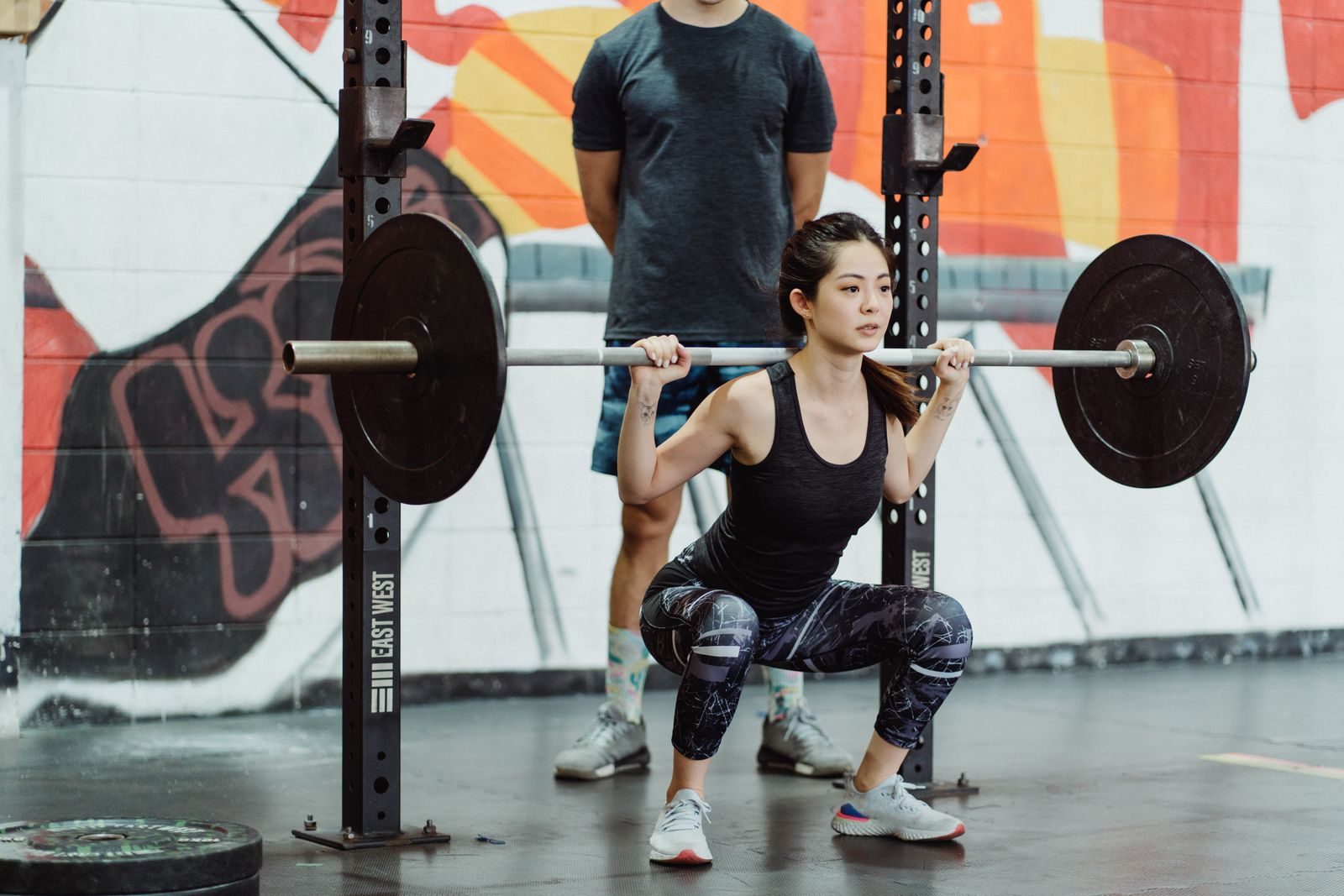
The best barbell leg exercises combine squatting, hinging, single-leg work, hip extension, and direct calf training to build balanced lower-body strength and muscle.
You do not need to perform every exercise in one session. Most lifters will get better results by choosing four or five movements that cover different patterns, training them consistently, and adding weight or repetitions gradually.
This guide explains how to perform 10 effective barbell leg exercises, which muscles they work, common mistakes to avoid, and how to organize them into a practical two-day routine.
Barbell Leg Exercises at a Glance
| Exercise | Main training purpose | Main muscles | Difficulty | Starting recommendation |
|---|---|---|---|---|
| Barbell back squat | Overall leg strength and size | Quadriceps, glutes, adductors | Beginner–intermediate | 3 sets of 4–8 reps |
| Barbell front squat | Quad-focused squat training | Quadriceps, glutes, upper-back stabilizers | Intermediate | 3 sets of 5–8 reps |
| Barbell Romanian deadlift | Hamstring and glute development | Hamstrings, glutes, spinal erectors | Beginner–intermediate | 3 sets of 6–10 reps |
| Conventional barbell deadlift | Heavy pulling strength | Glutes, hamstrings, quadriceps, back | Beginner–intermediate | 2–3 sets of 3–6 reps |
| Barbell hip thrust | Glute-focused hip extension | Glutes, hamstrings, adductors | Beginner–intermediate | 3 sets of 8–12 reps |
| Barbell reverse lunge | Single-leg strength and control | Quadriceps, glutes, adductors | Intermediate | 2–3 sets of 6–10 reps per leg |
| Barbell Bulgarian split squat | Single-leg muscle growth | Quadriceps, glutes, adductors | Intermediate | 2–3 sets of 8–12 reps per leg |
| Barbell step-up | Single-leg drive and stability | Quadriceps and glutes | Intermediate | 2–3 sets of 8–10 reps per leg |
| Barbell good morning | Posterior-chain accessory work | Hamstrings, glutes, spinal erectors | Intermediate–advanced | 2–3 sets of 8–12 reps |
| Barbell standing calf raise | Direct calf development | Gastrocnemius and soleus | Beginner–intermediate | 3 sets of 10–20 reps |
These are working-set recommendations. Complete lighter warm-up sets before your first heavy squat, deadlift, or hip-hinge exercise.
Before Starting Barbell Leg Exercises
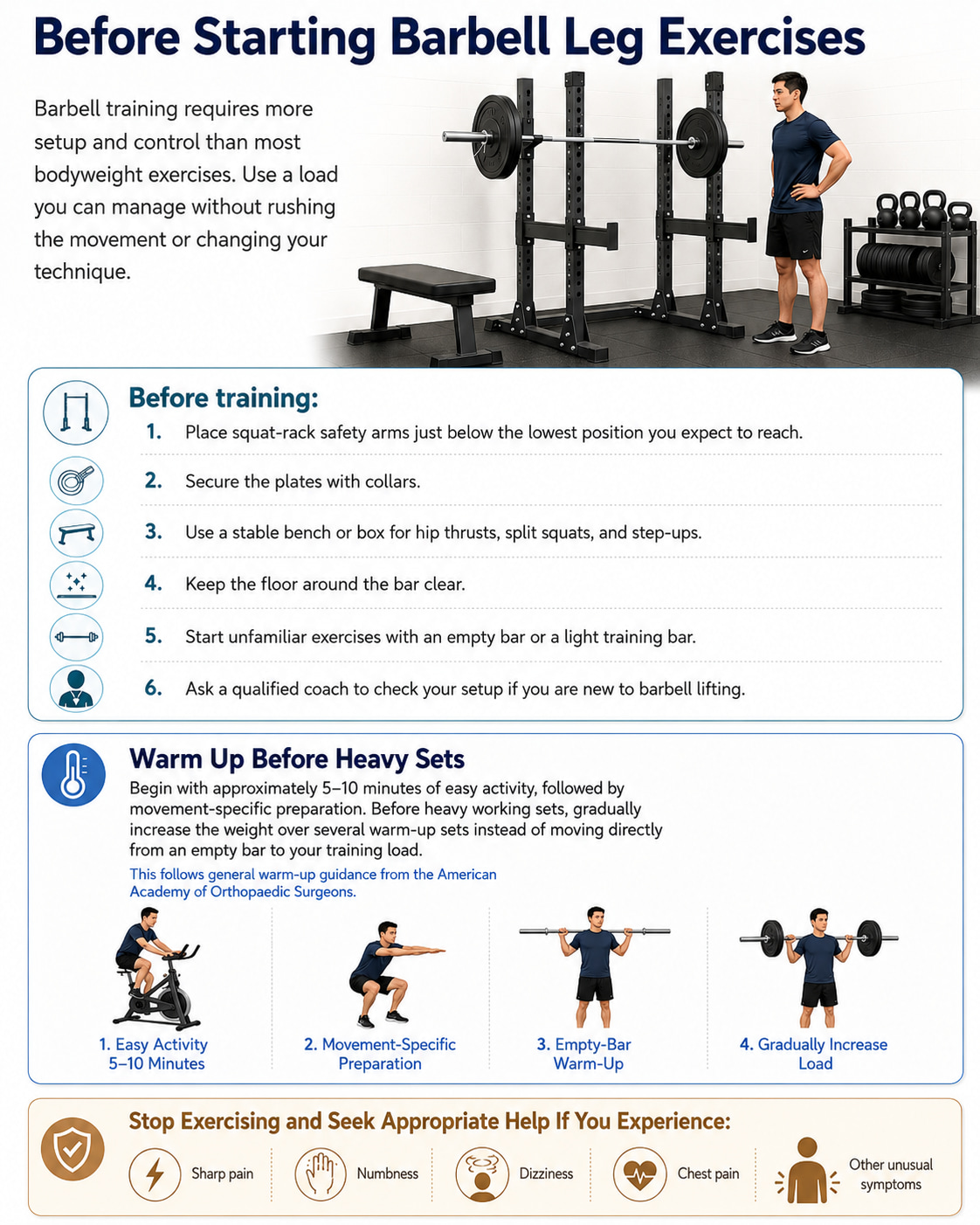
Barbell training requires more setup and control than most bodyweight exercises. Use a load you can manage without rushing the movement or changing your technique.
Before training:
- Place squat-rack safety arms just below the lowest position you expect to reach.
- Secure the plates with collars.
- Use a stable bench or box for hip thrusts, split squats, and step-ups.
- Keep the floor around the bar clear.
- Start unfamiliar exercises with an empty bar or a light training bar.
- Ask a qualified coach to check your setup if you are new to barbell lifting.
Begin with approximately 5–10 minutes of easy activity, followed by movement-specific preparation. Before heavy working sets, gradually increase the weight over several warm-up sets instead of moving directly from an empty bar to your training load. This follows the general principles in the American Academy of Orthopaedic Surgeons warm-up guidance.
Stop exercising and seek appropriate professional help if you experience sharp pain, numbness, dizziness, chest pain, or other unusual symptoms.
Why These Barbell Leg Exercises Work Well Together
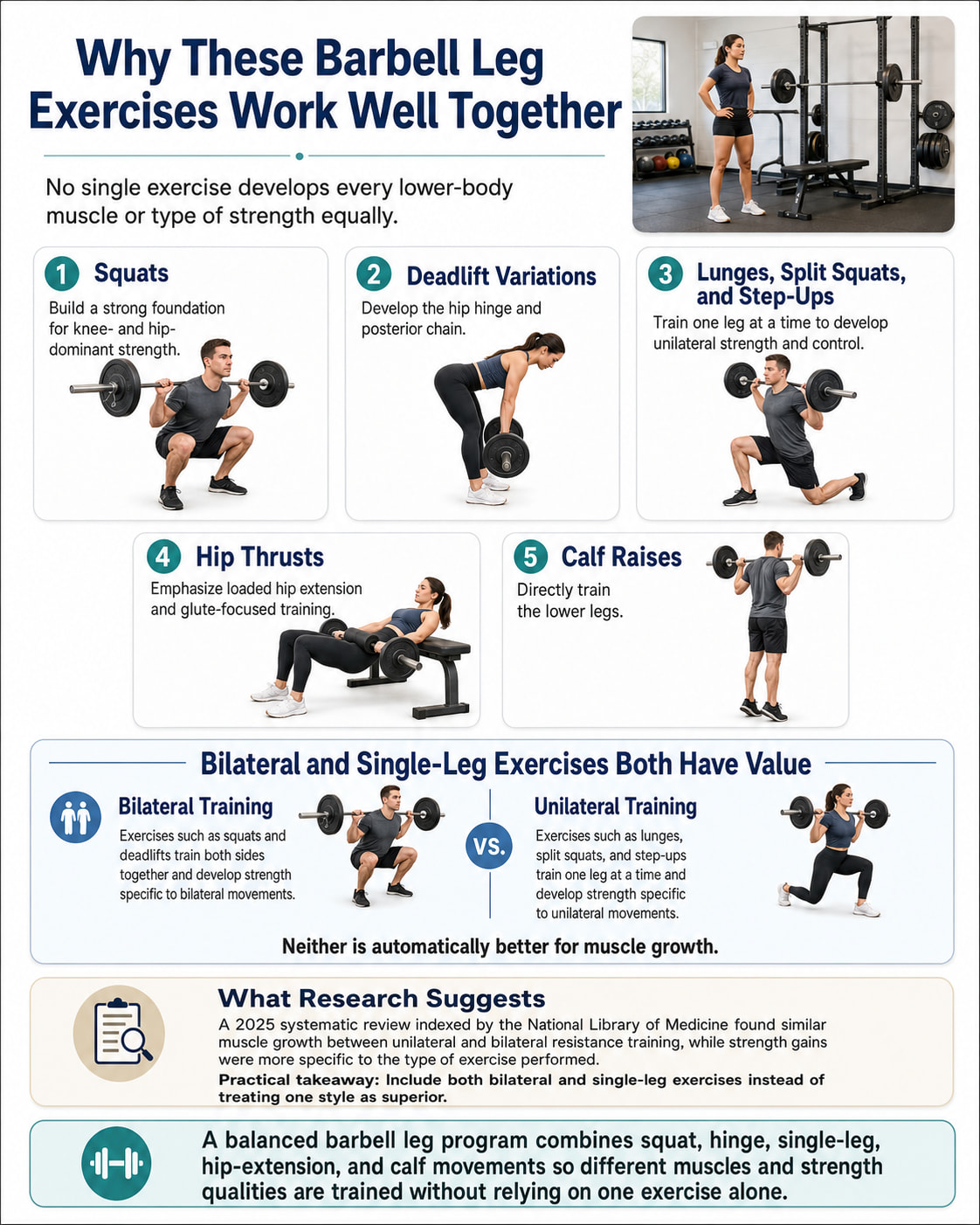
No single exercise develops every lower-body muscle or type of strength equally.
Squats provide a strong foundation for knee- and hip-dominant strength. Deadlift variations develop the hip hinge and posterior chain. Lunges, split squats, and step-ups train one leg at a time, while hip thrusts emphasize loaded hip extension and calf raises directly train the lower legs.
Single-leg exercises are not automatically better than bilateral exercises for muscle growth. A 2025 systematic review indexed by the National Library of Medicine found similar hypertrophy between unilateral and bilateral training, while strength gains were more specific to the type of exercise performed. That supports including both rather than treating one category as superior.
10 Best Barbell Leg Exercises
These 10 barbell leg exercises target the quads, glutes, hamstrings, calves, and supporting muscles to build balanced lower-body strength and size.
Choose movements that match your experience level, focus on controlled form, and increase weight or reps gradually as your technique improves.
1. Barbell Back Squat
Best for: Building overall lower-body strength and muscle with one compound exercise.
Muscles worked: Quadriceps, gluteus maximus, adductors, hamstrings, calves, abdominal muscles, and spinal erectors.
Equipment needed: Barbell, plates, collars, squat rack, and safety arms.
Sets, reps, and rest: Perform 3 sets of 4–8 repetitions. Rest for 2–4 minutes.
How to Do It
- Position the bar securely across your upper back rather than directly on your neck.
- Unrack the bar, step back carefully, and place your feet approximately shoulder-width apart.
- Brace your trunk and keep your entire foot in contact with the floor.
- Bend your hips and knees together, allowing your knees to track in the same direction as your toes.
- Descend as far as you can while maintaining balance and trunk control, then drive through your feet to stand.
Common mistakes: Avoid allowing the knees to collapse inward, lifting the heels, relaxing your trunk at the bottom, or forcing more depth than you can control. Do not increase the weight by shortening each repetition.
Progression or regression: Begin with an empty-bar squat to a box if you need help controlling depth. Progress by adding repetitions, load, or a brief pause at the bottom.
A study indexed by the National Library of Medicine comparing full and half squat training found greater growth in several lower-body muscles from full-squat training. However, your practical target should still be the deepest range you can perform with stable foot pressure and controlled positioning rather than an arbitrarily forced depth.
2. Barbell Front Squat
Best for: Quad-focused squat training and lifters who prefer a more upright torso position.
Muscles worked: Quadriceps, glutes, adductors, abdominal muscles, spinal erectors, and upper-back stabilizers.
Equipment needed: Barbell, plates, collars, squat rack, and safety arms.
Sets, reps, and rest: Perform 3 sets of 5–8 repetitions. Rest for 2–3 minutes.
How to Do It
- Rest the bar across the front of your shoulders in a secure front-rack position.
- Lift your elbows so your upper arms remain close to parallel with the floor.
- Unrack the bar and stand with your feet around shoulder-width apart.
- Brace your trunk and squat down between your feet while keeping your elbows lifted.
- Push through the whole foot and stand without allowing the elbows or chest to drop.
Common mistakes: The most common errors are supporting the bar entirely with the hands, allowing the elbows to fall, shifting onto the toes, and losing upper-back position near the bottom.
Progression or regression: Use an empty bar, lifting straps around the bar, or a controlled squat to a box while learning the front-rack position. A paused front squat is a useful progression once the basic movement is stable.
3. Barbell Romanian Deadlift
Best for: Building the hamstrings and glutes through a controlled hip hinge.
Muscles worked: Hamstrings, gluteus maximus, adductor magnus, spinal erectors, upper-back muscles, forearms, and grip.
Equipment needed: Barbell, plates, and collars. A rack is useful for setting the starting height.
Sets, reps, and rest: Perform 3 sets of 6–10 repetitions. Rest for 90–180 seconds.
How to Do It
- Stand tall with the bar against the front of your thighs and your knees slightly bent.
- Brace your trunk, keep your arms straight, and push your hips backward.
- Lower the bar close to your legs as your torso leans forward.
- Stop when you feel a strong hamstring stretch or can no longer maintain your controlled trunk position.
- Drive your hips forward to stand, finishing tall without leaning backward.
Common mistakes: Do not turn the movement into a squat by excessively bending your knees. Avoid allowing the bar to drift away from your legs, reaching for the floor, rounding to gain extra depth, or forcefully arching backward at the top.
Progression or regression: Shorten the range of motion and use an empty bar while learning the hinge. Progress by adding load or pausing briefly when the bar reaches just below your knees.
The National Strength and Conditioning Association emphasizes slightly flexed knees, backward hip movement, a close bar path, and ending the descent before the intended spinal position can no longer be maintained.
4. Conventional Barbell Deadlift
Best for: Developing heavy pulling strength and coordinating the legs, hips, trunk, and upper body.
Muscles worked: Glutes, hamstrings, quadriceps, adductors, spinal erectors, upper-back muscles, forearms, and grip.
Equipment needed: Barbell, full-size plates, collars, and a suitable lifting surface.
Sets, reps, and rest: Perform 2–3 sets of 3–6 repetitions. Rest for 2–4 minutes.
How to Do It
- Stand with the bar over your midfoot and your feet approximately hip-width apart.
- Push your hips back, bend your knees, and grip the bar just outside your legs.
- Brace your trunk, position your shoulders slightly in front of or over the bar, and keep the bar close.
- Push the floor away while extending your knees and hips together.
- Stand tall, then return the bar by pushing your hips backward before bending your knees.
Common mistakes: Avoid jerking the bar from the floor, allowing it to move forward, letting your hips rise before the bar moves, or leaning backward at lockout. Deadlift sets should normally end before your starting position becomes inconsistent.
Progression or regression: Raise the bar on secure blocks if reaching the floor causes you to lose position. Progress by gradually lowering the starting height or adding small amounts of weight.
Coaching cue: Push the floor away instead of trying to pull only with your back.
5. Barbell Hip Thrust
Best for: Adding focused, heavily loadable hip-extension work to a leg program.
Muscles worked: Gluteus maximus, hamstrings, adductors, and trunk stabilizers.
Equipment needed: Barbell, plates, collars, a stable bench, and a bar pad or folded exercise mat.
Sets, reps, and rest: Perform 3 sets of 8–12 repetitions. Rest for 90–150 seconds.
How to Do It
- Sit on the floor with your upper back against a stable bench and the padded bar across your hip crease.
- Plant your feet approximately hip-width apart with your knees bent.
- Brace your trunk and keep your chin gently tucked.
- Drive through your feet and lift your hips until your torso and thighs form a controlled line.
- Squeeze your glutes briefly, then lower your hips without bouncing the plates.
Common mistakes: Do not finish the movement by excessively arching your lower back. Avoid placing your feet so far away that the movement becomes mostly hamstring-dominant or so close that you cannot maintain stable foot pressure.
Progression or regression: Start with a barbell glute bridge from the floor. Progress to the bench-supported hip thrust, add a pause at the top, and then increase the load.
Back squats and hip thrusts can complement each other rather than compete for the same role. Research indexed by the National Library of Medicine found that both produced similar glute growth in a nine-week study of untrained young adults, while squats produced greater quadriceps and adductor growth. Strength gains were greatest in the specific exercise trained.
6. Barbell Reverse Lunge
Best for: Developing single-leg strength with a controlled backward step.
Muscles worked: Quadriceps, glutes, adductors, hamstrings, calves, and trunk stabilizers.
Equipment needed: Barbell, plates, collars, squat rack, and safety arms.
Sets, reps, and rest: Perform 2–3 sets of 6–10 repetitions per leg. Rest for 90–150 seconds.
How to Do It
- Place the bar securely across your upper back and stand tall with your feet hip-width apart.
- Step one foot backward far enough to maintain balance.
- Lower the rear knee toward the floor while keeping your front foot planted.
- Allow the front knee to track over the toes without collapsing inward.
- Push through the front foot and return to the starting position.
Common mistakes: Avoid stepping directly behind the front foot as though standing on a tightrope. Do not push excessively from the rear leg, let the front heel rise, or use a load that causes repeated loss of balance.
Progression or regression: Learn the movement with bodyweight, dumbbells, or an empty bar. Progress by adding load or pausing briefly at the bottom.
Coaching cue: Step back, then lower straight down.
7. Barbell Bulgarian Split Squat
Best for: Building the quadriceps and glutes one leg at a time.
Muscles worked: Quadriceps, gluteus maximus, adductors, hamstrings, calves, and trunk stabilizers.
Equipment needed: Barbell, plates, collars, squat rack, safety arms, and a stable bench or low platform.
Sets, reps, and rest: Perform 2–3 sets of 8–12 repetitions per leg. Rest for 90–150 seconds.
How to Do It
- Set a stable bench behind you and position the bar across your upper back.
- Place one foot on the floor far enough forward to keep the entire foot planted.
- Rest the top of your rear foot on the bench.
- Lower your hips under control as your front knee bends and tracks over your toes.
- Drive through the front foot to return to the top.
Common mistakes: Avoid using a bench that is too high, placing your feet on an extremely narrow line, bouncing out of the bottom, or relying heavily on the elevated leg.
Progression or regression: Begin with a regular split squat with both feet on the floor. Add rear-foot elevation only after you can remain balanced, then progress to an empty bar and additional load.
8. Barbell Step-Up
Best for: Developing single-leg drive, coordination, and control.
Muscles worked: Quadriceps, glutes, adductors, hamstrings, calves, and trunk stabilizers.
Equipment needed: Barbell, plates, collars, squat rack, safety arms, and a secure step or box.
Sets, reps, and rest: Perform 2–3 sets of 8–10 repetitions per leg. Rest for 90–150 seconds.
How to Do It
- Select a stable box that allows you to place your entire foot on top.
- Position the bar securely across your upper back.
- Step onto the box with one foot and brace your trunk.
- Drive through the elevated foot to raise your body onto the box.
- Step down slowly and complete your repetitions before changing sides.
Common mistakes: Do not use an unstable or excessively high box. Avoid pushing forcefully from the foot on the floor, allowing only part of the working foot onto the box, or dropping quickly during the descent.
Progression or regression: Begin with bodyweight and a lower platform. Add a barbell only when you can complete every repetition without pushing off the trailing leg or losing balance.
Coaching cue: Make the foot on the floor as quiet as possible.
9. Barbell Good Morning
Best for: Intermediate and advanced lifters who want an additional posterior-chain accessory.
Muscles worked: Hamstrings, gluteus maximus, adductor magnus, spinal erectors, and upper-back stabilizers.
Equipment needed: Barbell, plates, collars, squat rack, and safety arms.
Sets, reps, and rest: Perform 2–3 sets of 8–12 repetitions. Rest for 90–150 seconds.
How to Do It
- Place the bar securely across your upper back and stand with your feet around hip- to shoulder-width apart.
- Keep a small, consistent bend in your knees and brace your trunk.
- Push your hips backward while allowing your torso to lean forward.
- Stop when you feel strong hamstring tension or before losing trunk control.
- Drive your hips forward and return to a tall position.
Common mistakes: The good morning should not be treated as a maximal-strength lift. Avoid using more weight than you can hinge with smoothly, bending the knees until the movement resembles a squat, rounding your back, or dropping too quickly.
Progression or regression: Practice the hip hinge with a dowel or use a light Romanian deadlift first. Progress with a light bar, controlled tempo, and small load increases.
This exercise is optional. Beginners generally do not need both Romanian deadlifts and good mornings in the same workout.
10. Barbell Standing Calf Raise
Best for: Directly training the calves after compound leg exercises.
Muscles worked: Gastrocnemius and soleus.
Equipment needed: Barbell, plates, collars, squat rack, safety arms, and an optional stable calf block.
Sets, reps, and rest: Perform 3 sets of 10–20 repetitions. Rest for 60–120 seconds.
How to Do It
- Position the bar across your upper back and stand with your feet approximately hip-width apart.
- Begin on flat ground or place the balls of your feet on a stable calf block.
- Keep your knees controlled and rise onto the balls of your feet.
- Pause briefly at the top without rolling your ankles outward.
- Lower your heels slowly through your available range.
Common mistakes: Avoid bouncing, rushing the bottom position, completing only short partial repetitions, or using an unstable platform. Keep the rack safeties positioned appropriately when using a loaded bar.
Progression or regression: Start with bodyweight or an empty bar on flat ground. Progress by adding repetitions, pausing longer at the top, using a secure calf block, or gradually adding weight.
How to Choose the Right Barbell Leg Exercises
A productive workout does not need all 10 movements. Choose exercises by movement pattern rather than selecting several lifts that perform almost the same job.
A balanced session can include:
- One primary squat: Back squat or front squat.
- One hip hinge or pull: Romanian deadlift, conventional deadlift, or good morning.
- One unilateral exercise: Reverse lunge, Bulgarian split squat, or step-up.
- One additional hip or knee exercise: Hip thrust or a second squat variation.
- One calf exercise: Standing calf raise.
For a four-exercise workout, choose one squat, one hinge, one unilateral exercise, and one calf exercise. Add hip thrusts when glute development is a priority or when you want more hip-extension work without performing another deadlift variation.
Exercise Selection by Goal
| Goal | Useful exercise combination |
|---|---|
| Overall lower-body strength | Back squat, conventional deadlift, reverse lunge, calf raise |
| Quadriceps growth | Front squat, Bulgarian split squat, step-up, calf raise |
| Glute and hamstring growth | Romanian deadlift, hip thrust, reverse lunge, calf raise |
| Limited training time | Back squat, Romanian deadlift, reverse lunge, calf raise |
| Balanced two-day program | Back squat and RDL on Day 1; deadlift, front squat, and hip thrust on Day 2 |
Barbell Leg Workout for Strength and Muscle Growth
Train the legs twice per week on nonconsecutive days. Start with two working sets per exercise if you are new to structured barbell training. Add a third set only when your technique and recovery remain consistent.
Day 1: Squat Emphasis
| Exercise | Sets and reps | Rest | Effort |
|---|---|---|---|
| Barbell back squat | 3 × 4–6 | 2–4 minutes | Finish with about 2 reps in reserve |
| Romanian deadlift | 3 × 6–10 | 2 minutes | About 2 reps in reserve |
| Reverse lunge | 2 × 8–10 per leg | 90–120 seconds | About 2 reps in reserve |
| Standing calf raise | 3 × 10–15 | 60–120 seconds | About 1–2 reps in reserve |
Day 2: Hinge and Muscle-Growth Emphasis
| Exercise | Sets and reps | Rest | Effort |
|---|---|---|---|
| Conventional deadlift | 2–3 × 3–5 | 3–4 minutes | Finish with about 2 reps in reserve |
| Front squat | 3 × 6–8 | 2–3 minutes | About 2 reps in reserve |
| Barbell hip thrust | 3 × 8–12 | 90–150 seconds | About 1–2 reps in reserve |
| Step-up or Bulgarian split squat | 2 × 8–10 per leg | 90–120 seconds | About 2 reps in reserve |
| Standing calf raise | 3 × 12–20 | 60–120 seconds | About 1–2 reps in reserve |
Use either step-ups or Bulgarian split squats on Day 2, not both. The good morning can occasionally replace Romanian deadlifts, but it should not automatically be added after several other demanding hip-hinge exercises.
Sets, Reps, Rest, and Training Effort
The correct repetition range depends on your main goal.
For Strength
Use approximately:
- 3–6 repetitions for primary squats and deadlifts.
- 2–4 minutes of rest.
- Two or three challenging working sets.
- Approximately 1–3 repetitions in reserve.
For Muscle Growth
Use approximately:
- 6–12 repetitions for most compound exercises.
- 10–20 repetitions for calf raises.
- 90–180 seconds of rest for demanding compound movements.
- Approximately 1–3 repetitions in reserve.
Muscle can grow across a range of loads when sets are sufficiently challenging, while heavier training generally produces greater improvements in maximal one-repetition strength. A systematic review and network meta-analysis indexed by the National Library of Medicine supports using different resistance-training prescriptions depending on whether strength or hypertrophy is the primary goal.
The American College of Sports Medicine highlights heavier loads around or above 80% of one-repetition maximum for optimizing strength and higher weekly volume—approximately 10 sets per muscle group—as a useful hypertrophy target. It also emphasizes that individualization and consistency are more important than unnecessary complexity.
Beginners do not need to start with 10 hard sets for every leg muscle. Begin with fewer quality sets and increase volume only when you are recovering between workouts, maintaining technique, and continuing to progress.
How Long Should You Rest?
Rest long enough to perform the next set with stable form.
Heavy squats and deadlifts often require 2–4 minutes. Moderate-repetition compound exercises commonly need 90–180 seconds. Calf raises and lighter accessories may need 60–120 seconds.
A systematic review and meta-analysis indexed by the National Library of Medicine suggests that resting longer than 60 seconds may offer a small muscle-growth advantage by helping lifters maintain more training volume. Beyond approximately 90 seconds, the hypertrophy differences between longer rest periods appear less clear, so use the time needed to preserve repetition quality.
How to Progress Barbell Leg Exercises
Use a simple double-progression method:
- Choose a repetition range, such as 6–10 reps.
- Select a load that lets you reach the lower end with about two controlled reps remaining.
- Add repetitions over successive workouts.
- Once every set reaches the top of the range with stable form, add the smallest practical amount of weight.
- Return to the lower end of the repetition range and repeat.
Do not add weight when you are shortening the range of motion, losing balance, bouncing, or changing the movement to complete the set.
You also do not need to take every set to complete muscular failure. Current ACSM guidance indicates that momentary failure does not consistently improve outcomes for the average healthy adult, and stopping with approximately one to three repetitions in reserve usually makes technique and fatigue easier to manage.
Common Barbell Leg Training Mistakes
Performing All 10 Exercises in One Workout
More exercises do not automatically produce better results. Excessive overlap can reduce your performance and create fatigue that is difficult to recover from. Select four or five movements with different purposes.
Training Too Many Similar Variations
Back squats, front squats, and Bulgarian split squats all place substantial demands on the quadriceps. Conventional deadlifts, Romanian deadlifts, and good mornings all use a hip-hinge pattern. Spread similar exercises across the week instead of loading all of them heavily in one session.
Increasing Weight Before Technique Is Consistent
A heavier bar is only useful when you can control it. Keep the same load until your setup, range of motion, balance, and bar path remain repeatable across every set.
Taking Every Heavy Set to Failure
Grinding to failure on squats and deadlifts can create unnecessary fatigue and cause technique to deteriorate. End most compound sets while you could still perform one to three controlled repetitions.
Ignoring Setup and Safety Equipment
Safety arms, stable boxes, collars, and clear floor space are part of the exercise. Do not treat them as optional details.
Progressing Several Variables at Once
Avoid simultaneously increasing weight, repetitions, sets, range of motion, and training frequency. Change one variable at a time so you can judge how your body responds.
Frequently Asked Questions
What is the best barbell exercise for overall leg strength?
The barbell back squat is one of the most practical choices because it trains the quadriceps, glutes, adductors, and trunk together. However, it does not fully replace hip-hinge, single-leg, or calf exercises.
A complete program can combine a back squat with Romanian deadlifts, reverse lunges, and calf raises.
Which barbell leg exercises are best for the quadriceps?
Back squats, front squats, Bulgarian split squats, reverse lunges, and step-ups all train the quadriceps.
Front squats and Bulgarian split squats are useful when you want more knee-dominant training, while back squats allow many lifters to use substantial total loads.
Which barbell exercises work the glutes and hamstrings?
Romanian deadlifts, conventional deadlifts, hip thrusts, good mornings, reverse lunges, and Bulgarian split squats all involve the glutes.
Romanian deadlifts and good mornings place the hamstrings under tension through a hip hinge, while hip thrusts emphasize loaded hip extension near the top of the movement.
How many barbell leg exercises should I do in one workout?
Most lifters need approximately three to five leg exercises in one session.
A simple workout could contain:
- One squat.
- One hip hinge.
- One unilateral exercise.
- One calf exercise.
Add a fifth movement only when it supports a specific goal and does not reduce the quality of the main lifts.
How often should I perform barbell leg exercises?
Two lower-body sessions per week work well for many strength and muscle-building programs because they allow you to divide your weekly training volume across separate workouts.
One weekly session may be enough for a beginner to start, while advanced lifters may distribute lower-body exercises across three or more sessions.
Can beginners perform barbell leg exercises?
Yes, but beginners should start with simple variations, light loads, and qualified instruction when possible.
Empty-bar squats, Romanian deadlifts from a rack, barbell glute bridges, and controlled calf raises are reasonable starting options. Barbell step-ups, Bulgarian split squats, and good mornings usually require more balance or technical control.
Can I squat and deadlift in the same workout?
Yes. Perform the exercise that matches your main goal first, then use a lighter or lower-volume approach for the second movement.
For example, you could perform heavy back squats followed by moderate Romanian deadlifts. Alternatively, perform heavy conventional deadlifts followed by moderate front squats. Avoid trying to set maximal personal records on both exercises during the same session.
Conclusion
The best barbell leg exercises are not simply the movements that allow the most weight. They are the exercises you can perform consistently, control through an appropriate range of motion, and progress without sacrificing technique.
Start with one squat, one hinge, one single-leg exercise, and one calf exercise. Practice the movements, keep one to three controlled repetitions in reserve, and add weight only after you can complete the top of your repetition range with stable form.
This content is for informational purposes only and is not a substitute for medical advice.
References
- American College of Sports Medicine — Resistance Training Guidelines
Best overall source for resistance-training frequency, loading, strength development, hypertrophy, weekly volume, and progression. - National Strength and Conditioning Association — Romanian Deadlift Technique Guide
Directly supports the Romanian deadlift section, including hip-hinge mechanics, knee position, bar path, and controlled range of motion. - Kubo et al. — Effects of Squat Training With Different Depths on Lower-Limb Muscle Volumes
Highly relevant to the back squat section and the discussion of squat depth and lower-body muscle development. - Plotkin et al. — Hip Thrust and Back Squat Training and Glute Hypertrophy
Useful for comparing barbell back squats and hip thrusts for glute, quadriceps, and lower-body muscle development. - Kassiano et al. — Unilateral Versus Bilateral Resistance Training
Supports the inclusion of reverse lunges, Bulgarian split squats, and step-ups alongside bilateral barbell exercises. - Currier et al. — Resistance Training Prescription for Muscle Strength and Hypertrophy
Strong evidence for the article’s recommendations on training load, multiple sets, strength development, and muscle growth.