The dumbbell good morning is a hip-hinge exercise that primarily trains the hamstrings and glutes while the spinal erectors and core stabilize the torso. Proper form requires pushing the hips backward, keeping a small and consistent knee bend, and stopping before your back position changes.
This guide explains how to perform the dumbbell good morning, where to hold the weight, which muscles it works, how it differs from a Romanian deadlift, and how to program it safely.
What Is a Dumbbell Good Morning?
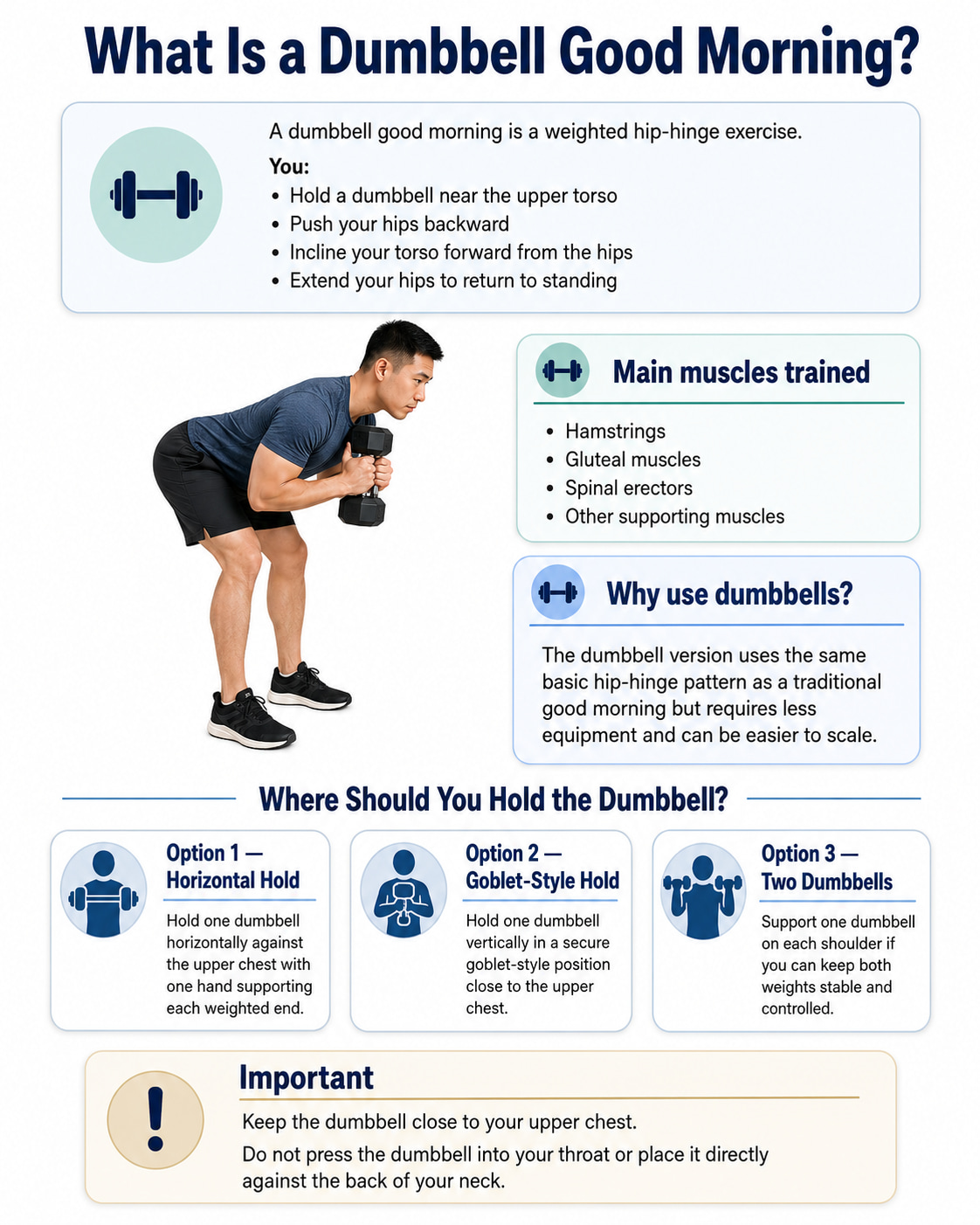
The dumbbell good morning is a weighted hip-hinge exercise. You hold a dumbbell near the upper torso, push your hips backward, incline your torso forward, and then extend your hips to return to standing.
The traditional good morning is performed with a barbell positioned across the upper back. A 2024 Strength and Conditioning Journal technique review describes it as a posterior-chain exercise that uses a hip hinge to train the hamstrings, gluteal muscles, spinal erectors, and other supporting muscles.
The dumbbell version uses the same basic movement pattern but requires less equipment and can be easier to scale. Most direct good morning research has examined the barbell exercise rather than the exact dumbbell variation, so exercise-specific findings should be applied carefully.
Where Should You Hold the Dumbbell?
This guide uses a single dumbbell held securely against the upper chest.
Depending on the dumbbell’s shape, you can:
- Hold it horizontally with one hand supporting each weighted end.
- Hold it vertically in a secure goblet-style position.
- Keep it close to the upper chest throughout the entire repetition.
Do not press the dumbbell into your throat or place it directly against the back of your neck.
A second option is to support one dumbbell on each shoulder. This can accommodate more total weight, but it requires enough shoulder mobility and control to prevent the dumbbells from shifting.
Dumbbell Good Morning at a Glance
| Category | Details |
|---|---|
| Exercise type | Weighted hip hinge |
| Primary muscles | Hamstrings and gluteus maximus |
| Supporting muscles | Erector spinae, abdominal muscles, adductor magnus, and upper back |
| Equipment | One dumbbell; two dumbbells are optional |
| Recommended level | Beginner to intermediate after learning the bodyweight hip hinge |
| Best for | Posterior-chain training and hip-hinge practice |
| Suggested sets and reps | 2–3 sets of 8–12 repetitions |
| Rest | 60–120 seconds |
| Typical placement | Main hinge exercise with a light-to-moderate load or posterior-chain accessory |
How to Do the Dumbbell Good Morning With Proper Form
Best for: Training the hamstrings and glutes while practicing a controlled hip hinge.
Muscles worked: Hamstrings, gluteus maximus, erector spinae, abdominal muscles, and adductor magnus.
Equipment needed: One dumbbell.
Sets, reps, and rest: Begin with 2 sets of 8–10 repetitions. Progress to 2–3 sets of 8–12 repetitions with 60–120 seconds of rest.
How to Do It
- Set your stance. Stand with your feet approximately hip- to shoulder-width apart. Keep your toes pointing mostly forward or turned slightly outward according to what feels comfortable.
- Secure the dumbbell. Hold one dumbbell firmly against your upper chest. Keep the weight close instead of allowing it to drift forward.
- Prepare your position. Stand tall with your ribs controlled, shoulders relaxed, and head aligned with your spine. Brace your midsection and soften your knees.
- Push your hips backward. Begin the repetition by moving your hips behind you. Let your torso incline forward as a result of the hip movement.
- Maintain the knee angle. Keep a small bend in your knees, but do not continue bending them as you descend. The exercise should look like a hinge rather than a squat.
- Use a controlled range. Continue hinging until you feel strong tension through your hamstrings or until you can no longer move farther without rounding your back, shifting onto your toes, or losing control of the dumbbell.
- Return to standing. Press your feet into the floor and bring your hips forward. Finish upright with your hips and knees extended, but do not lean backward or force your hips excessively forward.
The NASM good morning guide similarly emphasizes pushing the hips backward, maintaining only a slight knee bend, keeping a controlled spinal position, and using hamstring tension to determine the bottom of the movement.
Coaching cue: Imagine closing a car door behind you with your hips.
How Far Should You Bend Forward?
You do not need to lower your torso until it is parallel to the floor.
The correct range depends on your mobility, body proportions, experience, and ability to maintain control. Some people will reach a relatively deep hinge, while others will feel substantial hamstring tension after a much smaller movement.
Stop the descent when any of the following occurs:
- Your lower or upper back begins to round.
- Your knees continue moving forward.
- Your heels begin lifting.
- The dumbbell moves away from your chest.
- You lose abdominal tension.
- You feel discomfort instead of muscular tension.
Treat depth as an outcome of a good hinge, not as the goal of the exercise.
How to Breathe
Take a controlled breath before beginning the hinge and brace your torso as you lower.
Begin exhaling as you pass the hardest part of the return to standing. Reset your breath and brace before starting the next repetition.
Avoid rushing the breathing pattern or holding your breath longer than necessary.
Recommended Tempo
Use a controlled tempo while learning the movement:
- Lower for 2–3 seconds.
- Pause briefly without relaxing at the bottom.
- Return to standing in 1–2 seconds.
A slower lowering phase makes it easier to notice whether the hips, knees, and spine are moving as intended.
Dumbbell Good Morning Muscles Worked
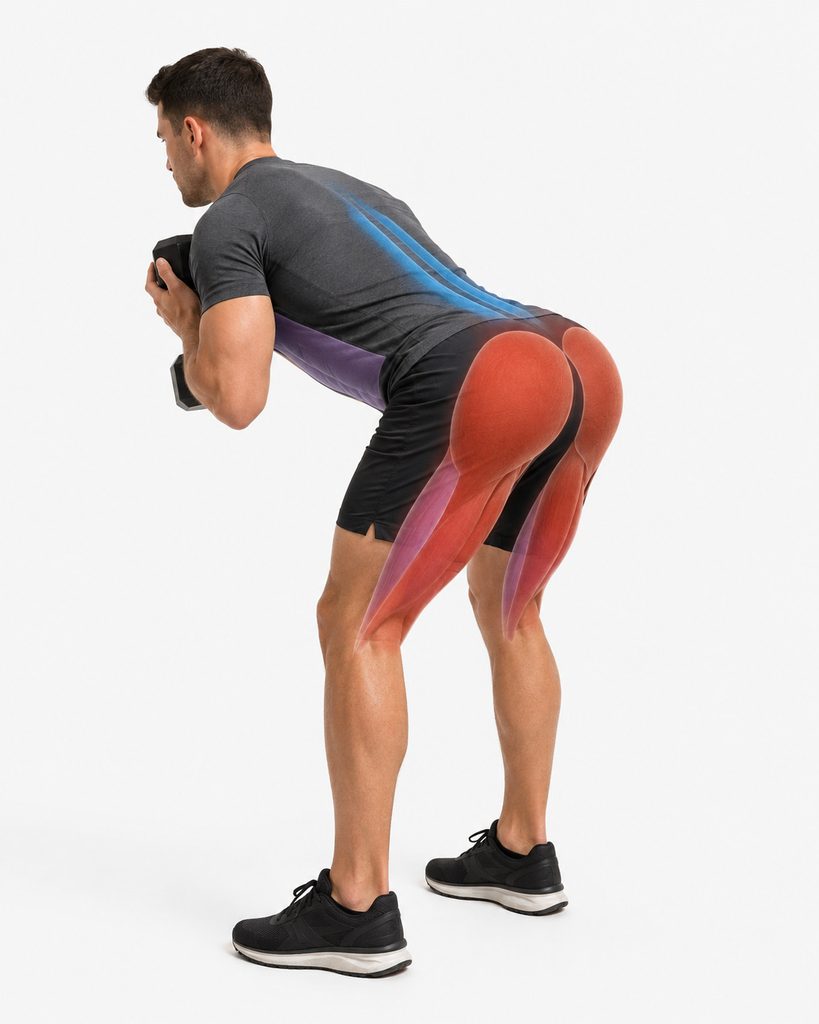
The dumbbell good morning primarily trains the muscles responsible for extending the hips. Other muscles work to keep the trunk stable and maintain the dumbbell’s position.
Hamstrings
The hamstrings run along the back of the thighs. They lengthen under tension as the hips move backward and help extend the hips as you return to standing.
The hamstrings also bend the knees, but their main role during a good morning is controlling and reversing hip flexion. The NCBI Bookshelf overview of the posterior thigh muscles identifies hip extension and knee flexion as the hamstrings’ primary actions.
You should usually feel the hamstrings working most clearly near the middle or upper portion of the back of the thighs.
Gluteus Maximus
The gluteus maximus is a major hip extensor. It helps bring the hips forward as you stand from the hinged position.
The glutes generally work harder as you reverse the bottom position and complete the upward phase. The NCBI Bookshelf hip anatomy review identifies the gluteus maximus and hamstrings as the primary muscles responsible for hip extension.
Finish each repetition by standing naturally tall. Leaning backward at the top does not create better glute activation and may shift unnecessary movement into the lower back.
Erector Spinae
The erector spinae muscles run along the back of the spine. During the dumbbell good morning, they help maintain the torso’s position as it inclines forward.
They should work mainly to resist unwanted spinal movement rather than repeatedly rounding and extending the back. The NCBI Bookshelf review of the vertebral column describes the erector spinae as important for spinal extension and maintaining the spine’s natural curvature.
Some muscular effort in the lower back can be normal. Sharp pain, pinching, or discomfort that increases with each repetition is not.
Abdominal and Deep Core Muscles
The abdominal muscles and deeper trunk stabilizers help control the position of the ribs, pelvis, and spine.
Bracing does not mean pulling your stomach inward as hard as possible. Instead, create firm tension around your midsection while continuing to breathe and keeping your ribs from flaring upward.
Adductor Magnus
The adductor magnus is located along the inner thigh. Part of this muscle can assist with hip extension, particularly when the hip begins from a flexed position.
It is a supporting muscle rather than the main target of the exercise.
Upper Back and Arms
The upper back, shoulders, forearms, and hands work isometrically to keep the dumbbell secure.
They are not the main muscles being trained, but they should maintain enough tension to prevent the weight from slipping or moving away from the torso.
Benefits of Dumbbell Good Mornings
1. Train the Posterior Chain With Minimal Equipment
One dumbbell is enough to train several posterior-chain muscles at the same time.
This makes the exercise practical for home workouts, small gyms, and situations where a barbell or lifting platform is unavailable.
2. Reinforce the Hip-Hinge Pattern
The exercise teaches you to move primarily from the hips while limiting unnecessary movement through the knees and spine.
That same general hinge pattern appears in Romanian deadlifts, conventional deadlifts, bent-over rows, kettlebell swings, and many daily lifting tasks. Practicing it with a manageable dumbbell can help you develop better awareness of how your hips and torso should move together.
3. Reduce Hanging-Grip Demands
During a dumbbell Romanian deadlift, the weights hang from your hands for the entire set. Grip fatigue may sometimes limit the set before the hamstrings and glutes are sufficiently challenged.
Holding the dumbbell against your chest reduces much of that sustained hanging-grip demand. Your hands still secure the weight, but they do not support it at arm’s length.
4. Provide Controlled Hamstring Loading
The hamstrings lengthen as the hips move backward and shorten as the hips extend.
A study examining barbell good mornings found that increasing load generally increased hamstring and spinal-erector muscle activity. However, heavier loads also changed participants’ technique and joint positions, reinforcing the importance of choosing a load that does not alter the intended hinge. The study involved trained men and a barbell variation, so it does not provide exact activation values for every dumbbell good morning.
5. Work as a Main Exercise or Accessory
A light-to-moderate dumbbell good morning can be used as:
- A hip-hinge teaching exercise
- A posterior-chain accessory after squats
- A hamstring exercise in a dumbbell-only workout
- A controlled warm-up drill when performed with very light resistance
- A replacement when an RDL is limited by grip fatigue
For most general workouts, it works best as an accessory rather than a maximum-strength exercise.
Dumbbell Good Morning vs. Romanian Deadlift
The dumbbell good morning and dumbbell Romanian deadlift are both hip hinges, but they are not the same exercise.
| Category | Dumbbell Good Morning | Dumbbell Romanian Deadlift |
|---|---|---|
| Weight position | Held against the chest or supported at the shoulders | Hangs from the hands in front of the thighs |
| Arm position | Arms remain bent and secure the weight near the torso | Arms remain long while holding the dumbbells |
| Grip demand | Lower sustained hanging-grip demand | Greater grip and forearm demand |
| Weight path | Weight remains near the upper torso | Dumbbells travel close to the thighs and lower legs |
| Main movement | Hips move backward and forward | Hips move backward and forward |
| Primary muscles | Hamstrings and glutes | Hamstrings and glutes |
| Best use | Hinge practice and posterior-chain accessory work | Progressive hip-hinge strength and muscle training |
The position of the resistance changes how the movements feel and how the load is distributed. However, neither exercise is automatically safe or unsafe. Technique, range, load, fatigue, and individual anatomy all matter.
A biomechanical study comparing barbell good mornings and deadlifts found that both could create substantial hip and lumbar demands, even though the exercises used different resistance positions. That study did not examine chest-held dumbbells, but it supports avoiding simplistic claims that one hinge variation always places less demand on the back.
Common Dumbbell Good Morning Mistakes
Turning the Movement Into a Squat
If your knees continue bending and traveling forward, the movement becomes increasingly squat-like.
Fix: Soften your knees at the start, then keep that angle relatively steady as you send your hips backward.
Rounding the Back for More Depth
Reaching a lower torso position is not useful if it requires losing your controlled spinal position.
Fix: Shorten the range and stop as soon as your hamstrings prevent further hip movement.
Looking Straight Ahead at the Bottom
Holding your gaze forward as your torso inclines can force the neck into excessive extension.
Fix: Let your gaze move naturally toward the floor several feet in front of you while keeping your head aligned with your torso.
Moving the Dumbbell Away From the Chest
Allowing the weight to drift forward increases the leverage against your torso and makes the movement harder to control.
Fix: Keep the dumbbell gently but firmly connected to your upper chest throughout the set.
Placing the Weight Against the Neck
A dumbbell should not press into the throat or sit directly on the cervical spine.
Fix: Use a secure chest hold or support two dumbbells on the muscular portion of the shoulders.
Chasing a Parallel Torso Position
Not every lifter can or should lower until the torso is parallel to the floor.
Fix: Use hamstring tension and position control—not an arbitrary depth—as your stopping point.
Using Momentum
Dropping quickly and bouncing out of the bottom reduces control.
Fix: Take 2–3 seconds to lower and reverse the movement smoothly.
Leaning Back at the Top
Excessively pushing the hips forward and arching the lower back does not improve the exercise.
Fix: Finish with your head, ribs, hips, knees, and ankles naturally stacked.
Starting Too Heavy
A heavy dumbbell can pull you out of position before you have learned the hinge.
Fix: Begin with bodyweight or a very light dumbbell. Increase resistance only when every repetition looks and feels consistent.
Dumbbell Good Morning Regressions
Wall Hip Hinge
Stand a short step in front of a wall with your back facing it. Push your hips backward until they lightly touch the wall, then stand.
Move slightly farther from the wall as your control improves.
Dowel Hip Hinge
Hold a dowel along your back so it maintains contact with your head, upper back, and pelvis.
Practice pushing your hips backward without losing any of the three contact points. The American Council on Exercise hip-hinge drill uses this setup to provide feedback and help the lifter move through the hips instead of rounding through the spine.
Bodyweight Good Morning
Cross your arms over your chest and perform the same hinge without external resistance.
This allows you to focus on balance, knee position, and hip movement.
Short-Range Dumbbell Good Morning
Use a light dumbbell and stop the hinge earlier.
Gradually increase the range only when you can maintain the same controlled torso and knee positions.
Dumbbell Good Morning Progressions
Add Repetitions
Begin at the lower end of your repetition range. Add repetitions while keeping the same tempo and form.
For example, progress from 2 sets of 8 to 2 sets of 12 before increasing the weight.
Increase the Dumbbell Weight
Add the smallest practical weight increase once you can complete every set with controlled technique and approximately two or three good repetitions still available.
Avoid increasing the weight when your range is becoming shorter or your back position is beginning to change.
Use a Slower Lowering Phase
Lower for three or four seconds before returning to standing.
This increases time under tension without requiring a large increase in weight.
Add a Pause
Pause for one second at the bottom of your controlled range.
Maintain your brace and hamstring tension instead of relaxing during the pause.
Use Two Dumbbells at the Shoulders
Support one dumbbell on each shoulder while keeping the wrists straight and the weights away from the sides of your neck.
Use this variation only when you can prevent the dumbbells from shifting and maintain the same hinge mechanics.
Progress to a Barbell Good Morning
Experienced lifters may eventually use a barbell across the upper back.
The barbell version allows substantially more resistance and requires greater setup skill. Learn the position with an appropriately qualified coach when possible rather than treating it as a required progression.
Sets, Reps, Rest, and Weight Selection
Beginner
- 2 sets
- 8–10 repetitions
- 60–90 seconds of rest
- Bodyweight or one light dumbbell
- Approximately 3 repetitions in reserve
Intermediate
- 2–3 sets
- 8–12 repetitions
- 60–120 seconds of rest
- Light-to-moderate dumbbell
- Approximately 2–3 repetitions in reserve
Tempo-Focused Option
- 2–3 sets
- 6–10 repetitions
- 3-second lowering phase
- 1-second controlled pause
- 90–120 seconds of rest
The March 2026 American College of Sports Medicine resistance-training guidance emphasizes individualizing load and volume while prioritizing consistent training over unnecessarily complicated programming. It also notes that reaching momentary muscle failure is not required for the average healthy adult.
For the dumbbell good morning, stopping before technique deteriorates is usually more productive than forcing additional repetitions.
How Often Should You Do Dumbbell Good Mornings?
One or two sessions per week is sufficient for most general strength routines.
The correct frequency depends on how many other posterior-chain exercises you perform. Deadlifts, Romanian deadlifts, hip thrusts, back extensions, leg curls, and heavy rows can all contribute to hamstring, glute, or trunk fatigue.
Allow enough recovery that your next session is not limited by lingering soreness or loss of control.
How to Add Dumbbell Good Mornings to a Workout
Perform them after a general warm-up and several bodyweight hip hinges.
When the dumbbell good morning is your main hip-hinge exercise, place it near the beginning of the workout. When it is an accessory exercise, perform it after your primary squat, deadlift, or lunge.
Sample Dumbbell Lower-Body Workout
| Exercise | Sets and reps | Rest |
|---|---|---|
| Dumbbell goblet squat | 3 × 8–10 | 90 seconds |
| Dumbbell good morning | 3 × 8–12 | 90 seconds |
| Dumbbell reverse lunge | 2 × 8 per side | 60–90 seconds |
| Dumbbell glute bridge | 2 × 10–15 | 60 seconds |
Frequency: Perform the routine once or twice per week with at least one recovery day between sessions.
Effort: Finish most sets with approximately 2–3 controlled repetitions still possible.
Progression: When you reach the top of the repetition range with consistent technique, add the smallest available weight increase or use a slightly slower lowering phase.
Dumbbell Good Morning Safety Considerations
The dumbbell good morning should not be used as a test of how far you can bend forward.
Start with a bodyweight hinge or very light resistance. Increase the weight only after you can keep the dumbbell stable, maintain a controlled trunk position, and move through the hips without turning the exercise into a squat.
People with an active or recent back, hip, pelvis, or hamstring injury should get individualized guidance before loading the movement. The exercise should not be presented as a treatment for back pain or any other medical condition.
Stop the set if you experience:
- Sharp or worsening pain
- Numbness or tingling
- Pain traveling into the hip or leg
- Dizziness
- Chest pain
- Loss of balance
- Any unusual symptoms
Frequently Asked Questions
Are dumbbell good mornings good for the lower back?
The spinal erectors work to stabilize the torso, so the exercise can strengthen them as part of a balanced program.
However, the dumbbell good morning is primarily a hip-hinge exercise, not a treatment for lower-back pain. Your hamstrings and glutes should contribute substantially instead of leaving your lower back to perform all the work.
Should I feel dumbbell good mornings in my lower back?
Some muscular effort in the spinal erectors can be normal because they help maintain the torso’s position.
You should also feel clear tension in your hamstrings and glutes. Stop if you feel sharp pain, pinching, numbness, or discomfort that increases from repetition to repetition.
How heavy should a dumbbell good morning be?
Start lighter than you think you need.
Choose a weight that allows you to lower under control, maintain a stable torso, and finish each set with two or three good repetitions still possible. A heavier weight is not an improvement if it changes the movement into a squat or shortens your usable range.
How low should I go?
Hinge until you feel strong hamstring tension or reach the deepest position you can control without rounding your back.
Your torso does not need to become parallel to the floor.
Is the dumbbell good morning the same as a dumbbell Romanian deadlift?
No. Both exercises use a hip hinge, but the resistance is positioned differently.
During the good morning, the dumbbell stays near the chest or shoulders. During the Romanian deadlift, the dumbbells hang from straight arms and travel close to the legs.
Can beginners do dumbbell good mornings?
Beginners can use the exercise after learning a basic bodyweight hip hinge.
Start with a wall hinge, dowel drill, or bodyweight good morning. Add a light dumbbell only when you can keep your knee angle, trunk position, and balance consistent.
Should I use one or two dumbbells?
One chest-held dumbbell is usually the simplest option for learning the exercise.
Two dumbbells at the shoulders can be used as a progression, but the weights must remain stable and should not press against the neck.
Conclusion
The dumbbell good morning is a practical posterior-chain exercise when it is performed as a controlled hip hinge rather than a squat or forward bend.
Start with a bodyweight hinge, use one light dumbbell against your chest, and let hamstring tension determine your depth. Progress the repetitions, range, tempo, and weight only while your technique remains consistent.
References
- National Academy of Sports Medicine: Good Mornings
- Ross et al.: The Good Morning—Exercise Technique and Exercise Selection Principles
- Vigotsky et al.: Effects of Load on Good Morning Kinematics and EMG Activity
- Schellenberg et al.: Kinetics and Kinematics of the Deadlift and Good Morning
- American College of Sports Medicine: Updated Resistance Training Guidelines
- American Council on Exercise: Dowel Hip-Hinge Instruction
- NCBI Bookshelf: Posterior Thigh Muscles
- NCBI Bookshelf: Hip Joint Anatomy
- NCBI Bookshelf: Vertebral Column and Erector Spinae
This content is for informational purposes only and is not a substitute for medical advice.