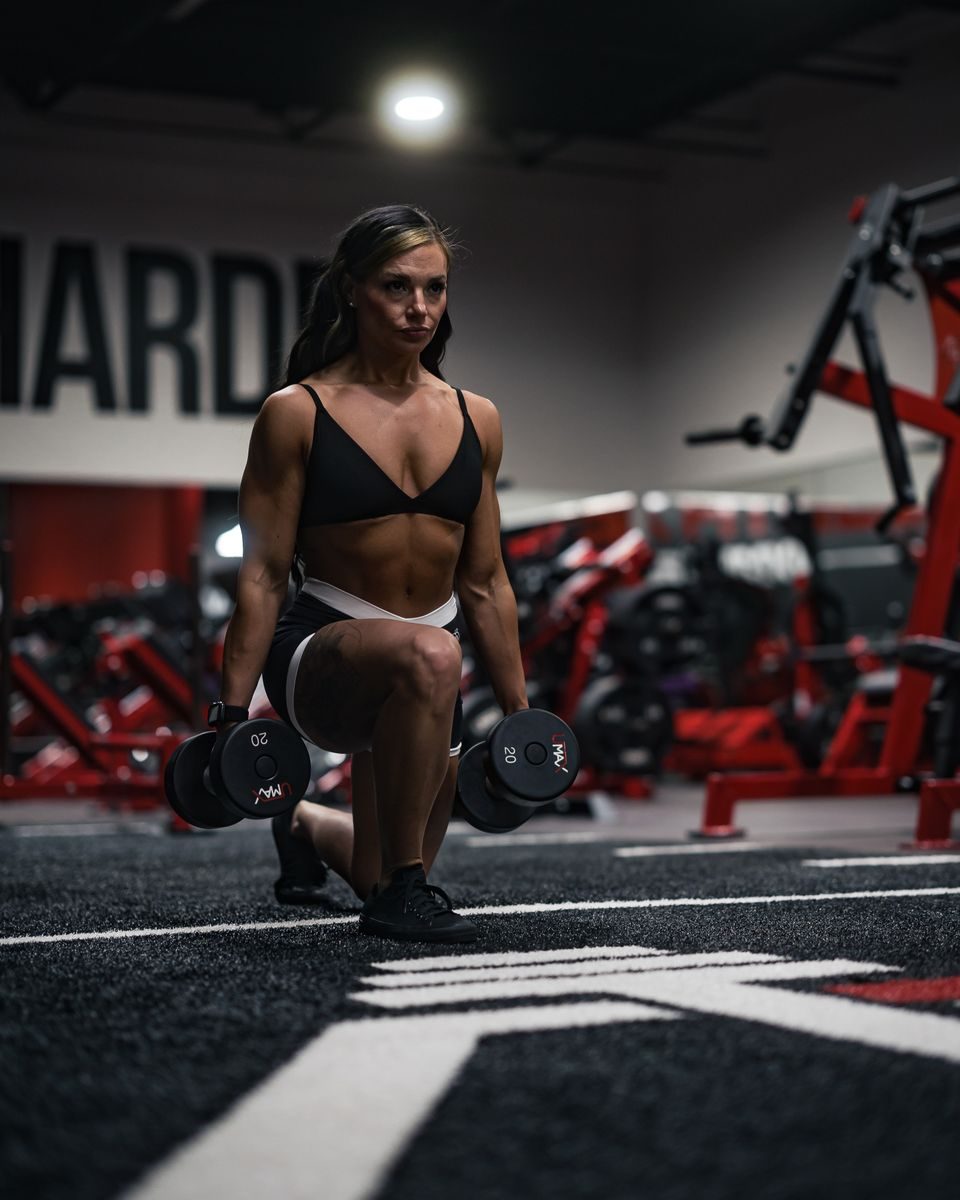
The dumbbell reverse lunge trains the quadriceps, glutes, hamstrings, calves, and hip-stabilizing muscles while developing single-leg strength, balance, and lower-body control. You perform it by holding dumbbells at your sides, stepping one foot backward, lowering into a split stance, and returning to standing.
Compared with stepping forward, stepping backward may make it easier for some people to control their front foot and knee. However, correct foot placement, an appropriate range of motion, and a manageable load still matter.
This guide explains the muscles worked, benefits, proper form, common mistakes, modifications, progressions, and practical ways to program dumbbell reverse lunges.
Dumbbell Reverse Lunge at a Glance
| Category | Details |
|---|---|
| Exercise type | Unilateral lower-body exercise |
| Main muscles worked | Quadriceps, gluteus maximus, hamstrings |
| Assisting muscles | Gluteus medius, adductors, calves, core |
| Equipment needed | Two dumbbells |
| Best for | Single-leg strength, muscle development, balance, and coordination |
| Beginner starting point | 2–3 sets of 6–10 reps per leg |
| Typical rest | 90–120 seconds |
| Difficulty | Beginner to intermediate after bodyweight technique is learned |
What Is a Dumbbell Reverse Lunge?
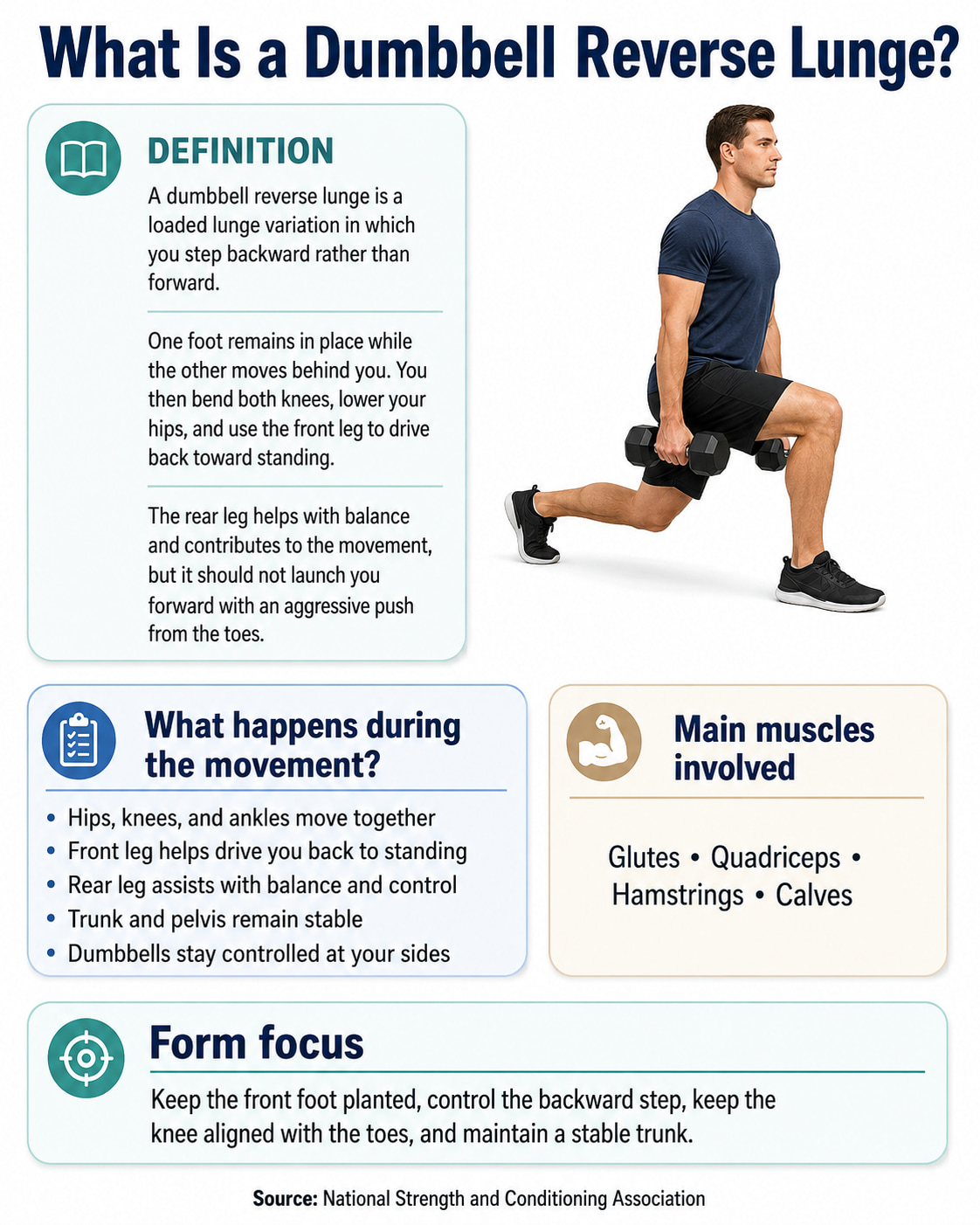
A dumbbell reverse lunge is a loaded lunge variation in which you step backward rather than forward.
One foot remains in place while the other moves behind you. You then bend both knees, lower your hips, and use the front leg to drive back toward standing. The rear leg helps with balance and contributes to the movement, but it should not launch you forward with an aggressive push from the toes.
The exercise involves coordinated movement at the hips, knees, and ankles. Your trunk and pelvis must also remain controlled while the dumbbells pull downward at your sides.
The National Strength and Conditioning Association’s lunge guide identifies the glutes, quadriceps, hamstrings, and calves as important lunge muscles and explains how the trunk helps maintain stability in a split stance.
How to Do a Dumbbell Reverse Lunge
Best for: Building unilateral leg strength and training the quads and glutes together.
Muscles worked: Quadriceps, gluteus maximus, hamstrings, hip stabilizers, calves, and core.
Equipment needed: Two matching dumbbells and a clear, nonslip training area.
Sets, reps, and rest: Start with 2–3 sets of 6–10 reps per leg. Rest for 90–120 seconds between sets.
Step-by-Step Instructions
- Stand with your feet approximately hip-width apart. Hold one dumbbell in each hand with your arms straight and palms facing your thighs.
- Keep your wrists neutral, shoulders relaxed, chest comfortably lifted, and ribs controlled. Brace your abdomen before moving.
- Shift your weight onto one foot and step the opposite foot backward. Maintain roughly hip-width side-to-side spacing instead of placing both feet on one narrow line.
- Land on the ball of the rear foot with the heel raised.
- Bend both knees and lower your hips under control. Keep the entire front foot planted.
- Guide the rear knee toward the floor while allowing the front knee to track in the same direction as the toes.
- Descend only as far as you can maintain balance, foot contact, and a neutral spine. The rear knee may approach the floor, but it does not need to touch.
- Press through the whole front foot and extend the front hip and knee to return to standing.
- Bring the rear foot forward without swinging the dumbbells or twisting your body.
- Complete all reps on one side before switching, or alternate legs while maintaining the same step length and depth.
Coaching cue: Step back on two railroad tracks, then push the floor away with your front foot.
Important Form Tips
Use a Stable, Hip-Width Stance
Do not step backward as though you are walking on a tightrope. Keeping some space between your feet creates a more stable base and makes it easier to control the pelvis and front knee.
The NSCA recommends keeping the feet approximately hip-width apart during a lunge rather than placing them directly in line.
Choose a Comfortable Step Length
Your step should be long enough to give both knees room to bend without lifting the front heel. It should not be so long that you cannot lower vertically or return smoothly.
A useful starting position places the rear knee beneath or slightly behind the rear hip near the bottom. Adjust from there according to your limb lengths and mobility.
Keep the Front Foot Fully Planted
Maintain contact through the heel, base of the big toe, and base of the little toe.
Do not roll onto the outside edge of the foot or allow the heel to rise as you descend.
Let the Knee Track With the Toes
The front knee should follow the general direction of the second and third toes.
Some forward knee movement is normal. Do not force a perfectly vertical shin if doing so makes the movement awkward. Prioritize a stable heel, controlled depth, and knee alignment rather than using the toes as a rigid stopping line.
Control the Torso
Keep your ribs stacked over your pelvis and your spine neutral.
A slight whole-body inclination is acceptable, particularly if it allows a comfortable hip position. Avoid rounding the back, dropping the chest sharply, or leaning sideways.
Use the Front Leg Without Making the Rear Leg Passive
Think about driving through the front foot as you rise. The rear leg can assist naturally, but avoid bouncing off the rear toes or using a forceful push that throws you forward.
Keep the Dumbbells Quiet
The dumbbells should travel straight down and up beside your body.
If they swing, collide with your legs, or move forward and backward, the load may be too heavy or your movement may be too fast.
Dumbbell Reverse Lunge Muscles Worked
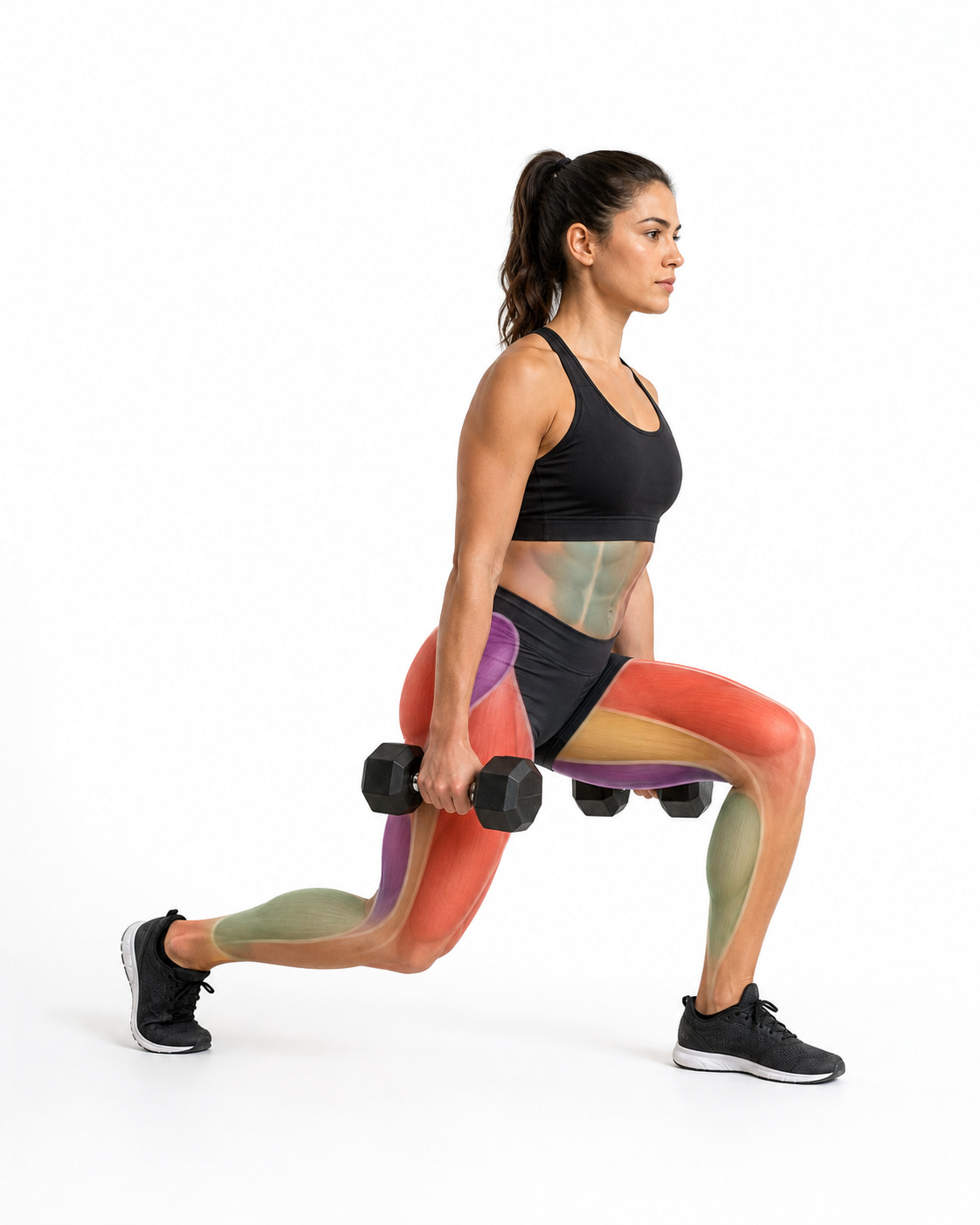
The dumbbell reverse lunge is not an isolation exercise. Several muscles work together to lower the body, stabilize the hips and knees, and return you to standing.
Quadriceps
The quadriceps are the large muscles on the front of the thighs. They extend the knee as you rise from the bottom of the lunge and help control knee flexion during the descent.
You will usually feel considerable quadriceps effort in the front, stationary leg. The quadriceps of the stepping leg also contribute, particularly as that knee bends and straightens.
Gluteus Maximus
The gluteus maximus extends the hip as you push back to standing. It works especially hard when the front hip reaches a deeper but controlled flexed position.
The exercise should not be treated as a glute-only movement, but it can be a useful part of a glute-focused program. Hospital for Special Surgery includes dumbbell reverse lunges among exercises used to strengthen the posterior chain and gluteus maximus.
Hamstrings
The hamstrings assist with hip extension and help stabilize the knee. They also contribute to controlling the movement as you lower.
Because the hamstrings cross both the hip and knee, their role is more complex than simply “bending the knee.” They work with the glutes, quadriceps, and calves throughout the exercise.
Gluteus Medius and Other Hip Stabilizers
The gluteus medius and smaller hip muscles help keep the pelvis level and control the position of the thigh.
These muscles become especially important when you balance on the stationary leg while moving the other foot backward. Weak control may appear as the pelvis shifting sideways or the front knee collapsing inward.
Adductors
The inner-thigh muscles help stabilize the hip and guide the thigh as you descend and stand.
They are not the main target of a standard reverse lunge, but they contribute to maintaining control in the split stance.
Calves and Foot Muscles
The gastrocnemius, soleus, and smaller muscles around the feet and ankles help maintain balance and control pressure through the front foot.
The front heel, base of the big toe, and base of the little toe should remain in contact with the floor.
Core and Back Muscles
The abdominal muscles, obliques, and spinal extensors work isometrically to keep your trunk stable under the dumbbell load.
The goal is not to eliminate every degree of torso movement. A small, controlled inclination may occur naturally. The problem is losing abdominal tension, rounding the back, twisting, or folding sharply at the waist.
Which Leg Works Harder?
Most people should aim to produce most of the upward force through the front, stationary leg. However, the rear leg is not inactive.
A 2024 bodyweight reverse-lunge study found different muscle-activation patterns between the two legs. Peak rectus femoris and biceps femoris activity was higher in the moving leg, while peak gluteus medius and gluteus maximus activity was higher in the stationary leg. The study involved 20 healthy young adults and did not test dumbbell loading, so its results explain how both legs contribute rather than proving which leg will gain the most muscle.
Benefits of Dumbbell Reverse Lunges
Builds Each Leg Individually
Because the exercise uses a split stance, each side must control its own repetitions.
This makes reverse lunges useful for developing unilateral strength and identifying differences in balance, coordination, range of motion, or strength between sides. The exercise does not automatically correct every imbalance, but it prevents both legs from working together as one unit in the way they do during a bilateral squat.
Trains the Quads and Glutes Together
Reverse lunges involve both knee extension and hip extension. That allows the quadriceps and gluteus maximus to contribute during the same exercise.
Your stride, depth, body proportions, and torso position can change how the exercise feels. A slightly longer stance and greater hip flexion may increase the hip demand, while a shorter stance often feels more knee-dominant. Neither approach completely isolates one muscle group.
Challenges Balance and Pelvic Control
Stepping backward temporarily reduces your base of support and requires you to locate the floor without looking directly at the moving foot.
Your front foot, ankle, hip, pelvis, and trunk must coordinate to keep you stable. This makes the reverse lunge more demanding than many machine exercises, but it also means beginners may need support before adding dumbbells.
Provides a Practical Way to Add Resistance
Dumbbells make the exercise easy to scale. You can begin with body weight, progress to light dumbbells, add reps, and then increase the load gradually.
Holding dumbbells at your sides also keeps the loading setup relatively simple. You do not need a squat rack or a barbell, and you can release the weights safely if necessary.
May Produce Less Knee Loading Than a Forward Lunge
In a 2021 biomechanics study involving asymptomatic women, forward lunges produced greater patellofemoral joint force and loading rate than backward lunges. Earlier research comparing common lower-body exercises also found meaningful differences in joint demands between forward and reverse lunges.
This does not mean reverse lunges are automatically safe or pain-free for everyone. Load, depth, technique, previous injuries, anatomy, and current symptoms all affect how an exercise feels.
Works in Home and Gym Programs
You need only a pair of dumbbells and enough floor space to step backward.
The movement can serve as a main unilateral exercise, an accessory after squats or deadlifts, or part of a full-body dumbbell workout.
Common Dumbbell Reverse Lunge Mistakes
Stepping Back on a Tightrope
A narrow stance makes balance harder and can cause the pelvis to rotate or the front knee to drift inward.
Fix: Step backward while keeping approximately hip-width space between your feet.
Taking Too Short a Step
A short step can crowd the bottom position, lift the front heel, and increase the demand at the front knee.
Fix: Lengthen the step until both knees can bend comfortably while the front foot stays planted.
Allowing the Front Knee to Collapse Inward
The knee may move toward the body’s midline when the foot, hip, or trunk loses control.
Fix: Keep the knee tracking with the toes and reduce the load or range if alignment cannot be maintained.
Pushing Mainly From the Rear Foot
Driving hard from the back toes reduces the work performed by the front leg and may cause you to stumble forward.
Fix: Keep the rear foot light enough that you can feel the front leg producing most of the upward force.
Hitting the Rear Knee Against the Floor
Bouncing the knee does not create a better range of motion and can be uncomfortable.
Fix: Stop just above the floor or use a soft pad as a depth target.
Leaning, Twisting, or Rounding
Poor trunk control often appears when the dumbbells are too heavy or the stance is unstable.
Fix: Brace before stepping, keep the weights close to your sides, and practice with body weight first.
Moving Too Quickly
Rushed alternating lunges often lead to inconsistent steps and shallow, uncontrolled reps.
Fix: Pause briefly after each return to standing before beginning the next rep.
Adding Weight Before Learning the Movement
Balance can hide whether the working muscles are strong enough to control the exercise.
Fix: First perform controlled bodyweight reps through a consistent range. Add dumbbells only after you can repeat the same step and depth on both sides.
Dumbbell Reverse Lunge vs. Forward Lunge
Both variations train similar lower-body muscles, but the movement strategy is different.
Reverse Lunge
- The moving foot steps backward.
- The front foot remains planted.
- Less forward braking is required.
- Some people find it easier to control the front knee and foot.
- It may produce lower patellofemoral loading than a forward lunge under comparable conditions.
- Locating the floor behind you may challenge balance.
Forward Lunge
- The moving foot steps forward.
- The body must decelerate as the foot lands.
- It generally requires more forward momentum control.
- It may involve greater knee and ankle loading.
- Some people find the step easier because they can see where the foot is going.
Neither variation is universally better. Choose the version that matches your goals, skill level, available space, and joint comfort.
Beginner Regressions
Supported Reverse Lunge
Hold a stable rack, rail, or countertop with one hand and perform the movement without dumbbells.
Support reduces the balance demand so you can concentrate on leg position and control.
Bodyweight Reverse Lunge
Practice the complete movement without external resistance.
Begin with a shallow range and gradually lower farther as your balance and strength improve.
Reduced-Range Reverse Lunge
Step back normally but descend only as far as you can maintain a planted front foot and stable knee.
Range of motion should increase through control, not by forcing the rear knee toward the floor.
Stationary Split Squat
Step into a split stance and leave both feet in place while completing the set.
This removes the backward stepping component and may make it easier to learn the lowering and rising phases. The NSCA lists support, reduced range, and stationary lunges as practical ways to make the movement easier.
Dumbbell Reverse Lunge Progressions
Increase the Dumbbell Weight
Add the smallest available increase after reaching the top of your rep range with stable form.
Do not increase weight if it shortens your range, changes your step length, or causes the knee to collapse inward.
Add Repetitions
Progress from 6 reps per leg toward 10 or 12 before increasing the load.
This is often the simplest progression for beginners.
Slow the Lowering Phase
Take approximately three seconds to descend, pause briefly, and stand normally.
A slower eccentric phase increases control and makes a moderate weight more challenging.
Use an Offset Load
Hold one dumbbell in one hand instead of two equal dumbbells.
A suitcase-style load increases the demand on the trunk to resist side bending and rotation. Change hands so both loading positions are trained.
Front-Foot-Elevated Reverse Lunge
Place the front foot on a low, stable platform. The elevation provides additional room to lower, increasing the available hip and knee range.
Start with a small elevation and use less weight than in the standard version.
Deficit Reverse Lunge
Stand on a low platform and step backward to the floor.
This increases the range of motion and should be reserved for lifters who already control the standard exercise without losing front-foot pressure or spinal position.
Sets, Reps, Rest, and Weekly Programming
The correct prescription depends on your experience, goal, and the rest of your lower-body training.
Beginner Strength and Technique
- Sets: 2–3
- Reps: 6–10 per leg
- Rest: 90–120 seconds
- Frequency: 1–2 times per week
- Effort: Finish with 2–4 good reps still possible
Start with body weight or light dumbbells. Technique should remain consistent from the first rep to the last.
Muscle-Building Accessory
- Sets: 3–4
- Reps: 8–12 per leg
- Rest: 90–150 seconds
- Frequency: 1–2 times per week
- Effort: Finish with approximately 1–3 reps in reserve
Perform reverse lunges after a squat, leg press, or deadlift, or use them first when unilateral leg development is the session’s priority.
Strength-Focused Training
- Sets: 3–4
- Reps: 5–8 per leg
- Rest: 2–3 minutes
- Effort: Challenging, but never so heavy that balance determines when the set ends
A one-repetition maximum is unnecessary. Use loads you can control through a repeatable range without stumbling or changing technique.
The American College of Sports Medicine’s 2026 resistance-training guidance emphasizes consistency, individualized programming, and appropriate adjustments to load and volume rather than complicated methods. It also notes that training to momentary failure is not consistently necessary for the average healthy adult.
How to Progress
Use a simple double-progression method:
- Choose a rep range, such as 8–12 per leg.
- Begin with a load you can perform for 8 controlled reps.
- Add reps over several workouts.
- Once you complete 12 reps per leg across every set with good form, increase the dumbbells slightly.
- Return to 8 reps and repeat the process.
Increase the load only when you can maintain the same stance width, step length, depth, knee tracking, and trunk position.
Sample Lower-Body Workout
Perform this workout once or twice per week, leaving at least one recovery day between lower-body sessions.
Beginner Dumbbell Lower-Body Workout
- Goblet squat: 3 sets of 8–12 reps
- Dumbbell reverse lunge: 3 sets of 6–10 reps per leg
- Dumbbell Romanian deadlift: 3 sets of 8–12 reps
- Standing calf raise: 2–3 sets of 12–15 reps
Rest for 90–150 seconds between sets. Use a load that leaves approximately two or three controlled reps in reserve.
Begin with 6 reverse lunges per leg. Add one rep per leg when all sets feel stable. Increase the dumbbell weight after reaching 10 reps per leg without losing form.
Safety Considerations
Warm up with five to ten minutes of easy walking, cycling, or another low-impact activity before loaded lower-body training. The American Academy of Orthopaedic Surgeons recommends a five-to-ten-minute low-impact warm-up and advises exercisers not to ignore pain.
Use a clear, nonslip floor and keep objects out of the area behind you. Begin without weights when learning the backward step.
Normal muscular effort and mild fatigue are expected. Stop the exercise and seek qualified professional guidance if it causes sharp pain, numbness, dizziness, chest pain, loss of balance that does not improve, or other unusual symptoms.
People recovering from an injury or surgery should use exercises and ranges approved by their doctor or physical therapist.
Frequently Asked Questions
Are dumbbell reverse lunges good for the glutes?
Yes. The gluteus maximus helps extend the front hip as you rise, while the gluteus medius helps stabilize the pelvis and thigh.
However, reverse lunges also train the quadriceps, hamstrings, calves, and trunk. They should be viewed as a complete lower-body exercise rather than a glute isolation movement.
Are reverse lunges better for the knees than forward lunges?
Reverse lunges may produce lower patellofemoral joint force and loading rate than forward lunges under comparable conditions. That may make the reverse variation more comfortable for some people.
It does not guarantee pain-free training. Reduce the load and range if the exercise is uncomfortable, and seek professional assessment for persistent or sharp knee pain.
Should I alternate legs or complete one side first?
Both methods work.
Completing one side first makes it easier to repeat the same step and can create more continuous fatigue in that leg. Alternating legs provides a brief rest between repetitions and may feel more natural in a circuit.
Beginners often learn faster by completing all reps on one side before switching.
How heavy should the dumbbells be?
Choose a weight that allows you to complete the target reps while keeping your front foot planted, knee aligned, trunk stable, and step length consistent.
For a new exercise, start with body weight. Add light dumbbells only when you can perform at least 8–10 controlled reps per leg.
Should the front knee stay behind the toes?
The knee does not need to remain rigidly behind the toes during every repetition. The amount of forward travel varies with depth, stride length, ankle mobility, and body proportions.
Focus on keeping the whole front foot planted and the knee tracking with the toes. Do not force additional depth if it causes pain or loss of control.
Should the rear knee touch the floor?
No. Lower the rear knee toward the floor, but stop before you lose pelvic control or strike the ground.
A folded mat or knee pad can provide a consistent depth target, but you should touch it gently rather than bounce.
How often should I do dumbbell reverse lunges?
One or two sessions per week is enough for many beginners and intermediate lifters, provided the rest of the program also trains the lower body.
Allow enough recovery for normal soreness and fatigue to settle before repeating hard sets.
Conclusion
The dumbbell reverse lunge is a practical exercise for building the quadriceps, glutes, hamstrings, and supporting hip muscles one side at a time. It also challenges balance, trunk control, and lower-body coordination without requiring a rack or specialized machine.
Learn the movement with body weight, step backward with hip-width spacing, keep the front foot planted, and progress the dumbbells only when every repetition remains controlled. A stable, repeatable lunge is more valuable than a heavier but inconsistent one.
References
- American College of Sports Medicine: 2026 Resistance Training Guidelines
- National Strength and Conditioning Association: The Undervalued Lunge
- Hoogenboom et al.: The Reverse Lunge—A Descriptive Electromyographic Study
- Goulette et al.: Patellofemoral Joint Loading During the Forward and Backward Lunge
- Comfort et al.: Joint Kinetics and Kinematics During Common Lower-Limb Exercises
- Hospital for Special Surgery: Exercises to Strengthen the Posterior Chain
- American Academy of Orthopaedic Surgeons: Knee Conditioning Program
This content is for informational purposes only and is not a substitute for medical advice.