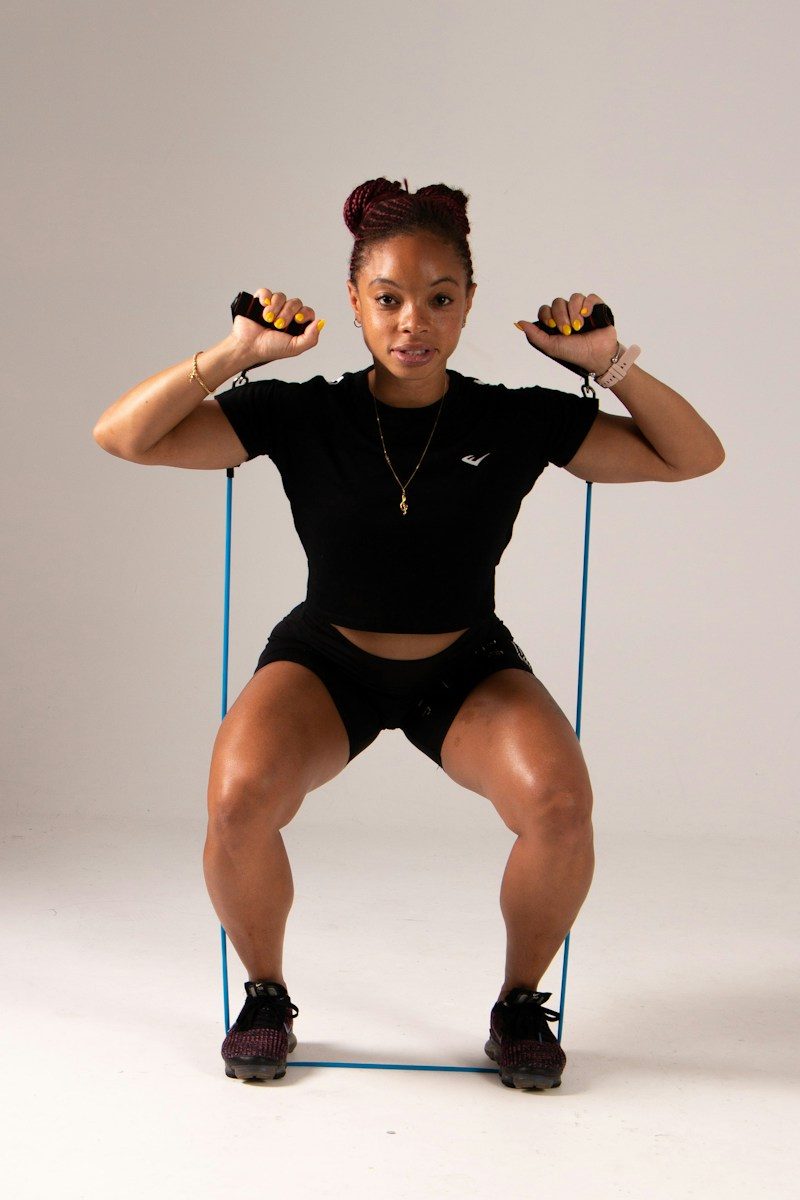
The best resistance band exercises for a full-body workout combine squats, hip hinges, rows, presses, and core training. The 12 exercises below cover those movements, along with targeted work for your hips, calves, and arms.
Bands can provide effective strength training without a room full of equipment. The American College of Sports Medicine recognizes elastic-band and home-based resistance training as useful options for improving strength and muscle size. What matters is consistent training, appropriate effort, and gradual progression.
Use this guide to learn the movements, then follow the smaller sample routine—you do not need to perform all 12 exercises in every workout.
What You Need Before Starting
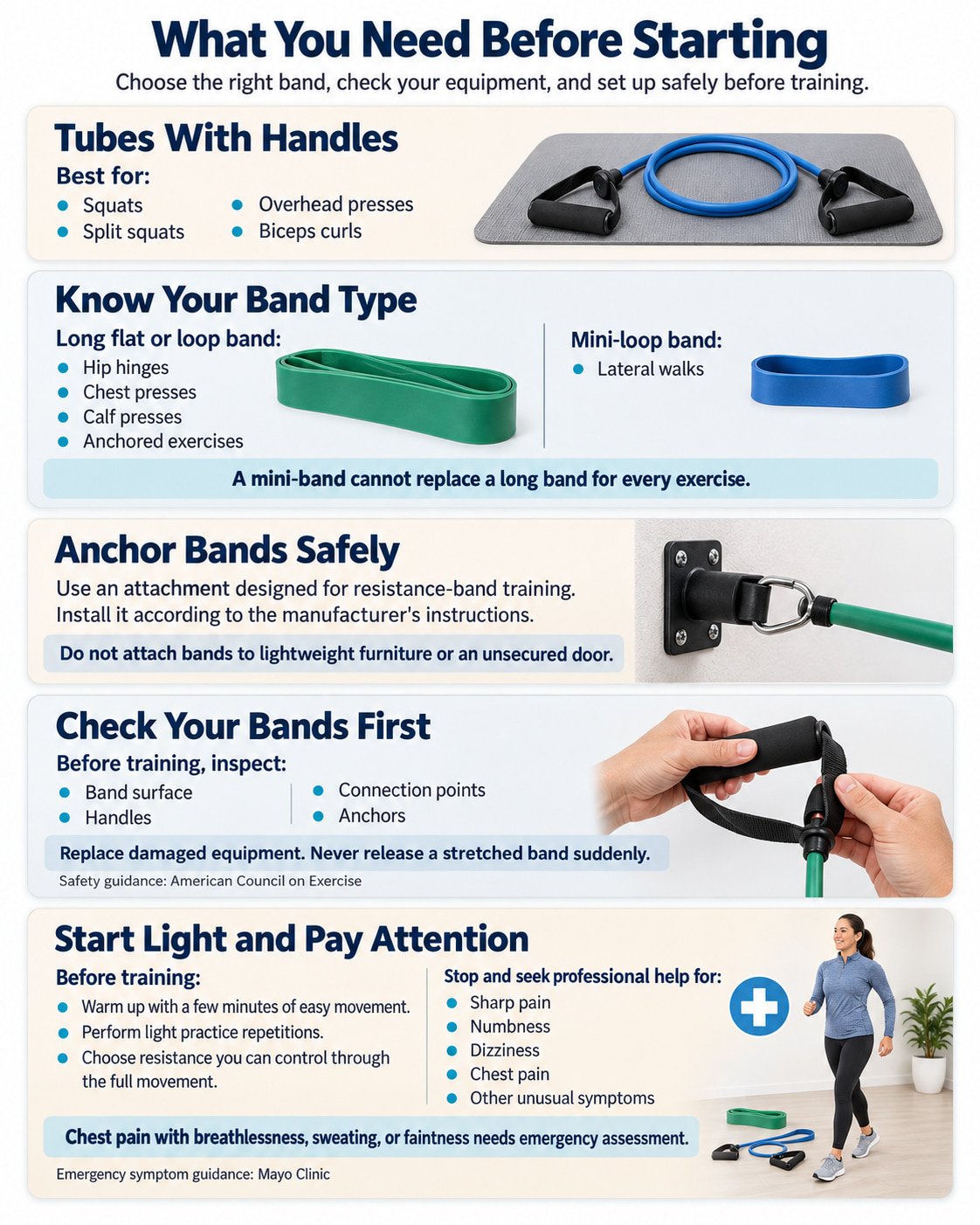
Different exercises need different band setups:
- Resistance tubes with handles: Used here for squats, split squats, overhead presses, and curls.
- Long flat or loop bands: Used for hip hinges, chest presses, calf presses, and anchored exercises.
- A mini-loop band: Used for lateral walks. A short mini-band cannot replace a long band in every movement.
For anchored exercises, use an attachment designed for resistance-band training and install it according to its instructions. Do not improvise with lightweight furniture or an unsecured door.
The American Council on Exercise recommends checking bands and handles for damage before every use, discarding damaged equipment, and never releasing a stretched band. Follow your manufacturer’s stretching limits and protective-equipment instructions.
Warm up with a few minutes of easy movement and light practice repetitions. Start with resistance you can control throughout the entire exercise.
Stop and seek professional help for sharp pain, numbness, dizziness, chest pain, or other unusual symptoms. Chest pain accompanied by breathlessness, sweating, or faintness needs emergency assessment, as explained by Mayo Clinic.
12 Best Resistance Band Exercises
The exercises below train your legs, back, chest, shoulders, arms, and core. Treat them as a menu: learn a manageable selection first, then add other movements as needed.
The sets and repetitions are suggested starting targets, not requirements to complete every exercise.
1. Resistance Band Squat
Best for: Building lower-body strength with a basic squat pattern.
Muscles worked: Quadriceps and glutes; the trunk muscles help stabilize your body.
Equipment: Resistance tube with handles.
Sets, reps, and rest: 2–3 sets of 8–12 repetitions; rest 90–120 seconds.
How to do it:
- Stand on the center of the tube with both feet approximately shoulder-width apart.
- Bring the handles beside your shoulders, keeping your elbows bent and the tubing clear of your neck.
- Bend your hips and knees to lower into a squat. Keep your whole foot planted and your knees moving in the same direction as your toes.
- Lower only as far as you can maintain control, then push through your feet to stand. Keep the handles at shoulder height.
Common mistakes: Lifting the heels, allowing the knees to collapse inward, pulling the handles upward during the repetition, or using resistance that prevents a controlled squat.
Make it easier: Practice the movement without the band before adding resistance. Cleveland Clinic also recommends starting with manageable resistance so you can maintain proper technique.
2. Resistance Band Romanian Deadlift
Best for: Training the hip hinge and strengthening the back of your legs.
Muscles worked: Hamstrings and glutes; the back and abdominal muscles stabilize your torso.
Equipment: Long resistance band.
Sets, reps, and rest: 2–3 sets of 10–15 repetitions; rest 90–120 seconds.
How to do it:
- Stand on the band with your feet hip-width apart. Hold the band beside your legs with your arms straight.
- Soften your knees and brace your abdomen. Start standing tall.
- Push your hips backward while allowing your torso to tip forward. Keep your hands close to your legs and maintain a neutral spine.
- Stop when you reach a comfortable hamstring stretch or before your back begins to round. Drive through your feet and bring your hips forward to stand.
Common mistakes: Turning the movement into a squat, reaching toward the floor by rounding the back, or leaning backward at the top.
Make it easier: Learn the hinge without resistance and use a shorter lowering range. The Girls Gone Strong exercise guide emphasizes that maintaining spinal position matters more than reaching a particular depth.
3. Resistance Band Split Squat
Best for: Giving each leg focused work in a stationary stance.
Muscles worked: Quadriceps and glutes; the hip and trunk muscles assist with stability.
Equipment: Resistance tube with handles.
Sets, reps, and rest: 2 sets of 8–12 repetitions per side; rest 60–90 seconds between sides as needed.
How to do it:
- Place the middle of the tube securely beneath your front foot. Step the other foot backward, keeping some sideways space between your feet.
- Hold the handles near your shoulders. Keep your front foot flat and your rear heel lifted.
- Bend both knees to lower your body. Keep your torso controlled and your front knee tracking in line with your foot.
- Push through your front foot to rise, keeping both feet in their original positions. Complete the set before switching sides.
Common mistakes: Placing the feet on one narrow line, bouncing off the bottom, lifting the front heel, or stepping between repetitions.
Make it easier: Remove the band and lightly hold a stable support while learning the movement. Performance Health demonstrates the resistance-band split squat as a stationary lower-body exercise rather than a stepping lunge.
4. Mini-Band Lateral Walk
Best for: Adding side-to-side hip work to a routine dominated by forward-and-back movements.
Muscles worked: Hip abductors, including the gluteus medius; the thighs and trunk assist with control.
Equipment: Mini-loop band.
Sets, reps, and rest: 2 sets of 8–12 steps in each direction; rest 45–60 seconds.
How to do it:
- Place the band around your thighs, just above your knees. Stand with your feet hip-width apart.
- Bend your hips and knees slightly into an athletic stance.
- Take a controlled step sideways, keeping your feet approximately parallel and your knees aligned with your toes.
- Bring the trailing foot inward without letting your feet come together. Continue for the planned steps, then reverse direction.
Common mistakes: Dragging the trailing foot, swaying the torso, standing up between steps, or allowing the knees to collapse inward.
Make it easier: Use a lighter mini-band and smaller steps. Guidance from the National Academy of Sports Medicine supports controlled lateral band movements rather than rushing through the steps.
5. Seated Resistance Band Calf Press
Best for: Training the calves without requiring standing balance.
Muscles worked: Gastrocnemius and soleus—the main calf muscles.
Equipment: Long flat band and a small rolled towel.
Sets, reps, and rest: 2 sets of 12–20 repetitions per side; rest 45–60 seconds.
How to do it:
- Sit with the working leg extended and a rolled towel beneath your ankle.
- Place the band securely around the ball of your foot and hold both ends. Keep your hands steady.
- Press your forefoot away from you, moving through the ankle as though pressing a pedal.
- Slowly bring your foot back toward you without letting the band snap it backward. Repeat, then switch feet.
Common mistakes: Moving the entire leg, curling only the toes, letting the foot roll inward or outward, or allowing the band to slip toward the toe tips.
Progression: Increase band resistance when you can complete the upper repetition target with steady ankle control. The resisted plantar-flexion setup shown by Ask Doctor Jo uses the same basic ankle movement.
6. Standing Resistance Band Row
Best for: Training a horizontal pulling movement for the back.
Muscles worked: Lats, rhomboids, middle trapezius, and rear shoulders; the biceps assist.
Equipment: Long band secured to an appropriate anchor in front of you.
Sets, reps, and rest: 2–3 sets of 10–15 repetitions; rest 60–90 seconds.
How to do it:
- Secure the band around lower-chest height. Hold an end in each hand with your palms facing inward.
- Step back until there is light tension with your arms extended. Keep your feet stable and knees slightly bent.
- Pull your hands toward your lower ribs, allowing your elbows to travel close to your sides.
- Slowly extend your arms again while keeping your torso still.
Common mistakes: Rocking backward, lifting the shoulders toward the ears, bending the wrists, or pulling the elbows excessively far behind the body.
Make it easier: Use a lighter band or move slightly closer to the anchor while retaining control at the starting position. Girls Gone Strong demonstrates the standing band row with a stable torso and elbows traveling alongside the body.
7. Tall-Kneeling Resistance Band Lat Pulldown
Best for: Adding an overhead pulling pattern without a pulldown machine.
Muscles worked: Lats; the biceps and other upper-back muscles assist.
Equipment: Long band, secure overhead anchor, and an exercise mat.
Sets, reps, and rest: 2–3 sets of 10–15 repetitions; rest 60–90 seconds.
How to do it:
- Kneel beneath and slightly behind the anchor, with your hips above your knees rather than sitting on your heels.
- Hold the band with your palms facing each other. Begin with your arms reaching overhead.
- Keep your ribs positioned over your pelvis as you pull your elbows down beside your torso. Bring your thumbs toward shoulder level.
- Slowly allow your arms to reach overhead again without leaning backward or losing control.
Common mistakes: Arching the lower back, sitting the hips backward, using body weight to pull, or forcing the hands farther down than the shoulders comfortably allow.
Make it easier: Reduce the band resistance. Do not compensate by leaning backward. The Girls Gone Strong tall-kneeling band pulldown guidance uses the same upright position and palms-in grip.
8. Standing Resistance Band Chest Press
Best for: Training the chest with a self-anchored setup.
Muscles worked: Pectorals; the triceps and front shoulders assist.
Equipment: Long flat resistance band.
Sets, reps, and rest: 2–3 sets of 8–15 repetitions; rest 60–90 seconds.
How to do it:
- Stand with your feet hip-width apart. Position the band across your upper back, below your neck, and bring the ends forward beneath your arms.
- Hold an end in each hand near chest level, with your elbows bent and angled outward comfortably.
- Press your hands forward until your arms are nearly straight. Keep your ribs controlled rather than arching backward.
- Return your hands slowly to the starting position.
Common mistakes: Allowing the band to ride toward the neck, flaring the elbows excessively, shrugging, or leaning forward to finish the press.
Make it easier: Use a lighter band. The British Heart Foundation includes this behind-the-back resistance-band chest press setup without requiring a door anchor.
9. Standing Resistance Band Overhead Press
Best for: Developing overhead pressing strength.
Muscles worked: Deltoids and triceps; the trunk muscles help stabilize your body.
Equipment: Resistance tube with handles.
Sets, reps, and rest: 2 sets of 8–12 repetitions; rest 60–90 seconds.
How to do it:
- Stand securely on the middle of the tube with both feet.
- Bring the handles just outside your shoulders, palms facing forward and wrists straight.
- Press both hands overhead through a comfortable range. Keep your body tall without pushing your ribs forward.
- Lower the handles to shoulder height under control.
Common mistakes: Leaning backward to finish, using a leg drive, bending the wrists, or choosing a band that makes the final part of the press uncontrollable.
Make it easier: Use less resistance. Do not force overhead range that causes pain. Performance Health describes the standing band overhead press with the band beneath the feet and the hands pressing above the shoulders.
10. Standing Resistance Band Biceps Curl
Best for: Adding direct elbow-flexor work after rows or pulldowns.
Muscles worked: Biceps and brachialis; the forearm muscles assist with grip.
Equipment: Resistance tube with handles.
Sets, reps, and rest: 2 sets of 10–15 repetitions; rest 45–60 seconds.
How to do it:
- Stand on the tube with both feet and hold the handles beside your thighs.
- Face your palms forward and keep your elbows close to your torso.
- Bend both elbows to curl the handles toward your shoulders without moving your upper arms forward.
- Lower slowly until your elbows are comfortably straight.
Common mistakes: Swinging the torso, driving the elbows forward, bending the wrists backward, or letting the band pull the hands down abruptly.
Progression: Increase resistance after you can complete both sets at the upper repetition target without body movement. FITTR describes the same two-arm standing curl with the tube beneath both feet and the palms facing forward.
11. Resistance Band Triceps Pressdown
Best for: Adding direct triceps work without another overhead exercise.
Muscles worked: Triceps.
Equipment: Long loop band and a secure overhead anchor.
Sets, reps, and rest: 2 sets of 10–15 repetitions; rest 45–60 seconds.
How to do it:
- Secure the band overhead and face the anchor.
- Grasp the band with your palms facing inward. Bring your upper arms beside your torso and begin with your elbows bent.
- Keep your upper arms still as you straighten your elbows, pressing your hands toward your thighs.
- Slowly bend your elbows to return without letting your shoulders rise or your body rock.
Common mistakes: Turning the movement into a whole-arm push, flaring the elbows, leaning onto the band, or snapping the elbows straight.
Make it easier: Use a lighter band rather than changing your body position to force the repetition. Horton Barbell describes an overhead-anchored band pressdown with the upper arms held relatively still while the elbows extend.
12. Standing Resistance Band Pallof Press
Best for: Training your core to resist rotation.
Muscles worked: Abdominal muscles and obliques; the hips and other trunk muscles assist with stability.
Equipment: Long band and a secure chest-height anchor.
Sets, reps, and rest: 2 sets of 8–12 repetitions per side; rest 45–60 seconds.
How to do it:
- Stand sideways to the anchor with your feet approximately hip-width apart and knees slightly bent.
- Hold the band in both hands in front of your chest. Step away enough to create manageable tension.
- Press your hands straight forward without allowing your shoulders, ribs, or pelvis to turn toward the anchor.
- Pause briefly, then bring your hands back in. Complete the set before turning to face the other direction.
Common mistakes: Twisting toward the anchor, leaning away from it, shrugging, or holding your breath.
Make it easier: Use a lighter band or a shorter arm reach while keeping the same upright position. Girls Gone Strong describes the standing Pallof press as an anti-rotation exercise with the band anchored around sternum height.
A Simple Full-Body Resistance Band Workout
Start with two sessions per week on nonconsecutive days, such as Monday and Thursday. Hospital for Special Surgery recommends nonconsecutive strength-training days and choosing resistance that allows controlled repetitions with good alignment.
The following is a practical beginner routine using six exercises from the guide.
| Exercise | Sets | Repetitions | Rest |
|---|---|---|---|
| Resistance band squat | 2 | 8–12 | 90–120 seconds |
| Standing resistance band row | 2 | 10–15 | 60–90 seconds |
| Resistance band Romanian deadlift | 2 | 10–15 | 90–120 seconds |
| Standing resistance band chest press | 2 | 8–15 | 60–90 seconds |
| Standing resistance band overhead press | 1–2 | 8–12 | 60–90 seconds |
| Standing resistance band Pallof press | 2 | 8–12 per side | 45–60 seconds |
Effort: Finish most sets feeling that you could perform approximately two or three more controlled repetitions. During your first sessions, stay farther from that limit while learning the movements.
Starting volume: Begin with one set per exercise when learning all six movements. Build toward the listed sets as your technique and recovery allow.
Optional accessories: Once the basic routine feels manageable, add one or two sets of calf presses, lateral walks, curls, or pressdowns. Choose according to your priorities rather than adding everything.
For variety in later sessions, split squats can replace regular squats, and pulldowns can replace rows. Keep the total workload manageable while you learn each new movement.
How to Choose Resistance and Progress
Choose Resistance for the Entire Repetition
A band that feels manageable at the beginning may become difficult near the end as it stretches. The American Council on Exercise recommends choosing resistance that lets you maintain controlled technique rather than compensating with swinging, shortened range of motion, or poor posture.
For example, a suitable overhead-press band should let you finish the press without arching your lower back. A suitable rowing band should let you reach your ribs without rocking backward.
Band colors are not standardized across manufacturers. Hospital for Special Surgery recommends judging resistance by your ability to perform the exercise with controlled technique rather than relying only on color.
Add Repetitions Before Adding Resistance
Use a simple progression rule: stay with the same band until you can complete every set at the top of the target range with consistent form.
For a squat prescribed at 8–12 repetitions, that might mean gradually building from two sets of eight to two sets of 12. Then try a slightly stronger band and return toward the lower end of the range.
Record the band used, anchor height, starting distance, and repetitions. Those details make comparisons between workouts more meaningful. Changing the setup substantially can change the difficulty even when the band stays the same.
Do Not Confuse Harder With Better
A stronger band is not an improvement when it makes you cut the movement short or lose control.
Cleveland Clinic emphasizes maintaining technique as resistance increases and warns against overstretching a band simply to make an exercise harder.
Training to complete muscular failure is also unnecessary for a useful general-strength routine. ACSM’s 2026 guidance emphasizes consistent, sufficiently challenging resistance training rather than forcing extra repetitions with poor form.
Frequently Asked Questions
Can Resistance Bands Build Muscle?
Yes. Resistance-band training can support muscle growth when the exercises provide sufficient challenge and training progresses over time. ACSM’s 2026 guidance includes elastic bands among effective resistance-training options.
A very light band used for easy repetitions indefinitely is unlikely to provide the same challenge as a progressively harder routine.
Are Resistance Bands as Effective as Weights?
They can produce meaningful strength gains. A systematic review and meta-analysis published in SAGE Open Medicine found no significant difference between elastic and conventional resistance training for the strength outcomes analyzed.
That does not establish identical results for every exercise, training goal, or experience level. Choose equipment that lets you train the intended movement effectively and progress it reliably.
Which Resistance Band Should a Beginner Use?
Start with a lighter option that lets you complete the exercise through a controlled range. You may need different resistance levels for different movements; one band does not have to serve every exercise.
Having light and moderate options makes it easier to adjust the workout without compromising technique. Check resistance ratings within the same product range rather than comparing colors across brands.
Can I Do Resistance Band Exercises Every Day?
Daily hard training for the same muscles is not necessary. For this full-body routine, start with two nonconsecutive sessions each week and allow recovery between them.
Do not assume a workout requires no recovery simply because it uses bands rather than weights.
Can I Exercise Without a Door Anchor?
Several exercises here are self-anchored, including squats, Romanian deadlifts, chest presses, curls, and lateral walks.
However, the row, pulldown, triceps pressdown, and Pallof press setups described in this guide require a secure external anchor. Skip those setups when you cannot attach the band safely; do not substitute an unstable attachment.
Build Your Routine Around the Basics
Start with a squat, a hip hinge, a pull, a press, and controlled core work. Learn those movements before adding more exercises or stronger bands.
Use the sample routine twice a week, record your repetitions and band setup, and progress only when your technique stays consistent. A manageable routine you repeat is more useful than an exhausting workout you cannot maintain.
This content is for informational purposes only and is not a substitute for medical advice.
References
- American College of Sports Medicine Position Stand: Resistance Training Prescription for Muscle Function, Hypertrophy, and Physical Performance in Healthy Adults
- Effects of Training With Elastic Resistance Versus Conventional Resistance on Muscular Strength: A Systematic Review and Meta-Analysis
- Effects of Elastic Resistance Exercise on Muscle Strength and Functional Performance in Healthy Adults: A Systematic Review and Meta-Analysis
- Multiple-Joint Exercises Using Elastic Resistance Bands vs. Conventional Resistance-Training Equipment: A Cross-Over Study
- Resistance Training Prescription for Muscle Strength and Hypertrophy in Healthy Adults: A Systematic Review and Bayesian Network Meta-Analysis
- Muscle Activation Comparisons Between Elastic and Isoinertial Resistance: A Meta-Analysis