
Glute medius exercises strengthen the muscles on the outside of your hips that help keep your pelvis stable when walking, climbing stairs, and balancing on one leg. Training these muscles can improve hip strength, movement control, and single-leg stability.
You don’t need heavy weights to get started. Bodyweight exercises, resistance bands, and a stable step can all challenge your gluteus medius.
Below are eight effective exercises, with proper form, beginner modifications, and a simple workout plan to help you progress.
What Is the Gluteus Medius, and Why Is It Important?
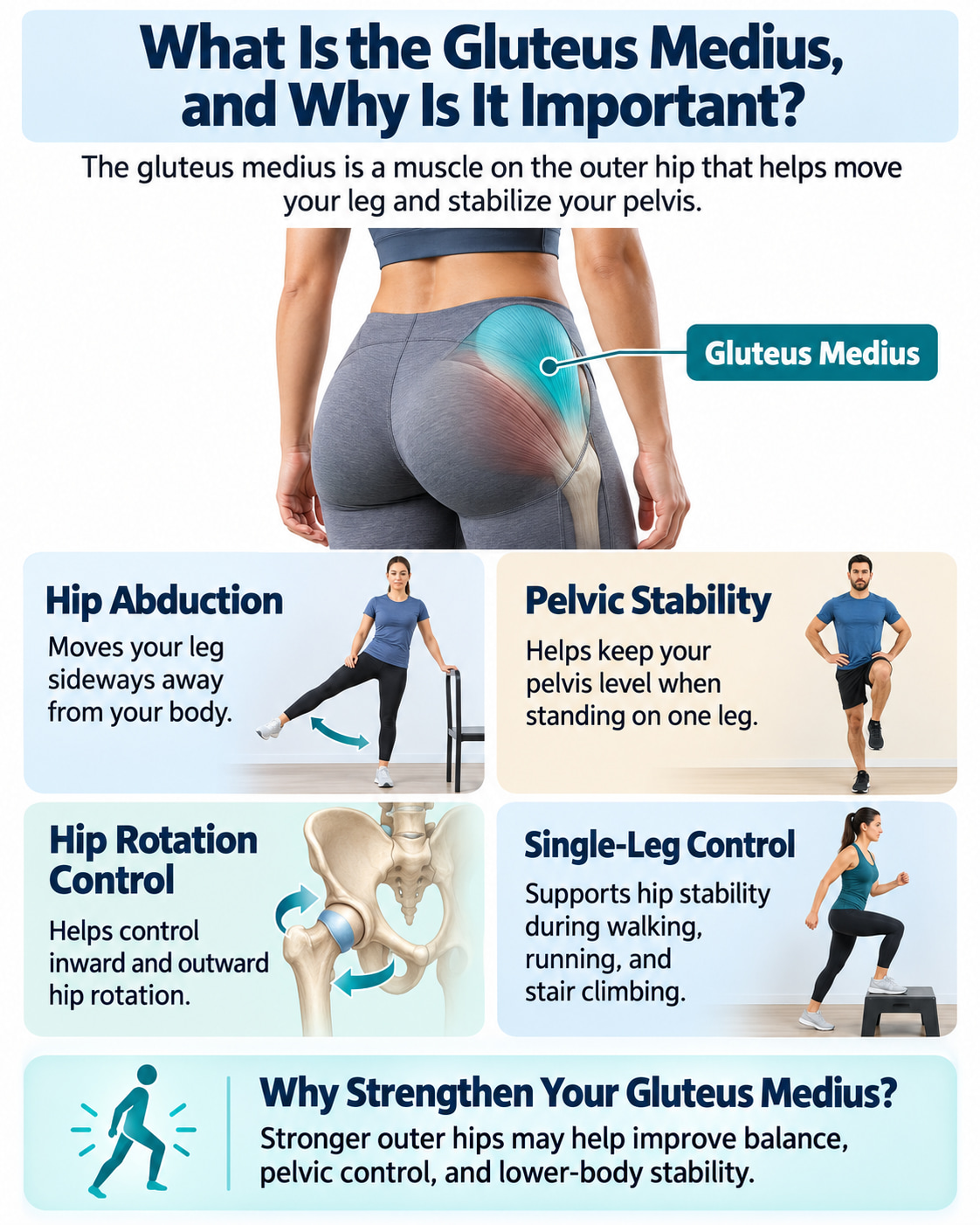
The gluteus medius is a broad muscle located on the outer side of your pelvis, partly beneath the gluteus maximus.
Its main functions include:
- Hip abduction: Moving your leg sideways away from your body.
- Pelvic stability: Helping prevent the opposite side of your pelvis from dropping when standing on one leg.
- Hip rotation control: Assisting with inward or outward rotation depending on which muscle fibers are active.
- Single-leg control: Helping stabilize your hips during walking, running, and stair climbing.
According to the National Library of Medicine, the gluteus medius works alongside the gluteus minimus to control hip movement and support pelvic stability.
Strengthening these muscles may help improve lower-body control during everyday movements and exercise.
8 Best Glute Medius Exercises
These eight glute medius exercises range from beginner-friendly floor movements to more challenging standing and single-leg exercises.
Start with clamshells, side-lying leg raises, and standing hip abduction if you’re new to hip strengthening. As your control improves, progress to lateral band walks, step-ups, bridges, and side-plank variations.
1. Clamshell
Best for: Beginners learning to strengthen and control the outer hips.
Muscles worked: Gluteus medius, gluteus minimus, and other hip external rotators.
Equipment needed: Exercise mat; optional mini resistance band.
Sets, reps, and rest: 2–3 sets of 12–15 repetitions per side. Rest 30–45 seconds between sets.
The clamshell strengthens muscles that help rotate and stabilize your hip. It is an accessible starting exercise because you can focus on controlling one hip without supporting your full body weight.
How to Do It
- Lie on your side with your knees bent and your feet together. Rest your head comfortably on your lower arm.
- Stack your hips and shoulders, keeping your heels approximately in line with your body.
- Keep your feet touching while slowly lifting your upper knee.
- Raise your knee only as far as you can without rolling your pelvis backward.
- Pause briefly, lower your knee with control, and repeat before switching sides.
Common mistakes: Rolling backward to lift the knee higher, separating the feet, or using momentum. Keep the movement small enough that your pelvis stays steady.
Progression: Place a light mini resistance band just above your knees when bodyweight repetitions become easy.
2. Side-Lying Hip Abduction
Best for: Direct glute medius strengthening without equipment.
Muscles worked: Gluteus medius, gluteus minimus, and tensor fasciae latae.
Equipment needed: Exercise mat.
Sets, reps, and rest: 2–3 sets of 10–15 repetitions per side. Rest 30–60 seconds between sets.
Side-lying hip abduction challenges the outer hip muscles by raising your straight leg against gravity.
It is particularly useful when you’re learning to separate hip movement from unwanted pelvic rotation.
How to Do It
- Lie on your side with your lower knee slightly bent and your upper leg straight.
- Stack your hips and keep your upper leg aligned with your torso.
- Keep your foot in a neutral position, with your toes pointing mostly forward.
- Slowly raise your upper leg approximately 8–12 inches, stopping sooner if your pelvis begins to tilt.
- Lower the leg with control and complete your repetitions before changing sides.
Common mistakes: Turning the toes upward, rolling the pelvis backward, or lifting the leg excessively high. These movements can shift the work away from the intended hip action.
Progression: Add a brief pause at the top or gradually introduce light resistance.
The American Council on Exercise emphasizes maintaining hip alignment and controlling the lifting range during side-lying hip abduction.
3. Standing Hip Abduction
Best for: Improving outer hip strength while practicing upright balance and control.
Muscles worked: Gluteus medius, gluteus minimus, and tensor fasciae latae. The standing leg’s hip stabilizers also contribute.
Equipment needed: Sturdy chair or countertop for optional support.
Sets, reps, and rest: 2–3 sets of 10–15 repetitions per leg. Rest 30–60 seconds between sets.
Standing hip abduction trains the muscles that move your leg sideways while the opposite hip stabilizes your body.
Unlike floor exercises, it also provides an opportunity to practice maintaining an upright posture.
How to Do It
- Stand upright with your feet approximately hip-width apart.
- Hold a sturdy chair or countertop if you need help balancing.
- Shift your weight onto one leg while keeping your pelvis level.
- Slowly lift your other leg sideways, keeping the working knee straight and your toes facing forward.
- Lower the leg with control and repeat before switching sides.
Common mistakes: Leaning your torso away from the working leg, swinging the leg, or rotating your toes outward. Keep your body upright and use a comfortable range of motion.
Progression: Add a light resistance band around your lower legs once you can maintain good balance and hip alignment.
4. Resistance Band Lateral Walk
Best for: Strengthening the outer hips during sideways movement.
Muscles worked: Gluteus medius, gluteus minimus, and gluteus maximus, with assistance from the quadriceps and core.
Equipment needed: Mini-loop resistance band.
Sets, reps, and rest: 2–3 sets of 8–12 controlled steps in each direction. Rest 45–60 seconds between sets.
The lateral band walk trains your hips to resist inward pulling forces from the resistance band.
Both legs work during the exercise: one moves against the band while the other helps stabilize your body.
How to Do It
- Place a light mini resistance band around your thighs, just above your knees.
- Stand with your feet approximately hip-width apart and bend your knees slightly.
- Push your hips backward into a shallow squat while keeping your chest comfortably upright.
- Step sideways with one foot, maintaining gentle tension in the band.
- Bring your other foot toward the first without allowing your knees to collapse inward. Continue stepping, then reverse direction.
Common mistakes: Taking steps that are too large, letting the knees cave inward, or bouncing up and down. Keep your steps controlled and your pelvis relatively level.
Progression: Use a stronger band or move the band toward your ankles as your strength improves.
A 2025 research review published in the Journal of Functional Morphology and Kinesiology found that band placement and body position influence gluteal muscle activation during lateral walking exercises.
5. Hip Hike (Pelvic Drop)
Best for: Improving pelvic control during single-leg standing.
Muscles worked: Primarily the supporting leg’s gluteus medius and gluteus minimus, with assistance from other pelvic stabilizers.
Equipment needed: Low, stable step; optional wall or railing for support.
Sets, reps, and rest: 2–3 sets of 8–12 repetitions per side. Rest 45–60 seconds between sets.
Hip hikes train your gluteus medius differently from leg raises.
Instead of moving your leg sideways, you use the hip muscles of your supporting leg to control the position of your pelvis.
This makes the exercise particularly relevant to single-leg stability.
How to Do It
- Stand sideways on a low, stable step with one foot fully supported.
- Allow your opposite leg to hang freely beside the step. Hold a railing or wall if needed.
- Keep your supporting knee mostly straight and your torso upright.
- Slowly lower the unsupported side of your pelvis a small distance toward the floor.
- Use the muscles around your supporting hip to raise your pelvis back toward a level position.
Common mistakes: Bending and straightening the supporting knee to create the movement or leaning your torso sideways. Focus on controlled pelvic movement.
Beginner modification: Practice on level ground while holding a sturdy chair for balance.
Progression: Perform the movement with less hand support or add a brief pause before returning to the starting position.
6. Lateral Step-Up
Best for: Building functional hip strength and single-leg stability.
Muscles worked: Gluteus medius, gluteus maximus, quadriceps, and gluteus minimus.
Equipment needed: Stable exercise step or low platform.
Sets, reps, and rest: 2–3 sets of 8–12 repetitions per leg. Rest 60–90 seconds between sets.
Lateral step-ups combine hip stabilization with the strength needed to lift your body onto an elevated surface.
Your gluteus medius helps control the pelvis while your gluteus maximus and quadriceps contribute to standing up.
How to Do It
- Stand sideways beside a stable, low step.
- Place your nearest foot completely on the elevated surface.
- Brace your abdomen and press through the foot on the step.
- Raise your body until you are standing upright on the elevated leg, keeping your knee aligned with your foot.
- Slowly lower your opposite foot back to the floor and repeat before switching sides.
Common mistakes: Pushing forcefully off the lower foot, allowing the elevated knee to collapse inward, or using a step that is too high.
Beginner modification: Use a lower step and hold a railing for balance.
Progression: Gradually increase the step height or hold light dumbbells when bodyweight repetitions feel manageable.
7. Single-Leg Glute Bridge
Best for: Strengthening the glutes while challenging pelvic stability.
Muscles worked: Gluteus maximus and hamstrings, with the gluteus medius, gluteus minimus, and core assisting with pelvic control.
Equipment needed: Exercise mat.
Sets, reps, and rest: 2–3 sets of 8–12 repetitions per side. Rest 45–75 seconds between sets.
The single-leg glute bridge is primarily a hip-extension exercise, but it also challenges the gluteus medius to help keep your pelvis from rotating.
It is a useful progression from the regular glute bridge.
How to Do It
- Lie on your back with both knees bent, feet flat on the floor, and arms resting beside you.
- Lift one foot off the floor and bring that knee toward your chest, keeping it bent.
- Brace your abdomen and press through your planted foot to raise your hips.
- Lift until your supporting thigh and torso form a comfortable, nearly straight line.
- Keep your pelvis level, then slowly lower your hips and repeat before switching sides.
Common mistakes: Allowing one side of the pelvis to drop, pushing through the lower back, or lifting too high by arching your spine.
Beginner modification: Perform a regular two-leg glute bridge until you can lift your hips without twisting.
Progression: Add a two-second pause at the top or increase repetitions while maintaining pelvic alignment.
8. Side Plank With Hip Abduction
Best for: Advanced lateral hip strength and core stability.
Muscles worked: Gluteus medius, gluteus minimus, obliques, and other core and shoulder stabilizers.
Equipment needed: Exercise mat.
Sets, reps, and rest: 2–3 sets of 6–10 controlled repetitions per side. Rest 60–90 seconds between sets.
This exercise combines two challenges: holding a stable side plank and raising the upper leg against gravity.
The supporting hip helps maintain body position while the upper leg performs hip abduction.
How to Do It
- Lie on your side with your legs straight and stacked. Position your lower elbow directly beneath your shoulder.
- Brace your abdomen and lift your hips into a full forearm side plank.
- Keep your body aligned from your head through your supporting leg.
- Slowly raise your upper leg toward the ceiling without turning your pelvis backward.
- Lower the leg with control while keeping your hips elevated. Repeat before switching sides.
Common mistakes: Allowing your hips to sag, rotating your torso, or lifting the leg so high that you lose balance.
Beginner modification: Bend your lower knee and keep it supported on the floor while performing the upper-leg movement.
Progression: Gradually increase repetitions or the duration of each controlled hold.
How to Build a Glute Medius Workout
You don’t need to perform all eight exercises in every session.
A productive routine can combine an isolated hip exercise with one or two movements that challenge your pelvis while standing or supporting your body weight.
Beginner Glute Medius Workout
Start with these four exercises if you’re new to hip strengthening.
| Exercise | Sets | Reps |
|---|---|---|
| Clamshell | 2 | 12–15 per side |
| Side-Lying Hip Abduction | 2 | 10–12 per side |
| Standing Hip Abduction | 2 | 10–12 per side |
| Supported Hip Hike | 2 | 8–10 per side |
Frequency: Twice weekly, with at least one recovery day between sessions.
Rest: Approximately 30–60 seconds between sets.
Effort: Finish each set with roughly 2–3 good repetitions remaining.
Start with one set per exercise if the full routine feels too demanding.
Intermediate Glute Medius Workout
Once you can control your pelvis during basic movements, increase the challenge.
| Exercise | Sets | Reps |
|---|---|---|
| Resistance Band Lateral Walk | 2 | 10 steps each direction |
| Lateral Step-Up | 3 | 8–10 per leg |
| Single-Leg Glute Bridge | 2 | 8–12 per leg |
| Hip Hike | 2 | 10–12 per side |
Frequency: Twice weekly.
Rest: 45–90 seconds between sets, depending on difficulty.
Effort: Use challenging resistance while keeping approximately 2 repetitions in reserve.
For an advanced option, replace the hip hike with 2 sets of 6–10 side-plank hip abductions per side when you can maintain good technique.
How to Progress
Progress when you can complete all prescribed repetitions with controlled movement.
For example:
- Start with 2 sets of 10 side-lying hip abductions.
- Gradually build to 15 controlled repetitions.
- Add light resistance or another suitable challenge.
- Return to a lower repetition target and build up again.
Change one variable at a time. More repetitions, stronger resistance, longer holds, and more challenging single-leg movements can all increase difficulty.
The American College of Sports Medicine’s 2026 resistance-training guidelines emphasize consistency, appropriate effort, and gradual progression. Bodyweight and resistance-band exercises can both contribute to effective strength training.
Common Mistakes When Training the Gluteus Medius
Even simple glute medius exercises become less effective when you lose control of the intended movement.
1. Moving Your Pelvis Instead of Your Hip
During clamshells and side-lying leg raises, excessive pelvic rotation makes the movement appear larger without necessarily increasing the intended muscle challenge.
What to do: Reduce your range of motion and keep your hips stacked.
2. Leaning During Standing Exercises
Leaning away from the moving leg can reduce the demand on the working hip abductors.
What to do: Keep your torso upright and use a chair for balance if needed.
3. Using Too Much Band Resistance
A band that is too strong may cause your knees to collapse inward or your body to sway during lateral walks.
What to do: Start with light resistance and increase the challenge only when your movements remain controlled.
4. Rushing Through Repetitions
Fast, uncontrolled repetitions make it easier to rely on momentum.
What to do: Lift and lower deliberately. A controlled lowering phase is particularly useful for maintaining consistent tension.
5. Only Performing Floor Exercises
Clamshells and side-lying raises are useful, but they don’t provide the same weight-bearing challenge as step-ups or hip hikes.
What to do: As your strength improves, include exercises that require you to stabilize your pelvis while standing on one leg.
How Often Should You Train Your Gluteus Medius?
For most healthy adults, two focused glute medius workouts per week are a practical starting point.
Beginners can begin with 2 sets of 10–15 repetitions per exercise, using controlled movement and manageable resistance.
More experienced exercisers can gradually increase resistance, sets, or exercise difficulty.
If your current lower-body routine already includes challenging squats, lunges, step-ups, and single-leg exercises, you may need only one or two additional glute medius exercises rather than a separate full workout.
Allow recovery between demanding sessions, especially when combining hip exercises with heavy lower-body training.
Safety Tips Before Starting
Begin with 5–10 minutes of easy movement, such as walking or gentle cycling, to prepare your hips and legs.
Choose a stable surface, inspect resistance bands for damage, and use secure support whenever balance is challenging.
Exercises should feel controlled and appropriately challenging. Muscle fatigue is normal, but sharp or worsening pain is not something to push through.
Stop exercising and seek professional help if you experience sharp pain, numbness, dizziness, chest pain, or other unusual symptoms. If you have an existing hip injury, persistent hip pain, or another condition affecting your movement, ask a qualified healthcare professional which exercises are appropriate.
Frequently Asked Questions
1. What Is the Best Exercise for the Gluteus Medius?
There isn’t one exercise that is best for everyone.
Hip hikes and lateral step-ups are useful for developing strength during weight-bearing movements. Side-lying hip abduction provides a more direct way to challenge the hip abductors, while lateral band walks offer adjustable resistance.
A 2020 systematic review in the International Journal of Sports Physical Therapy identified several of these exercises as producing substantial gluteus medius muscle activity.
However, muscle activation does not automatically predict long-term strength gains. The best choice depends on your ability, goals, and whether you can progressively challenge the exercise.
2. Are Clamshells Effective for the Gluteus Medius?
Yes. Clamshells activate the gluteus medius and other hip external rotators.
They are particularly useful for beginners because the movement is simple and requires no equipment.
However, more challenging exercises may be needed as your strength improves.
3. Can You Strengthen the Gluteus Medius Without Equipment?
Yes. Clamshells, side-lying hip abduction, standing hip abduction, and single-leg bridges can all be performed using body weight.
Hip hikes and lateral step-ups require a stable elevated surface, while resistance bands offer an additional way to increase difficulty.
4. Do Squats Work the Gluteus Medius?
Yes. The gluteus medius contributes to hip stability and helps control lower-body alignment during squats.
However, regular squats primarily challenge larger hip- and knee-extending muscles, including the gluteus maximus and quadriceps.
If your goal is focused outer-hip strengthening, adding lateral walks, hip abduction, or single-leg exercises can provide a more specific training stimulus.
5. How Long Does It Take to Strengthen the Gluteus Medius?
Strength improvements develop gradually with consistent training.
You may notice better exercise control before substantial strength changes become apparent. The timeline depends on your starting strength, training frequency, resistance, recovery, and overall activity.
Focus on steady progress over several weeks rather than expecting major changes after a few workouts.
6. Can You Perform Glute Medius Exercises Every Day?
Light, comfortable movement may be appropriate on most days, but hard strengthening sessions usually benefit from recovery time.
For beginners, two focused weekly sessions are generally a more manageable starting point than training the same muscles intensely every day.
If you perform demanding lower-body workouts, account for the hip-strengthening work already included in those sessions.
The Bottom Line
Glute medius exercises can help build stronger outer hips and improve your ability to control pelvic movement.
The most useful approach combines isolated strengthening exercises with movements that challenge single-leg stability.
Start with clamshells, side-lying hip abduction, and supported standing exercises. As your strength improves, progress to lateral band walks, hip hikes, step-ups, and more challenging variations.
Choose three or four exercises, train consistently, and increase the difficulty gradually while maintaining proper form.
References
- National Library of Medicine — Anatomy of the Gluteus Medius Muscle
- International Journal of Sports Physical Therapy — Gluteus Medius and Minimus Exercise Activation: Systematic Review
- Cambridge University Hospitals — Hip Strengthening Exercises
- American Council on Exercise — Side-Lying Hip Abduction
- Journal of Functional Morphology and Kinesiology — Optimizing Hip Abductor Strengthening With Lateral Band Walks
- American College of Sports Medicine — 2026 Resistance Training Guidelines
- Guy’s and St Thomas’ NHS Foundation Trust — Gluteal Strengthening
This content is for informational purposes only and is not a substitute for medical advice.