
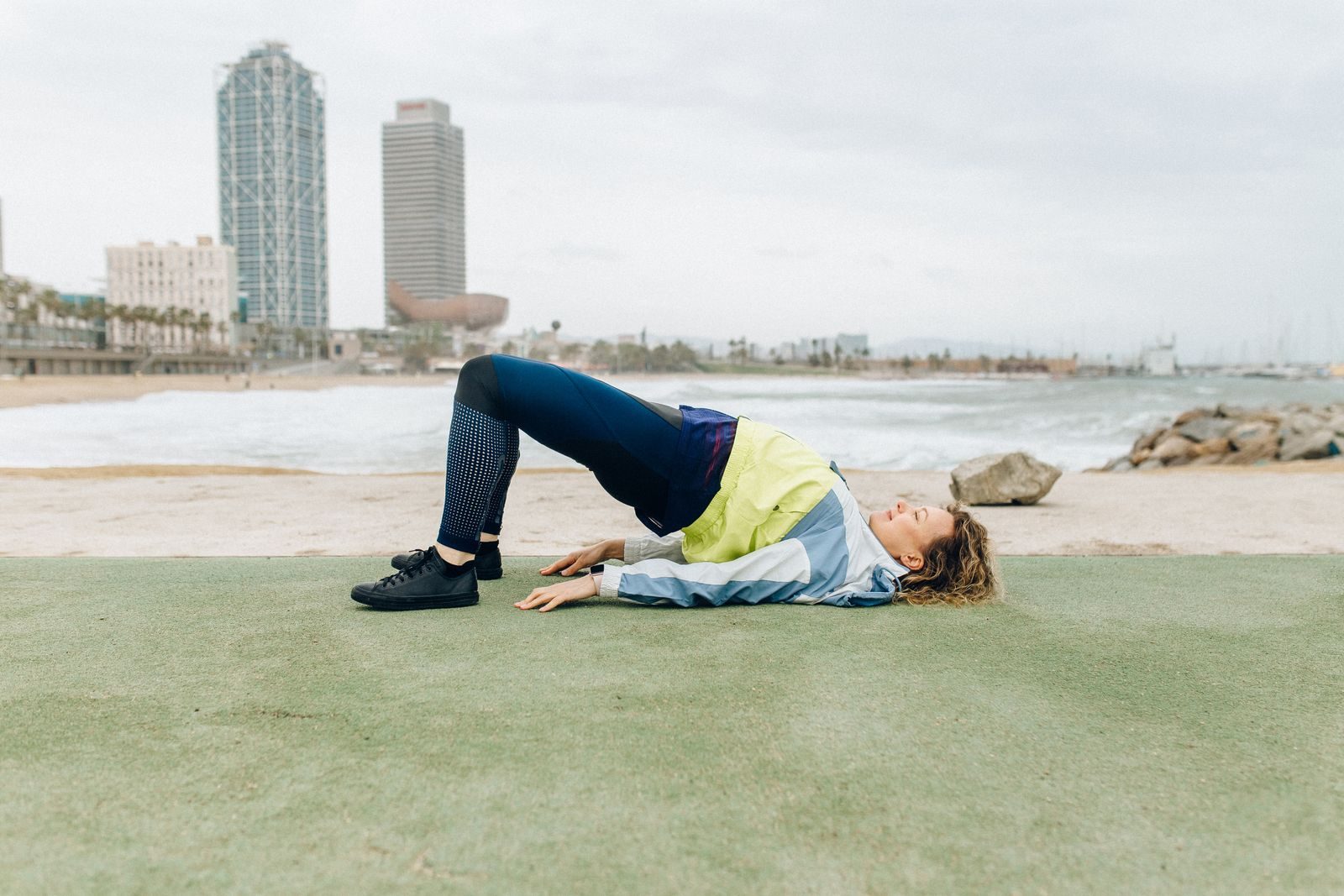
The best glute exercises include hip thrusts, glute bridges, squats, lunges, Romanian deadlifts, and hip-abduction movements. Together, they can help build stronger, more developed glutes while improving hip stability and lower-body control.
You don’t need to perform every exercise in one workout. This guide covers 15 effective options, how to do them correctly, which muscles they target, and how to combine them into a practical training routine.
15 Best Glute Exercises for Strength, Size, and Balance
These 15 exercises include beginner-friendly bodyweight movements, heavier gym exercises for muscle growth, and single-leg movements that challenge balance. Choose exercises based on your experience, available equipment, and training goals.
1. Glute Bridge
The glute bridge is an excellent starting exercise for learning to extend your hips using your glutes without heavy equipment.
Best for: Beginners, home workouts, and basic glute strength.
Muscles worked: Gluteus maximus primarily, with assistance from the hamstrings and core.
Equipment: Exercise mat (optional).
Sets, reps, and rest: 2–3 sets of 10–15 reps. Rest 45–60 seconds.
How to Do It
- Lie on your back with your knees bent and feet flat on the floor, hip-width apart.
- Keep your arms beside your body and gently tighten your abdominal muscles.
- Press through your feet and raise your hips until your shoulders, hips, and knees form a roughly straight line.
- Squeeze your glutes briefly without arching your lower back.
- Slowly lower your hips and repeat.
Common mistakes: Pushing the hips too high, arching the lower back, or lifting primarily through the toes. Keep your ribs controlled and focus on driving through your feet.
Progression: Once regular bridges become easy, try the single-leg glute bridge or add resistance across your hips.
2. Barbell Hip Thrust
The barbell hip thrust allows you to progressively load hip extension, making it a useful exercise for glute strength and muscle growth.
Best for: Building glute size and strength with progressively heavier resistance.
Muscles worked: Primarily the gluteus maximus, with assistance from the hamstrings and hip stabilizers.
Equipment: Barbell, weight plates, bar pad, and stable bench.
Sets, reps, and rest: 2–3 sets of 6–12 reps. Rest 90–180 seconds.
How to Do It
- Sit on the floor with your upper back against a stable bench.
- Position a padded barbell across your hip crease and place your feet flat on the floor, approximately hip-width apart.
- Hold the bar securely, brace your abdomen, and drive through your feet to raise your hips.
- Lift until your torso is roughly parallel to the floor, keeping your ribs aligned over your pelvis.
- Briefly squeeze your glutes, then lower slowly.
Common mistakes: Excessive lower-back arching, driving through the toes, using momentum, or positioning the feet too far forward or backward.
Beginner option: Master a bodyweight glute bridge or bodyweight bench hip thrust before adding a barbell.
3. Goblet Squat
The goblet squat strengthens the glutes and thighs while helping you practice a controlled squat pattern.
Best for: Beginners learning weighted squats and anyone building overall lower-body strength.
Muscles worked: Quadriceps and gluteus maximus, with help from the adductors and core.
Equipment: One dumbbell or kettlebell.
Sets, reps, and rest: 2–3 sets of 8–12 reps. Rest 60–120 seconds.
How to Do It
- Stand with your feet approximately shoulder-width apart, holding a dumbbell or kettlebell close to your chest.
- Brace your core and keep your feet firmly planted.
- Bend your hips and knees together, lowering into a squat.
- Descend as far as you can maintain a controlled position, allowing your knees to follow the direction of your toes.
- Push through your feet to stand upright.
Common mistakes: Raising the heels, letting the knees collapse inward, or rounding the back to reach greater depth.
Beginner option: Start with bodyweight squats or controlled sit-to-stands from a sturdy chair.
4. Dumbbell Romanian Deadlift
The dumbbell Romanian deadlift strengthens the glutes and hamstrings by emphasizing a hip-hinge movement rather than a deep knee bend.
Best for: Developing the posterior chain, including the glutes and hamstrings.
Muscles worked: Hamstrings and gluteus maximus, with the spinal erectors helping stabilize the torso.
Equipment: Two dumbbells.
Sets, reps, and rest: 2–3 sets of 8–12 reps. Rest 90–120 seconds.
How to Do It
- Stand with your feet hip-width apart, holding a dumbbell in each hand.
- Slightly bend your knees and brace your abdomen.
- Push your hips backward while lowering the dumbbells close to your legs.
- Keep your spine neutral and lower until you feel a comfortable stretch in your hamstrings.
- Drive your hips forward to stand tall without leaning backward.
Common mistakes: Turning the movement into a squat, rounding the lower back, or lowering farther than your hip mobility allows.
Beginner option: Practice the hip hinge without weights before adding dumbbells.
5. Bulgarian Split Squat
The Bulgarian split squat trains one leg at a time, challenging glute strength, quadriceps strength, and lower-body control.
Best for: Single-leg strength, glute development, and improving control between sides.
Muscles worked: Gluteus maximus, quadriceps, and hip stabilizers.
Equipment: Stable bench and optional dumbbells.
Sets, reps, and rest: 2–3 sets of 6–10 reps per leg. Rest 90–120 seconds.
How to Do It
- Stand a comfortable distance in front of a stable bench.
- Place the top of one foot on the bench behind you while keeping your front foot firmly planted.
- Brace your core and bend your front knee, lowering your body in a controlled motion.
- Allow a slight forward lean from your hips while maintaining a stable spine.
- Push through your front foot to return upright. Complete your repetitions before switching legs.
Common mistakes: Standing too close to the bench, relying heavily on the rear leg, or allowing the front knee to collapse inward.
Beginner option: Start with a regular split squat, keeping both feet on the floor.
6. Reverse Lunge
Reverse lunges strengthen the glutes and thighs while challenging coordination and single-leg control.
Best for: Functional lower-body strength, coordination, and home workouts.
Muscles worked: Gluteus maximus, quadriceps, and hip stabilizers.
Equipment: None required; dumbbells are optional.
Sets, reps, and rest: 2–3 sets of 8–12 reps per leg. Rest 60–90 seconds.
How to Do It
- Stand upright with your feet hip-width apart.
- Step your right foot backward into a comfortable split stance.
- Bend both knees, lowering your rear knee toward the floor.
- Keep your front foot planted and your torso stable.
- Push through your front foot to return to standing, then repeat on the opposite leg.
Common mistakes: Taking an excessively short step, collapsing the front knee inward, or pushing aggressively off the back foot.
Beginner option: Hold a stable support for balance or reduce the depth of the lunge.
7. Step-Up
Step-ups train the glutes through a movement similar to climbing stairs. They are particularly useful for strengthening one leg at a time.
Best for: Functional glute strength, balance, and controlled single-leg movement.
Muscles worked: Gluteus maximus, quadriceps, and gluteus medius for pelvic stability.
Equipment: Stable exercise step or platform.
Sets, reps, and rest: 2–3 sets of 8–12 reps per leg. Rest 60–90 seconds.
How to Do It
- Stand facing a sturdy, nonslip platform.
- Place your entire right foot on the platform.
- Press through your right foot to lift your body onto the step.
- Bring your left foot up without jumping or relying excessively on the trailing leg.
- Step down slowly and repeat before switching sides.
Common mistakes: Using a platform that is too high, pushing excessively off the trailing foot, or letting the working knee collapse inward.
Beginner option: Use a lower step and hold a stable handrail if needed.
8. Single-Leg Romanian Deadlift
The single-leg Romanian deadlift combines hip-hinge strength with a demanding balance challenge.
Best for: Glute and hamstring strength, balance, and single-leg coordination.
Muscles worked: Gluteus maximus, hamstrings, gluteus medius, and core stabilizers.
Equipment: None required; a dumbbell can add resistance.
Sets, reps, and rest: 2–3 sets of 6–10 reps per leg. Rest 60–90 seconds.
How to Do It
- Stand on your right leg with your knee slightly bent.
- Lift your left foot just off the floor.
- Push your right hip backward while extending your left leg behind you.
- Keep your hips facing the floor and your spine neutral as your torso leans forward.
- Drive through your standing foot to return upright, then repeat.
Common mistakes: Rotating the pelvis, rounding the back, or reaching so far forward that balance and control are lost.
Beginner option: Hold a sturdy support or practice a staggered-stance Romanian deadlift.
9. Single-Leg Glute Bridge
The single-leg glute bridge increases the challenge of a standard bridge by making one leg responsible for most of the hip-extension effort.
Best for: Building unilateral glute strength with minimal equipment.
Muscles worked: Gluteus maximus, hamstrings, and core and hip stabilizers.
Equipment: Exercise mat (optional).
Sets, reps, and rest: 2–3 sets of 8–12 reps per leg. Rest 45–75 seconds.
How to Do It
- Lie on your back with both knees bent and feet flat.
- Lift your left leg off the floor, keeping it bent or extending it comfortably.
- Brace your core and press through your right foot.
- Raise your hips while keeping your pelvis level.
- Lower slowly, complete the set, and switch legs.
Common mistakes: Allowing the hips to twist or drop toward one side, arching the lower back, or rushing the repetitions.
Beginner option: Return to the standard two-leg glute bridge until you can lift your hips with good control.
10. Cable Glute Kickback
Cable glute kickbacks isolate hip extension without requiring heavy spinal loading, making them useful as an accessory exercise.
Best for: Targeted glute training after heavier compound exercises.
Muscles worked: Primarily the gluteus maximus, with assistance from the hamstrings.
Equipment: Cable machine with a low pulley and ankle attachment.
Sets, reps, and rest: 2–3 sets of 10–15 reps per leg. Rest 45–75 seconds.
How to Do It
- Secure an ankle cuff around your right ankle and attach it to a low cable pulley.
- Face the machine and hold its frame for support.
- Slightly bend your supporting knee and keep your torso stable.
- Extend your right leg backward from the hip without arching your back.
- Slowly return your leg to the starting position and repeat before switching sides.
Common mistakes: Swinging the leg, using excessive weight, or extending the lower back instead of moving through the hip.
Beginner option: Practice standing bodyweight hip extensions while holding a sturdy support.
11. Lateral Band Walk
Lateral band walks strengthen the muscles responsible for moving the legs sideways and helping stabilize the pelvis.
Best for: Lateral hip strength and improved control during lower-body movements.
Muscles worked: Gluteus medius and minimus, with assistance from other hip abductors.
Equipment: Mini resistance band.
Sets, reps, and rest: 2–3 sets of 8–12 steps in each direction. Rest 45–60 seconds.
How to Do It
- Place a mini resistance band around your thighs, just above your knees.
- Stand with your feet hip-width apart and bend your knees slightly.
- Brace your abdomen and keep your toes mostly forward.
- Step sideways with your right foot while maintaining light band tension.
- Bring your left foot closer without letting the band become completely slack.
- Continue for several steps, then reverse direction.
Common mistakes: Dragging the trailing foot, rocking the torso, allowing the knees to cave inward, or taking oversized steps.
Progression: Move the band toward your ankles when you can maintain control with the band above your knees.
12. Side-Lying Hip Abduction
Side-lying hip abduction directly trains the muscles along the outside of the hip. It is especially useful when you want targeted work without standing or balancing.
Best for: Beginner-friendly gluteus medius strengthening.
Muscles worked: Gluteus medius and minimus, with assistance from other hip abductors.
Equipment: Exercise mat (optional).
Sets, reps, and rest: 2–3 sets of 12–20 reps per side. Rest 30–60 seconds.
How to Do It
- Lie on your right side, bending your bottom knee slightly for support.
- Keep your left leg straight and positioned in line with your torso.
- Stack your hips and brace your abdomen gently.
- Slowly raise your top leg without rolling your pelvis backward.
- Lower your leg with control and repeat before switching sides.
Common mistakes: Lifting the leg excessively high, pointing the toes upward by rotating the entire hip, or rolling the pelvis backward.
Progression: Add a brief pause at the top or use light ankle resistance.
13. Clamshell
Clamshells train hip external rotation and help strengthen the gluteus medius and other hip rotators.
Best for: Beginner hip-strengthening work and developing controlled outward hip rotation.
Muscles worked: Gluteus medius and other hip external rotators.
Equipment: Exercise mat; mini resistance band optional.
Sets, reps, and rest: 2–3 sets of 12–20 reps per side. Rest 30–60 seconds.
How to Do It
- Lie on your right side with both knees bent and legs stacked.
- Keep your feet together and your pelvis stable.
- Slowly raise your top knee while maintaining contact between your feet.
- Open only as far as you can without rolling your hips backward.
- Lower your knee slowly and repeat before changing sides.
Common mistakes: Rolling the entire pelvis backward, separating the feet, or using quick, uncontrolled movements.
Progression: Place a light mini resistance band just above your knees.
14. Seated Hip Abduction Machine
The seated hip abduction machine provides adjustable resistance for the muscles along the outer hips.
Best for: Progressively strengthening the hip abductors in a supported position.
Muscles worked: Gluteus medius, gluteus minimus, and other hip-abducting muscles.
Equipment: Seated hip abduction machine.
Sets, reps, and rest: 2–3 sets of 12–20 reps. Rest 45–75 seconds.
How to Do It
- Sit on the machine and adjust the pads and starting position for comfort.
- Place the outer sides of your legs against the pads.
- Hold the handles and keep your torso stable.
- Press your legs outward in a smooth, controlled motion.
- Pause briefly, then slowly return toward the starting position.
Common mistakes: Using excessive weight, bouncing at the end of the movement, or rocking the torso to move the pads.
Beginner option: Use a light mini band for seated hip abductions or practice side-lying hip abduction.
15. Glute-Biased 45-Degree Back Extension
The glute-biased 45-degree back extension trains the glutes and hamstrings through hip extension. Proper positioning is essential to avoid turning it into excessive lower-back movement.
Best for: Glute and posterior-chain strength as part of a gym workout.
Muscles worked: Gluteus maximus and hamstrings, with the spinal erectors supporting torso stability.
Equipment: 45-degree back extension bench.
Sets, reps, and rest: 2–3 sets of 8–12 reps. Rest 60–120 seconds.
How to Do It
- Adjust the bench so the top of the pad sits below your hip crease and does not restrict hip movement.
- Secure your feet and keep a controlled, neutral spinal position.
- Hinge forward from your hips, allowing your torso to lower through a comfortable range.
- Contract your glutes to raise your torso until it aligns approximately with your legs.
- Avoid leaning backward beyond that position, then lower slowly.
Common mistakes: Extending through the lower back instead of the hips, lifting too high, or adding weight before learning the movement.
Beginner option: Begin with bodyweight only or practice Romanian deadlifts with light dumbbells.
What Muscles Do Glute Exercises Work?
Your glutes contain three major muscles that work together to extend, rotate, and stabilize your hips.
According to Cleveland Clinic’s explanation of gluteal muscle anatomy, these muscles also contribute to everyday movements such as standing, walking, and climbing stairs.
| Glute muscle | Main function | Useful exercises |
|---|---|---|
| Gluteus maximus | Hip extension and producing lower-body force | Hip thrusts, bridges, squats, Romanian deadlifts |
| Gluteus medius | Hip abduction and pelvic stability | Lateral band walks, side-lying hip abduction, step-ups |
| Gluteus minimus | Hip abduction, rotation, and joint stabilization | Side-lying hip abduction, band walks, single-leg movements |
These muscles do not work entirely independently. For example, a Bulgarian split squat strongly challenges the gluteus maximus while the smaller hip muscles help stabilize your pelvis.
For more targeted lateral hip training, the American Council on Exercise’s gluteus medius exercise guidance describes side-lying hip abduction, clamshells, and band movements as useful options.
How to Choose Glute Exercises for Your Goals
Different exercises provide different training challenges. The right combination depends on whether you care most about muscle size, strength, or balance.
For Glute Muscle Growth
Choose exercises that allow you to challenge the glutes consistently and increase resistance or repetitions over time.
A practical combination includes:
- Barbell hip thrust: For progressively loaded hip extension.
- Dumbbell Romanian deadlift: For glute and hamstring loading through a hip hinge.
- Bulgarian split squat: For challenging one leg at a time.
- Seated hip abduction: For additional lateral hip training.
Hip thrusts are useful, but they are not the only effective glute-building exercise. A 2023 study comparing hip thrusts and back squats found similar gluteal muscle growth between the groups over nine weeks of training in previously untrained adults.
The practical lesson is to choose exercises you can perform well, progressively overload, and recover from.
For Glute Strength
Prioritize exercises that allow controlled increases in resistance, including goblet squats, hip thrusts, Romanian deadlifts, and split squats.
Perform the more demanding exercises earlier in your workout, when you are less fatigued. Use a challenging weight while maintaining proper technique.
For Balance and Hip Stability
Choose controlled single-leg and lateral hip exercises, such as step-ups, single-leg Romanian deadlifts, lateral band walks, and side-lying hip abduction.
These movements challenge the glutes to help control the pelvis and lower limbs. However, building glute strength alone does not replace practicing balance itself.
If balancing is difficult, use a stable support and increase the challenge gradually.
Sample Glute Workout Routines
You do not need to perform all 15 exercises to strengthen your glutes. Three or four well-chosen movements can provide an effective session.
Before training, complete 5–10 minutes of easy movement, such as walking or stationary cycling, followed by a few controlled practice repetitions of your main exercises.
Beginner Glute Workout at Home
Perform this routine twice per week, allowing at least one day between sessions.
| Exercise | Sets | Reps | Rest |
|---|---|---|---|
| Glute Bridge | 2 | 10–15 | 60 sec |
| Reverse Lunge | 2 | 6–8 per leg | 90 sec |
| Step-Up | 2 | 8 per leg | 90 sec |
| Side-Lying Hip Abduction | 2 | 12–15 per side | 60 sec |
Effort: Finish each set feeling that you could perform approximately 2–3 more good repetitions.
Progression: Add repetitions first. When the upper end of the range feels controlled, add a small amount of resistance or progress to a harder variation.
If you don’t have a stable exercise step, replace step-ups with bodyweight squats.
Gym Glute Workout for Strength and Size
This routine combines hip extension, hip hinging, unilateral strength, and lateral hip training.
| Exercise | Sets | Reps | Rest |
|---|---|---|---|
| Barbell Hip Thrust | 2–3 | 6–10 | 120 sec |
| Dumbbell Romanian Deadlift | 2 | 8–12 | 120 sec |
| Bulgarian Split Squat | 2 | 8–10 per leg | 90–120 sec |
| Seated Hip Abduction | 2 | 12–20 | 60 sec |
Frequency: Start with two sessions per week, separated by at least one recovery day.
Effort: Choose weights that leave approximately 1–3 controlled repetitions in reserve. If you’re new to the movements, stay farther from muscular failure.
Progression: When you can complete every set at the top of its repetition range with good technique, increase the resistance slightly.
If you are also performing demanding lower-body exercises on other days, account for that work before adding more glute volume.
How Often Should You Train Your Glutes?
For most beginners, two glute-focused sessions per week is a practical starting point. More experienced lifters may train their glutes two or three times weekly, depending on recovery and total workout volume.
The American College of Sports Medicine’s 2026 resistance-training guidance emphasizes progressive resistance training and matching training volume to individual goals.
For muscle growth, approximately 10 or more challenging weekly sets per muscle group can be a useful target, although beginners can make progress with less. Exercises that train several muscles simultaneously also contribute to your overall training workload.
Focus on these principles:
- Start with a manageable number of challenging sets.
- Train consistently instead of constantly changing exercises.
- Increase repetitions or resistance gradually.
- Allow sufficient recovery between demanding sessions.
- Reduce volume when fatigue starts affecting movement quality or performance.
Muscle growth depends on consistent training over time, not on completing as many exercises as possible in one session.
Common Glute Training Mistakes to Avoid
1. Using Momentum Instead of Muscle Control
Swinging your legs during kickbacks or bouncing through hip thrusts makes it harder to maintain consistent muscular tension.
Use a controlled lowering phase and avoid weights that force you to rush the exercise.
2. Overarching Your Lower Back
This commonly happens during glute bridges, hip thrusts, and back extensions.
Finish hip-extension movements by contracting your glutes rather than trying to lift higher through your lower spine.
3. Choosing Only One Type of Exercise
Hip thrusts are useful, but relying entirely on them leaves out other movement patterns.
Combining a thrust or bridge, squat or lunge, hinge, and hip-abduction movement provides a broader training stimulus.
4. Adding Resistance Too Quickly
Heavier weights are useful only when you can control them.
Increase resistance once you can complete the prescribed repetitions without losing balance, shortening your movement excessively, or changing your technique.
5. Ignoring Recovery
Challenging glute training requires recovery, particularly when combining hip hinges, squats, lunges, and other lower-body exercises.
Avoid adding extra sets simply because you are not sore. Soreness is not a reliable measure of workout effectiveness.
Safety reminder: Stop exercising if you experience sharp pain, numbness, dizziness, chest pain, or unusual symptoms. Seek appropriate professional medical advice rather than trying to push through them.
Frequently Asked Questions
1. What Are the Best Glute Exercises for Building Size?
Barbell hip thrusts, Romanian deadlifts, squats, and Bulgarian split squats are useful choices because they can be progressively loaded. Adding hip-abduction work can help train the lateral glute muscles.
The most effective combination is one you can perform consistently with sufficient effort, progression, and recovery.
2. Can You Build Glutes at Home Without Weights?
Yes. Beginners can improve glute strength and may build muscle using glute bridges, reverse lunges, step-ups, and single-leg movements.
As you become stronger, resistance bands, dumbbells, or more demanding exercise variations can help maintain the training challenge.
3. How Many Glute Exercises Should You Do Per Workout?
For most people, three to five exercises are enough. Choose complementary movements rather than repeating several nearly identical exercises.
A balanced workout might include a hip thrust, Romanian deadlift, split squat, and hip-abduction exercise.
4. Do Squats Really Work Your Glutes?
Yes. Squats train the gluteus maximus along with the quadriceps and other lower-body muscles.
However, squats are not the only effective exercise for glute development. Adding hip-hinge or hip-thrust movements can provide a more varied program.
5. Are Glute Exercises Good for Balance?
Glute strengthening can support pelvic stability and lower-body control. Step-ups, single-leg Romanian deadlifts, and split squats also provide opportunities to practice maintaining balance during movement.
Use a sturdy support when needed, especially when learning single-leg exercises.
6. How Long Does It Take to Build Stronger Glutes?
You may notice improvements in exercise control and strength within the first several weeks of consistent training. Visible muscle growth generally requires more time and varies with training experience, effort, nutrition, recovery, and individual differences.
Track progress through improved technique, more repetitions, or gradually increasing resistance rather than expecting immediate visible changes.
The Bottom Line
The best glute exercises strengthen your hips through several movement patterns instead of relying on one favorite exercise.
For muscle growth, prioritize progressively loaded movements such as hip thrusts, Romanian deadlifts, and split squats. For beginners, start with bridges and controlled bodyweight exercises. For balance and hip stability, add step-ups, single-leg movements, and hip-abduction work.
Choose three or four exercises that match your goals, train consistently, and increase the challenge as your strength improves.
References
- American College of Sports Medicine — Updated Resistance Training Guidelines (2026)
- National Strength and Conditioning Association — Program Design for Glute Strength and Hypertrophy
- Cleveland Clinic — Gluteal Muscles: Anatomy and Function
- American Council on Exercise — Glute Bridge Exercise
- American Council on Exercise — Gluteus Medius Exercises for Strength and Stability
- National Academy of Sports Medicine — Dumbbell Romanian Deadlift
- PubMed — Hip Thrust and Back Squat Training: Glute Muscle Hypertrophy Study (2023)
This content is for informational purposes only and is not a substitute for medical advice.
1 thought on “15 Best Glute Exercises for Strength, Size, and Balance”