
The best glute max exercises include hip thrusts, Romanian deadlifts, step-ups, split squats, and other movements that challenge hip extension. These exercises can strengthen your glutes, build lower-body muscle, and help you develop greater hip power.
Whether you’re training at home or in a gym, the key is choosing exercises that match your ability and progressing gradually.
Below are nine effective exercises, with instructions, common mistakes, and workout routines to help you get started.
What Is the Gluteus Maximus?
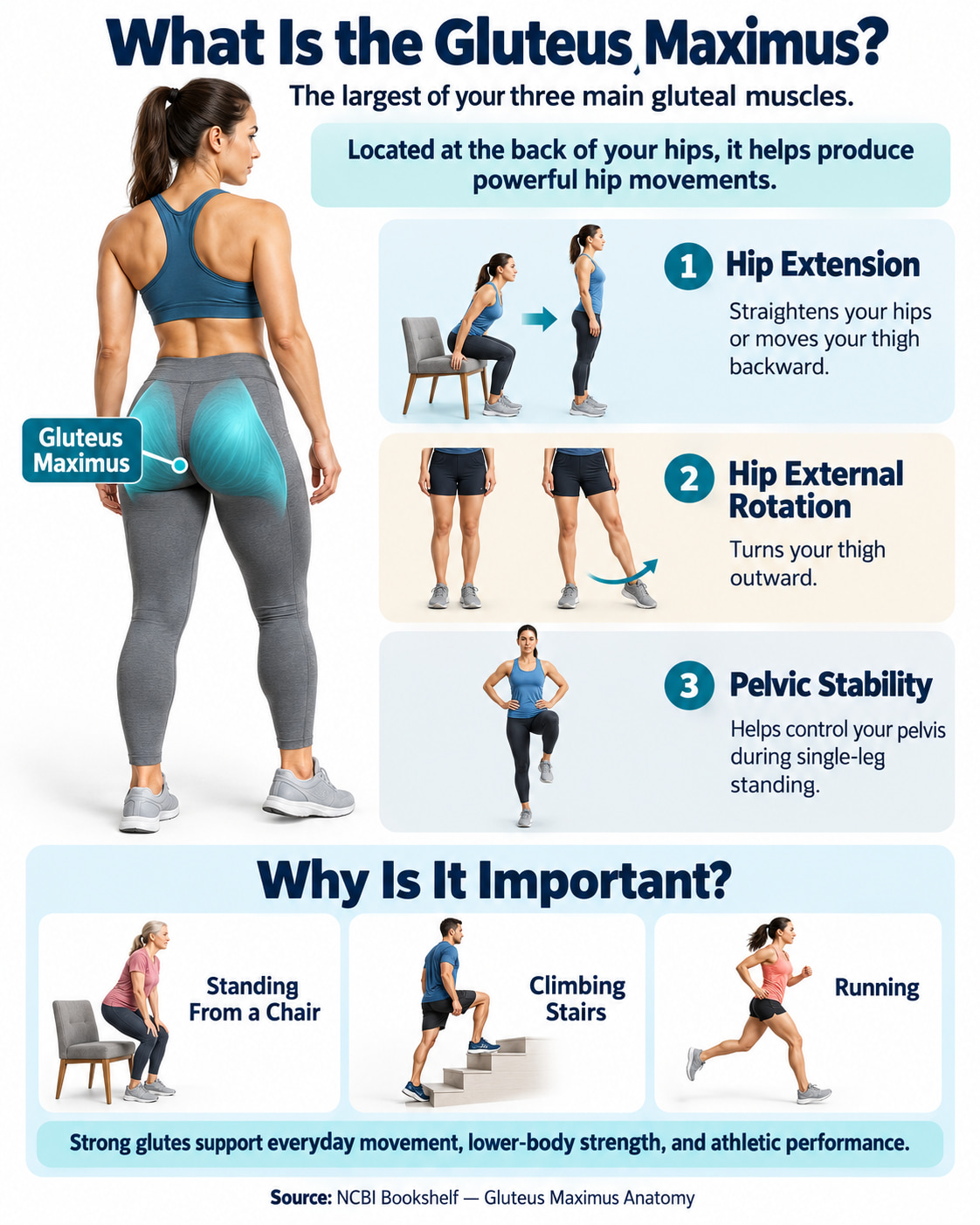
The gluteus maximus is the largest of your three main gluteal muscles. It covers much of the back of your hips and plays an important role in lower-body movement.
Its main functions include:
- Hip extension: Moving your thigh backward or straightening your hips from a bent position.
- Hip external rotation: Turning your thigh outward.
- Pelvic stability: Helping control your pelvis and trunk during activities such as walking and standing on one leg.
According to the NCBI Bookshelf anatomy guide, the gluteus maximus contributes to movements such as rising from a chair, climbing stairs, and running.
Strengthening this muscle can support everyday movement, lower-body strength, and athletic performance.
9 Best Glute Max Exercises
These nine exercises cover hip-extension strength, single-leg control, compound lower-body training, and explosive hip power.
You don’t need to perform all nine in one workout. Choose two to four movements that match your goals, equipment, and experience.
1. Barbell Hip Thrust
Best for: Building gluteus maximus strength and muscle through progressively heavier hip-extension training.
Muscles worked: Gluteus maximus primarily; hamstrings, quadriceps, and core muscles assist or stabilize.
Equipment needed: Barbell, bar pad, and stable workout bench.
Sets, reps, and rest: 3 sets of 6–10 repetitions. Rest 90–150 seconds.
How to Do It
- Sit on the floor with your upper back resting against a stable workout bench.
- Position a padded barbell across your hip crease. Bend your knees and place your feet approximately hip-width apart.
- Brace your abdomen and press through your feet to lift your hips.
- Raise your hips until your torso and thighs form a straight line, squeezing your glutes without excessively arching your lower back.
- Pause briefly at the top, then lower your hips under control.
Common mistakes: Lifting too high by arching the lower back, placing the feet too far forward, or allowing the barbell to shift during repetitions. At the top, your shins should be approximately vertical.
Progression or regression: Start with a bodyweight glute bridge if you’re unfamiliar with hip thrusts. Progress by gradually adding barbell weight while maintaining controlled hip extension.
2. Dumbbell Romanian Deadlift
Best for: Strengthening the glutes and hamstrings through a loaded hip-hinge movement.
Muscles worked: Hamstrings and gluteus maximus; adductors, spinal erectors, and core muscles assist.
Equipment needed: Two dumbbells.
Sets, reps, and rest: 2–3 sets of 8–12 repetitions. Rest 90–120 seconds.
How to Do It
- Stand with your feet approximately hip-width apart, holding one dumbbell in each hand.
- Keep your knees slightly bent, abdomen braced, and spine naturally aligned.
- Push your hips backward while lowering the dumbbells close to your legs.
- Continue lowering until you feel a comfortable hamstring stretch without rounding your back.
- Extend your hips to return to standing, finishing upright without leaning backward.
Common mistakes: Rounding the back, bending the knees excessively, or allowing the dumbbells to move far away from the legs.
The ACE Romanian deadlift technique guide emphasizes keeping the load close to the body and moving primarily through the hips.
Progression or regression: Practice unloaded hip hinges before adding dumbbells. Increase the weight only when you can maintain a neutral spine throughout the movement.
3. Dumbbell Step-Up
Best for: Developing single-leg glute strength, coordination, and functional hip extension.
Muscles worked: Gluteus maximus and quadriceps; gluteus medius, calves, and core muscles help stabilize.
Equipment needed: Two dumbbells and a stable exercise step or low box.
Sets, reps, and rest: 2 sets of 8–10 repetitions per leg. Rest 60–90 seconds.
How to Do It
- Stand facing a sturdy exercise box while holding a dumbbell in each hand.
- Place your entire right foot on the elevated surface.
- Press through your right foot to lift yourself onto the platform, bringing your left foot up beside it.
- Lower your left foot to the floor first, followed by your right foot, moving slowly and maintaining balance.
- Repeat with your left leg leading, alternating sides.
Common mistakes: Pushing excessively through the trailing foot, stepping onto an unstable surface, or using a box too high to control.
Progression or regression: Beginners can use a lower step without dumbbells. Progress by increasing resistance gradually rather than immediately choosing a taller platform.
Why it works: Step-ups challenge the gluteus maximus while requiring the hips and pelvis to remain stable.
A 2020 systematic review of gluteus maximus activation found particularly high muscle activation during several step-up variations. However, higher activation does not automatically guarantee greater long-term muscle growth.
4. Dumbbell Bulgarian Split Squat
Best for: Building unilateral glute strength, lower-body control, and muscular development.
Muscles worked: Gluteus maximus and quadriceps; adductors, hamstrings, and hip stabilizers assist.
Equipment needed: Two dumbbells and a stable bench.
Sets, reps, and rest: 2–3 sets of 6–10 repetitions per leg. Rest 90–120 seconds.
How to Do It
- Stand approximately one comfortable stride in front of a stable bench, holding dumbbells beside your body.
- Place the top of your back foot on the bench while keeping your front foot planted.
- Brace your abdomen and bend your front knee to lower your hips.
- Allow a slight forward torso lean while maintaining a neutral spine and keeping your front knee aligned with your foot.
- Press through your front foot to return to standing. Complete your repetitions before changing legs.
Common mistakes: Standing too close to the bench, losing balance, or using excessive weight before mastering the movement.
Progression or regression: Begin with a regular split squat, keeping both feet on the floor. Progress to the rear-foot-elevated version, then add dumbbells.
5. Dumbbell Goblet Squat
Best for: Developing glute and quadriceps strength while learning controlled squat mechanics.
Muscles worked: Quadriceps and gluteus maximus; adductors and core muscles assist.
Equipment needed: One dumbbell.
Sets, reps, and rest: 2–3 sets of 8–12 repetitions. Rest 90–120 seconds.
How to Do It
- Hold a dumbbell vertically in front of your chest, gripping it securely with both hands.
- Stand with your feet approximately shoulder-width apart and toes pointing slightly outward.
- Brace your abdomen and bend your hips and knees to lower into a squat.
- Keep your heels planted, knees tracking in line with your toes, and chest comfortably lifted.
- Lower to a controlled depth, then push through your feet to stand.
Common mistakes: Allowing the heels to lift, forcing a deeper squat by rounding the lower back, or letting the knees collapse inward.
Progression or regression: Start with bodyweight squats or squats to a sturdy chair. Add a dumbbell once you can control the movement comfortably.
6. Bodyweight Reverse Lunge
Best for: Building beginner-friendly glute strength, balance, and lower-body coordination.
Muscles worked: Gluteus maximus and quadriceps; hamstrings, adductors, and hip stabilizers assist.
Equipment needed: None.
Sets, reps, and rest: 2 sets of 8–12 repetitions per leg. Rest 60–90 seconds.
How to Do It
- Stand upright with your feet approximately hip-width apart.
- Step your right foot backward into a comfortable lunge stance.
- Bend both knees to lower your body while keeping your torso controlled.
- Lower until your back knee approaches the floor or you reach a comfortable depth.
- Push through your front foot to return to standing, then repeat on the opposite side.
Common mistakes: Taking excessively narrow steps, dropping too quickly, or relying mainly on the rear foot to return to standing.
Progression or regression: Hold a sturdy support if balancing is difficult. Once comfortable, progress to dumbbell reverse lunges.
7. Floor Glute Bridge
Best for: Beginners learning to strengthen their glutes through controlled hip extension.
Muscles worked: Gluteus maximus primarily; hamstrings and trunk muscles assist.
Equipment needed: Exercise mat, optional.
Sets, reps, and rest: 2–3 sets of 10–15 repetitions. Rest 45–75 seconds.
How to Do It
- Lie on your back with your knees bent and feet flat on the floor.
- Position your feet approximately hip-width apart and rest your arms beside your body.
- Gently brace your abdomen and press through your feet.
- Squeeze your glutes to lift your hips until your shoulders, hips, and knees form a straight line.
- Hold briefly, then lower your hips slowly to the floor.
Common mistakes: Lifting the hips by excessively arching the lower back, pushing primarily through the toes, or allowing the knees to collapse inward.
Progression or regression: Beginners can use a shorter range of motion. Progress with longer pauses, additional resistance, or single-leg glute bridges.
8. Standing Cable Glute Kickback
Best for: Adding focused gluteus maximus training after compound lower-body exercises.
Muscles worked: Gluteus maximus; hamstrings and core muscles assist with movement and stability.
Equipment needed: Cable machine with a low pulley and ankle cuff.
Sets, reps, and rest: 2 sets of 10–15 repetitions per leg. Rest 45–75 seconds.
How to Do It
- Attach an ankle cuff to a low cable pulley and secure it around one ankle.
- Face the machine and hold its frame for balance.
- Hinge forward slightly from your hips, keeping your spine neutral and abdomen braced.
- Extend your working leg backward through your hip without twisting your pelvis or arching your back.
- Pause briefly, then return your leg slowly to the starting position. Complete your repetitions before switching sides.
Common mistakes: Swinging the leg, rotating the hips, or increasing the weight until the lower back compensates.
Progression or regression: Start with unweighted standing hip extensions while holding a sturdy support. Progress by adding light cable resistance.
9. Two-Handed Kettlebell Swing
Best for: Developing explosive hip-extension power and posterior-chain strength.
Muscles worked: Gluteus maximus, hamstrings, and adductor magnus; core, upper-back, and grip muscles stabilize.
Equipment needed: One kettlebell.
Sets, reps, and rest: 2–3 sets of 5–8 controlled, explosive repetitions. Rest 90–150 seconds.
How to Do It
- Stand with your feet approximately shoulder-width apart and place a kettlebell slightly in front of you.
- Push your hips backward, keeping your spine neutral, and grip the kettlebell with both hands.
- Hike the kettlebell backward between your upper thighs.
- Drive your hips forward explosively, allowing the kettlebell to swing naturally to approximately chest height.
- Let the kettlebell descend, hinge backward as it passes between your legs, and repeat. After the final repetition, return it safely to the floor.
Common mistakes: Turning the swing into a squat, lifting the kettlebell with the shoulders, or leaning backward excessively at the top.
The ACE two-handed kettlebell swing guide emphasizes generating movement through the hips while maintaining a stable trunk.
Progression or regression: Learn the bodyweight hip hinge and kettlebell deadlift before attempting swings. Perform swings near the beginning of your workout, before fatigue affects your technique.
How to Build a Glute Max Workout
You don’t need a complicated routine to strengthen your gluteus maximus.
Start with 5–10 minutes of easy movement, such as brisk walking or cycling, followed by a few bodyweight squats, hip hinges, or glute bridges.
Then choose a workout that matches your experience.
Beginner Glute Max Workout
This routine develops basic hip-extension strength, lower-body control, and balance.
Perform it twice per week on nonconsecutive days.
| Exercise | Sets | Reps | Rest |
|---|---|---|---|
| Goblet squat | 2 | 8–10 | 90 sec |
| Floor glute bridge | 2 | 10–15 | 60 sec |
| Bodyweight reverse lunge or low step-up | 2 | 6–8 per leg | 60–90 sec |
Effort level: Choose a resistance or variation that leaves approximately 2–3 good repetitions available at the end of each set.
If you’re completely new to strength training, start with one set per exercise and gradually build up.
Progression: When you can perform every repetition with good form, increase repetitions or resistance slightly.
Intermediate Gym Glute Workout
Alternate Workout A and Workout B, leaving at least one rest day between sessions.
Workout A — Glute Strength
| Exercise | Sets | Reps | Rest |
|---|---|---|---|
| Barbell hip thrust | 3 | 6–10 | 2 min |
| Dumbbell Romanian deadlift | 2 | 8–10 | 90–120 sec |
| Standing cable glute kickback | 2 | 12–15 per leg | 60 sec |
Training focus: Controlled hip extension, progressively heavier resistance, and consistent technique.
Workout B — Hip Power and Single-Leg Strength
| Exercise | Sets | Reps | Rest |
|---|---|---|---|
| Two-handed kettlebell swing | 2 | 5–8 | 2 min |
| Dumbbell step-up | 2 | 8 per leg | 90 sec |
| Dumbbell Bulgarian split squat | 2 | 8 per leg | 90–120 sec |
Training focus: Explosive hip extension followed by controlled single-leg strength exercises.
Stop kettlebell swing sets before fatigue noticeably reduces your movement speed or technique.
How to Progress Your Glute Training
Use these practical progression rules:
- Prioritize technique. Learn each exercise with a manageable resistance.
- Increase repetitions first. Work toward the upper end of the recommended rep range.
- Add resistance gradually. Increase weight when every repetition remains controlled.
- Track your progress. Record exercises, sets, repetitions, and resistance.
- Allow recovery. Adjust training volume if fatigue or soreness affects your form.
The American College of Sports Medicine’s 2026 resistance-training guidance recommends progressive resistance training at least twice weekly. It also identifies higher weekly training volume, around 10 challenging sets per muscle group, as useful for supporting hypertrophy.
Beginners do not need to start with that much volume. Begin with a manageable workload and increase it as your strength and recovery improve.
Glute Strength vs. Hip Power: What’s the Difference?
Strength and power are related, but they are not identical training goals.
Glute strength refers to how much force your glute muscles can produce.
Hip power refers to how quickly you can produce force through your hips.
| Training Goal | Recommended Approach |
|---|---|
| Glute strength | Progressively heavier hip thrusts, squats, and Romanian deadlifts |
| Glute muscle growth | Consistent resistance training with adequate weekly volume |
| Hip power | Fast, controlled hip extension with suitable resistance |
| Single-leg strength | Step-ups, Bulgarian split squats, and reverse lunges |
For strength, progressively challenge the muscles with heavier resistance while maintaining proper technique.
For power, focus on producing force quickly. Kettlebell swings can be useful once you have mastered the hip hinge.
Keep explosive sets short and prioritize movement quality over fatigue.
A 2025 systematic review of gluteus maximus hypertrophy found that both single-joint and compound resistance exercises can stimulate glute growth. Combining suitable exercises can provide an effective approach to developing this muscle.
Common Glute Max Training Mistakes to Avoid
Even effective exercises can become less productive when technique or programming is poorly managed.
- Doing too many exercises: Two to four well-chosen glute movements are usually enough for one workout. More exercises are not automatically better.
- Using excessive weight: Heavy resistance is useful only when you can maintain control of your hips, spine, and knees.
- Arching the lower back: During bridges, hip thrusts, and kickbacks, focus on extending the hips rather than leaning backward.
- Rushing repetitions: Use controlled movement during strength exercises. Save explosive speed for movements specifically intended to develop power.
- Ignoring progressive overload: Repeating the same easy exercises indefinitely can limit further strength development.
- Neglecting recovery: Allow sufficient recovery between demanding lower-body workouts, especially when training close to your current strength limits.
Safety: Stop exercising and seek appropriate professional help if you experience sharp pain, numbness, dizziness, chest pain, or other unusual symptoms. Seek urgent medical attention for chest pain or other potentially serious symptoms.
Frequently Asked Questions
1. What Is the Best Exercise for the Gluteus Maximus?
There is no single exercise that is best for everyone.
Barbell hip thrusts are useful for focused glute loading, while Romanian deadlifts strengthen the glutes alongside the hamstrings. Step-ups and split squats develop unilateral hip strength and stability.
Choose exercises you can perform safely and progressively challenge.
2. Are Squats or Hip Thrusts Better for Glute Growth?
Both can build the gluteus maximus.
A 2023 study comparing barbell back squats and hip thrusts found similar gluteus maximus growth after nine weeks of training in previously untrained adults.
However, squats produced greater quadriceps and adductor development.
Hip thrusts may be preferable when you want more glute-focused training, while squats are useful for overall lower-body development.
3. Can You Strengthen Your Glute Max Without Weights?
Yes. Bodyweight glute bridges, reverse lunges, and step-ups can help beginners strengthen their glutes.
As your strength improves, increase the challenge through additional resistance, more demanding variations, or greater controlled ranges of motion.
4. How Often Should You Train Your Gluteus Maximus?
Training twice weekly is a practical starting point for most healthy adults.
Space demanding workouts apart and adjust your weekly volume according to your experience, recovery, and other lower-body training.
5. How Many Glute Max Exercises Should You Do per Workout?
For most people, two to four exercises are sufficient.
A practical combination includes one main compound exercise, one hip-hinge or unilateral movement, and an optional accessory exercise.
Focus on performing challenging sets with good technique rather than completing every available exercise.
6. What Is the Difference Between the Glute Max and Glute Medius?
The gluteus maximus is the primary muscle responsible for powerful hip extension.
The gluteus medius helps move the thigh outward and stabilizes the pelvis, particularly during single-leg activities.
Exercises such as step-ups and split squats challenge both muscles, although their functions differ.
The Bottom Line
The best glute max exercises combine controlled hip extension, progressively challenging resistance, and consistent training.
Start with floor glute bridges, goblet squats, and reverse lunges if you’re a beginner. As your strength improves, add hip thrusts, Romanian deadlifts, and single-leg exercises.
If developing hip power is your goal, introduce kettlebell swings once you have mastered the hip hinge.
Choose three suitable exercises, practice proper form, and progress gradually. Consistency matters more than performing every exercise in one session.
References
- NCBI Bookshelf — Gluteus Maximus Anatomy
- Frontiers in Physiology (2025) — Gluteus Maximus Hypertrophy: Systematic Review
- Journal of Sports Science & Medicine (2020) — Glute Max Activation Review
- Frontiers in Physiology (2023) — Hip Thrust vs. Back Squat
- American College of Sports Medicine (2026) — Updated Resistance Training Guidelines
- ACE Fitness (2025) — Romanian Deadlift Technique
- ACE Fitness (2025) — Two-Handed Kettlebell Swing Technique
This content is for informational purposes only and is not a substitute for medical advice.