
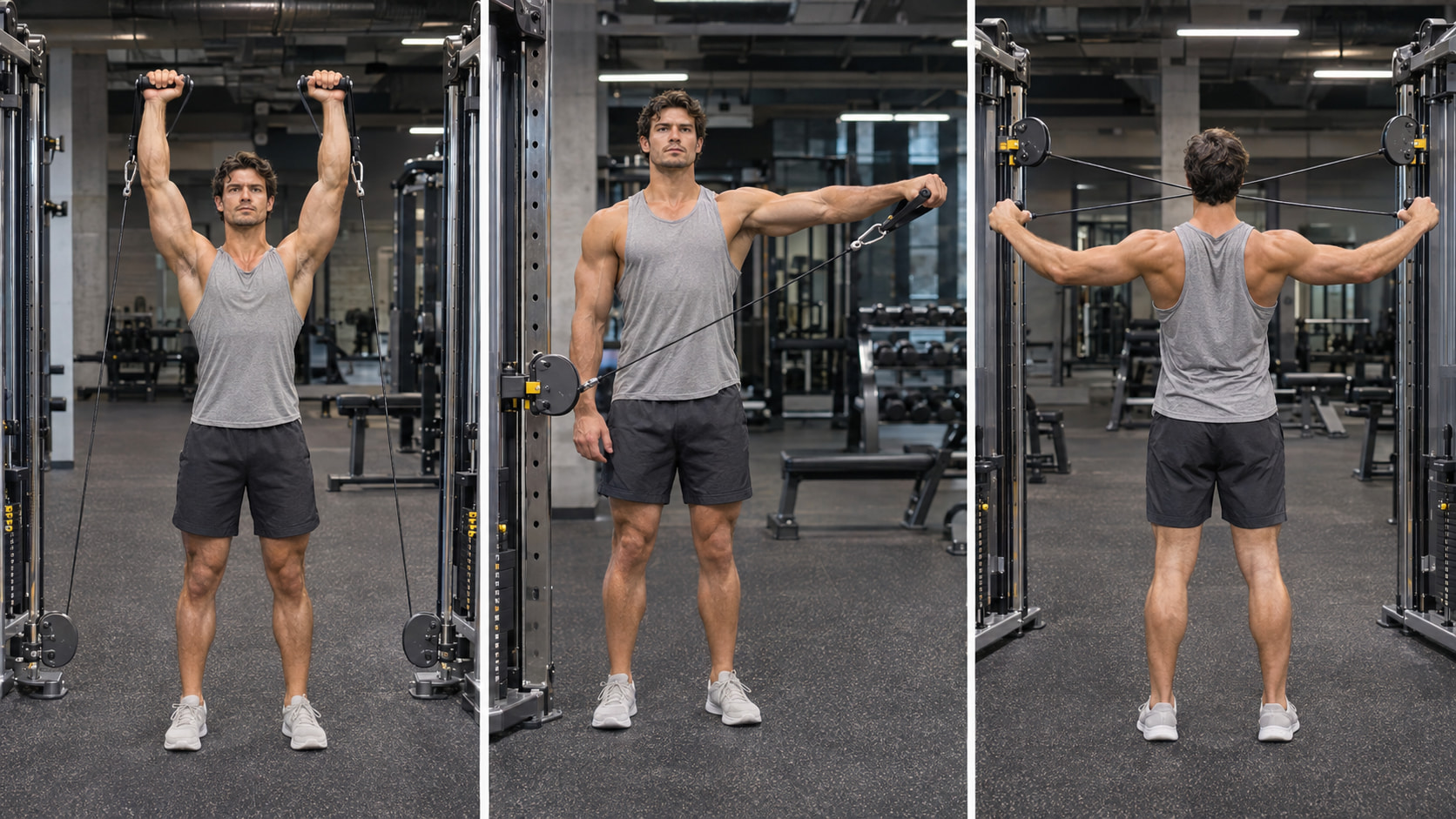
Cable shoulder exercises can train your front, side, and rear delts, along with the muscles that rotate and support your shoulders. For a simple starting workout, choose a press, a lateral raise, and one rear-delt exercise—not all ten movements in one session.
The exercises below explain where to place the pulley, which attachment to use, how to position your body, and how to combine suitable options into a manageable workout.
Before You Start: Choose Your Exercises and Set Up the Cable Machine
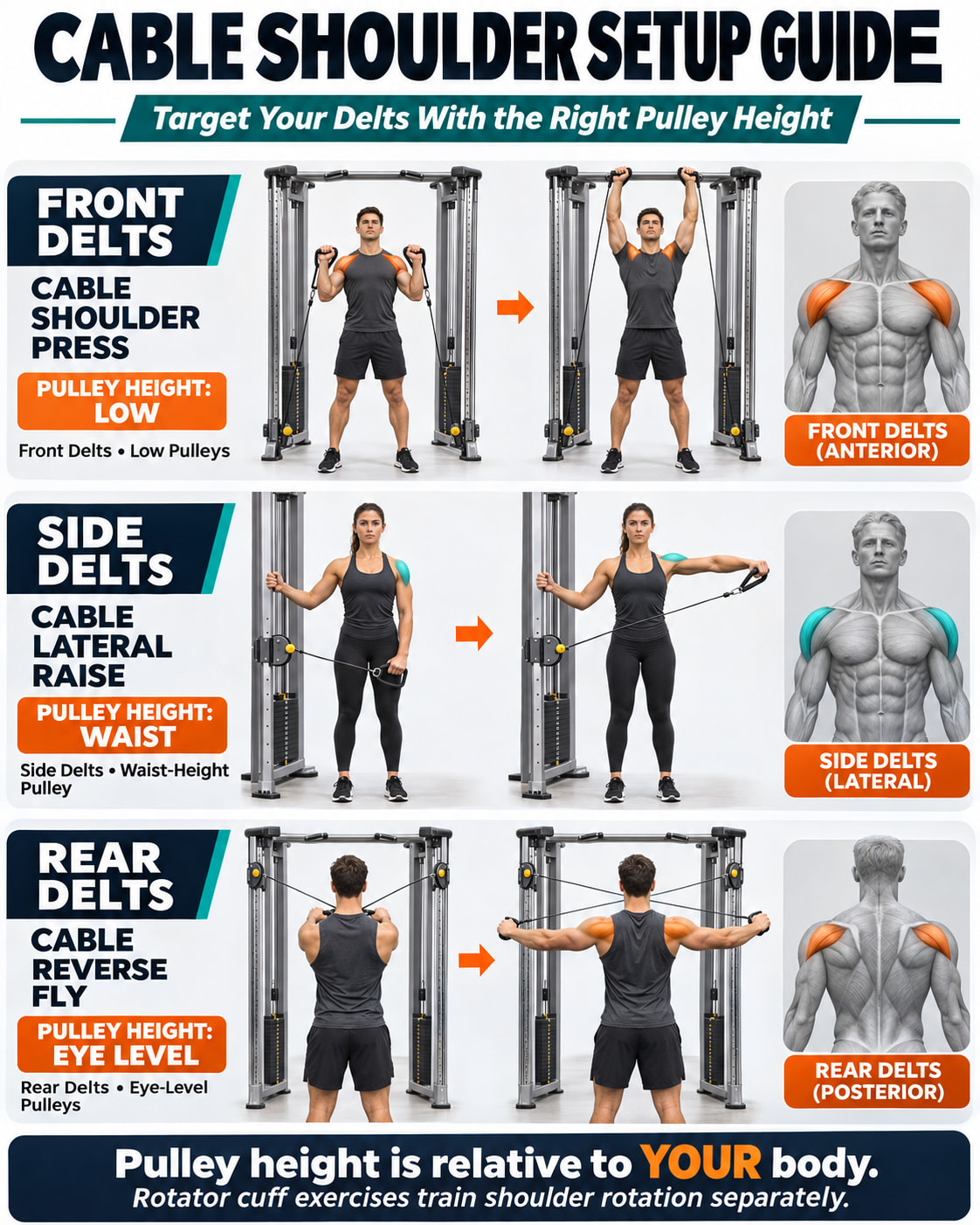
Know which part of the shoulder you are training
Your deltoid has three main portions: the front, side, and rear. Presses and front raises emphasize the front of the shoulder; lateral raises emphasize the side; and reverse flies and rear-delt rows emphasize the back. The rotator cuff is a separate group of muscles involved in shoulder rotation and joint support.
For exercise selection, think in terms of complementary movements. A press, lateral raise, and reverse fly make a useful starting combination. Front raises, Y raises, upright rows, and rotation exercises are additional options—not requirements for every workout.
Match the pulley height to your body
“Waist height” and “eye level” refer to your body, not a universal numbered setting on the machine. After setting the pulley, perform a few light practice repetitions to check your position and cable clearance.
The cable pulls toward its pulley. Changing the pulley height or your distance from the station changes the direction of resistance and where the exercise feels hardest. A taut cable does not mean the demand on your shoulder stays identical throughout the repetition.
You will need an adjustable cable station, single handles—often called D-handles—a rope attachment, and a straight bar. The bilateral shoulder press, reverse fly, and crossed-cable Y raise require two cable outlets. The other exercises use one.
Check the equipment before adding weight
Make sure attachment clips are secure, adjustment pins are fully engaged, and the cables show no obvious damage. Change the weight only after the stack has settled. Do not use a frayed cable or improvise extra resistance by hanging weights from the selector pin. Follow the instructions for your specific machine.
Start light when using an unfamiliar station. Different pulley ratios can make the same number on two weight stacks feel different, so compare progress on the same machine whenever possible.
These exercises are intended for general fitness, not injury treatment. Get individualized guidance for an existing injury, recent surgery, or persistent shoulder symptoms. Stop for sharp pain, numbness, dizziness, chest pain, or other concerning symptoms; seek appropriate medical help, urgently for chest pain or severe symptoms.
10 Cable Shoulder Exercises and Their Pulley Setups
The sets and repetitions below are practical starting suggestions, not a prescription to complete the entire list. For most working sets, finish when you could still perform about two or three more repetitions with the same technique.
As a starting point, rest 90–120 seconds after pressing sets and 60–90 seconds after the other exercises. For unilateral movements, complete both sides before taking that rest, allowing extra time between sides when needed.
1. Standing Dual-Cable Shoulder Press
Main focus: Front delts, with help from the other shoulder muscles and triceps.
Pulley setup: Put both pulleys at their lowest settings and attach a D-handle to each. Use matching resistance settings.
How to do it:
- Stand centrally between the outlets, facing away from the station. Bring the handles to shoulder height with your palms facing forward and your elbows slightly in front of your torso.
- Plant your feet and tighten your abdomen. Keep your ribs over your pelvis rather than lifting your chest into a large backward arch.
- Press the handles overhead, extending your elbows through a comfortable range without using your legs.
- Lower the handles slowly to shoulder height before starting the next repetition.
Setup tip: Choose a load you can bring into position without heaving or twisting. A weight that is manageable overhead may still be too awkward to set up safely.
Common mistake: Leaning backward as the handles rise. Reduce the weight and keep your torso steady rather than turning the movement into an inclined press.
Starting work: 2 sets of 8–12 repetitions.
2. Standing Single-Arm Cable Lateral Raise
Main focus: Side delts.
Pulley setup: Position one pulley around waist height and attach a single handle. Stand side-on, holding the handle in the hand farther from the machine, with the cable passing in front of your body.
How to do it:
- Stand far enough from the station that the cable can travel freely. Let the working hand begin slightly across the front of your body.
- Keep a small bend in your elbow and raise your arm outward toward shoulder height.
- Keep your torso still rather than leaning away to lift the handle.
- Lower slowly to the starting position, controlling the cable’s pull across your body. This waist-height, cable-in-front setup follows ACE’s single-arm lateral raise guidance.
Setup tip: Your free hand can lightly hold a fixed part of the frame for support. Keep it away from the moving carriage and weight stack.
Common mistake: Bending the elbow more and more as the weight rises. Use a lighter load and maintain approximately the same elbow angle throughout.
Starting work: 2 sets of 12–20 repetitions per side.
3. Single-Arm Cable Front Raise, Facing Away
Main focus: Front delts.
Pulley setup: Use the lowest pulley and a single handle. Face away from the station so the cable approaches from behind the working side.
How to do it:
- Hold the handle beside the front of your thigh with an overhand grip. Your palm should face downward as you raise your arm.
- Stand tall with a slight bend in your elbow and your abdomen braced.
- Raise the handle forward until your arm reaches approximately shoulder height.
- Lower under control without swinging or allowing the cable to pull your arm far behind your torso.
Setup tip: Position yourself so the cable clears your leg. There should be no need to twist your hips to make room for each repetition.
Common mistake: Leaning backward to raise the handle higher. Stop around shoulder height and reduce the load when your torso starts doing the work.
Starting work: 2 sets of 12–20 repetitions per side.
Treat this as an optional front-delt exercise. When your program already contains substantial pressing, consider using your limited training time for side- or rear-delt work instead.
4. Standing Dual-Cable Reverse Fly
Main focus: Rear delts, with upper-back involvement.
Pulley setup: Set both pulleys around eye level and attach single handles. Hold the left-side handle in your right hand and the right-side handle in your left hand.
How to do it:
- Face the station and step back with your arms extended in front. Keep your elbows softly bent.
- Open your arms outward and slightly downward, maintaining that elbow bend.
- Stop when your upper arms are roughly in line with your torso rather than forcing your hands far behind you.
- Return slowly, allowing your hands to cross in front.
Setup tip: Start with a light load. The crossed setup should allow both arms to move smoothly without the handles striking each other.
Common mistake: Bending your elbows substantially and pulling your hands toward your chest. That changes the movement into a row. Keep the arm shape consistent and use less weight.
Starting work: 2 sets of 12–20 repetitions.
Choose this when you want a rear-delt movement with relatively little elbow motion. You do not also need a rear-delt row and face pull in the same session.
5. Rope Cable Face Pull With External Rotation
Main focus: Rear shoulders and upper back, with an external-rotation component.
Pulley setup: Attach a rope around forehead height. Face the station and use a stable, slightly staggered stance.
How to do it:
- Hold the rope ends with your palms facing inward and step back until your arms extend in front.
- Pull toward your face while moving your elbows outward.
- Separate your hands and rotate your forearms upward, finishing with your hands beside your head and higher than your elbows within a comfortable range.
- Reverse the movement slowly until your arms extend again.
Setup tip: The rope needs to let your hands separate comfortably. Do not force a cramped attachment past your face or pull your hands behind your head to achieve an exaggerated finish.
Common mistake: Jutting your head forward to meet the rope. Keep your head over your torso and bring the attachment toward you.
Starting work: 2 sets of 12–20 repetitions.
The upward forearm rotation is what distinguishes this version from the rear-delt row below. Use a load that lets you control that finish rather than merely pull the rope backward.
6. Standing Rope Cable Rear-Delt Row
Main focus: Rear delts and upper-back muscles.
Pulley setup: Position the pulley around shoulder or collarbone height and attach a rope. Face the station and hold the rope with an overhand grip.
How to do it:
- Step back with your arms extended in front and your torso upright.
- Pull the rope toward your upper chest or collarbone, letting your elbows travel outward.
- Bring your shoulder blades together naturally as your upper arms approach a line with your torso.
- Extend your arms forward slowly, keeping the return controlled.
Setup tip: Keep your hands and elbows at approximately the same height. Unlike the face pull, this movement does not finish by rotating your forearms upward.
Common mistake: Tucking the elbows close to your ribs and pulling toward your waist. Keep the upper-chest target and outward elbow path.
Starting work: 2 sets of 12–20 repetitions.
This is a useful alternative to the reverse fly when only one cable outlet is available. Substitute it for another rear-delt exercise rather than automatically adding more sets.
7. Standing Crossed-Cable Y Raise
Main focus: A light shoulder and upper-back accessory through an overhead arm path.
Pulley setup: Set two pulleys low and attach D-handles. Face the station and hold the opposite-side handle in each hand.
How to do it:
- Step back and position your hands in front of you around shoulder height, slightly wider than your shoulders. Keep a small bend in your elbows.
- Raise your arms upward and outward into a wide Y.
- Stop at the highest position you can reach comfortably without leaning backward or flaring your ribs.
- Lower slowly to the shoulder-height starting position.
Setup tip: This is an upper-range Y raise, moving from roughly shoulder height toward overhead—not a full sweep from your thighs.
Common mistake: Forcing the shoulder blades down while reaching overhead. Allow them to move and rotate upward naturally; keep your trunk steady instead of trying to immobilize your shoulders.
Starting work: 1–2 sets of 12–15 repetitions with a light load.
Use this as an optional accessory, not a replacement for every press or lateral raise. Do not force the overhead endpoint.
8. Shoulder-Width-Grip Cable Upright Row
Main focus: Side delts and upper trapezius.
Pulley setup: Attach a straight bar to the lowest pulley. Stand facing the station and use a shoulder-width overhand grip.
How to do it:
- Hold the bar in front of your thighs and stand close enough that you can keep it near your body.
- Raise the bar while moving your elbows outward.
- Stop when your elbows reach shoulder height, or earlier if that is your comfortable range.
- Lower the bar slowly without rocking your torso.
Setup tip: Let elbow height determine the endpoint. You do not need to pull the bar to your chin.
Common mistake: Combining a very narrow grip with a high, forceful pull. Keep the planned shoulder-width grip and avoid chasing extra height.
Starting work: 2 sets of 12–15 repetitions.
This exercise is optional. A limited range is not a guarantee of comfort; skip it when it causes pinching or pain. A comfortable lateral raise is another choice for side-delt work.
9. Standing Cable External Rotation
Main focus: Shoulder external rotators, including the infraspinatus and teres minor.
Pulley setup: Set one pulley approximately at elbow height with your arm beside your body—usually around waist height. Attach a single handle and hold it in the hand farther from the machine.
How to do it:
- Stand side-on with your elbow bent about 90 degrees and your upper arm resting beside your torso. Begin with your forearm across your abdomen.
- Rotate your forearm outward while keeping your elbow beside your body.
- Stop before your torso starts turning or your elbow drifts away.
- Return slowly across the front of your abdomen.
Setup tip: The cable should pull across your body rather than steeply upward or downward. Recheck the pulley position after settling into your stance.
Common mistake: Twisting your entire body to move the handle. Use substantially less weight than you would for a row and keep your chest facing forward.
Starting work: 1–2 sets of 12–15 controlled repetitions per side.
This is an optional rotation accessory, not a substitute for the main delt exercises or a guarantee against injury.
10. Standing Cable Internal Rotation
Main focus: Shoulder internal rotators, including the subscapularis, with help from other muscles such as the pectoralis major.
Pulley setup: Use the same elbow-height setting, but hold the single handle in the hand nearer the machine.
How to do it:
- Stand side-on with your elbow bent about 90 degrees and held beside your torso. Let your forearm begin angled toward the machine within a comfortable range.
- Rotate your forearm inward, bringing your hand across the front of your abdomen.
- Keep your wrist straight and avoid moving your elbow forward.
- Return outward slowly without letting the cable pull your arm abruptly.
Setup tip: The hand selection is the key difference from external rotation: nearer hand for internal rotation; farther hand for external rotation.
Common mistake: Turning your trunk or dragging your elbow across your body. Keep the movement at the shoulder while your upper arm stays beside you.
Starting work: 1–2 sets of 12–15 controlled repetitions per side.
When the machine’s lightest setting is still too heavy for controlled rotation, use a lighter suitable resistance option rather than forcing the cable exercise.
A Simple Cable Shoulder Workout
Use this as a starting example for the shoulder portion of a broader training program. It is not necessary to include every exercise that trains the same area.
Warm up with about five minutes of easy activity, then perform one or two progressively heavier practice sets of the shoulder press. Add a light practice set before an unfamiliar raise or fly.
| Order | Exercise | Working sets | Repetitions | Rest |
|---|---|---|---|---|
| 1 | Standing dual-cable shoulder press | 2 | 8–12 | 90–120 seconds |
| 2 | Single-arm cable lateral raise | 2 per side | 12–20 per side | 60–90 seconds after both sides |
| 3 | Standing dual-cable reverse fly | 2 | 12–20 | 60–90 seconds |
| Optional | Cable external rotation | 1–2 per side | 12–15 per side | About 60 seconds after both sides |
For unilateral exercises, allow enough time to change sides safely. “Two sets per side” means two sets for the left arm and two for the right—not two sets split between them.
Finish the main working sets with about two or three good repetitions remaining. Keep rotation work controlled and stop before you need to move your torso to finish a repetition.
Allow roughly 25–35 minutes, including the warm-up, both sides of unilateral exercises, setup changes, and the optional accessory.
How often to use it
A practical starting schedule is twice weekly on nonconsecutive days, such as Monday and Thursday. ACSM’s resistance-training guidance emphasizes regular training of all major muscle groups at least twice weekly, with the workload individualized rather than prescribed identically for everyone.
Account for the pressing and pulling already in your program. When you already perform substantial chest or overhead pressing, you may need fewer additional shoulder-press sets—not another complete pressing workout layered on top.
How to adapt the routine
Only one cable outlet available: Keep the lateral raise and replace the reverse fly with the rope rear-delt row. Perform your usual press elsewhere in the workout. A front raise provides front-delt isolation, but it is not the same movement as an overhead press.
Prefer a different rear-delt exercise: Replace the reverse fly with either the rear-delt row or face pull, keeping the same starting number of sets. You do not need all three.
Want to try the other options: Introduce one at a time. For example, test a light Y raise as an accessory rather than adding Y raises, upright rows, and front raises to the entire routine at once.
How to Progress Without Losing Control
Keep the machine, pulley setting, attachment, and approximate standing position consistent. Record these alongside your weight and repetitions so that you are comparing similar setups.
Use a simple repetition-first progression. For an exercise prescribed at 12–20 repetitions, begin with a load that allows at least 12 controlled repetitions. Gradually add repetitions while preserving the same range of motion and finishing effort.
Once you can complete both sets at 20 repetitions with two or three good repetitions remaining for two sessions, try the smallest manufacturer-approved weight increase. Expect your repetition count to drop toward the lower end of the range.
If the next increment makes you swing, shorten the movement, or lose the intended elbow position, return to the previous load. Do not improvise an attachment to the weight stack to create a smaller increase.
For single-arm exercises, start with the side that finds the movement harder and match its controlled repetitions on the other side.
Are cables better than dumbbells for shoulder growth?
Not automatically. An eight-week study involving 24 resistance-trained participants found similar lateral-deltoid growth from cable and dumbbell lateral raises when the range of motion was matched. That finding applies to the tested exercise and setup; it does not establish that every cable and dumbbell variation produces identical results.
Choose the option you can perform comfortably, repeat consistently, and progress without changing the technique. Cables offer useful setup flexibility, but they do not remove the need for appropriate effort and gradual progression.
Put the Setup Before the Weight
Start with a press, a lateral raise, and one rear-delt movement. Practice their pulley positions with light resistance, record the settings, and build repetitions before increasing the load. Add other exercises only when they serve a clear purpose in your program.
References
- American College of Sports Medicine: 2026 Resistance Training Guidelines
- Frontiers in Physiology: Dumbbell Versus Cable Lateral Raises for Lateral Deltoid Hypertrophy
- American Council on Exercise: Single-Arm Lateral Raise, External Rotation, and Internal Rotation
- American Council on Exercise: Functional Anatomy of the Shoulders
- REP Fitness: Cable Shoulder Exercise Setups and Understanding Cable Ratios
- Muscle & Strength: One-Arm Cable Front Raise and Face Pull With External Rotation
- StrengthLog: Face Pull and Cable Rear-Delt Row
- PureGym: Cable Upright Row
- AAOS OrthoInfo: Rotator Cuff and Shoulder Conditioning
- Life Fitness: Cable Motion Owner’s Manual and Safety Precautions
This content is for informational purposes only and is not a substitute for medical advice.