The dumbbell sumo squat is a wide-stance lower-body exercise that primarily trains the quadriceps, glutes, and hip adductors while requiring only one dumbbell. Correct form means bending the knees and hips together, keeping the entire foot planted, and allowing the knees to follow the direction of the toes.
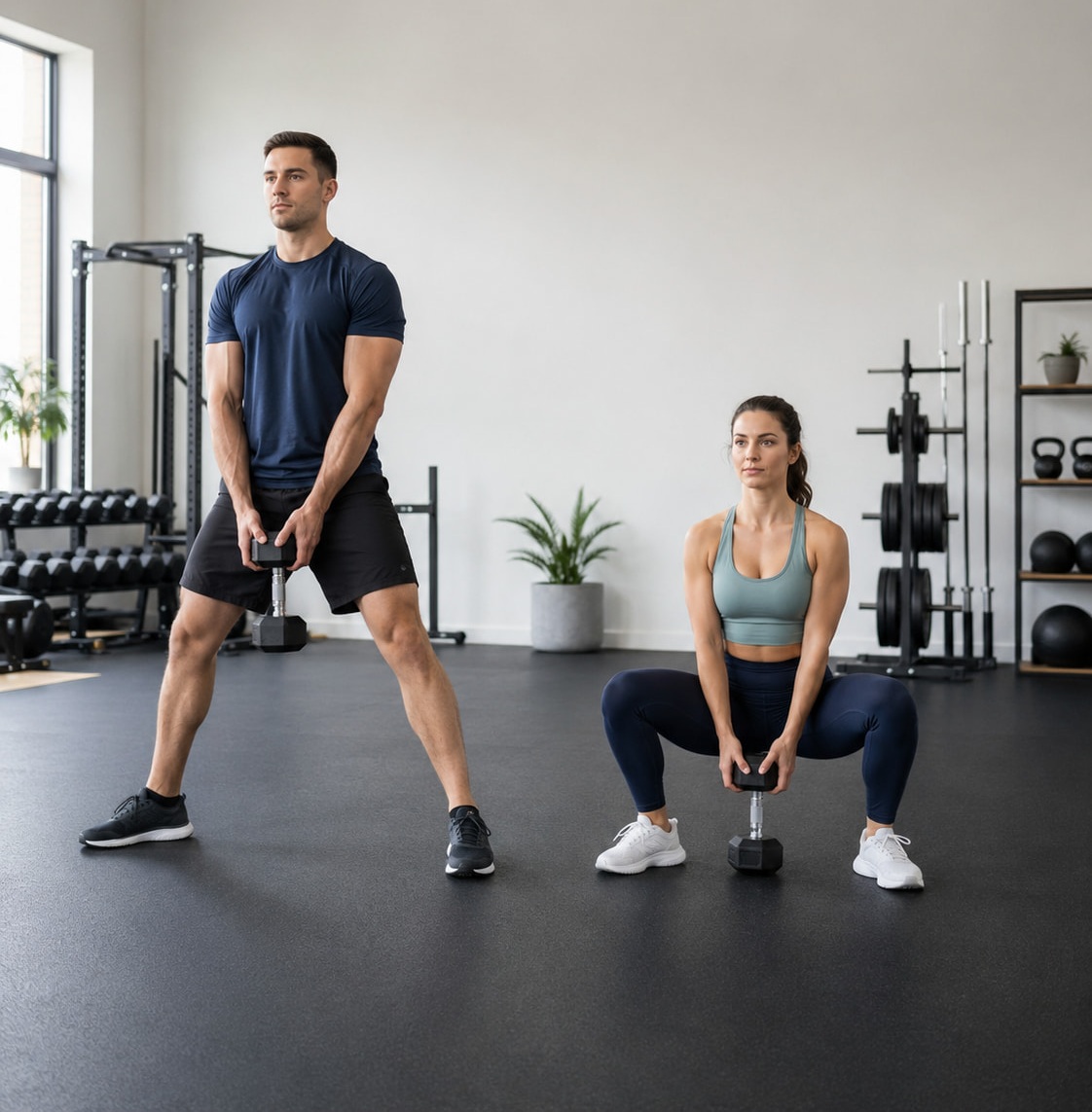
This guide explains how to perform the dumbbell sumo squat, choose a comfortable stance, avoid common mistakes, select an appropriate weight, and include the exercise in a practical workout.
Dumbbell Sumo Squat at a Glance
| Category | Recommendation |
|---|---|
| Exercise type | Compound lower-body squat |
| Best for | Training the legs and glutes with minimal equipment |
| Primary muscles | Quadriceps, gluteus maximus, hip adductors |
| Assisting muscles | Hamstrings, calves, core, spinal stabilizers |
| Equipment | One dumbbell |
| Difficulty | Beginner to intermediate |
| Starting sets | 2–3 |
| Repetition range | 8–15 |
| Rest between sets | 60–120 seconds |
| Suggested effort | Finish with 1–3 good repetitions remaining |
What Is a Dumbbell Sumo Squat?
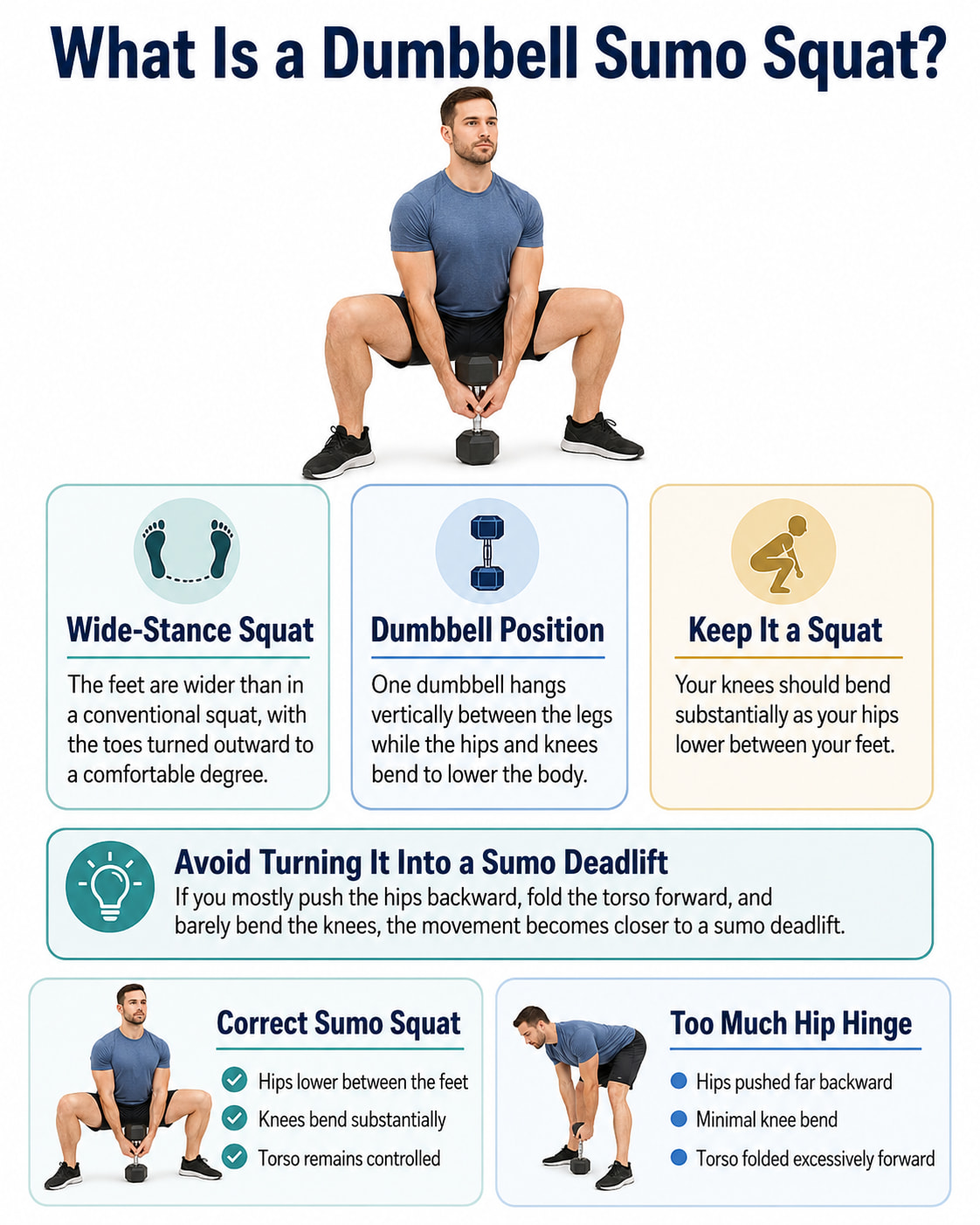
The dumbbell sumo squat is performed with the feet wider than in a conventional squat and the toes turned outward to a comfortable degree. One dumbbell hangs vertically between the legs while the hips and knees bend to lower the body.
The American Council on Exercise demonstrates the movement with the feet wider than the hips, the toes turned outward, and one dumbbell held with both hands while the arms remain extended toward the floor.
Although “sumo” describes the wide stance, the movement should still look like a squat. Your knees should bend substantially as your hips lower between your feet. If you mostly push the hips backward, fold the torso forward, and barely bend the knees, the movement becomes closer to a sumo deadlift.
Dumbbell Sumo Squat Muscles Worked
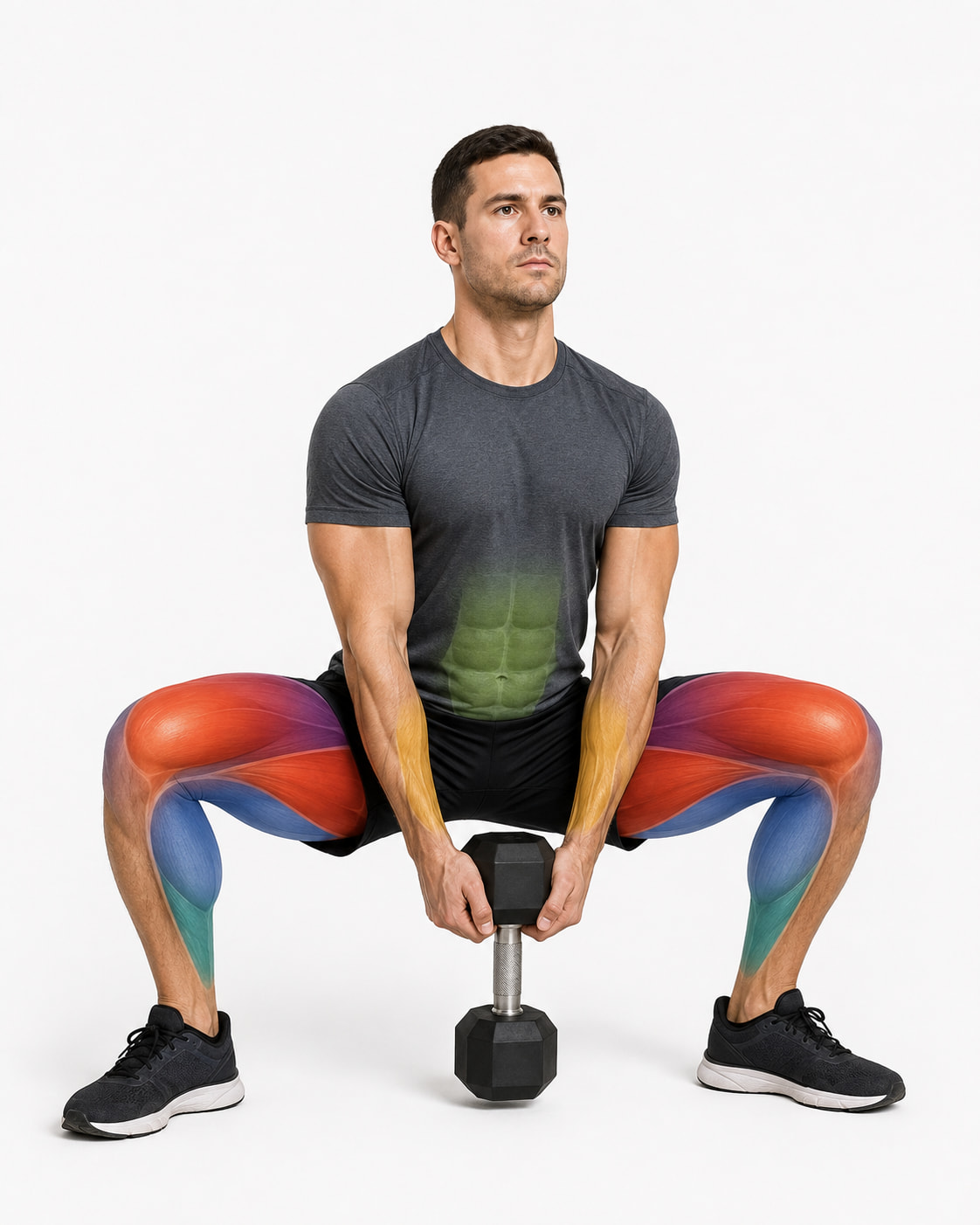
The dumbbell sumo squat is a compound exercise, so several muscles work together rather than one muscle working in isolation.
| Muscle | Role in the Dumbbell Sumo Squat | Training Emphasis |
|---|---|---|
| Quadriceps | Straighten the knees as you rise from the squat | Primary |
| Gluteus maximus | Extends the hips and helps control the lowering phase | Primary |
| Hip adductors | Help stabilize the wide stance and assist hip extension | Primary/assisting |
| Hamstrings | Assist with hip and knee control | Assisting |
| Calves | Help stabilize the ankles and maintain balance | Assisting |
| Core and spinal stabilizers | Keep the torso controlled and resist excessive rounding or arching | Stabilizing |
| Forearms and grip | Hold and control the dumbbell between the legs | Stabilizing |
Key takeaway: The dumbbell sumo squat is a compound lower-body exercise. It mainly trains the quadriceps, gluteus maximus, and hip adductors, while the hamstrings, calves, core, spinal stabilizers, and grip muscles help support the movement.
How to Do a Dumbbell Sumo Squat
Best for: Building lower-body strength with one dumbbell and adding a wide-stance squat variation to a leg workout.
Equipment needed: One fixed, securely assembled dumbbell and a clear, stable training area.
Sets, reps, and rest: Begin with 2–3 sets of 8–12 repetitions. Rest for 60–120 seconds and finish each set with approximately 2–3 technically good repetitions still possible.
Step-by-Step Instructions
- Set your stance. Stand with your feet slightly to moderately wider than shoulder width. Turn the toes outward to a comfortable angle.
- Hold the dumbbell securely. Hold one dumbbell vertically between your legs. With a fixed dumbbell, you may support the upper end with both hands. Use the handle instead when the dumbbell’s design makes holding the end unsafe.
- Brace your torso. Keep your chest comfortably lifted, ribs stacked over the pelvis, and spine controlled. Let your arms hang long without pulling the shoulders toward the ears.
- Lower into the squat. Bend your hips and knees together. Lower your hips between your feet while allowing the knees to move in the same general direction as the toes.
- Maintain whole-foot pressure. Keep the heel, base of the big toe, and base of the little toe in contact with the floor. Do not roll onto the inner edges of the feet.
- Use a controlled depth. Descend until you reach the deepest position you can control without the heels lifting, knees collapsing inward, or lower back rounding excessively.
- Stand up. Push the floor away and extend your knees and hips together. Keep the dumbbell close to your body rather than allowing it to swing.
- Finish tall. Stand with the hips and knees extended, but do not lean backward or forcefully thrust the hips forward.
Coaching cue: Sit between your feet while keeping your knees pointed in the same direction as your toes.
How Wide Should Your Sumo Squat Stance Be?
There is no universal stance width that works for everyone.
Begin with your feet only slightly wider than shoulder width. Turn the toes outward enough that your knees can bend comfortably in the same direction. Perform several bodyweight repetitions before adding the dumbbell.
A suitable stance should allow you to:
- Keep the entire foot planted
- Lower without hip, groin, or knee discomfort
- Keep the knees aligned with the toes
- Maintain a controlled torso position
- Reach a useful range of motion
A wider stance is not automatically better. An excessively wide position can shorten the range of motion, make the feet roll inward, or create discomfort around the hips and groin.
A biomechanical review available through the National Library of Medicine shows that stance width and foot angle can change hip, knee, and ankle positions. Individual anatomy, mobility, proportions, and training goals should therefore guide the setup rather than one fixed measurement.
How Far Should You Turn the Toes Out?
Turn the toes outward only as much as needed to squat comfortably with the knees tracking in the same general direction.
Some exercise demonstrations use an angle of approximately 45 degrees, but that should not be treated as a requirement. One person may feel comfortable with a moderate turnout, while another may need less.
Avoid forcing the feet into a dramatic angle while the knees remain pointed forward. The feet and knees should move as a coordinated unit.
How Deep Should You Squat?
Lower as far as your mobility and control allow.
Your ideal depth may be above, at, or below thigh-parallel. Depth is appropriate when you can maintain:
- Stable foot contact
- Controlled knee alignment
- A braced torso
- A comfortable hip position
- Smooth movement without bouncing
- No sharp or worsening pain
Do not force a deeper squat simply to make the dumbbell touch the floor. The dumbbell’s length, your limb proportions, and your stance all affect how close it comes to the ground.
A shorter range is a valid starting point. Increase depth gradually as your control and comfort improve.
Can Your Knees Move Past Your Toes?
Yes. The knees can move forward past the toes during a squat when that position is comfortable and controlled.
Research available through the National Library of Medicine shows that deliberately restricting forward knee movement changes how squat forces are distributed between the knees and hips rather than simply removing stress from the movement.
Focus on keeping the heels down and the knees tracking with the toes. People following a rehabilitation plan or managing a specific knee condition should use the range recommended by their qualified healthcare professional.
Benefits of Dumbbell Sumo Squats
1. Train Several Lower-Body Muscles Together
The movement combines knee extension, hip extension, ankle control, and trunk stabilization. This allows one exercise to train the quadriceps, glutes, and hip adductors together.
2. Provide a Wide-Stance Squat Option
Some people find a moderately wide stance more comfortable than a narrow squat. It can also provide a useful change in movement demands when a training program already includes conventional squats or lunges.
A wide stance is an option, not a universally superior position.
3. Require Minimal Equipment
You need only one dumbbell and enough room to stand. This makes the exercise practical for home workouts, small gyms, and full-body routines.
4. Allow Simple Progression
The exercise can be made harder by:
- Adding repetitions
- Increasing the dumbbell weight
- Slowing the lowering phase
- Pausing at the bottom
- Adding another set
- Using two dumbbells
5. Support Strength and Muscle Development
The dumbbell sumo squat can help develop lower-body strength and muscle when performed consistently with sufficient effort and gradual progression.
The American College of Sports Medicine emphasizes regular participation, individualized programming, and appropriate training effort rather than unnecessarily complicated methods.
Common Dumbbell Sumo Squat Mistakes
Using an Excessively Wide Stance
Making the stance as wide as possible does not guarantee greater glute or inner-thigh activation. It may reduce your depth and create unnecessary hip or groin discomfort.
Use the narrowest stance that still feels clearly wider than your regular squat and allows controlled movement.
Forcing the Toes Too Far Out
Do not force every lifter into a fixed 45-degree angle. Choose an angle that allows the feet and knees to remain aligned comfortably.
Letting the Knees Collapse Inward
The knees should follow the toes as you lower and stand. Reduce the weight, stance width, or depth if you cannot maintain that position.
Rolling Onto the Inner Edges of the Feet
Keep pressure across the whole foot rather than allowing the arches to collapse. Check whether the stance is too wide or the toes are turned out farther than you can control.
Turning the Squat Into a Deadlift
If the hips move far backward while the torso folds forward and the knees barely bend, you are using more of a hinge pattern.
Think about lowering your hips between your feet rather than reaching them as far behind you as possible.
Using Too Much Weight
A weight is too heavy when it causes swinging, shortened depth, inward-moving knees, heel lift, excessive torso lean, or loss of balance.
Choose a load you can control for every repetition.
Letting the Dumbbell Swing
The dumbbell should travel mostly straight up and down. Keep your arms long and the weight close to the center of your stance.
Forcefully Thrusting the Hips at the Top
Finish in a tall, stacked position. Excessively pushing the hips forward can cause the lower back to arch without adding meaningful benefit.
Forcing the Dumbbell to the Floor
The dumbbell does not need to touch the ground. Lower according to your controlled squat depth, not the length of the weight.
Dumbbell Sumo Squat Regressions
Bodyweight Sumo Squat
Practice the stance, knee tracking, and depth without external load. This is the best starting option when learning the movement.
Supported Sumo Squat
Lightly hold a secure railing, countertop, or suspension trainer. The support can help with balance while you practice sitting between the feet.
Sumo Squat to a Box
Place a stable box or bench behind you and squat until you make light contact. Do not relax or drop heavily onto the surface.
Gradually use a lower target as control improves.
Reduced-Range Sumo Squat
Use a shorter range while maintaining stable feet and smooth knee tracking. Increase depth gradually instead of forcing the bottom position.
Dumbbell Sumo Squat Progressions
Heavier Dumbbell Sumo Squat
Increase the load after you can reach the top of your repetition range with consistent technique.
Paused Dumbbell Sumo Squat
Pause for one or two seconds in the bottom position before standing. Stay braced rather than relaxing into the pause.
Tempo Dumbbell Sumo Squat
Lower over approximately three seconds, pause briefly, and stand under control. A slower descent increases difficulty without requiring a much heavier dumbbell.
Two-Dumbbell Sumo Squat
Hold one dumbbell in each hand between the legs or at your sides. This can provide more total load when one dumbbell is no longer challenging enough.
Goblet Sumo Squat
Hold one dumbbell close to the chest while maintaining the wider stance. The front-loaded position may make it easier to keep the torso upright, although the arms and upper back may fatigue sooner.
Dumbbell Sumo Squat vs. Other Exercises
| Exercise | Stance | Weight position | Main difference |
|---|---|---|---|
| Dumbbell sumo squat | Wider than shoulder width | Hanging between the legs | Wide-stance squat with substantial knee and hip bending |
| Regular dumbbell squat | Usually hip- to shoulder-width | At the sides or shoulders | More conventional squat stance |
| Goblet squat | Narrow, moderate, or wide | Held close to the chest | Front-loaded position helps counterbalance the body |
| Dumbbell sumo deadlift | Wide | Starts closer to the floor | Greater hip-hinge emphasis and usually less knee bending |
Dumbbell Sumo Squat vs. Regular Squat
Both exercises train the quadriceps and glutes. The sumo squat uses a wider stance and generally involves more outward hip rotation.
Neither variation is automatically better. Choose the stance that fits your anatomy, feels stable, and supports your training goals.
Dumbbell Sumo Squat vs. Goblet Squat
The main difference is the weight position.
During a standard dumbbell sumo squat, the weight hangs between the legs. During a goblet squat, it is held close to the chest. A goblet squat can also be performed with a wide sumo stance.
Dumbbell Sumo Squat vs. Sumo Deadlift
A sumo squat involves substantial bending at both the knees and hips as the pelvis lowers between the feet.
A sumo deadlift begins with the weight near the floor and normally uses more of a hip-hinge pattern. Both movements use a wide stance, but they are not interchangeable.
Sets, Reps, and Rest
Use the following ranges as practical starting points:
| Goal | Sets | Reps | Rest | Effort |
|---|---|---|---|---|
| Learn the movement | 2–3 | 8–12 | 60–90 seconds | 3 repetitions remaining |
| Build muscle | 3–4 | 8–15 | 60–120 seconds | 1–3 repetitions remaining |
| Lower-body accessory | 2–3 | 12–20 | 45–90 seconds | 2–3 repetitions remaining |
| Emphasize strength | 3–4 | 6–10 | 90–180 seconds | 1–3 repetitions remaining |
A heavier dumbbell is not useful if it shortens your range or changes the exercise into a deadlift.
How Often Should You Perform It?
Most people can include dumbbell sumo squats one to three times per week, depending on:
- Total lower-body training volume
- Other squat, lunge, and deadlift exercises
- Training experience
- Recovery between sessions
- Personal goals
When the exercise is your main squat, place it near the beginning of the workout. When it is an accessory movement, perform it after a heavier squat, deadlift, or single-leg exercise.
How to Progress
Choose a repetition range such as 8–12.
When you can complete every set at 12 repetitions with stable form and approximately two good repetitions remaining, increase the dumbbell by the smallest practical amount. Return to the lower end of the range and build up again.
You can also progress by adding a set, improving depth, slowing the descent, or adding a controlled pause.
Sample Dumbbell Sumo Squat Workout
Perform this lower-body routine one or two times per week, with at least one recovery day between sessions.
| Exercise | Sets and reps | Rest |
|---|---|---|
| Dumbbell sumo squat | 3 × 8–12 | 90 seconds |
| Dumbbell Romanian deadlift | 3 × 8–12 | 90–120 seconds |
| Dumbbell reverse lunge | 2 × 8–10 per leg | 60–90 seconds |
| Standing dumbbell calf raise | 2 × 12–20 | 60 seconds |
Use weights that leave approximately two technically sound repetitions available at the end of each set.
Once you reach the top of the range with consistent form, increase one exercise at a time rather than adding weight to the entire routine at once.
Dumbbell Sumo Squat Safety Tips
- Check that the dumbbell is securely assembled before lifting it.
- Do not support a loose or adjustable dumbbell by a plate that could detach.
- Practice the stance with body weight before adding resistance.
- Use a clear, level, nonslip training surface.
- Do not force an extremely wide stance or exaggerated toe angle.
- Keep the dumbbell under control rather than swinging it.
- Breathe continuously and avoid prolonged breath-holding.
- Stop if you experience sharp pain, numbness, dizziness, chest pain, unusual shortness of breath, or loss of balance.
People with an existing hip, knee, ankle, or back condition should obtain individualized guidance before using a wide, loaded squat.
Frequently Asked Questions
Do dumbbell sumo squats work the inner thighs?
Yes. The hip adductors along the inner thighs help control the wide stance and contribute to hip extension.
However, the exercise does not isolate the inner thighs. The quadriceps and glutes also perform substantial work.
Are dumbbell sumo squats better for glutes than regular squats?
Not necessarily.
A wider stance may increase glute involvement in some squat variations, but glute training depends on several factors, including depth, load, effort, anatomy, and overall programming. Use the variation that allows the best combination of comfort, control, range, and progression.
Are dumbbell sumo squats more glute- or quad-focused?
They train both.
More knee bending generally increases the role of the quadriceps, while hip extension involves the glutes and adductor magnus. Avoid trying to remove one muscle group from a movement that naturally uses several.
How wide should my feet be?
Start slightly wider than shoulder width and adjust from there.
Your stance is appropriate when the feet remain planted, the knees track with the toes, and you can lower without hip, groin, or knee discomfort.
Should my knees stay behind my toes?
No universal rule requires the knees to remain behind the toes.
Allow the knees to travel forward as needed while keeping the heels down and the movement controlled. Restrict knee travel only when it is part of individualized guidance for your needs.
How heavy should the dumbbell be?
Choose a weight you can control for at least 8 repetitions without swinging, losing balance, shortening the range, or allowing the knees to collapse inward.
The final repetitions should feel challenging, but your technique should remain similar to the first repetition.
Can beginners perform dumbbell sumo squats?
Yes, provided the stance feels comfortable and the movement can be controlled.
Beginners should first practice a bodyweight sumo squat or squat to a box. Add a light dumbbell only after they can maintain stable feet, controlled knees, and a braced torso.
Conclusion
The dumbbell sumo squat is a practical lower-body exercise for training the quadriceps, glutes, and hip adductors with minimal equipment.
Use a comfortably wide stance rather than the widest stance possible. Keep the whole foot planted, let the knees follow the toes, and lower only as far as you can control. Progress by improving your repetitions and technique before increasing the dumbbell weight.
References
- American Council on Exercise: 5 Variations of the Body-Weight Squat
- National Academy of Sports Medicine: Squat Biomechanics and Muscles Used
- American College of Sports Medicine: Updated 2026 Resistance Training Guidelines
- National Library of Medicine: Stance Width and Muscle Activity During the Back Squat
- National Library of Medicine: A Biomechanical Review of the Squat Exercise
- National Library of Medicine: Limitations of Anterior Knee Displacement During Squats
- National Library of Medicine: Effect of Knee Position on Hip and Knee Torques During the Barbell Squat
This content is for informational purposes only and is not a substitute for medical advice.