Barbell exercises for arms are a simple, effective way to train your biceps and triceps with progressive overload. With one straight barbell or EZ-bar, you can build stronger elbows, thicker upper arms, better pressing strength, and more balanced arm development.
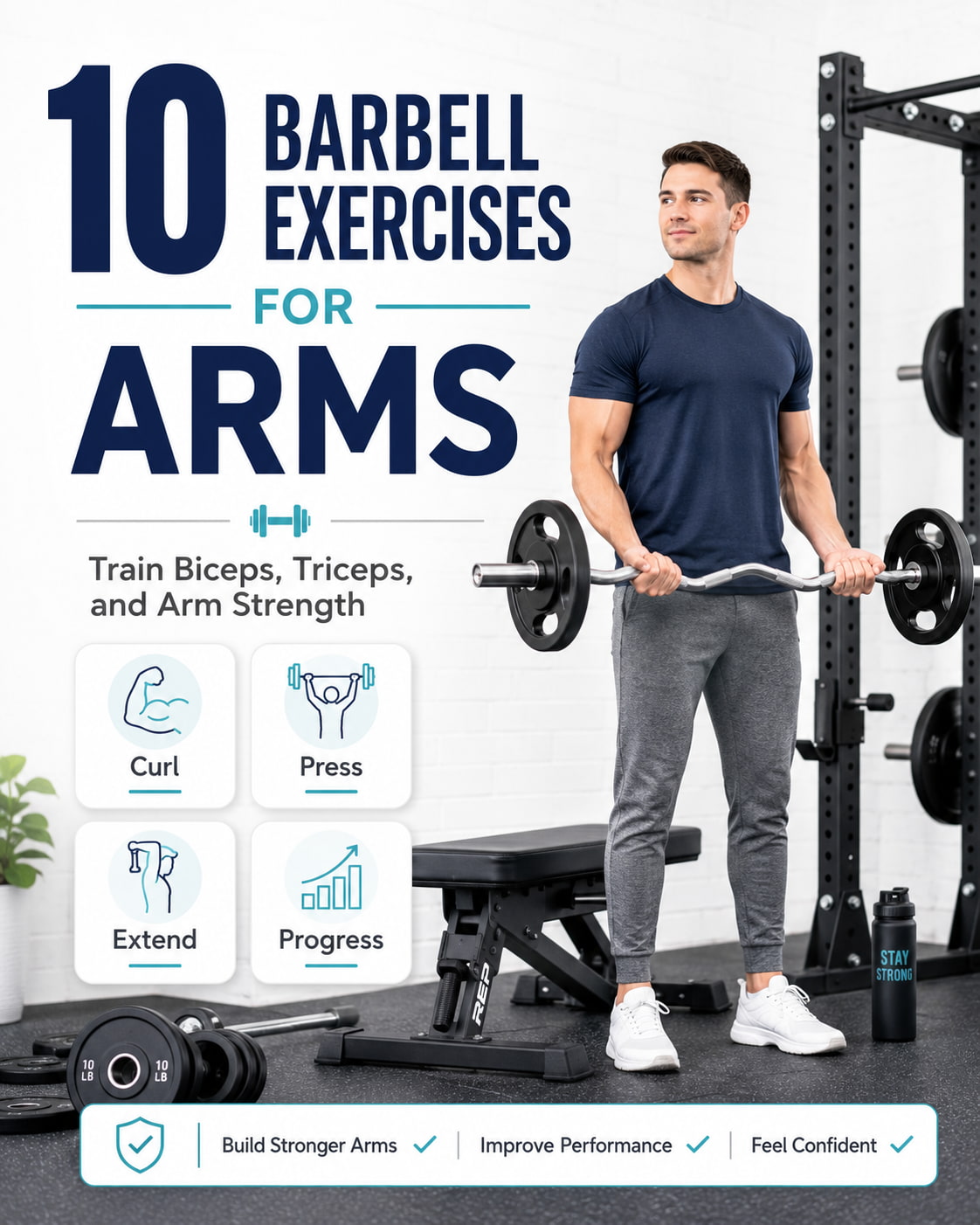
This guide covers the best barbell exercises for arms, how to do each one, which muscles they target, common mistakes to avoid, and how to use them in a real workout.
Barbell Exercises for Arms: Best Moves at a Glance
| Exercise | Main Focus | Best Use |
|---|---|---|
| Standing Barbell Curl | Biceps | Basic biceps strength and size |
| EZ-Bar Curl | Biceps and brachialis | Wrist-friendly curling |
| Reverse Barbell Curl | Brachialis and forearms | Arm thickness and grip support |
| Barbell Preacher Curl | Biceps isolation | Strict curling form |
| Barbell Drag Curl | Biceps | Reducing shoulder swing |
| Close-Grip Barbell Bench Press | Triceps | Heavy triceps strength |
| Lying Barbell Triceps Extension | Triceps | Long-head triceps work |
| Overhead Barbell Triceps Extension | Triceps | Stretch-focused triceps training |
| Close-Grip Barbell Floor Press | Triceps | Safer pressing range |
| Barbell JM Press | Triceps | Advanced triceps strength |
Muscles Worked by Barbell Arm Exercises
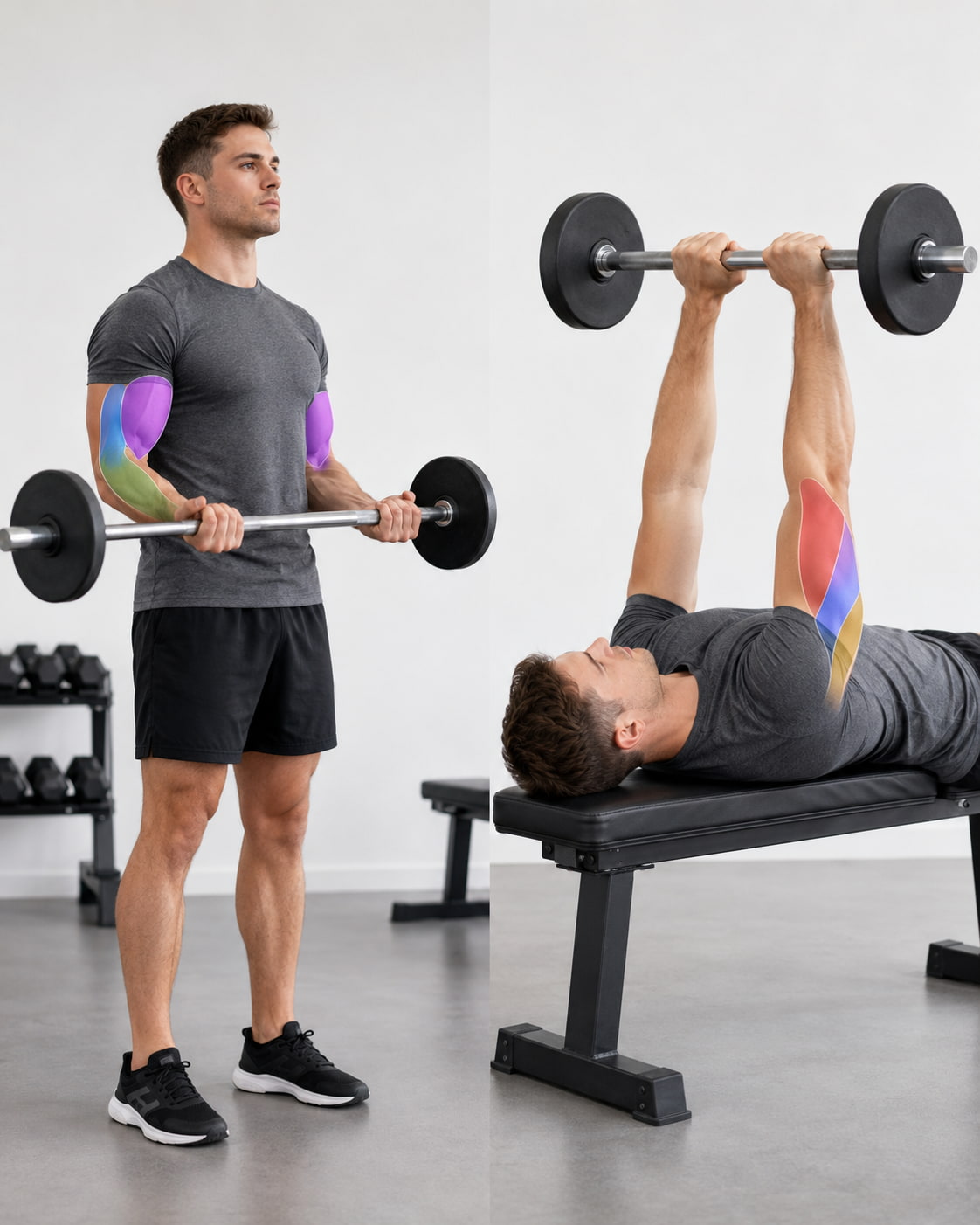
Barbell arm exercises mainly train the elbow flexors and elbow extensors.
The biceps brachii sits on the front of the upper arm and helps bend the elbow and turn the forearm palm-up. The brachialis sits deeper and is a strong elbow flexor, especially important for overall arm thickness. The brachioradialis, located on the forearm, assists during curls, especially reverse-grip variations. The NCBI Bookshelf biceps anatomy guide explains that the biceps is strongly involved in forearm supination, while the brachialis is a major elbow flexor.
The triceps brachii sits on the back of the upper arm and extends the elbow. It has three heads: long, lateral, and medial. Pressing movements load the triceps heavily, while overhead and lying extension variations can place more emphasis on the long head because it crosses the shoulder joint. The NCBI Bookshelf triceps anatomy guide describes the triceps as an elbow extensor, with the long head also contributing at the shoulder.
Before You Start: Barbell Arm Training Safety
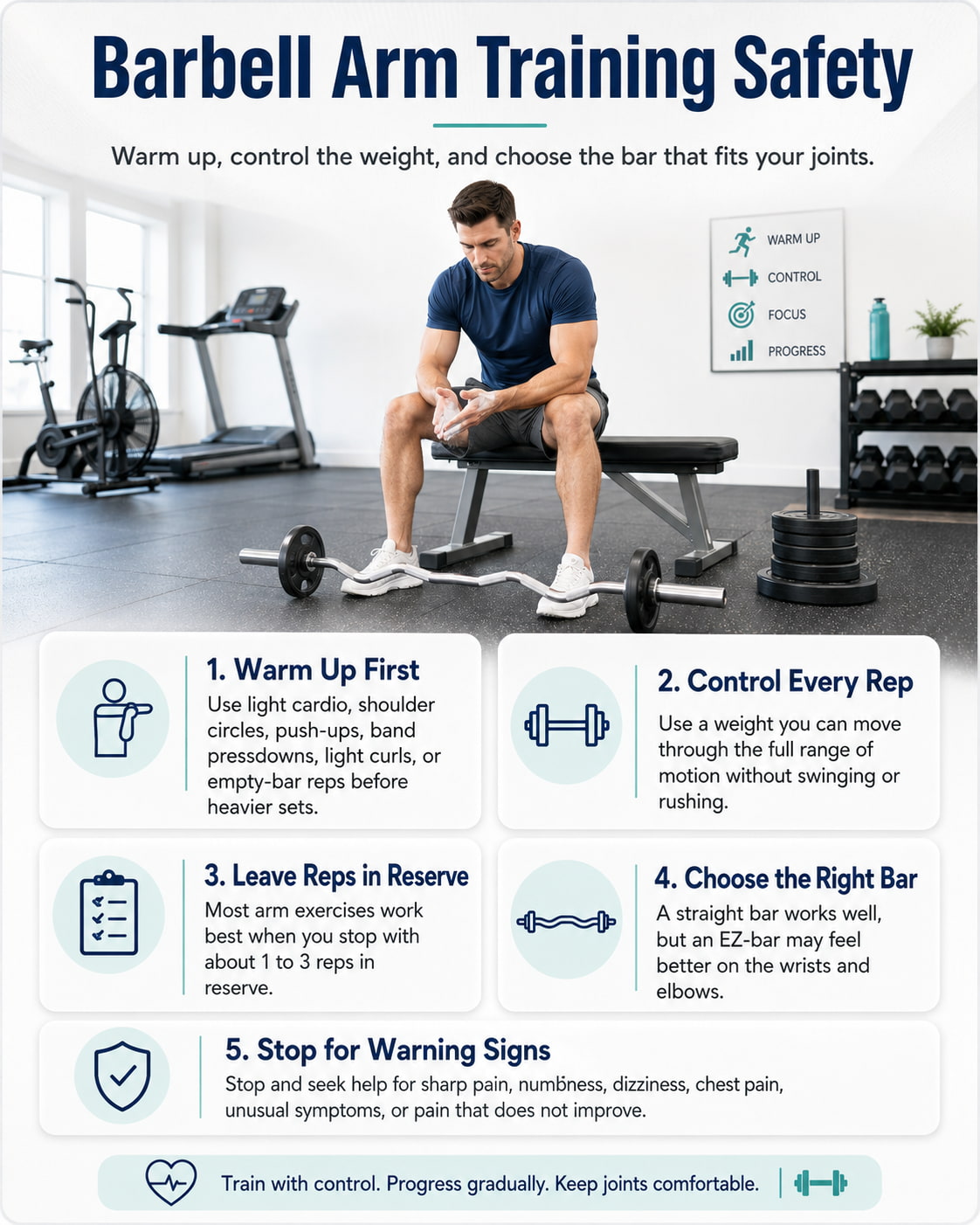
Warm up before lifting. A few minutes of light cardio, shoulder circles, push-ups, band pressdowns, light curls, or empty-bar reps can help you move better before heavier sets. Mayo Clinic’s weight training technique guidance recommends warming up, moving weights with control, and avoiding momentum.
Use a weight you can control through the full range of motion. Most arm exercises work best when you stop with about 1 to 3 reps in reserve instead of grinding every set to failure.
Choose the bar that fits your joints. A straight bar works well for many lifters, but an EZ-bar may feel better on the wrists and elbows during curls and triceps extensions.
Stop and seek professional help if an exercise causes sharp pain, numbness, dizziness, chest pain, unusual symptoms, or pain that does not improve when you reduce the load or adjust your form.
10 Best Barbell Exercises for Arms
These barbell exercises target the biceps, triceps, brachialis, and forearms with simple, progressive movements. Use them to build stronger arms, improve pressing and pulling strength, and train with better control.
1. Standing Barbell Curl
Best for: Building basic biceps strength, improving curling form, and adding direct arm volume.
Muscles worked: Biceps brachii, brachialis, brachioradialis, forearm flexors, and core stabilizers.
Equipment needed: Straight barbell or EZ-bar.
Suggested sets and reps: Do 3 to 4 sets of 6 to 12 reps.
Rest: Rest 60 to 90 seconds between sets, or up to 2 minutes for heavier sets.
How to do it:
- Stand tall with your feet about hip-width apart.
- Hold the bar with an underhand grip around shoulder-width.
- Keep your elbows close to your sides and brace your core.
- Curl the bar toward your shoulders without leaning back.
- Squeeze briefly at the top.
- Lower the bar under control until your elbows are fully extended.
Common mistakes: The biggest mistakes are swinging the torso, letting the elbows drift too far forward, bending the wrists backward, and using a partial range of motion.
Expert tip: Think “ribs down, elbows pinned, bar smooth.” If your shoulders move more than your elbows, the weight is too heavy.
2. EZ-Bar Curl
Best for: Training the biceps with a more wrist-friendly grip.
Muscles worked: Biceps brachii, brachialis, brachioradialis, and forearms.
Equipment needed: EZ-bar and weight plates.
Suggested sets and reps: Do 3 to 4 sets of 8 to 12 reps.
Rest: Rest 60 to 90 seconds between sets.
How to do it:
- Stand tall while holding the EZ-bar with an underhand angled grip.
- Keep your shoulders down and elbows close to your ribs.
- Curl the bar up without leaning backward.
- Pause briefly near the top.
- Lower the bar slowly until your elbows straighten.
Common mistakes: Avoid turning the curl into a hip-driven swing. Do not let your wrists collapse or your elbows flare away from your sides.
Expert tip: Keep your knuckles angled slightly upward throughout the curl so your wrists stay firm.
3. Reverse Barbell Curl
Best for: Building the brachialis, brachioradialis, forearms, and thicker-looking arms.
Muscles worked: Brachialis, brachioradialis, biceps brachii, wrist extensors, and grip muscles.
Equipment needed: Straight barbell or EZ-bar.
Suggested sets and reps: Do 2 to 4 sets of 10 to 15 reps.
Rest: Rest 60 to 90 seconds between sets.
How to do it:
- Stand tall with a shoulder-width overhand grip.
- Keep your elbows close to your sides.
- Curl the bar up while keeping your wrists straight.
- Stop when your forearms are near vertical or your form starts to change.
- Lower the bar slowly to the starting position.
Common mistakes: Many lifters go too heavy, bend the wrists downward, or shrug the shoulders during the lift.
Expert tip: Treat reverse curls like a controlled forearm and arm-builder, not a max-strength lift.
4. Barbell Preacher Curl
Best for: Strict biceps isolation and reducing body momentum.
Muscles worked: Biceps brachii, brachialis, brachioradialis, and forearms.
Equipment needed: Preacher bench and straight bar or EZ-bar.
Suggested sets and reps: Do 3 sets of 8 to 12 reps.
Rest: Rest 60 to 90 seconds between sets.
How to do it:
- Sit at the preacher bench and place your upper arms on the pad.
- Hold the bar with an underhand grip.
- Start with your elbows slightly bent, not forcefully locked.
- Curl the bar upward while keeping your upper arms on the pad.
- Squeeze the biceps near the top.
- Lower slowly until your arms are nearly straight.
Common mistakes: Do not bounce out of the bottom, lift your upper arms off the pad, or use more weight than your elbows can control.
Expert tip: Keep the bottom range smooth. The stretched position is useful, but it should never feel sharp or forced.
5. Barbell Drag Curl
Best for: Training the biceps while reducing shoulder swing.
Muscles worked: Biceps brachii, brachialis, brachioradialis, rear shoulder stabilizers, and forearms.
Equipment needed: Straight barbell or EZ-bar.
Suggested sets and reps: Do 2 to 3 sets of 8 to 12 reps.
Rest: Rest 60 to 90 seconds between sets.
How to do it:
- Stand tall with an underhand grip.
- Keep the bar close to your thighs.
- Pull your elbows slightly back as you curl.
- Drag the bar up the front of your body.
- Stop around lower-chest height.
- Lower the bar along the same close path.
Common mistakes: Do not turn this into an upright row. Avoid shrugging, flaring your elbows wide, or leaning back to finish reps.
Expert tip: Imagine shaving the front of your shirt with the bar. The bar path should stay close.
6. Close-Grip Barbell Bench Press
Best for: Heavy triceps strength, pressing power, and upper-body muscle building.
Muscles worked: Triceps brachii, chest, anterior deltoids, and upper-back stabilizers.
Equipment needed: Barbell, bench, plates, collars, and ideally a rack with safety pins.
Suggested sets and reps: Do 3 to 5 sets of 5 to 10 reps.
Rest: Rest 90 seconds to 3 minutes between sets.
How to do it:
- Lie on a bench with your eyes under the bar.
- Grip the bar about shoulder-width or slightly narrower.
- Set your feet, brace your core, and pull your shoulder blades back.
- Unrack the bar and lower it under control.
- Keep your elbows close to your ribs.
- Press the bar up until your elbows straighten.
Common mistakes: Avoid gripping too narrow, flaring your elbows, bouncing the bar, or letting your wrists bend backward.
Expert tip: A close grip does not mean hands touching. A shoulder-width grip is usually safer and stronger.
7. Lying Barbell Triceps Extension
Best for: Direct triceps training, especially the long head.
Muscles worked: Triceps brachii, forearm stabilizers, shoulders, and upper-back stabilizers.
Equipment needed: Flat bench and straight barbell or EZ-bar.
Suggested sets and reps: Do 2 to 4 sets of 8 to 12 reps.
Rest: Rest 60 to 90 seconds between sets.
How to do it:
- Lie on a flat bench with the bar over your chest.
- Hold the bar with a narrow to moderate grip.
- Keep your upper arms angled slightly back.
- Bend your elbows to lower the bar toward your forehead or slightly behind your head.
- Stop before your elbows flare or your shoulders lose control.
- Extend your elbows to return the bar to the starting position.
Common mistakes: Avoid dropping the bar too fast, flaring your elbows wide, turning it into a pullover, or using a weight that strains your elbows.
Expert tip: Keep the upper arms mostly still and let the elbows do the work.
8. Overhead Barbell Triceps Extension
Best for: Training the long head of the triceps through a deep stretch.
Muscles worked: Triceps brachii, especially the long head, plus shoulders, core, and upper-back stabilizers.
Equipment needed: EZ-bar or light straight barbell.
Suggested sets and reps: Do 2 to 3 sets of 10 to 15 reps.
Rest: Rest 60 to 90 seconds between sets.
How to do it:
- Sit or stand tall while holding the bar overhead.
- Keep your ribs down and core braced.
- Point your elbows forward rather than letting them flare wide.
- Bend your elbows to lower the bar behind your head.
- Stop at a comfortable stretch.
- Extend your elbows to press the bar back overhead.
Common mistakes: Avoid arching your lower back, flaring your elbows, lowering too deep, or forcing the movement if your shoulders feel uncomfortable.
Expert tip: Use the EZ-bar first. The angled handles usually make this exercise easier to control.
9. Close-Grip Barbell Floor Press
Best for: Triceps pressing strength with a shorter, more controlled range of motion.
Muscles worked: Triceps brachii, chest, anterior deltoids, and upper-back stabilizers.
Equipment needed: Barbell, plates, collars, and floor space or a rack setup.
Suggested sets and reps: Do 3 to 4 sets of 6 to 10 reps.
Rest: Rest 90 seconds to 2 minutes between sets.
How to do it:
- Lie on the floor with your knees bent and feet planted.
- Grip the bar around shoulder-width.
- Brace your core and keep your wrists stacked over your elbows.
- Lower the bar until your upper arms touch the floor.
- Pause briefly without relaxing your body.
- Press the bar back up until your elbows straighten.
Common mistakes: Do not bounce your arms off the floor, let your wrists fold back, or grip so narrow that your elbows and wrists feel jammed.
Expert tip: Treat the floor touch as a soft pause, not a rebound.
10. Barbell JM Press
Best for: Intermediate and advanced lifters who want stronger triceps for pressing.
Muscles worked: Triceps brachii, chest, anterior deltoids, and upper-back stabilizers.
Equipment needed: Barbell, bench, rack, and safety pins.
Suggested sets and reps: Do 2 to 4 sets of 6 to 10 reps.
Rest: Rest 90 seconds to 2 minutes between sets.
How to do it:
- Lie on a bench and grip the bar slightly narrower than shoulder-width.
- Unrack the bar with your wrists stacked and elbows slightly tucked.
- Lower the bar under control toward the upper-chest line.
- Let the elbows bend while keeping tension in the triceps.
- Stop before your elbows or shoulders feel strained.
- Press the bar back up by extending your elbows.
Common mistakes: Going too heavy too soon, lowering toward the face, flaring the elbows, and losing wrist position are the main errors.
Expert tip: This is a precision lift. If it feels awkward or painful, use close-grip bench presses instead.
How to Program Barbell Exercises for Arms
For muscle growth, most lifters do well with 8 to 15 challenging weekly sets for biceps and 8 to 15 challenging weekly sets for triceps. The exact amount depends on your training age, recovery, and how much pulling and pressing you already do.
The 2026 ACSM resistance-training update notes that hypertrophy can be supported by higher weekly training volume, around 10 sets per muscle group, while strength work often uses heavier loads and fewer reps. ACSM
Use these simple programming targets:
| Goal | Sets | Reps | Rest | Effort |
|---|---|---|---|---|
| Strength | 3 to 5 | 4 to 8 | 2 to 3 minutes | 1 to 3 reps in reserve |
| Muscle growth | 3 to 4 | 8 to 12 | 60 to 120 seconds | 1 to 3 reps in reserve |
| Pump and control | 2 to 3 | 12 to 15 | 45 to 90 seconds | 1 to 2 reps in reserve |
Train arms 1 to 3 times per week. If you already do heavy rows, pull-ups, bench presses, and overhead presses, you may need less direct arm work. If arms are a priority, add direct biceps and triceps exercises after your main upper-body lifts.
Sample Barbell Arm Workout
Beginner Barbell Arm Workout
Do this workout 1 to 2 times per week after a general warm-up.
| Exercise | Sets | Reps | Rest |
|---|---|---|---|
| EZ-Bar Curl | 3 | 8 to 12 | 60 to 90 seconds |
| Close-Grip Barbell Floor Press | 3 | 8 to 10 | 90 seconds |
| Reverse Barbell Curl | 2 | 10 to 15 | 60 seconds |
| Lying EZ-Bar Triceps Extension | 2 | 10 to 12 | 60 to 90 seconds |
Keep every set controlled. Stop with 2 to 3 good reps left in reserve.
Intermediate Barbell Arm Workout
Do this workout once per week as a direct arm day or after an upper-body session.
| Exercise | Sets | Reps | Rest |
|---|---|---|---|
| Close-Grip Barbell Bench Press | 4 | 6 to 8 | 2 minutes |
| Standing Barbell Curl | 4 | 6 to 10 | 90 seconds |
| Overhead EZ-Bar Triceps Extension | 3 | 10 to 12 | 90 seconds |
| Barbell Preacher Curl | 3 | 8 to 12 | 60 to 90 seconds |
| Reverse Barbell Curl | 2 | 12 to 15 | 60 seconds |
Progress by adding reps first. When you can complete the top end of the rep range for every set with good form, add a small amount of weight next time.
Common Barbell Arm Training Mistakes
Using too much weight is the most common mistake. If you need to swing your hips, lean back, bounce the bar, or cut the range of motion short, the load is too heavy.
Another mistake is ignoring wrist position. Keep your wrists stacked and strong during curls, presses, and extensions. Bent wrists can reduce control and make the movement feel rough on the joints.
Do not train biceps hard every day. Your arms also work during rows, pull-ups, presses, and other upper-body lifts. More work is not always better if your elbows and performance are getting worse.
Avoid gripping too narrow on close-grip presses. A shoulder-width or slightly narrower grip is usually enough to shift more work to the triceps without forcing your wrists and shoulders into an awkward position.
Do not skip the lowering phase. Controlled eccentrics help you keep tension on the target muscles and reduce the need for momentum.
FAQs About Barbell Exercises for Arms
Can you build arms with only a barbell?
Yes. You can train the biceps with curls, reverse curls, preacher curls, and drag curls. You can train the triceps with close-grip presses, floor presses, lying extensions, overhead extensions, and JM presses.
Are barbell curls enough for biceps?
Barbell curls are useful, but they are not the only option. For better arm development, combine standard curls with reverse curls, preacher curls, or drag curls so you train different grips and arm positions.
Is a straight bar or EZ-bar better for arms?
Both work. A straight bar is simple and effective, but an EZ-bar often feels more comfortable on the wrists and elbows. Use the bar that lets you train hard with clean form and no joint pain.
How many barbell arm exercises should I do in one workout?
Most lifters only need 2 to 4 direct arm exercises per session. A simple setup is one biceps curl, one triceps press, one biceps variation, and one triceps extension.
Should beginners do skull crushers?
Beginners can do lying triceps extensions with light weight, but they should not rush the load. If the movement bothers the elbows, start with close-grip floor presses or close-grip bench presses first.
What rep range is best for barbell arm exercises?
For most arm-building work, 8 to 15 reps works well. Heavier triceps presses can use 5 to 8 reps, while reverse curls and overhead extensions often feel better in the 10 to 15 rep range.
Why do my elbows hurt during barbell arm exercises?
Elbow discomfort can come from too much weight, too much weekly volume, poor wrist position, fast lowering, or forcing ranges that do not fit your body. Reduce the load, use an EZ-bar, control the tempo, and stop if the pain feels sharp or unusual.
Conclusion
Barbell exercises for arms can build strong biceps and triceps with simple equipment and clear progression. Start with strict curls, reverse curls, close-grip presses, and controlled triceps extensions. Use good form, add weight gradually, and keep your elbows and wrists comfortable.
For best results, train arms consistently, stop short of sloppy reps, and progress only when your technique stays solid.
This content is for informational purposes only and is not a substitute for professional medical advice.
References
- ACE Fitness: Bicep Curl
- ACE Fitness: Reverse Bicep Curl
- ACE Fitness: Close-Grip Bench Press
- ACE Fitness: Lying Barbell Triceps Extensions
- NCBI Bookshelf: Biceps Muscle Anatomy
- NCBI Bookshelf: Triceps Muscle Anatomy
- Mayo Clinic: Weight Training Do’s and Don’ts