Dumbbell rows are a horizontal pulling exercise that trains the lats, rhomboids, trapezius, rear shoulders, biceps, forearms, and grip while your trunk helps keep the body stable. They can build back strength and muscle with only a dumbbell and a stable bench.
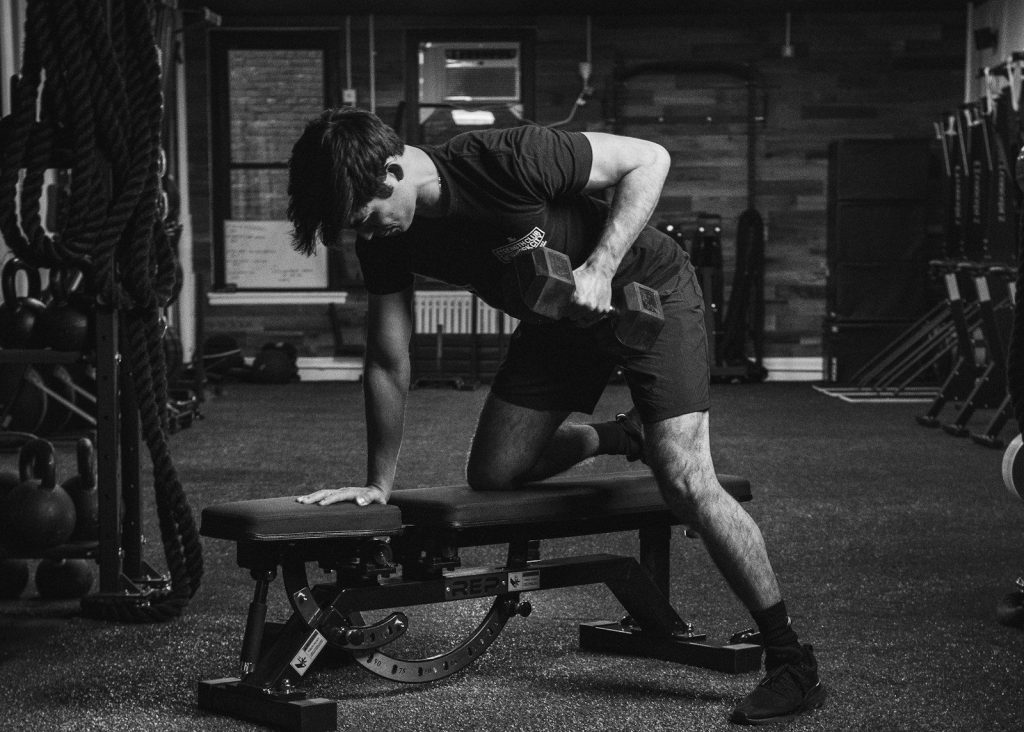
This guide focuses on the supported one-arm dumbbell row because the bench makes it easier to control the torso and learn the pulling movement. You will also learn how many sets and reps to perform, how much weight to use, which mistakes to avoid, and how to progress safely.
What Are Dumbbell Rows?
A dumbbell row involves pulling a dumbbell toward your torso while your upper body remains in a hinged or supported position. It is considered a horizontal pulling movement because the upper arm travels backward relative to the torso.
There are several versions, including:
- Supported one-arm dumbbell rows
- Two-arm bent-over dumbbell rows
- Chest-supported dumbbell rows
- Elbow-out dumbbell rows
- Paused or tempo dumbbell rows
This article uses the supported one-arm version as the standard. The American Council on Exercise teaches this version with one hand and knee supported on a bench, a braced torso, and a controlled pull without rotating the spine.
Dumbbell Rows at a Glance
| Detail | Recommendation |
|---|---|
| Main movement | Horizontal pull |
| Primary areas trained | Lats, rhomboids, middle trapezius |
| Assisting muscles | Rear deltoids, biceps, brachialis, forearms |
| Equipment | One dumbbell and a stable bench |
| Beginner starting point | 2–3 sets of 8–12 reps per side |
| General muscle-building range | 3–4 sets of 8–15 reps per side |
| Rest | Approximately 90–150 seconds |
| Main technique goal | Pull the elbow back without twisting the torso |
Dumbbell Rows Muscles Worked
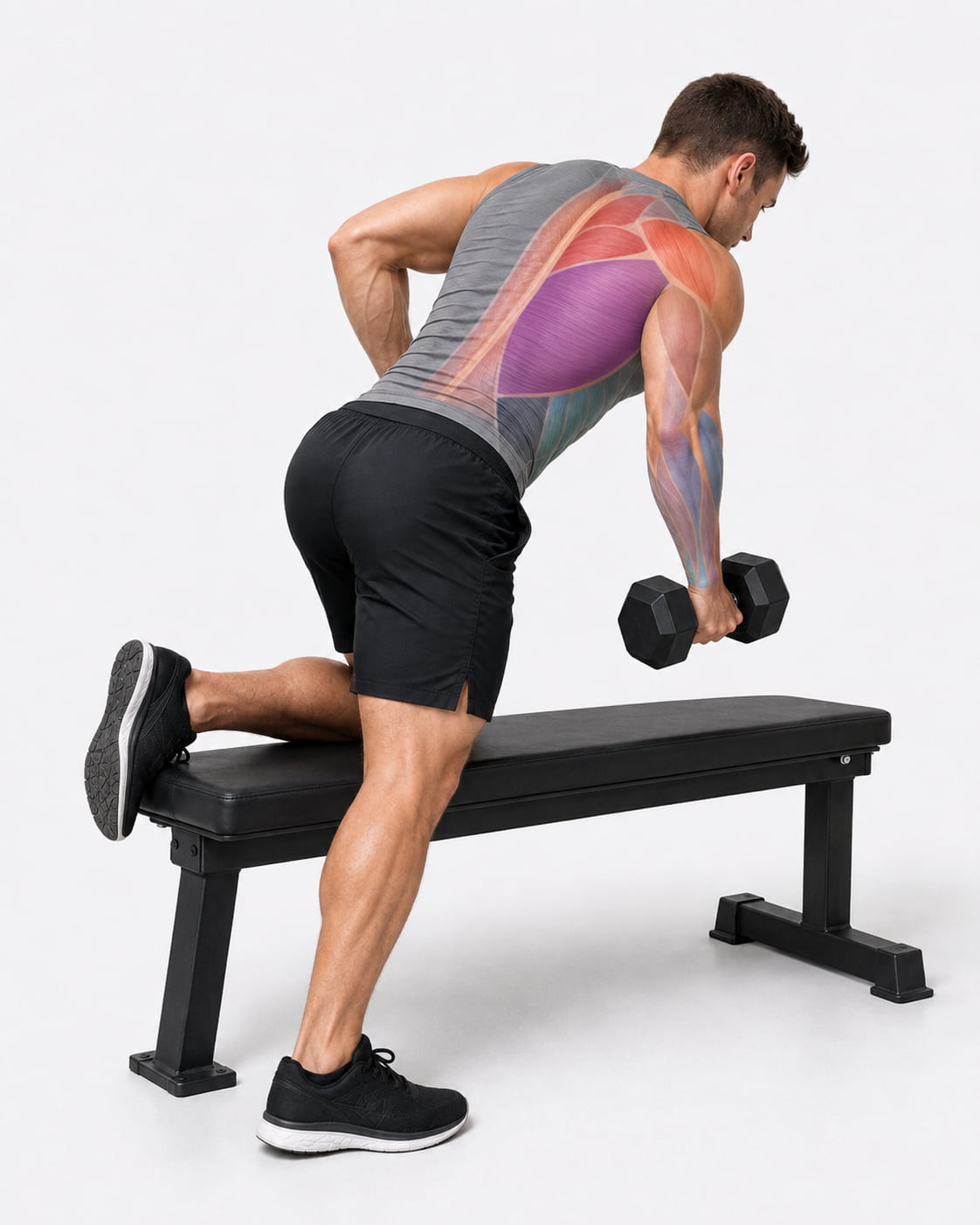
Dumbbell rows train several back, shoulder, arm, grip, and core muscles at the same time.
Latissimus Dorsi
The lats help pull the upper arm backward toward the torso. Keeping the elbow relatively close to your side generally increases their contribution. The lats work with the teres major during shoulder extension and adduction, as explained by NCBI Bookshelf.
Rhomboids and Middle Trapezius
The rhomboids and middle trapezius pull and control the shoulder blades as the dumbbell moves upward. They work best when the torso remains stable and the movement is controlled.
Posterior Deltoid and Teres Major
The rear deltoid and teres major assist the pull. Allowing the elbow to move slightly farther from the torso generally increases upper-back and rear-shoulder involvement.
Biceps, Brachialis, and Brachioradialis
These muscles bend the elbow during each repetition. Some arm involvement is normal, but excessive curling or using too much weight can reduce the emphasis on the back.
Forearms and Grip
The forearms hold the dumbbell and stabilize the wrist. Grip fatigue may limit heavier or higher-repetition sets.
Core and Spinal Stabilizers
The abdominals, obliques, multifidus, and erector spinae help prevent the torso from bending or rotating. Research published in the International Journal of Sports Medicine found that free-weight and unilateral rows can create greater trunk-muscle activity than more supported rowing exercises.
How to Do a Supported One-Arm Dumbbell Row
Best for: Building horizontal pulling strength while using the bench to help stabilize the torso.
Muscles worked: Latissimus dorsi, rhomboids, middle trapezius, posterior deltoid, teres major, biceps, brachialis, forearms, and trunk stabilizers.
Equipment needed: One dumbbell and a stable flat bench.
Sets, reps, and rest: Begin with 2–3 sets of 8–12 repetitions per side. Rest for approximately 90–120 seconds after completing both arms.
How to Do It
- Place a dumbbell beside a stable bench.
- Put your left knee and left hand on the bench. Position the supporting hand roughly beneath the shoulder and keep the other foot firmly on the floor.
- Hold the dumbbell in your right hand with a neutral grip, meaning your palm faces your body. Let the arm hang toward the floor.
- Brace your abdominal muscles and keep your head, ribs, hips, and spine in a controlled position. Avoid rounding or excessively arching your back.
- Pull your right elbow backward toward your hip or lower ribs. Keep the wrist reasonably straight and prevent your chest or hips from rotating.
- Stop when the upper arm reaches the torso or when pulling farther would require you to twist, shrug, or change your spinal position.
- Lower the dumbbell slowly until the arm is extended again. Keep the shoulder controlled instead of allowing the weight to pull it forcefully toward the floor.
- Complete the planned repetitions, switch sides, and repeat.
Keep your back controlled, your head aligned with your spine, and your torso still throughout the repetition. The Cleveland Clinic also recommends maintaining a neutral spine and lowering the dumbbell under control.
Coaching cue: Keep your chest and belt buckle facing the floor as you pull.
Breathing
Exhale as you pull the dumbbell upward and inhale as you lower it. Avoid prolonged breath-holding, particularly if you have blood-pressure concerns or have been advised not to hold your breath during resistance training.
Important Dumbbell Row Form Checkpoints
Keep the Torso Still
Your hips and chest should remain in approximately the same position throughout the repetition. A small amount of natural shoulder-blade movement is expected, but the torso should not rotate to help lift the weight.
Lead With the Elbow
Think about moving your elbow backward rather than bringing the dumbbell toward your shoulder. The hand should act like a hook connecting the weight to your back and arm muscles.
Use a Comfortable Elbow Path
You do not need to force the elbow tightly against your ribs.
- An elbow closer to the torso generally emphasizes shoulder extension and the lats.
- A moderately wider elbow usually involves more of the rear shoulders and upper back.
Choose an angle that feels comfortable and allows controlled movement. Changing the elbow angle can shift the exercise’s emphasis.
Stop Before You Twist
Pull only as high as you can without rotating your torso, shrugging the shoulder, or extending your lower back.
Bringing the dumbbell higher is not automatically better. The useful range ends when you can no longer maintain your position.
Control the Lowering Phase
Do not simply drop the dumbbell toward the floor. Lower it smoothly until the elbow is straight and the shoulder reaches a comfortable bottom position.
Common Dumbbell Row Mistakes
Using Too Much Weight
A weight is too heavy when you must twist, jerk, shorten the range, or push against the bench to complete the repetition.
Fix: Reduce the weight and complete every repetition with the same torso position.
Rotating the Torso
Turning the chest toward the working side may help move a heavier dumbbell, but it reduces control and changes the exercise.
Fix: Keep both shoulders and hips facing the floor. Stop the pull before rotation begins.
Rounding or Overarching the Back
Losing spinal position can place unnecessary stress on the lower back and makes the setup less stable.
Fix: Brace before lifting and maintain the same natural spinal curves throughout the set.
Shrugging the Shoulder
Lifting the shoulder toward the ear may cause unnecessary neck tension.
Fix: Keep the neck relaxed and guide the elbow backward without pulling the shoulder upward.
Turning the Row Into a Curl
Excessively bending the wrist or pulling the dumbbell toward the shoulder can make the biceps dominate the movement.
Fix: Keep the wrist neutral and direct the elbow toward the hip or lower ribs.
Pulling the Elbow Too Far Behind the Body
Forcing an exaggerated top position often leads to shoulder movement, torso rotation, or lower-back extension.
Fix: Stop when the upper arm reaches the torso or just before your position changes.
Dropping the Dumbbell Quickly
A fast, uncontrolled lowering phase reduces control and may pull the shoulder into an uncomfortable position.
Fix: Lower the weight smoothly and begin the next repetition only after regaining a stable bottom position.
Dumbbell Row Sets, Reps, and Rest
The best sets and reps depend on your goal, experience, available weights, and ability to maintain proper form.
| Goal | Sets | Reps per side | Rest | Suggested effort |
|---|---|---|---|---|
| Learn proper form | 2–3 | 8–12 | 90–120 seconds | Finish with 3–4 good reps remaining |
| Build general strength | 3–4 | 5–8 | 2–3 minutes | Finish with 2–3 reps remaining |
| Build muscle | 3–4 | 8–15 | 90–150 seconds | Finish with 1–3 reps remaining |
| Use lighter dumbbells | 2–4 | 12–20 | 60–90 seconds | Stop before swinging or twisting |
These are starting ranges rather than strict rules. The American College of Sports Medicine emphasizes adjusting load and volume to the person’s goal instead of using one prescription for everyone. Its current resistance-training guidance also reports that repeatedly training to complete muscular failure is not required for most healthy adults.
Rest long enough to repeat your technique and planned repetition range. A 2024 systematic review published in Frontiers in Sports and Active Living found a small potential muscle-growth advantage from resting longer than 60 seconds, possibly because longer rest helps maintain training volume.
For one-arm rows, complete one side, switch arms, and then take the full rest period. A brief transition between sides is fine when grip or breathing would otherwise reduce your form.
How Heavy Should Dumbbell Rows Be?
Use a dumbbell that makes the final repetitions challenging without changing your movement.
The weight is appropriate when you can:
- Keep the hips and shoulders square
- Maintain a neutral spine
- Use a similar range on both sides
- Lower the dumbbell under control
- Finish with approximately one to three good repetitions remaining
- Avoid jerking, shrugging, or twisting
Start with your weaker side when you notice a clear difference between arms. Perform the same number of controlled repetitions on the stronger side rather than adding extra repetitions.
A Simple Progression Method
Use double progression to increase the exercise gradually:
- Choose a range such as 8–12 repetitions.
- Begin with a weight you can control for approximately 8–10 reps.
- Add repetitions over future workouts.
- Once you can perform 12 controlled reps in every set on both sides, increase to the next manageable dumbbell.
- Return toward the lower end of the range and repeat.
A 2024 randomized trial indexed by PubMed found that progressing through either additional repetitions or increased resistance can support strength and muscle development. The study used leg extensions rather than dumbbell rows, so it supports the general progression method rather than proving an exercise-specific result.
When the next dumbbell is too large a jump, progress by adding one or two repetitions, pausing briefly at the top, slowing the lowering phase, or adding one additional set.
How Often Should You Do Dumbbell Rows?
Most people can perform dumbbell rows one or two times per week.
A practical starting point is:
- Once per week: 3–4 sets
- Twice per week: 2–4 sets per session
The exact dumbbell-row variation does not have to be performed twice weekly. You can combine it with pull-ups, pulldowns, cable rows, reverse fly variations, or other pulling exercises.
Current resistance-training guidance recommends training all major muscle groups at least twice weekly and identifies approximately 10 weekly sets per muscle group as a useful general target when muscle growth is the priority. Those sets should come from your full back program, not necessarily from 10 sets of dumbbell rows alone.
Dumbbell Row Regressions and Variations
| Variation | Best for | Main consideration |
|---|---|---|
| Chest-supported dumbbell row | Beginners or anyone who wants more torso support | Reduces the need to hold a bent-over position |
| Bench-supported one-arm row | Learning unilateral pulling form | Makes side-to-side differences easier to notice |
| Hand-supported row with both feet down | A simpler bench setup | Requires slightly more trunk and leg stability |
| Two-arm bent-over dumbbell row | Training both sides together | Increases the demand on the hips, core, and spinal stabilizers |
| Elbow-out dumbbell row | Upper back and rear-shoulder emphasis | Use less weight and avoid excessive shrugging |
| Paused dumbbell row | Increasing difficulty without heavier weights | Pause briefly near the top without twisting |
Chest support is not automatically easier for the back muscles. It mainly reduces the need for the trunk to stabilize the body.
Unsupported rows are not automatically superior; they simply add a greater stability requirement. Research on related rowing variations shows that support and unilateral loading can meaningfully change trunk-muscle activity.
Benefits of Dumbbell Rows
Build Back Strength and Muscle
Dumbbell rows train several muscles that move and stabilize the shoulder and shoulder blade, including the lats, trapezius, and rhomboids.
Train One Side at a Time
The one-arm setup makes it easier to notice differences in strength, control, grip, or range of motion between sides.
Balance Pressing Exercises
Rows provide a pulling movement that can be paired with pressing exercises such as push-ups, dumbbell presses, and overhead presses.
Strengthen the Arms and Grip
The biceps and other elbow flexors assist the pull, while the forearms hold the dumbbell and keep the wrist stable.
Work With Minimal Equipment
A single dumbbell and stable support are enough to perform the basic exercise, making rows suitable for home or gym training.
Adapt to Different Training Goals
You can use heavier controlled sets for strength, moderate repetitions for muscle growth, or higher repetitions when only lighter dumbbells are available.
Dumbbell rows are useful, but they are not a complete back program by themselves. Combining rows with a vertical pull and an upper-back or rear-shoulder exercise can provide a more balanced selection of movements.
Sample Dumbbell Back Workout
Perform this workout once or twice weekly, depending on the rest of your program.
| Exercise | Sets | Reps | Rest |
|---|---|---|---|
| Supported one-arm dumbbell row | 3 | 8–12 per side | 90–150 seconds |
| Dumbbell pullover | 2–3 | 10–15 | 90 seconds |
| Chest-supported reverse fly | 2 | 12–20 | 60–90 seconds |
| Dumbbell curl | 2 | 10–15 | 60–90 seconds |
Finish most sets with approximately one to three controlled repetitions remaining.
Progress the rows by reaching the top of the repetition range before increasing the weight. Add more total sets only when your technique is consistent and you are recovering well between sessions.
Dumbbell Row Safety Tips
- Use a stable bench that does not wobble or slide.
- Keep the floor around the bench clear.
- Begin with a light dumbbell while learning the setup.
- Avoid sudden twisting, jerking, or dropping the weight.
- Do not continue a set after you lose control of your spine or shoulder position.
- Breathe normally rather than holding your breath for extended periods.
- Speak with a qualified healthcare or exercise professional before training if you have a recent shoulder, elbow, neck, or back injury.
Stop exercising and seek professional help if you experience sharp pain, numbness, dizziness, chest pain, or other unusual symptoms.
Frequently Asked Questions
Are Dumbbell Rows Good for the Lats?
Yes. The lats help move the upper arm backward during the row, especially when the elbow travels relatively close to the torso. However, the exercise also trains the rhomboids, trapezius, rear shoulders, biceps, and grip.
How Many Dumbbell Rows Should a Beginner Do?
Begin with two or three sets of 8–12 repetitions per side. Use a manageable dumbbell and stop each set while you can still perform another three or four controlled repetitions.
How Heavy Should I Go on Dumbbell Rows?
Use the heaviest weight you can control without rotating your torso, shrugging, shortening the range, or dropping the dumbbell quickly. Increase the weight only after reaching the top of your repetition range with consistent form.
Should Your Elbow Stay Close to Your Body?
The elbow can remain relatively close to the torso during a standard row, but it does not need to be pinned tightly against your ribs. A closer elbow path usually emphasizes the lats, while a somewhat wider path involves more of the rear shoulders and upper back.
Why Do I Feel Dumbbell Rows in My Biceps?
The biceps help bend the elbow, so some involvement is normal. Reduce the weight if you mainly feel your arms, and concentrate on driving the elbow backward while keeping the wrist neutral.
Are One-Arm or Two-Arm Dumbbell Rows Better?
Neither is universally better. One-arm rows provide more support and let you train each side separately. Two-arm bent-over rows are time-efficient but require more trunk and hip stability. Choose the version that best matches your goal and allows consistent form.
Conclusion
Dumbbell rows are most effective when the weight is controlled and the torso remains stable. Start with the supported one-arm version, use two to four sets of 8–15 repetitions for most goals, and stop before your form begins to change.
Build repetitions first, increase the dumbbell gradually, and combine rows with other pulling movements for a complete back-training plan.
This content is for informational purposes only and is not a substitute for professional medical advice.
References
- American Council on Exercise: Single-Arm Row Exercise Guide — Proper setup, spinal position, elbow movement, controlled lowering, and torso stability.
- Cleveland Clinic: Dumbbell Rows—Proper Form and Muscles Worked — Technique, muscles worked, breathing, weight selection, elbow position, and common mistakes.
- American College of Sports Medicine: 2026 Resistance Training Guidelines — Sets, repetitions, frequency, progressive resistance, weekly volume, and training effort.
- Saeterbakken et al.: Unilateral and Bilateral Row Exercises and Core Muscle Activation — Trunk stabilization and differences between unilateral, bilateral, free-weight, and supported rows.
- Fenwick, Brown, and McGill: Rowing Exercises, Trunk Activation, and Lumbar Spine Demands — Spinal stability and the trunk demands of unsupported rowing exercises.
- Singer et al.: Interset Rest Periods and Muscle Hypertrophy — Rest periods for maintaining repetition quality, training volume, and proper form.
10 thoughts on “Dumbbell Rows: Muscles Worked, Sets, Reps, and Form”