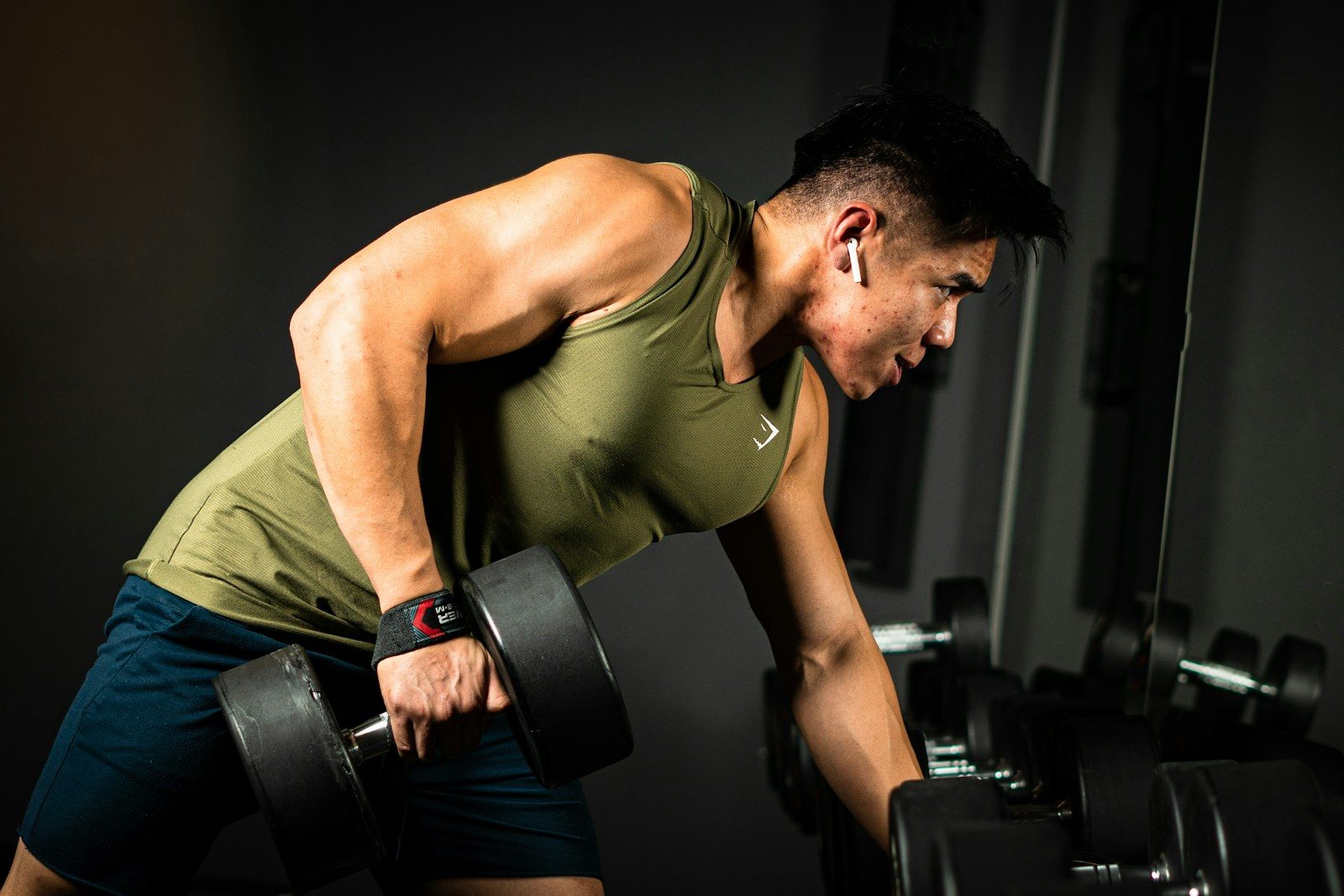
This 3 day dumbbell workout uses three nonconsecutive full-body sessions to build strength at home without requiring a bench or gym machines. Each workout trains your lower body, chest, back, shoulders, arms, and core through practical dumbbell exercises.
Beginners can start with two sets per exercise and gradually add repetitions, weight, or a third set. Most workouts take approximately 35–50 minutes, depending on your rest periods and experience level.
Why This 3 Day Dumbbell Workout Works
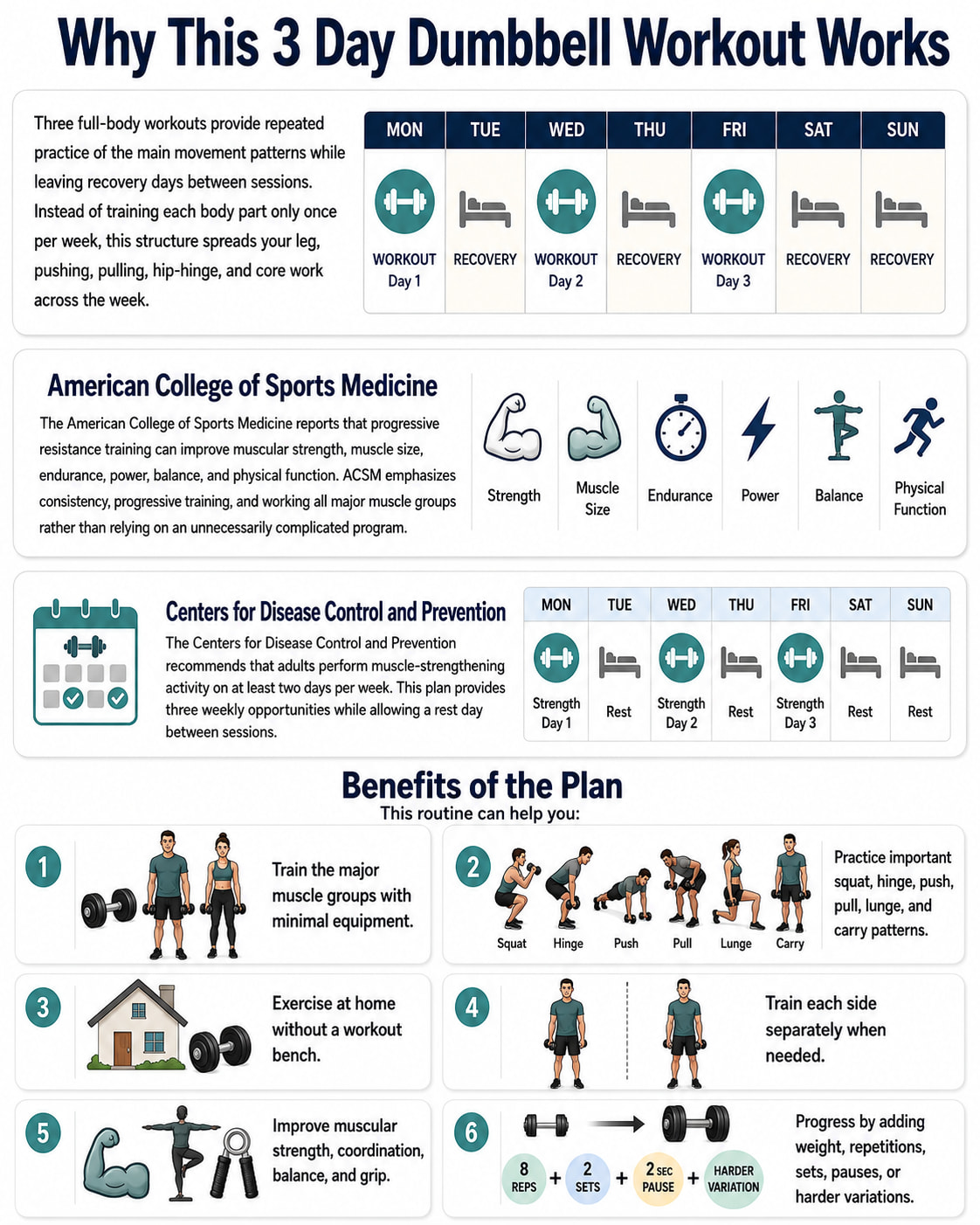
Three full-body workouts provide repeated practice of the main movement patterns while leaving recovery days between sessions. Instead of training each body part only once per week, this structure spreads your leg, pushing, pulling, hip-hinge, and core work across the week.
The American College of Sports Medicine reports that progressive resistance training can improve muscular strength, muscle size, endurance, power, balance, and physical function. ACSM emphasizes consistency, progressive training, and working all major muscle groups rather than relying on an unnecessarily complicated program.
The Centers for Disease Control and Prevention recommends that adults perform muscle-strengthening activity on at least two days per week. This plan provides three weekly opportunities while allowing a rest day between sessions.
Benefits of the Plan
This routine can help you:
- Train the major muscle groups with minimal equipment.
- Practice important squat, hinge, push, pull, lunge, and carry patterns.
- Exercise at home without a workout bench.
- Train each side separately when needed.
- Improve muscular strength, coordination, balance, and grip.
- Progress by adding weight, repetitions, sets, pauses, or harder variations.
Who Is This Plan For?
This plan is suitable for:
- Beginners learning basic dumbbell exercises.
- Early intermediate lifters who want a simple home routine.
- People with one or two pairs of dumbbells.
- Anyone who prefers three weekly strength workouts.
- People who do not have a weight bench.
Advanced lifters may need heavier adjustable dumbbells, additional weekly sets, or more challenging exercise variations to continue progressing.
Equipment You Need
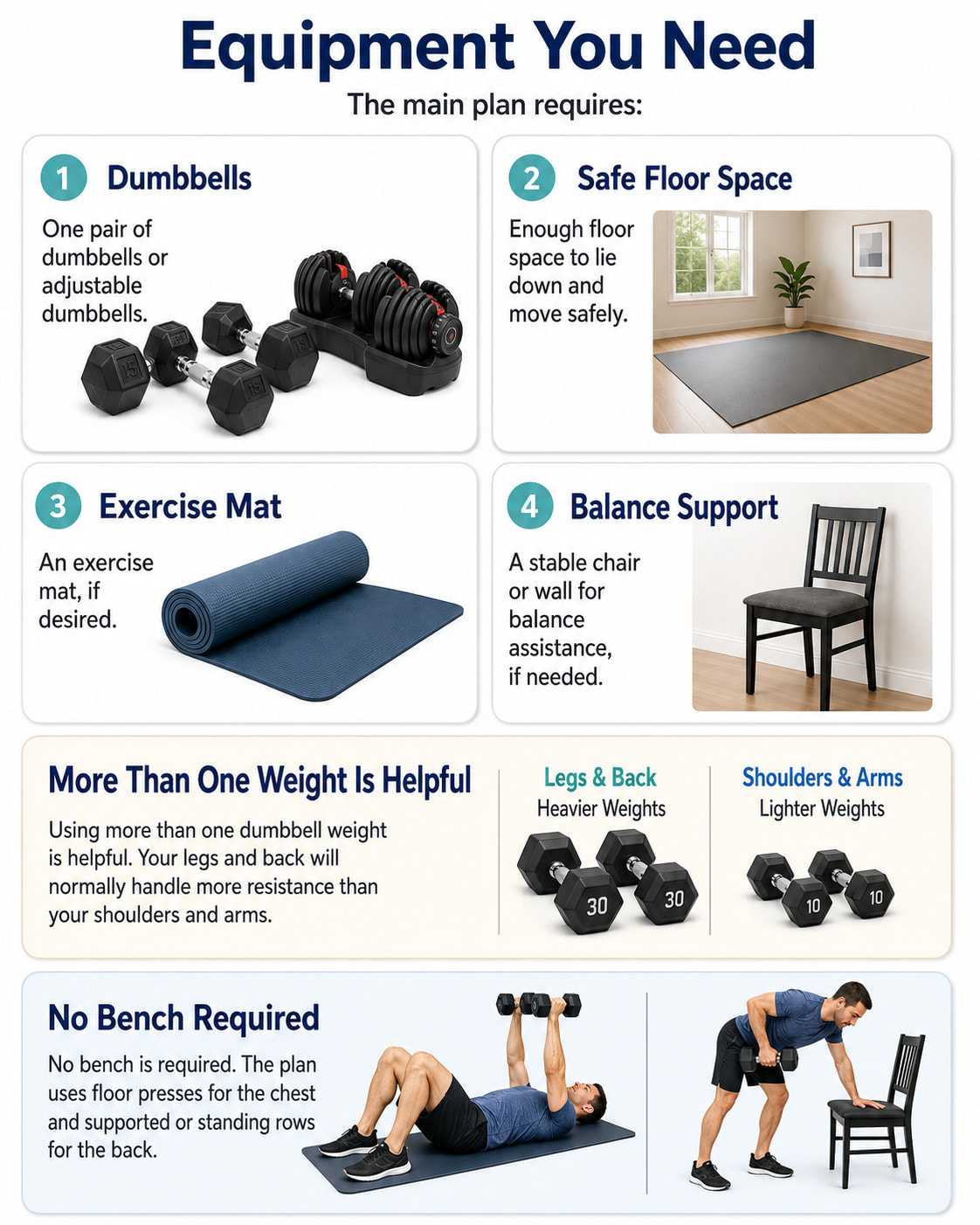
The main plan requires:
- One pair of dumbbells or adjustable dumbbells.
- Enough floor space to lie down and move safely.
- An exercise mat, if desired.
- A stable chair or wall for balance assistance, if needed.
Using more than one dumbbell weight is helpful. Your legs and back will normally handle more resistance than your shoulders and arms.
No bench is required. The plan uses floor presses for the chest and supported or standing rows for the back.
Weekly Schedule
Complete the workouts on nonconsecutive days whenever possible.
| Day | Training plan |
|---|---|
| Monday | Day 1: Full-body foundation |
| Tuesday | Rest, walking, or light mobility |
| Wednesday | Day 2: Unilateral legs and upper body |
| Thursday | Rest, walking, or light mobility |
| Friday | Day 3: Full-body strength and control |
| Saturday | Optional easy cardio or complete rest |
| Sunday | Rest |
Tuesday, Thursday, and Saturday is another suitable schedule.
Do not try to make up a missed session by completing two full workouts on the same day. Simply continue with the next workout when you are available.
Sets, Reps, Rest, and Effort
Use the following guidelines throughout the program:
| Training variable | Beginner starting point | After building consistency |
|---|---|---|
| Working sets | 2 sets per exercise | 3 sets for main exercises |
| Main exercise reps | 8–12 | 8–12 |
| Smaller exercise reps | 10–15 | 10–15 |
| Compound exercise rest | 90–120 seconds | 90–150 seconds |
| Smaller exercise rest | 60–90 seconds | 60–90 seconds |
| Effort | Approximately 2–3 reps in reserve | Approximately 1–3 reps in reserve |
A repetition in reserve is one good repetition you could still perform before your form starts to break down.
For example, finishing a set with two reps in reserve means you stopped when you probably could have completed two more controlled repetitions.
For this plan, you do not need to take every set to complete muscular failure. The ACSM review found that training to momentary fatigue did not consistently produce better outcomes for healthy adults.
How to Choose the Right Dumbbell Weight
Choose a weight that allows you to reach the lower end of the repetition range with controlled form and approximately two or three good repetitions remaining.
The weight is probably appropriate when:
- The first few repetitions feel comfortable.
- The final repetitions require concentration.
- Your movement remains controlled.
- You can complete the full intended range of motion.
- You do not need to swing, jerk, or hold your breath.
The dumbbells are probably too heavy when you cannot reach the minimum repetitions without shortening the movement or losing your posture.
They are probably too light when you can easily exceed the top of the range and still feel that many repetitions remain.
Use different weights for different exercises. A suitable weight for a Romanian deadlift will usually be too heavy for a reverse fly or hammer curl.
Warm-Up Before Each Workout
Spend approximately five to eight minutes preparing your joints and practicing the movements you are about to train.
Complete:
- Brisk marching in place for 60–90 seconds.
- Eight controlled bodyweight squats.
- Eight bodyweight hip hinges.
- Six alternating reverse lunges per side.
- Eight arm circles in each direction.
- One light practice set of the first two exercises.
The warm-up should make you feel prepared, not tired. Use a comfortable range of motion and gradually increase your movement speed.
The exercise instructions below follow standard movement principles also represented in the American Council on Exercise dumbbell exercise library, which provides exercise demonstrations organized by body area, equipment, and experience level.
Day 1: Full-Body Foundation
Day 1 introduces the main squat, press, row, hip-hinge, and loaded-core patterns.
| Exercise | Sets | Reps | Rest |
|---|---|---|---|
| Dumbbell goblet squat | 2–3 | 8–12 | 90 seconds |
| Dumbbell floor press | 2–3 | 8–12 | 90 seconds |
| One-arm dumbbell row | 2–3 | 8–12 per side | 75–90 seconds |
| Dumbbell Romanian deadlift | 2–3 | 8–12 | 90–120 seconds |
| Dumbbell suitcase march | 2 | 20–40 seconds per side | 45–60 seconds |
For one-sided exercises, complete both sides before taking the listed rest unless your grip or technique requires a short break.
1. Dumbbell Goblet Squat
Best for: Building foundational leg strength while learning a controlled squat pattern.
Muscles worked: Quadriceps and glutes, with assistance from the adductors, calves, and core.
Equipment needed: One dumbbell.
Sets, reps, and rest: Complete 2–3 sets of 8–12 repetitions. Rest for approximately 90 seconds.
How to do it:
- Hold one dumbbell vertically against the center of your chest.
- Stand with your feet approximately shoulder-width apart and your toes turned slightly outward.
- Brace your abdomen and lower your hips between your legs.
- Keep your knees tracking in the same general direction as your toes.
- Press through your whole foot to stand without letting your knees collapse inward.
Common mistakes: Avoid lifting your heels, rounding your back, allowing your knees to collapse inward, or letting the dumbbell drift away from your chest.
Regression or progression: Squat toward a stable chair if you need help controlling depth. Progress by using a heavier dumbbell, pausing briefly at the bottom, or taking three seconds to lower.
Coaching cue: Sit between your legs rather than pushing your knees straight forward.
2. Dumbbell Floor Press
Best for: Training the chest and triceps at home without a bench.
Muscles worked: Pectoralis major, triceps, and anterior deltoids.
Equipment needed: Two dumbbells and optional exercise mat.
Sets, reps, and rest: Complete 2–3 sets of 8–12 repetitions. Rest for approximately 90 seconds.
How to do it:
- Lie on your back with your knees bent and feet flat.
- Hold the dumbbells above your chest with your wrists straight.
- Turn your palms slightly inward and position your elbows approximately 30–45 degrees from your torso.
- Lower the weights until your upper arms gently contact the floor.
- Press the dumbbells upward without forcefully locking your elbows or hitting the weights together.
Common mistakes: Avoid excessively flaring your elbows, bending your wrists backward, bouncing your arms off the floor, or creating an exaggerated lower-back arch.
Regression or progression: Use a lighter weight or a neutral grip if your shoulders feel uncomfortable. Progress by adding weight or pausing for one second when your upper arms reach the floor.
Coaching cue: Keep your wrists stacked above your elbows.
3. One-Arm Dumbbell Row
Best for: Training each side of the back independently and improving pulling strength.
Muscles worked: Latissimus dorsi, rhomboids, middle trapezius, posterior deltoids, and biceps.
Equipment needed: One dumbbell and an optional stable chair.
Sets, reps, and rest: Complete 2–3 sets of 8–12 repetitions per side. Rest for 75–90 seconds after both sides.
How to do it:
- Take a staggered stance and support your free hand on your front thigh or a stable chair.
- Hinge forward from your hips while keeping your spine neutral.
- Allow the dumbbell to hang beneath your shoulder.
- Pull your elbow toward your hip without rotating your torso.
- Lower the dumbbell until your arm is extended while maintaining control.
Common mistakes: Avoid shrugging the working shoulder, twisting your chest upward, rounding your lower back, or jerking the dumbbell to create momentum.
Regression or progression: Use a chair for additional support and reduce the weight if your torso moves. Progress with a heavier dumbbell, a brief pause at the top, or a slower lowering phase.
Coaching cue: Pull your elbow toward your back pocket.
4. Dumbbell Romanian Deadlift
Best for: Strengthening the hamstrings and glutes through a hip-hinge movement.
Muscles worked: Hamstrings, gluteus maximus, adductors, spinal erectors, forearms, and core.
Equipment needed: Two dumbbells.
Sets, reps, and rest: Complete 2–3 sets of 8–12 repetitions. Rest for 90–120 seconds.
How to do it:
- Stand with the dumbbells in front of your thighs and your feet about hip-width apart.
- Soften your knees without turning the exercise into a squat.
- Brace your abdomen and push your hips backward.
- Keep the weights close to your legs as your torso leans forward.
- Stop when you feel tension through your hamstrings, then drive your hips forward to stand.
Common mistakes: Avoid rounding your back, bending your knees excessively, lowering farther than your mobility allows, or letting the dumbbells move away from your legs.
Regression or progression: Use a shorter range of motion while learning the hinge. Progress by adding weight or taking approximately three seconds to lower the dumbbells.
Coaching cue: Close an imaginary car door with your hips.
5. Dumbbell Suitcase March
Best for: Building core stability, grip strength, and resistance to sideways leaning.
Muscles worked: Obliques, transverse abdominis, spinal stabilizers, glutes, hip flexors, and forearms.
Equipment needed: One dumbbell.
Sets, reps, and rest: Complete 2 sets of 20–40 seconds per side. Rest for 45–60 seconds.
How to do it:
- Hold one dumbbell beside your thigh.
- Stand tall with your ribs positioned over your pelvis.
- Brace your abdomen without holding your breath.
- Slowly lift one foot and then the other as though marching.
- Keep your shoulders and hips level before switching the dumbbell to the other side.
Common mistakes: Avoid leaning away from the weight, shrugging the loaded shoulder, rushing your steps, or allowing the dumbbell to swing.
Regression or progression: Begin with a stationary suitcase hold. Progress by using a heavier dumbbell, marching longer, or performing a walking suitcase carry in a clear space.
Coaching cue: Stay tall as though balancing a glass of water on your head.
Day 2: Unilateral Legs and Upper Body
Day 2 adds single-leg work, vertical pressing, a two-dumbbell row, glute training, and direct arm work.
| Exercise | Sets | Reps | Rest |
|---|---|---|---|
| Dumbbell reverse lunge | 2–3 | 8–10 per side | 90 seconds |
| Standing dumbbell overhead press | 2–3 | 8–12 | 90 seconds |
| Dumbbell bent-over row | 2–3 | 8–12 | 90 seconds |
| Dumbbell glute bridge | 2–3 | 10–15 | 75–90 seconds |
| Dumbbell hammer curl | 2 | 10–15 | 60 seconds |
1. Dumbbell Reverse Lunge
Best for: Training the quadriceps and glutes one leg at a time with less forward momentum than a forward lunge.
Muscles worked: Quadriceps, glutes, hamstrings, adductors, calves, and core.
Equipment needed: One or two dumbbells.
Sets, reps, and rest: Complete 2–3 sets of 8–10 repetitions per side. Rest for approximately 90 seconds.
How to do it:
- Stand tall while holding the dumbbells at your sides or one dumbbell at your chest.
- Step one foot backward and place the ball of that foot on the floor.
- Lower both knees while keeping your front foot planted.
- Keep your front knee tracking over the same general direction as your toes.
- Push through your front foot to return to standing.
Common mistakes: Avoid stepping too narrowly, pushing mainly from the back leg, allowing the front knee to collapse inward, or rushing before you regain your balance.
Regression or progression: Perform bodyweight reverse lunges while holding a wall or chair. Progress by increasing the load or pausing briefly at the bottom.
Coaching cue: Let the front leg perform most of the work.
2. Standing Dumbbell Overhead Press
Best for: Developing overhead pressing strength and shoulder stability.
Muscles worked: Anterior and lateral deltoids, triceps, upper chest, upper back, and core.
Equipment needed: Two dumbbells.
Sets, reps, and rest: Complete 2–3 sets of 8–12 repetitions. Rest for approximately 90 seconds.
How to do it:
- Stand with the dumbbells at shoulder height and your palms facing forward or slightly inward.
- Brace your abdomen and gently tighten your glutes.
- Press the dumbbells overhead while keeping your wrists above your forearms.
- Finish with the weights over your shoulders rather than far in front of your body.
- Lower them slowly to shoulder height.
Common mistakes: Avoid leaning backward, flaring your ribs, bending your wrists, using your legs to bounce the weights upward, or shrugging excessively.
Regression or progression: Use lighter dumbbells or press one arm at a time. A seated neutral-grip press on a stable chair is another option. Progress by adding weight or using a slower lowering phase.
Coaching cue: Keep your ribs down as the weights travel up.
3. Dumbbell Bent-Over Row
Best for: Training both sides of the upper back in the same set.
Muscles worked: Latissimus dorsi, rhomboids, middle trapezius, posterior deltoids, biceps, and forearms.
Equipment needed: Two dumbbells.
Sets, reps, and rest: Complete 2–3 sets of 8–12 repetitions. Rest for approximately 90 seconds.
How to do it:
- Hold the dumbbells at your sides and stand with your feet about hip-width apart.
- Push your hips backward and lean forward with a neutral spine.
- Let your arms hang beneath your shoulders.
- Pull both elbows backward toward your hips.
- Lower the weights fully without losing your torso position.
Common mistakes: Avoid standing upright during each repetition, shrugging your shoulders, rounding your lower back, or swinging the weights.
Regression or progression: Use the supported one-arm row from Day 1 if maintaining the hinge is difficult. Progress by pausing at the top or lowering for three seconds.
Coaching cue: Keep your torso still while your arms move.
4. Dumbbell Glute Bridge
Best for: Training the glutes without requiring standing balance or heavy equipment.
Muscles worked: Gluteus maximus, hamstrings, adductors, and core.
Equipment needed: One dumbbell and optional mat or folded towel.
Sets, reps, and rest: Complete 2–3 sets of 10–15 repetitions. Rest for 75–90 seconds.
How to do it:
- Lie on your back with your knees bent and your feet flat.
- Place one dumbbell securely across the front of your hips, using a folded towel for comfort if needed.
- Brace your abdomen and press through your feet.
- Lift your hips until your shoulders, hips, and knees form a comfortable line.
- Squeeze your glutes briefly before lowering under control.
Common mistakes: Avoid arching your lower back to lift higher, pushing mainly through your toes, allowing your knees to collapse inward, or placing the dumbbell directly on an uncomfortable area.
Regression or progression: Begin with a bodyweight bridge. Progress by adding weight, pausing at the top, or using a single-leg bodyweight bridge.
Coaching cue: Lift with your glutes, not by arching your back.
5. Dumbbell Hammer Curl
Best for: Adding direct elbow-flexor and grip training after the compound exercises.
Muscles worked: Biceps brachii, brachialis, brachioradialis, and forearms.
Equipment needed: Two dumbbells.
Sets, reps, and rest: Complete 2 sets of 10–15 repetitions. Rest for approximately 60 seconds.
How to do it:
- Stand tall with the dumbbells at your sides and your palms facing your thighs.
- Keep your elbows close to your torso.
- Curl the dumbbells upward without rotating your palms.
- Stop before your elbows move far in front of your body.
- Lower the weights slowly until your arms are extended.
Common mistakes: Avoid swinging your torso, moving your elbows forward, bending your wrists, or dropping the weights quickly.
Regression or progression: Perform alternating curls if lifting both weights affects your posture. Progress by adding weight or using a slower lowering phase.
Coaching cue: Keep your upper arms quiet.
Day 3: Full-Body Strength and Control
Day 3 uses different lower-body positions, a triceps-focused press, another back exercise, and direct rear-shoulder work.
| Exercise | Sets | Reps | Rest |
|---|---|---|---|
| Dumbbell sumo squat | 2–3 | 10–15 | 90 seconds |
| Close-grip dumbbell floor press | 2–3 | 8–12 | 90 seconds |
| Dumbbell kickstand Romanian deadlift | 2–3 | 8–12 per side | 90 seconds |
| One-arm dumbbell row | 2–3 | 10–15 per side | 75–90 seconds |
| Dumbbell reverse fly | 2 | 10–15 | 60–75 seconds |
Use the Day 1 one-arm row instructions. The slightly higher repetition range on Day 3 allows you to use a manageable weight and emphasize strict control.
1. Dumbbell Sumo Squat
Best for: Training the quadriceps, glutes, and inner-thigh muscles with a wider stance.
Muscles worked: Quadriceps, glutes, adductors, hamstrings, calves, and core.
Equipment needed: One dumbbell.
Sets, reps, and rest: Complete 2–3 sets of 10–15 repetitions. Rest for approximately 90 seconds.
How to do it:
- Stand wider than shoulder width with your toes turned outward comfortably.
- Hold one dumbbell vertically at your chest or between your legs.
- Brace your abdomen and lower your hips between your legs.
- Keep your knees tracking in the direction of your toes.
- Press through your feet and squeeze your glutes as you stand.
Common mistakes: Avoid using an excessively wide stance, allowing your knees to collapse inward, lifting your heels, or rounding your lower back near the bottom.
Regression or progression: Narrow your stance slightly or squat toward a chair if needed. Progress with a heavier dumbbell or a pause at the bottom.
Coaching cue: Keep your knees and toes moving in the same direction.
2. Close-Grip Dumbbell Floor Press
Best for: Emphasizing the triceps while still training the chest and shoulders.
Muscles worked: Triceps, pectoralis major, and anterior deltoids.
Equipment needed: Two dumbbells and optional mat.
Sets, reps, and rest: Complete 2–3 sets of 8–12 repetitions. Rest for approximately 90 seconds.
How to do it:
- Lie on your back with your knees bent and feet planted.
- Hold the dumbbells above your chest with your palms facing each other.
- Keep the weights close together without forcefully pushing them into each other.
- Lower your elbows near your sides until your upper arms touch the floor.
- Press the dumbbells upward while keeping your wrists straight.
Common mistakes: Avoid flaring your elbows, bending your wrists backward, dropping your arms onto the floor, or allowing the dumbbells to drift toward your face.
Regression or progression: Use lighter dumbbells or return to the standard floor press. Progress by pausing on the floor or increasing the load.
Coaching cue: Keep your elbows closer to your ribs than in a standard press.
3. Dumbbell Kickstand Romanian Deadlift
Best for: Training one leg more than the other without the balance demands of a full single-leg deadlift.
Muscles worked: Hamstrings and glutes of the front leg, with assistance from the adductors, spinal stabilizers, and core.
Equipment needed: One or two dumbbells.
Sets, reps, and rest: Complete 2–3 sets of 8–12 repetitions per side. Rest for approximately 90 seconds after both sides.
How to do it:
- Place one foot firmly on the floor and position the toes of the other foot slightly behind you.
- Keep most of your body weight over the front leg.
- Hold the dumbbells beside or in front of your thighs.
- Push your hips backward while keeping your hips facing the floor.
- Drive through the front foot and bring your hips forward to stand.
Common mistakes: Avoid shifting most of your weight onto the back foot, rotating your hips, rounding your spine, or bending the front knee until the movement becomes a squat.
Regression or progression: Return to the two-leg Romanian deadlift if the position feels unstable. Progress to a full single-leg Romanian deadlift only after you can control the kickstand version.
Coaching cue: Treat the back foot as a kickstand, not the working leg.
4. Dumbbell Reverse Fly
Best for: Training the rear shoulders and upper-back muscles that support controlled shoulder-blade movement.
Muscles worked: Posterior deltoids, rhomboids, and middle trapezius.
Equipment needed: Two light dumbbells.
Sets, reps, and rest: Complete 2 sets of 10–15 repetitions. Rest for 60–75 seconds.
How to do it:
- Stand with your feet stable and push your hips backward.
- Hold the dumbbells beneath your shoulders with a slight bend in your elbows.
- Brace your torso and raise your arms outward and slightly backward.
- Stop when your upper arms are approximately level with your torso.
- Lower the weights slowly without allowing them to swing.
Common mistakes: Avoid using weights that are too heavy, shrugging your shoulders, lifting your torso to create momentum, or raising your arms far above your back.
Regression or progression: Perform one arm at a time while supporting your free hand on a chair. Progress with a longer pause or slower lowering rather than immediately choosing much heavier dumbbells.
Coaching cue: Move from the back of your shoulders, not your hands.
How to Progress the 3 Day Dumbbell Workout
Progressive overload means gradually asking your muscles to perform more work while maintaining controlled technique. You do not need to increase the weight every workout.
Use Double Progression
Follow these steps:
- Choose a weight you can use at the lower end of the prescribed repetition range.
- Keep the same weight while gradually adding repetitions.
- Reach the top of the range on every planned set.
- Confirm that you still have approximately two controlled repetitions in reserve.
- Increase the weight by the smallest practical amount.
- Return to the lower end of the range and repeat.
For example:
- Workout 1: 10, 9, and 8 goblet squats.
- Workout 2: 10, 10, and 9.
- Workout 3: 11, 10, and 10.
- Later workout: 12, 12, and 12 with good form.
- Next workout: Use a slightly heavier weight and return to approximately 8–10 repetitions.
You do not need to progress every set at the same speed.
Beginner Progression Schedule
| Training period | Recommended approach |
|---|---|
| Weeks 1–2 | Perform 2 sets and learn each movement |
| Weeks 3–4 | Gradually add repetitions within the range |
| Week 5 onward | Add a third set to the first 3–4 exercises if recovery is good |
| After reaching the top of the range | Increase the dumbbell weight and reduce the reps |
Stay at any stage longer when needed. Technique and recovery matter more than following an exact calendar.
When Your Dumbbells Are Too Light
When heavier dumbbells are unavailable, increase difficulty by:
- Taking approximately three seconds to lower the weight.
- Adding a one- or two-second pause.
- Adding repetitions within a controlled range.
- Adding one additional set.
- Increasing the range of motion when appropriate.
- Using a unilateral variation.
- Reducing momentum.
- Choosing a more difficult variation.
Change one variable at a time. Adding sets, repetitions, pauses, and slower tempos simultaneously can create an unnecessary jump in workload.
Common 3 Day Dumbbell Workout Mistakes
Using the Same Weight for Every Exercise
Your lower body and back can normally handle more resistance than your shoulders and arms. Select the weight separately for each movement.
Turning Every Workout Into a Fast Circuit
Moving quickly between exercises may limit the weight you can control and make technique harder to maintain. Rest long enough to perform the next set well.
Training to Failure on Every Set
Constant failure training can make later exercises less productive and may increase fatigue. Most sets in this plan should finish with approximately one to three controlled repetitions remaining.
Adding Weight Before Controlling the Movement
Do not increase the dumbbells when you are shortening the range, losing balance, swinging, or changing your posture. First improve the repetition quality.
Completing All Three Workouts Consecutively
This is a full-body routine. Leave a recovery day between sessions whenever possible instead of completing all three days in a row.
Changing the Program Every Week
Repeated practice helps you improve exercise technique and measure progress. Follow the plan long enough to see whether your repetitions, weights, and control are improving.
Recovery and Safety Tips
Leave at least one day between workouts whenever your schedule allows. Walking, gentle mobility work, or easy cardiovascular exercise can be performed on rest days if you feel recovered.
Use these safety guidelines:
- Train in a clear area with a nonslip surface.
- Check adjustable dumbbells before each workout.
- Use only a stable chair for support.
- Lift with controlled repetitions rather than momentum.
- Breathe continuously instead of deliberately holding your breath.
- Stop a set when your form changes significantly.
- Do not perform maximum-effort lifts while training alone.
- Increase only one part of the program at a time.
Normal muscular effort and mild temporary soreness can occur after training. Stop exercising and seek appropriate professional help if you experience sharp pain, numbness, dizziness, chest pain, faintness, or other unusual symptoms.
People returning from surgery, managing an injury, living with a health condition, or exercising during pregnancy may need individualized guidance from an appropriate healthcare or exercise professional.
Frequently Asked Questions
Is a 3 day dumbbell workout enough to build strength?
Three weekly sessions can be enough for many beginners and intermediate exercisers when the workouts train the major muscle groups and become gradually more challenging.
The CDC recommends at least two weekly muscle-strengthening days for adults, while ACSM emphasizes regular progressive resistance training and working the major muscle groups consistently.
Can you build muscle with only dumbbells?
Yes. Dumbbells can provide progressive resistance for the legs, hips, chest, back, shoulders, and arms.
The 2026 ACSM review found that equipment type did not consistently determine training outcomes. A systematic review indexed by the National Library of Medicine also found broadly similar changes in muscle growth and general strength outcomes when comparing free weights and resistance machines, although improvements can be specific to the exercises used.
The important factors are using enough resistance, controlling the movement, completing sufficient weekly work, recovering, and progressively increasing the challenge.
Should the three workout days be consecutive?
Nonconsecutive days are generally more practical for this plan because every session trains most of the body.
Schedules such as Monday, Wednesday, and Friday or Tuesday, Thursday, and Saturday give you time to recover. An occasional change is not necessarily a problem, but avoid routinely compressing all three workouts into consecutive days.
How long should each workout take?
Most sessions should take approximately 35–50 minutes.
Beginners completing two sets may finish sooner. Three-set workouts with longer rest periods will take closer to the upper end of the range.
Can I follow the workout with only one dumbbell?
Yes, but some exercises will take longer.
You can perform one-arm floor presses, one-arm overhead presses, supported rows, goblet squats, sumo squats, reverse lunges, glute bridges, suitcase marches, and single-dumbbell Romanian deadlifts.
When using one dumbbell for a one-sided exercise, complete the same number of repetitions on both sides.
Do I need a bench?
No. The floor press replaces the dumbbell bench press, while rows can be performed from a staggered stance or with one hand supported on a stable chair.
A bench can provide additional exercise options, but it is not required for this plan.
How long should I follow this routine?
Follow the routine for at least six to eight weeks as a practical starting block. You can continue longer when your technique, repetitions, or dumbbell loads are still improving.
Change exercises only when:
- Your equipment no longer provides enough resistance.
- An exercise does not suit your body or available space.
- You have stopped progressing despite appropriate recovery.
- You need a more advanced variation.
Conclusion
A successful 3 day dumbbell workout does not need dozens of exercises or complicated training methods. Three consistent full-body sessions, appropriate rest, controlled form, and gradual progression can create an effective home strength-training routine.
Begin with two sets, keep two or three good repetitions in reserve, and record the weight and repetitions you complete. Add difficulty only after you can perform the current workload with consistent technique.
This content is for informational purposes only and is not a substitute for professional medical advice.
References
- American College of Sports Medicine Position Stand: Resistance Training Prescription for Muscle Function, Hypertrophy, and Physical Performance in Healthy Adults
- CDC Physical Activity Guidelines for Adults
- Effect of Free-Weight Versus Machine-Based Strength Training on Strength and Muscle Hypertrophy
- Resistance Training Prescription for Muscle Strength and Hypertrophy: A Systematic Review and Network Meta-Analysis
- Effects of Resistance Training Frequency on Gains in Muscular Strength
- Effects of Resistance Training to Repetition Failure or Non-Failure on Strength and Hypertrophy
- Dose-Response Relationship Between Weekly Resistance-Training Volume and Increases in Muscle Mass
2 thoughts on “3 Day Dumbbell Workout Plan for Home Strength Training”