This 5 day dumbbell workout uses two upper-body sessions, two lower-body sessions, and one pull-focused workout to build strength and muscle with only dumbbells and an optional bench.
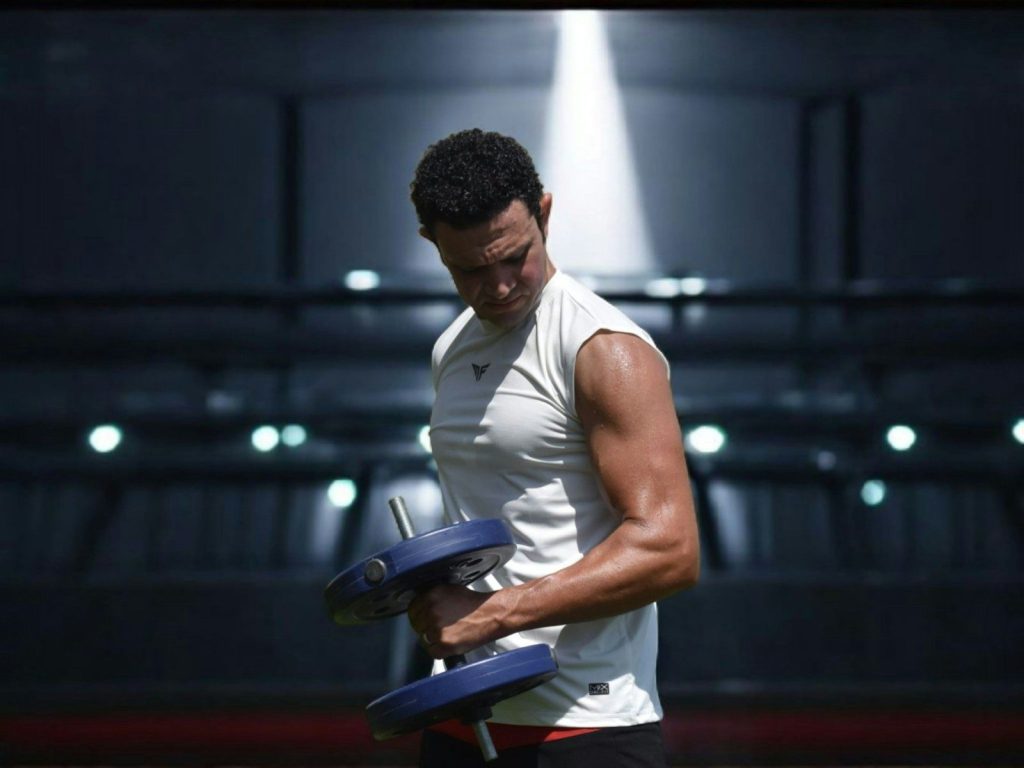
The plan trains the major muscle groups across the week without placing five demanding workouts on five consecutive days. Each session includes practical sets, repetitions, rest periods, form instructions, and progression guidance.
The program is best suited to early-intermediate and intermediate lifters. Beginners can use it by starting with fewer sets and lighter weights.
Is a 5 Day Dumbbell Workout Effective?
Yes. Dumbbells can provide enough resistance to improve muscular strength and support muscle growth when you train consistently, use challenging loads, and gradually increase the workload.
The American College of Sports Medicine’s 2026 resistance-training guidance emphasizes consistency, gradual progression, and training all major muscle groups at least twice per week. It also notes that home-based resistance training and different types of equipment can produce meaningful results.
Five days is not automatically better than three or four days. A higher training frequency mainly allows you to spread your weekly exercises across shorter, more focused sessions. Research suggests that training frequency has little independent effect on muscle growth when total weekly volume is similar. (PubMed)
The current Physical Activity Guidelines for Americans recommend muscle-strengthening activity on at least two days per week. Five strength sessions are therefore an optional training structure, not a minimum health requirement.
Who Should Follow This Plan?
This plan may be suitable if you:
- Already understand basic squat, hinge, press, and row movements
- Can maintain consistent form with dumbbells
- Have approximately 45–65 minutes for each session
- Recover comfortably from four or more weekly workouts
- Have access to several dumbbell weights or adjustable dumbbells
- Want a structured home or gym program
Complete beginners should begin with two working sets per exercise instead of the full amount. Another option is to perform only Days 1, 2, and 3 for the first two weeks before adding Days 4 and 5.
A five-day program may not be appropriate when you are returning after a long break, regularly missing recovery days, or experiencing persistent joint discomfort or declining workout performance.
Equipment You Need
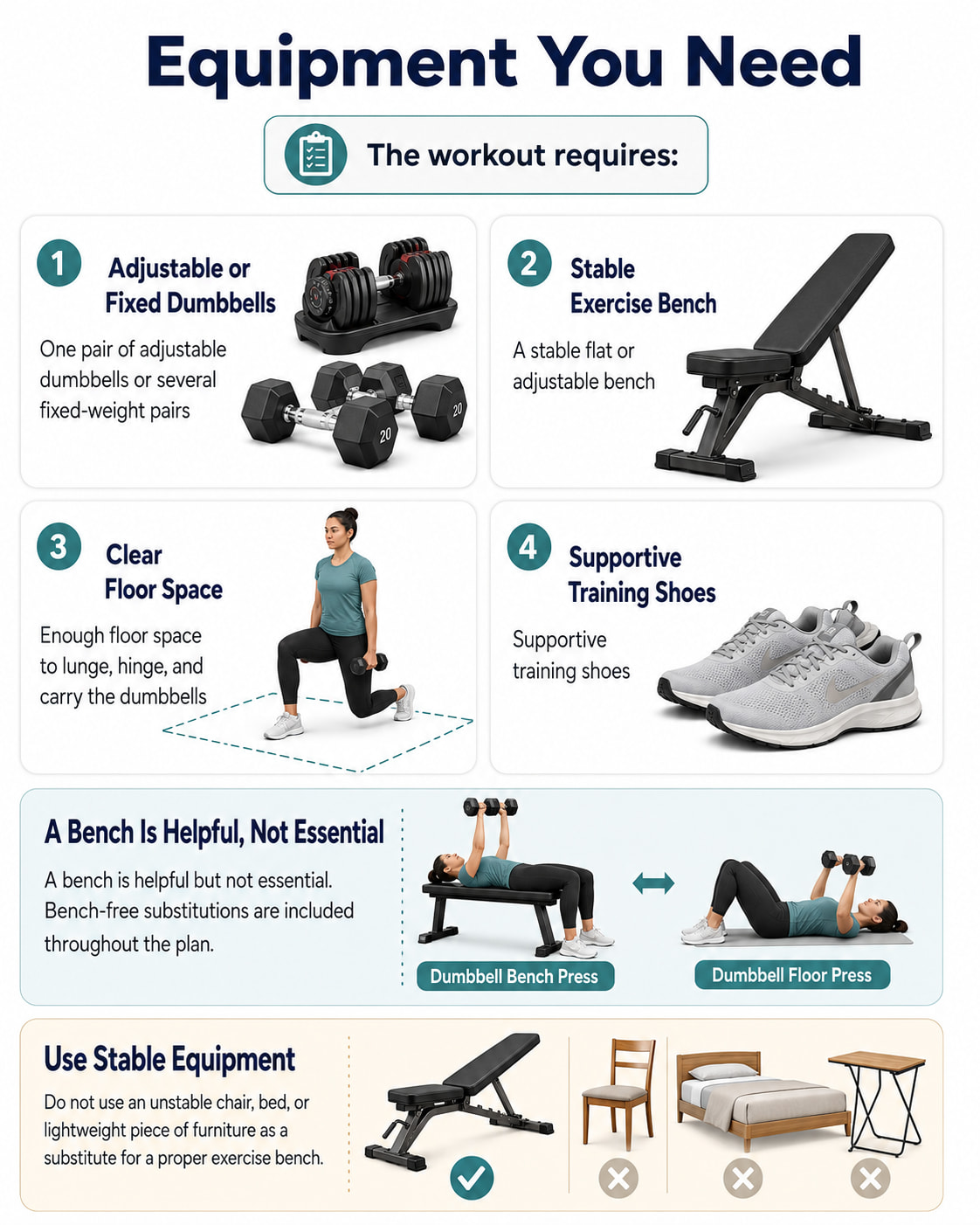
The workout requires:
- One pair of adjustable dumbbells or several fixed-weight pairs
- A stable flat or adjustable bench
- Enough floor space to lunge, hinge, and carry the dumbbells
- Supportive training shoes
A bench is helpful but not essential. Bench-free substitutions are included throughout the plan.
Do not use an unstable chair, bed, or lightweight piece of furniture as a substitute for a proper exercise bench.
5 Day Dumbbell Workout Schedule at a Glance
| Day | Training focus | Main muscles |
|---|---|---|
| Monday | Day 1: Push | Chest, shoulders, triceps |
| Tuesday | Day 2: Lower Body A and Core | Quadriceps, glutes, hamstrings, calves, core |
| Wednesday | Day 3: Pull | Back, rear shoulders, biceps |
| Thursday | Rest or light activity | Recovery |
| Friday | Day 4: Upper Body | Chest, back, shoulders, arms |
| Saturday | Day 5: Lower Body B and Core | Glutes, hamstrings, quadriceps, core |
| Sunday | Rest | Recovery |
This schedule avoids five consecutive resistance-training days. You can move the days to match your week, but try to keep at least one rest day between Day 3 and Day 4.
How to Use This 5 Day Dumbbell Workout
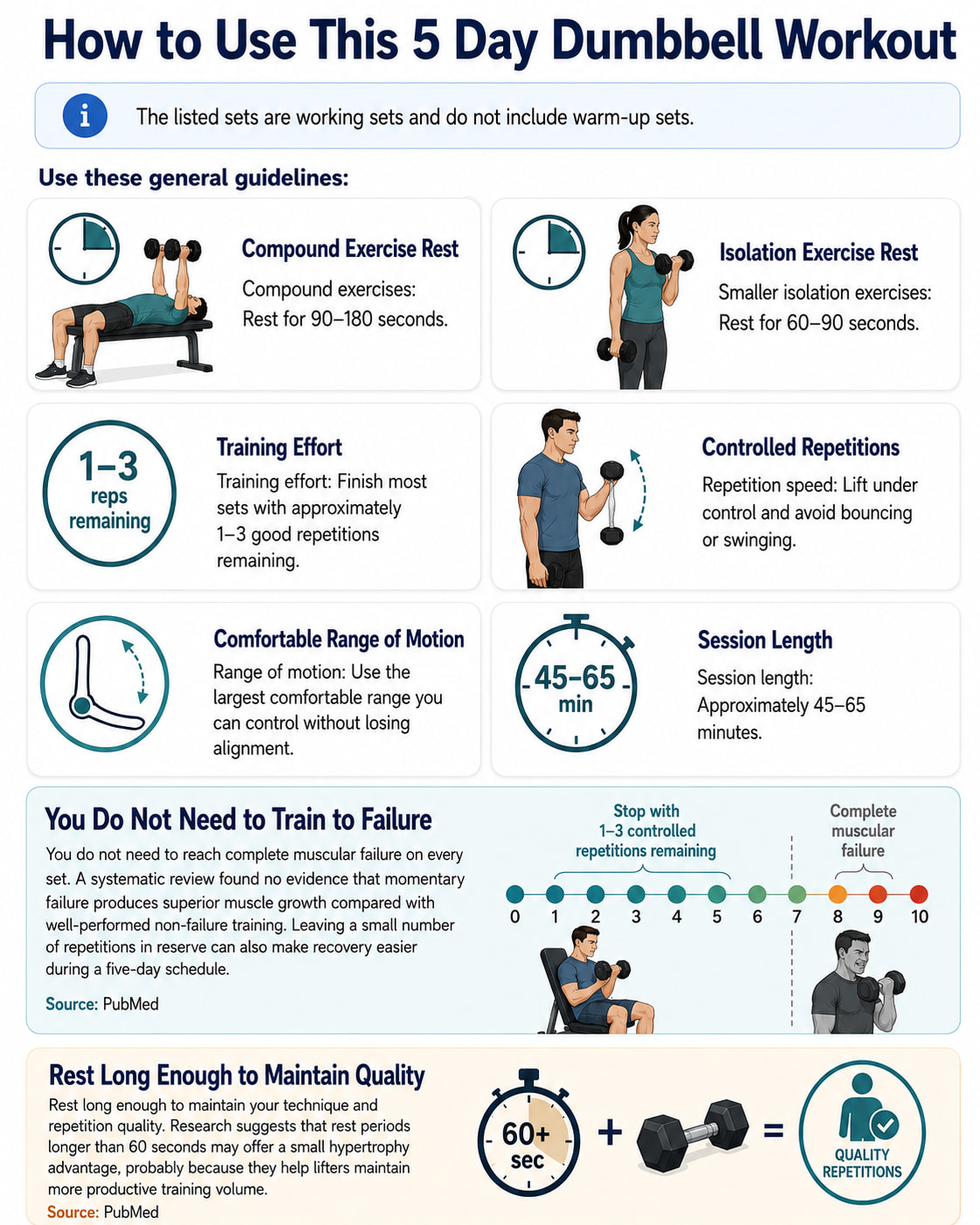
The listed sets are working sets and do not include warm-up sets.
Use these general guidelines:
- Compound exercises: Rest for 90–180 seconds.
- Smaller isolation exercises: Rest for 60–90 seconds.
- Training effort: Finish most sets with approximately 1–3 good repetitions remaining.
- Repetition speed: Lift under control and avoid bouncing or swinging.
- Range of motion: Use the largest comfortable range you can control without losing alignment.
- Session length: Approximately 45–65 minutes.
You do not need to reach complete muscular failure on every set. A systematic review found no evidence that momentary failure produces superior muscle growth compared with well-performed non-failure training. Leaving a small number of repetitions in reserve can also make recovery easier during a five-day schedule.
Rest long enough to maintain your technique and repetition quality. Research suggests that rest periods longer than 60 seconds may offer a small hypertrophy advantage, probably because they help lifters maintain more productive training volume. (PubMed)
How to Choose the Right Dumbbell Weight
Choose a weight that allows you to complete at least the minimum number of prescribed repetitions without:
- Swinging the dumbbells
- Shortening the movement
- Holding your breath
- Losing your balance
- Bending your wrists excessively
- Changing your posture to finish the set
The final repetitions should feel challenging, but your form should remain recognizable and controlled.
The weight is probably too heavy when you cannot reach the lower end of the repetition range. It may be too light when you exceed the top of the range and could still complete several additional repetitions.
Use heavier dumbbells for squats, Romanian deadlifts, rows, and presses than for lateral raises, reverse flies, curls, and triceps extensions.
Warm-Up Before Each Workout
Spend approximately 5–8 minutes preparing for the session.
Begin with easy whole-body movement, such as brisk walking, marching, or cycling. Then perform controlled movements related to the workout, including:
- Bodyweight squats before lower-body training
- Hip hinges before Romanian deadlifts
- Arm circles before pressing
- Light rows before back training
- Reverse lunges without weight before loaded lunges
Before the first major exercise, complete one to three lighter warm-up sets. Gradually increase the weight while keeping the repetitions low enough that the warm-up does not cause fatigue.
Day 1: Dumbbell Push Workout
| Exercise | Sets and reps | Rest |
|---|---|---|
| Dumbbell bench press | 3 × 6–10 | 2–3 minutes |
| Incline dumbbell press | 3 × 8–12 | 90–120 seconds |
| Seated dumbbell shoulder press | 3 × 6–10 | 2 minutes |
| Dumbbell lateral raise | 2 × 12–20 | 60–90 seconds |
| Overhead dumbbell triceps extension | 2 × 10–15 | 60–90 seconds |
1. Dumbbell Bench Press
Best for: Building chest pressing strength.
Muscles worked: Pectoralis major, anterior deltoids, and triceps.
How to do it:
- Lie on a flat bench with your head, upper back, and hips supported.
- Plant both feet firmly on the floor and hold the dumbbells above your chest.
- Lower the weights with your elbows slightly below shoulder level.
- Press the dumbbells upward until your arms are straight without forcefully locking the elbows.
Common mistakes: Flaring the elbows directly sideways, bending the wrists backward, bouncing the weights, or using an excessive lower-back arch.
The ACE chest press instructions similarly emphasize stable foot placement and a controlled pressing position.
No-bench option: Perform a dumbbell floor press.
2. Incline Dumbbell Press
Best for: Adding a second chest movement with greater emphasis on the upper chest and front shoulders.
Muscles worked: Pectoralis major, anterior deltoids, and triceps.
How to do it:
- Set the bench to a low or moderate incline.
- Keep your feet planted and upper back supported.
- Begin with the dumbbells beside the upper chest.
- Press upward and slightly inward, then lower under control.
Common mistakes: Setting the bench too upright, allowing the shoulders to roll forward, or bringing the dumbbells together forcefully at the top.
No-bench option: Use a neutral-grip floor press or single-arm floor press.
3. Seated Dumbbell Shoulder Press
Best for: Building overhead pressing strength.
Muscles worked: Deltoids, triceps, upper chest, and upper-back stabilizers.
How to do it:
- Sit against the bench with your feet flat.
- Hold the dumbbells near shoulder height with neutral wrists.
- Brace your abdomen and keep your ribs controlled.
- Press overhead without leaning backward, then lower smoothly.
Common mistakes: Flaring the ribs, overextending the lower back, pressing the weights too far behind the head, or shrugging excessively.
The ACE seated overhead press guide recommends supporting the torso, planting the feet, and bracing the core.
No-bench option: Perform the movement standing with a lighter weight.
4. Dumbbell Lateral Raise
Best for: Directly training the side deltoids.
Muscles worked: Middle deltoids, with assistance from the upper trapezius and rotator-cuff muscles.
How to do it:
- Stand tall with light dumbbells beside your thighs.
- Keep a small bend in your elbows.
- Raise your arms slightly forward of your sides until approximately shoulder height.
- Lower slowly without resting between repetitions.
Common mistakes: Swinging the torso, leading with the hands, raising the dumbbells far above the shoulders, or shrugging toward the ears.
Regression: Perform one arm at a time while holding a stable support.
5. Overhead Dumbbell Triceps Extension
Best for: Direct triceps training, particularly in an overhead position.
Muscles worked: Triceps, especially the long head.
How to do it:
- Hold one dumbbell with both hands above your head.
- Keep the elbows pointing generally forward.
- Bend the elbows to lower the dumbbell behind your head.
- Extend the elbows to return to the starting position.
Common mistakes: Allowing the elbows to spread widely, arching the back, moving the upper arms excessively, or lowering farther than your shoulders comfortably allow.
Day 2: Dumbbell Lower Body A and Core
| Exercise | Sets and reps | Rest |
|---|---|---|
| Dumbbell goblet squat | 3 × 8–12 | 2 minutes |
| Dumbbell Romanian deadlift | 3 × 8–12 | 2–3 minutes |
| Dumbbell reverse lunge | 3 × 8–12 per side | 90–120 seconds |
| Standing dumbbell calf raise | 3 × 12–20 | 60–90 seconds |
| Dumbbell dead bug | 2 × 6–10 per side | 60 seconds |
1. Dumbbell Goblet Squat
Best for: Training the quadriceps and glutes with a simple front-loaded squat.
Muscles worked: Quadriceps, gluteus maximus, adductors, and core.
How to do it:
- Hold one dumbbell vertically close to your chest.
- Stand with your feet in a comfortable squat stance.
- Sit down between your legs while keeping your heels planted.
- Keep your knees tracking in the same general direction as your toes.
- Push through both feet to stand.
Common mistakes: Letting the heels lift, allowing the knees to collapse inward, rounding the back, or holding the dumbbell away from the chest.
The ACE goblet squat guide uses a close-to-the-chest dumbbell position and a controlled squat with the back maintained.
Regression: Squat to a stable bench and stand back up.
2. Dumbbell Romanian Deadlift
Best for: Strengthening the hamstrings, glutes, and hip-hinge pattern.
Muscles worked: Hamstrings, gluteus maximus, adductors, spinal stabilizers, and grip muscles.
How to do it:
- Hold the dumbbells in front of your thighs.
- Soften your knees and push your hips backward.
- Keep the dumbbells close to your legs as your torso inclines.
- Stop when you reach your controlled hamstring range.
- Drive your hips forward to stand tall.
Common mistakes: Turning the movement into a squat, allowing the weights to drift forward, rounding the lower back, or leaning backward at the top.
Coaching cue: Move your hips backward as though closing a door behind you.
3. Dumbbell Reverse Lunge
Best for: Unilateral leg strength with generally less forward momentum than a forward lunge.
Muscles worked: Quadriceps, glutes, hamstrings, adductors, and calves.
How to do it:
- Stand with a dumbbell in each hand.
- Step one foot backward and place the ball of that foot on the floor.
- Bend both knees while keeping the front foot planted.
- Push through the front leg to return to standing.
- Complete all repetitions or alternate sides.
Common mistakes: Stepping directly behind the front foot, pushing mainly from the rear leg, losing front-knee alignment, or rushing the return.
Regression: Use body weight or hold one dumbbell at your chest.
4. Standing Dumbbell Calf Raise
Best for: Training the calf muscles through ankle plantar flexion.
Muscles worked: Gastrocnemius and soleus.
How to do it:
- Hold the dumbbells beside your body.
- Rise onto the balls of your feet.
- Pause briefly at the top.
- Lower your heels under control.
Common mistakes: Bouncing, rolling the ankles outward, using only a shortened range, or rushing the lowering phase.
Progression: Perform the exercise one leg at a time while holding a stable support.
5. Dumbbell Dead Bug
Best for: Practicing trunk control while the arms and legs move.
Muscles worked: Abdominals, deep trunk stabilizers, and hip flexors.
How to do it:
- Lie on your back and hold one light dumbbell above your chest with both hands.
- Lift your legs so the hips and knees are bent to approximately 90 degrees.
- Gently brace your abdomen.
- Lower one heel toward the floor without allowing your lower back to arch.
- Return and repeat on the opposite side.
Common mistakes: Moving too quickly, holding the breath, using a heavy dumbbell, or continuing after the lower back begins lifting.
Day 3: Dumbbell Pull Workout
| Exercise | Sets and reps | Rest |
|---|---|---|
| Single-arm dumbbell row | 3 × 8–12 per side | 90–120 seconds |
| Chest-supported dumbbell row | 3 × 8–12 | 90–120 seconds |
| Chest-supported reverse fly | 2 × 12–20 | 60–90 seconds |
| Dumbbell hammer curl | 3 × 8–12 | 60–90 seconds |
1. Single-Arm Dumbbell Row
Best for: Training each side of the back independently.
Muscles worked: Latissimus dorsi, trapezius, rhomboids, rear deltoids, biceps, and forearms.
How to do it:
- Support one hand and knee on a bench.
- Keep your spine neutral and brace your abdomen.
- Allow the working arm to extend toward the floor.
- Pull the elbow toward your hip without rotating your torso.
- Lower the dumbbell until the arm is extended again.
Common mistakes: Twisting the torso, shrugging the working shoulder, jerking the dumbbell, or pulling the elbow excessively high.
The ACE single-arm row guide emphasizes a supported position, a braced trunk, and alignment between the head and spine. (ACE Fitness)
No-bench option: Brace your free hand against your front thigh.
2. Chest-Supported Dumbbell Row
Best for: Training the back while reducing the amount of work required from the lower back.
Muscles worked: Latissimus dorsi, rhomboids, trapezius, rear deltoids, and biceps.
How to do it:
- Set an incline bench to a comfortable angle.
- Lie face down with your chest supported.
- Let the dumbbells hang beneath your shoulders.
- Pull your elbows backward and bring the weights toward your lower ribs.
- Lower until the arms are straight.
Common mistakes: Lifting the chest away from the bench, shrugging, shortening the lowering phase, or using momentum.
No-bench option: Perform a two-dumbbell bent-over row with a lighter load.
3. Chest-Supported Reverse Fly
Best for: Training the rear shoulders and upper-back muscles.
Muscles worked: Posterior deltoids, rhomboids, and middle trapezius.
How to do it:
- Lie face down on an incline bench with light dumbbells hanging below you.
- Keep a small bend in your elbows.
- Sweep your arms outward until they are approximately level with your torso.
- Lower slowly to the starting position.
Common mistakes: Using heavy dumbbells, pulling the shoulders toward the ears, bending the elbows into a row, or swinging the weights.
The ACE incline reverse fly instructions recommend supporting the torso and bracing the core while the arms move.
4. Dumbbell Hammer Curl
Best for: Building the elbow flexors and forearms with a neutral grip.
Muscles worked: Biceps brachii, brachialis, and brachioradialis.
How to do it:
- Stand with the dumbbells beside your thighs and palms facing inward.
- Keep your upper arms close to your torso.
- Bend the elbows to raise the weights.
- Lower until the arms are straight without forcing the elbows backward.
Common mistakes: Swinging the hips, moving the elbows forward, bending the wrists, or dropping the weights quickly.
Day 4: Dumbbell Upper-Body Workout
| Exercise | Sets and reps | Rest |
|---|---|---|
| Dumbbell floor press | 3 × 8–12 | 90–120 seconds |
| Dumbbell bent-over row | 3 × 8–12 | 90–120 seconds |
| Dumbbell Arnold press | 2 × 8–12 | 90 seconds |
| Alternating dumbbell curl | 2 × 10–15 per side | 60–90 seconds |
| Lying dumbbell triceps extension | 2 × 10–15 | 60–90 seconds |
1. Dumbbell Floor Press
Best for: A bench-free chest press with a naturally limited bottom position.
Muscles worked: Chest, anterior deltoids, and triceps.
How to do it:
- Sit on the floor with the dumbbells beside your thighs.
- Carefully lie back and bring the dumbbells above your chest.
- Bend your elbows until the backs of your upper arms gently contact the floor.
- Press the dumbbells upward and lower again under control.
Common mistakes: Slamming the elbows into the floor, allowing the wrists to bend, or losing control while getting into position.
Progression: Perform a single-arm floor press to increase the trunk-stability demand.
2. Dumbbell Bent-Over Row
Best for: Training the back and hip-hinge position together.
Muscles worked: Latissimus dorsi, trapezius, rhomboids, rear deltoids, biceps, and spinal stabilizers.
How to do it:
- Hold the dumbbells and hinge at your hips.
- Keep a small bend in your knees and brace your trunk.
- Row both dumbbells toward your lower ribs.
- Pause briefly, then extend your arms under control.
Common mistakes: Standing more upright with each repetition, rounding the back, shrugging, or turning the exercise into a partial deadlift.
Regression: Support your chest on an incline bench.
3. Dumbbell Arnold Press
Best for: Training the shoulders through a combined rotation and press.
Muscles worked: Anterior and middle deltoids, triceps, and upper chest.
How to do it:
- Sit or stand with the dumbbells in front of your shoulders and palms facing you.
- Rotate your palms forward while pressing overhead.
- Finish with the dumbbells above your shoulders.
- Reverse the movement under control.
Common mistakes: Rushing the rotation, flaring the ribs, forcing an uncomfortable shoulder range, or using momentum.
Regression: Use a neutral-grip dumbbell shoulder press.
4. Alternating Dumbbell Curl
Best for: Direct biceps training while focusing on one arm at a time.
Muscles worked: Biceps brachii, brachialis, and forearm muscles.
How to do it:
- Stand tall with the dumbbells beside your thighs.
- Curl one dumbbell while keeping the upper arm still.
- Lower it fully before repeating with the other arm.
- Keep your trunk steady throughout the set.
Common mistakes: Rotating the torso, swinging the weight, lifting the elbow forward, or cutting the lowering phase short.
5. Lying Dumbbell Triceps Extension
Best for: Directly training the triceps after pressing exercises.
Muscles worked: All three heads of the triceps.
How to do it:
- Lie on a bench or the floor with the dumbbells above your shoulders.
- Keep your upper arms relatively still.
- Bend your elbows and lower the dumbbells toward the sides of your head.
- Extend the elbows to return to the starting position.
Common mistakes: Allowing the elbows to spread widely, turning the movement into a chest press, or lowering beyond your comfortable elbow and shoulder range.
Day 5: Dumbbell Lower Body B and Core
| Exercise | Sets and reps | Rest |
|---|---|---|
| Dumbbell Bulgarian split squat | 3 × 8–12 per side | 2 minutes |
| Dumbbell hip thrust or glute bridge | 3 × 8–15 | 90–120 seconds |
| Staggered-stance dumbbell Romanian deadlift | 3 × 10–12 per side | 90–120 seconds |
| Dumbbell suitcase carry | 3 × 20–40 seconds per side | 60–90 seconds |
1. Dumbbell Bulgarian Split Squat
Best for: Building single-leg strength and increasing the challenge without extremely heavy dumbbells.
Muscles worked: Quadriceps, glutes, adductors, and hamstrings.
How to do it:
- Stand in front of a bench and place the top of one foot behind you.
- Position the front foot far enough forward that you can descend comfortably.
- Lower your hips while keeping the front foot planted.
- Push through the front foot to stand.
- Complete the set before switching sides.
Common mistakes: Setting the feet too close together, pushing mainly through the rear leg, losing balance by rushing, or allowing the front heel to lift.
Regression: Perform a reverse lunge or supported split squat.
2. Dumbbell Hip Thrust or Glute Bridge
Best for: Direct glute training with less knee movement than a squat or lunge.
Muscles worked: Gluteus maximus, hamstrings, and hip stabilizers.
How to do it:
- Place your upper back against a bench for a hip thrust, or lie on the floor for a glute bridge.
- Position one dumbbell securely across your hips.
- Plant your feet and brace your trunk.
- Drive your hips upward until your torso and thighs form a straight line.
- Lower under control.
Common mistakes: Overarching the lower back, pushing through the toes, placing the feet too far away, or bouncing out of the bottom.
Coaching cue: Finish by squeezing the glutes, not by leaning backward.
3. Staggered-Stance Dumbbell Romanian Deadlift
Best for: Emphasizing one hamstring and glute while using the rear foot for balance.
Muscles worked: Hamstrings, glutes, adductors, and trunk stabilizers.
How to do it:
- Place most of your weight on one foot.
- Set the other foot slightly behind you as a kickstand.
- Push the working-side hip backward while keeping the dumbbells close to your legs.
- Stop at your controlled hamstring range.
- Drive through the front foot to stand.
Common mistakes: Shifting too much weight onto the rear foot, opening the hips, rounding the back, or turning the movement into a squat.
Regression: Use a regular two-leg Romanian deadlift.
4. Dumbbell Suitcase Carry
Best for: Grip strength and resisting sideways trunk movement.
Muscles worked: Obliques, deep core muscles, grip, shoulders, glutes, and legs.
How to do it:
- Hold one heavy dumbbell beside your body.
- Stand tall with your shoulders level.
- Walk with controlled steps without leaning toward or away from the weight.
- Turn carefully and complete the planned time.
- Switch hands.
Common mistakes: Leaning sideways, shrugging the loaded shoulder, rushing, or using a weight that pulls you out of alignment.
Limited-space option: March slowly in place while holding the dumbbell.
How to Progress the Workout
Use double progression rather than adding weight at every session.
- Begin with a weight that allows you to reach the lower end of the repetition range.
- Add one or two repetitions over future workouts while maintaining 1–3 repetitions in reserve.
- When you reach the top of the range on every set with controlled form, use the next heavier dumbbell.
- Return to the lower end of the repetition range and build upward again.
For example, the dumbbell bench press is programmed for 6–10 repetitions:
- Workout 1: 10 kg × 8, 8, 7
- Workout 2: 10 kg × 9, 8, 8
- Workout 3: 10 kg × 10, 10, 9
- Workout 4: 10 kg × 10, 10, 10
- Next workout: Increase the weight and begin near 6–8 repetitions
Do not increase the load when the additional weight causes you to shorten the range, swing, lose balance, or change the exercise into a different movement.
When Your Dumbbells Are Too Light
You can continue progressing by:
- Adding repetitions within a controlled range
- Taking approximately three seconds to lower the weight
- Pausing briefly in the hardest position
- Using a single-arm or single-leg variation
- Increasing the safe range of motion
- Adding one set to selected exercises
Do not add all of these methods at once. Change one variable and track whether performance improves.
Beginner Modification
For the first two weeks:
- Perform two sets per exercise
- Keep approximately three repetitions in reserve
- Use the lower end of each repetition range
- Skip optional isolation exercises when you feel overly fatigued
- Focus on learning consistent positions and controlled movement
After two weeks, add the third set to the first two exercises of each workout. Add the remaining volume only when you are recovering well.
A beginner does not need to complete every prescribed set immediately for the program to be useful.
No-Bench Substitutions
| Original exercise | No-bench alternative |
|---|---|
| Dumbbell bench press | Dumbbell floor press |
| Incline dumbbell press | Single-arm or neutral-grip floor press |
| Seated shoulder press | Standing dumbbell shoulder press |
| Single-arm supported row | Row with one hand braced on the thigh |
| Chest-supported row | Two-dumbbell bent-over row |
| Chest-supported reverse fly | Bent-over reverse fly |
| Bulgarian split squat | Reverse lunge or stationary split squat |
| Dumbbell hip thrust | Dumbbell floor glute bridge |
Recovery and Weekly Programming
The two rest days are part of the program. You do not need to replace them with additional hard lifting.
Light walking, comfortable mobility work, and normal daily activity are reasonable on recovery days. Avoid turning every rest day into another demanding leg, arm, or conditioning workout.
Reduce your training volume when:
- Performance decreases across several sessions
- Normal soreness does not improve before the next workout
- Your joints become increasingly irritated
- Your technique worsens with weights you previously controlled
- You cannot maintain the planned effort level
A simple adjustment is to remove one set from each exercise for a week. You can also keep the same number of sets while stopping each set farther from failure.
Common 5 Day Dumbbell Workout Mistakes
Training Five Hard Days in a Row
Five consecutive lifting days can make it harder to maintain performance, especially during the later sessions. Use the planned Thursday and Sunday recovery days when possible.
Taking Every Set to Failure
Failure training is not required for strength or muscle growth and can produce unnecessary fatigue. Save extremely challenging sets for occasional final sets of safer isolation exercises rather than every compound movement.
Using the Same Dumbbells for Every Exercise
Your legs and back will usually handle more load than your shoulders and arms. Select the weight separately for each movement.
Progressing Before Form Is Stable
Adding weight is not progress when it causes swinging, shortened repetitions, loss of balance, or uncontrolled lowering.
Changing Exercises Too Often
Keep the main movements consistent long enough to compare repetitions, weight, and technique. A practical approach is to follow the plan for approximately 6–8 weeks before making major exercise changes.
Adding Too Much Extra Volume
More exercises are not automatically better. Complete the planned work first and add volume only when recovery and performance remain strong.
Frequently Asked Questions
Can a 5 day dumbbell workout build muscle?
Yes. Dumbbells can build muscle when the exercises provide sufficient resistance, the sets are challenging, and the workload increases gradually. ACSM’s current guidance indicates that equipment type is less important than consistent progressive resistance training.
Is this plan suitable for beginners?
It can be modified for beginners, but five full sessions may be more than a new lifter needs. Begin with two sets per exercise, lighter weights, and approximately three repetitions in reserve. Complete beginners may progress just as well with three weekly full-body sessions.
Can I perform all five workouts consecutively?
You can, but it is generally less practical for recovery and session quality. The recommended structure uses three training days, one rest day, two training days, and another rest day.
How long should each workout take?
Most sessions should take approximately 45–65 minutes. The exact duration depends on your warm-up, rest periods, equipment setup, and whether you perform two or three sets.
Can light dumbbells build muscle?
Light dumbbells can still create a productive training stimulus when sets become challenging, but very high repetitions may become uncomfortable or inefficient. Research suggests that muscle growth can occur across a range of loads, while heavier loads tend to provide a greater advantage for maximal strength development.
Use unilateral movements, pauses, slower lowering phases, and larger controlled ranges when heavier dumbbells are unavailable.
How long should I follow the program?
Follow it for approximately 6–8 weeks while recording your weights and repetitions. Continue longer when you are progressing and the exercises remain comfortable. Change the plan when progress has stalled despite appropriate recovery or when an exercise consistently does not suit you.
What should I do after missing a workout?
Continue with the next unfinished session rather than trying to perform two complete workouts on the same day. The weekly labels are less important than maintaining the order and allowing reasonable recovery.
Conclusion
A productive 5 day dumbbell workout does not need complicated techniques or a large collection of exercises. Use controlled compound movements, add a small amount of direct shoulder and arm work, leave one or two weekly recovery days, and track your repetitions and weights.
Begin with a manageable workload, stop most sets with 1–3 good repetitions remaining, and increase resistance only after you can complete the full repetition range with stable form.
Stop exercising and seek professional help if you experience sharp pain, numbness, dizziness, chest pain, or other unusual symptoms.
References
- American College of Sports Medicine: 2026 Resistance Training Guidelines
- ACSM Position Stand on Resistance Training Prescription
- Physical Activity Guidelines for Americans
- Resistance Training Frequency and Muscle Hypertrophy
- Proximity to Failure and Muscle Hypertrophy
- Inter-Set Rest Periods and Muscle Hypertrophy
- ACE Dumbbell Exercise Library
This content is for informational purposes only and is not a substitute for professional medical advice.