The dumbbell shoulder press is an overhead pressing exercise that primarily trains the front and sides of the shoulders, with the triceps assisting. Good form requires a stable torso, straight wrists, controlled elbows, and a comfortable overhead range without excessive back arching.
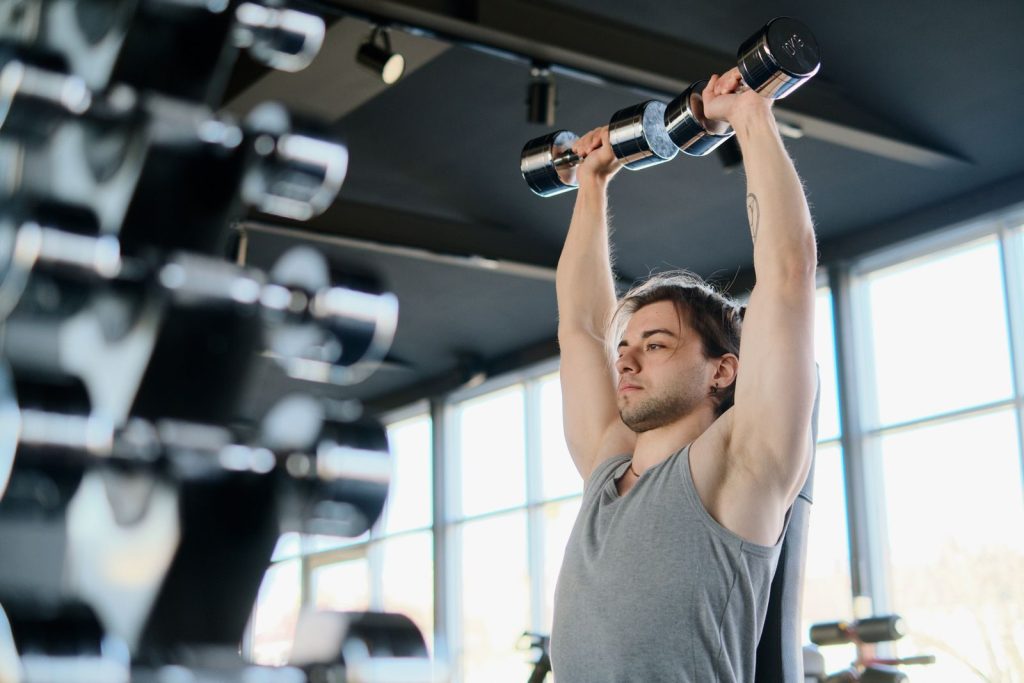
You can perform the dumbbell shoulder press seated or standing. The seated, back-supported version is usually the easiest variation to learn because the bench provides additional stability.
This guide explains proper dumbbell shoulder press form, muscles worked, benefits, common mistakes, variations, and practical ways to include it in your workout.
What Is a Dumbbell Shoulder Press?
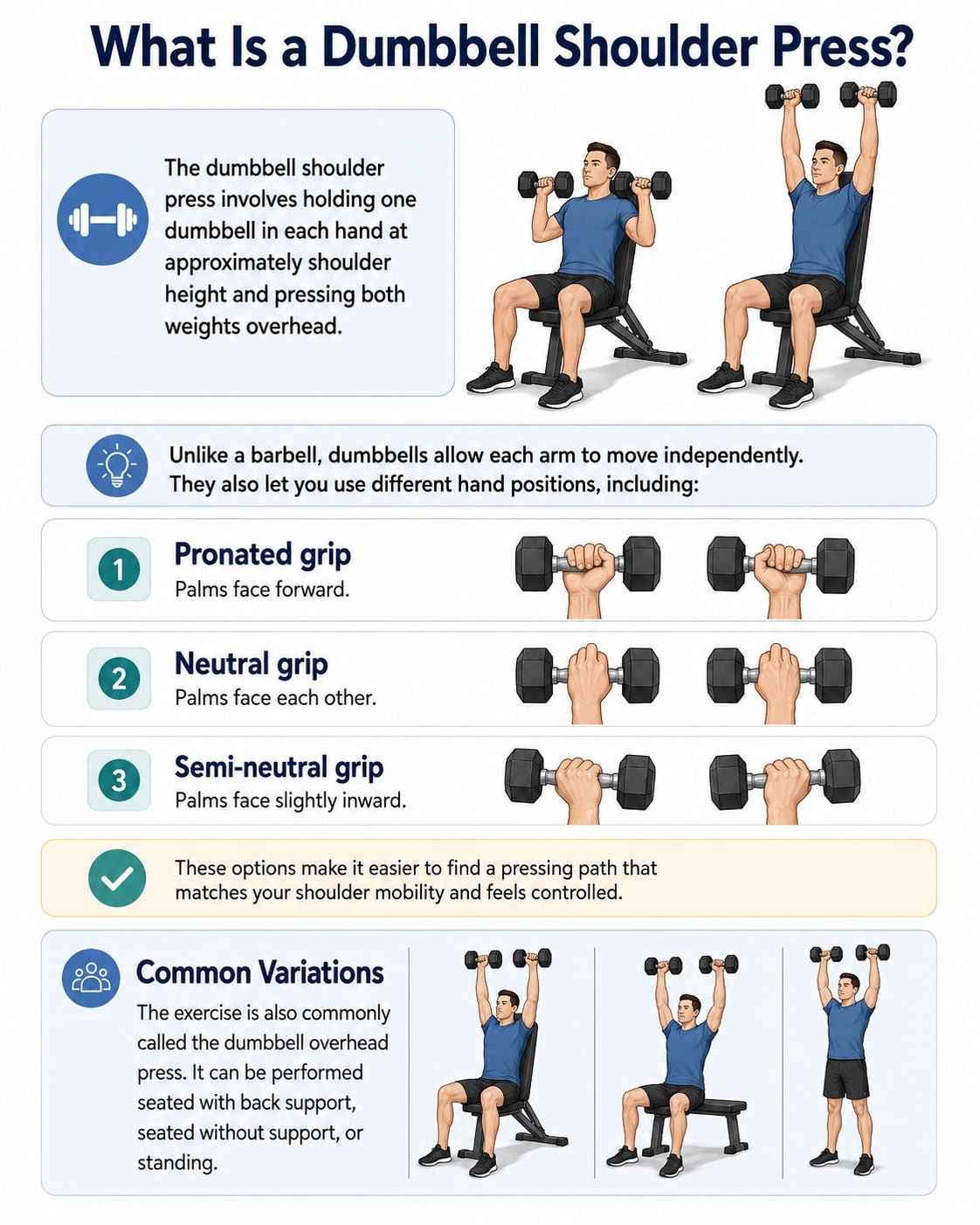
The dumbbell shoulder press involves holding one dumbbell in each hand at approximately shoulder height and pressing both weights overhead.
Unlike a barbell, dumbbells allow each arm to move independently. They also let you use different hand positions, including:
- Pronated grip: Palms face forward.
- Neutral grip: Palms face each other.
- Semi-neutral grip: Palms face slightly inward.
These options make it easier to find a pressing path that matches your shoulder mobility and feels controlled.
The exercise is also commonly called the dumbbell overhead press. It can be performed seated with back support, seated without support, or standing.
Dumbbell Shoulder Press Muscles Worked
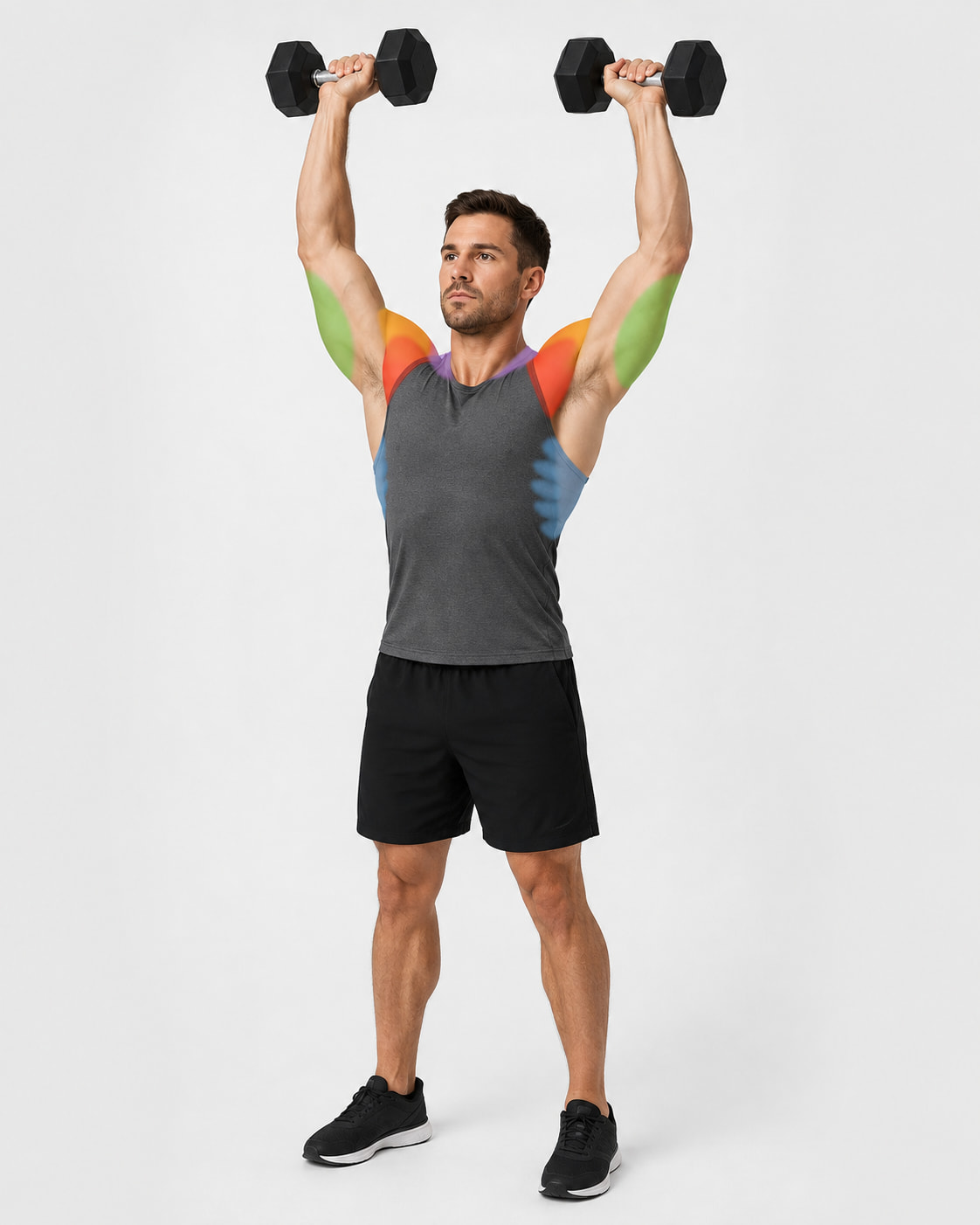
The dumbbell shoulder press is a compound upper-body exercise because movement occurs at both the shoulder and elbow joints.
| Muscle | Role during the exercise |
|---|---|
| Anterior deltoid | Helps raise and press the upper arm overhead |
| Lateral deltoid | Assists with raising the arm and controlling the press |
| Triceps brachii | Straightens the elbows during the upward phase |
| Trapezius and serratus anterior | Help move and control the shoulder blades as the arms rise |
| Rotator cuff | Helps stabilize the upper arm within the shoulder joint |
| Core and spinal stabilizers | Keep the torso controlled, especially during standing presses |
A small study available through the National Library of Medicine found that the shoulder press produced greater anterior-deltoid activation than the bench press, dumbbell fly, and lateral raise used in the comparison.
However, the press did not maximally train every part of the deltoid. Lateral raises and rear-delt exercises are still useful for balanced shoulder training.
Acute muscle-activation findings should not be interpreted as proof that one exercise will automatically produce more long-term muscle growth.
How to Do the Seated Dumbbell Shoulder Press
Best for: Building shoulder and triceps strength with additional torso support
Muscles worked: Anterior deltoids, lateral deltoids, triceps, upper-back stabilizers, and rotator cuff
Equipment needed: Two dumbbells and a stable bench with back support
Sets, reps, and rest: Start with 2–3 sets of 8–12 repetitions. Rest for approximately 90–150 seconds between sets.
Step-by-Step Instructions
- Set the bench backrest to a comfortable upright position.
- Sit with your feet flat on the floor. Keep your head, upper back, and hips supported by the bench.
- Hold one dumbbell in each hand using a secure, closed grip. Bring the weights to shoulder height.
- Position your wrists directly over or close to your elbows. Keep the wrists straight rather than allowing them to bend backward.
- Brace your abdomen and maintain a comfortable ribcage and pelvis position. Do not force your lower back flat, but avoid creating an exaggerated arch.
- Position your elbows slightly forward of a directly side-facing position. Your forearms should remain close to vertical.
- Exhale and press the dumbbells overhead. Keep your torso against the bench and avoid leaning backward to complete the repetition.
- Finish with your arms straight overhead in a comfortable position. Do not slam the dumbbells together or aggressively snap the elbows into lockout.
- Inhale as you lower the dumbbells slowly to approximately shoulder height, or to the lowest position you can control comfortably.
The American Council on Exercise similarly emphasizes firm foot placement, torso bracing, neutral wrists, controlled lowering, and avoiding lower-back arching.
Coaching cue: Keep your wrists stacked over your forearms and press without letting your ribs lift.
Important Dumbbell Shoulder Press Form Tips
Keep Your Forearms Close to Vertical
When viewed from the front, the wrists should remain reasonably aligned over the elbows.
If the dumbbells drift far inside or outside the elbows, you may lose pressing efficiency and place unnecessary stress on the wrists.
Use a Comfortable Elbow Position
Your elbows do not need to point directly sideways.
Allowing them to sit slightly forward often creates a more natural pressing path. A neutral or semi-neutral grip can move the elbows even farther forward when that position feels more comfortable.
Avoid forcing an exact elbow angle that does not match your shoulder structure or mobility.
Control Your Ribcage and Lower Back
Some natural spinal curvature is normal. The problem occurs when you lean far backward and turn the shoulder press into a steep incline press.
If your ribs rise sharply or your lower back arches more with every repetition, reduce the weight, use back support, or end the set.
Let the Shoulder Blades Move Naturally
The shoulder blades need to move as the arms travel overhead. Keep them controlled, but do not try to force them permanently down and back throughout the entire repetition.
Avoid beginning every repetition with a hard shrug. The movement should be smooth rather than forced.
Choose a Manageable Range of Motion
Lower the dumbbells until they are near shoulder height or until you reach the deepest position you can control without pain or compensation.
You do not need to force the elbows as low as possible. Stop the descent if your wrists bend, your shoulders roll forward, or your torso begins shifting.
Lower the Dumbbells Slowly
Do not allow gravity to pull the weights rapidly toward your shoulders.
A controlled lowering phase makes it easier to maintain alignment and prepare for the next repetition. A practical tempo is approximately one second up and two seconds down, although an exact speed is not required.
Benefits of the Dumbbell Shoulder Press
Builds Shoulder and Triceps Strength
The exercise trains the deltoids and triceps together, making it useful for developing general pressing strength.
This may support other exercises such as incline presses, push-ups, machine presses, and overhead sports movements.
Supports Shoulder Muscle Growth
The dumbbell shoulder press allows you to train the deltoids through a substantial range with progressively heavier resistance.
It works particularly well as the main compound exercise in a shoulder workout. Lateral raises and rear-delt exercises can then be added to train the other portions of the shoulder more directly.
Trains Each Arm Independently
Each hand controls its own dumbbell. This can make noticeable left-to-right differences in strength, coordination, or range of motion easier to identify.
The goal is not to force both arms into perfectly identical paths. Instead, maintain consistent control on each side.
Provides Several Grip Options
Dumbbells allow you to move between a palms-forward, semi-neutral, or neutral grip.
This freedom can help you find a strong pressing path without being restricted to one fixed hand position.
Can Challenge Torso Stability
The standing variation requires you to control the weights without support from a bench.
A study indexed by the National Library of Medicine involving 15 healthy men found that the standing dumbbell press produced high deltoid muscle activity but allowed less weight to be lifted than more stable shoulder-press variations.
This suggests that standing increases the stability demand, but it does not prove that standing is better for long-term muscle growth.
Seated Versus Standing Dumbbell Shoulder Press
Neither variation is automatically better. Choose the version that matches your goal and current ability.
| Variation | Main advantage | Best for |
|---|---|---|
| Seated with back support | Provides the most external stability | Beginners, muscle-building workouts, and lifters who tend to lean backward |
| Seated without back support | Requires more torso control while removing balance demands | Intermediate lifters |
| Standing | Challenges whole-body stability and coordination | General overhead strength and experienced lifters |
| Single-arm standing | Increases the demand to resist leaning and rotation | Advanced trunk control and unilateral training |
Choose the Seated Version When:
- You are learning the movement.
- Your main goal is shoulder muscle development.
- You have difficulty controlling your lower back.
- You want to focus on the shoulders without managing standing balance.
- You are using moderately challenging dumbbells.
Choose the Standing Version When:
- You can press overhead without excessive leaning.
- You want more whole-body stabilization.
- Your training goal includes standing overhead strength.
- You can keep your knees and hips still during each repetition.
A strict standing press should not include leg drive. Bending and extending the knees turns the movement into a push press, which is a different exercise.
Common Dumbbell Shoulder Press Mistakes
Using Too Much Weight
Heavy dumbbells often cause shortened repetitions, bent wrists, excessive back arching, and uncontrolled lowering.
Choose a load that allows you to maintain the same technique from the first repetition to the last.
Leaning Far Backward
Leaning backward shifts more work toward the upper chest and increases the demand on the lower back.
Brace before pressing and keep your torso stable. Reduce the weight if you cannot finish a repetition without changing your body position.
Bending the Wrists Backward
Keep your knuckles generally facing upward and the dumbbell handles supported over your forearms.
A lighter load may be necessary if your wrists repeatedly collapse backward.
Flaring the Elbows Directly Sideways
Forcing the upper arms into a straight line across the body is not necessary.
Bring the elbows slightly forward and use a grip that lets the shoulders move comfortably.
Lowering Too Deeply
More range is not automatically better when you cannot control it.
Lower only as far as your mobility and technique allow without pain, shoulder rolling, or wrist movement.
Stopping Every Rep Too High
Using an unnecessarily short range can reduce the amount of work performed.
When comfortable, lower the dumbbells close to shoulder height while keeping the forearms controlled.
Hitting the Dumbbells Together
The weights do not need to touch at the top.
Maintain a small space between them and keep tension under control instead of using the collision as a target.
Using Leg Drive During a Strict Press
Keep the feet planted and the knees still. If your legs repeatedly help start the press, the dumbbells are probably too heavy for strict repetitions.
Dumbbell Shoulder Press Regressions
Seated Neutral-Grip Shoulder Press
Perform the exercise with your palms facing each other and elbows positioned slightly forward.
This is a useful starting option for lifters who find a fully palms-forward grip awkward.
Light Back-Supported Shoulder Press
Use a stable backrest and very light dumbbells while learning to coordinate the elbow, wrist, and dumbbell path.
Increase the load only after your movement remains consistent.
Reduced-Range Dumbbell Press
Lower the dumbbells only to the depth you can control comfortably. Gradually increase the range when you can do so without pain or compensation.
Machine Shoulder Press
A machine follows a more fixed path and removes some of the balance required by dumbbells.
Adjust the seat so the handles begin near shoulder level, and use a grip that feels comfortable.
Single-Arm Landmine Press
A landmine press travels forward and upward rather than directly overhead. It can be a useful alternative when a vertical press is uncomfortable or difficult to control.
Dumbbell Shoulder Press Progressions
Standing Dumbbell Shoulder Press
Remove the back support and perform the press while standing with your feet approximately hip- to shoulder-width apart.
Keep your glutes and abdomen engaged without squeezing so hard that you cannot breathe normally.
Single-Arm Standing Press
Press one dumbbell while keeping your torso upright. Avoid leaning sideways or rotating toward the working arm.
Paused Shoulder Press
Pause briefly near shoulder height before each repetition. This removes momentum and encourages a stable starting position.
Slow-Eccentric Shoulder Press
Take approximately three seconds to lower the dumbbells. Use a lighter load so you can maintain control.
Heavier Seated Press
Increase the dumbbell weight only after you can complete the top of your repetition range without leaning, shortening the motion, or losing wrist alignment.
Dumbbell Shoulder Press Sets, Reps and Rest
Use the following ranges as practical starting points rather than rigid rules.
| Goal | Sets | Repetitions | Rest | Suggested effort |
|---|---|---|---|---|
| Beginner technique | 2–3 | 8–12 | 90–120 seconds | Finish with 2–3 good reps remaining |
| Muscle building | 3–4 | 6–12 | 90–180 seconds | Finish with 1–3 good reps remaining |
| Strength | 2–4 | 4–8 | 2–3 minutes | Use a challenging but controlled load |
| Lighter accessory work | 2–3 | 10–15 | 60–90 seconds | Avoid technique breakdown |
The 2026 American College of Sports Medicine resistance-training position stand concluded that progressive resistance training improves strength and muscle size.
It also found that heavier loads tend to favor maximal strength, higher weekly volume can support hypertrophy, and training every set to complete muscular failure is not consistently necessary.
Rest long enough to keep your repetitions controlled. A 2024 systematic review indexed by the National Library of Medicine found a small potential muscle-building advantage from rest periods longer than 60 seconds, possibly because longer rests help maintain training volume.
How to Choose the Right Dumbbell Weight
Choose a weight that lets you complete the planned repetitions without:
- Leaning far backward
- Bending your wrists
- Using leg drive
- Shortening the movement more with each repetition
- Dropping the dumbbells quickly
- Losing control of your elbow position
A practical approach is to finish most working sets with approximately 1–3 repetitions in reserve. This means you feel you could perform another one to three controlled repetitions before your form would break down.
Beginners can leave slightly more repetitions in reserve while learning the exercise.
How to Progress the Dumbbell Shoulder Press
Use a simple double-progression method:
- Select a repetition range, such as 8–12.
- Begin with a weight you can press for at least eight controlled repetitions.
- Add repetitions over several workouts.
- When you can complete all planned sets at 12 repetitions with consistent form, increase to the next available dumbbell weight.
- Return toward the lower end of the repetition range and repeat.
Do not increase the weight merely because you completed the target repetitions once. Your technique should remain stable across every working set.
How Often Should You Do the Dumbbell Shoulder Press?
Most lifters can perform the exercise once or twice per week.
Your ideal frequency depends on:
- Your total number of pressing exercises
- How much bench and incline pressing you already perform
- Your weekly shoulder volume
- The difficulty of your working sets
- Your recovery between workouts
Bench presses, incline presses, and push-ups also train the anterior deltoids. More shoulder pressing is not always necessary when your routine already contains substantial chest pressing.
Allow enough recovery that shoulder soreness, triceps fatigue, or reduced performance does not interfere with your next session.
Sample Dumbbell Shoulder Workout
Perform this workout once or twice per week with at least two days between demanding shoulder sessions.
Beginner-to-Intermediate Shoulder Workout
| Exercise | Sets | Repetitions | Rest |
|---|---|---|---|
| Seated dumbbell shoulder press | 3 | 6–10 | 90–150 seconds |
| Dumbbell lateral raise | 2–3 | 12–20 | 60–90 seconds |
| Incline reverse fly | 2–3 | 10–15 | 60–90 seconds |
Finish most sets with approximately two controlled repetitions remaining.
Place the shoulder press first when improving it is your main goal. Progress by adding repetitions before increasing the dumbbell weight.
The lateral raise and reverse fly are included because a shoulder press alone does not train every portion of the deltoid equally.
Before Starting Your Shoulder Press Workout
Complete two or three lighter warm-up sets before your first challenging set.
For example:
- First warm-up set: Very light dumbbells for 10–12 repetitions
- Second warm-up set: Moderate weight for 6–8 repetitions
- Optional third set: Slightly heavier weight for 3–5 repetitions
Keep the warm-up repetitions easy. Their purpose is to practice the movement and prepare for the working weight, not to fatigue your shoulders.
Use a stable bench, keep the area around you clear, and make sure you can bring the dumbbells into and out of position safely. For very challenging sets, use an experienced spotter or choose a shoulder-press machine.
Dumbbell Shoulder Press Safety
Muscular effort is expected, but the exercise should not cause sharp or increasing shoulder pain.
Stop the set if you experience:
- Sharp shoulder, neck, or back pain
- Numbness or tingling
- Sudden weakness
- Dizziness
- Chest pain
- Loss of control over a dumbbell
- Any unusual symptoms
The American Academy of Orthopaedic Surgeons notes that shoulder problems may involve pain when lifting or lowering the arm, loss of strength, restricted movement, and pain that becomes worse at night.
Persistent symptoms should be assessed by a qualified healthcare professional rather than trained through.
A smaller range, lighter dumbbells, or neutral grip may help you find a more manageable position, but modifications should not be used to ignore continuing pain.
Frequently Asked Questions
Is the dumbbell shoulder press the same as an overhead press?
The terms are often used interchangeably. “Overhead press” is a broad category that includes dumbbell, barbell, kettlebell, and machine variations. A dumbbell shoulder press is one type of overhead press.
Should my palms face forward or toward each other?
Both positions can work.
A palms-forward grip is the traditional version. A neutral or semi-neutral grip places the elbows slightly farther forward and may feel more natural for some lifters. Use the grip that allows controlled, comfortable repetitions.
How low should I lower the dumbbells?
Lower them to approximately shoulder height or to the deepest position you can control without pain, wrist bending, shoulder rolling, or torso movement.
There is no single depth that is correct for every person.
Should the dumbbells touch at the top?
No. Press until your arms are comfortably straight, but keep a small space between the dumbbells.
Hitting them together can reduce control without improving the exercise.
Why do I feel the dumbbell shoulder press in my lower back?
You may be leaning backward, allowing your ribs to flare, or using more weight than you can control.
Reduce the load, brace before pressing, and use a back-supported bench. End the set when you can no longer maintain your torso position.
Does the dumbbell shoulder press work the rear deltoids?
The rear deltoids may assist with shoulder control, but they are not a primary target of the exercise.
Include reverse flies, rear-delt rows, or similar movements if balanced shoulder development is your goal.
Is seated or standing better for building muscle?
Both can build muscle when performed progressively.
The seated version often makes it easier to stabilize the torso and focus on the shoulders. The standing version requires more whole-body control and may limit how much weight you can press.
Choose the version that lets you train consistently with strong technique.
Conclusion
The dumbbell shoulder press is an effective compound exercise for building shoulder and triceps strength. Start with the back-supported seated version, keep your wrists stacked, use a comfortable elbow path, and press without leaning backward.
Choose a weight you can control through a pain-free range, progress gradually, and combine the press with lateral- and rear-delt exercises for a more complete shoulder workout.
This content is for informational purposes only and is not a substitute for professional medical advice.
References
- American College of Sports Medicine: Resistance Training Prescription for Muscle Function, Hypertrophy, and Physical Performance
- American Council on Exercise: Seated Overhead Press
- Effects of Body Position and Loading Modality on Muscle Activity and Strength in Shoulder Presses
- Different Shoulder Exercises Affect Deltoid Muscle Activation
- Resistance Training Prescription for Muscle Strength and Hypertrophy in Healthy Adults
- Inter-Set Rest Periods and Muscle Hypertrophy: Systematic Review and Meta-Analysis
- American Academy of Orthopaedic Surgeons: Shoulder Impingement and Rotator Cuff Tendinitis
2 thoughts on “Dumbbell Shoulder Press: Form, Muscles Worked and Tips”