
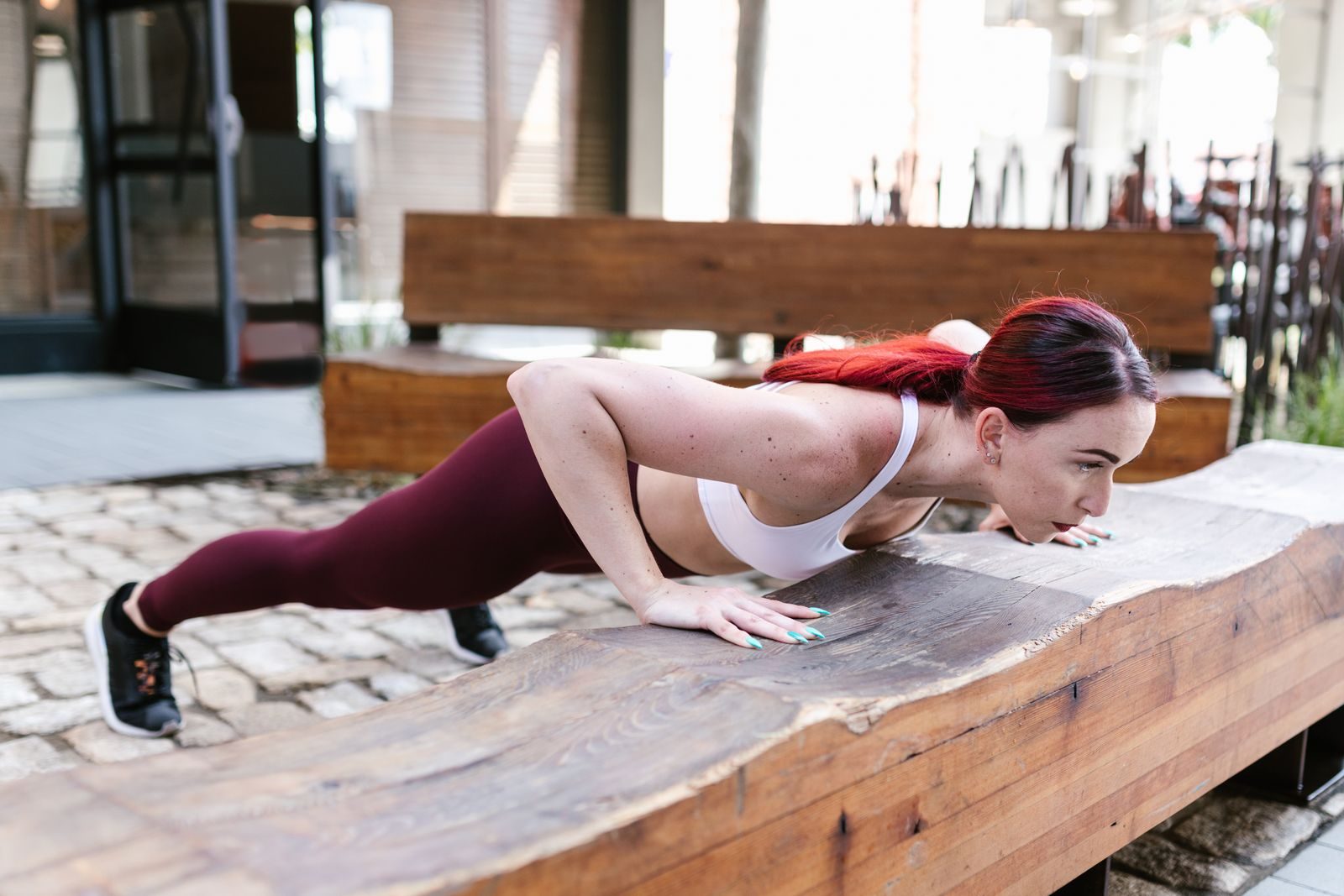
Chest exercises for women can start with straightforward movements such as push-ups, dumbbell presses, and machine presses. Choose one or two exercises that match your strength and equipment—not all nine in the same workout.
This guide explains how to perform each movement, choose suitable alternatives, and build a manageable routine you can progress over time.
What to Know Before Choosing Chest Exercises
Your pectoralis major, the large muscle across your chest, works with your triceps and the fronts of your shoulders during pressing exercises. Push-ups also require your abdominal muscles to help hold your body steady. You are training several muscles together, not just your chest.
Chest muscles and breast tissue are different. As Johns Hopkins Medicine explains, muscles lie underneath the breasts rather than within them. Strengthening those muscles should not be presented as a guaranteed way to lift or enlarge your breasts. The goal here is stronger, more controlled upper-body movement.
Choose an Exercise That Fits Your Starting Point
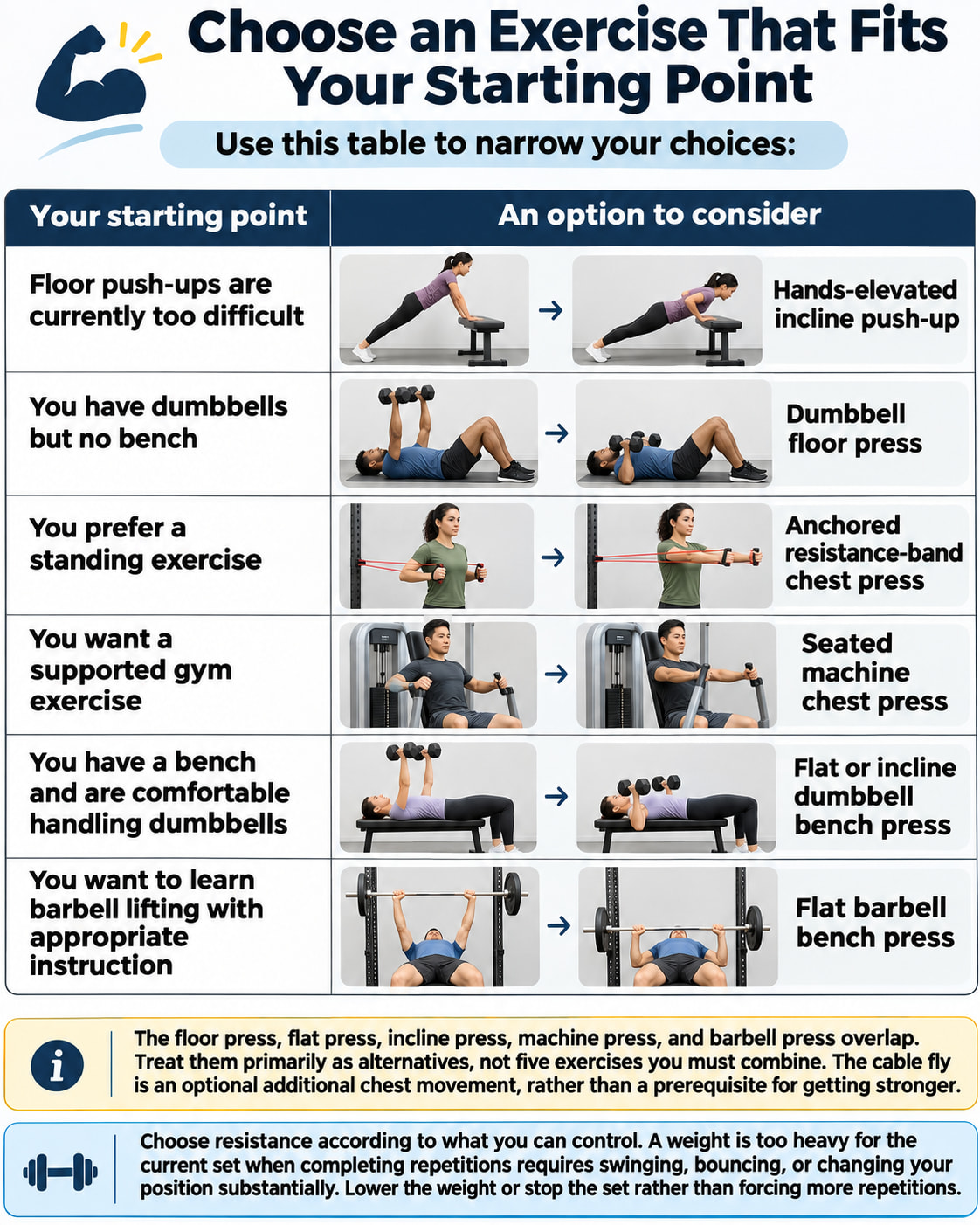
Use this table to narrow your choices:
| Your starting point | An option to consider |
|---|---|
| Floor push-ups are currently too difficult | Hands-elevated incline push-up |
| You have dumbbells but no bench | Dumbbell floor press |
| You prefer a standing exercise | Anchored resistance-band chest press |
| You want a supported gym exercise | Seated machine chest press |
| You have a bench and are comfortable handling dumbbells | Flat or incline dumbbell bench press |
| You want to learn barbell lifting with appropriate instruction | Flat barbell bench press |
The floor press, flat press, incline press, machine press, and barbell press overlap. Treat them primarily as alternatives, not five exercises you must combine. The cable fly is an optional additional chest movement, rather than a prerequisite for getting stronger.
Choose resistance according to what you can control. A weight is too heavy for the current set when completing repetitions requires swinging, bouncing, or changing your position substantially. Lower the weight or stop the set rather than forcing more repetitions.
9 Chest Exercises for Women
The sets and repetitions below are suggested starting ranges for the exercises you select. Unless otherwise noted, rest about two minutes between sets.
Aim to finish most sets feeling that you could perform approximately two or three more controlled repetitions. This is a practical effort guide, not a number you need to judge perfectly. Training until you cannot complete another repetition is not necessary for strength gains.
1. Hands-Elevated Incline Push-Up
Choose this variation when you are building toward floor push-ups. Raising your hands reduces the difficulty while letting you practice keeping your body aligned. Use a stable bench or fixed countertop that cannot slide.
How to do it:
- Place your hands slightly wider than shoulder-width on the elevated surface.
- Step your feet back until your body forms a straight line from your head to your heels. Tighten your abdomen and glutes.
- Bend your elbows to lower your chest toward the surface. Let your elbows angle backward rather than point straight out to the sides.
- Press through your hands to straighten your arms, moving your chest and hips upward together.
Keep in mind: Do not reach forward with your chin or let your hips sag. Choose a higher surface when you cannot maintain your body position. A wall is an easier modification; a lower stable bench makes the exercise harder.
Starting dose: Two sets of 6–12 repetitions.
2. Standard Floor Push-Up
The floor push-up is a no-equipment option once you can control your body through the movement. You do not need to rush toward it simply because an elevated version feels less advanced.
How to do it:
- Start in a high plank with your hands slightly wider than your shoulders and your feet together or about hip-width apart.
- Brace your abdomen and glutes, keeping your neck aligned with your torso.
- Bend your elbows and lower your chest toward the floor. Use the deepest comfortable range you can control without losing your body alignment.
- Push the floor away and return to the starting position, raising your chest and hips together.
Keep in mind: A repetition is not complete when your chest rises but your hips stay behind. Return to an incline push-up when you cannot maintain a steady body position. Avoid bouncing at the bottom or flaring your elbows directly sideways.
Starting dose: Two sets of 6–12 repetitions. Use an elevated variation when six controlled floor repetitions are not yet available.
3. Dumbbell Floor Press
The floor press is a useful home option when you have two dumbbells but no bench. The floor limits how far your upper arms can travel behind your torso.
How to do it:
- Lie on your back on a mat with your knees bent and feet flat. Hold one dumbbell in each hand above your chest.
- Keep your wrists straight and your shoulder blades gently settled against the floor.
- Bend both elbows to lower the weights together. Keep your upper arms angled away from your ribs rather than flared straight out.
- Stop when the backs of your upper arms gently contact the floor.
- Press both dumbbells upward until your arms are straight, keeping your hips down.
Keep in mind: Touch the floor softly instead of bouncing your elbows. Do not lift your hips to help move the weights or knock the dumbbells together overhead. Start with weights you can get into and out of position with under control.
Starting dose: Two sets of 8–12 repetitions.
4. Flat Dumbbell Bench Press
Choose the flat dumbbell press when you have a bench and are comfortable controlling two weights. Unlike the floor press, the bench does not stop your upper arms at floor level, so you need to manage the bottom position yourself.
How to do it:
- Lie on a flat bench with your head, upper back, and hips supported. Plant your feet on the floor or a stable raised platform.
- Hold the dumbbells above your chest with your palms facing toward your feet. Keep your wrists straight and gently draw your shoulder blades back against the bench.
- Lower both weights together toward the sides of your chest. Keep your forearms approximately upright beneath the dumbbells.
- Stop at a comfortable depth, then press upward without lifting your hips or shrugging your shoulders.
Keep in mind: Do not force the dumbbells down to a particular depth when that causes discomfort or changes your position. Ask for help with the handoff when needed, and maintain a secure grip while the weights are being passed.
Starting dose: Two sets of 8–12 repetitions.
5. Incline Dumbbell Bench Press
An incline press changes the pressing angle and places more emphasis on the upper portion of your chest. This version uses an adjustable bench set to approximately 45 degrees.
How to do it:
- Set the bench to about 45 degrees. Sit back with your feet planted and your back and hips supported.
- Hold a dumbbell in each hand beside your upper chest, with your wrists positioned over your elbows.
- Press both weights upward together, keeping your shoulders away from your ears.
- Lower the dumbbells slowly to the starting position without bouncing or allowing your lower back to arch excessively.
Keep in mind: Do not turn the exercise into a shrug or use a larger back arch to finish a difficult repetition. Reduce the weight when you cannot maintain your position. There is no need to include both flat and incline presses in every session.
Starting dose: Two sets of 8–12 repetitions.
6. Standing Resistance-Band Chest Press
This exercise provides a standing alternative to lying presses. You need a long resistance band and a secure anchor behind you at approximately chest height.
How to do it:
- Secure the band at chest height using an anchoring method approved for your equipment.
- Face away from the anchor, grip the band securely in both hands, and step forward until there is tension.
- Place one foot in front of the other. Bring your hands beside your chest, with your elbows bent and slightly below shoulder height.
- Brace your abdomen and press both hands forward, keeping your torso steady.
- Slowly bend your elbows to return to the starting position. Do not let the band pull your hands backward abruptly.
Keep in mind: Your body should not rock forward and backward with each repetition. Use a lighter band when you cannot keep a stable stance. ACE includes the standing, chest-height anchored press as a home-training option.
Inspect the band and attachment points before use, and replace damaged equipment. Follow the manufacturer’s instructions for anchoring, stretch limits, and eye protection; do not improvise with unstable furniture.
Starting dose: Two sets of 10–15 repetitions.
7. Seated Machine Chest Press
A seated chest-press machine offers back support and a guided movement path. It is a practical choice when you prefer adjusting a weight stack to handling free weights.
How to do it:
- With the weight stack resting, select a manageable resistance and adjust the seat according to the machine’s instructions. The handles generally sit around mid-chest level.
- Sit with your back against the pad and your feet on the floor or designated support.
- Grasp the handles securely, keeping your wrists straight and your elbows below shoulder height.
- Press forward smoothly without lifting your torso away from the backrest.
- Return the handles slowly, keeping control as the weight stack lowers.
Keep in mind: Machines differ in handle options, starting positions, and adjustment mechanisms. Follow the instructions on the specific machine rather than copying another machine’s settings. Ask gym staff to check the setup when you are unsure. Avoid using momentum or slamming the stack.
Starting dose: Two sets of 8–12 repetitions.
8. Flat Barbell Bench Press
The barbell bench press is an optional choice for readers who want to develop barbell pressing skills. It is not a required step beyond dumbbells or machines.
For your first sessions, learn the setup with a qualified trainer or experienced coach. Use an appropriate bench station, a competent spotter, and correctly adjusted rack safeties where available.
How to do it:
- Lie on the bench with your eyes beneath the racked bar. Keep your head, upper back, and hips supported and your feet firmly planted.
- Grip the bar slightly wider than shoulder-width, with your thumbs wrapped around it. Unrack with assistance as needed and hold it above your chest.
- Lower the bar under control toward your middle-to-lower chest. Keep your wrists steady and avoid bouncing the bar.
- Press upward, keeping your hips on the bench and your feet planted.
- At the end of the set, guide the bar back into the rack with your spotter’s assistance. Keep holding it until both ends are securely supported.
Keep in mind: Begin with an empty bar or lighter training bar that you can control. Do not use a thumbless grip or attempt a final repetition that you expect to need help finishing.
Starting dose: Two sets of 6–10 repetitions, resting two to three minutes between sets.
9. Standing Cable Chest Fly
The cable fly adds a different movement: bringing your upper arms toward each other while maintaining a small bend in your elbows. Use it as an optional second exercise rather than feeling obligated to add it after several presses.
How to do it:
- Attach a single-hand handle to each pulley and set both pulleys slightly above shoulder height.
- Take one handle in each hand and step forward into a staggered stance. Keep your abdomen braced.
- With a soft bend in your elbows, bring your hands together in front of your chest in a wide, hugging motion.
- Pause briefly, then open your arms slowly. Stop within a comfortable shoulder range rather than pulling your arms far behind your torso.
Keep in mind: Keep the elbow angle relatively steady. Bending and straightening your elbows substantially turns the movement into a press. Reduce the resistance when you have to swing your torso or force the stretch.
Starting dose: Two sets of 10–15 repetitions.
How to Build a Chest Workout
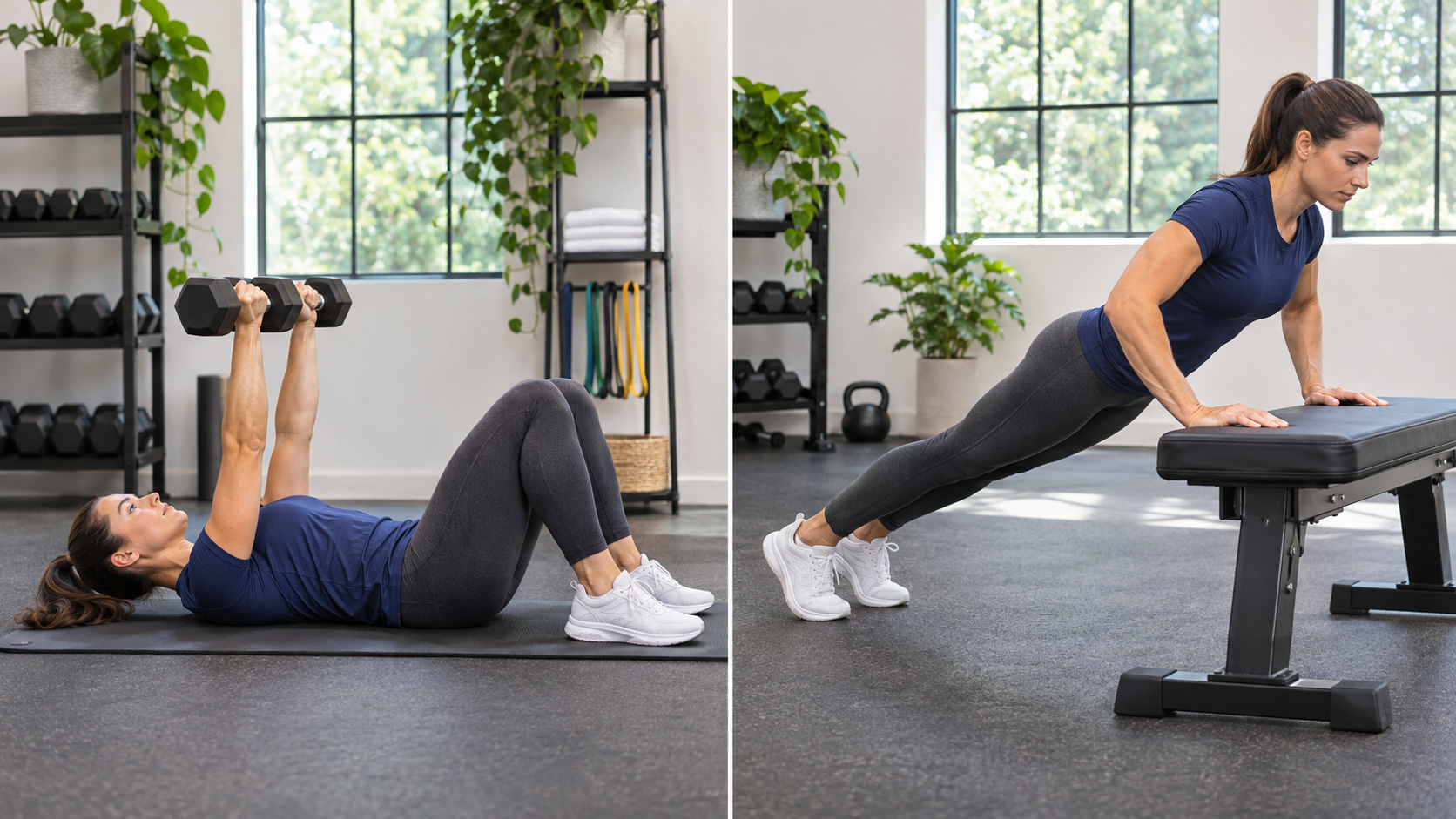
Use the following example as the chest portion of an upper-body or full-body workout, not a complete strength program.
Training all major muscle groups at least twice weekly is consistent with ACSM’s updated resistance-training guidance. A practical starting schedule for this routine is Monday and Thursday, leaving recovery time between sessions.
A Two-Exercise Starting Routine
Before lifting, warm up with five to ten minutes of comfortable aerobic movement. Then rehearse the exercises with an easy set: use lighter dumbbells for the floor press and a higher hand position for the push-up. These preparation sets should not leave you tired.
| Order | Exercise | Sets | Repetitions | Rest |
|---|---|---|---|---|
| 1 | Dumbbell floor press | 2 | 8–12 | About 2 minutes |
| 2 | Hands-elevated incline push-up | 2 | 6–12 | About 2 minutes |
Complete both sets of the floor press before moving to the push-up. Also rest about two minutes between exercises.
Allow roughly 15–25 minutes, including the warm-up, rest periods, and equipment transitions. Longer rests or additional setup practice will extend that estimate.
For your first few sessions, one set of each exercise is a reasonable way to learn the movements. Build toward two sets as the technique and recovery become manageable. The routine is a starting example, not a universal prescription.
Adjust the Routine to Your Equipment
Without weights: Perform two or three sets of either incline or standard push-ups instead of completing both entries in the table. You do not need two nearly identical push-up variations in the same beginner session.
With gym equipment: Replace the floor press with a flat dumbbell press, incline dumbbell press, or machine press. Keep the same two sets of 8–12 repetitions. The cable fly can replace the push-up for two sets of 10–15 repetitions rather than becoming an automatic third exercise.
For a standing option: Replace the floor press with two sets of 10–15 band presses. Keep the incline push-up only when its setup is suitable for you; starting with the band press alone is also an option.
Your broader program should still include the back, legs, hips, and other major muscle groups. Rows or pulldowns are examples of pulling movements to include elsewhere in your training. Chest work already present in another workout counts toward your overall workload—do not automatically add this routine on top of it.
How to Progress Your Chest Training
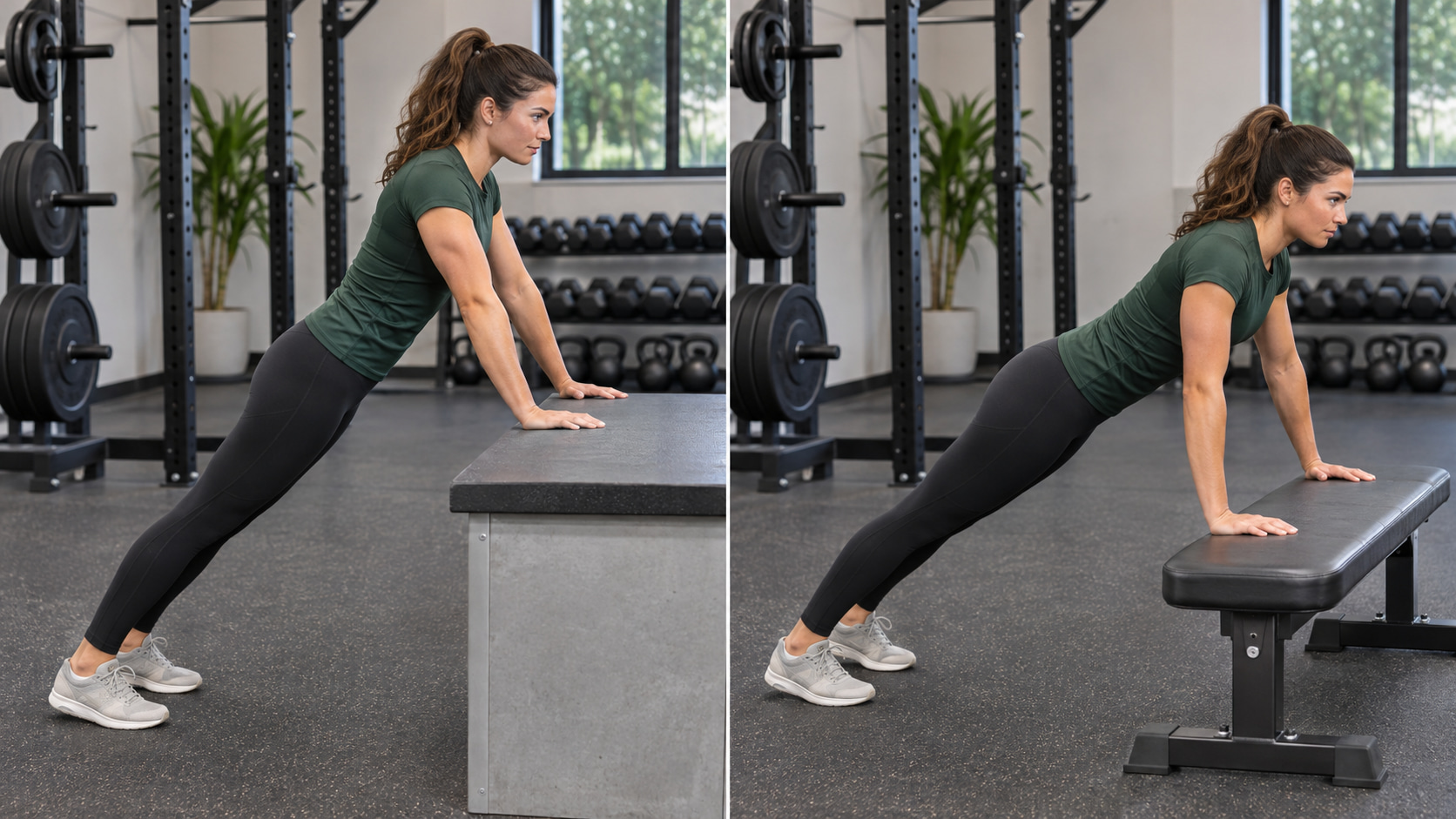
Keep a record of the exercise, resistance, repetitions, and any relevant setup details, such as the height of your push-up surface. Progress means making the exercise more demanding while preserving control, not simply doing more work.
Add Repetitions Before Increasing Resistance
For a floor press prescribed at two sets of 8–12 repetitions, begin with a weight that lets you reach the lower end comfortably with good technique.
A practical progression rule is to increase the weight after you can complete 12 repetitions in both sets, with roughly two repetitions still available, for two sessions. Choose the smallest available increase, then build up again from the lower end of the range.
This is a coaching guideline, not a requirement to progress on a fixed schedule. Keep the same weight longer when the next increment causes your range of motion or control to deteriorate.
Make Push-Ups Harder by Lowering the Support
For incline push-ups, use the same principle: first build controlled repetitions at your current height, then move to a slightly lower stable surface. Eventually, try the floor version when you can maintain the same coordinated movement of your chest and hips.
For band presses, increase resistance within the manufacturer’s instructions rather than continually stepping farther from the anchor. For machines and free weights, increase the load in manageable increments.
Change one main variable at a time. Adding weight, extra sets, and a harder variation simultaneously makes it difficult to judge what you can recover from.
Heavier loading can become useful as maximal strength becomes a bigger priority, but you do not need to test your heaviest possible lift to begin. Consistent, progressively challenging training is the foundation.
Train With Control and Know When to Stop
Breathe throughout each repetition; a simple starting pattern is to exhale as you press and inhale as you lower. Ask a qualified trainer for help when you cannot establish a comfortable, controlled setup.
Stop for sharp pain, numbness, dizziness, chest pain, or other concerning symptoms, and seek appropriate professional advice. Chest pressure, severe shortness of breath, or chest pain accompanied by dizziness or nausea warrants immediate medical attention. Do not treat those symptoms as normal exercise effort.
Start with a press you can control, add a second chest movement when useful, and record what you do. Your next step is to choose your exercises and establish a repeatable starting workload—not to complete the entire list.
References
- American College of Sports Medicine: 2026 resistance-training guidance and the resistance-training position stand.
- Johns Hopkins Medicine: Anatomy of the breasts.
- National Academy of Sports Medicine: Incline push-up, standard push-up, incline dumbbell press, and machine chest press.
- American Council on Exercise: Dumbbell chest press, barbell chest press, standing chest fly, and chest-training exercise options.
- PureGym and Muscle & Strength: Dumbbell bench-press and floor-press instructions and standing cable fly instructions.
- Mayo Clinic: Weight training: Do’s and don’ts of proper technique.
- THERABAND / Performance Health: Resistance-band inspection and safety guidance and product instructions.
- NIDDK and MedlinePlus: Physical-activity safety guidance and chest-pain warning signs.