The dumbbell Russian twist is a seated core exercise that primarily trains the internal and external obliques while the rest of your trunk works to maintain a stable, leaned-back position. Proper form requires controlled torso rotation—not swinging a heavy dumbbell from side to side.
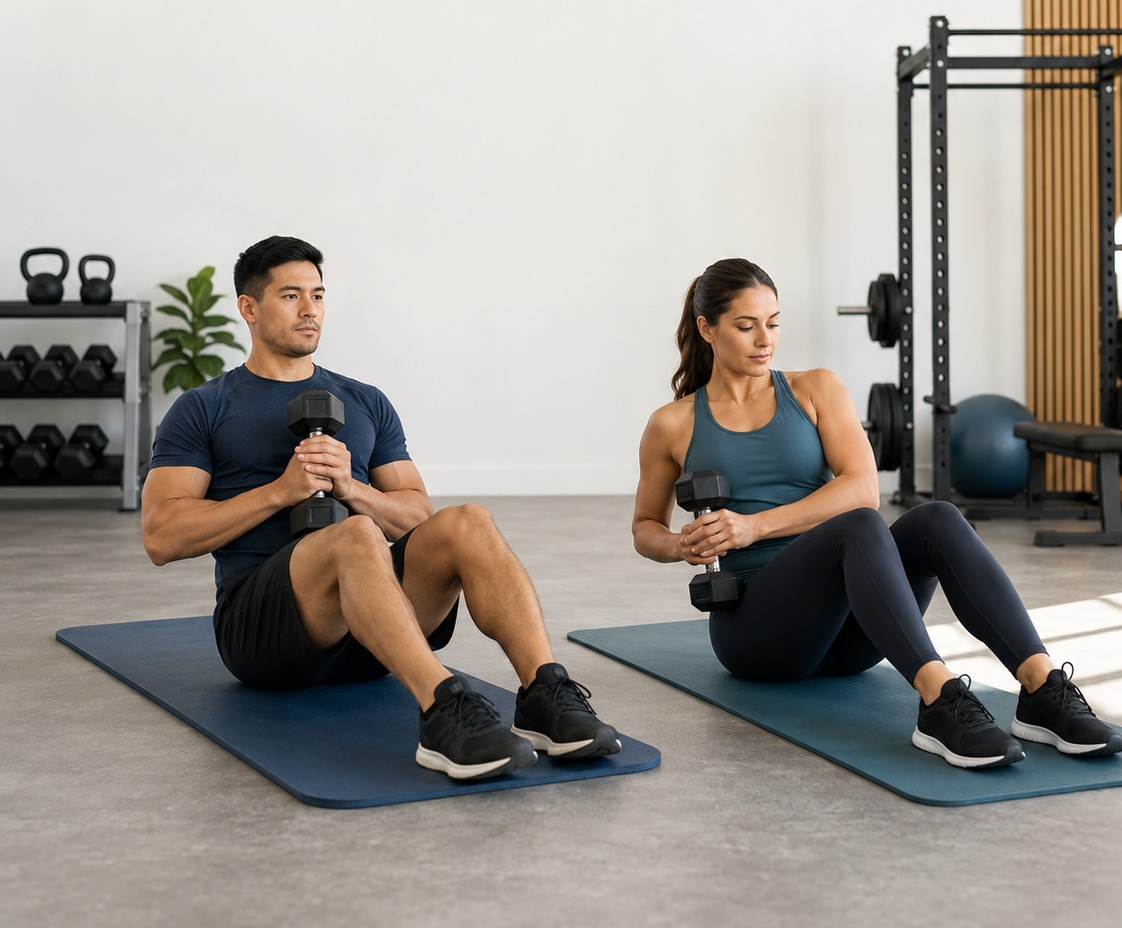
Beginners should learn the movement with their feet planted and little or no weight. This guide explains how to perform the dumbbell Russian twist, which muscles it works, how to choose the right weight, common mistakes to avoid, and how to include it in a balanced core workout.
Dumbbell Russian Twist at a Glance
| Category | Details |
|---|---|
| Main purpose | Rotational core strength and muscular endurance |
| Primary muscles | Internal and external obliques |
| Secondary muscles | Rectus abdominis, transversus abdominis, spinal stabilizers, hip flexors |
| Equipment needed | One dumbbell and an optional exercise mat |
| Recommended starting position | Knees bent with both feet planted |
| Typical volume | 2–3 sets of 6–12 repetitions per side |
| Rest | 45–75 seconds |
| Main coaching cue | Turn your chest with the dumbbell instead of swinging your arms |
What Is a Dumbbell Russian Twist?
A dumbbell Russian twist is a weighted variation of the bodyweight Russian twist. You sit with your knees bent, lean your torso backward slightly, hold one dumbbell with both hands, and rotate from one side to the other.
The movement combines two demands:
- Maintaining a stable, leaned-back torso
- Producing and controlling rotation through the trunk
The National Academy of Sports Medicine Russian twist guide describes the exercise as a controlled torso rotation performed with the feet either planted or slightly elevated. It also emphasizes leading the movement with the shoulders rather than swinging the weight independently.
The dumbbell should move because your shoulders and rib cage turn. Your hands should not race ahead of your torso.
Dumbbell Russian Twist Muscles Worked
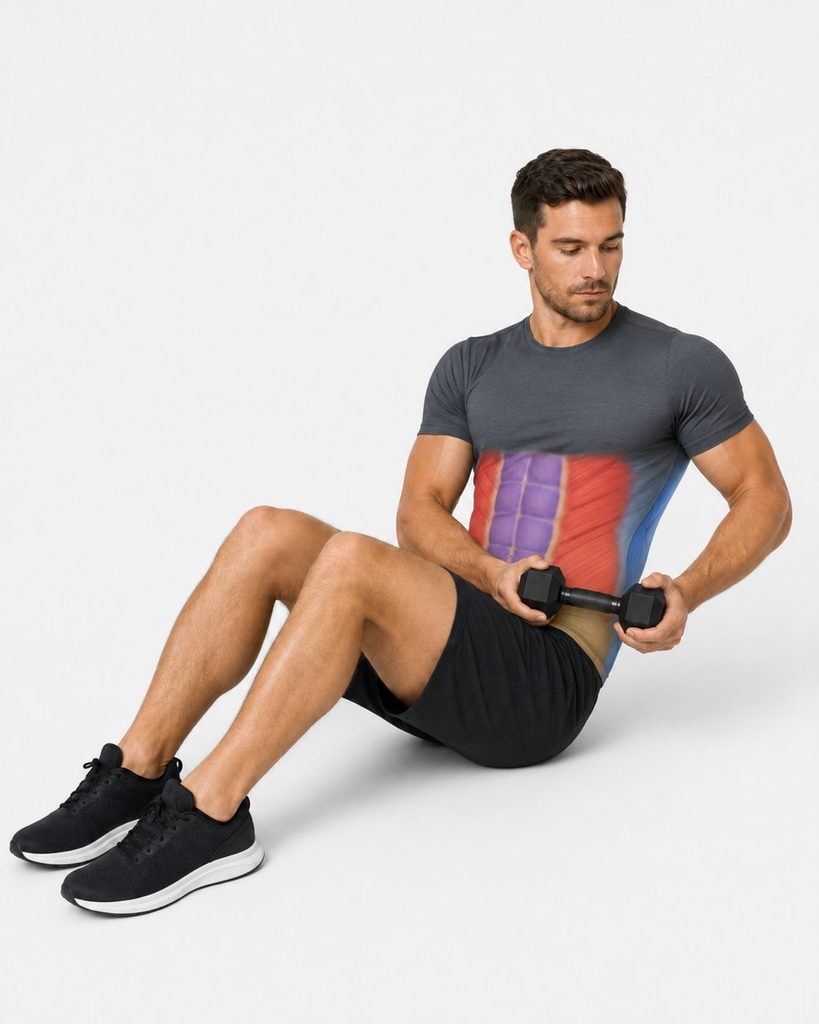
The dumbbell Russian twist is mainly an oblique exercise, but several other muscles help maintain posture and control the weight.
1. Internal and External Obliques
The internal and external obliques are located along the sides of the abdominal wall. Their functions include rotating and laterally flexing the trunk.
During each twist, the obliques on both sides coordinate to produce the turn, slow the movement, and reverse direction. The NCBI Bookshelf overview of the abdominal wall muscles identifies the obliques as part of the flat abdominal muscle group responsible for trunk rotation.
You should usually feel these muscles working along the sides of your abdomen rather than only through the center of your stomach.
2. Rectus Abdominis
The rectus abdominis runs vertically along the front of the abdomen.
It is not the primary muscle producing rotation. Instead, it helps maintain the leaned-back position and prevents the torso from collapsing as the dumbbell moves from side to side.
Leaning farther backward increases the demand on the rectus abdominis, but only when you can maintain a controlled torso position.
3. Transversus Abdominis and Deep Core Muscles
The transversus abdominis is the deepest of the flat abdominal muscles. It contributes to abdominal-wall tension and trunk control.
It works with other deeper muscles to help stabilize the torso while the obliques create and control rotation. You cannot completely isolate one abdominal muscle during the Russian twist because the trunk muscles work together.
4. Spinal Stabilizers
The erector spinae, multifidus, and other muscles around the spine help maintain the position of your torso.
These muscles should work isometrically to control posture. They should not be forced to compensate for a dumbbell that is too heavy or a torso that is collapsing backward.
5. Hip Flexors
The hip flexors help maintain the seated hip angle. Their involvement becomes more noticeable when:
- You lean farther backward
- You lift your feet
- Your abdominal endurance begins to decrease
- You use excessive load
Some hip-flexor effort is normal. However, if the exercise is felt almost entirely at the front of the hips, plant your feet, sit more upright, or reduce the weight.
6. Shoulders, Arms, Forearms, and Grip
The shoulders and arms hold the dumbbell in front of the torso. The forearms and hands maintain a secure grip.
These muscles assist with the exercise, but they should not create most of the side-to-side motion.
A small 2026 crossover study measured external-oblique and rectus-abdominis activity during Russian twists performed with a static load and a water-filled training device. The study supports the involvement of these abdominal muscles, but it included only 12 moderately trained men and did not examine long-term strength or muscle development from the dumbbell variation specifically.
How to Do the Dumbbell Russian Twist With Proper Form
Equipment needed: One dumbbell and an optional exercise mat.
Sets, reps, and rest: Start with 2 sets of 6–8 repetitions per side. Rest for 45–60 seconds between sets.
Step-by-Step Instructions
- Sit with your feet planted.
Sit on a mat with your knees bent and your feet approximately hip-width apart. Keep your heels and the rest of each foot comfortably supported. - Hold the dumbbell securely.
Hold one dumbbell with both hands near the center of your chest. Use a grip that keeps the weight secure and your wrists neutral. - Set your torso position.
Sit tall and gently brace your abdomen. Lean backward slightly while keeping your chest comfortably lifted and your torso long. - Rotate toward one side.
Turn your shoulders and rib cage toward one side. Allow the dumbbell to travel with your torso while keeping it close to your chest. - Return through the center.
Reverse the movement smoothly until your chest faces forward again. Avoid bouncing or relaxing your abdomen at the center. - Rotate toward the other side.
Turn through the same comfortable range in the opposite direction. Continue alternating sides while keeping your knees and hips relatively still. - Finish before your posture changes.
End the set when you can no longer maintain the same torso angle, speed, range, and control.
Coaching cue: Turn your chest with your hands.
How to Breathe
Continue breathing throughout the set. You can exhale gently as you rotate and inhale as you pass through the center.
Avoid holding your breath for the entire set. Breathing should not cause you to completely relax your abdominal brace.
How to Count Repetitions
The simplest method is to count each side separately.
For example:
- One turn to the right equals one right-side repetition.
- One turn to the left equals one left-side repetition.
- Eight repetitions per side equals 16 individual turns.
Writing the workout as “8 repetitions per side” prevents confusion about whether a complete right-and-left cycle counts as one or two repetitions.
Should Your Feet Be Planted or Elevated?
Both positions are possible, but they are not equally suitable for every exerciser.
Feet Planted
Keeping your feet on the floor provides a more stable base. It allows you to focus on torso rotation without balance becoming the main challenge.
This is usually the best option for:
- Beginners
- Anyone learning the exercise
- People using a heavier dumbbell
- Exercisers who feel excessive hip-flexor tension
- Anyone whose knees move excessively during the feet-elevated version
The feet-down position is not an incomplete version. It can remain challenging when you use controlled repetitions, a suitable dumbbell, and an appropriate torso angle.
Feet Elevated
Lifting the feet reduces your base of support and increases the balance and hip-flexor demands.
Use this progression only after you can complete the feet-down version without:
- Swinging the dumbbell
- Rounding your back
- Moving your knees from side to side
- Losing balance
- Holding your breath
- Rushing through the repetitions
Elevating the feet does not automatically make the exercise more effective for the obliques. It simply changes the overall challenge.
How to Choose the Right Dumbbell Weight
Start lighter than you think you need. The dumbbell is positioned away from your base of support, so even a modest load can become difficult when combined with a leaned-back torso.
The correct weight should allow you to:
- Maintain the same torso angle throughout the set
- Rotate through a similar range on both sides
- Keep the dumbbell moving with your chest
- Control each change of direction
- Keep your feet and knees relatively steady
- Finish with approximately 2–3 technically sound repetitions still possible
The weight is probably too heavy if you must:
- Swing your arms
- Bounce out of each side
- Round your back
- Pull with your shoulders
- Shorten the range as the set continues
- Drop or tap the dumbbell against the floor
- Hold your breath to complete the repetitions
Beginners can first practice with empty hands. Once bodyweight repetitions feel stable, add the lightest suitable dumbbell and progress gradually.
The 2026 American College of Sports Medicine resistance-training guidance emphasizes consistency, individualization, and matching load and volume to the exerciser’s goals and abilities. It also notes that training to complete muscular failure is not necessary for the average healthy exerciser.
Benefits of Dumbbell Russian Twists
Train Controlled Torso Rotation
Many popular core exercises focus on preventing movement or controlling forward and backward trunk positions.
The Russian twist adds active rotation. It can help you practice turning the torso while controlling the weight and keeping the lower body relatively stable.
Build Oblique Muscular Endurance
The obliques work repeatedly to turn the torso, decelerate the dumbbell, and change direction.
The exercise also requires the abdominal muscles to maintain tension throughout the set. This makes it useful for building core muscular endurance as part of a broader program.
Allow Gradual Resistance Progression
Adding a dumbbell provides a straightforward way to increase resistance once the bodyweight movement is controlled.
Progress does not have to mean adding more weight. You can also make the exercise harder by:
- Performing more controlled repetitions
- Pausing briefly near each side
- Slowing the tempo
- Holding the dumbbell slightly farther from your chest
- Leaning backward slightly more
- Elevating your feet
Change only one variable at a time so you can identify whether your form remains stable.
Require Minimal Equipment
The exercise requires only one dumbbell and enough floor space to sit comfortably.
It can be performed at home or in a gym and added to full-body, upper-body, or dedicated core workouts.
Complement Other Types of Core Training
The Russian twist trains active rotation. A complete core program can also include exercises that train other functions, such as:
- Dead bugs for controlling trunk extension
- Side planks for lateral trunk endurance
- Pallof presses for resisting rotation
- Bird dogs for maintaining trunk position while the limbs move
- Loaded carries for whole-body bracing
A systematic review of core-training programs found potential improvements in outcomes such as balance, jumping, and throwing or hitting performance. However, these findings apply to complete training programs and do not prove that Russian twists alone produce every performance benefit.
Common Dumbbell Russian Twist Mistakes
Swinging the Dumbbell With Your Arms
Moving the hands from side to side without turning the shoulders reduces the rotational demand on the trunk.
Keep the dumbbell in front of your chest and rotate your chest, shoulders, and hands together.
Using Too Much Weight
A heavy dumbbell often causes faster repetitions, a shorter range of motion, and greater loss of posture.
Reduce the weight until you can control both the rotation and the change of direction.
Rounding and Collapsing the Back
Leaning backward too far can cause the chest to collapse and the lower back to round excessively.
Sit more upright and reduce the dumbbell weight. A smaller lean performed with control is more useful than a deeper lean you cannot maintain.
Forcing the Dumbbell to Touch the Floor
The dumbbell does not need to touch the floor beside your hip.
Reaching for the floor can encourage excessive arm movement, back rounding, hip shifting, or forced rotation. Stop at the largest range you can control while keeping your torso organized.
Moving the Knees From Side to Side
Large knee movements usually indicate that the pelvis is rotating excessively or that balance has been lost.
Plant your feet, reduce the range, and imagine keeping your kneecaps pointed generally forward.
Rotating Too Quickly
Fast repetitions make it easier to rely on momentum.
Slow down enough that you can stop the dumbbell at any point without losing your torso position.
Elevating the Feet Too Soon
Lifting the feet may turn the exercise into more of a balance challenge and increase hip-flexor fatigue.
Master the feet-down version before attempting the feet-elevated variation.
Holding Your Breath
Breath holding can increase unnecessary tension and make it difficult to sustain controlled repetitions.
Maintain a gentle brace while continuing to breathe.
Dumbbell Russian Twist Regressions
Use a regression when you cannot maintain control or when the exercise is felt mainly in the lower back or front of the hips.
Bodyweight Russian Twist
Perform the same movement with your hands held together near your chest.
This removes the external load while allowing you to practice the torso position and rotation.
More Upright Russian Twist
Reduce the backward lean and keep your torso closer to vertical.
The exercise will place less demand on the abdominal muscles responsible for maintaining the seated position.
Short-Range Russian Twist
Rotate only a small distance to each side.
Gradually increase the range after you can move without swinging, rounding, or shifting your knees.
Alternating Rotation With a Pause
Rotate to one side, return to the center, pause, and reset your brace before turning toward the other side.
The pause removes some momentum and makes each repetition easier to organize.
Dumbbell Russian Twist Progressions
Increase the Dumbbell Weight
Add the smallest available weight increase after you can reach the top of your repetition range with consistent form.
Do not increase both weight and repetitions in the same workout.
Hold the Dumbbell Farther Forward
Extending the arms slightly creates a longer lever and makes the existing dumbbell feel heavier.
Keep a small bend in the elbows and stop if the shoulders become the limiting factor.
Add a Controlled Pause
Pause for approximately one second near each side before returning through the center.
The pause prevents bouncing and increases the time spent controlling the rotated position.
Use a Slower Tempo
Take approximately two seconds to rotate toward each side.
A slower tempo can increase difficulty without requiring a heavier dumbbell.
Elevate the Feet
Lift the feet only after the feet-down variation is stable.
Keep the knees softly bent and avoid allowing the legs to counterbalance every turn.
Sets, Reps, and Workout Placement
Beginner Programming
- Sets: 2
- Repetitions: 6–8 per side
- Load: Bodyweight or a very light dumbbell
- Rest: 45–60 seconds
- Effort: Approximately 5–7 out of 10
- Frequency: 1–2 times per week
General Core Training
- Sets: 2–3
- Repetitions: 8–12 per side
- Load: Light to moderate
- Rest: 45–75 seconds
- Effort: Approximately 6–8 out of 10
- Frequency: 1–3 times per week
Muscular-Endurance Option
- Sets: 2–3
- Repetitions: 12–15 per side
- Load: Light
- Rest: 30–60 seconds
- Tempo: Smooth and controlled
Stop each set before your technique changes. More repetitions are not useful when they are completed with arm swinging, back rounding, or uncontrolled momentum.
When Should You Perform Russian Twists?
In most strength workouts, perform Russian twists after your main compound exercises.
Fatiguing your trunk before exercises such as squats, deadlifts, rows, or overhead presses may make it harder to maintain stability during those movements. A light bodyweight practice set can be used earlier, but harder working sets usually fit better near the end of the session.
Sample Dumbbell Russian Twist Core Workout
Complete the following routine for two rounds:
1. Dead Bug
- Repetitions: 6–8 per side
- Rest: 30 seconds
- Focus: Keep the lower torso controlled as the arms and legs move
2. Dumbbell Russian Twist
- Repetitions: 8–10 per side
- Rest: 30–45 seconds
- Focus: Move the shoulders and dumbbell together
3. Side Plank
- Duration: 20–30 seconds per side
- Rest: 60 seconds before starting the next round
- Focus: Maintain a straight, stable position
Perform the routine one or two times per week after your main strength work. Keep the overall effort around 6–8 out of 10.
When all repetitions feel controlled, progress the Russian twist by adding two repetitions per side, using a slightly heavier dumbbell, or adding a brief pause. Change only one of these variables at a time.
Safety Considerations
A dumbbell Russian twist should create muscular effort through the abdomen, but it should not cause sharp or pinching pain in the back or hips.
Research examining spinal movement shows that axial rotation is not distributed equally through every region of the spine. The lumbar region generally has less available rotation than the thoracic region. Use a comfortable range and avoid forcing a heavy dumbbell into an end position.
Use these precautions:
- Learn the movement without weight first.
- Keep the dumbbell close to your chest while developing control.
- Avoid fast, bouncing changes of direction.
- Do not force the largest possible rotation.
- Stop the set when your back begins rounding or your hips start shifting.
- Use a stable, nonslip surface.
- Do not continue through sharp pain, numbness, dizziness, chest pain, or unusual symptoms.
Anyone with active back or hip pain, a known spinal condition, medical exercise restrictions, or a recent injury should seek individualized advice before performing loaded rotational exercises.
A Pallof press, dead bug, bird dog, or side plank may be a more comfortable alternative when dynamic rotation is not well tolerated.
Frequently Asked Questions
What muscles do dumbbell Russian twists work?
Dumbbell Russian twists primarily train the internal and external obliques. The rectus abdominis, transversus abdominis, spinal stabilizers, and hip flexors help maintain the seated position. The shoulders, arms, forearms, and grip hold and guide the dumbbell.
Should beginners keep their feet on the floor?
Yes. Keeping both feet planted provides more stability and allows beginners to focus on controlled torso rotation.
Elevating the feet should be treated as an optional progression rather than a requirement for correct form.
How heavy should the dumbbell be?
Use a weight that allows you to complete every repetition without swinging your arms, rounding your back, shifting your knees, or shortening the range.
You should usually finish with approximately 2–3 controlled repetitions still possible. Begin with bodyweight when you are unsure.
Should the dumbbell touch the floor?
No. Floor contact is not required.
Rotate only as far as you can keep your chest lifted, your lower body controlled, and the dumbbell moving with your torso. Forcing a floor tap can encourage excessive reaching or back rounding.
How many dumbbell Russian twists should a beginner do?
Begin with 2 sets of 6–8 repetitions per side. Rest for approximately 45–60 seconds between sets.
Increase the repetitions only after you can maintain the same speed, range, and posture throughout both sets.
Are dumbbell Russian twists safe for the lower back?
They may be appropriate for people who can rotate comfortably and maintain control, but they are not suitable for everyone.
Use a light load, keep your feet planted, avoid forced end-range rotation, and stop if the exercise causes pain. People with an existing back condition or current symptoms should obtain individualized guidance.
Do dumbbell Russian twists reduce belly fat?
Dumbbell Russian twists can strengthen the abdominal muscles, but they are not a reliable way to selectively remove fat from the waist.
Changes in body fat depend on overall activity, nutrition, energy balance, and other individual factors. The American Council on Exercise explanation of spot reduction advises against relying on exercises for one body area to remove fat specifically from that location.
Conclusion
The dumbbell Russian twist is most effective when it is treated as a controlled torso-rotation exercise rather than a fast weight-swinging movement.
Begin with your feet planted, keep the dumbbell near your chest, and rotate only through a range you can control. Progress by improving repetition quality first, then gradually add repetitions, pauses, a longer lever, or more weight.
Include Russian twists alongside exercises that train extension control, lateral stability, and anti-rotation for a more complete core routine.
References
- National Academy of Sports Medicine: Russian Twist Exercise Guide
- NCBI Bookshelf: Anatomy of the Anterolateral Abdominal Wall Muscles
- American College of Sports Medicine: Updated Resistance Training Guidelines
- Scientific Journal of Sport and Performance: Muscle Activation During Russian Twists
- PubMed: Core Training and Performance Systematic Review
- PMC: Differences in Spinal Axial Rotation Angles
- American Council on Exercise: Spot-Reduction Guidance
This content is for informational purposes only and is not a substitute for medical advice.