The best dumbbell exercises for women are movements that train the legs, hips, back, chest, shoulders, arms, grip, and core through a balanced strength program. You do not need complicated exercise combinations or a separate set of “women-only” movements to become stronger.
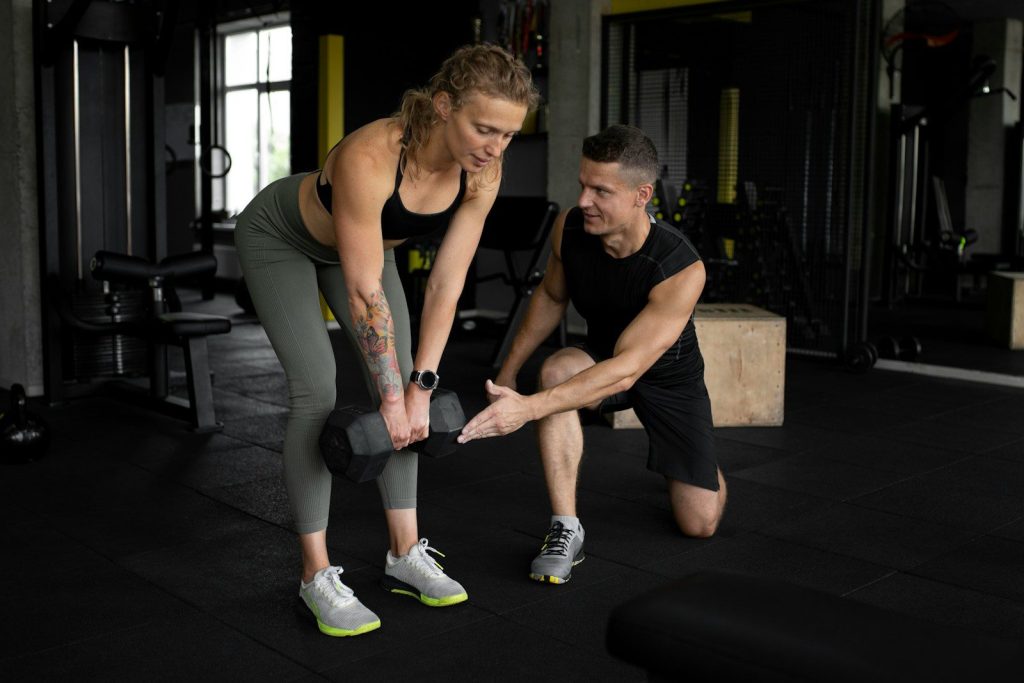
The 12 exercises below cover the main movement patterns needed for a practical full-body routine. You will learn how to perform each exercise, choose an appropriate weight, avoid common mistakes, and combine the movements into a weekly workout.
Research consistently shows that resistance training can produce meaningful improvements in strength and muscular development in women. A systematic review of healthy adult women reported substantial improvements in both upper- and lower-body strength, while another review found broadly similar relative muscle and lower-body strength adaptations between women and men following comparable training.
Why Dumbbell Training Works for Women
Dumbbells are useful because they can be adjusted to different strength levels and used for both compound and isolation exercises. They also allow each arm or leg to work independently during movements such as rows, lunges, and presses.
A well-designed dumbbell program can help you:
- Build upper- and lower-body strength
- Train at home or in a gym
- Strengthen both sides of the body
- Practice the major movement patterns
- Progress gradually without complicated equipment
- Adjust exercises to match your experience and mobility
The latest American College of Sports Medicine resistance-training guidance emphasizes that consistency and effort are more important for most adults than advanced techniques, specialized equipment, or complicated periodization. It also notes that home-based training and different forms of resistance can produce meaningful improvements.
These exercises are not exclusive to women. They are included because they are accessible, effective, and easy to adjust for different strength levels.
How to Choose the Right Dumbbell Weight
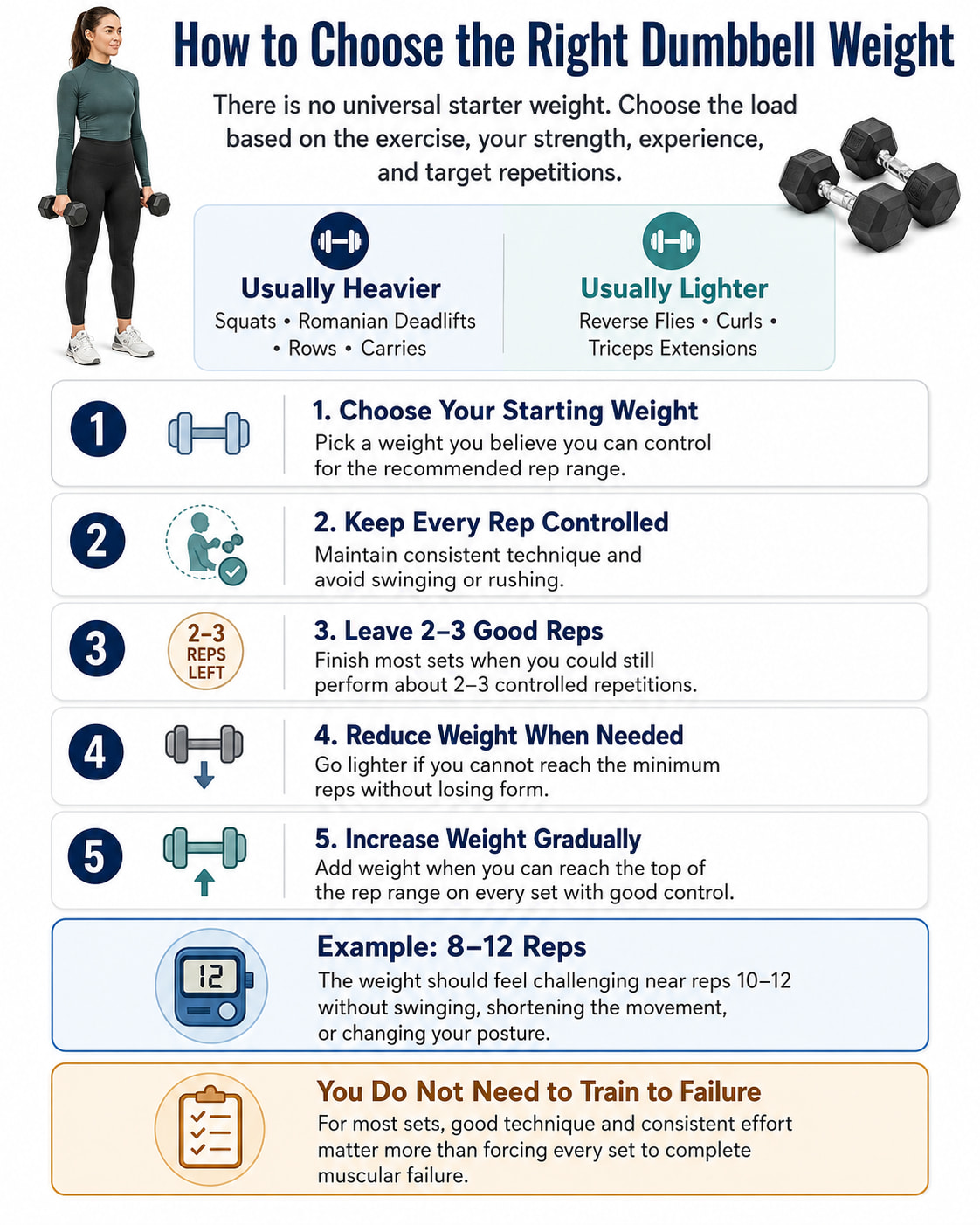
There is no universal starter weight for women. The appropriate dumbbell depends on the exercise, your current strength, your experience, and the number of repetitions you plan to perform.
You will usually need heavier dumbbells for squats, Romanian deadlifts, rows, and carries than for reverse flies, curls, or triceps extensions.
Use this simple method:
- Choose a weight you believe you can lift for the recommended repetition range.
- Perform each repetition with a controlled tempo and consistent technique.
- Finish the set when you could still complete approximately two or three good repetitions.
- Reduce the weight if you cannot reach the bottom of the repetition range without losing form.
- Increase the weight when you can complete the top of the range on every set with good control.
For example, when an exercise calls for 8–12 repetitions, the weight should feel challenging near repetitions 10–12 without forcing you to swing, shorten the movement, or change your posture.
You do not need to take every set to complete muscular failure. Current ACSM guidance reports that training to momentary failure does not consistently improve results for the average healthy adult.
Dumbbell Exercises for Women at a Glance
| Exercise | Main movement | Main areas trained | |
|---|---|---|---|
| 1 | Dumbbell goblet squat | Squat | Quadriceps, glutes, inner thighs |
| 2 | Dumbbell Romanian deadlift | Hip hinge | Hamstrings, glutes, back |
| 3 | Dumbbell reverse lunge | Lunge | Quadriceps, glutes, hamstrings |
| 4 | Dumbbell glute bridge | Hip extension | Glutes, hamstrings |
| 5 | One-arm dumbbell row | Pull | Back, rear shoulders, biceps |
| 6 | Dumbbell chest press | Push | Chest, shoulders, triceps |
| 7 | Dumbbell shoulder press | Vertical push | Shoulders, triceps |
| 8 | Dumbbell reverse fly | Shoulder movement | Rear shoulders, upper back |
| 9 | Dumbbell biceps curl | Elbow flexion | Biceps, brachialis, forearms |
| 10 | Dumbbell overhead triceps extension | Elbow extension | Triceps |
| 11 | Dumbbell standing calf raise | Ankle extension | Calves |
| 12 | Dumbbell farmer’s carry | Loaded carry | Grip, upper back, core, legs |
12 Best Dumbbell Exercises for Women
These 12 dumbbell exercises for women target the major muscle groups to help build balanced full-body strength.
Use controlled form, choose a manageable weight, and progress gradually as your strength and confidence improve.
1. Dumbbell Goblet Squat
Best for: Building general lower-body strength while learning a controlled squat pattern.
Muscles worked: Quadriceps, gluteus maximus, adductors, hamstrings, calves, and trunk stabilizers.
Equipment needed: One dumbbell.
Sets, reps, and rest: Perform 2–3 sets of 8–12 repetitions. Rest for 60–120 seconds.
How to Do It
- Hold one dumbbell vertically against your chest, supporting the upper end with both hands.
- Stand with your feet at a comfortable squat width and your toes turned slightly outward.
- Brace your midsection and keep the dumbbell close to your body.
- Bend your hips and knees together, lowering between your legs while keeping your whole foot in contact with the floor.
- Descend as far as you can without your heels lifting, knees collapsing inward, or lower back rounding.
- Push through your feet and straighten your hips and knees to stand.
The NASM goblet squat guide similarly emphasizes a secure front-loaded position, an upright torso, and a controlled descent.
Common mistakes: Holding the dumbbell away from the chest, allowing the knees to collapse inward, rising onto the toes, dropping too quickly, or forcing a deeper squat than you can control.
Regression: Squat to a sturdy bench or chair and stand back up. You can begin without a dumbbell.
Progression: Increase the dumbbell weight, pause briefly at the bottom, or use two dumbbells in a front-rack position.
Coaching cue: Keep your chest and the dumbbell moving together.
2. Dumbbell Romanian Deadlift
Best for: Strengthening the hamstrings and glutes while learning how to hinge at the hips.
Muscles worked: Hamstrings and glutes, with assistance from the adductors, spinal erectors, upper back, and forearms.
Equipment needed: Two dumbbells.
Sets, reps, and rest: Perform 2–3 sets of 8–12 repetitions. Rest for 90–120 seconds.
How to Do It
- Stand with your feet approximately hip-width apart and hold the dumbbells in front of your thighs.
- Soften your knees slightly and brace your midsection.
- Push your hips backward while allowing your torso to lean forward.
- Keep the dumbbells close to your legs and maintain a long, neutral spine.
- Lower until you feel a clear hamstring stretch or reach the deepest position you can control without rounding your back.
- Push the floor away and bring your hips forward to stand tall.
The NASM dumbbell Romanian deadlift instructions emphasize a slight knee bend, neutral spine, backward hip movement, and stopping at an individually controlled depth.
Common mistakes: Turning the movement into a squat, lowering the weights too far, letting the dumbbells drift forward, rounding the back, or leaning backward at the top.
Regression: Practice the hip hinge without weight by standing a short distance in front of a wall and reaching your hips toward it.
Progression: Increase the dumbbell weight or use a staggered-stance Romanian deadlift.
Coaching cue: Send your hips backward rather than moving the dumbbells straight down.
3. Dumbbell Reverse Lunge
Best for: Building one-leg strength with a generally manageable lunge setup.
Muscles worked: Quadriceps, glutes, hamstrings, calves, adductors, and trunk stabilizers.
Equipment needed: One or two dumbbells.
Sets, reps, and rest: Perform 2–3 sets of 8–10 repetitions per leg. Rest for 60–120 seconds.
How to Do It
- Stand tall while holding the dumbbells at your sides.
- Step one foot backward and land on the ball of that foot.
- Lower both knees while keeping most of your working pressure through the front foot.
- Keep the front knee tracking in the same general direction as the toes.
- Stop before your posture, balance, or front-foot contact changes.
- Push through the front foot to return to standing.
- Complete all repetitions on one side or alternate legs.
Common mistakes: Taking a step that is too short or too narrow, pushing mainly from the rear leg, allowing the front knee to collapse inward, or rushing before balance is established.
Regression: Perform bodyweight reverse lunges while lightly holding a stable support. A split squat without stepping is another useful option.
Progression: Use heavier dumbbells, add a controlled pause near the bottom, or perform a front-rack reverse lunge.
Coaching cue: Let the front leg do most of the work.
4. Dumbbell Glute Bridge
Best for: Training the glutes in a stable floor-based position.
Muscles worked: Gluteus maximus, hamstrings, adductors, and trunk stabilizers.
Equipment needed: One dumbbell, an exercise mat, and an optional folded towel or bar pad.
Sets, reps, and rest: Perform 2–3 sets of 10–15 repetitions. Rest for 60–90 seconds.
How to Do It
- Sit on the floor and position a dumbbell horizontally across the front of your hips.
- Lie back with your knees bent and feet flat, approximately hip-width apart.
- Hold the dumbbell securely with both hands.
- Brace your midsection and press through your feet.
- Lift your hips until your thighs and torso form a generally straight line.
- Pause briefly while contracting your glutes.
- Lower your hips under control.
The basic setup follows the same hip-extension pattern shown in the NASM floor bridge guide, with the dumbbell providing additional resistance.
Common mistakes: Pushing the dumbbell with the hands, placing it on an uncomfortable part of the pelvis, driving the hips too high by arching the lower back, or positioning the feet so far away that the hamstrings dominate.
Regression: Perform the bridge without a dumbbell.
Progression: Increase the weight, pause longer at the top, or progress to a single-leg bodyweight bridge before adding external load.
Coaching cue: Finish the movement with your glutes, not your lower back.
5. One-Arm Dumbbell Row
Best for: Strengthening the back while allowing one side to work at a time.
Muscles worked: Latissimus dorsi, rhomboids, trapezius, rear deltoids, biceps, brachialis, and forearms.
Equipment needed: One dumbbell and a stable bench or sturdy support.
Sets, reps, and rest: Perform 2–3 sets of 8–12 repetitions per arm. Rest for 60–120 seconds.
How to Do It
- Place one hand on a stable bench and step into a staggered stance.
- Hold the dumbbell in the opposite hand with your arm hanging toward the floor.
- Brace your torso and keep your neck aligned with your spine.
- Pull your elbow toward your hip while keeping it reasonably close to your side.
- Stop when the upper arm reaches your torso or before your shoulder rolls forward.
- Lower the dumbbell until the arm is extended without losing your torso position.
Common mistakes: Twisting the torso, shrugging the working shoulder, pulling the dumbbell toward the chest instead of the hip, jerking the weight, or rounding the lower back.
Regression: Use a lighter dumbbell and support both the hand and knee on a bench.
Progression: Increase the load, slow the lowering phase, or perform the row from a less-supported split stance.
Coaching cue: Pull your elbow toward your back pocket.
6. Dumbbell Chest Press
Best for: Building pushing strength through the chest, shoulders, and triceps.
Muscles worked: Pectoralis major, anterior deltoids, triceps, and shoulder stabilizers.
Equipment needed: Two dumbbells and a flat bench. A mat can be used for the floor-press version.
Sets, reps, and rest: Perform 2–3 sets of 8–12 repetitions. Rest for 90–120 seconds.
How to Do It
- Sit on the end of a bench with a dumbbell resting on each thigh.
- Carefully lie back and position the dumbbells beside your chest.
- Plant your feet, maintain natural contact between your back and the bench, and keep your wrists straight.
- Position your upper arms at a comfortable angle rather than directly out to the sides.
- Press the dumbbells upward until your arms are extended without forcefully locking the elbows.
- Lower the dumbbells under control until you reach a comfortable depth.
Common mistakes: Flaring the elbows directly outward, bending the wrists backward, bouncing the weights at the bottom, lifting the hips, or letting the dumbbells drop too quickly.
Regression: Perform a dumbbell floor press. The floor limits how far the upper arms can move behind the torso and removes the need for a bench.
Progression: Increase the weight, add a pause near the bottom, or use an alternating dumbbell press.
Coaching cue: Keep your wrists stacked over your forearms.
7. Dumbbell Shoulder Press
Best for: Building overhead pressing strength.
Muscles worked: Anterior and lateral deltoids, triceps, upper chest, trapezius, and trunk stabilizers.
Equipment needed: Two dumbbells and an optional back-supported bench.
Sets, reps, and rest: Perform 2–3 sets of 8–12 repetitions. Rest for 90–120 seconds.
How to Do It
- Stand with your feet stable or sit against an upright bench.
- Hold the dumbbells near shoulder height with your palms facing forward or slightly inward.
- Brace your midsection and keep your ribs controlled.
- Press the dumbbells upward, allowing them to travel naturally over your shoulders.
- Finish with the arms extended without shrugging aggressively.
- Lower the dumbbells back to shoulder height under control.
Common mistakes: Excessively arching the lower back, pushing the head forward, starting with the dumbbells too far outside the shoulders, bending the wrists, or turning the exercise into a push press by using the legs.
Regression: Use a seated, back-supported position or press one dumbbell with both hands.
Progression: Increase the dumbbell weight or use a standing single-arm press, which adds a greater trunk-stability demand.
Coaching cue: Press up while keeping your ribs stacked over your pelvis.
8. Dumbbell Reverse Fly
Best for: Adding focused training for the rear shoulders and upper back.
Muscles worked: Posterior deltoids, rhomboids, middle trapezius, and other shoulder-blade stabilizers.
Equipment needed: Two light dumbbells.
Sets, reps, and rest: Perform 2–3 sets of 10–15 repetitions. Rest for 45–90 seconds.
How to Do It
- Stand with your feet stable and hold the dumbbells with your palms facing each other.
- Hinge at the hips while maintaining a neutral spine.
- Allow the dumbbells to hang below your shoulders with a slight bend in your elbows.
- Raise your arms outward until they are approximately level with your torso.
- Pause without shrugging.
- Lower the weights slowly to the starting position.
Common mistakes: Choosing weights that are too heavy, swinging the torso, turning the movement into a row, raising the hands far above the shoulders, or squeezing the shoulder blades together as hard as possible.
Regression: Use lighter dumbbells or perform the movement seated with your torso supported against your thighs.
Progression: Perform a chest-supported reverse fly on an incline bench or increase the weight while maintaining the same range and control.
Coaching cue: Move your upper arms outward rather than throwing the dumbbells upward.
9. Dumbbell Biceps Curl
Best for: Adding direct training for the front of the upper arms.
Muscles worked: Biceps brachii, brachialis, brachioradialis, and forearm muscles.
Equipment needed: Two dumbbells.
Sets, reps, and rest: Perform 2–3 sets of 8–15 repetitions. Rest for 45–90 seconds.
How to Do It
- Stand tall with a dumbbell in each hand and your arms resting by your sides.
- Turn your palms forward and keep your wrists straight.
- Keep your elbows near your torso.
- Bend your elbows and curl the dumbbells upward.
- Stop before your elbows move significantly forward or your shoulders shrug.
- Lower the dumbbells until the arms are extended under control.
Common mistakes: Swinging the hips, leaning backward, allowing the elbows to travel forward, bending the wrists, or dropping the weights quickly.
Regression: Perform seated curls with lighter dumbbells or alternate arms.
Progression: Increase the load, slow the lowering phase, or use incline dumbbell curls when a suitable bench is available.
Coaching cue: Keep your upper arms quiet while your forearms move.
10. Dumbbell Overhead Triceps Extension
Best for: Directly training the triceps with the arms in an overhead position.
Muscles worked: All three heads of the triceps, with the shoulders and trunk helping stabilize the position.
Equipment needed: One dumbbell and an optional upright bench.
Sets, reps, and rest: Perform 2–3 sets of 8–15 repetitions. Rest for 45–90 seconds.
How to Do It
- Sit or stand tall and hold one dumbbell securely with both hands.
- Press the dumbbell overhead and keep your wrists neutral.
- Brace your midsection and position your upper arms in a comfortable overhead position.
- Bend your elbows and lower the dumbbell behind your head.
- Stop at the deepest range you can control without arching your back or forcing your shoulders.
- Straighten your elbows to return the dumbbell overhead.
Common mistakes: Flaring the ribs, excessively arching the back, forcing the elbows tightly together, allowing the wrists to bend, or moving the shoulders instead of primarily bending and straightening the elbows.
Regression: Use a lighter dumbbell and sit against a back-supported bench.
Progression: Increase the weight, use a slower lowering phase, or perform a single-arm overhead extension.
Coaching cue: Keep the dumbbell moving by bending and straightening your elbows.
11. Dumbbell Standing Calf Raise
Best for: Adding direct strength work for the lower legs.
Muscles worked: Gastrocnemius, soleus, and smaller foot and ankle stabilizers.
Equipment needed: One or two dumbbells and an optional stable support.
Sets, reps, and rest: Perform 2–3 sets of 10–15 repetitions. Rest for 45–90 seconds.
How to Do It
- Stand upright while holding the dumbbells at your sides.
- Position your feet approximately hip-width apart with your weight distributed evenly.
- Press through the balls of your feet and raise your heels.
- Pause briefly at the top without rolling your ankles outward.
- Lower your heels slowly until they return to the floor.
Common mistakes: Bouncing through the repetitions, rushing the lowering phase, allowing the ankles to roll outward, bending and straightening the knees to create momentum, or using weights that disrupt balance.
Regression: Hold one light dumbbell and use the other hand on a stable support.
Progression: Perform the movement with the front of the feet on a stable step for a greater range, or use a supported single-leg calf raise.
Coaching cue: Rise straight upward through the center of each foot.
12. Dumbbell Farmer’s Carry
Best for: Building grip strength and practicing controlled posture while walking under load.
Muscles worked: Forearms, trapezius, shoulder stabilizers, trunk muscles, hips, and legs.
Equipment needed: Two dumbbells and a clear walking area.
Sets, duration, and rest: Perform 2–3 carries lasting 20–40 seconds. Rest for 60–90 seconds.
How to Do It
- Place two dumbbells on the floor beside your feet.
- Hinge or squat down and pick them up with a secure grip.
- Stand tall with the weights beside your hips.
- Keep your head neutral, ribs controlled, and shoulders level.
- Walk using steady, deliberate steps.
- Turn carefully if needed.
- Return the dumbbells to the floor with a controlled hinge or squat.
The ACE farmer’s carry guide also describes holding a dumbbell in each hand, maintaining an upright back position, and walking a predetermined distance.
Common mistakes: Leaning forward, shrugging continuously, holding the weights away from the body, rushing the turn, walking through a cluttered area, or using weights that cannot be placed down safely.
Regression: Use lighter dumbbells or shorten the walking time.
Progression: Carry heavier dumbbells, walk slightly longer, or use one dumbbell for a suitcase carry.
Coaching cue: Walk tall as though you are carrying two heavy grocery bags.
How to Turn These Dumbbell Exercises Into a Workout
You do not need to perform all 12 exercises during every workout. A balanced session should usually include:
- One squat or lunge
- One hip-hinge or bridge
- One pulling exercise
- One pressing exercise
- One or two smaller accessory exercises
- An optional loaded carry
The CDC physical activity guidelines recommend muscle-strengthening activity on at least two days each week that covers all major muscle groups.
Beginner Two-Day Full-Body Dumbbell Workout
Perform the workouts on nonconsecutive days, such as Monday and Thursday. Start with two sets per exercise. Add a third set later if you are recovering well and maintaining good technique.
Workout A
| Exercise | Sets and reps | Rest |
|---|---|---|
| Dumbbell goblet squat | 2–3 × 8–12 | 90 seconds |
| Dumbbell Romanian deadlift | 2–3 × 8–12 | 90–120 seconds |
| One-arm dumbbell row | 2–3 × 8–12 per arm | 75–120 seconds |
| Dumbbell chest press | 2–3 × 8–12 | 90–120 seconds |
| Dumbbell standing calf raise | 2 × 10–15 | 60 seconds |
| Dumbbell farmer’s carry | 2–3 × 20–40 seconds | 60–90 seconds |
Workout B
| Exercise | Sets and reps | Rest |
|---|---|---|
| Dumbbell reverse lunge | 2–3 × 8–10 per leg | 90 seconds |
| Dumbbell glute bridge | 2–3 × 10–15 | 60–90 seconds |
| One-arm dumbbell row | 2–3 × 8–12 per arm | 75–120 seconds |
| Dumbbell shoulder press | 2–3 × 8–12 | 90 seconds |
| Dumbbell reverse fly | 2 × 10–15 | 60 seconds |
| Dumbbell biceps curl | 2 × 8–15 | 60 seconds |
| Dumbbell overhead triceps extension | 2 × 8–15 | 60 seconds |
The curl and triceps extension can be alternated as a superset: perform one set of curls, rest briefly, complete one set of extensions, and then rest before repeating.
Three-Day Option
Alternate the two workouts across three nonconsecutive days:
Week 1: Workout A, Workout B, Workout A
Week 2: Workout B, Workout A, Workout B
Continue alternating in this pattern rather than adding more exercises to every session.
Recommended Effort Level
Finish most sets with approximately two or three controlled repetitions still possible. The final repetitions should feel challenging, but your technique should remain consistent.
Rest longer when needed after squats, Romanian deadlifts, lunges, rows, and presses. Shorter rest periods can work for curls, extensions, calf raises, and reverse flies.
How to Progress Your Dumbbell Workouts
Progress does not require changing exercises every week. Repeating the same core movements gives you time to improve your technique and measure whether you are getting stronger.
Use Double Progression
Suppose your program calls for 8–12 repetitions:
- Begin with a weight you can control for at least eight repetitions.
- Keep the same weight while gradually adding repetitions.
- Once you can perform 12 repetitions on every set with good form, increase to the smallest practical weight increment.
- Return to the lower end of the range and build upward again.
For example:
- Week 1: 10, 9, and 8 repetitions
- Week 2: 11, 10, and 9 repetitions
- Week 3: 12, 12, and 11 repetitions
- Week 4: 12, 12, and 12 repetitions
- Next workout: Increase the weight and return to approximately 8–10 repetitions
You can also progress by improving your range of motion, adding a controlled pause, slowing the lowering phase, or adding one set. Increase only one or two variables at a time.
ACSM’s current guidance supports tailoring training volume and load to the individual rather than using one rigid prescription for everyone.
Common Dumbbell Training Mistakes
Using the Same Weight for Every Exercise
Your legs and back can usually handle more resistance than your shoulders and arms. Choose the dumbbell separately for each movement instead of forcing one pair to work for everything.
Starting Too Heavy
A weight that causes swinging, shortened repetitions, unstable joints, or uncontrolled lowering is not helping you progress efficiently. Reduce the weight and build control first.
Rushing the Repetitions
Move deliberately enough to maintain your position. You do not need an extremely slow tempo, but you should be able to stop the dumbbell at any point in the repetition.
Performing Only Glute and Arm Exercises
A balanced program also needs pulling, pressing, squatting, hinging, and carrying. Training the whole body supports more complete strength development.
Changing Exercises Too Frequently
Progress is difficult to measure when the routine changes every session. Keep the main exercises consistent for several weeks before deciding whether they need to be replaced.
Training to Failure on Every Set
Some hard sets can be appropriate for experienced lifters, but complete failure is not required for every exercise. Leaving a small number of repetitions in reserve can make technique and recovery easier to manage.
Adding Weight Before Earning It
Increase the dumbbell only after you can complete the target repetitions with consistent range, posture, and control.
Safety Tips for Dumbbell Training
Warm up before beginning your working sets. The American Academy of Orthopaedic Surgeons recommends 5–10 minutes of low-impact activity before strengthening exercises. You can then perform a light practice set of the first two exercises in your workout.
Also follow these basic precautions:
- Clear enough floor space for the exercise and for placing the dumbbells down.
- Use a stable, non-rolling chair or bench.
- Wear shoes that provide reliable contact with the floor.
- Pick dumbbells up and place them down with control.
- Avoid holding your breath for long periods.
- Do not continue a movement that causes sharp or worsening pain.
- Use a qualified coach when you are unsure about your technique.
- Seek individualized guidance before beginning if you have an injury, medical condition, or significant movement limitation.
Stop exercising and seek appropriate professional help if you experience sharp pain, numbness, dizziness, chest pain, unusual shortness of breath, or other concerning symptoms. Chest discomfort accompanied by shortness of breath, nausea, sweating, or lightheadedness requires urgent medical attention.
Frequently Asked Questions
What Are the Best Dumbbell Exercises for Women?
There is no single best exercise. A complete program should include a squat or lunge, hip hinge, pulling exercise, pressing exercise, and some direct arm, calf, grip, or core work.
Goblet squats, Romanian deadlifts, one-arm rows, chest presses, and farmer’s carries provide a strong foundation. Smaller exercises such as curls and reverse flies can then fill specific gaps.
How Heavy Should Dumbbells Be for a Beginner Woman?
Use a weight that lets you complete the target repetition range with steady form while leaving approximately two or three repetitions in reserve.
The correct weight may be very different for each exercise. A beginner might use substantially more weight for a Romanian deadlift than for a reverse fly. Avoid selecting dumbbells based only on gender or another person’s starting weight.
How Often Should Women Do Dumbbell Workouts?
Two or three nonconsecutive full-body sessions per week work well for many beginners. Allow at least one day between demanding sessions when possible.
More experienced lifters can train more frequently by dividing the weekly workload across different sessions.
Should I Perform All 12 Exercises in One Workout?
No. Performing every exercise may create unnecessary fatigue and make the session difficult to maintain.
Choose approximately five to eight exercises that cover the main movement patterns. Divide the remaining exercises between a second workout, as shown in the sample routine.
Can You Build Muscle Using Only Dumbbells?
Yes. Dumbbells can provide enough resistance to build strength and muscle when the exercises become gradually more challenging.
Progress can come from increasing the weight, completing more repetitions, adding a set, improving control, or using a harder variation. Research in healthy women supports resistance training as an effective method for improving strength and muscular development.
Can These Dumbbell Exercises Be Done at Home?
Most can be performed at home with dumbbells and a small amount of clear floor space. A stable bench is useful but not essential.
You can replace the bench chest press with a floor press, perform supported rows using an appropriate sturdy surface, and complete glute bridges on an exercise mat.
When Should I Increase the Dumbbell Weight?
Increase the weight when you can perform the top of the prescribed repetition range on every set while maintaining your intended range of motion and leaving approximately two good repetitions in reserve.
Choose the smallest available increase. If the heavier dumbbell causes your repetitions to fall below the range or changes your form, return to the previous weight and continue building repetitions.
Conclusion
The best dumbbell exercises for women are not complicated. Goblet squats, Romanian deadlifts, lunges, rows, presses, bridges, arm exercises, calf raises, and carries provide the foundation for a balanced strength routine.
Begin with manageable weights, train two or three times per week, and focus on controlled repetitions. Keep the main exercises consistent long enough to improve them, then add repetitions or weight gradually as your strength increases.
References
- American College of Sports Medicine: Updated Resistance Training Guidelines
- PubMed: The Effect of Resistance Training in Women on Strength and Muscular Hypertrophy
- PubMed: Sex Differences in Resistance Training
- Centers for Disease Control and Prevention: Adult Physical Activity Guidelines
- National Academy of Sports Medicine Exercise Library
- American Council on Exercise Exercise Library
- American Academy of Orthopaedic Surgeons: Exercise Warm-Up and Safety Guidance
This content is for informational purposes only and is not a substitute for medical advice.
2 thoughts on “12 Best Dumbbell Exercises for Women to Build Strength”