Dumbbell hip thrusts strengthen the glutes by loading hip extension while your upper back is supported on a bench. They are a practical option for building glute strength and muscle when a barbell is unavailable, unnecessary, or too difficult to position comfortably.
Although the movement looks simple, small setup errors can shift the work toward your thighs, hamstrings, or lower back. This guide explains where to place the dumbbell, how to position your feet, what the top of each repetition should look like, and how to progress safely.
Dumbbell Hip Thrusts at a Glance
| Detail | Recommendation |
|---|---|
| Best for | Glute-focused strength and muscle training |
| Primary muscle | Gluteus maximus |
| Assisting muscles | Hamstrings, adductor magnus, gluteus medius, gluteus minimus |
| Stabilizing muscles | Abdominals and other trunk muscles |
| Equipment needed | One or two dumbbells, stable bench, optional pad |
| Suggested starting volume | 2–3 sets of 10–15 repetitions |
| Rest between sets | 60–120 seconds |
| Effort level | Finish with approximately 2–3 good repetitions remaining |
| Main form cue | Lift with your hips without arching your lower back |
What Are Dumbbell Hip Thrusts?
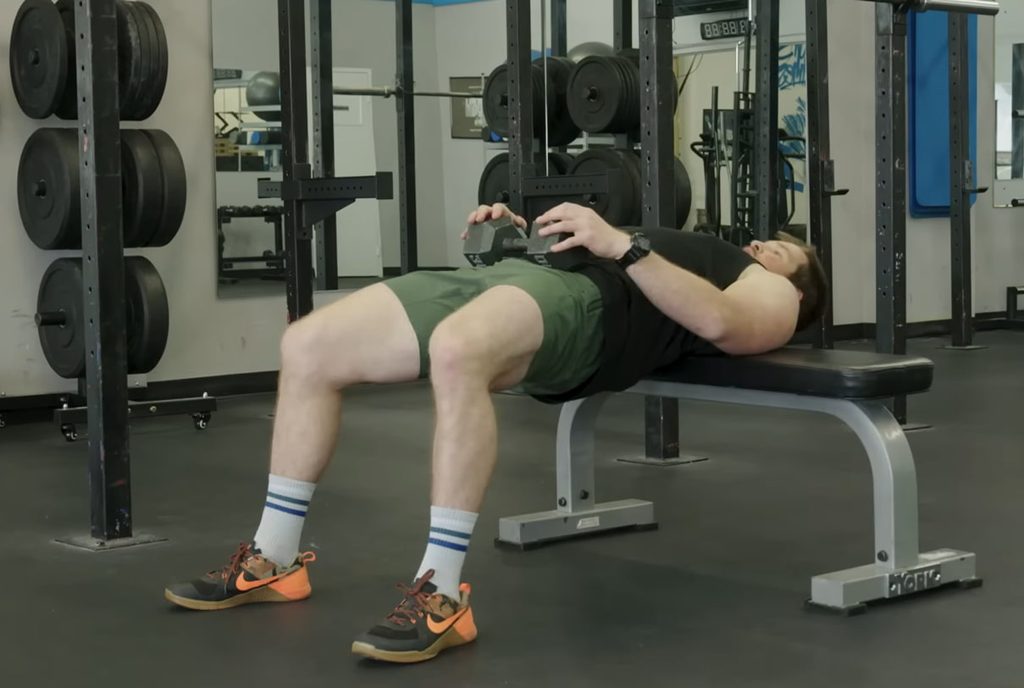
A dumbbell hip thrust is a weighted hip-extension exercise performed with the upper back supported on an elevated surface.
You sit on the floor with your upper back against a bench, place a dumbbell across your hip crease, and drive your hips upward. At the top, your shoulders, hips, and knees should form an approximately straight line.
The American Council on Exercise elevated glute bridge guide demonstrates the same general movement with the upper back across a flat bench, feet planted about hip-width apart, and dumbbells resting on the hips.
The exercise is sometimes called an elevated glute bridge. In everyday gym language, however, “hip thrust” usually describes the bench-supported version, while “glute bridge” refers to the version performed with the shoulders on the floor.
Dumbbell Hip Thrusts vs. Dumbbell Glute Bridges
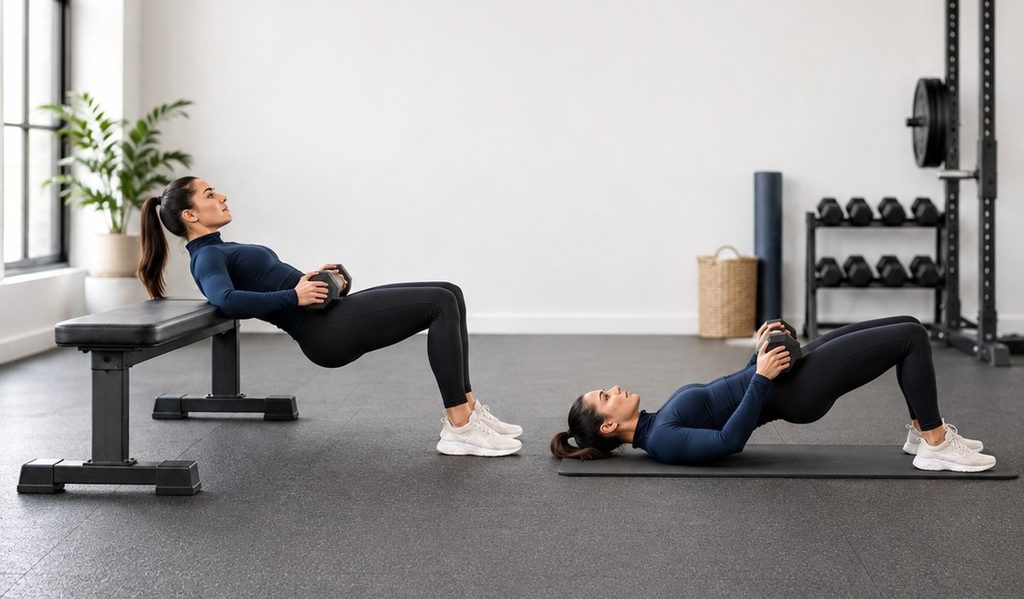
The main difference is the position of your upper body.
Dumbbell Hip Thrust
- Upper back is supported on a bench or padded box.
- Hips begin closer to the floor.
- The elevated setup usually permits a larger hip range of motion.
- Setup requires a stable elevated surface.
Dumbbell Glute Bridge
- Shoulders and upper back remain on the floor.
- The hips move through a shorter range.
- The exercise is easier to set up.
- It is usually a better starting variation for beginners.
Neither variation is automatically better for everyone. Use the floor bridge when you are still learning how to extend your hips without arching your back. Move to the hip thrust when you can control that movement and have a secure bench.
Equipment and Setup
Stable Bench or Padded Box
Choose a surface that will not slide, tip, or collapse. A standard flat bench often works well, but the correct height depends on your body size.
The edge should allow your upper back to pivot comfortably without pressing into your neck. Avoid soft furniture that sinks deeply or moves while you exercise.
Placing the bench against a wall or heavy piece of equipment can help prevent sliding, provided the setup remains stable.
Dumbbell
Start with one dumbbell that you can position without struggling. A hexagonal dumbbell is often easier to control than a round dumbbell because it is less likely to roll.
A single dumbbell can be placed horizontally across both hip creases. Hold it securely with both hands throughout the set.
Two dumbbells can also be used, with one positioned over each side of the hips, but only when both weights can be controlled evenly.
Padding
A folded exercise mat, bar pad, or thick towel can reduce discomfort between the dumbbell and your hips.
Padding should improve comfort without making the weight unstable. Continue holding the dumbbell even when padding is used.
How to Do Dumbbell Hip Thrusts With Proper Form
Equipment needed: Stable bench, one dumbbell, and optional padding.
Sets, reps, and rest: Begin with 2–3 sets of 10–15 repetitions. Rest for 60–120 seconds and finish each set with approximately 2–3 controlled repetitions remaining.
How to Do It
- Sit against the bench. Sit on the floor with your upper back against the long edge of a stable bench. Bend your knees and plant your feet approximately hip-width apart.
- Position the dumbbell. Place one dumbbell horizontally across your hip crease. Add padding if needed and hold the dumbbell securely with both hands.
- Set your upper back. Position the bench against your upper-to-middle back rather than your neck or lower back. Keep your head aligned with your spine.
- Brace before lifting. Gently tighten your abdominal muscles and keep your ribs from flaring upward.
- Drive through the floor. Press through your full feet and extend your hips. Allow your upper back to pivot around the bench without sliding excessively.
- Finish with the hips, not the spine. Stop when your shoulders, hips, and knees form an approximately straight line. Squeeze your glutes without forcing your hips higher by arching your lower back.
- Lower under control. Bring your hips toward the floor slowly while keeping the dumbbell secure. Begin the next repetition before completely relaxing.
Coaching cue: Think, “Bring my belt buckle toward my ribs,” rather than “push my stomach toward the ceiling.”
How to Position the Dumbbell Safely
Place the dumbbell across the crease where your thighs meet your pelvis. It should not sit high on your abdomen.
Hold the dumbbell during every repetition. Do not assume your body position will keep it in place.
For one heavy dumbbell:
- Sit on the floor with your back against the bench.
- Stand the dumbbell beside one hip.
- Roll or guide it carefully onto your lap.
- Use both hands to position it evenly.
- Add padding before beginning the set.
- Guide it safely back to the floor after finishing.
Do not choose a weight that is difficult to move into position. Once the setup becomes more demanding than the exercise itself, a barbell, Smith machine, or dedicated hip thrust machine may be more practical.
How to Find the Right Foot Position
Begin with your feet hip-width apart and your shins close to vertical at the top. Treat that as a starting point rather than a universal rule.
Body proportions differ, so small adjustments may be necessary.
When You Feel Your Quadriceps Too Much
Your feet may be too close to your hips. Move them a few inches farther forward and try again.
Also check that your heels stay planted and that you are not pushing mainly through your toes.
When Your Hamstrings Take Over or Cramp
Move your feet slightly closer to your hips.
The National Academy of Sports Medicine glute bridge guide similarly recommends bringing the feet closer when the hamstrings dominate.
You may also need to reduce the weight or shorten the range until you can maintain glute tension.
When You Feel Your Lower Back
Reduce the height of your lift and brace your abdominals before each repetition.
Do not continue raising your hips after they have reached a straight line with your shoulders and knees. Lifting higher usually adds spinal movement rather than useful hip extension.
When Your Heels Lift
Move your feet slightly farther away, reduce the load, and focus on keeping the whole foot in contact with the floor.
When Your Knees Move Inward
Use a slightly lighter dumbbell and keep your knees tracking in the same general direction as your toes. Do not force them excessively outward, but prevent them from collapsing toward each other.
What the Top Position Should Look Like
At the top of a controlled dumbbell hip thrust:
- Your shoulders, hips, and knees form an approximately straight line.
- Your feet remain flat.
- Your knees remain aligned with your toes.
- Your hips are fully extended without being forced upward.
- Your ribs remain controlled.
- Your lower back is not excessively arched.
- Your head and neck remain neutral.
- The dumbbell stays centered and secure.
A brief pause can help you confirm the position, but it is not necessary to hold every repetition for several seconds.
Biomechanical evidence does not support the common claim that hip-extension demand is always greatest at the exact top. The hip extensors work through the movement, and a top pause is mainly a technique and control tool.
Dumbbell Hip Thrust Muscles Worked
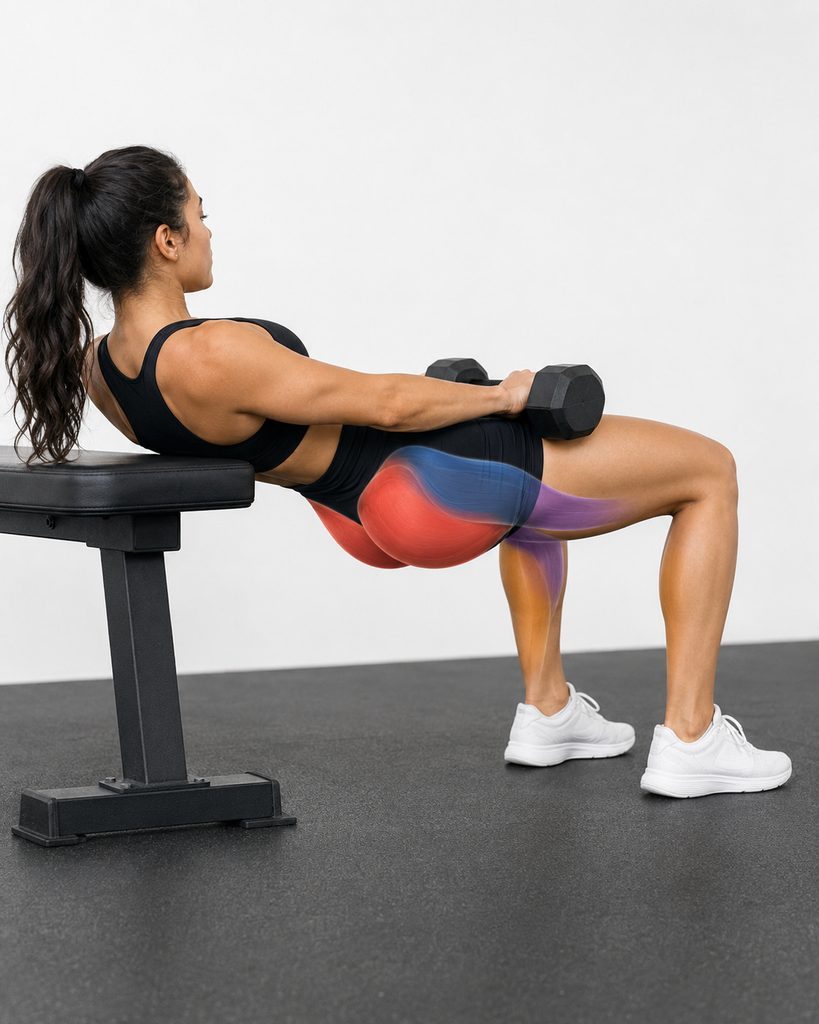
1. Gluteus Maximus
The gluteus maximus is the primary muscle trained during dumbbell hip thrusts. Its main role in the exercise is extending the hip, which brings your torso and thighs into alignment as you lift.
A biomechanical study of the barbell hip thrust found that the greatest joint demand occurred at the hips rather than the knees or ankles. Although that study used a barbell, the same basic hip-extension action occurs in the dumbbell variation.
2. Hamstrings
The hamstrings assist with hip extension and help control the position of the legs. They should contribute to the movement, but they should not normally overpower the glutes.
Feeling only your hamstrings may indicate that your feet are too far from your body or that you are trying to lift beyond your controlled range.
3. Adductor Magnus
The rear portion of the adductor magnus assists with hip extension. Its contribution is less obvious than that of the gluteus maximus, but it helps produce and control the movement.
4. Gluteus Medius and Gluteus Minimus
The smaller gluteal muscles help stabilize the pelvis and keep the thighs aligned. They are not the main muscles driving a standard two-leg hip thrust, but they support a controlled repetition.
5. Abdominals and Other Trunk Muscles
Your trunk muscles brace to prevent excessive movement through the spine. Their job is to keep your ribs and pelvis controlled while the hips perform most of the motion.
Benefits of Dumbbell Hip Thrusts
They Provide Direct Glute Training
Hip thrusts allow you to train hip extension with a strong emphasis on the gluteus maximus.
Research on glute growth has mostly studied barbell hip thrusts rather than dumbbell hip thrusts. A 2025 systematic review and meta-analysis of gluteus maximus hypertrophy found that resistance training can increase gluteus maximus size and identified hip thrusts as a useful glute-focused exercise.
The dumbbell version uses the same movement pattern, but its results will still depend on sufficient resistance, training effort, weekly volume, recovery, and gradual progression.
They Require Less Equipment Than Barbell Hip Thrusts
You need only a dumbbell and a secure elevated surface. There is no need to load weight plates, roll a barbell over your legs, or use a dedicated hip thrust machine.
This makes the exercise practical for home gyms and smaller training spaces.
They Bridge the Gap Between Bodyweight and Barbell Training
A bodyweight hip thrust may eventually become too easy, but a barbell variation may feel unnecessarily complicated. Adding a dumbbell provides an intermediate loading option.
You can gradually increase the dumbbell weight before deciding whether you need a barbell, Smith machine, or hip thrust machine.
They Can Complement Squats and Hinges
Squats, lunges, Romanian deadlifts, and hip thrusts all train the lower body, but they do not challenge every muscle in exactly the same way.
A study comparing barbell back squats with barbell hip thrusts found similar glute growth between the two programs, while squats produced more thigh growth. That supports using hip thrusts as a glute-focused complement rather than treating them as a replacement for every squat or hinge.
They Are Easy to Adjust
You can change the difficulty by adjusting:
- Dumbbell weight
- Repetition range
- Number of sets
- Pause duration
- Lowering speed
- Stance
- Number of working legs
The simplest progression is usually adding repetitions and then increasing the dumbbell weight.
Common Dumbbell Hip Thrust Mistakes
Using an Unstable Bench
A sliding or tipping bench makes it difficult to control the exercise and can create an unsafe setup.
Test the bench before adding weight. Stop the set immediately if the surface begins to move.
Placing the Weight on the Abdomen
The dumbbell should rest across the hip crease, not the stomach. Placing it too high can be uncomfortable and harder to control.
Letting the Dumbbell Roll
Keep both hands on the dumbbell. Padding improves comfort but does not replace a secure grip.
Driving Through the Toes
Pushing mainly through the front of the feet may cause the heels to rise and make the exercise less stable.
Maintain full-foot pressure. A useful cue is to keep the heel, base of the big toe, and base of the little toe in contact with the floor.
Overarching the Lower Back
The repetition ends when the hips are extended. Continuing to lift by flaring the ribs and arching the lower back does not create better glute training.
Brace your trunk, reduce the range, and use a lighter dumbbell when necessary.
Bouncing Out of the Bottom
Dropping quickly and rebounding upward uses momentum. Lower the hips under control and reverse direction without crashing toward the floor.
Pushing the Head Back
Do not throw your head backward to help lift the weight. Keep your neck aligned with your torso and your gaze comfortably forward.
Progressing Before the Setup Is Consistent
Adding weight does not improve the exercise when your bench position, foot placement, and lockout change on every repetition.
First make your technique repeatable. Then increase the resistance.
Dumbbell Hip Thrust Sets, Reps, and Rest
Choose your training range according to your experience, available weight, and main goal.
| Goal | Sets | Repetitions | Rest | Effort |
|---|---|---|---|---|
| Learn the movement | 2 | 10–15 | 60–90 seconds | 3–4 reps remaining |
| Build muscle | 3–4 | 8–15 | 90–150 seconds | 2–3 reps remaining |
| Limited dumbbell weight | 2–4 | 15–25 | 60–120 seconds | 1–3 reps remaining |
| Glute accessory exercise | 2–3 | 10–20 | 60–90 seconds | 2–3 reps remaining |
The updated American College of Sports Medicine resistance-training position stand recommends progressive training with sufficient effort and notes that approximately 2–3 repetitions in reserve can provide an effective stimulus without requiring every set to reach complete muscular failure.
You do not need to test a one-repetition maximum for dumbbell hip thrusts. Choose a weight based on repetition quality and remaining effort.
How Often Should You Do Dumbbell Hip Thrusts?
Most beginners can perform dumbbell hip thrusts one or two times per week.
Two weekly sessions may make it easier to practice the movement and distribute your glute training volume. However, you do not need to perform hip thrusts in every lower-body workout.
Count sets from your other glute exercises as well, including squats, lunges, step-ups, Romanian deadlifts, and split squats. The ACSM position stand reports that higher weekly volume can support muscle growth, with approximately 10 weekly sets per muscle group serving as a useful target for people trying to optimize hypertrophy. Beginners can often progress with less and add volume gradually.
Avoid adding more sets automatically when your performance, technique, or recovery is getting worse.
How to Progress Dumbbell Hip Thrusts
Use a simple double-progression method:
- Select a range such as 8–15 repetitions.
- Begin with a weight you can control for at least eight repetitions.
- Add repetitions over later workouts.
- Once every set reaches 15 repetitions with approximately two good repetitions remaining, increase the weight.
- Return to the lower end of the range and repeat.
Increase only one major variable at a time. Adding more weight, repetitions, sets, and pauses simultaneously makes progress difficult to track.
Other Progression Options
- Use a heavier dumbbell.
- Add a second dumbbell if both can be secured.
- Pause for one or two seconds at the top.
- Lower for approximately two or three seconds.
- Add a resistance band above the knees.
- Use a B-stance hip thrust.
- Progress to a single-leg hip thrust.
- Move to a barbell, Smith machine, or hip thrust machine.
A more complicated variation is not automatically more effective. The best progression is one that increases the challenge while preserving control and stability.
Beginner Regressions
Bodyweight Floor Glute Bridge
Lie on the floor with your knees bent and lift your hips without external resistance. This is the simplest way to learn hip extension and trunk control.
Dumbbell Floor Glute Bridge
Place a dumbbell across your hips while keeping your upper back on the floor. This adds resistance without requiring a bench.
Bodyweight Bench Hip Thrust
Use the elevated setup without a dumbbell. Practice finding a stable upper-back position and consistent foot placement.
Reduced-Range Hip Thrust
Lower only as far as you can while controlling your pelvis and spine. Gradually increase the range as your technique improves.
Isometric Glute Bridge Hold
Hold the top of a bodyweight floor bridge for 10–30 seconds. This can help you learn the finished position before adding dynamic repetitions.
B-Stance Dumbbell Hip Thrust
A B-stance hip thrust shifts more work toward one side without requiring the balance of a full single-leg variation.
Place one foot firmly on the floor. Move the other foot slightly forward and keep only light pressure through its heel. Perform the repetitions mainly through the working leg.
Use a lighter dumbbell than you use for the two-leg version. Keep the pelvis level rather than rotating toward one side.
Single-Leg Dumbbell Hip Thrust
The single-leg variation greatly increases the stability demand and can become difficult before the glutes receive enough loading.
Use it only after you can perform consistent bilateral hip thrusts and bodyweight single-leg repetitions.
Keep your pelvis level, avoid twisting, and use a very light dumbbell initially. A B-stance version is usually the better intermediate step.
How to Add Dumbbell Hip Thrusts to a Workout
Exercise placement should reflect your priority.
When Glute Development Is the Main Goal
Perform hip thrusts early in the workout, after your warm-up. This allows you to use more resistance and focus on technique before fatigue builds.
When General Lower-Body Strength Is the Main Goal
Perform a squat or hinge first, followed by dumbbell hip thrusts as a secondary glute exercise.
A practical order might be:
- Squat or split squat
- Romanian deadlift
- Dumbbell hip thrust
- Smaller leg or core exercise
Hip thrusts can also be paired with an upper-body exercise in a full-body workout because the exercises do not heavily compete for the same muscles.
Sample Beginner Dumbbell Glute Workout
Perform this routine once or twice per week. Use a weight that leaves approximately 2–3 repetitions in reserve on each working set.
1. Goblet Squat
- Sets: 3
- Reps: 8–12
- Rest: 90 seconds
Keep your full feet planted and use a controlled depth that allows you to maintain a stable torso.
2. Dumbbell Hip Thrust
- Sets: 3
- Reps: 10–15
- Rest: 90–120 seconds
Pause briefly at the top without arching your lower back.
3. Dumbbell Romanian Deadlift
- Sets: 2–3
- Reps: 8–12
- Rest: 90–120 seconds
Push your hips backward and keep the dumbbells close to your legs.
4. Dumbbell Reverse Lunge
- Sets: 2
- Reps: 8–10 per side
- Rest: 90 seconds
Use a stable step length and keep the front foot planted.
5. Side Plank
- Sets: 2
- Duration: 20–30 seconds per side
- Rest: 45–60 seconds
Maintain a straight line without allowing the hips to rotate.
Workout Progression
When you reach the top of the repetition range for every set with stable form, increase the dumbbell weight by the smallest practical amount.
Do not increase the weight if you are shortening the range, bouncing, losing foot pressure, or finishing by arching your back.
Dumbbell Hip Thrust Safety Tips
- Use a bench that cannot slide or tip.
- Check that the floor is dry and clear.
- Hold the dumbbell throughout the set.
- Use padding when the weight causes pressure against the hips.
- Do not place the dumbbell on the abdomen.
- Keep the movement controlled rather than explosive.
- Stop the set when you can no longer maintain your trunk and pelvic position.
- Use a spotter or a different exercise when a heavy dumbbell is difficult to position safely.
Stop exercising and seek appropriate professional help if you experience sharp pain, numbness, dizziness, chest pain, or other unusual symptoms.
Frequently Asked Questions
Are Dumbbell Hip Thrusts Good for Growing the Glutes?
They can be. Dumbbell hip thrusts directly load hip extension and can provide a useful glute-building stimulus when the weight is challenging, the repetitions are controlled, and resistance is increased over time.
Most long-term research has studied barbell hip thrusts, so specific claims about dumbbells should be made cautiously. The dumbbell version may eventually become limited by the amount of weight you can position comfortably.
How Heavy Should the Dumbbell Be?
Use a weight that allows you to complete your target repetitions with stable feet, controlled hips, and no lower-back arching.
For your first session, choose a lighter weight than you think you need. Increase it after you can repeat the same technique across every set.
Should I Feel Dumbbell Hip Thrusts in My Hamstrings?
Some hamstring involvement is normal. However, your glutes should usually feel like the main working muscles.
Move your feet slightly closer, reduce the weight, and avoid lowering beyond the range you can control if your hamstrings dominate or cramp.
Why Do I Feel Dumbbell Hip Thrusts in My Quadriceps?
Your feet may be too close to your body, causing greater knee involvement. Move them a few inches forward and keep your heels planted.
Also make sure you are extending your hips rather than pushing your body backward along the bench.
Should I Squeeze My Glutes at the Top?
Yes, but the squeeze should come from finishing hip extension—not from forcing your lower back into an arch.
Pause briefly when your hips are aligned with your shoulders and knees, then lower under control.
Can I Do Dumbbell Hip Thrusts Without a Bench?
Without a bench, perform a dumbbell glute bridge on the floor. It trains the same general hip-extension pattern with a shorter range of motion and simpler setup.
Are Dumbbell Hip Thrusts Better Than Squats?
They serve different purposes. Hip thrusts provide more glute-focused training, while squats train the glutes along with the quadriceps and other lower-body muscles.
A balanced program can include both rather than requiring you to choose only one.
Conclusion
Dumbbell hip thrusts are a practical glute exercise when you have a stable bench and a dumbbell you can position safely. The key is to place the weight across the hip crease, keep the full feet planted, extend through the hips, and stop before the lower back begins to arch.
Begin with a manageable load and repeat the same setup on every set. Once you can reach the top of your repetition range with controlled form, add weight gradually or move to a more loadable hip thrust variation.
References
- American Council on Exercise: Elevated Glute Bridge
- National Academy of Sports Medicine: How to Do a Glute Bridge
- American College of Sports Medicine Position Stand: Resistance Training Prescription
- Frontiers in Physiology: Resistance Training and Gluteus Maximus Hypertrophy
- PLOS ONE: Biomechanical Analysis of the Barbell Hip Thrust
- Frontiers in Physiology: Hip Thrust and Back Squat Training Comparison
- International Journal of Strength and Conditioning: Adding the Barbell Hip Thrust
This content is for informational purposes only and is not a substitute for medical advice.