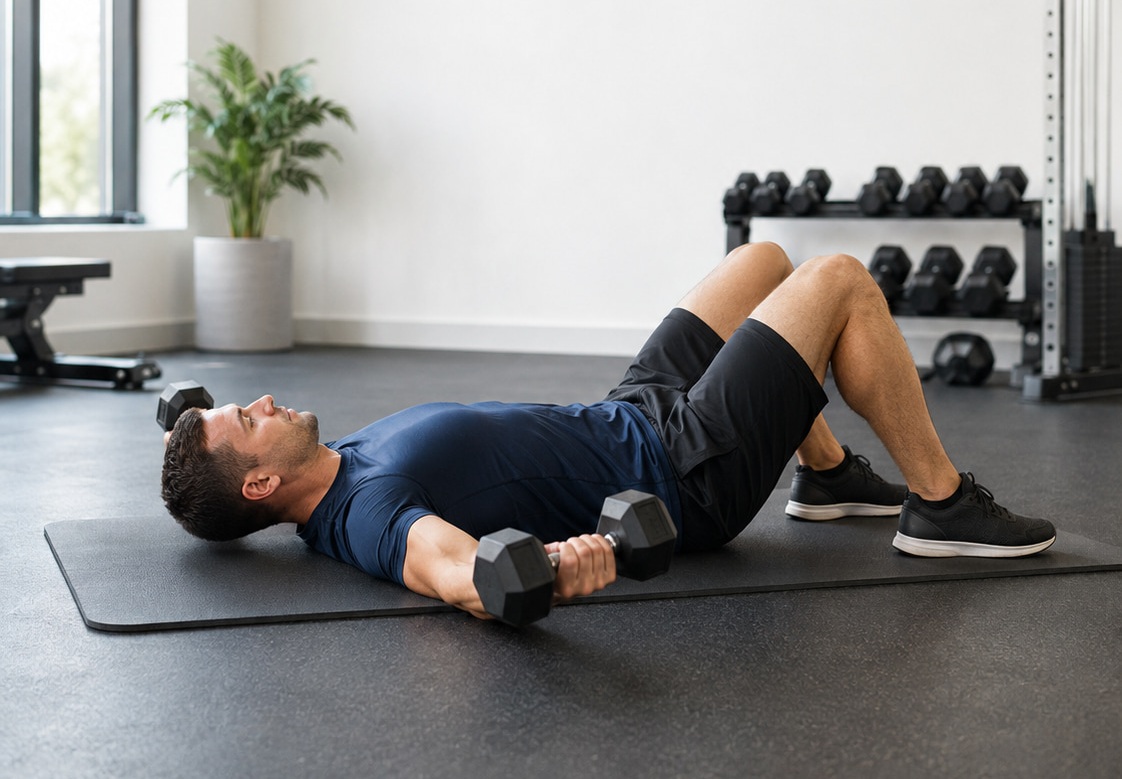
The dumbbell floor fly is a chest-focused isolation exercise performed while lying on the floor instead of a bench. It primarily trains the pectoralis major, while the front shoulders and muscles surrounding the shoulder joint assist with movement and stability.
The floor prevents your upper arms from moving far below your torso, creating a clear stopping point and a shorter bottom range than a conventional bench fly. This guide explains how to perform the dumbbell floor fly correctly, which muscles it works, how to avoid common mistakes, and where it fits into a chest workout.
What Is a Dumbbell Floor Fly?
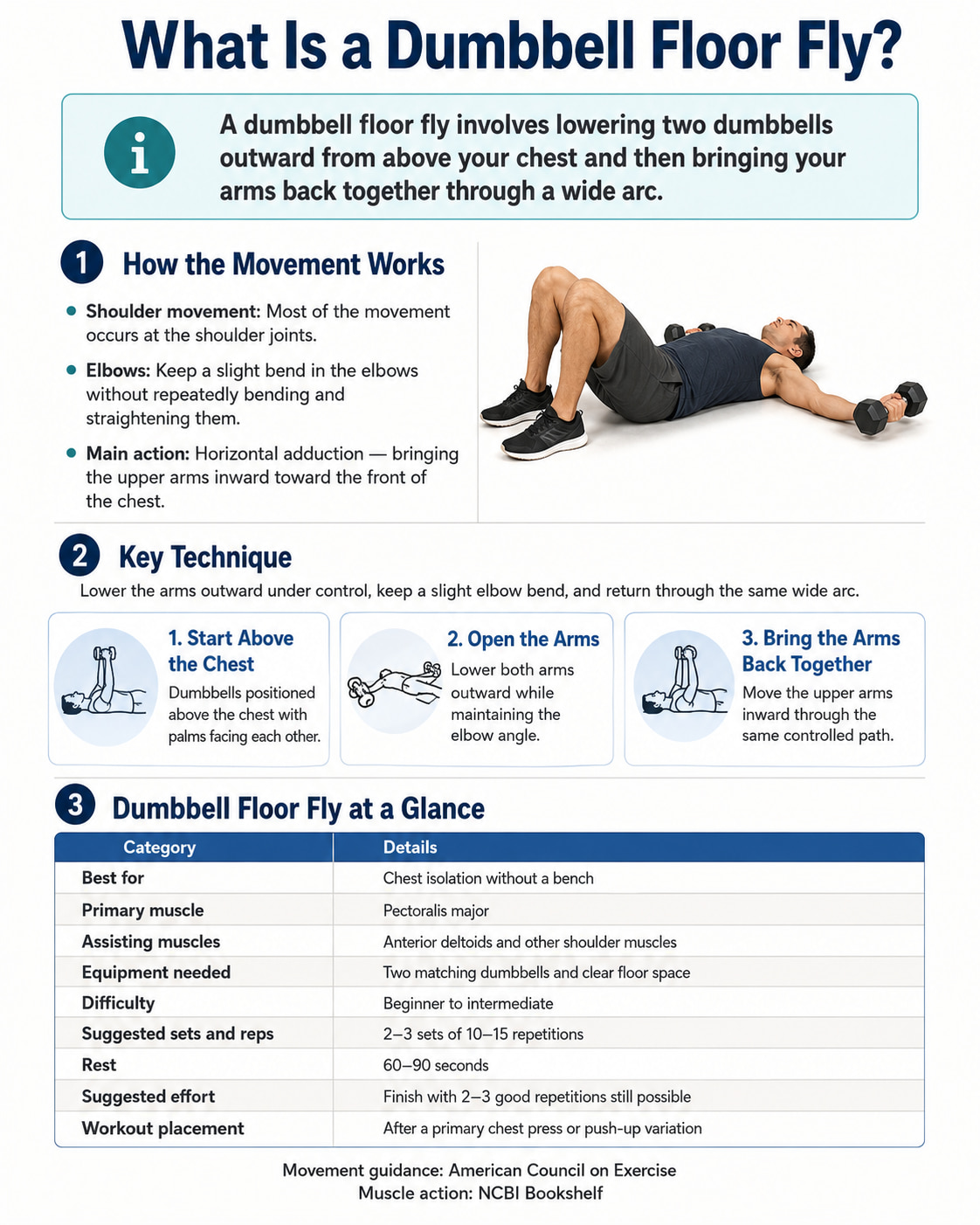
A dumbbell floor fly involves lowering two dumbbells outward from above your chest and then bringing your arms back together through a wide arc.
Most of the movement occurs at the shoulder joints. Your elbows remain slightly bent but do not repeatedly bend and straighten as they would during a dumbbell press.
The main shoulder action is horizontal adduction, which means bringing your upper arms inward toward the front of your chest. The NCBI Bookshelf overview of shoulder muscles identifies horizontal adduction as one of the primary actions of the pectoralis major.
The American Council on Exercise chest-fly instructions include the floor as an acceptable alternative to a flat bench. ACE recommends keeping a slight bend in the elbows, lowering the arms outward, and returning them through the same controlled path.
Dumbbell Floor Fly at a Glance
| Category | Details |
|---|---|
| Best for | Chest isolation without a bench |
| Primary muscle | Pectoralis major |
| Assisting muscles | Anterior deltoids and other shoulder muscles |
| Equipment needed | Two matching dumbbells and clear floor space |
| Difficulty | Beginner to intermediate |
| Suggested sets and reps | 2–3 sets of 10–15 repetitions |
| Rest | 60–90 seconds |
| Suggested effort | Finish with 2–3 good repetitions still possible |
| Workout placement | After a primary chest press or push-up variation |
Dumbbell Floor Fly Muscles Worked
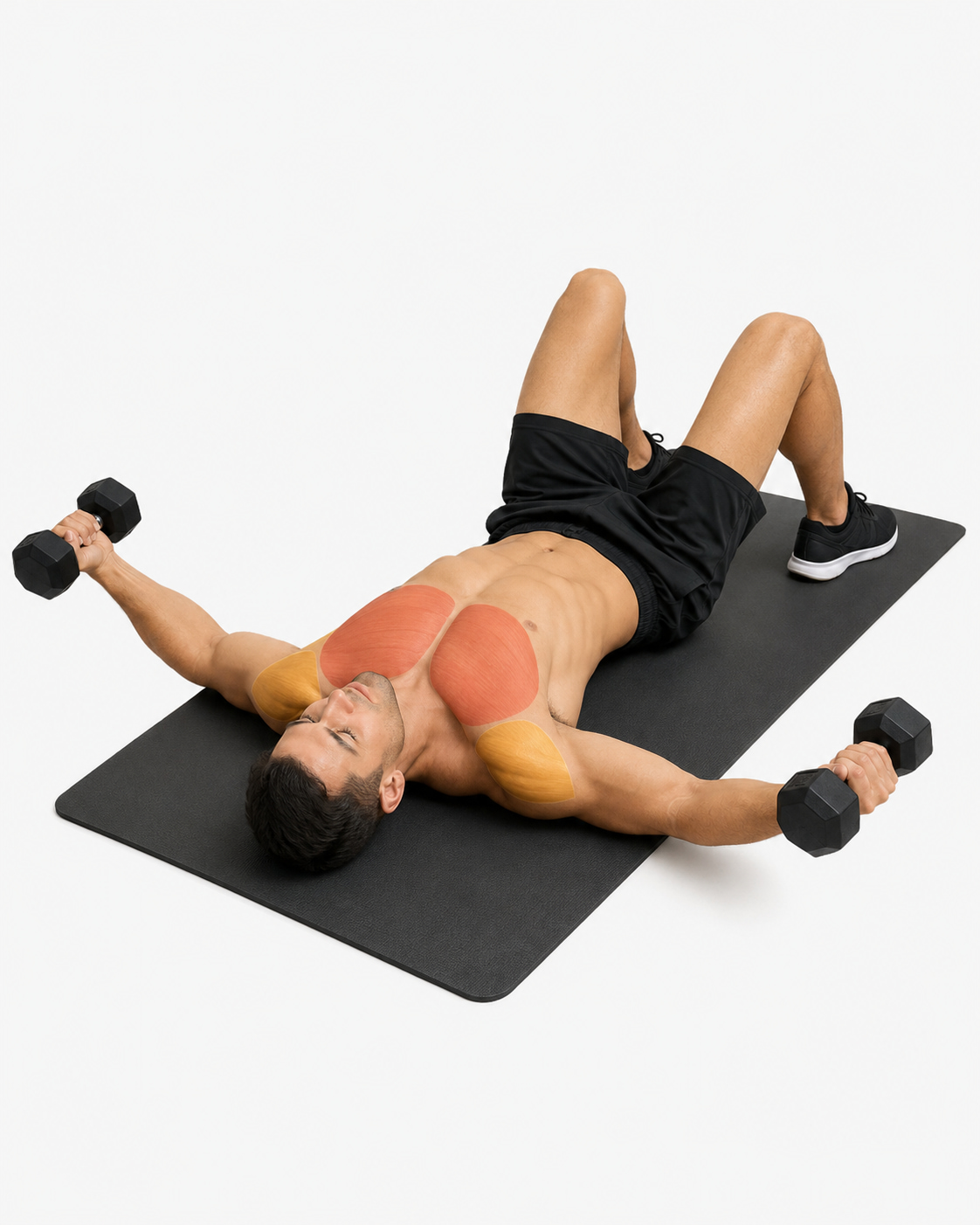
The dumbbell floor fly is mainly a chest exercise, but several muscles contribute to moving and stabilizing your arms.
Pectoralis Major
The pectoralis major is the large, fan-shaped muscle covering most of the front of your chest. It is the primary muscle responsible for bringing your upper arms inward during the upward phase of the floor fly.
The muscle has clavicular and sternocostal portions. These portions work together during horizontal adduction, although their relative contribution may change slightly depending on the direction of the arm movement.
The NCBI Bookshelf description of the pectoral muscles identifies adduction, shoulder flexion, and internal rotation as important functions of the pectoralis major.
Anterior Deltoids
The anterior deltoids are located at the front of your shoulders. They assist the pectoralis major as your arms move upward and inward.
Some front-shoulder involvement is normal. However, the shoulders may take over more of the exercise if you use excessive weight, allow the dumbbells to drift toward your face, shrug, or lower into a range you cannot control.
Shoulder Stabilizers
The rotator-cuff muscles and other muscles surrounding the shoulder blades help keep the shoulder joints controlled while the arms move.
These muscles are not the main target of the exercise, but they help prevent unwanted movement of the upper-arm bones and shoulder blades.
Your abdominal and trunk muscles also work at a low level to help maintain a stable torso against the floor.
Triceps and Biceps
The triceps help maintain your chosen elbow position, but they are not a primary mover because the elbows should not straighten significantly during each repetition.
The biceps and coracobrachialis may assist with shoulder control, but they should not be considered the main target muscles.
Does the Dumbbell Floor Fly Work the Inner Chest?
The dumbbell floor fly trains the pectoralis major, including fibers that originate near the sternum. However, there is no separate “inner chest” muscle that can be completely isolated.
You may feel a strong chest contraction as your arms come together, but pressing the dumbbells against each other does not create a special inner-chest effect. Focus on controlled upper-arm movement rather than trying to force the weights together.
How to Do a Dumbbell Floor Fly
Best for
The dumbbell floor fly is useful for home training, chest isolation, and lifters who want a clearly limited bottom position without using a bench.
Equipment needed
- Two matching dumbbells
- A clear, level floor
- An exercise mat for comfort, if needed
Sets, reps, and rest
Start with 2–3 sets of 10–15 repetitions. Rest for 60–90 seconds between sets and stop with approximately 2–3 controlled repetitions still possible.
Step-by-Step Instructions
- Sit on the floor with one dumbbell beside each thigh.
- Hold the dumbbells close to your body as you carefully lower yourself onto your back.
- Bend your knees and place both feet flat on the floor. Keep your head, upper back, hips, and feet supported.
- Hold the dumbbells above the middle of your chest with your palms facing each other.
- Maintain a small bend in your elbows. Keep your wrists straight and aligned with your forearms.
- Gently brace your core and keep your shoulders controlled against the floor. Do not force your lower back completely flat.
- Inhale as you slowly lower both arms outward through a wide arc.
- Keep the elbow angle nearly unchanged as the dumbbells move apart.
- Stop when the backs of your upper arms or elbows lightly contact the floor. Stop earlier if you cannot maintain control or the position feels uncomfortable.
- Exhale as you bring your upper arms inward through the same arc.
- Finish with the dumbbells above your chest. Keep them separated rather than striking them together.
- After the final repetition, bend your elbows and bring the dumbbells toward your chest before carefully placing them on the floor.
The ACE lying chest fly guide similarly recommends maintaining a slight elbow bend, neutral wrists, a wide controlled arc, and stable contact with the supporting surface.
Coaching cue
Move your upper arms as though you are hugging a large barrel.
This cue helps you move from the shoulders while maintaining a consistent elbow angle.
Recommended tempo
Lower the dumbbells for approximately two to three seconds, pause briefly without relaxing on the floor, and return them smoothly.
The tempo does not need to be counted perfectly. The important point is to avoid dropping, bouncing, or rushing the weights.
What the Floor Changes
The floor does more than replace a bench. It changes the available range of motion.
During a bench fly, your upper arms can move approximately level with your torso and potentially farther if you continue lowering. During a floor fly, your upper arms meet the floor before they can travel substantially below your torso.
This creates two important differences.
The Bottom Range Is Shorter
The floor limits deep horizontal abduction at the shoulder. You will generally experience less stretch across the chest than you would during a controlled bench fly.
This can make the bottom position easier to judge, but it does not guarantee that the exercise will be comfortable for every shoulder.
The Floor Provides a Consistent Stop
Your upper arms contact the same surface on each repetition, giving you a clear reference for the bottom position.
That reference is only helpful when you make gentle contact. Dropping or bouncing your arms against the floor removes muscular control and may create unnecessary stress.
Benefits of the Dumbbell Floor Fly
1. Trains the Chest Without a Bench
The only equipment required is a pair of dumbbells, making the exercise practical for home workouts or crowded gyms where a bench is unavailable.
The 2026 American College of Sports Medicine resistance-training guidance notes that home-based routines and different types of resistance can improve muscle strength and size when training is performed consistently and progressed appropriately.
2. Provides a Chest-Focused Accessory Exercise
Because your elbow angle remains relatively fixed, the movement emphasizes bringing the upper arms together rather than pressing the dumbbells by straightening the elbows.
This makes the floor fly useful after a floor press, bench press, push-up, or another compound chest exercise.
3. Creates a Clear Bottom Position
The floor helps prevent the upper arms from unintentionally dropping far below the torso.
This can be useful for beginners who have difficulty judging the bottom of a bench fly, provided they lower the weights gently and remain within a comfortable range.
4. Helps Develop Controlled Shoulder Movement
The exercise teaches you to move both arms through a consistent arc while controlling the wrists, elbows, shoulders, and torso.
This technique can transfer to other fly variations, including bench, cable, resistance-band, and machine flyes.
5. Can Support Chest Muscle Growth
The floor fly can contribute to chest development when it is performed with sufficient effort, repeated consistently, and progressed over time.
However, it is best treated as an accessory rather than your only chest exercise. A study indexed by PubMed comparing dumbbell flyes with dumbbell and barbell bench presses found that flyes had less relative muscle-activation time and concluded that they may be better suited as an auxiliary lift. The study examined a conventional fly rather than the floor-specific variation, so the result should be applied cautiously.
Limitations of the Dumbbell Floor Fly
The exercise has several practical limitations:
- The floor reduces the available bottom range.
- It provides less chest stretch than a bench fly.
- It is not well suited to very heavy loading.
- Resistance becomes relatively low near the top of the movement.
- It does not train elbow extension as a press does.
- It should not replace all pressing movements in a balanced chest program.
Dumbbells are pulled vertically downward by gravity. When your arms are open, the weights are farther horizontally from your shoulders and create a larger challenge. As the dumbbells move above your shoulders, the leverage decreases and the exercise becomes easier.
This is why the floor fly should remain controlled rather than becoming an attempt to slam or squeeze the dumbbells together at the top.
Dumbbell Floor Fly vs. Bench Fly
| Feature | Dumbbell Floor Fly | Dumbbell Bench Fly |
|---|---|---|
| Equipment | Dumbbells and floor space | Dumbbells and a bench |
| Bottom range | Limited by the floor | Greater available range |
| Chest stretch | Moderate | Potentially greater |
| Bottom-position reference | Clear physical stop | Controlled by the lifter |
| Shoulder-control demand | Moderate | Usually greater in the deeper range |
| Best use | Home training and shorter-range flyes | Greater-range chest isolation |
| Loading | Light to moderate | Light to moderate |
Neither variation is automatically better.
Choose the floor fly when you do not have a bench or prefer a shorter bottom range. Choose the bench fly when you can control the additional range without pain, bouncing, or losing shoulder position.
A bench fly should be considered a range-of-motion progression, not simply a heavier version of the floor fly.
Dumbbell Floor Fly vs. Floor Press
Although both exercises begin from a similar position, their movement patterns are different.
| Feature | Dumbbell Floor Fly | Dumbbell Floor Press |
|---|---|---|
| Main action | Arms open and close through an arc | Dumbbells press vertically |
| Elbow movement | Elbow angle stays nearly fixed | Elbows bend and straighten |
| Main muscles | Chest with front-shoulder assistance | Chest, triceps, and front shoulders |
| Typical load | Lighter | Heavier |
| Primary purpose | Chest isolation | Upper-body pressing strength |
| Best workout role | Accessory exercise | Primary or secondary press |
Use the floor press when your main goal is pressing strength or when the fly pattern is difficult to control. Use the floor fly when you want additional chest work after your pressing exercises.
Common Dumbbell Floor Fly Mistakes
1. Using Too Much Weight
Heavy dumbbells can cause you to bounce your arms, shorten the range, bend your elbows excessively, or lose shoulder control.
Choose a weight that allows you to lower both arms slowly and complete every repetition through the same path.
2. Turning the Fly Into a Press
If your elbows bend deeply during the lowering phase and straighten as the weights rise, you are performing a pressing movement.
Keep a small, nearly fixed elbow bend from the beginning to the end of each repetition.
3. Locking the Elbows Completely
Completely straight arms create a longer lever and can make the dumbbells harder to control.
Maintain a soft elbow position without allowing the elbows to collapse inward.
4. Bouncing the Arms Off the Floor
The floor should provide a reference, not momentum.
Lower until your upper arms make light contact, pause without relaxing, and reverse the movement under muscular control.
5. Letting the Dumbbells Drift Toward the Face
The weights should remain above the chest rather than moving over your forehead or excessively toward your abdomen.
Think about opening your upper arms out from the chest and returning them to the same starting point.
6. Shrugging the Shoulders
Allowing the shoulders to rise toward the ears can reduce control and make the exercise feel more shoulder-dominant.
Keep your neck relaxed and your shoulders comfortably away from your ears.
7. Bending the Wrists
The dumbbells should remain stacked over straight wrists. Avoid allowing the weights to pull your hands backward or sideways.
A secure grip and lighter load usually make wrist alignment easier to maintain.
8. Hitting the Dumbbells Together
The dumbbells do not need to touch at the top.
Finish with the weights separated and controlled above your chest. Striking them together adds noise and instability without increasing meaningful resistance.
9. Raising the Hips
Keep your hips supported by the floor unless you are intentionally performing a separate bridge-fly variation.
Lifting the hips does not improve the standard floor fly and may distract from maintaining a stable upper body.
How Much Weight Should You Use?
Use less weight than you would for a dumbbell floor press.
The floor fly creates a long lever because the dumbbells remain relatively far from your shoulder joints. A weight that feels light during a press can become difficult to control during a fly.
Choose dumbbells that let you:
- Complete at least 10 controlled repetitions
- Lower for two to three seconds
- Maintain the same elbow angle
- Touch the floor gently
- Keep your wrists straight
- Finish with two or three repetitions still available
If you cannot meet these standards, reduce the weight or shorten the range.
There is no need to test a one-repetition maximum or use very low repetitions for this exercise.
Sets, Reps, Rest, and Workout Placement
A practical starting point is:
- Sets: 2–3
- Repetitions: 10–15
- Rest: 60–90 seconds
- Effort: Approximately 2–3 repetitions in reserve
- Frequency: Once or twice per week within your chest training
- Placement: After your main pressing exercise
Beginners can start with two sets. Add a third set only after the movement feels consistent and you recover comfortably between sessions.
The floor fly usually works best in the middle or near the end of a workout. Performing it first may fatigue your chest and shoulders before heavier presses.
How to Progress the Dumbbell Floor Fly
Use a simple repetition-range progression:
- Choose a weight you can perform for approximately 10 controlled repetitions.
- Keep the same weight until you can complete all planned sets for 15 repetitions.
- Increase to the next manageable dumbbell size.
- Return to the lower end of the repetition range.
- Build the repetitions again while maintaining the same technique.
Increase the weight only when you can complete every repetition without bouncing, changing your elbow angle, shrugging, or rushing the lowering phase.
When the next dumbbell increase is too large, progress by:
- Adding one repetition per set
- Using a three-second lowering phase
- Pausing just above the floor
- Adding one set within your overall training plan
Change only one variable at a time.
Beginner Modifications and Regressions
Use Lighter Dumbbells
This is the simplest and usually the most effective regression. Very light weights can still be challenging because of the long arm position.
Shorten the Range
Stop before your arms reach the floor if the full available range is difficult to control.
Use the largest comfortable range that allows stable shoulders and smooth repetitions.
Bend the Elbows Slightly More
A little more elbow bend shortens the lever and reduces the challenge. Keep that new elbow angle consistent throughout the set.
Do not bend so far that the exercise becomes a floor press.
Substitute a Dumbbell Floor Press
A floor press is not an exact regression because it uses a different movement pattern. However, its bent-elbow position is often easier to control.
Practice the press first if you are not yet comfortable stabilizing dumbbells with your arms opened widely.
Dumbbell Floor Fly Progressions and Variations
Paused Dumbbell Floor Fly
Pause for one second when your upper arms reach the bottom. Do not relax completely against the floor.
This removes bouncing and improves control when reversing the movement.
Slow-Eccentric Floor Fly
Take three to four seconds to lower the dumbbells.
Use the same weight or reduce it slightly because the longer lowering phase increases the difficulty.
Alternating Dumbbell Floor Fly
Keep one dumbbell supported above your chest while lowering the opposite arm.
This variation adds a trunk-stability challenge but should only be used after you can control the standard two-arm version.
Dumbbell Bench Fly
Moving to a bench increases the available bottom range. Use lighter dumbbells initially and stop at the deepest position you can control comfortably.
Cable Chest Fly
A cable fly provides a different resistance profile. Unlike dumbbells, cables can maintain meaningful resistance as the hands move closer together.
Use this variation when you want more tension near the closed position.
Sample Dumbbell Chest Workout
This routine uses the floor fly as an accessory after a compound pressing exercise.
Beginner Home Chest Routine
| Exercise | Sets and reps | Rest | Effort |
|---|---|---|---|
| Dumbbell floor press | 3 sets of 8–12 | 90–120 seconds | Stop with 2 repetitions in reserve |
| Dumbbell floor fly | 2 sets of 10–15 | 60–90 seconds | Stop with 2–3 repetitions in reserve |
| Incline or standard push-up | 2 sets of 6–15 | 60–90 seconds | Stop before technique breaks down |
Perform the routine once or twice per week on nonconsecutive days, depending on your experience, recovery, and other upper-body training.
Before starting, complete five to ten minutes of easy activity followed by one or two light practice sets of the floor press and floor fly.
When you reach the top of the repetition range for every set with consistent technique, increase the resistance by the smallest practical amount.
Include pulling exercises such as dumbbell rows in your wider weekly program to train the back and maintain a balanced upper-body routine.
Safety Considerations
The floor limits the bottom range, but the dumbbell floor fly is not automatically appropriate for every shoulder.
Follow these safety guidelines:
- Warm up before using your working weight.
- Begin with lighter dumbbells than you think you need.
- Maintain a controlled, pain-free range.
- Do not bounce your upper arms against the floor.
- Do not force the shoulders deeper by lifting your torso or twisting.
- Keep the dumbbells away from your face when getting into position.
- Bring the weights toward your chest before setting them down.
- Avoid attempting maximum-weight or very low-repetition flyes.
The American Academy of Orthopaedic Surgeons shoulder guidance advises people not to ignore pain during shoulder exercise and to seek guidance from a doctor or physical therapist when exercise causes pain.
Stop the exercise and seek professional help if you experience sharp pain, numbness, dizziness, chest pain, or other unusual symptoms.
Anyone recovering from a shoulder, chest, elbow, or wrist injury should obtain individualized guidance before adding loaded flyes.
Frequently Asked Questions
Are dumbbell floor flyes effective for building the chest?
Dumbbell floor flyes can support chest development when they are performed with sufficient effort and progressed over time.
They are most useful as an accessory exercise after a press or push-up rather than as the only movement in a chest program.
Are floor flyes better than bench flyes?
Neither variation is better for everyone.
The floor fly provides a shorter range and a clear bottom stop. The bench fly provides a greater available range and potentially more stretch but requires more control in the bottom position.
Choose the variation you can perform comfortably and consistently.
Should my elbows touch the floor?
The backs of your upper arms or elbows may lightly contact the floor, depending on your arm position and body proportions.
Do not drop onto the floor. Stop earlier if contact causes discomfort or makes you lose control.
Why do I feel dumbbell floor flyes in my shoulders?
The anterior deltoids normally assist during the exercise. However, excessive shoulder involvement may indicate that the dumbbells are too heavy, the weights are drifting toward your face, you are shrugging, or you are using more range than you can control.
Reduce the weight and reassess your arm path. Stop if you feel sharp or persistent pain.
Should the dumbbells touch at the top?
No. Finish with the dumbbells controlled above your chest without striking them together.
The exercise becomes mechanically easier near the top, so forcing the weights together does not meaningfully increase the external resistance.
Can beginners perform dumbbell floor flyes?
Beginners can perform the exercise when they use light dumbbells and maintain a controlled range.
A dumbbell floor press may be a more manageable starting exercise for someone who is not yet comfortable stabilizing the weights through a wide fly arc.
How many repetitions should I perform?
Start with 10–15 repetitions per set.
Higher repetitions with lighter dumbbells are generally more practical for this exercise than heavy, low-repetition sets. Stop the set when your elbow position, wrist alignment, or movement speed begins to change.
Conclusion
The dumbbell floor fly is a practical chest-isolation exercise for home or gym training. It primarily works the pectoralis major while the front shoulders and surrounding stabilizers assist.
Its main advantage is a clear bottom stopping point without requiring a bench. Its main limitation is a shorter range and less bottom-position stretch than a bench fly.
Use light-to-moderate dumbbells, maintain a small fixed elbow bend, lower slowly, and treat the movement as an accessory after your main chest press. Progress only when every repetition remains smooth and controlled.
References
- American Council on Exercise: Dumbbell Chest Fly on a Bench or Floor
- American Council on Exercise: Lying Chest Fly
- NCBI Bookshelf: Anatomy of the Pectoral Muscles
- NCBI Bookshelf: Anatomy of the Scapulohumeral Muscles
- PubMed: Electromyographic Activity During Dumbbell Flyes and Bench Presses
- American College of Sports Medicine: 2026 Resistance Training Guidelines
- American Academy of Orthopaedic Surgeons: Shoulder Conditioning Guidance
This content is for informational purposes only and is not a substitute for medical advice.