
Lower glute exercises can strengthen and build the lower region of the gluteus maximus through hip hinges, squats, lunges, and other hip-extension movements. Combining a few complementary exercises gives you a practical way to train the glutes and surrounding posterior thigh.
Below are nine options with clear form instructions, common mistakes, and a two-day routine. Choose movements that suit your equipment and experience, then progress them consistently.
What Is the Glute-Ham Tie-In?
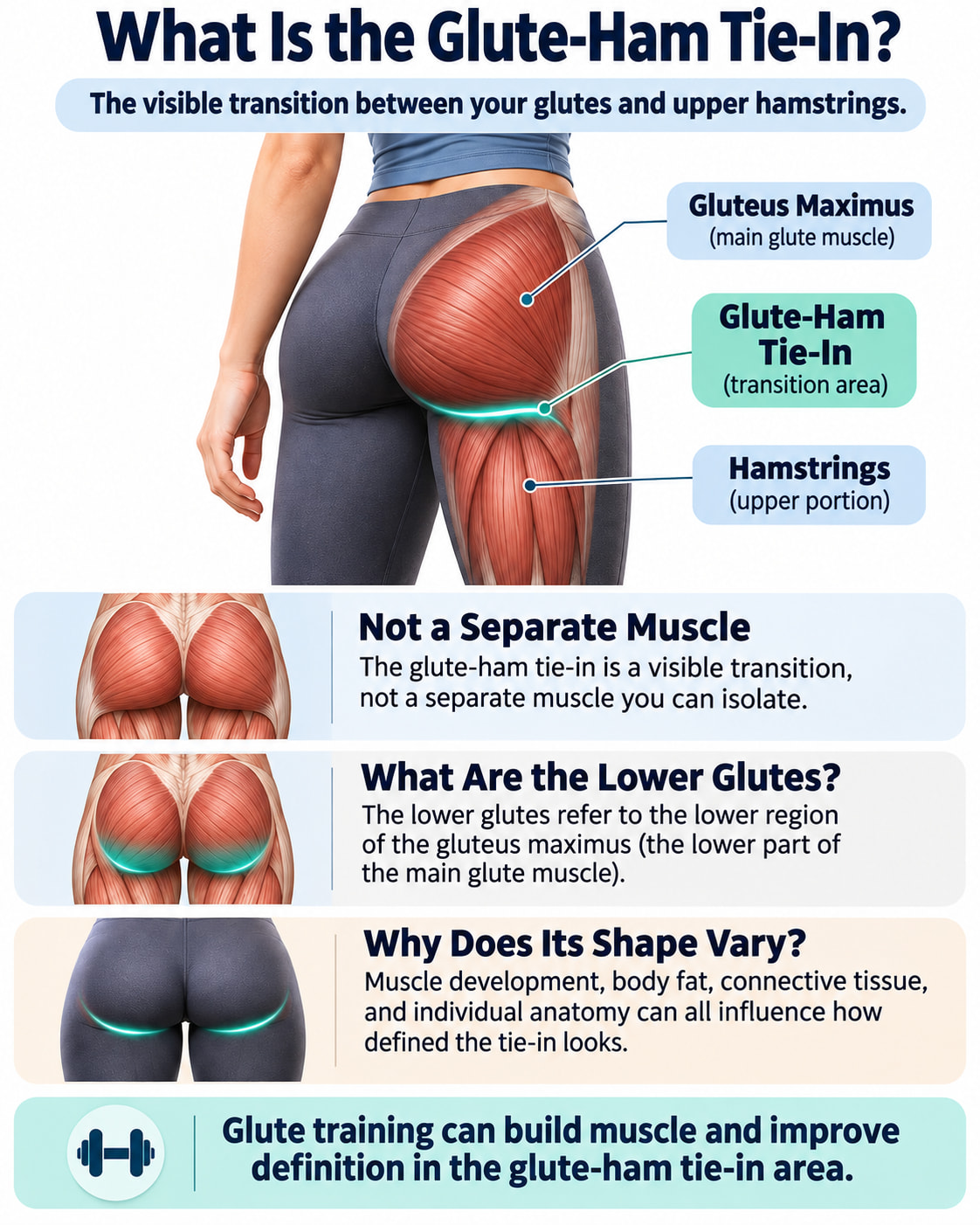
The glute-ham tie-in is the visible transition between your buttocks and the back of your upper thighs. It is not a separate muscle you can isolate.
“Lower glutes” refers to the lower region of the gluteus maximus. The crease beneath the buttocks also involves connective tissue, as described in anatomical research published in Aesthetic Plastic Surgery. Building nearby muscle does not guarantee a particular fold or shape.
Before You Start
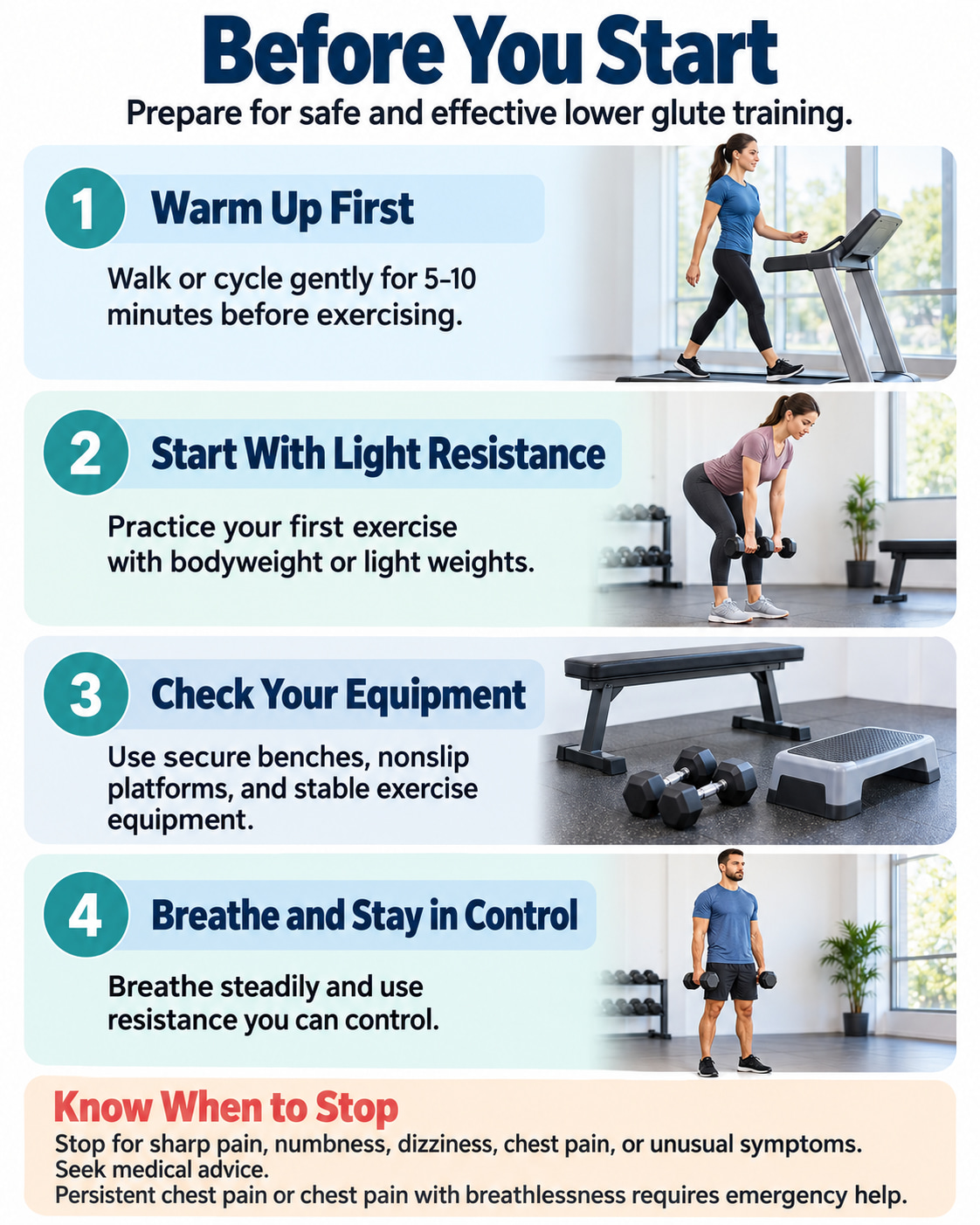
Warm up with 5–10 minutes of easy walking or cycling, as recommended by the American Academy of Orthopaedic Surgeons. Then rehearse your first exercise with bodyweight or a light load.
Use secure benches and nonslip platforms. Breathe steadily, and choose resistance that lets you control every repetition.
Stop and seek medical advice if you experience sharp pain, numbness, dizziness, chest pain, or unusual symptoms. The NHS advises emergency help for persistent chest pain or chest pain with breathlessness or lightheadedness.
9 Best Lower Glute Exercises
Choose two or three exercises for a session, using the routine below as a starting point. The list offers alternatives for different equipment and abilities; it is not a ranking of proven lower-glute growth.
1. Dumbbell Romanian Deadlift
Best for: Training the glutes and hamstrings together through a hip hinge.
Muscles worked: Gluteus maximus and hamstrings, with the trunk and spinal muscles stabilizing.
Equipment: Two dumbbells.
Sets, reps, and rest: 2–3 sets of 8–12 reps; rest about 2 minutes.
How to do it:
- Stand with your feet about hip-width apart, holding the dumbbells in front of your thighs.
- Slightly bend your knees, brace your abdomen, and push your hips backward. Keep the weights close to your legs.
- Lower until you reach the limit of your controlled hinge. Maintain a neutral spine rather than rounding to reach the floor.
- Press through your feet and bring your hips forward to stand tall without leaning backward.
Common mistakes: Bending the knees progressively until the movement becomes a squat, letting the weights drift forward, or chasing extra depth. Hospital for Special Surgery advises stopping when hamstring mobility limits the hinge instead of rounding farther.
Beginner option: Practice the hip hinge without weights, then introduce light dumbbells.
2. Dumbbell Bulgarian Split Squat
Best for: Challenging one leg at a time with a loadable squat variation.
Muscles worked: Gluteus maximus and quadriceps, with assistance from the adductors and hip stabilizers.
Equipment: Two dumbbells and a stable bench.
Sets, reps, and rest: 2–3 sets of 8–12 reps per leg; rest about 2 minutes before repeating the same side.
How to do it:
- Stand in front of a secure bench, holding dumbbells at your sides. Rest the top of one foot on the bench behind you.
- Position your front foot so you can descend comfortably. Keep your feet separated about hip-width.
- Bend your knees to lower under control, keeping the front foot flat and its knee following the direction of your toes.
- Press through your front foot to rise. Complete your repetitions, then switch legs.
Common mistakes: Using an unstable support, placing the feet on a narrow line, or forcing the dumbbells to touch the floor. A small, controlled forward torso lean is acceptable.
Beginner option: Use a supported split squat with both feet on the floor before elevating the rear foot.
3. Dumbbell Reverse Lunge
Best for: Single-leg glute and quadriceps work without an elevated rear-foot setup.
Muscles worked: Gluteus maximus and quadriceps, with the hip and trunk muscles helping you stay balanced.
Equipment: Two dumbbells.
Sets, reps, and rest: 2–3 sets of 8–12 reps per leg; rest about 2 minutes between sets.
How to do it:
- Stand with your feet hip-width apart and a dumbbell at each side.
- Step one foot backward, landing on the ball of that foot while keeping your front foot planted.
- Bend both knees and lower through a comfortable range. Keep your torso controlled and your front knee aligned with the foot.
- Press through your front foot to return to standing. Alternate legs or finish one side before switching.
Common mistakes: Stepping directly behind the front foot, dropping quickly, or pushing mainly from the rear leg.
Make it easier: Begin without dumbbells. Use light hand support if balance limits your control.
4. Dumbbell Step-Up
Best for: Building single-leg strength with an adjustable step height.
Muscles worked: Gluteus maximus and quadriceps, with hip stabilizers assisting.
Equipment: Two dumbbells and a stable step or box.
Sets, reps, and rest: 2–3 sets of 8–12 reps per leg; rest about 2 minutes between sets.
How to do it:
- Face a stable platform while holding dumbbells at your sides.
- Place your entire right foot on the platform. Choose a height that lets you keep your hips and knee controlled.
- Press through your right foot to straighten that hip and knee, bringing your left foot onto the platform.
- Slowly lower your left foot to the floor, then step down with your right. Complete your repetitions and change the leading leg.
Common mistakes: Jumping from the trailing foot, letting the lead heel hang off the edge, or dropping quickly during the descent.
Progression: First make the movement smooth with bodyweight. Add dumbbell resistance once you can rise and lower without bouncing; a taller box is optional.
5. Goblet Squat
Best for: Practicing a controlled squat with a simple front-held weight.
Muscles worked: Quadriceps, gluteus maximus, and adductors.
Equipment: One dumbbell.
Sets, reps, and rest: 2–3 sets of 8–12 reps; rest about 2 minutes.
How to do it:
- Stand with your feet about shoulder-width apart and your toes turned out slightly if comfortable. Hold one dumbbell vertically at your chest.
- Brace your abdomen, then bend your hips and knees to lower between your legs.
- Keep your heels planted and let your knees follow the direction of your toes. Descend only as far as you can maintain control.
- Press through your whole feet to stand without leaning backward.
Common mistakes: Forcing depth after losing your brace, letting the weight pull you forward, or allowing the knees to collapse inward.
Beginner option: Practice a bodyweight squat to a sturdy box. As the movement improves, add a light dumbbell and gradually expand your comfortable range, following the exercise guidance from the National Academy of Sports Medicine.
6. Barbell Hip Thrust
Best for: Progressively loading hip extension with the upper back supported.
Muscles worked: Primarily gluteus maximus, with assistance from other hip and thigh muscles.
Equipment: A secure bench, barbell, plates, and a bar pad.
Sets, reps, and rest: 2–3 sets of 8–12 reps; rest about 2 minutes.
How to do it:
- Sit in front of a secure bench with its edge beneath your shoulder blades. Position a padded barbell across your hip crease and hold it steady.
- Bend your knees and plant your feet about hip-width apart. Adjust their position so your shins are approximately vertical at the top.
- Brace your abdomen and press through your feet to lift your hips until your shoulders, hips, and knees form a nearly straight line.
- Pause briefly, then lower your hips under control while keeping the bar steady.
Common mistakes: Arching the lower back to lift higher, resting the bench against the neck, or using a bench that slides.
Beginner option: Start with a floor glute bridge or an unloaded hip thrust before adding external resistance. The American Council on Exercise provides additional guidance on the bench-supported barbell hip thrust.
7. 45-Degree Hip Extension
Best for: Adding a supported hip hinge to train the glutes and hamstrings.
Muscles worked: Gluteus maximus and hamstrings, with spinal muscles stabilizing the torso.
Equipment: A 45-degree hip-extension bench, also called a Roman chair.
Sets, reps, and rest: 2–3 sets of 10–15 reps; rest 60–90 seconds.
How to do it:
- Adjust the pad so its top sits below your hip crease, allowing your hips to bend freely. Secure both feet.
- Begin with your body in a straight line and your arms held close to your chest. Brace your abdomen.
- Hinge at your hips to lower your torso slowly, keeping your neck aligned and your back position controlled.
- Extend your hips to return to a straight body line. Stop before arching your lower back.
Common mistakes: Setting the pad too high, swinging upward, or turning the movement into repeated lower-back bending.
Progression: Master the bodyweight version, then hold a light weight close to your chest.
8. Cable Pull-Through
Best for: Training a bilateral hip hinge with cable resistance.
Muscles worked: Gluteus maximus and hamstrings, with trunk muscles providing stability.
Equipment: A cable machine with a low pulley and rope attachment.
Sets, reps, and rest: 2–3 sets of 10–15 reps; rest 60–90 seconds.
How to do it:
- Attach a rope to the lowest pulley. Face away from the machine and hold the rope between your legs.
- Step forward until the cable has tension. Set your feet slightly wider than shoulder-width, with your knees gently bent.
- Push your hips backward, letting the rope travel between your legs while your arms remain long.
- Extend your hips to stand upright. Finish without leaning backward.
Common mistakes: Pulling with the arms, dropping into a deep squat, or using resistance that pulls you off balance. The University of Sussex demonstrates this low-pulley, facing-away setup.
Make it easier: Reduce the load and use a shorter controlled hinge before gradually increasing the range.
9. Standing Cable Hip Extension
Best for: Adding supported glute work with minimal knee movement.
Muscles worked: Gluteus maximus, with hamstring assistance.
Equipment: A low cable pulley, ankle cuff, and secure hand support.
Sets, reps, and rest: 2–3 sets of 12–15 reps per leg; rest 60–90 seconds between sets.
How to do it:
- Attach an ankle cuff to a low pulley. Face the machine and hold a secure support.
- Keep your torso nearly upright, your abdomen braced, and your supporting knee relaxed.
- Move your nearly straight working leg backward from the hip. Stop before your pelvis rotates or your lower back arches.
- Return slowly without swinging. Complete your repetitions, then change legs.
Common mistakes: Kicking higher by arching the back, turning the movement sideways, or using momentum to move the weight.
Progression: Add resistance only when your pelvis and torso remain steady through every repetition.
Can You Specifically Target the Lower Glutes?
Exercise choice may influence growth across glute regions, but the evidence does not identify one exercise that creates a particular glute-ham contour.
A small 2026 study indexed by the National Library of Medicine followed 17 young adults for 10 weeks. Cable hip-extension training produced a growth pattern favoring the lower measured region of the gluteus maximus compared with cable hip abduction. That supports hip extension as a useful choice, while leaving plenty to learn about other exercises and longer-term results.
A separate nine-week trial published in Frontiers in Physiology found similar growth in upper, middle, and lower gluteus maximus regions after back-squat or hip-thrust training. That trial tested back squats, not goblet squats.
The practical approach is to train through controlled ranges, use exercises you can progressively load, and judge progress by improving performance over time.
A Two-Day Lower Glute Workout
Train on two nonconsecutive days, such as Monday and Thursday. These sessions fit into a broader strength program; count any other squats, lunges, hinges, and thrusts you already perform.
The American College of Sports Medicine identifies roughly 10 weekly sets per muscle group as a useful hypertrophy target while emphasizing individual needs. Beginners can benefit from less, and more work is only useful when you can recover from it.
Workout A
| Exercise | Sets and reps | Rest |
|---|---|---|
| Dumbbell Romanian deadlift | 2 × 8–12 | About 2 minutes |
| Goblet squat | 2 × 8–12 | About 2 minutes |
| Standing cable hip extension | 2 × 12–15 per leg | 60–90 seconds |
Workout B
| Exercise | Sets and reps | Rest |
|---|---|---|
| Dumbbell Bulgarian split squat | 2 × 8–12 per leg | About 2 minutes |
| Barbell hip thrust | 2 × 8–12 | About 2 minutes |
| 45-degree hip extension | 2 × 10–15 | 60–90 seconds |
This provides 12 working sets involving the glutes across the week. Warm-up sets are additional. For single-leg exercises, the listed sets apply to each leg; two sets on each side count as two sets for each glute.
Beginner version: Omit the last exercise from each session for eight weekly working sets. Use the easier variations described above when needed.
Useful substitutions:
- Replace Bulgarian split squats with reverse lunges or step-ups.
- Replace Romanian deadlifts or 45-degree hip extensions with cable pull-throughs.
- Use each substitute in place of the original exercise rather than adding it.
Optional hamstring work: If your wider program does not include a knee-flexion exercise, add 2 sets of 10–15 seated hamstring curls after Workout B. This complements the routine but is hamstring training, so it does not count toward the nine glute exercises or the glute-set total.
How to Progress Without Adding Too Much Work
Choose a load that leaves about 1–3 good repetitions in reserve at the end of most sets. For example, stop at 10 repetitions when you estimate you could perform another two with the same technique. Beginners can stay near three repetitions in reserve.
When you reach the top of the repetition range on every working set with consistent form, increase the resistance by the smallest practical amount. Your repetitions may drop toward the lower end of the range after adding weight.
For single-leg exercises, meet that standard on both sides. Record your weights and repetitions, and increase one variable at a time. Extend your rest if fatigue would otherwise compromise the next set.
The National Strength and Conditioning Association also provides practical guidance on designing strength and hypertrophy programs for the gluteal muscles.
Frequently Asked Questions
Can I train lower glutes at home?
Yes. With dumbbells and a suitable stable support, you can perform Romanian deadlifts, reverse lunges, goblet squats, and some single-leg variations. Floor glute bridges provide a useful starting option. Progress becomes easier when you can increase resistance or exercise difficulty.
Do hip thrusts work the lower glutes?
Yes. Research comparing squat and hip-thrust training measured growth in the lower gluteus maximus region after hip-thrust training. Treat hip thrusts as one useful glute exercise rather than an upper-glute-only movement.
Should I train glutes and hamstrings together?
They fit well in the same session because hip hinges involve both. If hamstring development is also a priority, include knee-flexion work, such as a leg curl, alongside your glute exercises.
Do I need to feel every exercise directly under my glutes?
No. A localized sensation does not establish which region will grow most. Look for controlled technique and gradual improvements in load or repetitions. Muscle-activation readings also did not reliably predict growth in the squat-versus-hip-thrust trial.
Should I train lower glutes every day?
A demanding daily routine is unnecessary. Two nonconsecutive sessions are a practical starting point. Adjust training around your other lower-body work and your ability to recover and maintain performance.
Build a Routine You Can Progress
Start with a hinge, a squat or lunge, and a hip-extension exercise that you can perform confidently. Use the two-day routine, begin with manageable resistance, and build repetitions before adding load. Consistent training can improve glute strength and muscle development while your individual anatomy continues to influence appearance.
This content is for informational purposes only and is not a substitute for medical advice.
References
- 1. Attarieh, P., et al. (2026). Regional Hypertrophy of the Gluteal Muscles Is Task-Specific: Differential Responses to 10 Weeks of Hip Extension Versus Hip Abduction Training. Journal of Strength and Conditioning Research.
- 2. Krause Neto, W., Krause, T. L. V., & Gama, E. F. (2025). The Impact of Resistance Training on Gluteus Maximus Hypertrophy: A Systematic Review and Meta-Analysis. Frontiers in Physiology.
- 3. Plotkin, D. L., et al. (2023). Hip Thrust and Back Squat Training Elicit Similar Gluteus Muscle Hypertrophy and Transfer Similarly to the Deadlift. Frontiers in Physiology.
- 4. Babuccu, O., et al. (2008). Infragluteal Sulcus: A Combined Histologic and Anatomic Reappraisal. Aesthetic Plastic Surgery.
- 5. Currier, B. S., et al. (2026). Resistance Training Prescription for Muscle Function, Hypertrophy, and Physical Performance in Healthy Adults: An Overview of Reviews. American College of Sports Medicine.
- 6. Hospital for Special Surgery. 8 Exercises to Strengthen Your Posterior Chain. HSS Health Library.