Barbells are generally better for maximizing barbell-specific strength and lifting the heaviest possible loads, while dumbbells and barbells can both build muscle effectively.
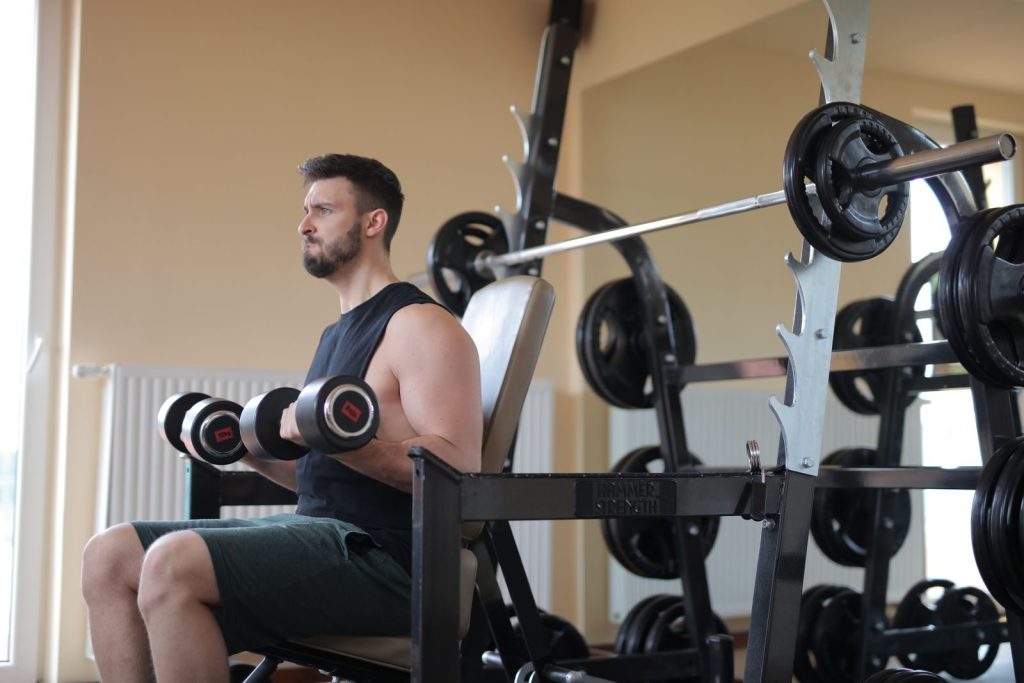
The right choice depends on the exercise, your training goal, the equipment available, and which option lets you perform challenging repetitions with consistent technique.
The updated American College of Sports Medicine resistance-training guidelines found that equipment type did not consistently determine strength or muscle-growth outcomes. Heavier loads were more favorable for maximal strength, while higher weekly training volume was more important for hypertrophy.
Dumbbell vs Barbell at a Glance
| Training factor | Dumbbells | Barbells | Practical advantage |
|---|---|---|---|
| Maximum loading | Usually lower | Usually higher | Barbell |
| Muscle gain | Highly effective | Highly effective | Tie |
| Barbell-specific strength | Limited transfer | Direct practice | Barbell |
| Independent-side training | Easy to perform | More limited | Dumbbells |
| Grip options | Neutral, angled, or palms-forward | Hands remain connected to one bar | Dumbbells |
| Load progression | May require larger jumps per hand | Small plate increases are often easier | Barbell |
| Stability demands | Each weight moves independently | One shared implement | Depends on the goal |
| Home-gym setup | Adjustable dumbbells can be compact | Usually requires a bar, plates, and often a rack | Dumbbells |
| Powerlifting and weightlifting | Not competition-specific | Required for the main lifts | Barbell |
| Exercise variety | Excellent for presses, rows, lunges, raises, and curls | Excellent for heavy squats, presses, rows, and deadlifts | Depends on the exercise |
Neither implement wins every category. A barbell may be the better choice for one movement and dumbbells the better choice for another within the same workout.
What Is the Difference Between Dumbbells and Barbells?
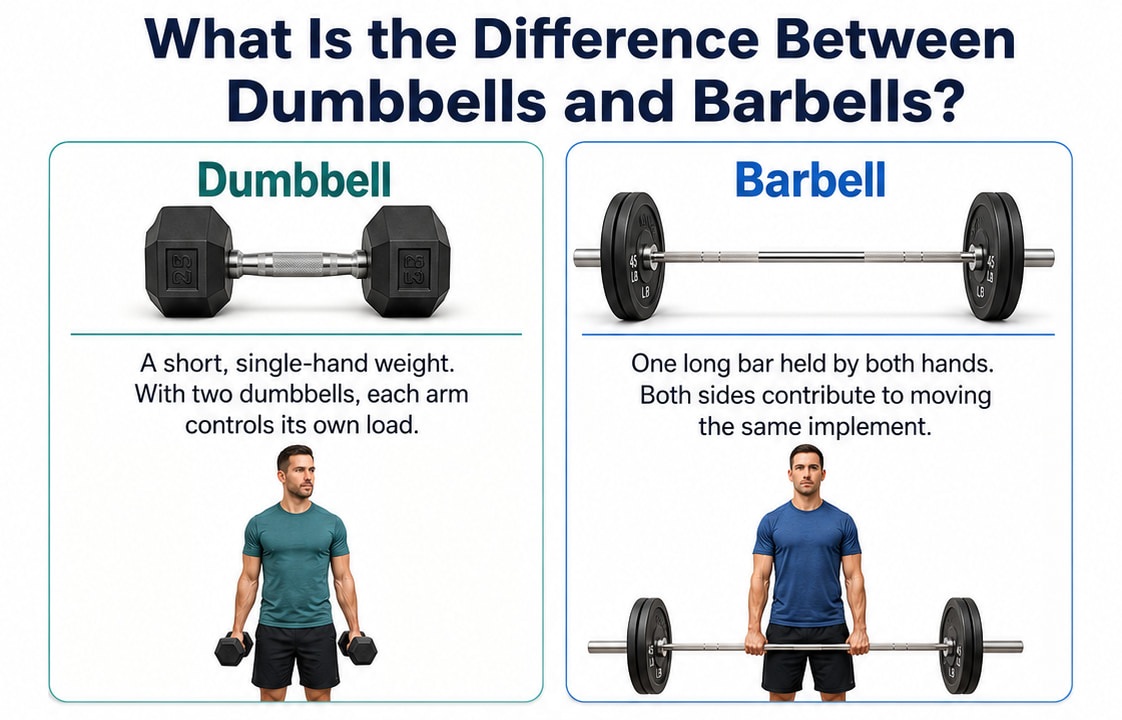
A dumbbell is a short, single-hand weight. When you use two dumbbells, each arm controls its own load.
A barbell is one long bar held by both hands. The hands remain connected, and both sides contribute to moving the same implement.
That difference affects:
- How much total weight you can lift
- How much independent control each arm needs
- Which grip positions are available
- How easily you can perform unilateral exercises
- How you set up and progress the movement
Dumbbells are not automatically unilateral. A dumbbell bench press uses two separate weights but still trains both arms simultaneously. A one-arm dumbbell row is a true unilateral exercise because one side works at a time.
Is a Dumbbell or Barbell Better for Strength?
1. Barbells Usually Allow Greater Total Loading
For exercises such as bench presses, squats, rows, and deadlifts, most people can eventually lift more total weight with a barbell.
A barbell creates one shared implement and usually requires less independent control than two separate dumbbells. It is also easier to load a barbell gradually with small plates.
In a small study of 12 resistance-trained men, the participants’ dumbbell chest-press one-repetition maximum was approximately 17% lower than their barbell bench-press maximum. Chest and front-deltoid muscle activity did not differ significantly between the two presses, showing that a lower dumbbell load did not mean those muscles stopped working. The study measured one workout rather than long-term strength or muscle growth, so its findings should not be treated as a universal percentage. (PubMed study)
The practical advantage still favors the barbell when the goal is to:
- Develop a heavy bench press, squat, or deadlift
- Practice powerlifting movements
- Improve Olympic weightlifting technique
- Use smaller, more precise load increases
- Measure progress with standardized barbell lifts
2. Strength Is Specific to the Movement You Practice
Strength is not one universal ability. It includes the skill and coordination required to perform a particular movement.
Training the barbell bench press is therefore the most direct way to improve your barbell bench press. Dumbbell pressing can strengthen the same general muscle groups, but it does not perfectly reproduce the balance, grip, or bar path of the barbell exercise.
The reverse is also true. Someone who only performs barbell presses may initially struggle to control two heavy dumbbells because each hand must stabilize a separate weight.
A systematic review comparing unilateral and bilateral resistance training found similar muscle-growth outcomes overall. However, bilateral training produced greater bilateral-strength improvements, while unilateral training produced greater unilateral-strength improvements. (Unilateral versus bilateral training review)
3. Dumbbells Are Better for Some Types of Strength
Dumbbells may be the more useful strength tool when your goal involves:
- One-arm pressing or rowing strength
- Single-leg squats, lunges, or step-ups
- Independent control of each side
- Strength through a neutral or angled grip
- Sports or activities that require each limb to work independently
Therefore, the better question is not simply, “Which builds more strength?” It is, “Which movement do you want to become stronger at?”
4. Strength Verdict
Choose a barbell when maximum bilateral loading or barbell-specific performance is the priority.
Choose dumbbells when independent-side control, unilateral strength, or grip flexibility matters more.
Dumbbell vs Barbell for Muscle Gain
There Is No Clear Hypertrophy Winner
Muscles respond to resistance, effort, training volume, and progressive overload. They do not identify whether the resistance came from a dumbbell or barbell.
The 2026 ACSM Position Stand concluded that using a particular equipment type did not consistently determine results for the average healthy adult. For muscle growth, it emphasized sufficient weekly volume, with approximately 10 sets per muscle group per week presented as a useful target for many trainees. Beginners can often progress with less volume and build up gradually.
Both implements can provide:
- Challenging muscular tension
- Controlled eccentric and concentric repetitions
- Progressive resistance
- Multi-joint and isolation exercises
- Suitable training across different repetition ranges
The implement that lets you train the intended muscle effectively is usually the better hypertrophy choice for that exercise.
Heavy Weight Is Not the Only Way to Build Muscle
Higher loads are particularly useful for improving maximal strength. Muscle growth, however, can occur across a wider range of loads when sets are sufficiently challenging.
A network meta-analysis comparing low-, moderate-, and high-load resistance training found similar hypertrophy across the loading ranges under the study conditions, while heavier loads produced greater one-repetition-maximum strength improvements. (Resistance-training load meta-analysis)
You do not need to perform every set to complete muscular failure. A practical approach is to finish most working sets with approximately 1–3 controlled repetitions still possible.
For many exercises, a moderate range such as 6–15 repetitions is convenient because it allows meaningful loading without extremely long sets. Higher repetitions can also be effective for exercises such as lateral raises, curls, and triceps extensions.
Independent Weights Do Not Automatically Produce More Growth
Two separate dumbbells normally require more independent control than one barbell. This may increase the coordination demands placed on the arms, shoulders, and trunk.
That does not automatically make dumbbells better for hypertrophy.
Greater activity in a stabilizing muscle during one workout does not prove that the exercise will produce greater long-term muscle growth. A research review on surface electromyography cautioned against using acute EMG readings as a direct predictor of hypertrophy. (Review of acute EMG and hypertrophy)
Use muscle-activation findings to understand an exercise, not to declare an automatic winner.
Muscle-Gain Verdict
For hypertrophy, dumbbells and barbells are both effective.
Choose the option that allows you to:
- Target the intended muscles
- Use a comfortable, controlled range of motion
- Keep the load stable
- Perform enough challenging sets
- Add repetitions or resistance over time
- Recover and train consistently
Key Differences Between Dumbbells and Barbells
1. Loading and Progressive Overload
Barbells are usually easier to load heavily. Small plates can also provide manageable increases without dramatically changing the exercise.
Fixed dumbbells often increase in larger steps. Moving from a pair of 40-pound dumbbells to a pair of 45-pound dumbbells adds 10 pounds to the total exercise, which may be too large an immediate increase.
When a dumbbell jump is too large, progress by:
- Adding one repetition per set
- Reaching the top of your repetition range
- Improving control and consistency
- Adding a set when additional volume is appropriate
- Using adjustable dumbbells with smaller increments
Do not change several variables at once. Increase the load only when you can maintain the same range of motion and technique.
2. Independent-Side Training
Dumbbells make it easier to notice when one arm:
- Moves through a shorter range
- Presses or rows more slowly
- Loses wrist position
- Reaches fatigue earlier
- Follows a different path
This can help you train both sides more deliberately, but dumbbells do not automatically correct a strength difference.
For unilateral exercises, begin with the less capable side and perform the same controlled number of repetitions with the other side. Avoid giving one side a large amount of extra work unless a qualified professional has recommended it.
3. Grip and Movement Path
A barbell fixes the relationship between your hands. You can change your grip width, but your hands remain attached to the same straight bar.
Dumbbells allow each hand to use a:
- Palms-forward grip
- Neutral grip with the palms facing each other
- Slightly angled grip
- Rotating path in selected exercises
Some people find this freedom more comfortable, especially during pressing movements. That does not make every dumbbell variation suitable for every shoulder or wrist.
Use the grip that lets you control the weight without forcing the joints into an uncomfortable position.
4. Range of Motion
Dumbbells can sometimes provide a longer range of motion because there is no bar crossing the chest or torso. A dumbbell bench press, for example, may allow the hands to descend below the level possible with a barbell.
However, more range is not automatically better.
Use the greatest range you can control comfortably while maintaining:
- Stable shoulders
- Neutral or comfortably aligned wrists
- Consistent balance
- Appropriate muscle tension
- No sharp pain
Body proportions, bench height, mobility, and the specific exercise can all change the useful range.
5. Stability and Coordination
A barbell connects both sides, while dumbbells can drift independently. Dumbbell exercises may therefore require more coordination and side-to-side control.
This can be useful, but stability demands should not prevent the target muscles from receiving enough resistance.
For example, if a dumbbell press becomes limited mainly by your ability to position or balance the weights, a barbell or machine press may provide a more practical muscle-building exercise.
6. Equipment and Space
A complete barbell setup commonly includes:
- A barbell
- Weight plates
- Collars
- A rack or stands
- A bench
- Enough space to load and move around the bar safely
A pair of adjustable dumbbells may require less space and can support a large number of exercises. A complete rack of fixed dumbbells, however, can occupy considerable room.
For home training, choose equipment based on your available space, floor strength, storage, and long-term goals rather than assuming one option is always more compact.
Dumbbell vs Barbell by Exercise
Bench Press
Barbell advantage: Heavier loading, easier small increases, and direct practice for barbell bench-press strength.
Dumbbell advantage: Independent-arm control, adjustable grip position, and potentially greater range of motion.
For muscle gain, either can work. Choose the version that lets you lower the weight under control and press without losing shoulder or wrist position.
Overhead Press
Barbell advantage: A stable shared implement that can support heavier pressing and straightforward progression.
Dumbbell advantage: Neutral or angled grips and independent-arm movement.
Dumbbells are not automatically safer. Heavy dumbbells can be difficult to lift into the starting position, while barbell presses require adequate overhead space and an appropriate rack setup.
Squat
Barbell advantage: Back squats and front squats allow substantial loading and are more suitable for developing maximal squat strength.
Dumbbell advantage: Goblet squats, split squats, reverse lunges, and step-ups are accessible options that require less equipment.
Heavy dumbbell squats may eventually become limited by grip strength, dumbbell size, or the ability to hold the weights comfortably. A barbell may be more practical when lower-body loading becomes the main priority.
Deadlift and Romanian Deadlift
Barbell advantage: Easier heavy loading, standardized setup, and direct practice for barbell deadlift performance.
Dumbbell advantage: Accessible starting loads, less equipment, and a convenient option for home workouts.
Dumbbells should remain close to the legs during a Romanian deadlift. Their shape and handle height may change how close they can move toward the floor, so do not force additional depth by rounding the back.
Rows
Barbell advantage: Efficient bilateral loading and straightforward progression.
Dumbbell advantage: One-arm variations, adjustable grip, and the option to support the free hand or chest.
A supported dumbbell row can be useful when you want to reduce the balance demands of a bent-over position and focus on one side at a time.
Curls, Raises, and Triceps Exercises
Dumbbells are often more versatile for isolation exercises because each arm can use its own position and path.
Barbells can still be useful for curls, extensions, and other bilateral movements, especially when you want to load both arms together and track progression easily.
Which Is Better for Beginners?
Neither implement is automatically best for every beginner.
Dumbbells provide light starting loads and can make several exercises easy to scale. However, two independent weights may require more coordination, and heavy dumbbells can become difficult to position.
Barbells provide one connected implement and allow small load increases. However, many barbell exercises require a rack, bench, safety equipment, and more technical instruction.
A beginner should choose movements that are:
- Easy to set up
- Appropriate for the available equipment
- Stable enough to control
- Comfortable through the intended range
- Simple to progress
- Suitable for the training environment
Start with manageable loads and learn the movement before trying to lift as much as possible. Beginners do not need to test a true one-repetition maximum.
Can You Build Strength and Muscle With Only Dumbbells?
Yes. Dumbbells can train every major muscle group through movements such as:
- Goblet squats
- Split squats and lunges
- Romanian deadlifts
- Floor or bench presses
- Overhead presses
- One-arm rows
- Pullovers
- Curls
- Triceps extensions
- Lateral and rear-delt raises
- Loaded carries
The main limitation appears when your dumbbells become too light for your current strength, particularly during squats, deadlifts, and other lower-body exercises.
You can continue progressing temporarily by adding repetitions, sets, unilateral variations, or more challenging exercise variations. Eventually, heavier dumbbells or another form of resistance may be needed.
Can You Build Strength and Muscle With Only a Barbell?
Yes. A barbell can provide a complete program using:
- Squats
- Deadlifts and Romanian deadlifts
- Bench presses
- Overhead presses
- Bent-over rows
- Hip thrusts
- Curls
- Triceps extensions
A barbell-only program may offer fewer grip options and less convenient unilateral work, but it can still develop substantial whole-body strength and muscle.
How to Use Dumbbells and Barbells Together
You do not have to choose only one.
A practical workout structure is:
- Perform the main barbell strength exercise first.
- Use dumbbells for moderate-repetition secondary exercises.
- Add unilateral work where independent-side control is useful.
- Finish with smaller dumbbell exercises when needed.
For example:
- Barbell squat followed by dumbbell reverse lunges
- Barbell bench press followed by a dumbbell incline press
- Barbell Romanian deadlift followed by dumbbell split squats
- Barbell overhead press followed by dumbbell lateral raises
- Barbell row followed by a supported one-arm dumbbell row
Avoid adding two nearly identical exercises simply to include both tools. Every exercise should have a clear purpose.
Sample Dumbbell and Barbell Full-Body Workout
Perform this routine twice per week with at least one recovery day between sessions.
Beginners can start with two working sets per exercise. More experienced trainees can use the sets listed below.
| Exercise | Sets and reps | Rest |
|---|---|---|
| Barbell back squat | 3 × 5–8 | 2–3 minutes |
| Dumbbell bench press | 3 × 8–12 | 90–120 seconds |
| Barbell Romanian deadlift | 2–3 × 6–10 | 2 minutes |
| One-arm dumbbell row | 3 × 8–12 per side | 60–90 seconds |
| Dumbbell overhead press | 2 × 8–12 | 90 seconds |
| Dumbbell curl or triceps extension | 2 × 10–15 | 60 seconds |
Effort Level
Finish most sets with approximately:
- 2–3 repetitions in reserve for squats, presses, rows, and Romanian deadlifts
- 1–2 repetitions in reserve for curls, extensions, and other smaller exercises
Technical breakdown should end the set even when the muscles could perform more repetitions.
How to Progress
Use a simple double-progression system:
- Select a weight that allows you to reach the bottom of the repetition range.
- Add repetitions over several sessions.
- When you reach the top of the range for every set with controlled technique, add the smallest available weight.
- Return to the lower end of the range and repeat.
When a dumbbell increase is too large, continue building repetitions before moving to the next pair.
Equipment Substitutions
Without a barbell:
- Replace the back squat with a goblet squat or dumbbell split squat.
- Replace the barbell Romanian deadlift with a dumbbell Romanian deadlift.
Without dumbbells:
- Replace the dumbbell bench press with a barbell bench press.
- Replace the one-arm row with a barbell bent-over row.
- Replace the dumbbell overhead press with a light barbell overhead press.
Common Dumbbell vs Barbell Mistakes
Choosing Based Only on the Weight Lifted
A heavier number does not automatically mean an exercise is better for muscle growth. Different implements create different stability, grip, and range-of-motion demands.
Compare your progress within the same exercise rather than directly comparing every dumbbell lift with its barbell variation.
Changing Equipment Too Frequently
Constantly switching between variations makes progress difficult to measure.
Keep important exercises in your routine long enough to improve technique and track performance. Change them when your goal, comfort, equipment, or programming needs change.
Assuming Dumbbells Fix Every Imbalance
Dumbbells can reveal side-to-side differences, but they do not diagnose or automatically correct the reason for those differences.
Use controlled repetitions and similar effort on both sides. Seek qualified guidance when a difference is accompanied by pain, sudden weakness, numbness, or a history of injury.
Using More Range Than You Can Control
Do not lower dumbbells farther simply because the equipment allows it. Stop the repetition before the shoulders, spine, knees, or wrists lose a stable position.
Ignoring Equipment Setup
A suitable exercise can become unsafe when the bench, rack, plates, floor space, or dumbbells are not prepared correctly.
Complete the setup before beginning the set rather than adjusting equipment while holding a heavy load.
Dumbbell and Barbell Safety Tips
Warm up with approximately 5–10 minutes of easy activity and perform lighter practice sets before heavy compound lifts. The American Academy of Orthopaedic Surgeons recommends gradually increasing exercise difficulty and not ignoring pain.
Additional precautions include:
- Use rack safety arms or pins at an appropriate height for barbell squats and presses.
- Ask a capable spotter for assistance when a heavy lift cannot be performed safely alone.
- Secure plates with suitable collars when the exercise and equipment require them.
- Keep the floor clear of loose plates and unused dumbbells.
- Do not use dumbbells that you cannot move safely into and out of the starting position.
- Maintain control during both the lifting and lowering phases.
- Stop the set when technique changes substantially.
- Avoid holding your breath longer than necessary; reset your breathing between repetitions when appropriate.
Stop exercising and seek professional help if you experience sharp pain, numbness, dizziness, chest pain, or other unusual symptoms.
Frequently Asked Questions
Are dumbbells or barbells better for building muscle?
Neither is universally better. Both can build muscle when you perform enough challenging sets, train through a controlled range, and progress over time. Choose the implement that fits the exercise and lets the target muscles work without discomfort or unstable technique.
Why can I lift more with a barbell than with dumbbells?
A barbell connects both hands to one implement and generally requires less independent control. Dumbbells can move separately, so balance, positioning, and coordination may limit the load before the main muscles reach their maximum force.
Are dumbbells or barbells better for beginners?
Both can be appropriate. Dumbbells offer accessible starting loads and exercise variety, while barbells offer stable bilateral movements and small load increases. The better choice is the one the beginner can set up, control, and learn safely.
Can dumbbells make me as strong as barbells?
Dumbbells can build substantial strength, but strength is movement-specific. Dumbbell training will improve dumbbell performance most directly. Training with a barbell is necessary when the goal is to maximize a particular barbell lift.
Are dumbbells safer than barbells?
Not automatically. Dumbbells provide more grip freedom but can be difficult to position when heavy. Barbells allow stable heavy loading but require suitable racks, safeties, and spotting for certain exercises. Safety depends on the movement, load, setup, and technique.
Should I use dumbbells and barbells in the same workout?
You can, but it is not required. A common approach is to perform a barbell compound lift first and use dumbbells for secondary or unilateral exercises. A well-designed dumbbell-only or barbell-only program can also be effective.
Conclusion
Barbells generally have the advantage when the goal is maximum loading, barbell-specific strength, powerlifting, or Olympic-style lifting.
Dumbbells provide greater grip flexibility, independent-side control, and convenient unilateral exercise options.
For muscle gain, neither implement is an automatic winner. Select exercises that fit your body and goals, perform enough challenging work, and gradually add repetitions or resistance. Using both tools can create a versatile program, but consistent progression matters more than forcing both into every workout.
References
- American College of Sports Medicine Position Stand: Resistance Training Prescription for Muscle Function, Hypertrophy, and Physical Performance
- ACSM 2026 Resistance Training Guidelines Summary
- Comparison of Dumbbell, Barbell, and Smith-Machine Chest Press
- Comparison of Unilateral and Bilateral Resistance Training
- Resistance-Training Load Effects on Muscle Hypertrophy and Strength
- Acute Surface EMG Amplitude and Long-Term Hypertrophy
- AAOS Exercise and Warm-Up Guidance
This content is for informational purposes only and is not a substitute for medical advice.